
10-1
Chapter 10
Issues between Organizations and Individuals
Chapter Overview
This chapter discusses some of the relationships of individuals to organizations, including rights of
privacy, the individual and drug abuse, discipline, quality of work life, and individuals’
organizational responsibilities. First, issues about areas of legitimate organizational influence are
presented, which is followed by rights of privacy and related issues. The next section deals with
discipline and quality of work life. The final section deals with the individual’s responsibilities to the
organization.
Chapter Learning Objectives
After reading this chapter, students should understand:
1. A model of legitimacy of organizational influence
2. How rights to privacy are interpreted
3. Bases for discrimination at work
4. Using discipline to change behaviors
5. Quality of Work Life (QWL)
6. Job enrichment: pros and cons
7. Mutual individual-organization responsibilities
8. Whistle-blowing as a prosocial behavior
Discussion and Project Ideas
Issues such as legitimacy of organizational influence and invasion of privacy are discussed in the
beginning of the chapter. Discipline is a reflection of organizational climate, and lapses of discipline
are enforced by disciplinary action. The discussion of discipline action at this point in the course
offers further evidence that organizational behavior is not merely making people happy, whether
they meet organizational standards or not. Disciplinary action is a necessary and accepted part of an
organization’s social system.
Finally, the chapter emphasizes that not only do organizations have responsibilities to individuals,
but that individuals also have responsibilities to organizations. The exercises and assignments
described below help to illustrate these key points.

10-2
Traditional work design brought tremendous economic benefits to society, but its disadvantage was
its high human costs. Better design of jobs and emphasis on the quality of work life seek to maintain
reasonable economic efficiency while making jobs more human. Although job enrichment, as
developed by Herzberg, originally meant the addition of more motivators to a job, concern with the
job has now evolved into a perspective that emphasizes the total quality of work life within the work
environment.
• Divide the class into three groups—the organization; the informal work group; and the external
community. Have each group present a list of behaviors and modes of dress resulting from
pressures exerted by their respective groups.
• Ask students to rate the university administration’s rights to discipline students (on a 1 to 5
scale) for the following behaviors:
o Smoking pot in the dorm.
o Copying from another paper during a test.
o Giving test answers to a student in another section.
o Public drunkenness at a local bar.
o Stealing an automobile in another city.
o Public drunkenness in the classroom.
o Smoking pot in a public park.
o Stealing an automobile on campus.
o Buying a term paper from a professional writer.
o Selling cosmetics on campus.
o Smoking in the classroom.
o Having sexual relations in their own dorm rooms.
o Having sexual relations with another student while on vacation.
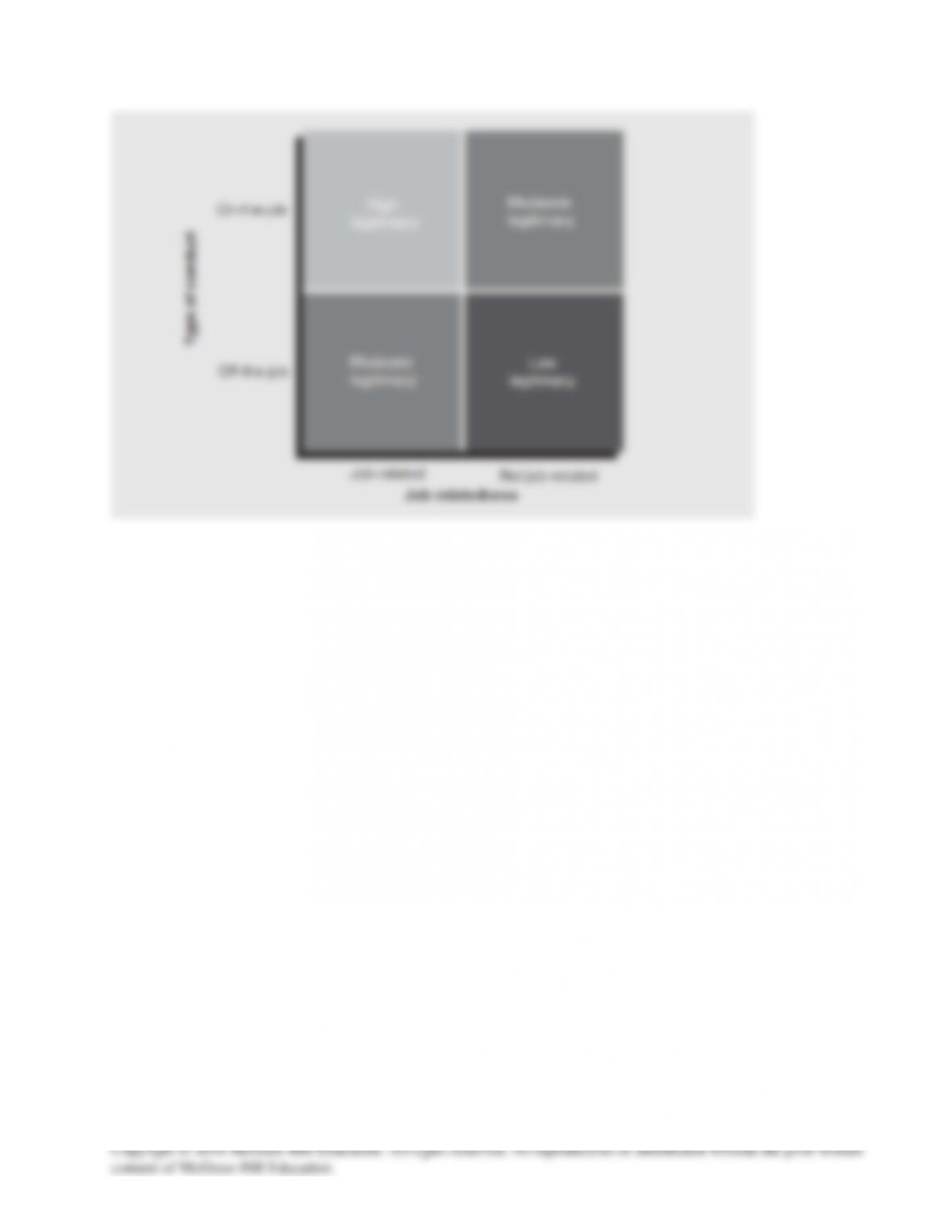
To what extent do the results of your survey mirror the model of legitimacy presented in
Figure 10.1?
• Invite a local personnel officer from a private organization to discuss her or his company’s
alcohol and drug abuse policies and programs.
• Ask each student to write a one-half page description of a situation where he or she wishes to
change the behavior of a work group. Divide the class into groups of four or five. Have the
students in each group exchange their situations and choose one on which to implement job
enrichment.
• Emphasize the restructuring of the work according to the five core job dimensions described in
the text. Have one member of each group report the group’s suggestions to the class.
10-3
Copyright © 2014 McGraw-Hill Education. All rights reserved. No reproduction or distribution without the prior written
consent of McGraw-Hill Education.
the secretarial pool, even though the supervisor is well liked. Turnover is high, absenteeism
is high, and the quality of work is extremely poor. The professors are also displeased. They
say that the quality of work is extremely poor and important work is often put on low priority
status and occasionally even last. The Dean of the College, however, defends the secretarial
pool concept saying that it evens out the workload for the secretaries and reduces costs.
Divide the class into work groups of four or five students and ask each group to analyze the
case and provide suggestions for job enrichment. Their comments should focus on the five
core job dimensions suggested in the book, and they should have specific suggestions for
implementing these core dimensions.
Lecture Outline
Introduction
• Individuals use organizations as instruments to achieve their goals just as much as
organizations use people to reach objectives.
o There is a mutual social transaction in which each contributes to, and benefits from, the
other.
Areas of Legitimate Organizational Influence
• Every organization develops policies and requirements for performance.
o If the organization and an individual define the boundaries of legitimate influence
differently, conflict is likely to develop.
A Model of Legitimacy of Organizational Influence
• The simplified model of legitimacy of organizational influence that has been developed
from research is shown in Figure 10.1.
10-4
Copyright © 2014 McGraw-Hill Education. All rights reserved. No reproduction or distribution without the prior written
consent of McGraw-Hill Education.
o The two key variables in the model are where it occurs (conduct on the job or off of it)
and the degree of job-relatedness (conduct that is job-related or not job-related).
▪ As the model shows, there is agreement on high legitimacy when conduct is both on
the job and job-related.
▪ Legitimacy becomes less accepted as an act’s connection with the job weakens.
▪ If the act is on the job but not job-related, employer questions may arise about
legitimacy.
▪ Generally, only moderate legitimacy is supported, depending on the situation.
Off-the-Job Conduct
• The power of business to regulate employee conduct off the job is very limited.
o The more job-related the conduct is when off the job, the more support there is for
organizational influence on the employee.
• Interpretations become more difficult in some borderline situations.
o In the United States, the organization’s jurisdictional line is clearly functional, related
to the total job system, not the property line.
• Current issues involving job-related behaviors that receive extensive attention include the
following:
o Surveillance
o Substance abuse
o Genetic screening of prospective employees to identify health risks
o Office romances
o Assessments of ethical values of job applicants

10-5
Rights of Privacy
• Rights of privacy become contentious issues when an organization invades a person’s private
life or makes an unauthorized release of confidential information about a person in a way that
would cause emotional harm or suffering.
• Business activities that may involve employee rights of privacy:
o Lie detectors (polygraph tests)
o Personality tests
o Location trackers
o Medical examinations
o Treatment of alcoholism and drug abuse
o Monitoring of employee lifestyles
o Surveillance devices
o Computer data banks
o Confidential records
o Genetic screening/biometric data
o Inquiry into personal relationships
• Areas that employees, customers, and others believe should not be subject to snooping and
analysis:
o Religious, political, and social beliefs
o Personal acts, conversations, and locations, such as company rest rooms and private
homes
• Four conditions that lead to a perception of invasion of privacy:
o Personal (versus performance) information
o No permission obtained before disclosure
o Unfavorable consequences
o External disclosure (rather than inside the company)
Policy Guidelines Relating to Privacy
• Because of the importance of employee privacy, most large employers have developed policy
guidelines to protect it.
o These guidelines also help establish uniform practices and facilitate the handling of any
unusual situations that may develop.
• The following are some policy guidelines on privacy that organizations use:
o Relevance—only necessary, useful information should be recorded and retained.
o Recency—obsolete information should be removed periodically.
o Notice—no personal data system unknown to an employee should be used.
o Fiduciary duty—the keeper of the information is responsible for its security.
o Confidentiality—information should be released only to those who have a need to

10-6
know, and release outside the organization normally should occur only with the
employee’s permission.
o Due process—the employee should be able to examine records and challenge them if
they appear incorrect.
o Protection of the psyche—the employee’s inner self should not be invaded or exposed
except with prior consent and for compelling reasons.
Surveillance Devices
• Except for compelling reasons, employers should avoid surveillance of private places, such
as locker rooms, or secret surveillance, as with listening devices.
• Surveillance that is known to employees and has a compelling job reason is seldom
considered an undue privacy infringement.
o Examples: Hidden cameras in banks and convenience stores.
• Surveillance devices, equipment and procedures for monitoring employee actions, have
emerged through advances in computer technology.
o Electronic sensor badges are microcomputers in clip-on ID cards, which emit infrared
signals.
• Electronic monitoring takes many forms, including:
o Automatic counting of keystrokes
o Remote observations of the screens of desktop computer operators
o Surreptitious reading of an employee’s electronic mail
o Voice-record system to assess the effectiveness of stockbrokers, travel agents, or other
customer service personnel
• The availability of the Internet at work has resulted in a phenomenon known as cybersurfing.
o It is an activity done by employees who use work time and work computers to surf the
Web, looking for a wide range of information of personal interest.
o Cybersurfers may use their terminal to check the stock market, get an update on a golf
tournament, place a bid on a newly released product on eBay, etc.
o Employers are using electronic monitoring to identify the most serious abusers of their
Internet privileges—persons known as cyberloafers or cyberslackers.
• Secret organizational monitoring can have a detrimental impact on employees.
o Monitored employees have higher levels of physiological and emotional distress, such
as headaches and emotional anxiety.
• Employees (and future employees) need to be aware that some companies now use social
screening (information gleaned from e-mails, Facebook, Twitter, Blogs, and LinkedIn) to
probe for additional information prior to hiring (or firing) an employee.

10-7
Honesty Testing
• Employee theft is a major problem in U.S. businesses.
o It is estimated to cost employers $50-100 billion per year, with up to three-fourths of
employees participating at least once.
• Honesty tests, also known as integrity tests, attempt to get the respondent to disclose
information about his or her previous or prospective honesty.
o They appear in two forms.
▪ Overt tests inquire about attitudes towards theft.
▪ Personality-based tests more indirectly identify dishonest individuals by relating
scores on selected personality-test items to a theft criterion.
• Validity of honesty test is controversial and employers run some risks of legal action if they
reject an applicant solely on the basis of integrity test scores.
• Scores on the honesty subscale of the Personnel Selection Inventory have been found to
predict accurately subsequent employee theft.
Health Issues and Privacy
Treatment of Alcoholism
• Alcoholism presents major medical and job problems.
o Employers need to develop responsible policies and programs to deal with it without
endangering rights of privacy.
• 5 to 10 percent of employees are estimated to be alcoholics.
o This costs employers billions of dollars annually in absenteeism, poor work, lost
productivity, and increased health care costs.
o Absence rates for alcoholic employees are two to four times those of other employees.
o Alcoholics are found in all types of industries, occupations, and job levels.
• The job environment can contribute to the problem, as can personal habits and problems.
• Reasons for Company Programs
o An increasing number of firms recognize that they have a role to play in helping
alcoholics control or break their habit.
▪ The firm and employee already have a working relationship on which they can
build.
▪ Any success with the employee will save both a valuable person for the company
and a valuable citizen for society.
▪ The job appears to be the best environment for supporting recovery since it helps
an alcoholic retain a self-image as a useful person in society.
• Successful Programs
o Successful employer programs:
▪ Treat alcoholism as an illness

10-8
▪ Focus on the job behavior caused by alcoholism
▪ Provide both medical and psychological help
▪ Provide a non-threatening atmosphere
Drug Abuse
• Abuse of drugs other than alcohol, particularly if used at work, can cause severe problems for
the employee, the employer, and other employees.
o These drugs may include heroin, powder cocaine, crack cocaine, methamphetamines,
and marijuana, or the abuse may stem from the improper use of stimulants,
barbiturates, and tranquilizers.
o In some job situations, such as those of a pilot, surgeon, railroad engineer, or crane
operator, the direct effects of drug abuse can be disastrous—both for the individual and
for many others.
• Drug Testing
o The direct consequences of employee drug abuse are enormous.
▪ Employee theft to support habits costs industry billions each year.
▪ Absentee rates can be up to 16 times higher than for nonusers.
▪ Accident rates are 4 times higher.
▪ Lost productivity and additional health costs have been estimated to exceed $100
billion annually.
o To combat this problem, the Drug-Free Workplace Act became law in the United States
in 1988.
▪ The law applies to employers with federal contracts over $25,000 and those
obtaining financial assistance grants.
▪ These businesses must create and distribute to their employees policies
prohibiting drug abuse at work.
o Many companies have adopted a policy for drug testing both new and current
employees and some test job applicants as well.
▪ The tests may be done on a periodic schedule, administered randomly, or given
only when there is reason to suspect an employee.
o Testing policies can be highly controversial.
▪ Some tests are not satisfactorily accurate.
▪ Some tests may produce false negative when the results fail to identify 5% of
users.
▪ Other employees may be incorrectly identified as users (false positives) can occur
because of prescription drugs or food eaten.
▪ Harm to reputation and self-esteem can occur before a false positive is detected.
▪ Some may object to drug test due to their fear of revelation of medical conditions
that they would prefer to keep private.
▪ Some find it intrusive to be watched while providing test samples.

10-9
▪ Many presume that they have a right to consume whatever substance they desire,
however, possession and use of illegal drugs is not a right guaranteed by the U.S.
Constitution.
o A possible solution to these problems with drug-testing lies in impairment testing.
▪ This method usually consists of a brief motor-skills test performed on a
computer; the test is much like playing a video game.
Genetic Testing
• Employee privacy rights issues have also emerged in the area of genetic testing.
o New developments in the field of genetics allow physicians to use medical tests to
accurately predict whether an employee may be genetically susceptible to or more
types of illnesses or harmful substances.
• Genetic testing is a more aggressive tool than genetic monitoring, which identifies harmful
substances in the workplace, examines their effects on the genetic makeup of employees, and
provides the basis for corrective action.
o Positive uses of genetic testing information include:
▪ Transferring the susceptible employees to other work areas where they will not
be exposed to the substances
▪ Providing health warnings
▪ Developing protective measures to shield employees from danger
o The negative side of genetic testing comes into play when a firm screens present
employees or job applicants on the basis of genetic predispositions and uses the
information to discriminate against them in an attempt to minimize the firm’s future
health costs.
o Effective in 2009, employee rights became increasingly protected under the Genetic
Information Nondiscrimination Act (GINA).
▪ This law prohibits employers from using personal or family genetic information
to discriminate against them—even through accidental acquisition of such data.
Discrimination
• Equal Employment Opportunity (EEO) laws generally prohibit job discrimination on the
basis of:
o Race
o Color
o National origin
o Sex
o Religion
o Handicapped status
o Other factors
• Two EEO issues stand out as contemporary problems related to privacy.
10-10
o Sexual harassment on the job, in which right to a non-offensive work environment is
violated.
o Diseases (AIDs) that some employees may have and their right to maintain medical
privacy, continue working, and receive medical care.
• Sexual Harassment
o When supervisors make employment or promotion decisions contingent on sexual
favors or when an employee’s colleagues engage in any verbal or physical conduct that
creates an offensive working environment, sexual harassment exists.
o Unwelcome sexual advances, requests for sexual favors, and other verbal or physical
conduct of a sexual nature constitute sexual harassment when:
▪ Submission to such conduct is made either explicitly or implicitly a term or
condition of an individual’s employment.
▪ Such conduct has the purpose or effect of unreasonably interfering with an
individual’s work performance or creating an intimidating, hostile, or offensive
working environment.
o Harassment is a perceived action by others, but it is very real to the recipient.
▪ Because it is somewhat individually defined, there is some disagreement over
what constitutes sexual harassment.
o Females responding to one survey included in their definition:
▪ Sexual propositions
▪ Unwanted physical touching
o Sexual harassment at work is still far too pervasive.
▪ Such harassment can occur anywhere in a company, from executive offices to
assembly lines.
▪ It is distasteful and demeaning to its victims.
▪ It is discriminatory, according to EEO laws and state and federal guidelines.
o Preventive practices include
▪ Training programs to educate employees about the relevant law
▪ Identifying actions that constitute harassment
▪ Communicating possible liabilities and negative effects
o Employers may be liable for reinstatement of the victims if they were unfairly
discharged, and may have to pay back wages, punitive damages, and substantial awards
for psychological suffering and pain.
• AIDs

10-11
o Acquired immune deficiency syndrome (AIDS) is a deadly virus affecting the human
immune system.
▪ It is contagious through the receipt of infected blood and certain types of sexual
contact.
▪ It is incurable, often fatal, and is spreading rapidly in some part of the world.
▪ There is widespread public concern and a lack of understanding.
▪ The legal status of infected employees is unclear.
o AIDs-related work issues
▪ Protection of medical privacy
▪ Educating co-workers
▪ Effects on teamwork and group participation
▪ Preventing harassment or social isolation
▪ Employee AIDs testing
o Employers need to be aware of the relevant laws that appear to include persons with
AIDS under the definition and protection of “handicapped” or “disabled.”
▪ These include the Vocational Rehabilitation Act of 1973 and the Americans with
Disabilities Act of 1990.
Discipline
• The area of discipline can have a strong impact on the individual in the organization.
o Discipline is management action taken to enforce organizational standards.
• The two types of discipline are preventive and corrective.
o Preventive discipline is action taken to encourage employees to follow standards and
rules so infractions do not occur.
▪ Prevention is best done by making company standards known and understood in
advance.
▪ The basic objective is to encourage employee self-discipline.
o Corrective discipline is action that follows infraction of a rule.
▪ It seeks to discourage further infractions so future acts will be in compliance with
standards.
▪ It is a penalty of some type and is called disciplinary action. Examples are a
warning or suspension with or without pay.
• The objectives of disciplinary action are positive, educational, and corrective, as follows:
o Reforming the offender
o Deterring others from similar actions
o Maintaining consistent, effective group standards
• Most employers apply a policy of progressive discipline, which means there are stronger
penalties for repeated offences.
o The purpose is to give an employee an opportunity for self-correction before more

10-12
serious penalties are applied.
o A typical system of progressive discipline is shown in Figure 10.4.
Quality of Work Life
• Quality of work life (QWL) refers to the favorableness or unfavorableness of a total job
environment for people.
• QWL programs are another way in which organizations recognize their responsibility to develop
jobs and working conditions that are excellent for people as well as for the economic health of
the organization.
• The elements in a typical QWL program include:
o Open communications
o Equitable reward systems
o Concern for employee job security and satisfying careers
o A caring supervisor
o Participation in decision making
• Many early QWL efforts focused on job enrichment.
• In addition to improving the work system, QWL programs usually emphasize development of
employee skills, the reduction of occupational stress, and the development of more cooperative
labor–management relations.
A Rationale
• Job specialization and simplification were popular in the early twentieth century.
o Employees were assigned narrow jobs supported by a rigid hierarchy in the expectation
that efficiency would improve.
o The idea was to lower costs by using unskilled workers who could be trained easily to
do a small, repetitive part of each job.
• Many difficulties developed from the classical job design.
o Excessive division of labor
o Social isolation from co-workers
o Weakened interest in the whole product
o De-skilled workers lost pride in their work
o Workers became bored with their work
10-13
o Higher-order (social and growth) needs were left unsatisfied
▪ The result was higher turnover and absenteeism, declines in quality, and alienated
workers.
• Two reasons for redesigning jobs and organizations for better QWL:
o Classical design originally gave inadequate attention to human needs
o The needs and aspirations of workers themselves were changing
• One option that emerged was to redesign jobs to have the attributes desired by people, and
redesign organizations to have the environment desired by people.
o This approach seeks to improve QWL.
o There is a need to give workers more of a challenge, more of a whole task, more
opportunity to use their ideas.
• Close attention to QWL provides a more humanized work environment.
• The idea is that human resources should be developed, not simply used.
• Work should not have excessively negative conditions.
o It should not put workers under undue stress.
o It should not damage or degrade their humanness.
Job Enlargement vs. Job Enrichment
• The modern interest in quality of work life was stimulated through efforts to change the
scope of people’s jobs in order to motivate them.
• Job scope has two dimensions—breadth and depth.
o Job breadth is the number of different tasks an individual is directly responsible for.
▪ It ranges from very narrow to wide.
▪ Periodic assignment of an employee to a completely different set of job activities
is called job rotation.
o Job enrichment adds additional motivators to a job to make it more rewarding.
▪ It was developed by Frederick Herzberg based on his studies indicating that the
most effective way to motivate workers was by focusing on higher-order needs.
▪ It seeks to add depth to a job by giving workers more control, responsibility, and
discretion over how their job is performed.
• Job enrichment brings many benefits, as shown in Figure 10.6.