
Solutions Manual Orbital Mechanics for Engineering Students Third Edition Chapter 1
Solutions Manual Orbital Mechanics for Engineering Students Third Edition Chapter 1
Problem 1.19 Numerically solve the differential equation
&&&
y3&&
y4&
y12yte2t
for y at t = 3 if, at t =
0,
y&
y&&
y0
.

Solutions Manual Orbital Mechanics for Engineering Students Third Edition Chapter 1
Solutions Manual Orbital Mechanics for Engineering Students Third Edition Chapter 1
Problem 1.20 Numerically solve the differential equation
t&&
yt2&
y2y0
to obtain y at t = 4 if the
initial conditions are y = 0 and
&
y1
at t = 1.
end %problem_1_20

Solutions Manual Orbital Mechanics for Engineering Students Third Edition Chapter 1
>>
Problem 1.21 Numerically solve the system
&
xy
2z
20
x
2&
yz
20
x
2y
2&
z0
to obtain x, y and z at t = 20. The initial conditions are x = 1 and y = z = 0 at t = 0.
Solution
—–––––—–––––––—––—–––––—–––––––—–––—–––––—–
>>
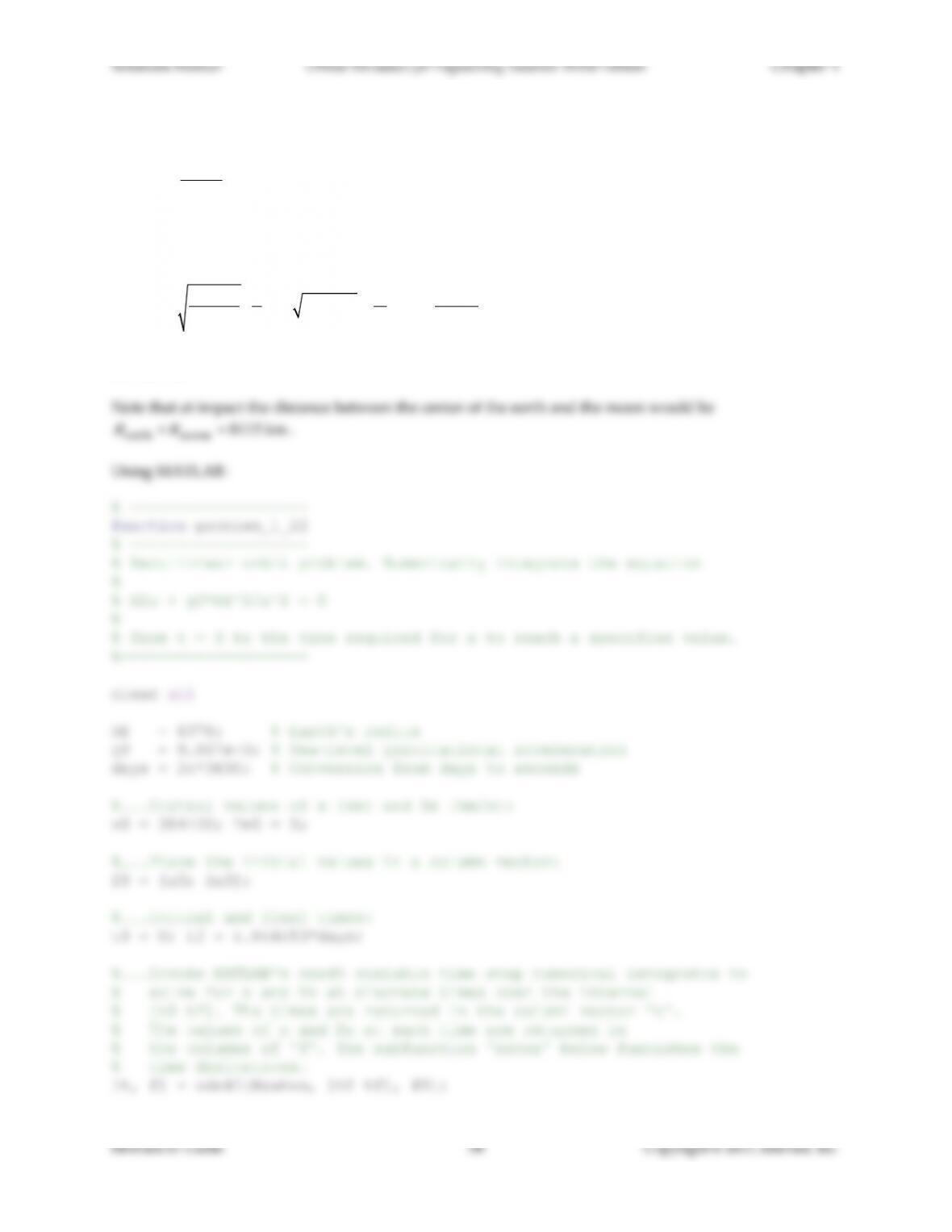
Problem 1.22 Use one of the numerical methods discussed in Section 1.8 to solve Equation 1.127
&&
xg0RE
2
x20
(1)
for the time required for the moon to fall to the earth if it were somehow stopped in its orbit while the
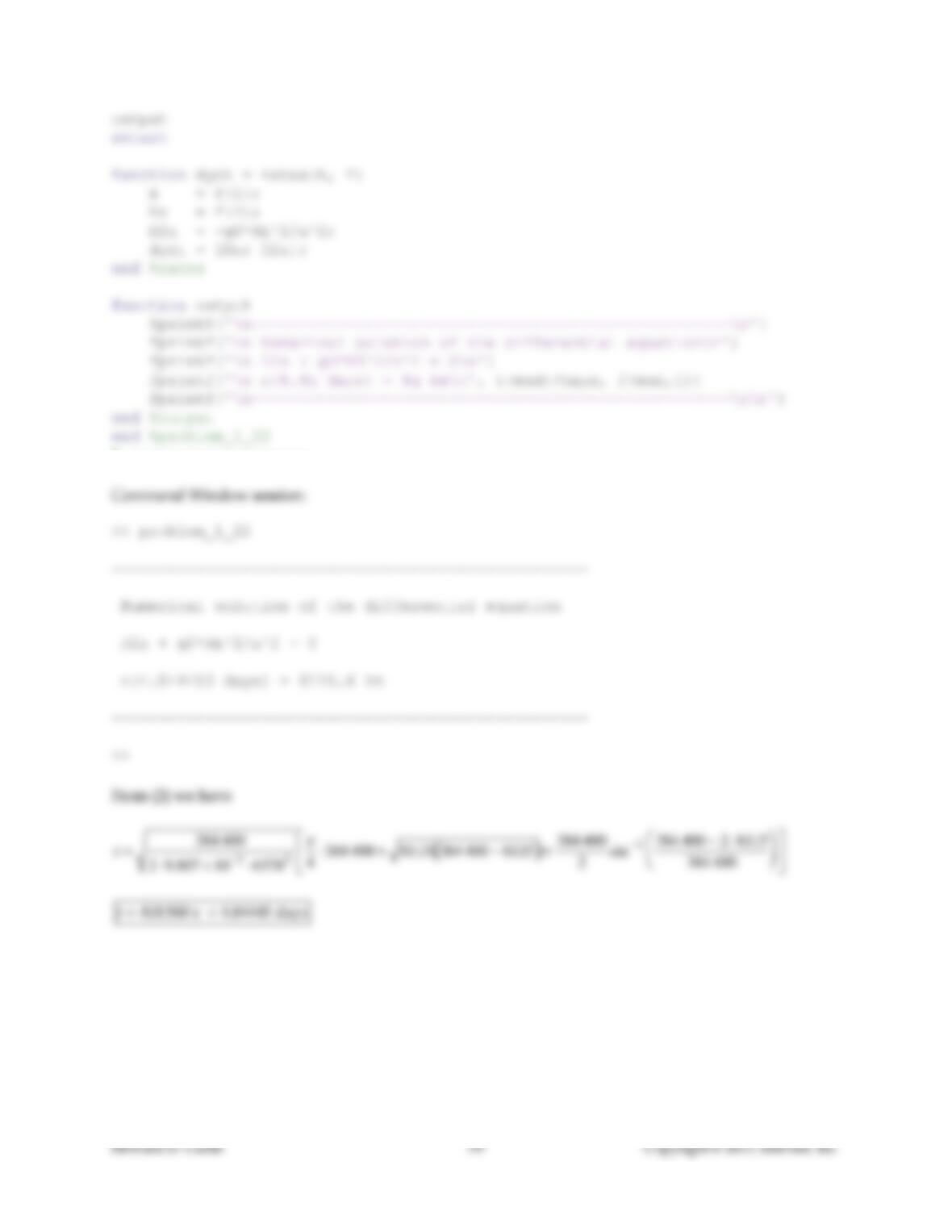
earth remained fixed in space. Compare your answer with the analytical solution,
tr
0
2g0RE
2
4r
0r r
0r
r
0
2sin 1r
02r
r
0
(2)
Solution
Solutions Manual Orbital Mechanics for Engineering Students Third Edition Chapter 1
% ~~~~~~~~~~~~~~~~~~~
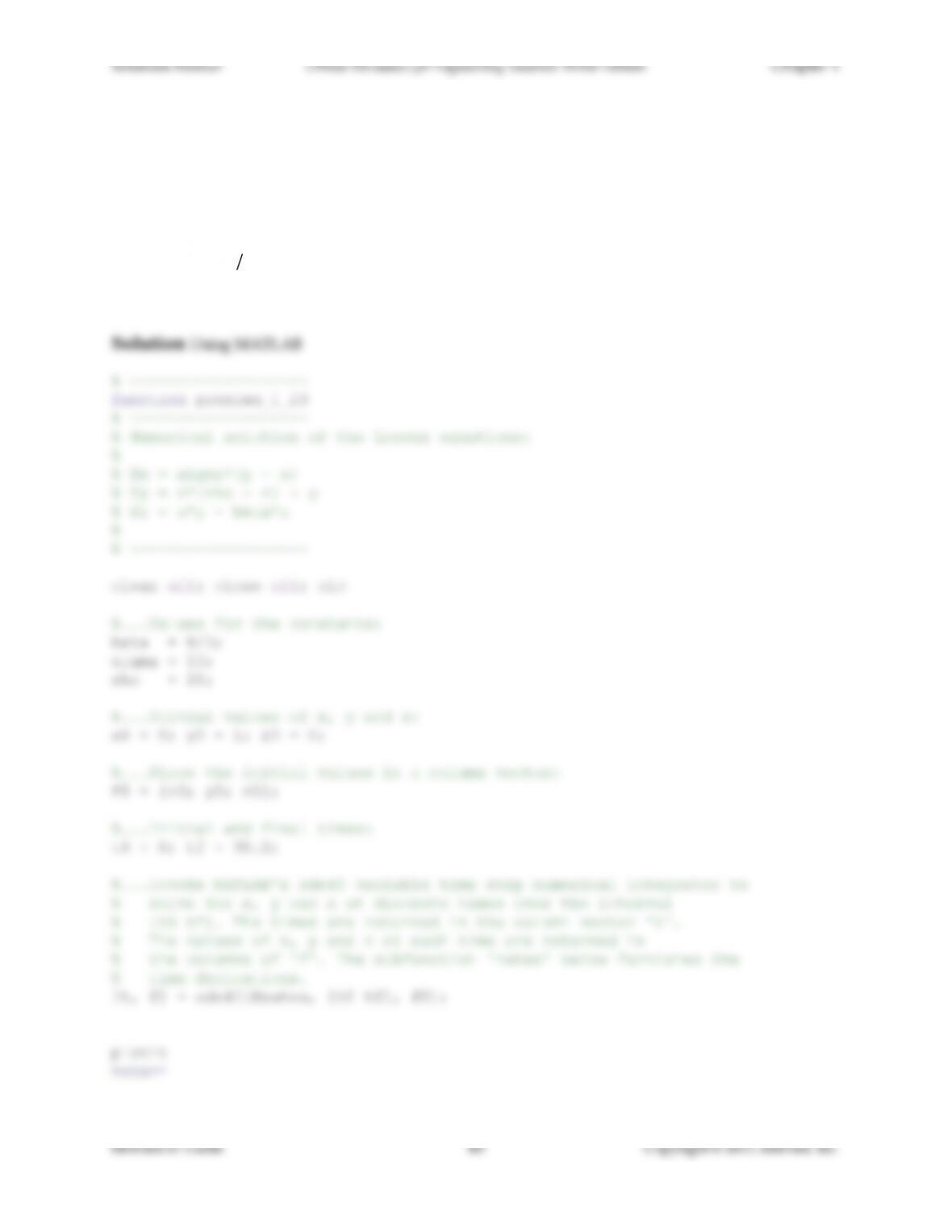
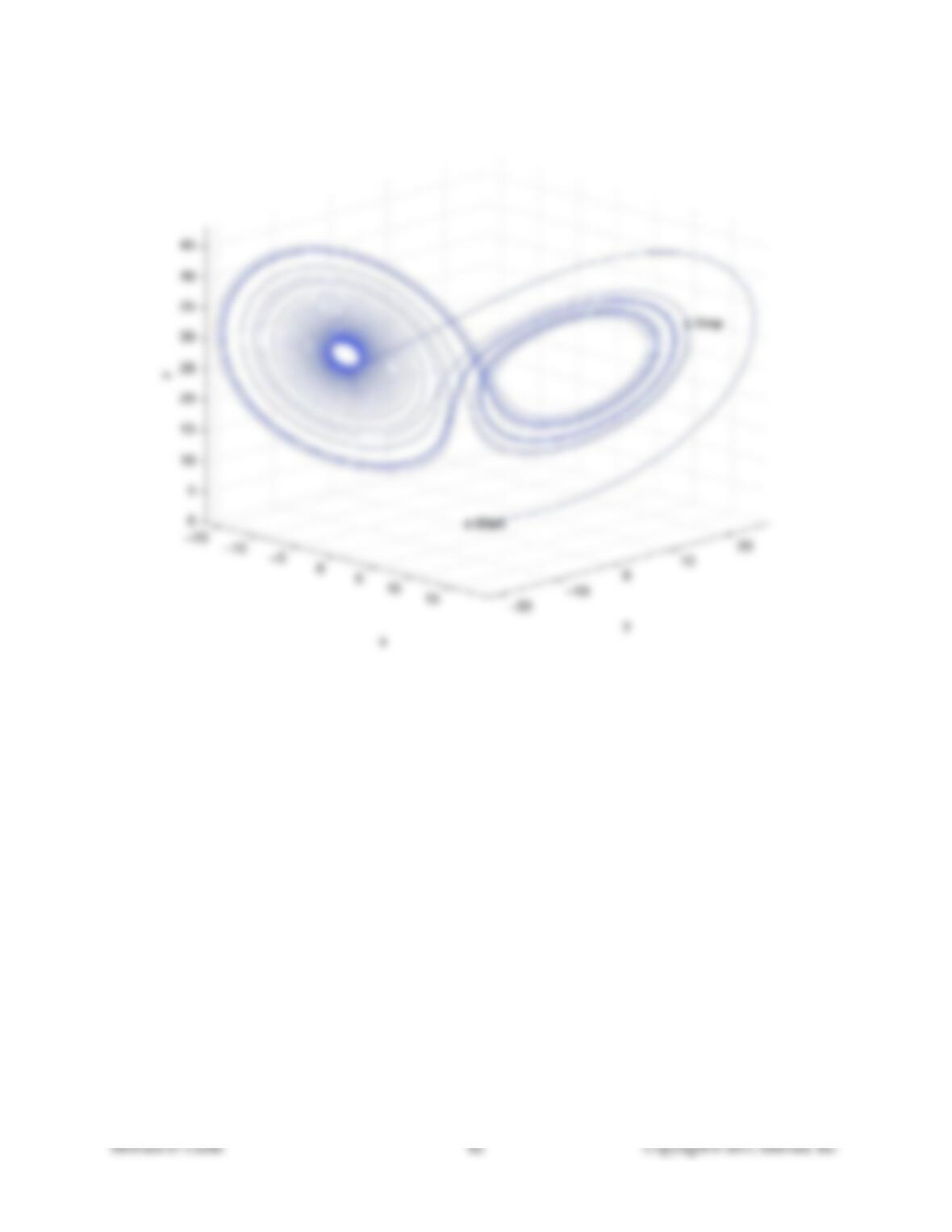
Problem 1.23 Use a Runge-Kutta solver to solve the nonlinear Lorenz equations
&
x
yx
&
yx
z
y
&
zxy
z
Use
10
,
8 3
and
28
and the initial conditions x = 0, y = 1 and z = 0 at t = 0. Let t range to a
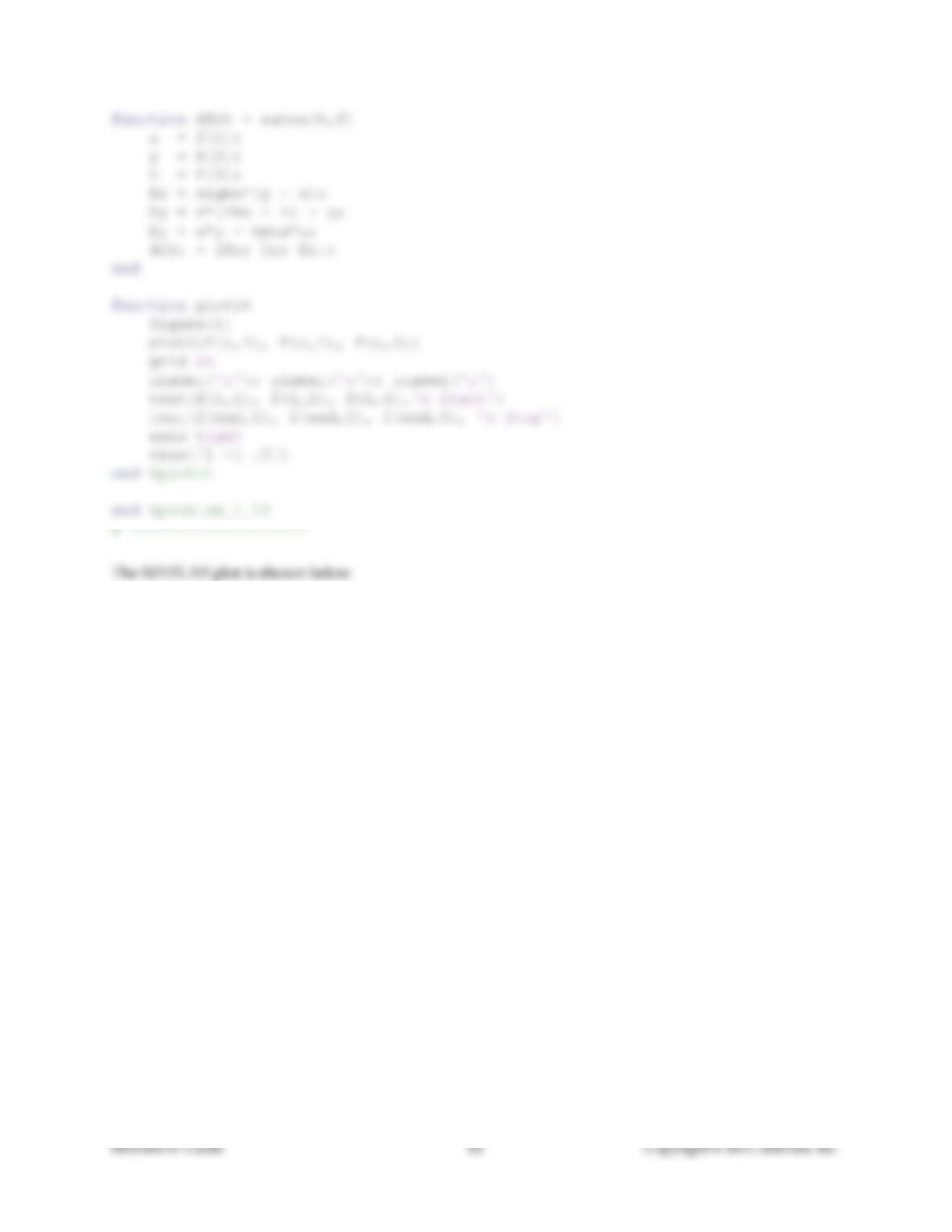
value of 20 or higher. Plot the phase trajectory x = x(t), y= y(t), z = z(t).
Solutions Manual Orbital Mechanics for Engineering Students Third Edition Chapter 1
Solutions Manual Orbital Mechanics for Engineering Students Third Edition Chapter 1