2-21
b) Calories: 800 (lb. Type A) + 1000 (lb. Type B) ≥ 8000
c)
1
2
3
4
5
6
7
8
9
10
11
A B C D E F
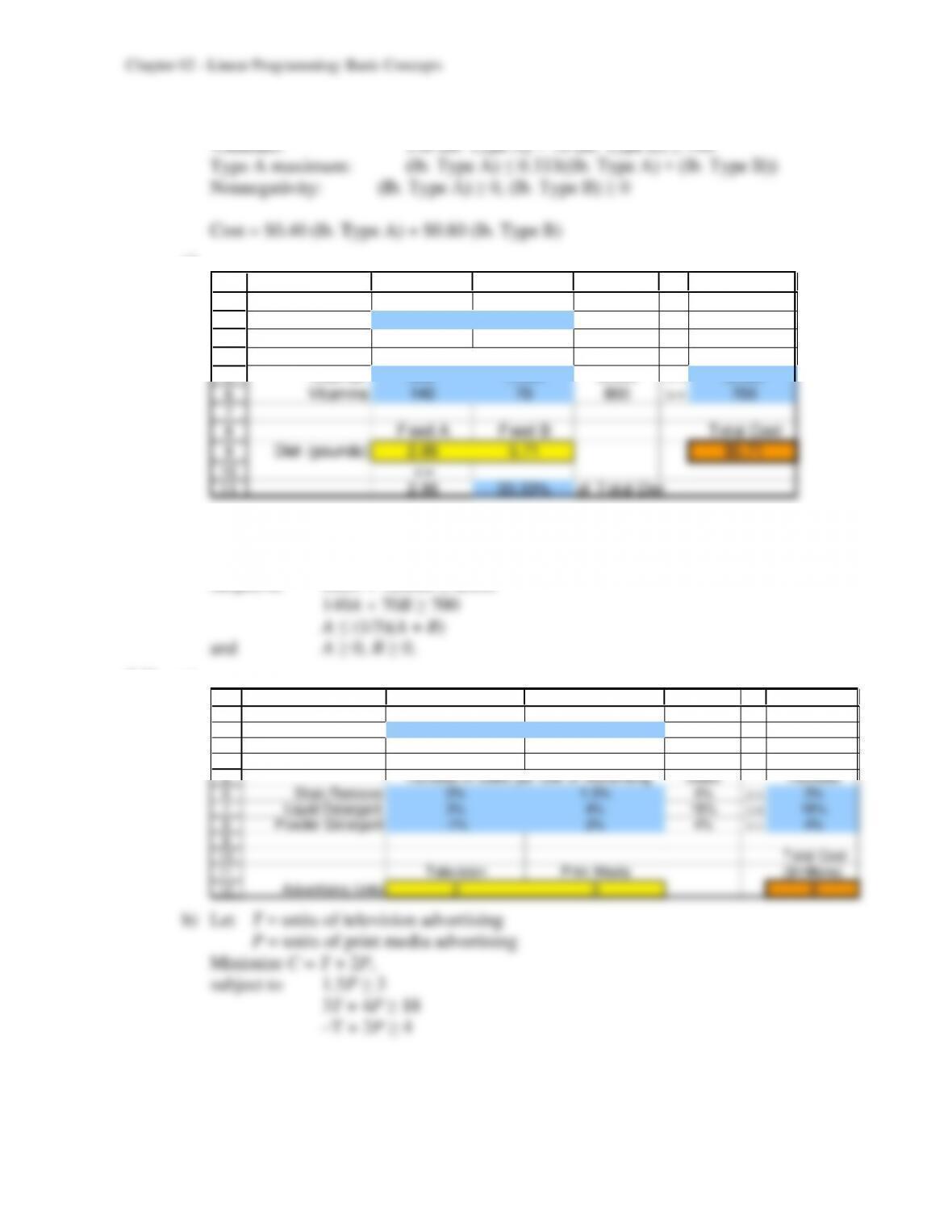
Feed A Feed B
Unit Cost $0.40 $0.80
(per pound) Total Daily
Nutrition Requirement
Calories 800 1,000 8,000 >= 8,000
Vitamins 140 70 800 >= 700
Feed A Feed B Total Cost
Diet (pounds) 2.86 5.71 $5.71
<=
Nutrition (per pound)
d) Let A = pounds of Feed Type A in diet
B = pounds of Feed Type B in diet
Minimize C = $0.40A + $0.80B,
subject to 800A + 1,000B ≥ 8,000
2.21 a)
1
2
3
4
5
6
7
8
9
10
11
12
A B C D E F
Television Print Media
Unit Cost ($millions) 1 2
Increased Minimum
Sales Increase
Stain Remover 0% 1.5% 4% >= 3%
Liquid Detergent 3% 4% 18% >= 18%
Powder Detergent -1% 2% 4% >= 4%
Total Cost
Television Print Media ($millions)
Advertising Units 2 3 8
Increase in Sales per Unit of Advertising
b) Let T = units of television advertising
P = units of print media advertising
Minimize C = T + 2P,
subject to 1.5P ≥ 3
3T + 4P ≥ 18
–T + 2P ≥ 4
2-22
d) Management changed their assessment of how much each type of ad would change
sales. For print media, sales will now increase by 1.5% for product 1, 2% for product
2, and 2% for product 3.
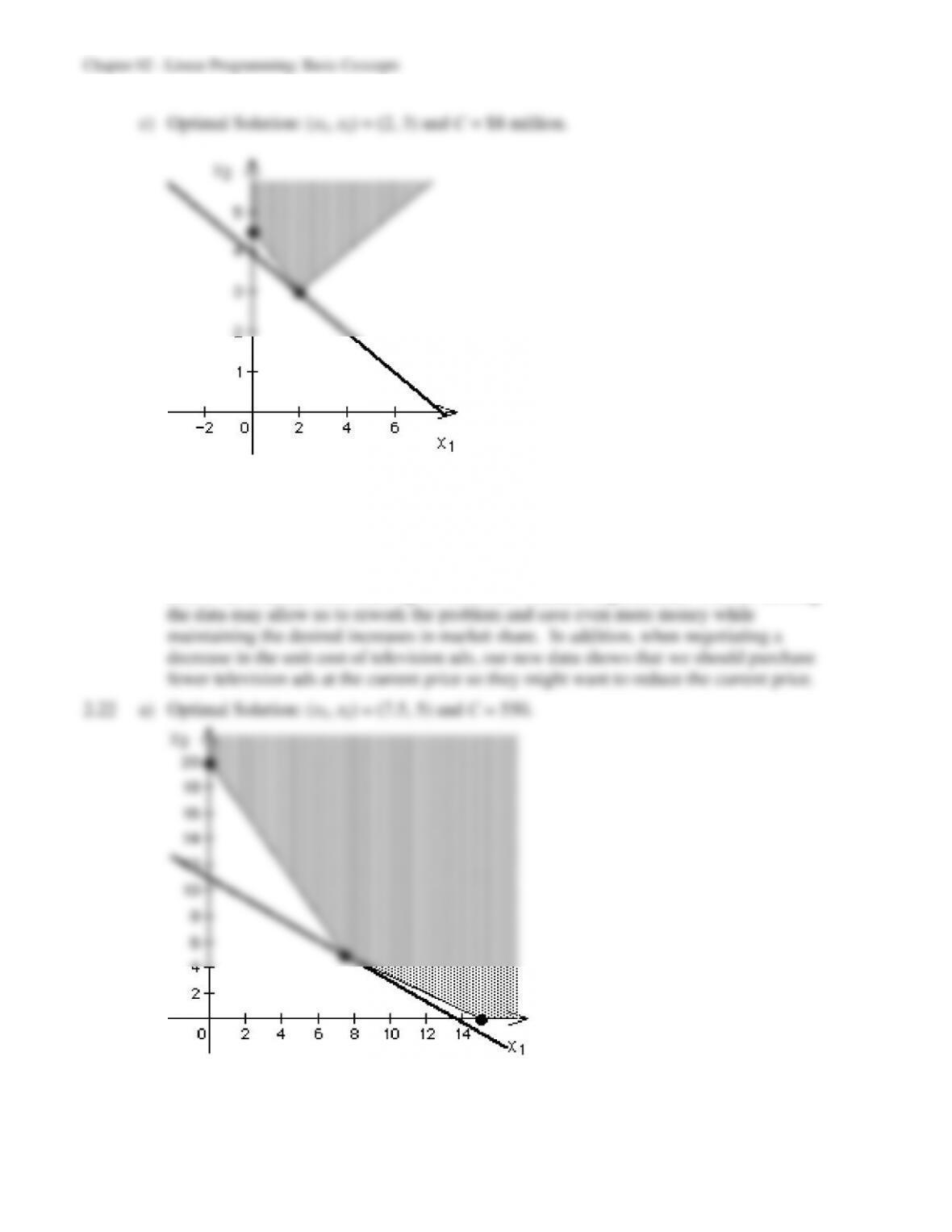
e) Given the new data on advertising, I recommend that there be 2 units of advertising on
television and 3 units of advertising in the print media. This will minimize cost, with a
cost of $8 million, while meeting the minimum increase requirements. Further refining
2-24
e) Part b)
1
2
3
4
5
6
7
8
9
10
A B C D E F
Activity 1 Activity 2
Unit Cost 40 70
Totals Limit
Constraint 1 2 3 30 >= 30
Constraint 2 1 1 15 >= 12
Constraint 3 2 1 30 >= 20
Activity 1 Activity 2 Total Cost
Decision 15 0 600
Part c)
1
2
3
4
5
6
7
8
9
10
A B C D E F
Activity 1 Activity 2
Unit Cost 40 50
Totals Limit
Constraint 1 2 3 30 >= 30
Constraint 2 1 1 12 >= 12
Constraint 3 2 1 18 >= 15
Activity 1 Activity 2 Total Cost
Decision 6 6 540
2.23 a)
1
2
3
4
5
6
7
8
9
10
11
12
13
14
15
16
17
18
19
A B C D E F G H I J K L
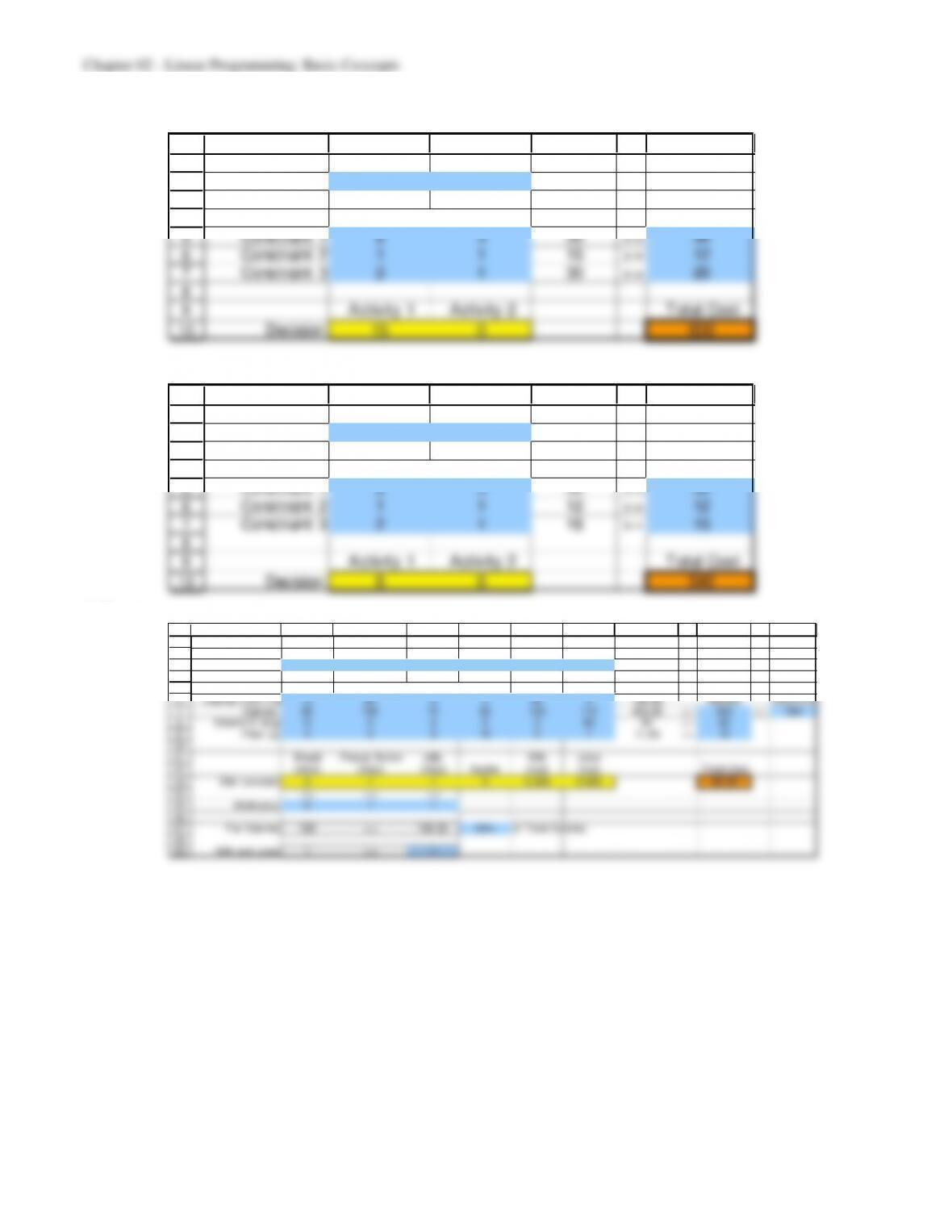
Bread Peanut Butter Jelly Milk Juice
(slice) (tbsp) (tbsp) Apples (cup) (cup)
Unit Cost $0.06 $0.05 $0.08 $0.35 $0.20 $0.40
Nutritional Data Total in Diet
Calories from F at 15 80 0 0 60 0 128.46 Needed Maximum
Calories 80 100 70 90 120 110 443.08 >= 300 <= 500
Vitamin C (mg) 0 0 4 6 2 80 60 >= 60
Fiber (g) 4 0 3 10 0 1 11.69 >= 10
Bread Peanut Butter Jelly Milk Juice
(slice) (tbsp) (tbsp) Apples (cup) (cup) Total Cost
Diet (ounces) 2 1 1 0 0.308 0.692 $0.59
>= >= >=
Minimums 2 1 1
Fat Calories 128 <= 132.92 30% of T otal Calories
Milk and Juice 1 >= 1
2-25
b) Let B =slices of bread,
P = Tbsp. of peanut butter,
B ≥ 2
P ≥ 1
J ≥ 1
M + C ≥ 1
and B≥ 0, P ≥ 0, J ≥ 0, A ≥ 0, M ≥ 0, C ≥ 0.

2-26
Cases
2-27
2.1 a) In this case, we have two decision variables: the number of Family Thrillseekers we
should assemble and the number of Classy Cruisers we should assemble. We also have
the following three constraints:
1. The plant has a maximum of 48,000 labor hours.
1
2
3
4
5
6
7
8
9
10
11
12
13
A B C D E F
Family Classy
Thrillseeker Cruiser
Unit Profit $3,600 $5,400
Resources Resources
Used Available
Labor Hours 6 10.5 48,000 <= 48,000
Doors 4 2 20,000 <= 20,000
Family Classy
Thrillseeker Cruiser Total Profit
Production 3,800 2,400 $26,640,000
<=
Demand 3,500
Resource Requirements
4
5
6
7
D
Res ources
Used
=SUMPRODUCT(B6:C 6,Production)
=SUMPRODUCT(B7:C 7,Production)
10
11
F
Total Profit
=SUMPRODUCT(UnitProfit,Production)
Solver Parameters
Set Objective (Target Cell): TotalProfit
To: Max
By Changing (Variable) Cells:
Production
Subject to the Constraints:
ClassyCruisers <= Demand
ResourcesUsed <= ResourcesAvailable
Solver Options (Excel 2010):
Make Variables Nonnegative
Solving Method: Simplex LP
Solver Options (older Excel):
Assume Nonnegative
Assume Linear Model
Range N ame Cells
Clas syC ru is ers C11
Demand C1 3
Production B1 1:C11
Resourc esAvailable F6:F7
Resourc esUs ed D6:D7
TotalPr ofit F11
UnitProfit B3:C3
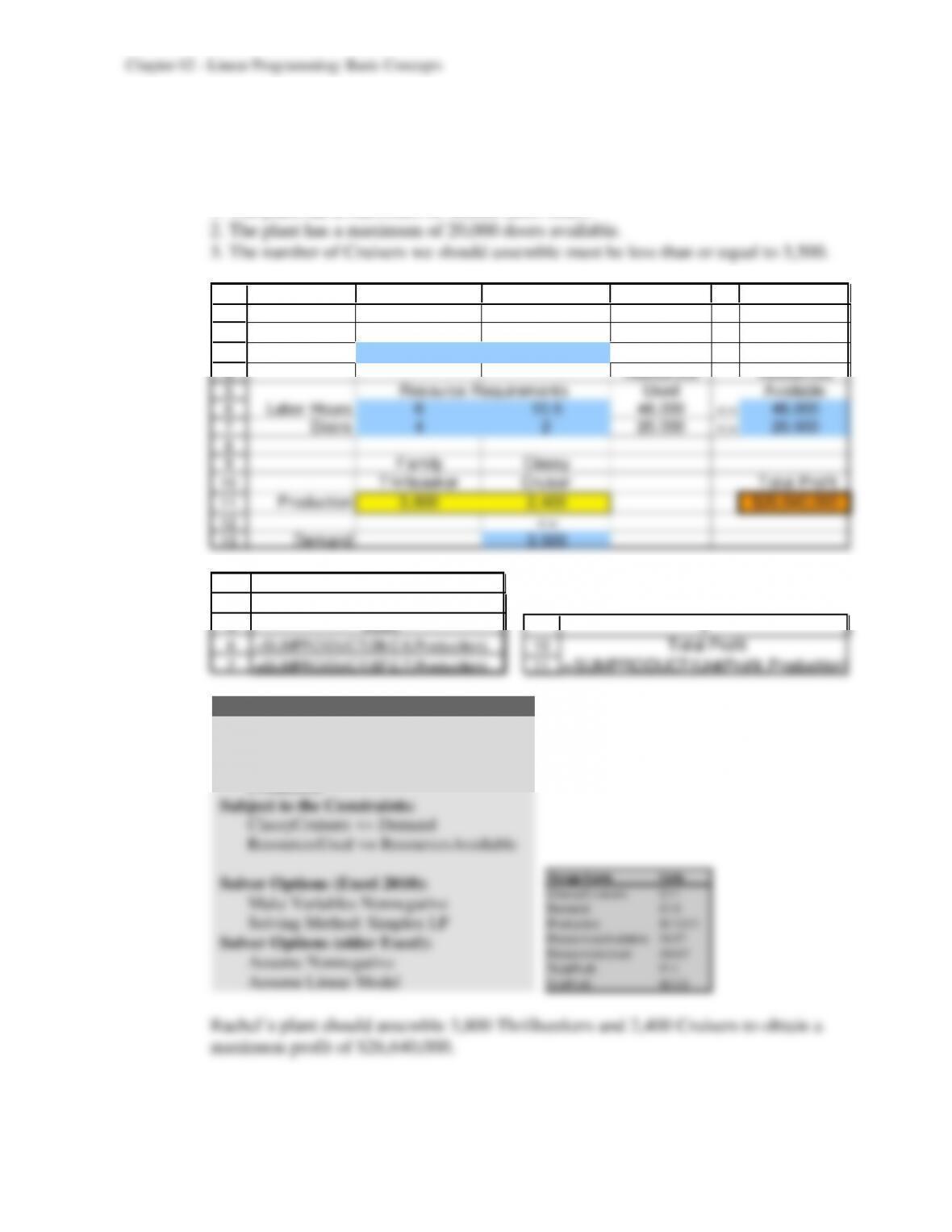
Rachel’s plant should assemble 3,800 Thrillseekers and 2,400 Cruisers to obtain a
2-28
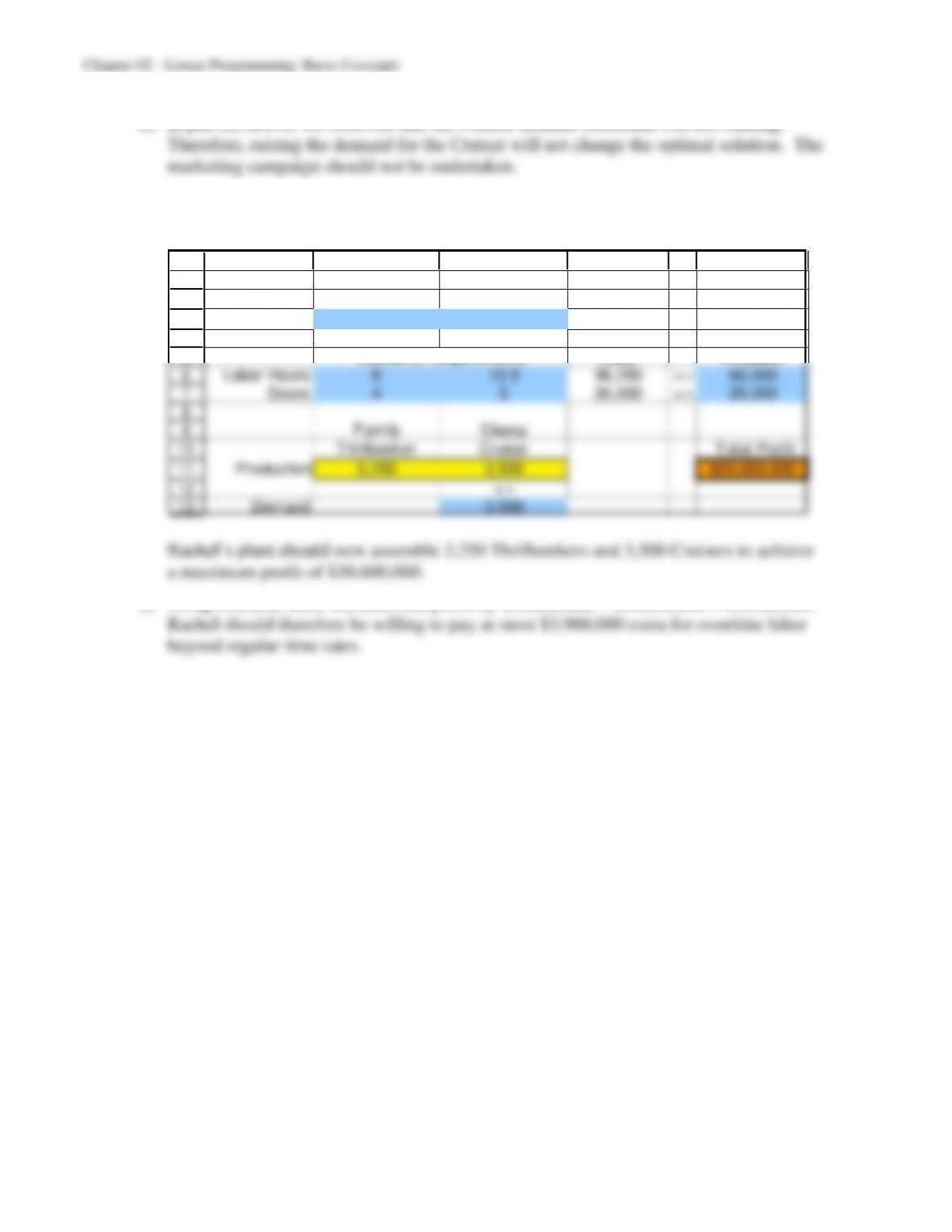
c) The new value of the right-hand side of the labor constraint becomes 48,000 * 1.25 =
60,000 labor hours. All formulas and Solver settings used in part (a) remain the same.
1
2
3
4
5
6
7
8
9
10
11
12
13
A B C D E F
Family Classy
Thrillseeker Cruiser
Unit Profit $3,600 $5,400
Resources Resources
Used Available
Labor Hours 6 10.5 56,250 <= 60,000
Doors 4 2 20,000 <= 20,000
Family Classy
Thrillseeker Cruiser Total Profit
Production 3,250 3,500 $30,600,000
<=
Demand 3,500
Resource Requirements
d) Using overtime labor increases the profit by $30,600,000 – $26,640,000 = $3,960,000.
2-29
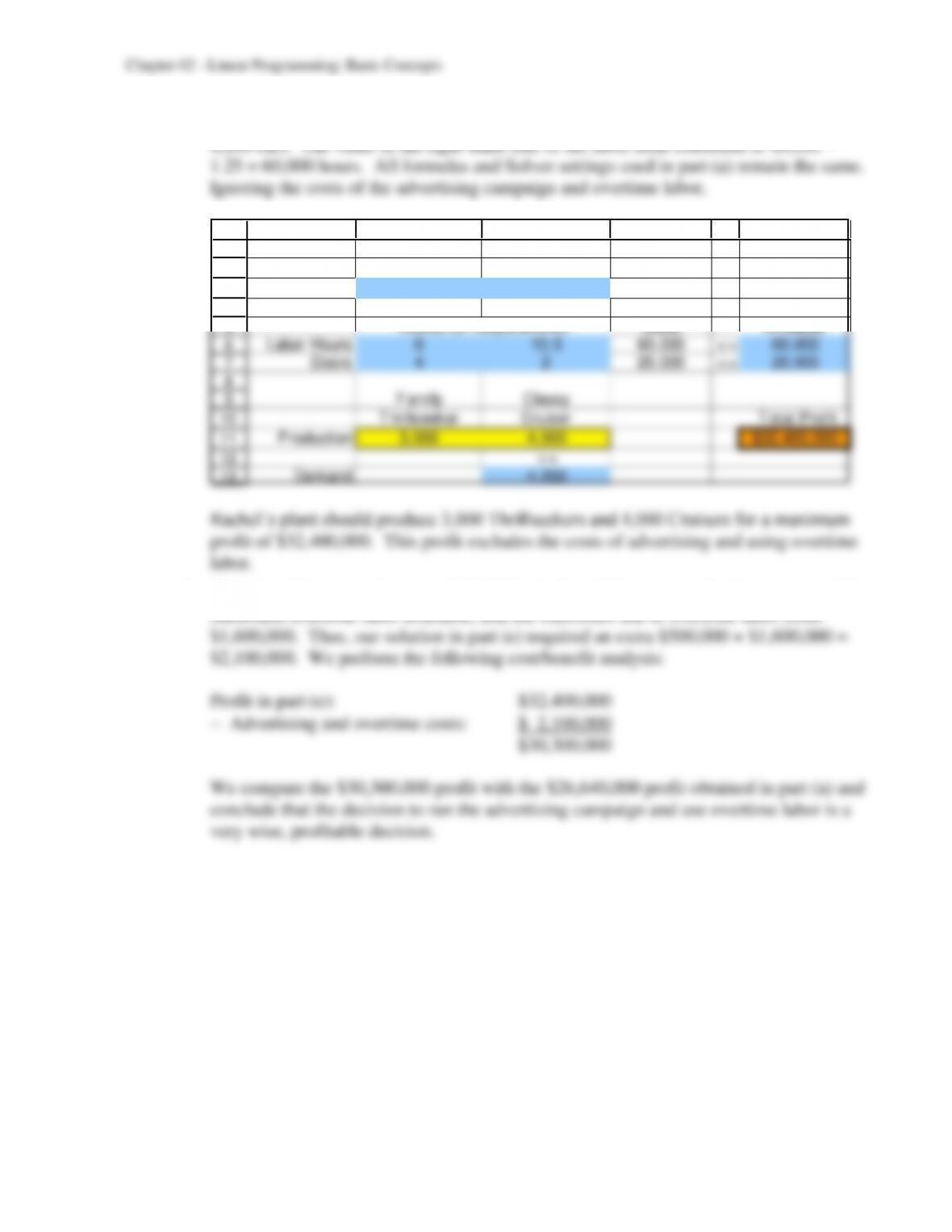
e) The value of the right-hand side of the Cruiser demand constraint is 3,500 * 1.20 =
1
2
3
4
5
6
7
8
9
10
11
12
13
A B C D E F
Family Classy
Thrillseeker Cruiser
Unit Profit $3,600 $5,400
Resources Resources
Used Available
Labor Hours 6 10.5 60,000 <= 60,000
Doors 4 2 20,000 <= 20,000
Family Classy
Thrillseeker Cruiser Total Profit
Production 3,000 4,000 $32,400,000
<=
Demand 4,200
Resource Requirements
f) The advertising campaign costs $500,000. In the solution to part (e) above, we used the
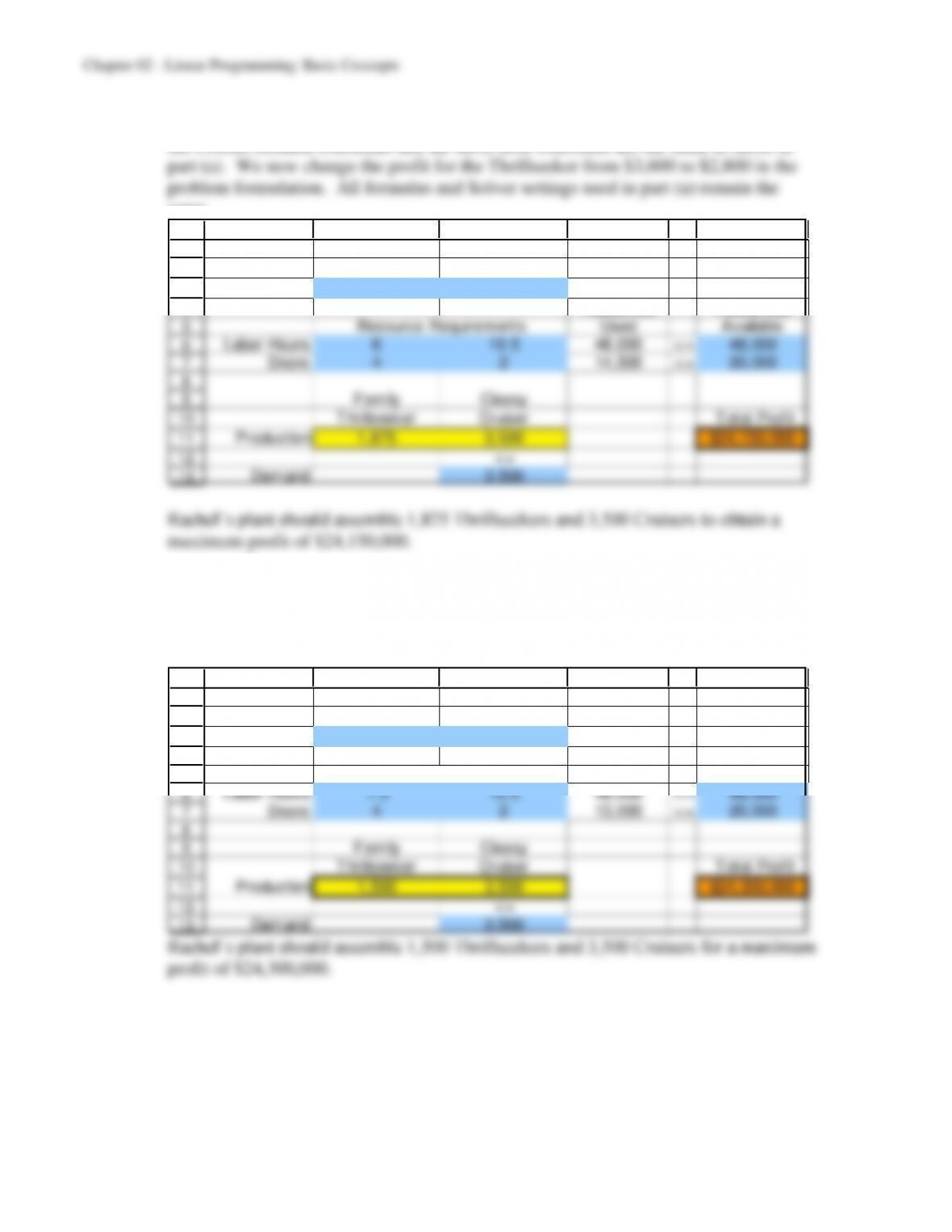
2-30
g) Because we consider this question independently, the values of the right-hand sides for
the Cruiser demand constraint and the labor hour constraint are the same as those in
same.
1
2
3
4
5
6
7
8
9
10
11
12
13
A B C D E F
Family Classy
Thrillseeker Cruiser
Unit Profit $2,800 $5,400
Resources Resources
Used Available
Labor Hours 6 10.5 48,000 <= 48,000
Doors 4 2 14,500 <= 20,000
Family Classy
Thrillseeker Cruiser Total Profit
Production 1,875 3,500 $24,150,000
<=
Demand 3,500
Resource Requirements
Rachel’s plant should assemble 1,875 Thrillseekers and 3,500 Cruisers to obtain a
maximum profit of $24,150,000.
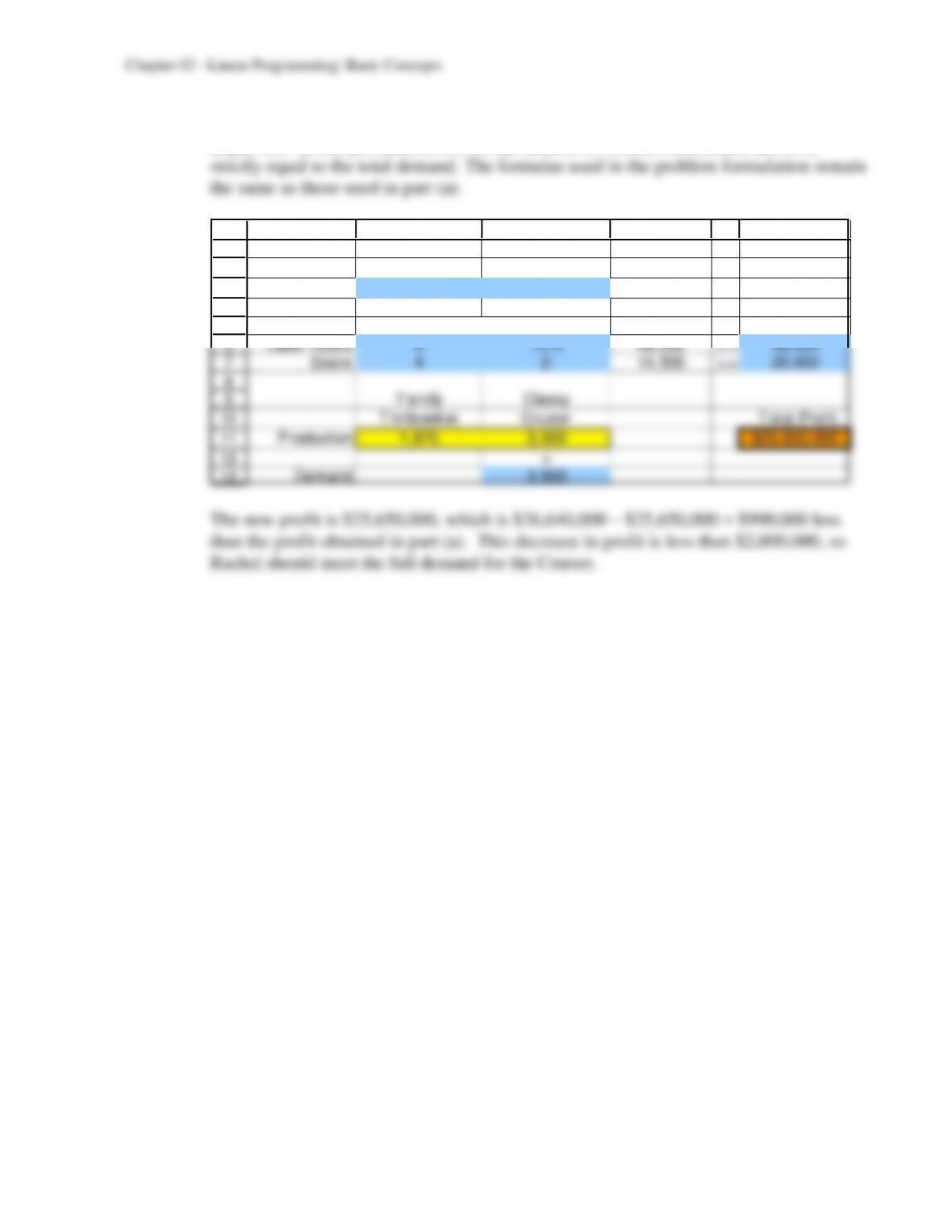
h) Because we consider this question independently, the profit for the Thrillseeker remains
the same as the profit specified in part (a). The labor hour constraint changes. Each
Thrillseeker now requires 7.5 hours for assembly. All formulas and Solver settings
used in part (a) remain the same.
1
2
3
4
5
6
7
8
9
10
11
12
13
A B C D E F
Family Classy
Thrillseeker Cruiser
Unit Profit $3,600 $5,400
Resources Resources
Used Available
Labor Hours 7.5 10.5 48,000 <= 48,000
Doors 4 2 13,000 <= 20,000
Family Classy
Thrillseeker Cruiser Total Profit
Production 1,500 3,500 $24,300,000
<=
Demand 3,500
Resource Requirements
2-31
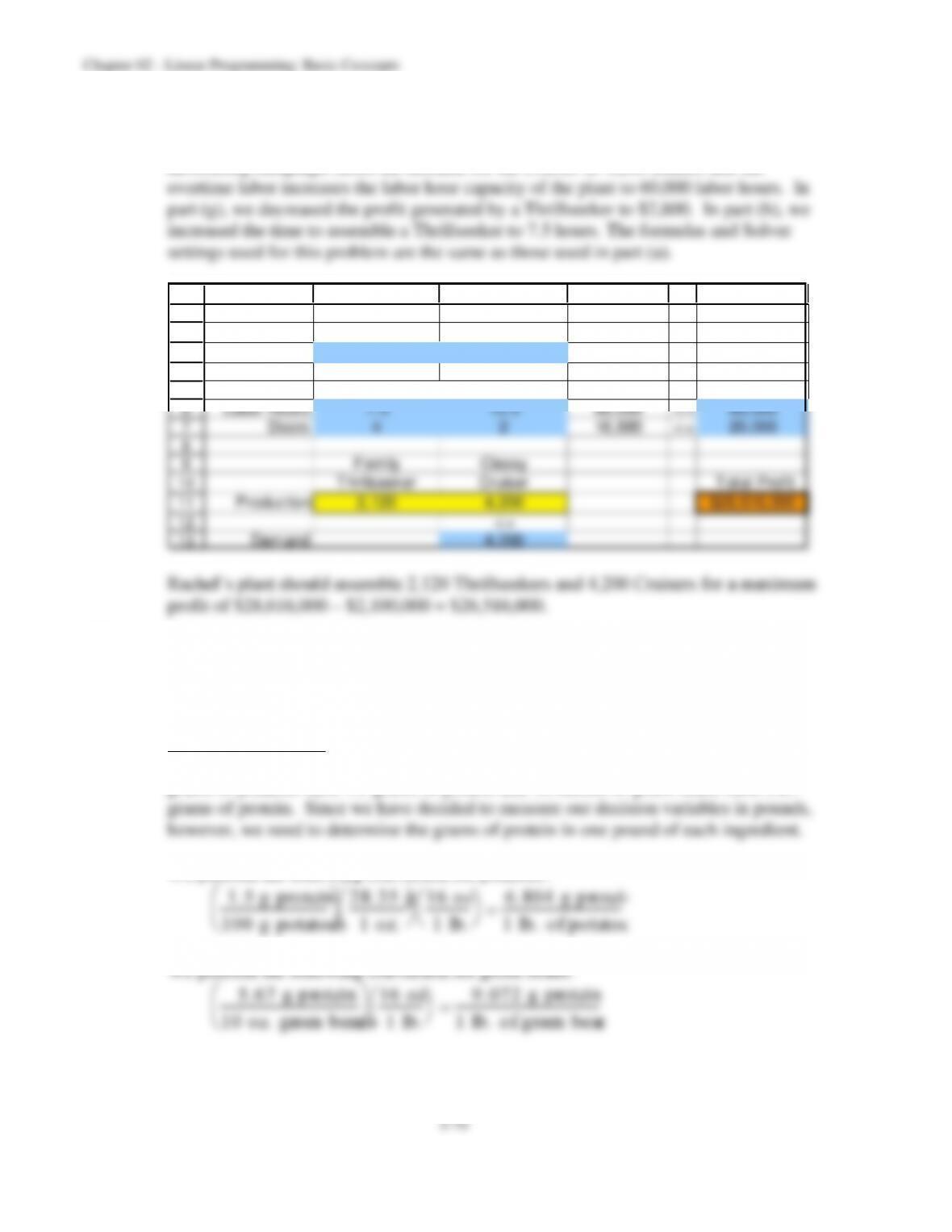
i) Because we consider this question independently, we use the problem formulation used
in part (a). In this problem, however, the number of Cruisers assembled has to be
1
2
3
4
5
6
7
8
9
10
11
12
13
A B C D E F
Family Classy
Thrillseeker Cruiser
Unit Profit $3,600 $5,400
Resources Resources
Used Available
Labor Hours 6 10.5 48,000 <= 48,000
Doors 4 2 14,500 <= 20,000
Family Classy
Thrillseeker Cruiser Total Profit
Production 1,875 3,500 $25,650,000
=
Demand 3,500
Resource Requirements
2-33
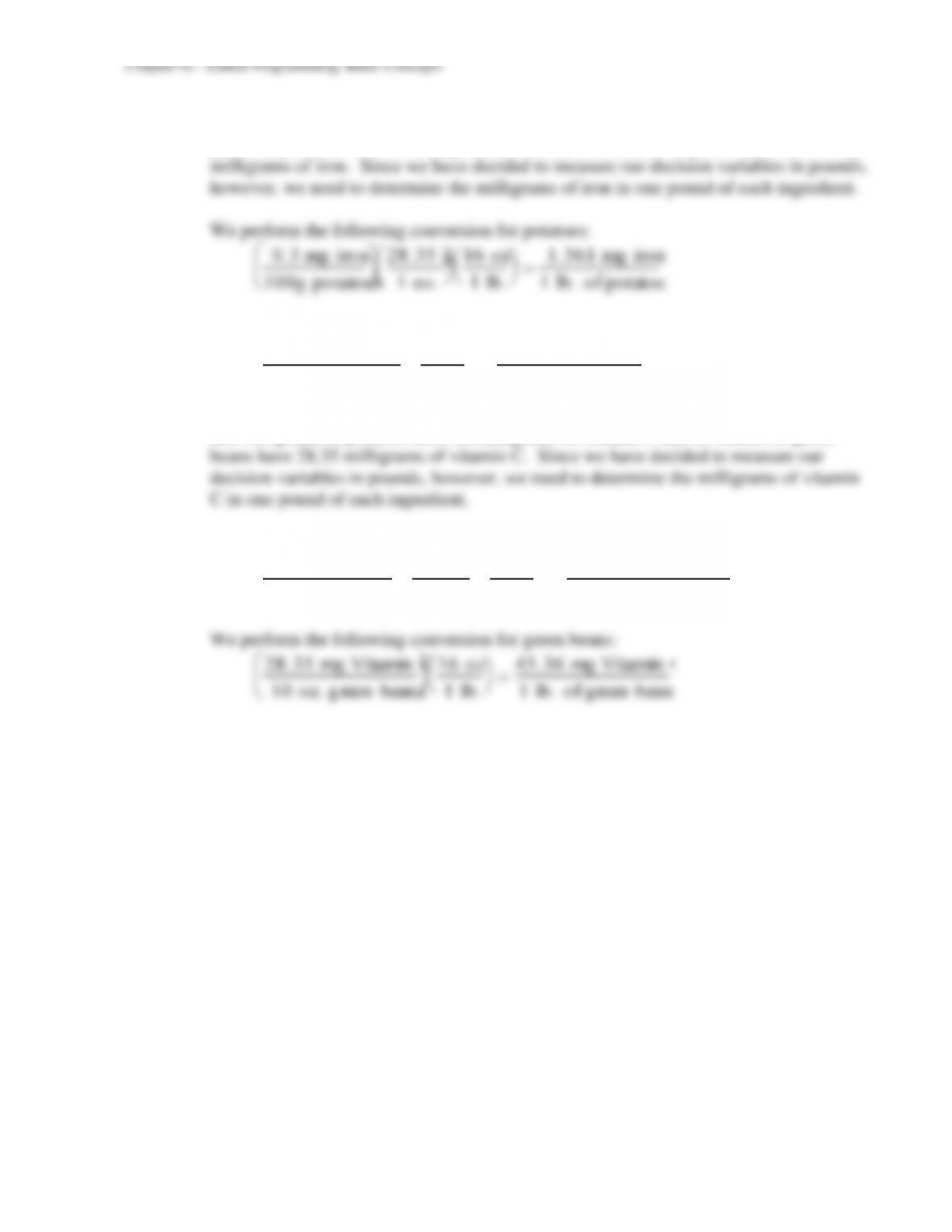
2. We next need to ensure that the dish has 80 milligrams of iron. We are told that 100
grams of potatoes have 0.3 milligrams of iron and 10 ounces of green beans have 3.402
100g po tatoes
1 oz.
1 lb.
=1.361 mg iron
1 lb. of potatoe
We perform the following conversion for green beans:
3.402 mg iron
10 oz. green beans
16 oz.
1 lb.
=5.443 mg iron
1 lb. of green bean
3. We next need to ensure that the dish has 1,050 milligrams of vitamin C. We are told
that 100 grams of potatoes have 12 milligrams of vitamin C and 10 ounces of green
We perform the following conversion for potatoes:
12 mg Vitamin C
100g potatoes
28.35 g
1 oz.
16 oz.
1 lb.
=54.432 mg Vitamin
1 lb. of potatoes
10 oz. green beans
1 lb.
=45.36 mg Vitamin C
1 lb. of green bean