
Chapter 07 – Risks of Financial Institutions
7-1
Solutions for End-of-Chapter Questions and Problems: Chapter Seven
1. What is the process of asset transformation performed by a financial institution? Why does
this process often lead to the creation of interest rate risk? What is interest rate risk?
2. What is refinancing risk? How is refinancing risk part of interest rate risk? If an FI funds
long-term fixed-rate assets with short-term liabilities, what will be the impact on earnings
of an increase in the rate of interest? A decrease in the rate of interest?
3. What is reinvestment risk? How is reinvestment risk part of interest rate risk? If an FI funds
short-term assets with long-term liabilities, what will be the impact on earnings of a
decrease in the rate of interest? An increase in the rate of interest?
7-2
Education.
4. The sales literature of a mutual fund claims that the fund has no risk exposure since it
invests exclusively in federal government securities which are free of default risk. Is this
claim true? Explain why or why not.
5. How can interest rate risk adversely affect the economic or market value of an FI?
When interest rates increase (or decrease), the values of fixed-rate assets decrease (or increase)
6. Consider an FI that issues $100 million of liabilities with one year to maturity to finance the
purchase of $100 million of assets with a two year maturity. Suppose that the cost of funds
(liabilities) for the FI is 5 percent per year and the interest return on the assets is 8 percent
per year.
Chapter 07 – Risks of Financial Institutions
7-3
Education.
In this case the FI’s profit spread in the second year is negative: 8 percent -9 percent = -1
7. Consider an FI that issues $200 million of liabilities with two years to maturity to finance
the purchase of $200 million of assets with a one year maturity. Suppose that the cost of
funds (liabilities) for the FI is 5 percent per year and the interest return on the assets is 9
percent per year.
a. Calculate the FI’s profit spread and dollar value of profit in year 1.
b. Calculate the profit spread and dollar value of profit in year 2, if the FI can reinvest its
assets at 9 percent.
c. If interest rates fall and the FI can invest in one-year assets at 6 percent in the second
year, calculate the FI’s profit spread and dollar value of profit in year 2.
Chapter 07 – Risks of Financial Institutions
7-4
Education.
d. If interest rates rise and the FI can invest in one-year assets at 11 percent in the second
year, calculate the FI’s profit spread and dollar value of profit in year 2.
8. A financial institution has the following market value balance sheet structure:
Assets Liabilities and Equity
Cash $1,000 Certificate of deposit $10,000
Bond $10,000 Equity $1,000
Total assets $11,000 Total liabilities and equity $11,000
a. The bond has a 10-year maturity, a fixed-rate coupon of 10 percent paid at the end of
each year, and a par value of $10,000. The certificate of deposit has a 1-year maturity
and a 6 percent fixed rate of interest. The FI expects no additional asset growth. What
will be the net interest income (NII) at the end of the first year? Note: Net interest
income equals interest income minus interest expense.
b. If at the end of year 1 market interest rates have increased 100 basis points (1 percent),
what will be the net interest income for the second year? Is the change in NII caused
by reinvestment risk or refinancing risk?
c. Assuming that market interest rates increase 1 percent, the bond will have a value of
$9,446 at the end of year 1. What will be the market value of the equity for the FI?
Assume that all of the NII in part (a) is used to cover operating expenses or is
distributed as dividends.

Chapter 07 – Risks of Financial Institutions
7-5
Education.
d. If market interest rates had decreased 100 basis points by the end of year 1, would the
market value of equity be higher or lower than $1,000? Why?
e. What factors have caused the changes in operating performance and market value for
this firm?
9. How does a policy of matching the maturities of assets and liabilities work (a) to minimize
interest rate risk and (b) against the asset-transformation function of FIs?
A policy of maturity matching will allow changes in market interest rates to have approximately
10. Corporate bonds usually pay interest semiannually. If a company decided to change from
semiannual to annual interest payments, how would this affect the bond’s interest rate risk?
11. Two 10-year bonds are being considered for an investment that may have to be liquidated
before the maturity of the bonds. The first bond is a 10-year premium bond with a coupon

7-6
Copyright © 2014 McGraw-Hill Education. All rights reserved. No reproduction or distribution without the prior written consent of McGraw-Hill
Education.
The zero-coupon bond would have more interest rate risk. Because the entire cash flow is not
received until the bond matures, the entire cash flow is exposed to interest rate changes over the
entire life of the bond. The cash flows of the coupon-paying bond are returned with periodic
regularity, thus allowing less exposure to interest rate changes. In effect, some of the cash flows
may be received before interest rates change.
12. Consider again the two bonds in problem 11. If the investment goal is to leave the assets
untouched until maturity, such as for a child’s education or for one’s retirement, which of
the two bonds has more interest rate risk? What is the source of this risk?
13. A money market mutual fund bought $1 million of two-year Treasury notes six months
ago. During this time, the value of the securities has increased, but for tax reasons the
14. A bank invested $50 million in a two-year asset paying 10 percent interest per year and
simultaneously issued a $50 million, one-year liability paying 8 percent interest per year.
The liability will be rolled over after one year at the current market rate. What will be the
7-7
Copyright © 2014 McGraw-Hill Education. All rights reserved. No reproduction or distribution without the prior written consent of McGraw-Hill
Education.
15. What is credit risk? Which types of FIs are more susceptible to this type of risk? Why?
Credit risk is the risk that promised cash flows from loans and securities held by FIs may not be
16. What is the difference between firm-specific credit risk and systematic credit risk? How
can an FI alleviate firm-specific credit risk?
Firm-specific credit risk refers to the likelihood that a single asset may deteriorate in quality,
17. Many banks and savings institutions that failed in the 1980s had made loans to oil
companies in Louisiana, Texas, and Oklahoma. When oil prices fell, these companies, the
regional economy, and the banks and savings institutions all experienced financial
18. What is liquidity risk? What routine operating factors allow FIs to deal with this risk in
times of normal economic activity? What market reality can create severe financial
difficulty for an FI in times of extreme liquidity crises?
7-8
Copyright © 2014 McGraw-Hill Education. All rights reserved. No reproduction or distribution without the prior written consent of McGraw-Hill
Education.
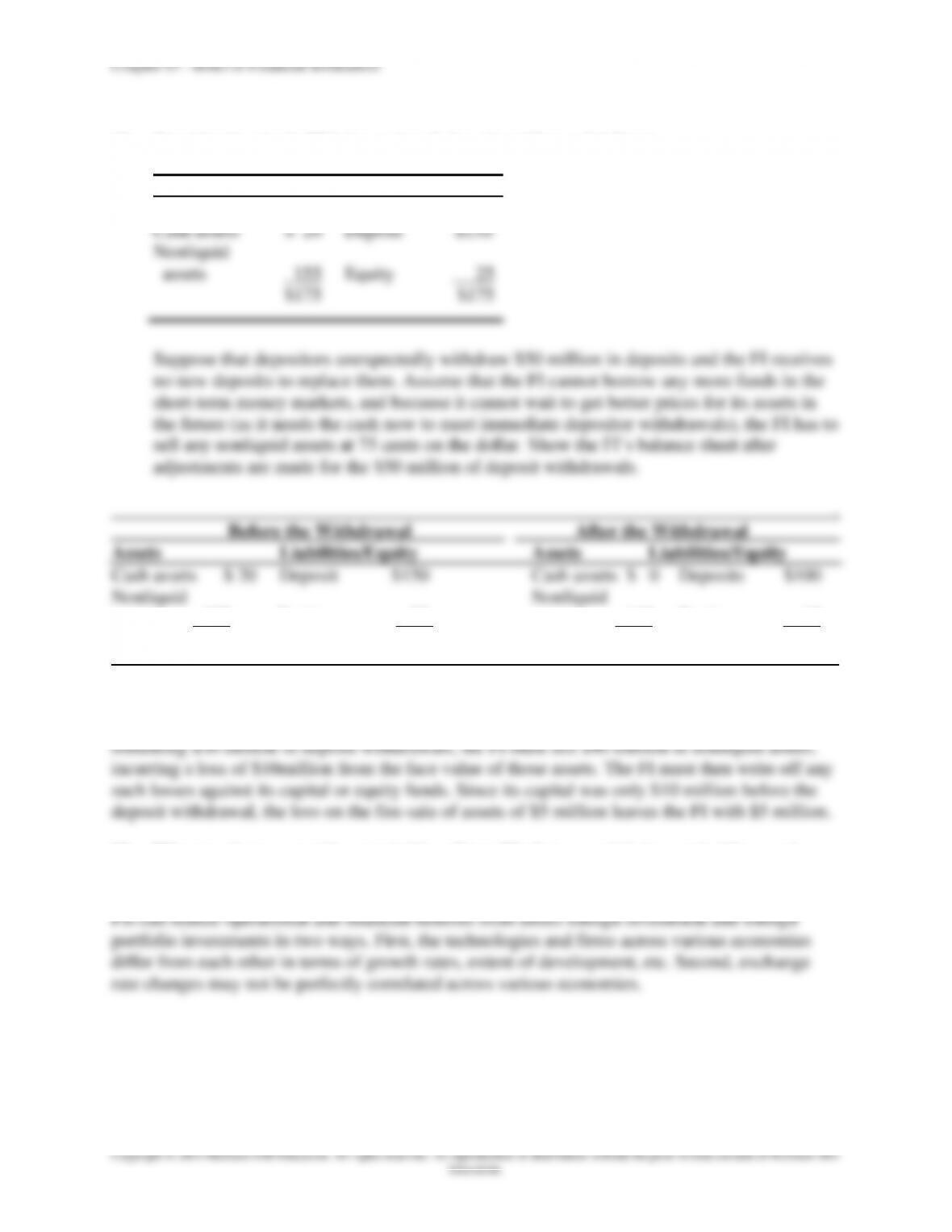
19. Consider the simple FI balance sheet below (in millions of dollars).
Before the Withdrawal
Assets Liabilities/Equity
assets 155 Equity 25 assets 115 Equity 15
$175 $175 $115 $115
To meet these deposit withdrawals, the FI first uses the $20 million it has in cash assets and then
seeks to sell some of its nonliquid assets to raise an additional $30 million in cash. To cover the
20. What two factors provide potential benefits to FIs that expand their asset holdings and
liability funding sources beyond their domestic borders?

Chapter 07 – Risks of Financial Institutions
7-9
21. What is foreign exchange risk? What does it mean for an FI to be net long in foreign
assets? What does it mean for an FI to be net short in foreign assets? In each case, what
must happen to the foreign exchange rate to cause the FI to suffer losses?
22. If the Swiss franc is expected to depreciate in the near future, would a U.S.-based FI in
Bern City prefer to be net long or net short in its asset positions? Discuss.
23. If international capital markets are well integrated and operate efficiently, will FIs be
exposed to foreign exchange risk? What are the sources of foreign exchange risk for FIs?
24. If an FI has the same amount of foreign assets and foreign liabilities in the same currency,
has that FI necessarily reduced the risk involved in these international transactions to zero?
Chapter 07 – Risks of Financial Institutions
7-10
Education.
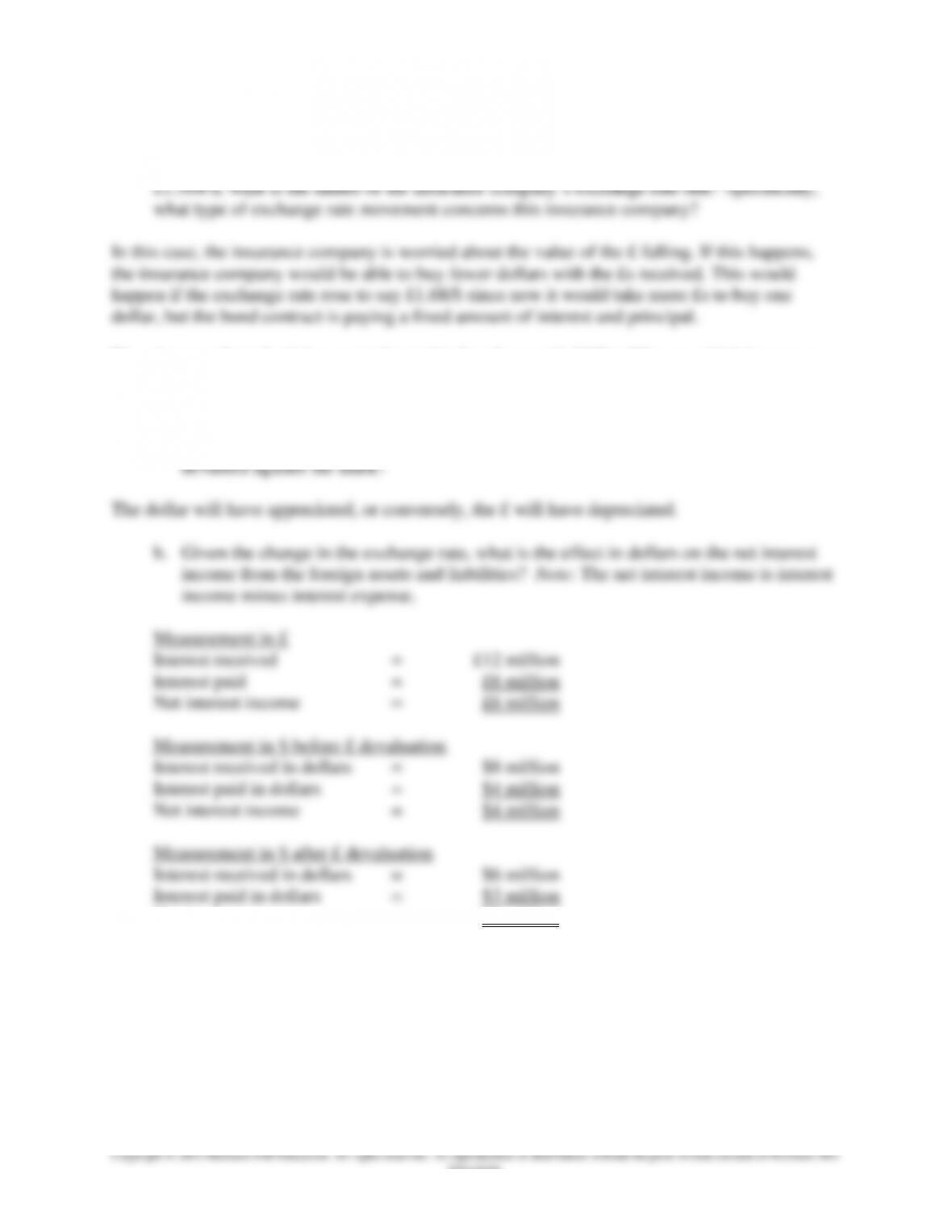
25. A U.S. insurance company invests $1,000,000 in a private placement of British bonds.
Each bond pays £300 in interest per year for 20 years. If the current exchange rate is
26. Assume that a bank has assets located in London worth £150 million on which it earns an
average of 8 percent per year. The bank has £100 million in liabilities on which it pays an
average of 6 percent per year. The current spot exchange rate is £1.50/$.
a. If the exchange rate at the end of the year is £2.00/$, will the dollar have appreciated or
Net interest income = $3 million
Thus, net interest income decreases by $1 million as a result of foreign exchange risk.
c. What is the effect of the exchange rate change on the value of assets and liabilities in
dollars?

7-11
Education.
27. Six months ago, Qualitybank, issued a $100 million, one-year maturity CD denominated in
euros. On the same date, $60 million was invested in a €-denominated loan and $40 million
was invested in a U.S. Treasury bill. The exchange rate on this date was €1.5675/$.
Assume no repayment of principal and an exchange rate today of €1.2540/$.
a. What is the current value of the CD principal (in euros and dollars)?
b. What is the current value of the euro-denominated loan principal (in euros and
dollars)?
c. What is the current value of the U.S. Treasury bill (in euros and dollars)?
d. What is Qualitybank’s profit/loss from this transaction (in euros and dollars)?
7-12
Copyright © 2014 McGraw-Hill Education. All rights reserved. No reproduction or distribution without the prior written consent of McGraw-Hill
Education.
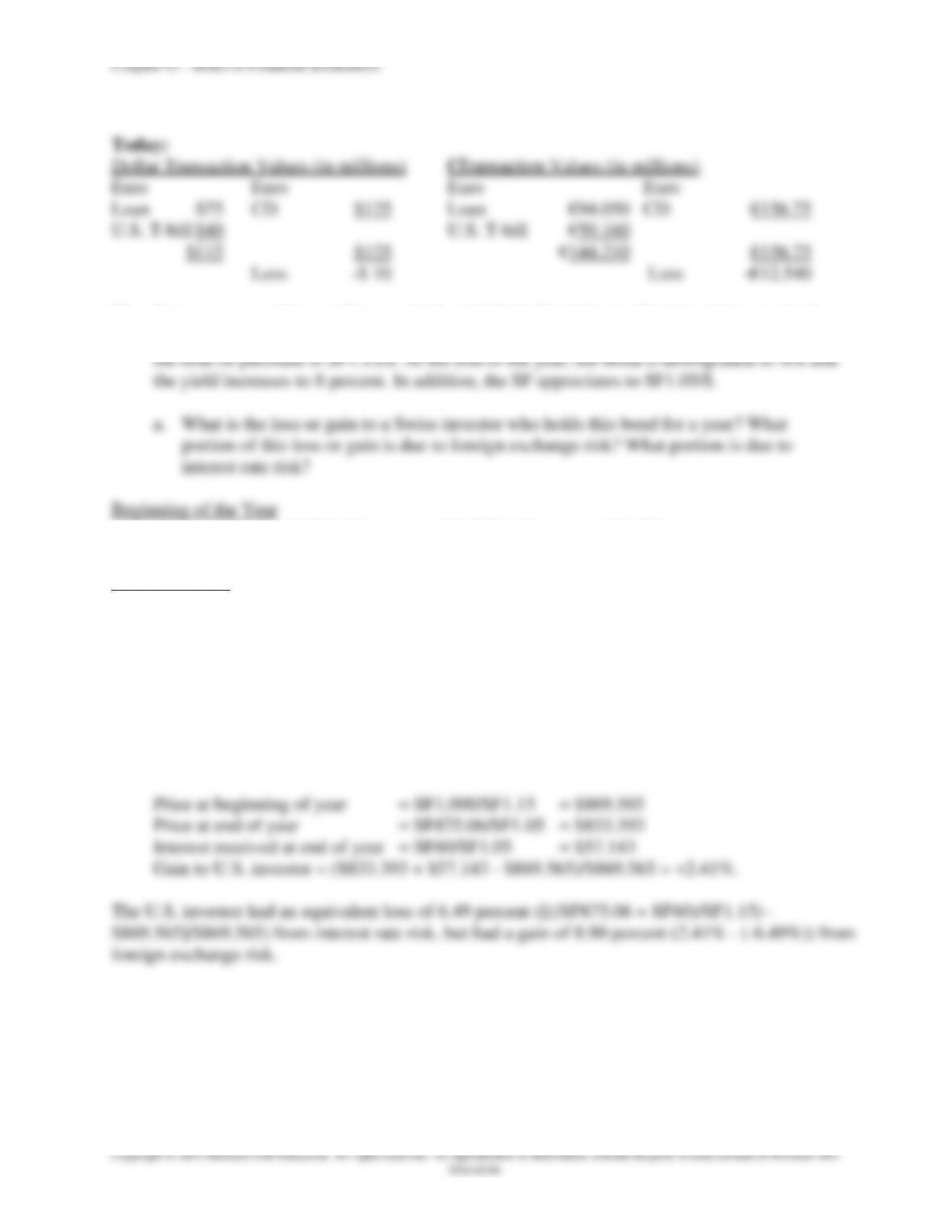
Today:
Dollar Transaction Values (in millions) €Transaction Values (in millions)
Euro Euro Euro Euro
Loan $75 CD $125 Loan €94.050 CD €156.75
U.S. T-bill $40 U.S. T-bill €50.160
$115 $125 €144.210 €156.75
Loss -$ 10 Loss –€12.540
28. Suppose you purchase a 10-year, AAA-rated Swiss bond for par that is paying an annual
coupon of 6 percent. The bond has a face value of 1,000 Swiss francs (SF). The spot rate at
000,1*000,1*60 10,610,6 SFPVSFPVASFBondofPrice nini =+= ====
End of the Year
06.875*000,1*60 9,89,8 SFPVSFPVASFBondofPrice nini =+= ====
The loss to the Swiss investor (SF875.06 + SF60 – SF1,000)/SF1,000 = -6.49 percent. The entire
amount of the loss is due to interest rate risk.
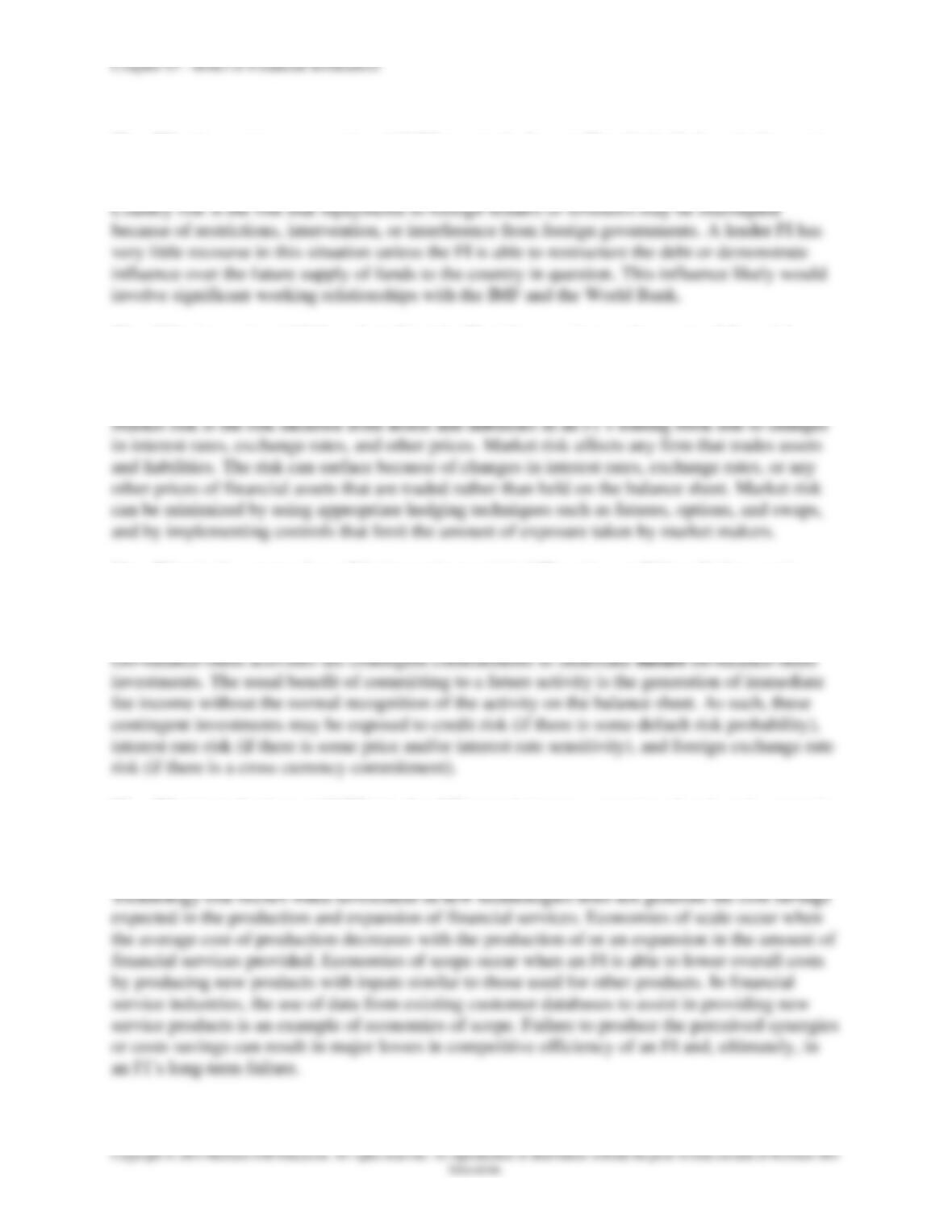
b. What is the loss or gain to a U.S. investor who holds this bond for a year? What portion
of this loss or gain is due to foreign exchange risk? What portion is due to interest rate
risk?
7-13
Copyright © 2014 McGraw-Hill Education. All rights reserved. No reproduction or distribution without the prior written consent of McGraw-Hill
Education.
29. What is country or sovereign risk? What remedy does an FI realistically have in the event
of a collapsing country or currency?
30. What is market risk? How does this risk affect the operating performance of financial
institutions? What actions can be taken by an FI’s management to minimize the effects of
this risk?
31. What is the nature of an off-balance-sheet activity? How does an FI benefit from such
activities? Identify the various risks that these activities generate for an FI, and explain how
these risks can create varying degrees of financial stress for the FI at a later time.
32. What is technology risk? What is the difference between economies of scale and economies
of scope? How can these economies create benefits for an FI? How can these economies
prove harmful to an FI?

7-14
Copyright © 2014 McGraw-Hill Education. All rights reserved. No reproduction or distribution without the prior written consent of McGraw-Hill
Education.
33. What is the difference between technology risk and operational risk? How does
internationalizing the payments system among banks increase operational risk?
Technology risk is the risk incurred by an FI when its technological investments do not produce
anticipated cost savings. For example, if an FI spends millions on upgrading its computer
34. Why can insolvency risk be classified as a consequence or outcome of any or all of the
other types of risks?
7-15
Education.
35. Discuss the interrelationships among the different sources of FI risk exposure. Why would
the construction of an FI risk management model to measure and manage only one type of
risk be incomplete?
Measuring each source of FI risk exposure individually creates the false impression that they are
36. Characterize the risk exposure(s) of the following FI transactions by choosing one or more
of the risk types listed below:
a. Interest rate risk d. Technology risk
b. Credit risk e. Foreign exchange rate risk
37. Consider these four types of risks: credit, foreign exchange, market, and sovereign. These

7-16
Copyright © 2014 McGraw-Hill Education. All rights reserved. No reproduction or distribution without the prior written consent of McGraw-Hill
Education.
Credit risk and sovereign risk comprise one pair, while FX and market risk make up the other.
Sovereign risk is a type of credit risk in that one reason why a loan may default is because of
political upheaval in the country in which the borrower resides. FX risk is a type of market risk
in that one reason why the market value of an outstanding loan or security may change is due to
a change in exchange rates.