Chapter 06 – Financial Services: Insurance
6-1
Solutions for End-of-Chapter Questions and Problems: Chapter Six
1. What is the primary function of an insurance company? How does this function compare
with the primary function of a depository institution?
The primary function of an insurance company is to provide protection from adverse events.
2. What is the adverse selection problem? How does adverse selection affect the profitable
management of an insurance company?
3. What are the similarities and differences among the four basic lines of life insurance
products?
The four basic lines of life insurance products are (1) ordinary life, (2) group life, (3) industrial
6-2
Education.
4. Explain how annuity activities represent the reverse of life insurance activities.
A typical life insurance contract requires a periodic payment by one party for a promised
5. Explain how life insurance and annuity products can be used to create a steady stream of
cash disbursements and payments to avoid paying or receiving a single-lump sum cash
6. a. Calculate the annual cash flows from a $1 million, 20-year fixed-payment annuity
earning a guaranteed 10 percent per year if payments are to begin at the end of the
current year.
The annual cash flows are given by X:
b. Calculate the annual cash flows from a $1 million, 20-year fixed-payment annuity
earning a guaranteed 10 percent per year if payments are to begin at the end of year 5.
c. What is the amount of the annuity purchase required if you wish to receive a fixed
payment of $200,000 for 20 years? Assume that the annuity will earn 10 percent per
year.
Chapter 06 – Financial Services: Insurance
6-3
Copyright © 2014 McGraw-Hill Education. All rights reserved. No reproduction or distribution without the prior written consent of McGraw-Hill
Education.
The required payment is the present value of $200,000 per year for 20 years at 10 percent.
)
PVA
( 000,200$ = 74.712,702,1$ 20 =n %,10 = i
7. You deposit $10,000 annually into a life insurance fund for the next 10 years, after which
time you plan to retire.
a. If the deposits are made at the beginning of the year and earn an interest rate of 8
percent, what will be the amount of retirement funds at the end of year 10?
b. Instead of a lump sum, you wish to receive annuities for the next 20 years (years 11
through 30). What is the constant annual payment you expect to receive at the
beginning of each year if you assume an interest rate of 8 percent during the
distribution period?
c. Repeat parts (a) and (b) above assuming earning rates of 7 percent and 9 percent during
the deposit period and earning rates of 7 percent and 9 percent during the distribution
period. During which period does the change in the earning rate have the greatest
impact?
Deposit Value at Distribution Annual
Period 10 Years Period Payment
Chapter 06 – Financial Services: Insurance
6-4
Education.
8. You deposit $12,000 annually into a life insurance fund for the next 10 years, at which time
you plan to retire. Instead of a lump sum, you wish to receive annuities for the next 20
years. What is the annual payment you expect to receive beginning in year 11 if you
assume an interest rate of 6 percent for the whole time period?
The value of $12,000 deposited annually in a fund will amount to the following in ten years:
9. a. Suppose a 65-year-old person wants to purchase an annuity from an insurance company
that would pay $20,000 per year until the end of that person’s life. The insurance
company expects this person to live for 15 more years and would be willing to pay 6
percent on the annuity. How much should the insurance company ask this person to pay
for the annuity?
b. A second 65-year-old person wants the same $20,000 annuity, but this person is much
healthier and is expected to live for 20 years. If the same 6 percent interest rate applies,
how much should this healthier person be charged for the annuity?
c. In each case, what is the difference in the purchase price of the annuity if the
distribution payments are made at the beginning of the year?
10. Contrast the balance sheet of a life insurance company (Table 6-3) with the balance sheet
of a commercial bank (Table 2-6) and that of a savings institution (Table 2-10). Explain the
balance sheet differences in terms of the differences in the primary functions of the three
organizations.
Chapter 06 – Financial Services: Insurance
6-5
Life insurance companies have long-term liabilities because of the life insurance products that
they sell. As a result, the asset side of the balance sheet predominantly includes long-term
11. Using the data in Table 6-2, how has the composition of assets of U.S. life insurance
companies changed over time?
12. How do life insurance companies earn a profit?
Insurance companies earn profits by taking in more premium income than they pay out in policy
payments. Firms can increase their spread between premium income and policy payouts in two
Chapter 06 – Financial Services: Insurance
6-6
Education.
13. How would the balance sheet of a life insurance company change if it offered to run a
private pension fund for another company?
The primary change in the balance sheet of a life insurance company would be an increase in the
14. How does the regulation of insurance companies differ from the regulation of depository
institutions? What are the major pieces of life insurance regulatory legislation?
Insurance companies are more exclusively subject to state regulations compared to banks and
In 2009, the U.S. Congress considered establishing an optional federal insurance charter. The
move behind such a charter picked up steam following the failure of the existing state by state
regulatory system to act in preventing the problems at insurance giant AIG from becoming a
Chapter 06 – Financial Services: Insurance
6-7
The final version of the overhaul bill, the Wall Street Reform and Consumer Protection
15. How do state guarantee funds for life insurance companies compare with deposit insurance
for depository institutions?
State guarantee funds are different from deposit insurance in several ways. First, the insurance
guarantee funds are administered by the life insurance companies as opposed to a separate
16. What are the two major activity lines of property-casualty insurance firms?
The two major lines of property-casualty insurance are:
a) Property insurance: Insurance compensating the insured, fully or partially, for personal
6-8
Copyright © 2014 McGraw-Hill Education. All rights reserved. No reproduction or distribution without the prior written consent of McGraw-Hill
Education.
17. How have the product lines of property-casualty insurance companies changed over time?
Product lines based on net premiums typically are included in the property-casualty insurance
18. Contrast the balance sheet of a property-casualty insurance company (Table 6-5) with the
balance sheet of a commercial bank (Table 2-6). Explain the balance sheet differences in
terms of the differences in the primary functions of the two organizations.
19. What are the three sources of underwriting risk in the property-casualty insurance industry?
The three sources of underwriting risk in the PC industry are (a) unexpected increases in loss
rates, (b) unexpected increases in expenses, and (c) unexpected decreases in investment yields.
20. How do unexpected increases in inflation affect property-casualty insurers?
Inflation generally has an adverse effect on the cost of providing benefits that have been
6-9
Copyright © 2014 McGraw-Hill Education. All rights reserved. No reproduction or distribution without the prior written consent of McGraw-Hill
Education.
21. Identify the four characteristics or features of the perils insured against by property-
casualty insurance. Rank the features in terms of actuarial predictability and total loss
potential.
22. Insurance companies will charge a higher premium for which of the insurance lines listed
below? Why?
a. Low-severity, high-frequency lines versus high-severity, low-frequency lines.
b. Long-tail versus short-tail lines.
23. What does the loss ratio measure? What has been the long-term trend of the loss ratio?
Why?
1950s to the 70 and 80 percent range in the 1990s into the 2010s. Increases in social inflation and
6-10
Copyright © 2014 McGraw-Hill Education. All rights reserved. No reproduction or distribution without the prior written consent of McGraw-Hill
Education.
24. What does the expense ratio measure? Identify and explain the two major sources of
expense risk to a property-casualty insurer. Why has the long-term trend in this ratio been
25. How is the combined ratio defined? What does it measure?
The combined ratio is equal to the loss ratio plus the expense ratio. The ratio may be stated
26. What is the investment yield on premiums earned? Why has this ratio become so important
to property-casualty insurers?
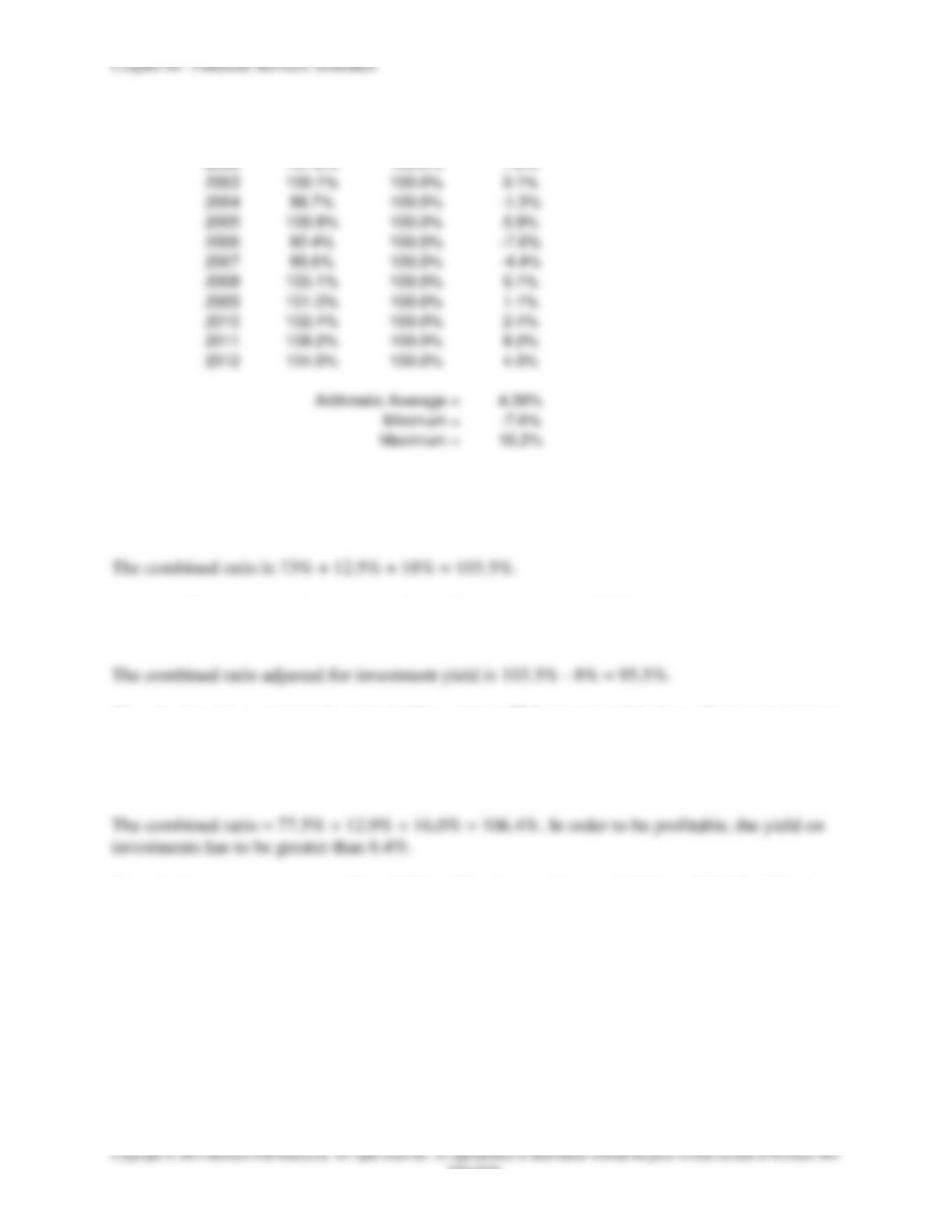
27. Consider the data in Table 6-6. Since 1980, what has been the necessary investment yield
for the industry to enable the operating ratio to be less than 100 in each year? How is this
requirement related to the interest rate risk and credit risk faced by a property-casualty
insurer?
Combined
Required
Minimum
Ratio after
Combined
Investment
Year
Dividends
Ratio
Yield
1980
103.1%
100.0%
3.1%
1985
116.2%
100.0%
16.2%
1990
109.6%
100.0%
9.6%
1995
106.4%
100.0%
6.4%
1997
101.6%
100.0%
1.6%
6-11
Education.
2000
110.5%
100.0%
10.5%
2001
116.0%
100.0%
16.0%
2002
107.2%
100.0%
7.2%
2003
100.1%
100.0%
0.1%
2004
98.7%
100.0%
–1.3%
2005
100.9%
100.0%
0.9%
2006
92.4%
100.0%
-7.6%
2007
95.6%
100.0%
–4.4%
2008
105.1%
100.0%
5.1%
2009
101.0%
100.0%
1.1%
2010
102.4%
100.0%
2.4%
2011
108.2%
100.0%
8.2%
2012
104.0%
100.0%
4.0%
Arithmetic Average =
4.39%
Minimum =
-7.6%
Maximum =
16.2%
28. a. What is the combined ratio for a property insurer that has a loss ratio of 73 percent, a
loss adjustment expense of 12.5 percent, and a ratio of commissions and other
acquisition expenses of 18 percent?
b. What is the combined ratio adjusted for investment yield if the company earns an
investment yield of 8 percent?
29. An insurance company’s projected loss ratio is 77.5 percent and its loss adjustment expense
ratio is 12.9 percent. The company estimates that commission payments and dividends to
policyholders will be 16 percent. What must be the minimum yield on investments to
achieve a positive operating ratio?
30. An insurance company collected $3.6 million in premiums and disbursed $1.96 million in
losses. Loss adjustment expenses amounted to 6.6 percent and dividends paid to
policyholders totaled 1.2 percent. The total income generated from the company’s
investments was $170,000 after all expenses were paid. What is the net profitability in
dollars?
Chapter 06 – Financial Services: Insurance
6-12
Copyright © 2014 McGraw-Hill Education. All rights reserved. No reproduction or distribution without the prior written consent of McGraw-Hill
Education.
Pure loss = $3.6 million – $1.96 million = $1,640,000
Expenses = 0.066 x $3,600,000 = $237,600
Dividends = 0.012 x $3,600,000 = $43,200
Investment returns = $170,000
Net profits = $1,640,000 – $237,600 – $43,200 + $170,000 = $1,529,200
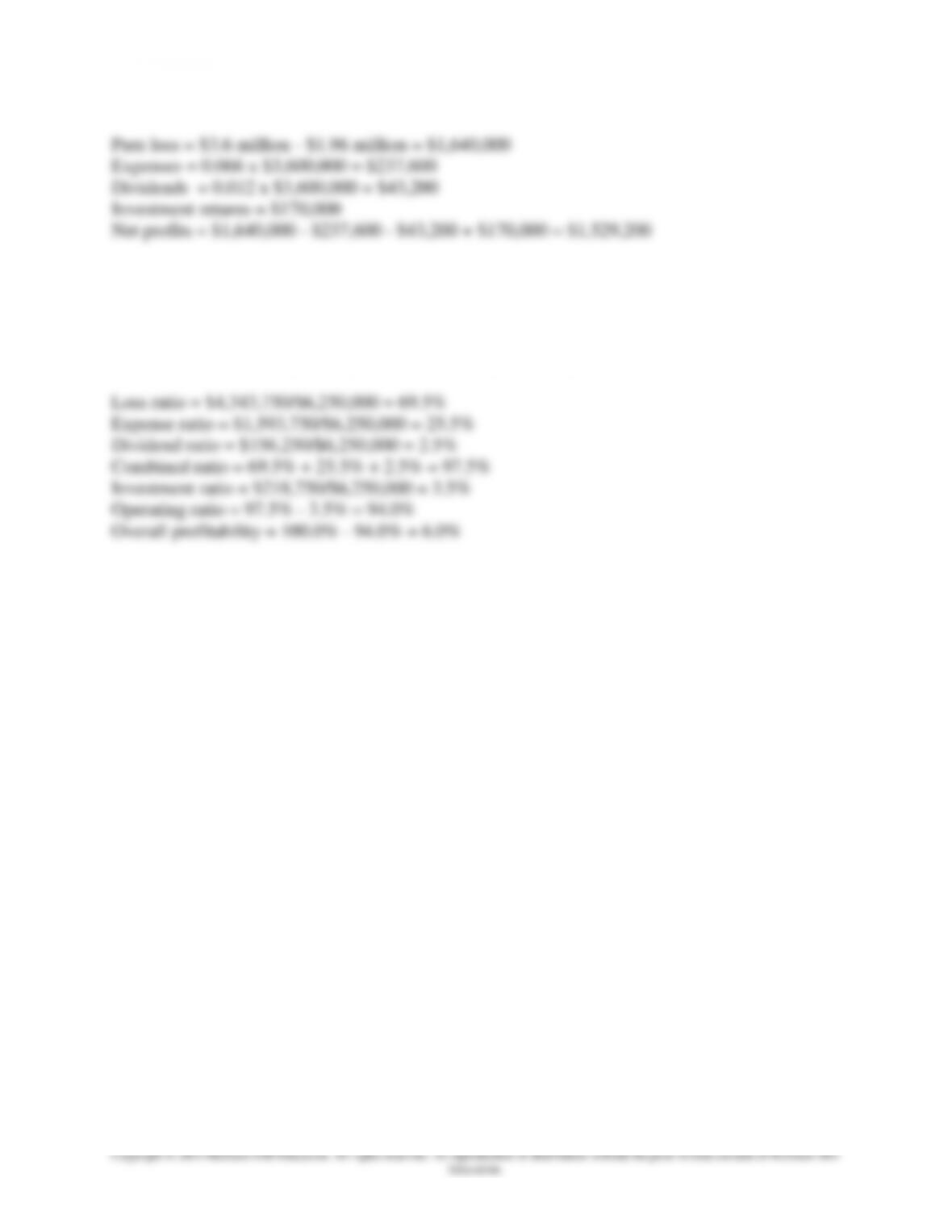
31. A property–casualty insurer brings in $6.25 million in premiums on its homeowners
multiple line of insurance. The line’s losses amount to $4,343,750, expenses are
$1,593,750, and dividends are $156,250. The insurer earns $218,750 in the investment of
its premiums. Calculate the line’s loss ratio, expense ratio, dividend ratio, combined ratio,
investment ratio, operating ratio, and overall profitability.