Chapter 26 – Securitization
26–14
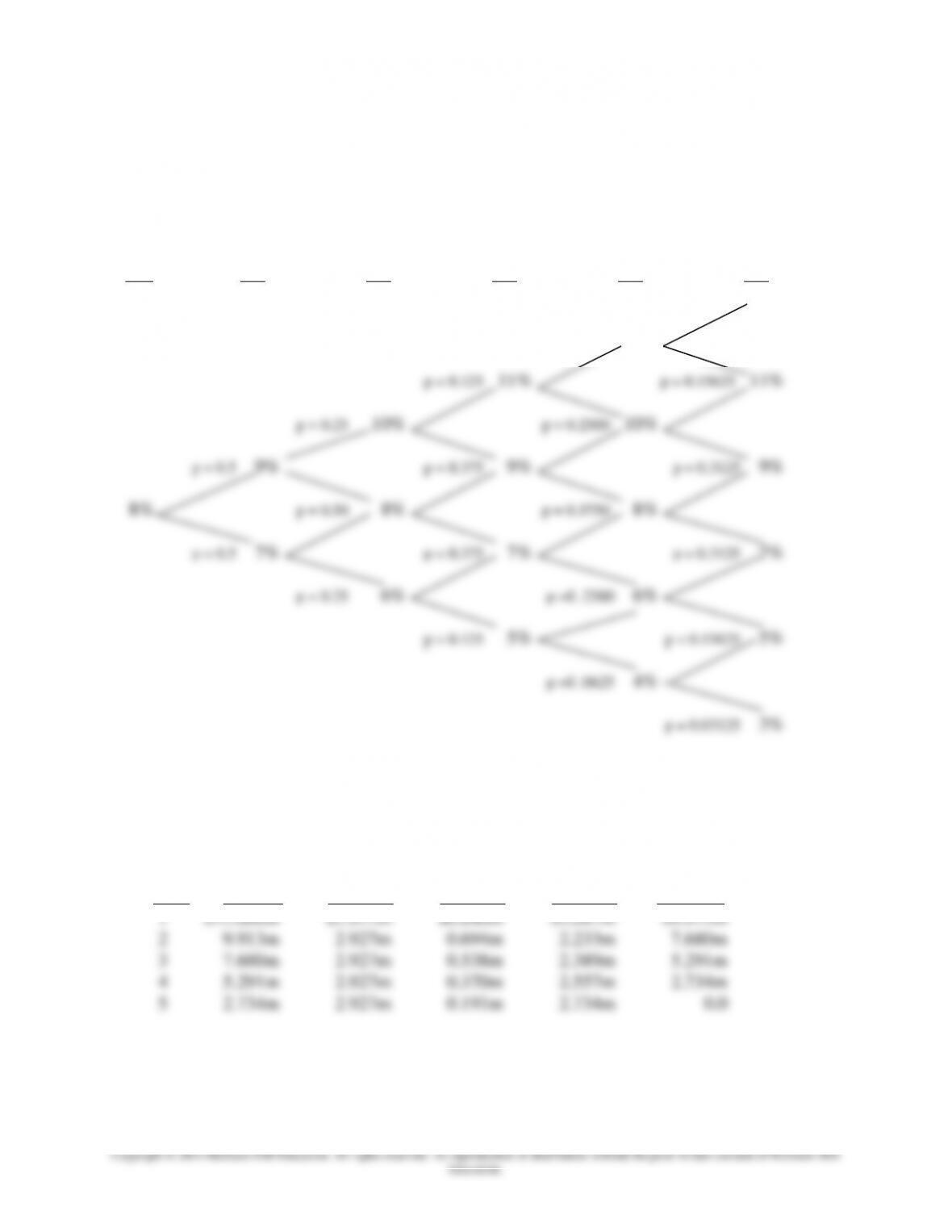
c. Interest rate movements over time are assumed to change a maximum of 1 percent per
year. Both an increase of 1 percent and a decrease of 1 percent in interest rates are
equally probable. If interest rates fall 3 percent below the current mortgage coupon
rates, all mortgages in the pool will be completely prepaid. Diagram the interest rate
tree and indicate the probabilities of each node in the tree.
t=0 t=1 t=2 t=3 t=4 t=5
p = 0.03125 13%
p = 0.0625 12%
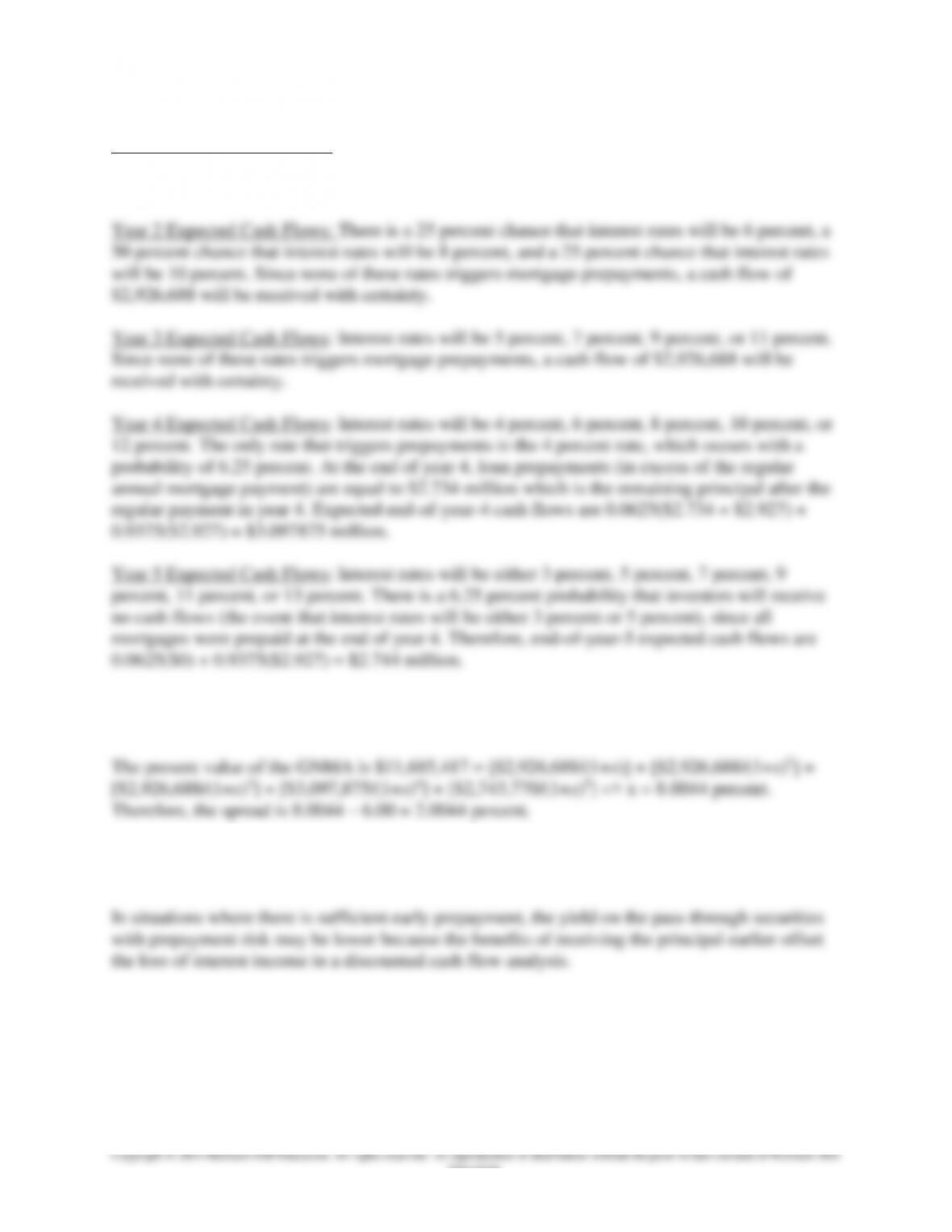
d. What are the expected annual cash flows for each possible situation over the five-year
period?
The annual mortgage cash flows are:
(Fixed) Interest Principal Remaining
Year Balance Payment Payment Payment Principal
Chapter 26 – Securitization
26–15
Education.
Year 1 Expected Cash Flows: There is a 50 percent chance of either a 9 percent or 7 percent
market interest rate. Since neither rate triggers mortgage prepayments, a cash flow of $2,926,688
will be received with certainty.
e. The Treasury bond yield curve is flat at a discount yield of 6 percent. What is the
option-adjusted spread on the GNMA pass-through?
29. What conditions would cause the yield on pass-through securities with prepayment risk to
be less than the yield on pass-through securities without prepayment risk?
30. What is a collateralized mortgage obligation (CMO)? How is it similar to a pass-through
security? How does it differ? In what way does the creation of a CMO use market
segmentation to redistribute prepayment risk?
Chapter 26 – Securitization
26–16
Education.
31. Consider $200 million of 30-year mortgages with a coupon of 10 percent per year paid
quarterly.
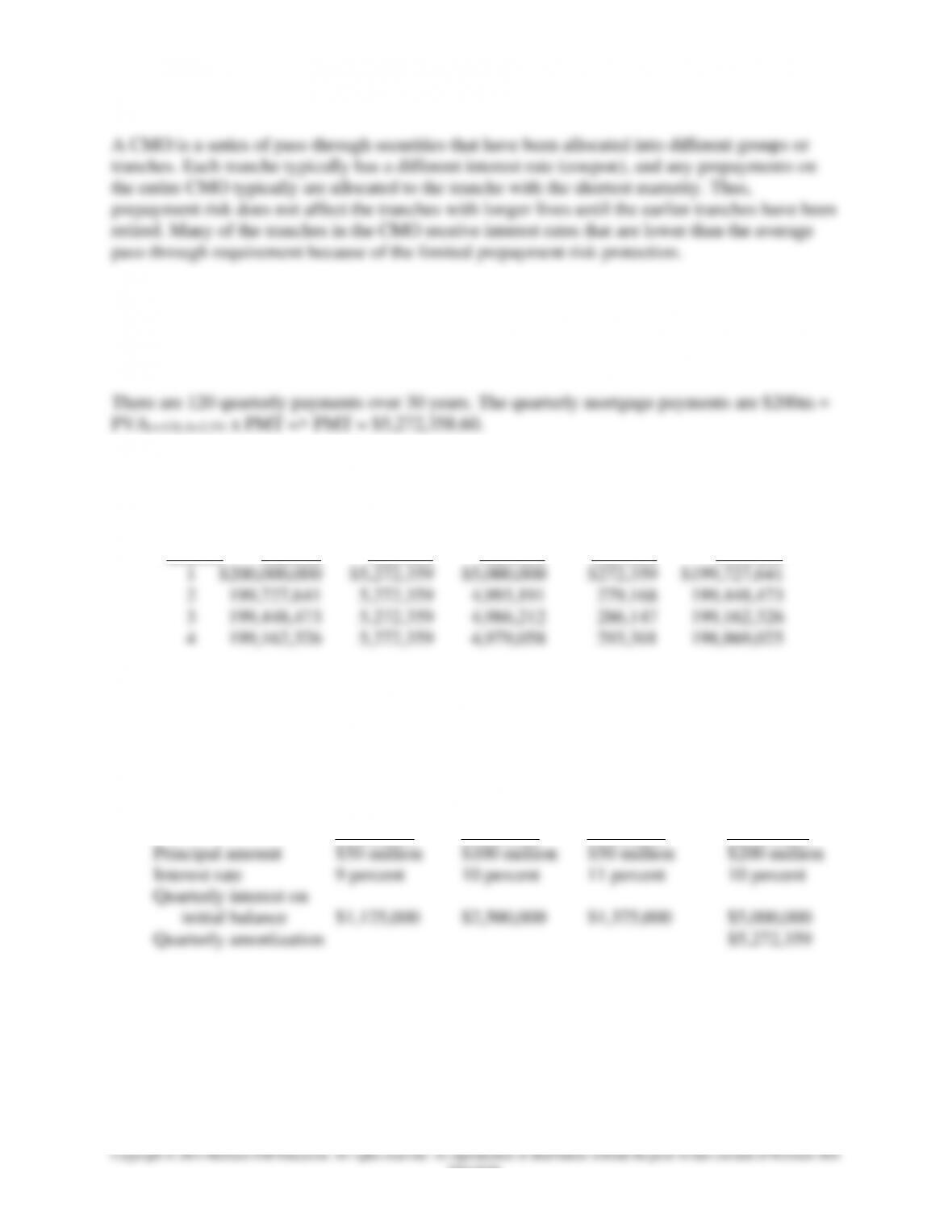
a. What is the quarterly mortgage payment?
b. What are the interest and principal repayments over the first year of life of the
mortgages?
(Fixed) Interest Principal Remaining
Quarter Balance Payment Payment Payment Principal
c. Construct a 30-year CMO using this mortgage pool as collateral. The pool has three
tranches, where tranche A offers the least protection against prepayment and tranche C
offers the most protection against prepayment. Tranche A of $50 million receives
quarterly payments at 9 percent per year, tranche B of $100 million receives quarterly
payments at 10 percent per year, and tranche C of $50 million receives quarterly
payments at 11 percent per year.
Tranche A Tranche B Tranche C Total Issue
d. Assume non-amortization of principal and no prepayments. What are the total promised
coupon payments to the three classes? What are the principal payments to each of the
three classes for the first year?
Chapter 26 – Securitization
26–17
Education.
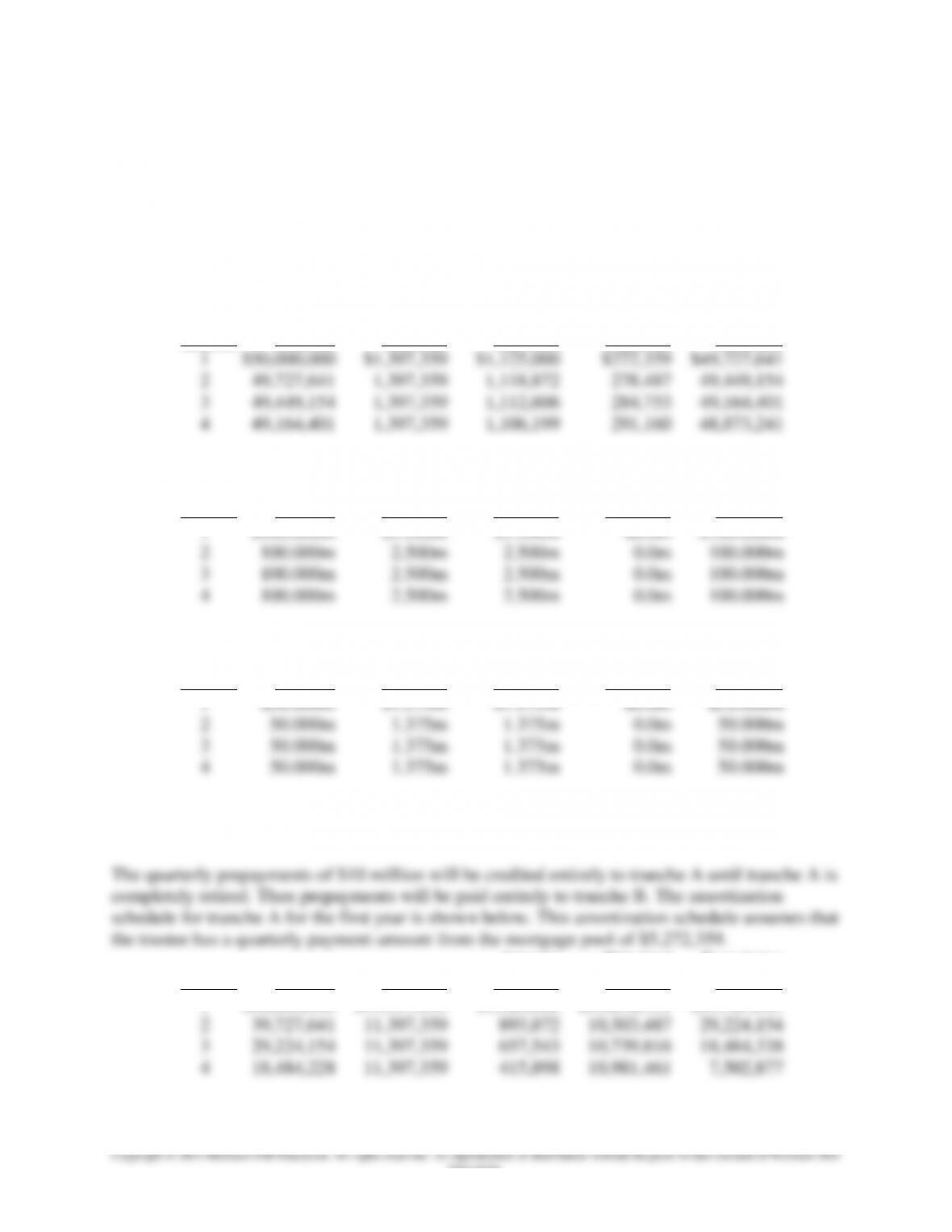
Regular tranche A interest payments are $1.125 million quarterly. If there are no prepayments,
then the regular GNMA quarterly payment of $5,272,359 is distributed among the three tranches.
Five million is the total coupon interest payment for all three tranches. Therefore, $272,359 of
principal is repaid each quarter. Tranche A receives all principal payments. Tranche A cash
flows are $1,125,000 + $272,359 = $1,397,359 quarterly. The cash flows to tranches B and C are
the scheduled interest payments.
Tranche A amortization schedule:
Interest Principal Remaining
Quarter Balance Payment Payment Payment Principal
Tranche B amortization schedule:
Interest Principal Remaining
Quarter Balance Payment Payment Payment Principal
Tranche C amortization schedule:
Interest Principal Remaining
Quarter Balance Payment Payment Payment Principal
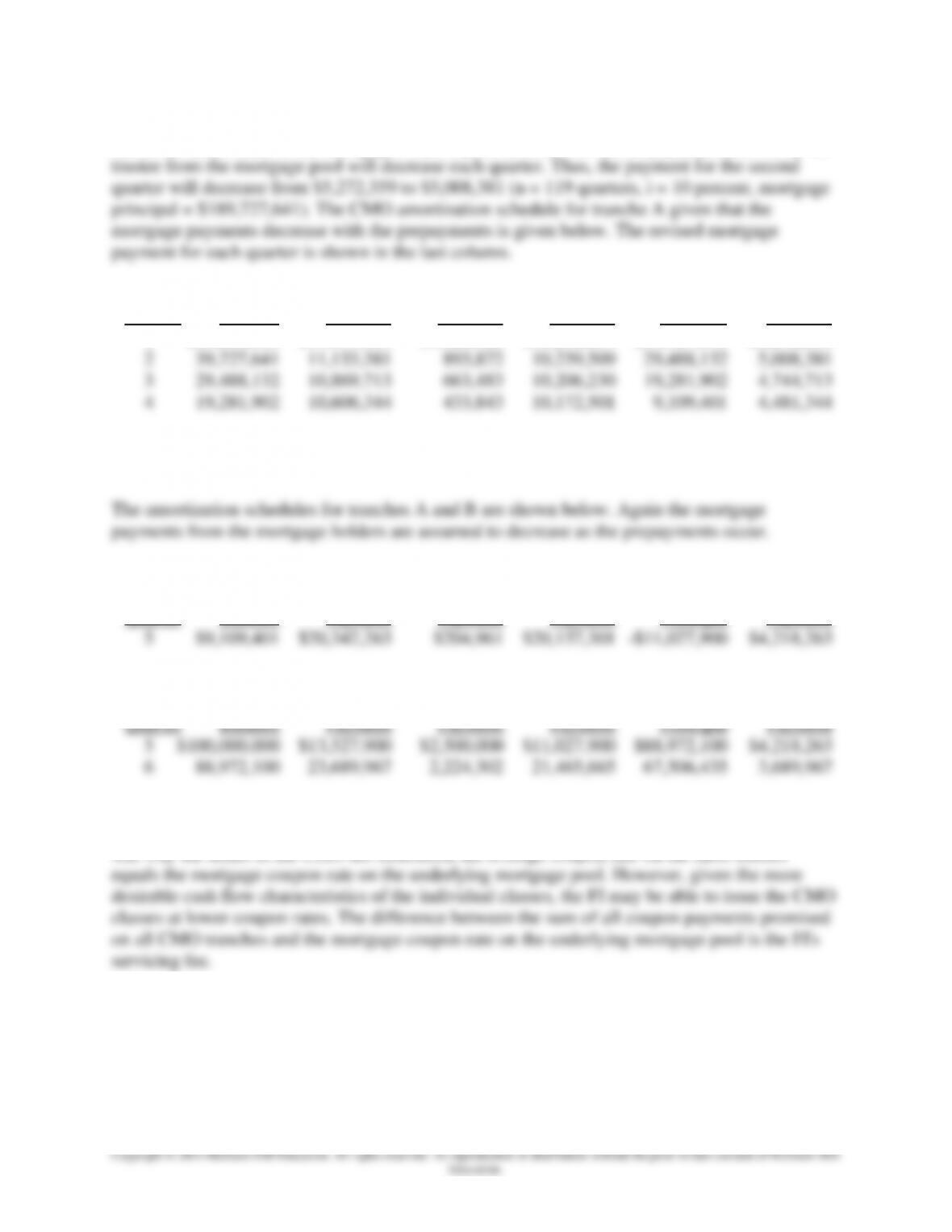
e. If, over the first year, the trustee receives quarterly prepayments of $10 million on the
mortgage pool, how are these funds distributed?
Interest Principal Remaining
Quarter Balance Payment Payment Payment Principal
1 $50,000,000 $11,397,359 $1,125,000 $10,272,359 $39,727,641
Chapter 26 – Securitization
26–18
However, since some of the mortgages will be paid off early, the actual payment received by the
Interest Principal Remaining Mortgage
Quarter Balance Payment Payment Payment Principal Payment
1 $50,000,000 $11,397,359 $1,125,000 $10,272,359 $39,727,641 $5,272,359
f. How are the cash flows distributed if prepayments in the first half of the second year
are $20 million quarterly?
Amortization schedule for tranche A:
Tranche Interest Principal Remaining Mortgage
Quarter Balance Payment Payment Payment Principal Payment
Amortization schedule for tranche B:
Tranche Interest Principal Remaining Mortgage
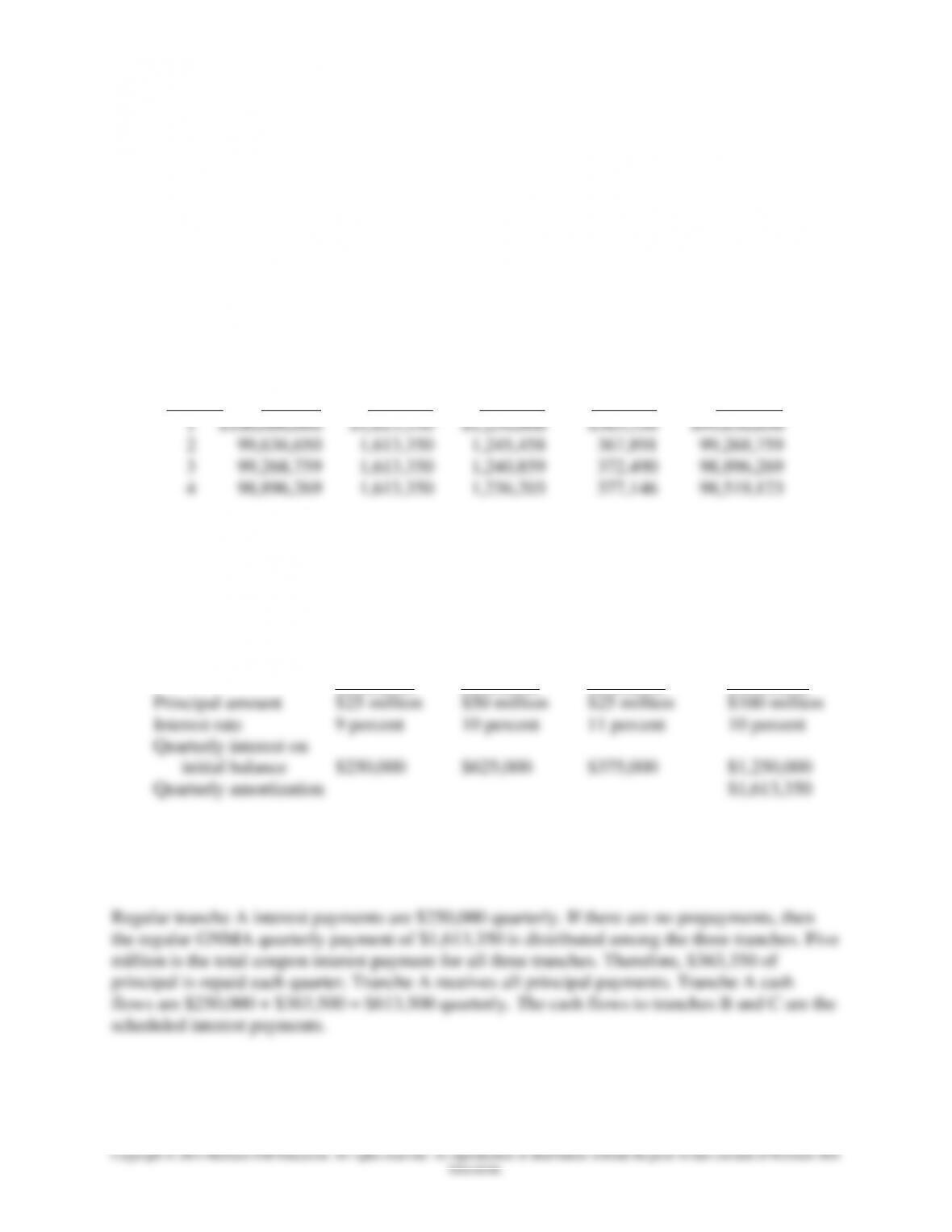
g. How can the CMO issuer earn a positive spread on the CMO?
The way the terms of the CMO are structured, the average coupon rate on the three classes
Chapter 26 – Securitization
26–19
32. Consider $100 million of 30-year mortgages with a coupon of 5 percent per year paid
quarterly.
a. What is the quarterly mortgage payment?
There are 120 quarterly payments over 30 years. The quarterly mortgage payments are $100m =
PVAn=120, k=1.25% x PMT => PMT = $1,613,350.
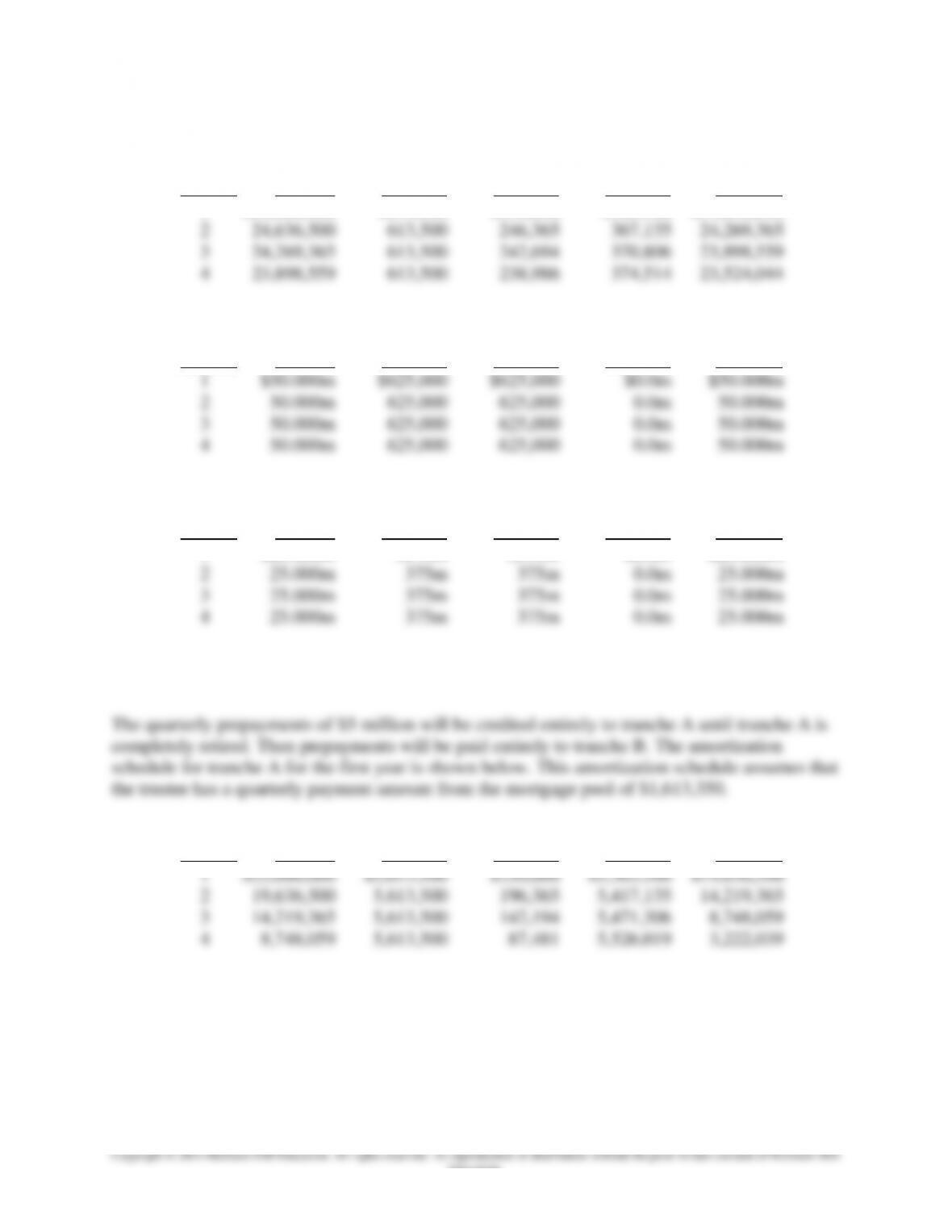
b. What are the interest and principal repayments over the first year of life of the
mortgages?
(Fixed) Interest Principal Remaining
Quarter Balance Payment Payment Payment Principal
c. Construct a 30-year CMO using this mortgage pool as collateral. The pool has three
tranches, where tranche A offers the least protection against prepayment and tranche C
offers the most protection against prepayment. Tranche A of $25 million receives
quarterly payments at 4 percent per year, tranche B of $50 million receives quarterly
payments at 5 percent per year, and tranche C of $25 million receives quarterly
payments at 6 percent per year.
Tranche A Tranche B Tranche C Total Issue
d. Assume nonamortization of principal and no prepayments. What are the total promised
coupon payments to the three classes? What are the principal payments to each of the
three classes for the first year?
Chapter 26 – Securitization
26–20
Education.
Tranche A amortization schedule:
Interest Principal Remaining
Quarter Balance Payment Payment Payment Principal
1 $25,000,000 $613,500 $250,000 $363,500 $24,636,500
Tranche B amortization schedule:
Interest Principal Remaining
Quarter Balance Payment Payment Payment Principal
Tranche C amortization schedule:
Interest Principal Remaining
Quarter Balance Payment Payment Payment Principal
1 $25.000m $375m $375m $0.0m $25.000m
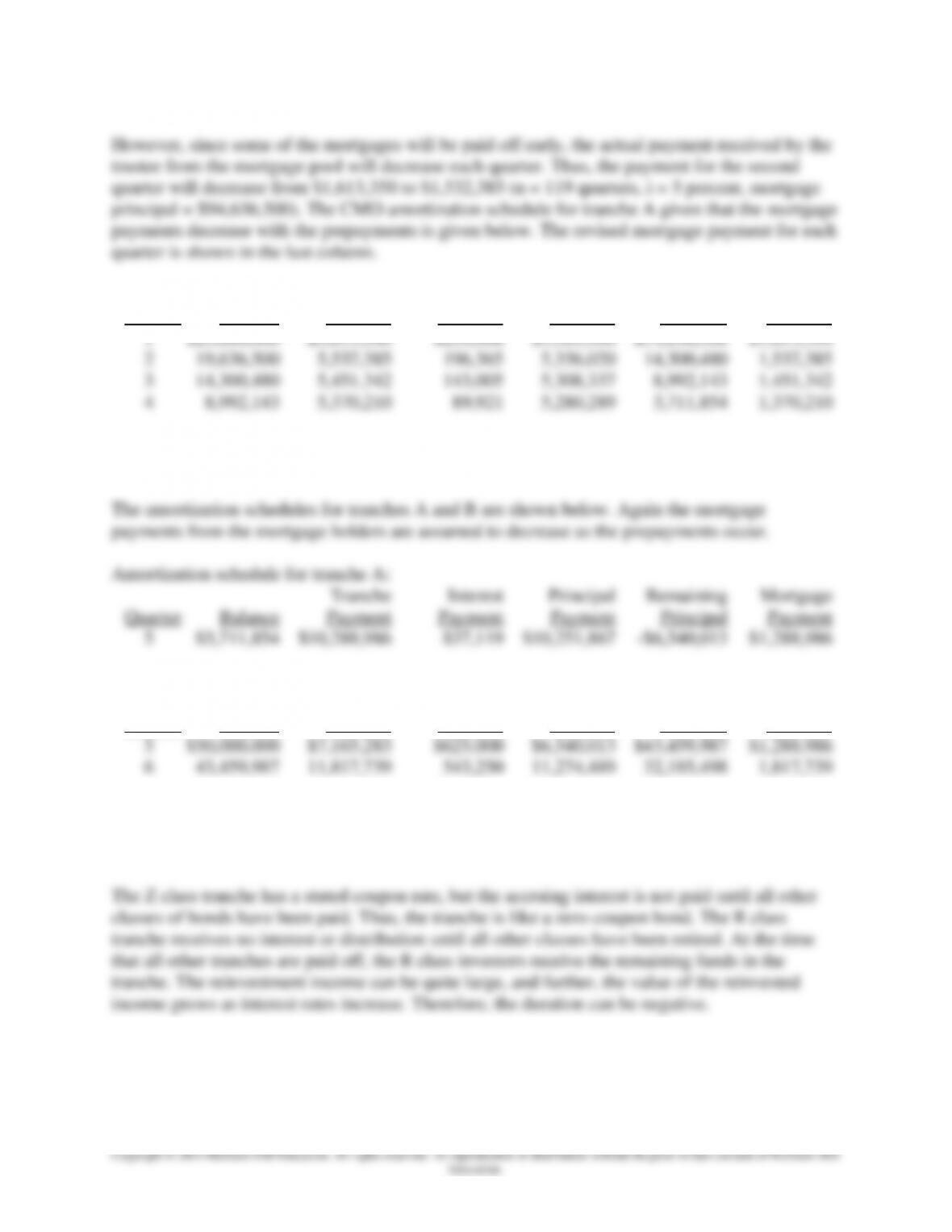
e. If, over the first year, the trustee receives quarterly prepayments of $5 million on the
mortgage pool, how are these funds distributed?
Interest Principal Remaining
Quarter Balance Payment Payment Payment Principal
Chapter 26 – Securitization
26–21
Copyright © 2014 McGraw-Hill Education. All rights reserved. No reproduction or distribution without the prior written consent of McGraw-Hill
Education.
However, since some of the mortgages will be paid off early, the actual payment received by the
trustee from the mortgage pool will decrease each quarter. Thus, the payment for the second
quarter will decrease from $1,613,350 to $1,532,385 (n = 119 quarters, i = 5 percent, mortgage
principal = $94,636,500). The CMO amortization schedule for tranche A given that the mortgage
payments decrease with the prepayments is given below. The revised mortgage payment for each
quarter is shown in the last column.
Interest Principal Remaining Mortgage
Quarter Balance Payment Payment Payment Principal Payment
f. How are the cash flows distributed if prepayments in the first half of the second year
are $10 million quarterly?
Amortization schedule for tranche B:
Tranche Interest Principal Remaining Mortgage
Quarter Balance Payment Payment Payment Principal Payment
33. How does a class Z tranche of a CMO differ from a class R tranche? What causes a Z class
to have characteristics of both a zero-coupon bond and a regular bond? What factors can
cause an R class to have a negative duration?
Chapter 26 – Securitization
26–22
Education.
34. Why would buyers of class C tranches of collateralized mortgage obligations (CMOs) be
willing to accept a lower return than purchasers of class A tranches?
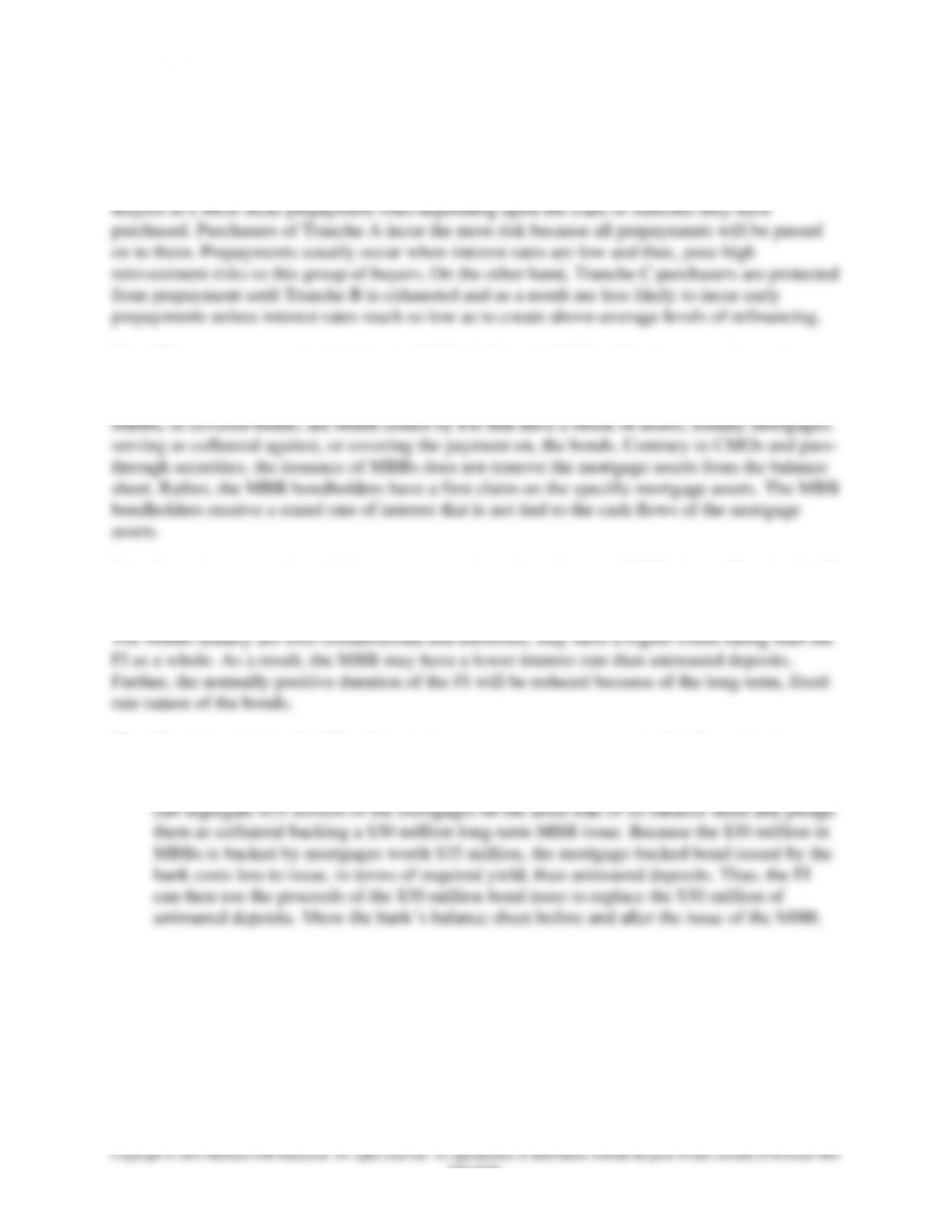
35. What are mortgage-backed bonds (MBBs)? How do MBBs differ from pass-through
securities and CMOs?
36. From the perspective of risk-management, how does the use of MBBs by an FI assist the FI
in managing credit and interest rate risk?
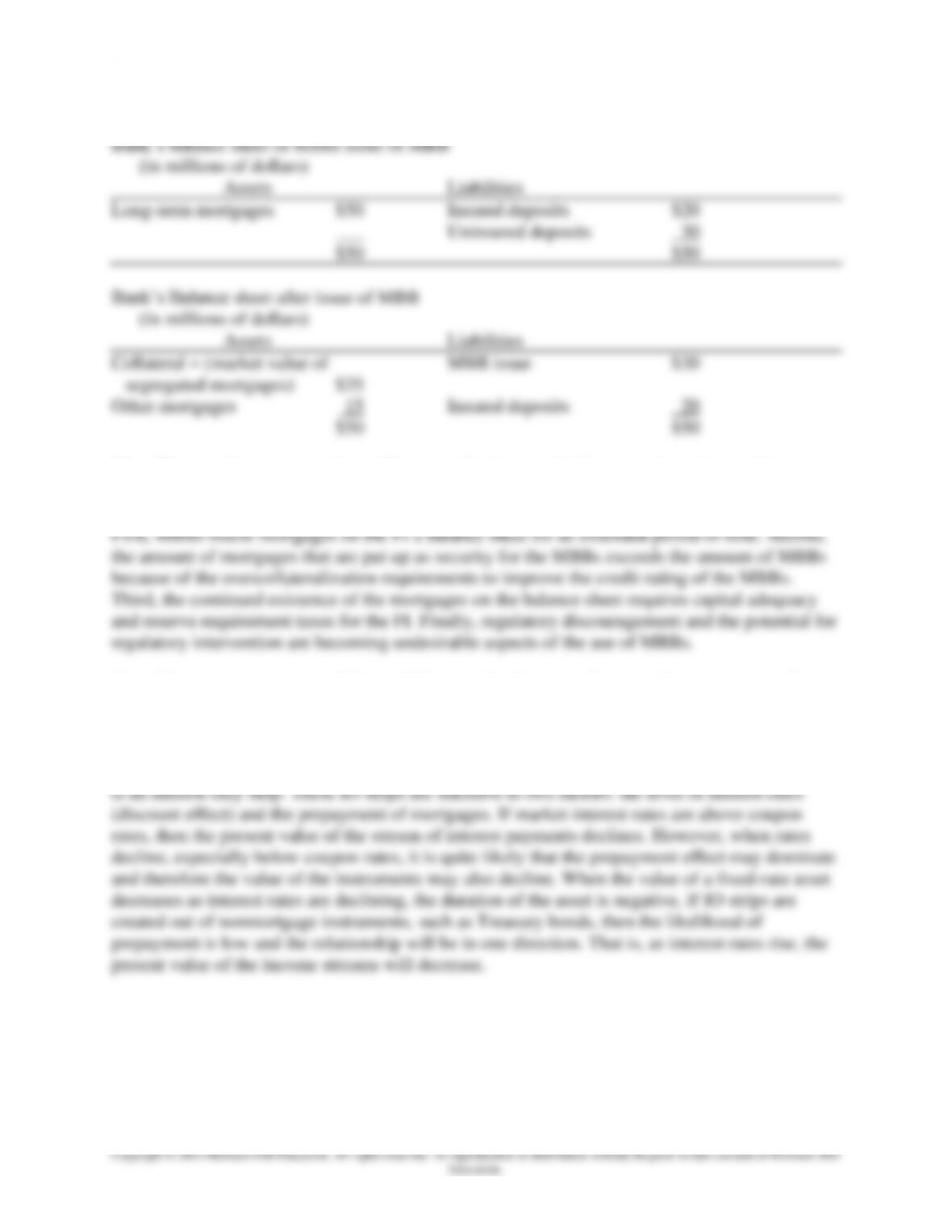
37. Consider a bank with $50 million in long-term mortgages as assets. It is financing these
mortgages with $30 million in short-term uninsured deposits and $20 million in insured
deposits. To reduce its interest rate risk exposure and to lower its funding costs, the bank
Chapter 26 – Securitization
26–23
38. What are four reasons why an FI may prefer the use of either pass-through securities or
CMOs to the use of MBBs?
39. What is an interest only (IO) strip? How do the discount effect and the prepayment effect
of an IO create a negative duration asset? What macroeconomic effect is required for this
negative duration effect to be possible?
A mortgage pass-through that has a claim only to the interest payments of underlying mortgages
Chapter 26 – Securitization
26–24
40. What is a principal only (PO) strip? What causes the price-yield profile of a PO strip to
have a steeper slope than a normal bond?
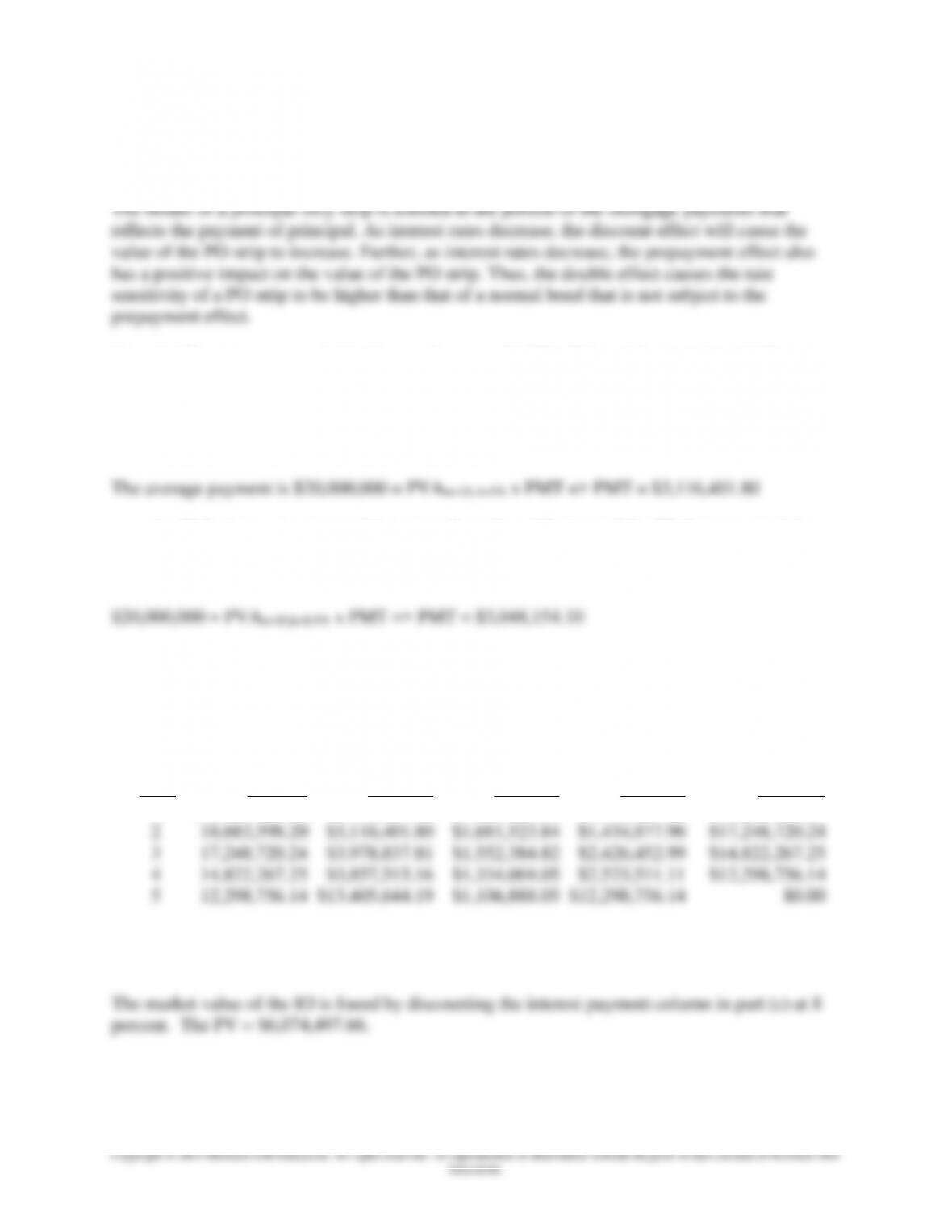
41. An FI originates a pool of real estate loans worth $20 million with maturities of 10 years
and paying interest rates of 9 percent per year.
a. What is the average payment received by the FI, including both principal and interest, if
no prepayment is expected over the life of the loan?
b. If the loans are converted into pass-through certificates and the FI charges a servicing
of 50 basis points, including insurance, what is the payment amount expected by the
holders of the pass-through securities if no prepayment is expected?
c. Assume that the payments are separated into interest only (IO) and principal only (PO)
payments, that prepayments of 5 percent occur at the end of years 3 and 4, and that the
payment of the remaining principal occurs at the end of year 5. What are the expected
annual payments for each instrument? Assume discount rates of 9 percent.
Interest Principal Remaining
Year Balance Payment Payment Payment Principal
1 $20,000,000.00 $3,116,401.80 $1,800,000.00 $1,316,401.80 $18,683,598.20
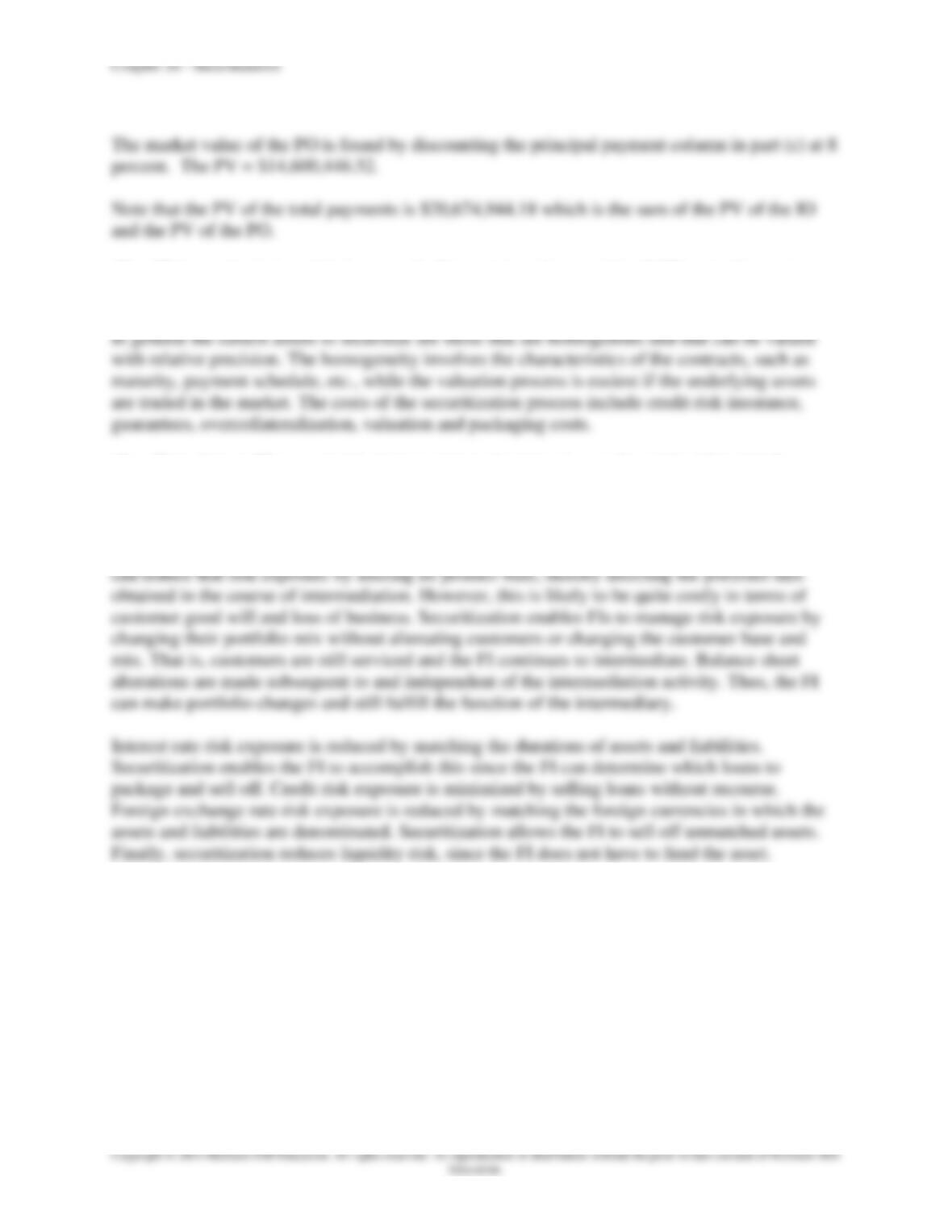
d. What is the market value of IOs and POs if the market interest rates for instruments of
similar risk decline to 8 percent?
26–25
Copyright © 2014 McGraw-Hill Education. All rights reserved. No reproduction or distribution without the prior written consent of McGraw-Hill
Education.
The market value of the PO is found by discounting the principal payment column in part (c) at 8
percent. The PV = $14,600,446.52.
Note that the PV of the total payments is $20,674,944.18 which is the sum of the PV of the IO
and the PV of the PO.
42. What are the factors that, in general, allow assets to be securitized? What are the costs
involved in the securitization process?
43. How does an FI use securitization to manage interest rate, credit and liquidity risks?
Summarize how each of the possible methods of securitization products affects the balance
sheet and profitability of an FI in the management of these risks.
In the process of intermediation on behalf of its customers, the FI assumes risk exposure. The FI