Chapter 26 – Securitization
26-1
Solutions for End-of-Chapter Questions and Answers: Chapter Twenty-Six
1. What has been the effect of securitization on the asset portfolios of financial institutions?
2. What are the primary functions of GNMA? What is timing insurance?
3. How does FNMA differ from GNMA?
4. How does FHLMC differ from FNMA? How are they the same?
Chapter 26 – Securitization
26-2
5. What three levels of regulatory taxes do FIs face when making loans? How does
securitization reduce the levels of taxation?
6. An FI is planning to issue $100 million in BB-rated commercial loans. The FI will finance
the loans by issuing demand deposits.
a. What is the minimum capital required under Basle III?
b. What is the minimum amount of demand deposits needed to fund this loan assuming
there is a 10 percent average reserve requirement on demand deposits?
c. Show a simple balance sheet with total assets, total liabilities, and equity if this is the
only project funded by the bank.
d. How does this balance sheet differ from Table 26-1? Why?
Chapter 26 – Securitization
26-3
7. Consider the FI in problem (6).
a. What additional risk exposure problems does the FI face?
b. What are some possible solutions to the duration mismatch and the illiquidity
problems?
c. What advantages does securitization have in dealing with the FI’s risk exposure
problems?
8. How are investors in pass-through securities protected against default risk emanating from
the mortgagees and the FI/trustee?
9. What specific changes occur on the balance sheet at the completion of the securitization
process? What adjustments occur to the risk profile of the FI?
Chapter 26 – Securitization
26-4
10. Consider the mortgage pass-through example presented in Table 26-3. The total monthly
payment by the borrowers reflecting a 12 percent mortgage rate is $1,028,610. The
payment passed through to the ultimate investors reflecting an 11.5 percent return is
$990,291. Who receives the difference between these two payments? How are the shares
determined?
11. Consider a GNMA mortgage pool with principal of $20 million. The maturity is 30 years
with a monthly mortgage payment of 10 percent per year. Assume no prepayments.
a. What is the monthly mortgage payment (100 percent amortizing) on the pool of
mortgages?
b. If the GNMA insurance fee is 6 basis points and the servicing fee is 44 basis points,
what is the yield on the GNMA pass-through?
c. What is the monthly payment on the GNMA in part (b)?
d. Calculate the first monthly servicing fee paid to the originating FIs.
e. Calculate the first monthly insurance fee paid to GNMA.
Chapter 26 – Securitization
26-5
Education.
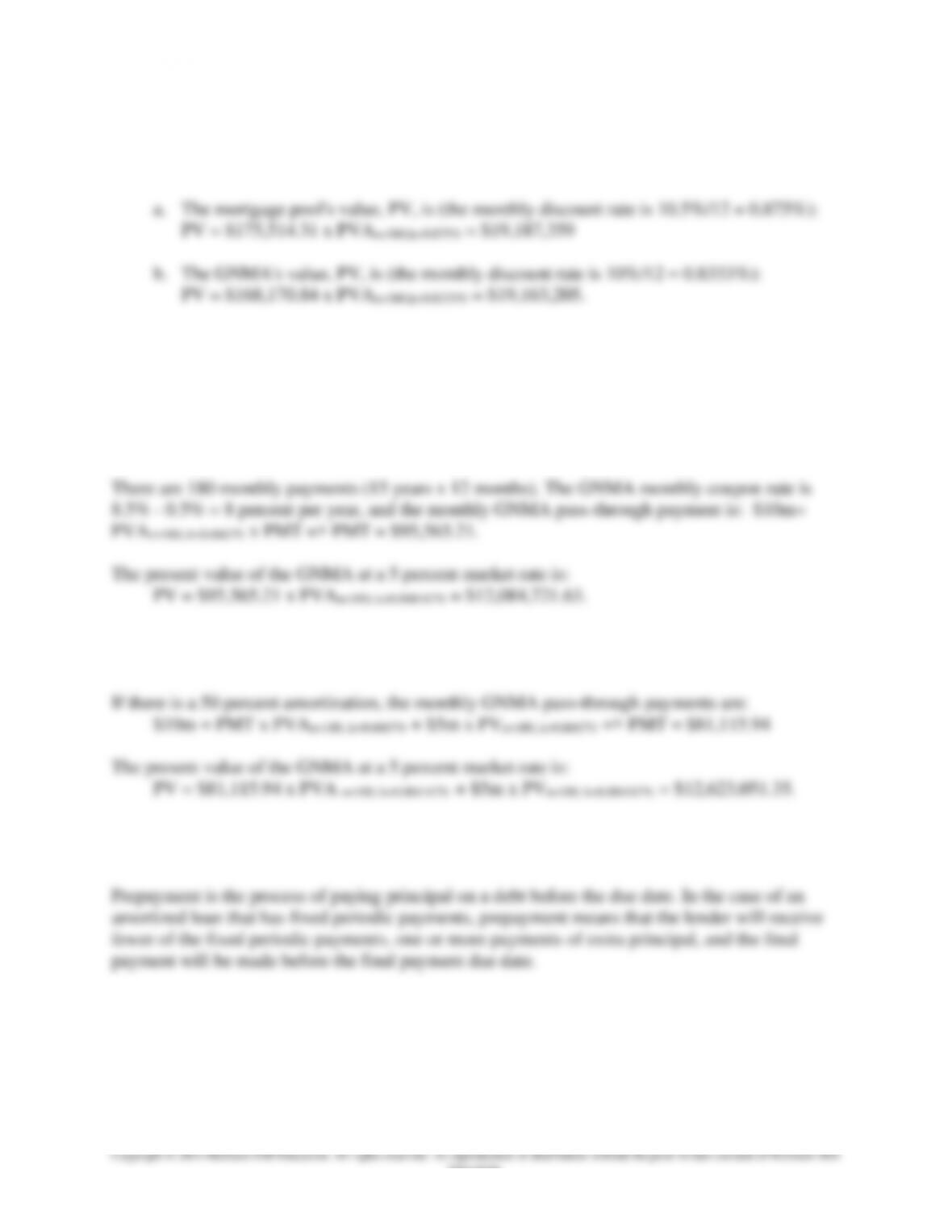
12. Calculate the value of (a) the mortgage pool and (b) the GNMA pass-through in question
11 if market interest rates increase 50 basis points. Assume no prepayments.
13. What would be the impact on GNMA pricing if the pass-through was not fully amortized?
What is the present value of a $10 million pool of 15-year mortgages with an 8.5 percent
per year monthly mortgage coupon if market rates are 5 percent? The GNMA guarantee fee
is 6 basis points and the FI servicing fee is 44 basis points.
a. Assume that the GNMA is fully amortized.
b. Assume that the GNMA is only half amortized. There is a lump sum payment at the
maturity of the GNMA that equals 50 percent of the mortgage pool’s face value.
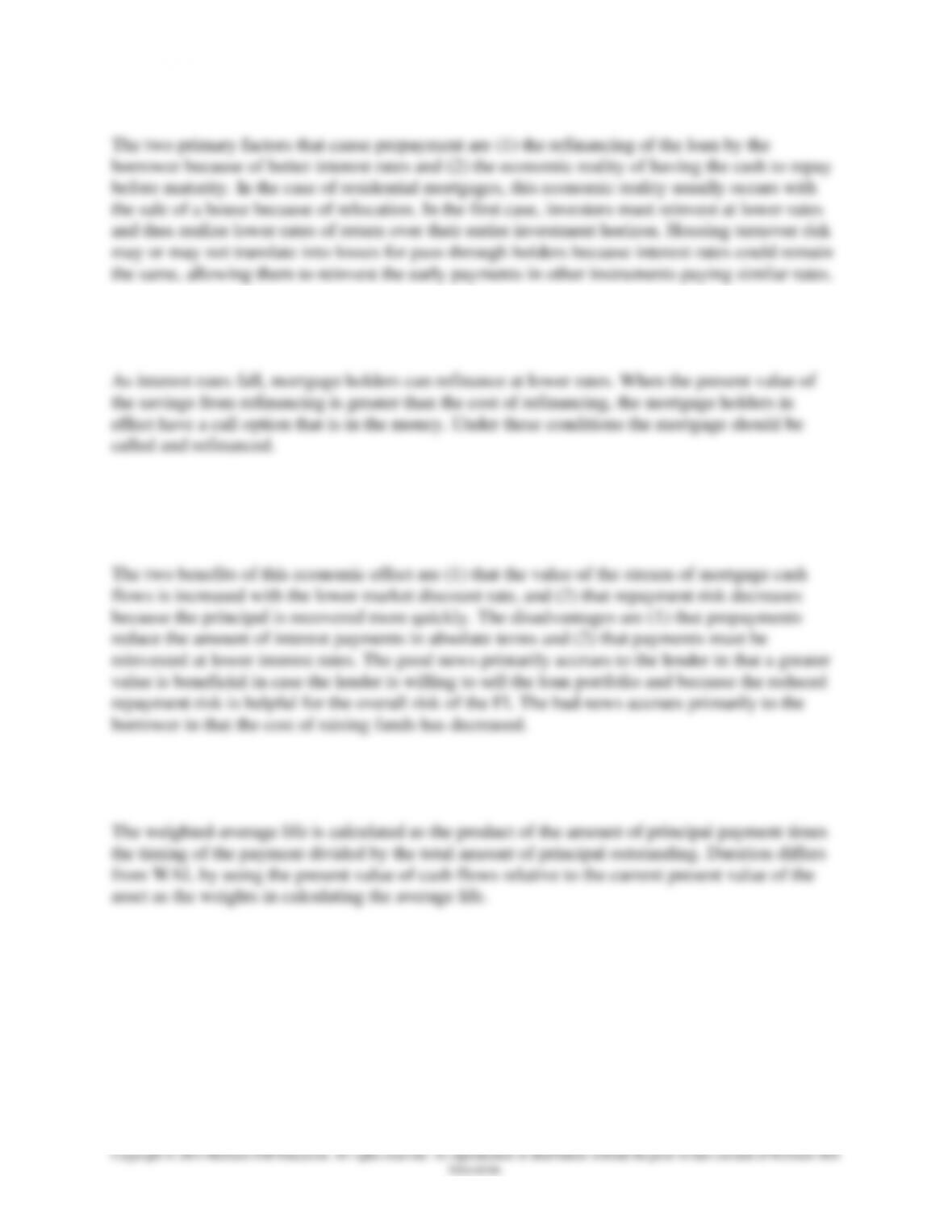
14. What is prepayment risk? How does prepayment risk affect the cash flow stream on a fully
amortized mortgage loan? What are the two primary factors that cause early payment?
Chapter 26 – Securitization
26-6
Copyright © 2014 McGraw-Hill Education. All rights reserved. No reproduction or distribution without the prior written consent of McGraw-Hill
Education.
The two primary factors that cause prepayment are (1) the refinancing of the loan by the
borrower because of better interest rates and (2) the economic reality of having the cash to repay
before maturity. In the case of residential mortgages, this economic reality usually occurs with
the sale of a house because of relocation. In the first case, investors must reinvest at lower rates
and thus realize lower rates of return over their entire investment horizon. Housing turnover risk
may or may not translate into losses for pass-through holders because interest rates could remain
the same, allowing them to reinvest the early payments in other instruments paying similar rates.
15. Under what conditions do mortgage holders have a call option on their mortgages? When is
the call option in the money?
16. What are the benefits of market yields that are less than the average rate in the GNMA
mortgage pool? What are the disadvantages of this rate inversion? To whom do the good
news and bad news accrue?
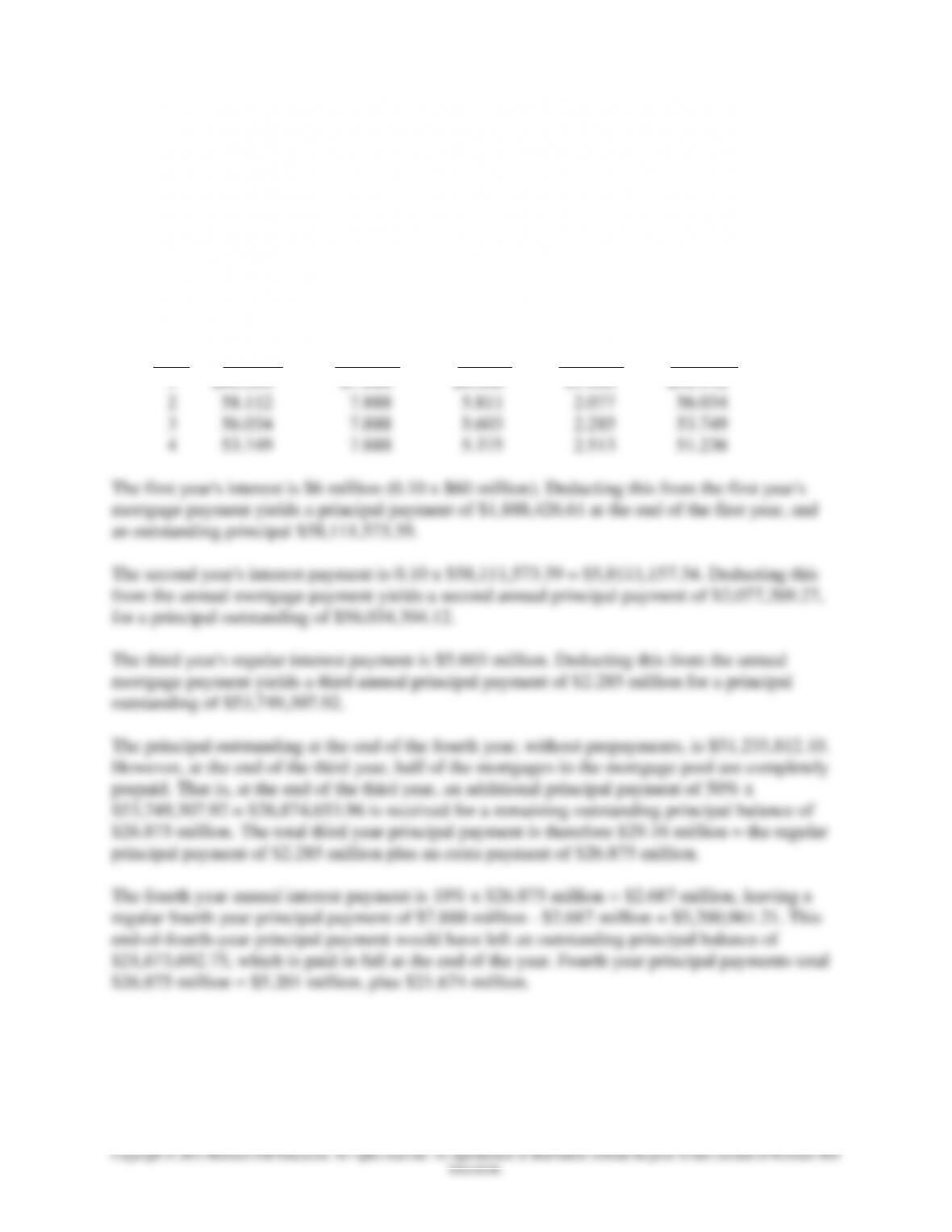
17. What is the weighted-average life (WAL) of a mortgage pool supporting pass-through
securities? How does WAL differ from duration?
Chapter 26 – Securitization
26-7
18. If 150 $200,000 mortgages in a $60 million 15-year mortgage pool are expected to be
prepaid in three years and the remaining 150 $200,000 mortgages are to be prepaid in four
years, what is the weighted-average life of the mortgage pool? Mortgages are fully
amortized, with mortgage coupon rates set at 10 percent to be paid annually.
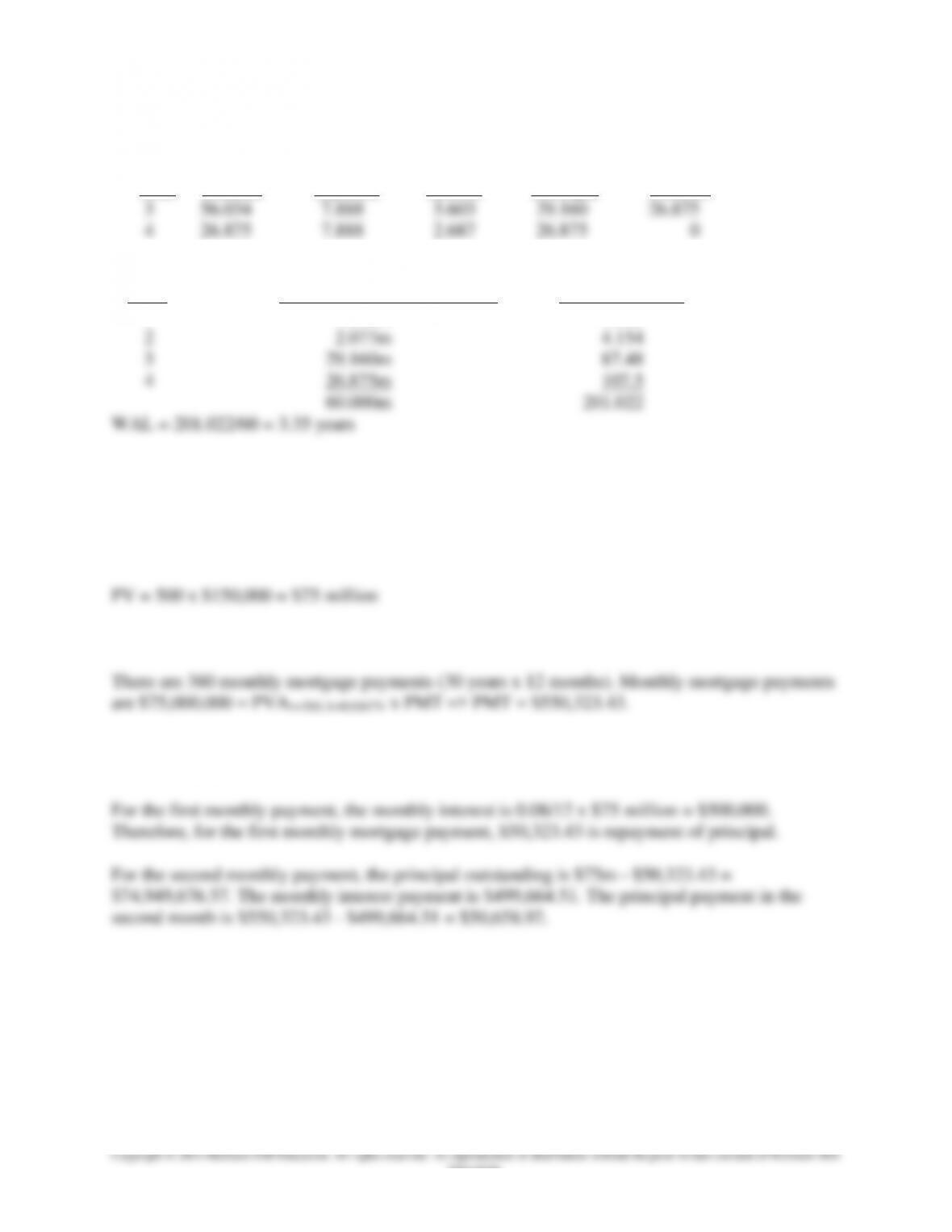
The annual mortgage payment is $60 million = PVAn=15, k=10% x PMT => PMT = $7,888,426.61.
Annual mortgage payments, with no prepayments, can be decomposed into principal and interest
payments (in millions of $s):
Interest Principal Remaining
Year Balance Payment Payment Payment Principal
Chapter 26 – Securitization
26-8
Education.
Prepayments alter the annual cash flows for years 3 and 4 as follows (in millions of $s):
Year Balance Payment Interest Principal Balance
Calculating the weighted average life:
Time Expected Principal Payments Time x Principal
1 1.888m 1.888
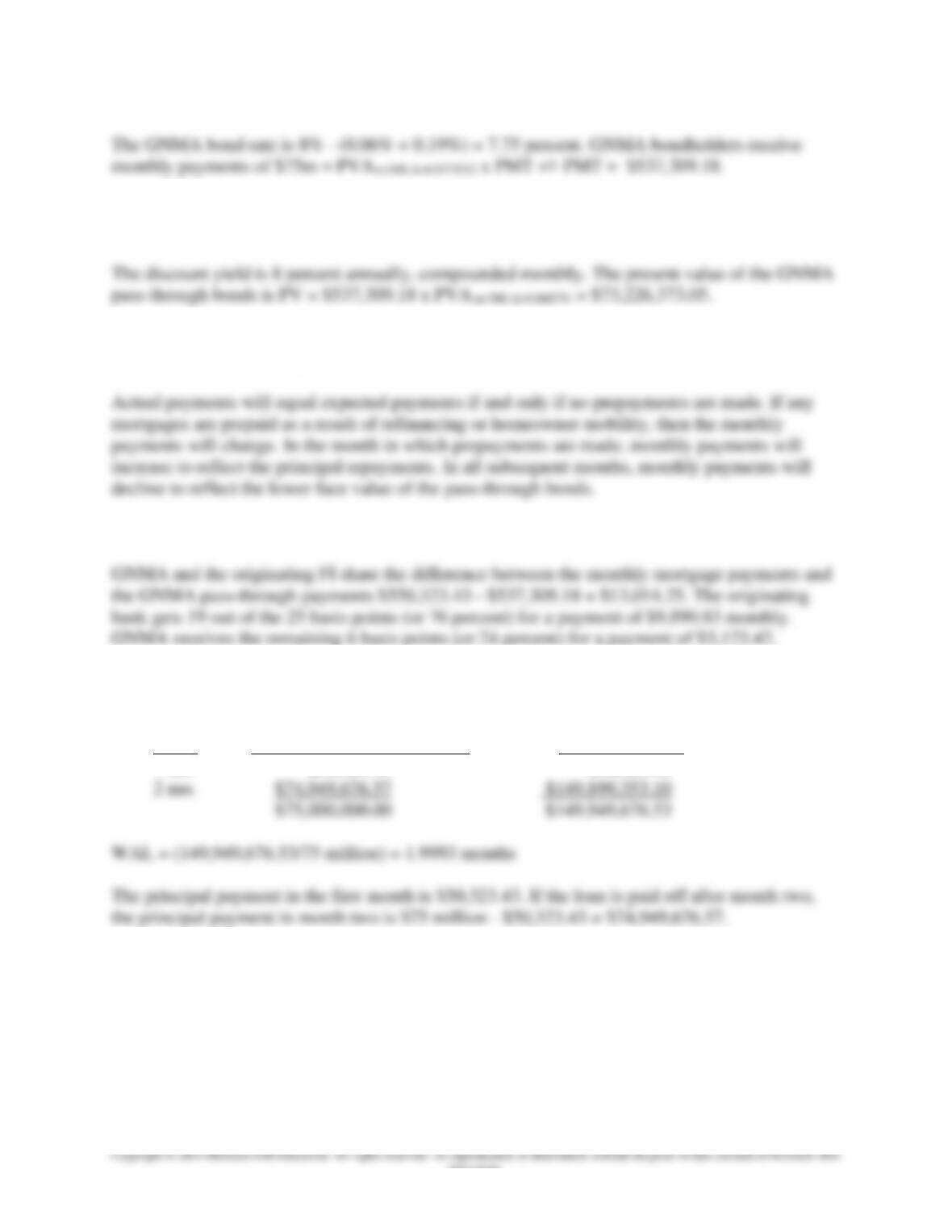
19. An FI originates a pool of 500 30-year mortgages, each averaging $150,000 with an annual
mortgage coupon rate of 8 percent. Assume that the GNMA credit risk insurance fee is 6
basis points and that the FI’s servicing fee is 19 basis points.
a. What is the present value of the mortgage pool?
b. What is the monthly mortgage payment?
c. For the first two payments, what portion is interest and what portion is principal
repayment?
d. What are the expected monthly cash flows to GNMA bondholders?
Chapter 26 – Securitization
26-9
Education.
e. What is the present value of the GNMA pass-through bonds? Assume that the risk-
adjusted market annual rate of return is 8 percent compounded monthly.
f. Would actual cash flows to GNMA bondholders deviate from expected cash flows as in
part (d)? Why or why not?
g. What are the expected monthly cash flows for the FI and GNMA?
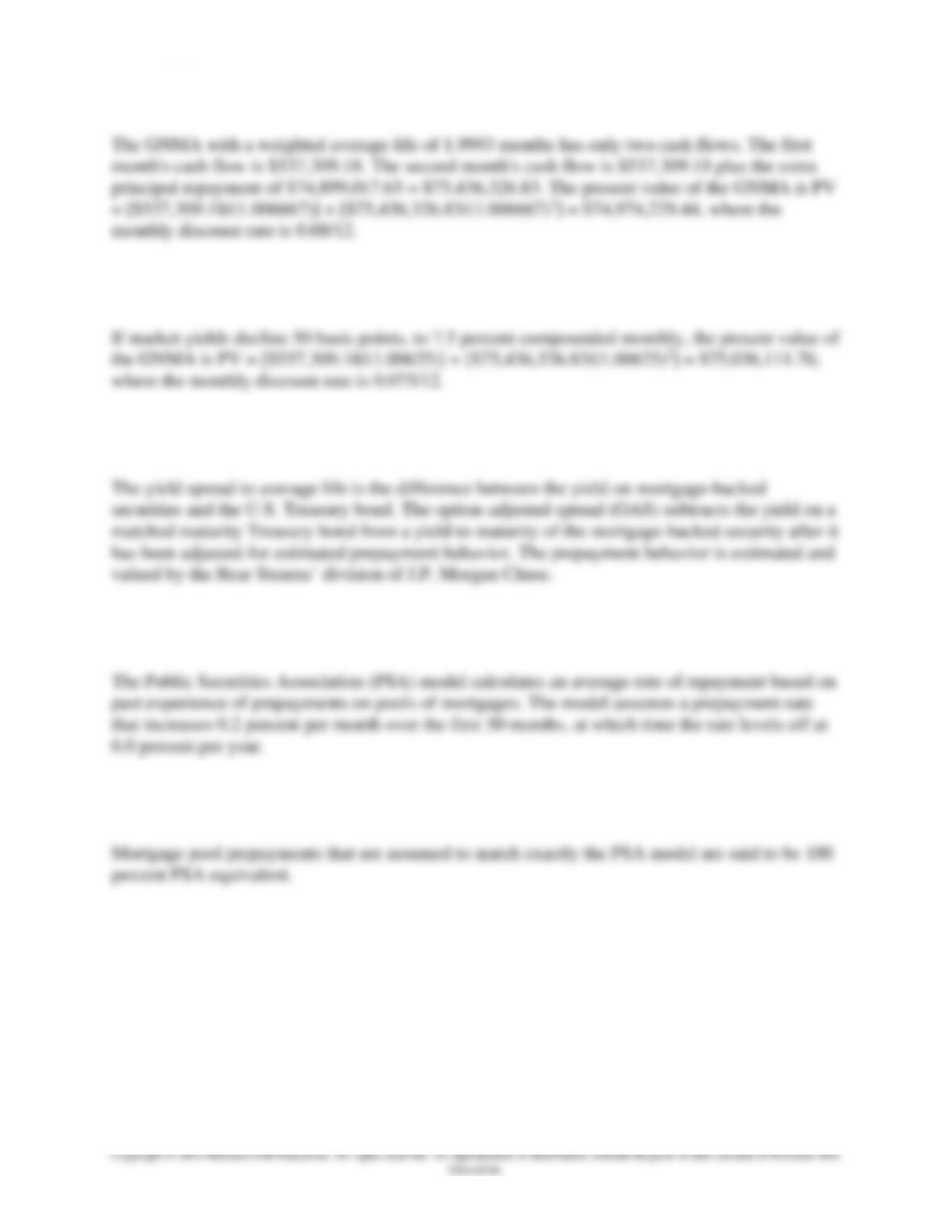
h. If all of the mortgages in the pool are completely prepaid at the end of the second
month, what is the pool’s weighted-average life? Hint: Use your answer to part (c).
Time Expected Principal Payments Time x Principal
1 mo. $50,323.43 $50,323.43
i. What is the price of the GNMA pass-through security if its weighted-average life is
equal to your solution for part (h)? Assume no change in market interest rates.
Chapter 26 – Securitization
26–10
Copyright © 2014 McGraw-Hill Education. All rights reserved. No reproduction or distribution without the prior written consent of McGraw-Hill
Education.
The GNMA with a weighted average life of 1.9993 months has only two cash flows. The first
month’s cash flow is $537,309.18. The second month’s cash flow is $537,309.18 plus the extra
principal repayment of $74,899,017.65 = $75,436,326.83. The present value of the GNMA is PV
= [$537,309.18/(1.006667)] + [$75,436,326.83/(1.006667)2] = $74,974,229.44, where the
monthly discount rate is 0.08/12.
j. What is the price of the GNMA pass-through with a weighted-average life equal to
your solution for part (h) if market yields decline by 50 basis points?
20. What is the difference between the yield spread to average life and the option-adjusted
spread on mortgage-backed securities?
21. Explain precisely the prepayment assumptions of the Public Securities Association
prepayment model.
22. What does an FI mean when it states that its mortgage pool prepayments are assumed to be
100 percent PSA equivalent?
26–11
Education.
23. What factors may cause the actual prepayment pattern to differ from the assumed PSA
pattern? How would an FI adjust for the presumed occurrence of some of these factors?
The factors that are assumed to cause the prepayment pattern to differ from the PSA rate include
24. What is the burnout factor? How is it used in modeling prepayment behavior? What other
factors may be helpful in modeling the prepayment behavior of a given mortgage pool?
25. What is the goal of prepayment models that use option pricing theory? How do these
models differ from the PSA or empirical models? What criticisms often are directed toward
26. How does the price on a GNMA bond relate to the yield on a GNMA option from the
perspective of the investor? What is the option-adjusted spread (OAS)?
27. Use the options prepayment model to calculate the yield on a $30 million, three-year, fully
amortized mortgage pass-through where the mortgage coupon rate is 6 percent paid
annually. Market yields are 6.4 percent paid annually. Assume that there is no servicing or
GNMA guarantee fee.
Chapter 26 – Securitization
26–12
a. What is the annual payment on the GNMA pass-through?
b. What is the present value of the GNMA pass-through?
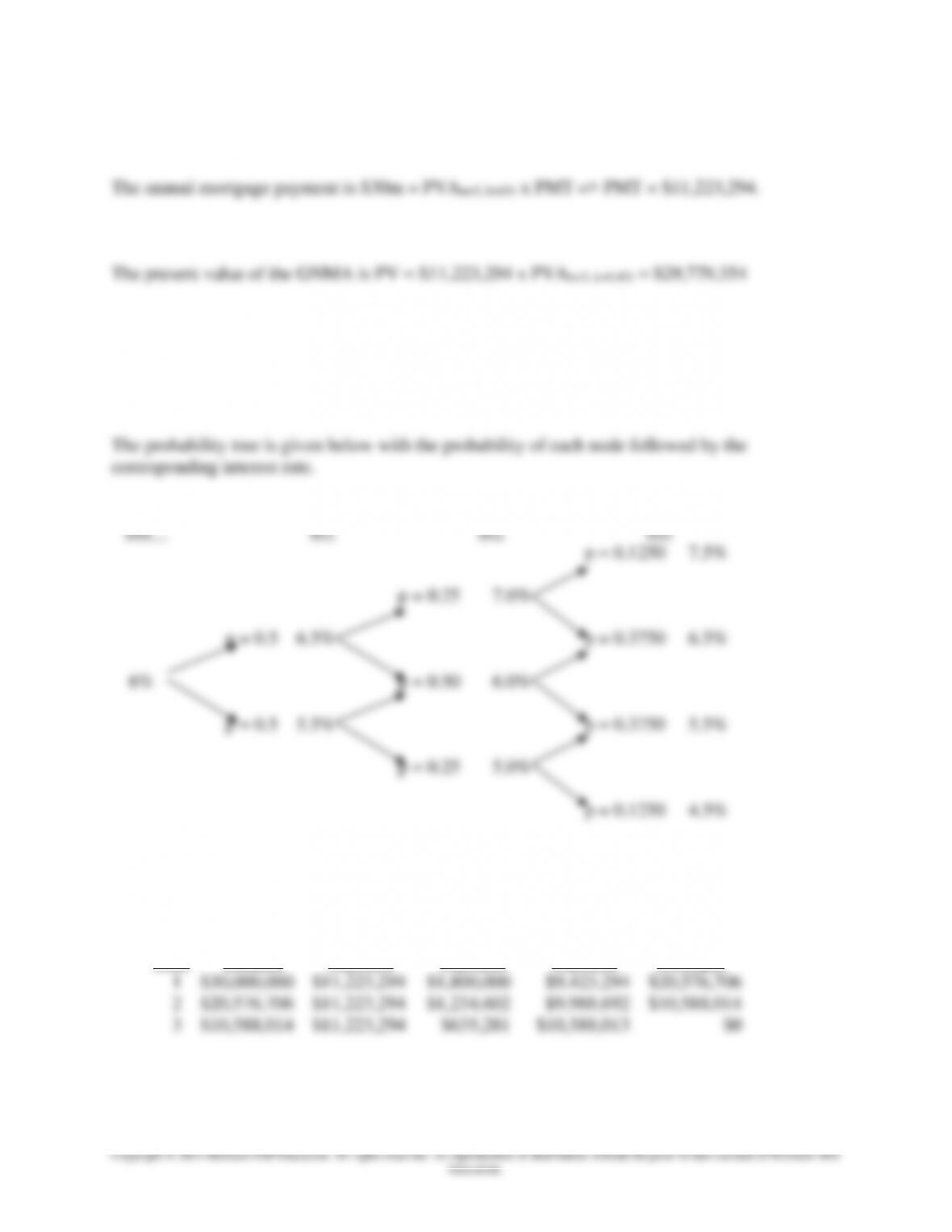
c. Interest rate movements over time are assumed to change a maximum of 0.5 percent per
year. Both an increase of 0.5 percent and a decrease of 0.5 percent in interest rates are
equally probable. If interest rates fall 1.0 percent below the current mortgage coupon
rates, all of the mortgages in the pool will be completely prepaid. Diagram the interest
rate tree and indicate the probabilities of each node in the tree.
d. What are the expected annual cash flows for each possible situation over the three-year
period?
The annual mortgage cash flows are:
(Fixed) Interest Principal Remaining
Year Balance Payment Payment Payment Principal
Chapter 26 – Securitization
26–13
Year 1 Expected Cash Flows: There is a 50 percent chance of either a 5.5 percent or 6.5 percent
Year 2 Expected Cash Flows: There is a 25 percent chance that interest rates will be 5.0 percent,
e. The Treasury bond yield curve is flat at a discount yield of 6 percent. What is the option-
adjusted spread on the GNMA pass-through?
28. Use the options prepayment model to calculate the yield on a $12 million, five-year, fully
amortized mortgage pass-through where the mortgage coupon rate is 7 percent paid
annually. Market yields are 8 percent paid annually. Assume that there is no servicing or
GNMA guarantee fee.
a. What is the annual payment on the GNMA pass-through?
b. What is the present value of the GNMA pass-through?