Chapter 25 – Loan Sales
25-1
Solutions for End-of-Chapter Questions and Problems: Chapter Twenty Five
1. What is the difference between loans sold with recourse and loans sold without recourse
from the perspective of both sellers and buyers?
2. A bank has made a three-year $10 million loan that pays annual interest of 8 percent. The
principal is due at the end of the third year.
a. The bank is willing to sell this loan with recourse at an interest rate of 8.5 percent.
What price should it receive for this loan?
b. The bank has the option to sell this loan without recourse at a discount rate of 8.75
percent. What price should it receive for this loan?
c. If the bank expects a 0.5 percent probability of default on this loan, is it better to sell
this loan with or without recourse? It expects to receive no interest payments or
principal if the loan is defaulted.
3. What are some of the key features of short-term loan sales?
Chapter 25 – Loan Sales
25-2
4. Why are yields higher on loan sales than on commercial paper issues with similar maturity
and issue size?
5. What are highly leveraged transactions? What constitutes the federal regulatory definition
of an HLT?
6. How do the characteristics of an HLT loan differ from those of a short-term loan that is
sold?
Some of the common characteristics of the two types of loans are listed below:
Short-term loans HLT loans
Secured by the assets of borrowing firm. Secured by the assets of the borrowing firm.
7. What is a possible reason why the spreads on HLT loans perform differently than do the
spreads on junk bonds?
Chapter 25 – Loan Sales
25-3
8. City Bank has made a 10-year, $2 million loan that pays annual interest of 10 percent. The
principal is expected to be paid at maturity.
a. What should City Bank expect to receive from the sale of this loan if the current market
interest rate on loans of this risk is 12 percent?
b. The price of loans of this risk is currently being quoted in the secondary market at bid-
offer prices of 88-89 cents (on each dollar). Translate these quotes into actual prices
for the above loan.
c. Do these prices reflect a distressed or nondistressed loan? Explain.
9. What is the difference between loan participations and loan assignments?
Chapter 25 – Loan Sales
25-4
10. What are the difficulties in completing a loan assignment?
11. Who are the buyers of U.S. loans and why do they participate in this activity?
a. What are vulture funds?
b. What are three reasons the interbank market has been shrinking?
c. What are reasons a small bank would be interested in participating in a loan
syndication?
Chapter 25 – Loan Sales
25-5
12. Who are the sellers of U.S. loans and why do they participate in this activity?
The primary sellers of loans include (1) major money center banks for the purpose of reducing
capital requirements, diversifying the loan portfolio, reducing reserve requirements, and
increasing liquidity; (2) foreign banks for the same reasons as the money center banks; (3)
investment banks because of their role as market makers; and (4) U.S. government agencies
including The Resolution Trust Corporation, before it was dissolved, to dispose of assets
obtained upon closure of troubled institutions in the course of resolving the thrift crisis.
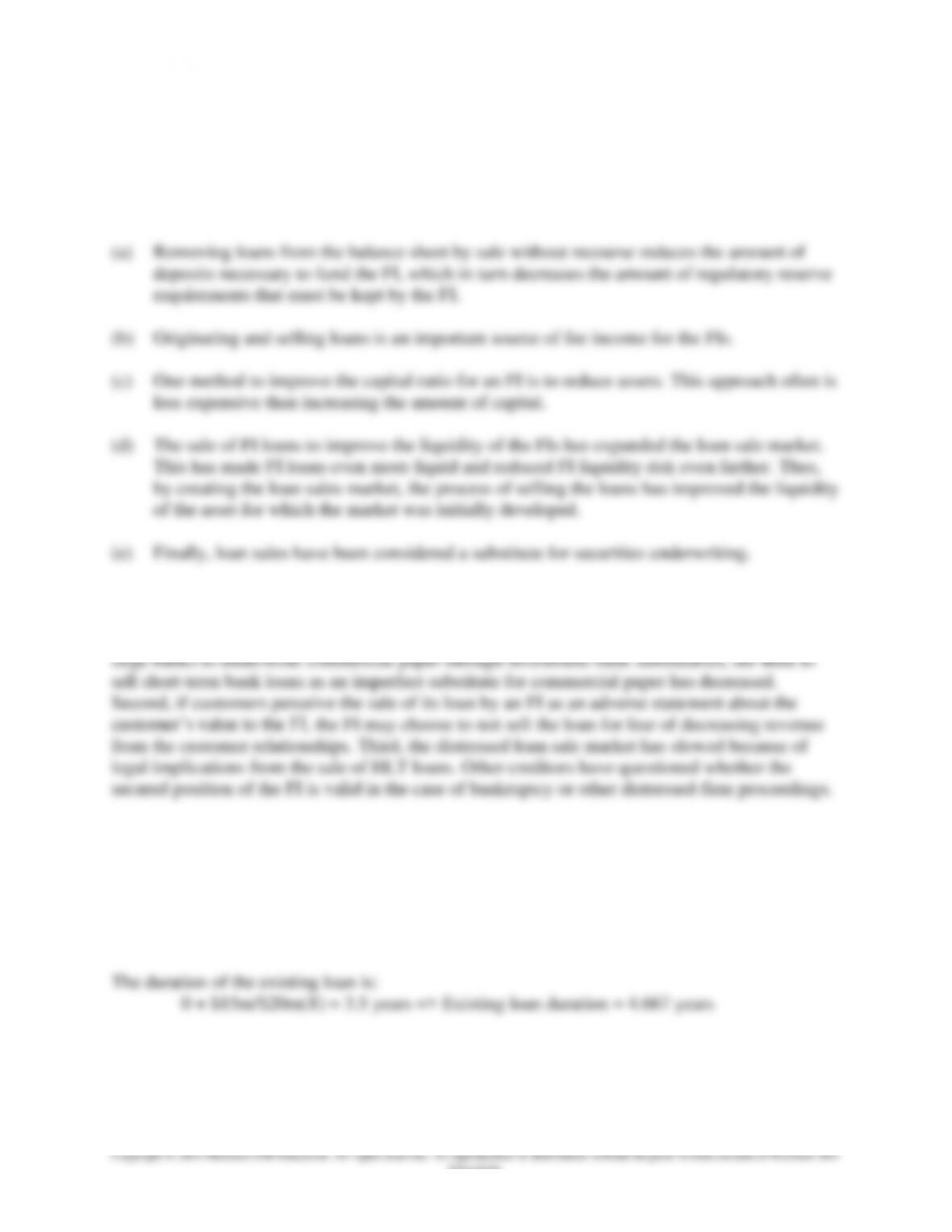
a. What is the purpose of a bad bank?
b. What are the reasons why loan sales through a bad bank will be value enhancing?
Some of the reasons for selling or liquidating bad loans through a special purpose vehicle such as
a bad bank include:
c. What impact has the 1996 Federal Debt Improvement Act had on the loan sale market?
Chapter 25 – Loan Sales
25-6
Education.
13. In addition to managing credit risk, what are some other reasons for the sale of loans by
FIs?
The reasons for an increase in loan sales, apart from hedging credit risk, include:
14. What are factors that may deter the growth of the loan sale market in the future? Discuss.
Several factors may deter the growth of the loans sales market. First, because of the ability for
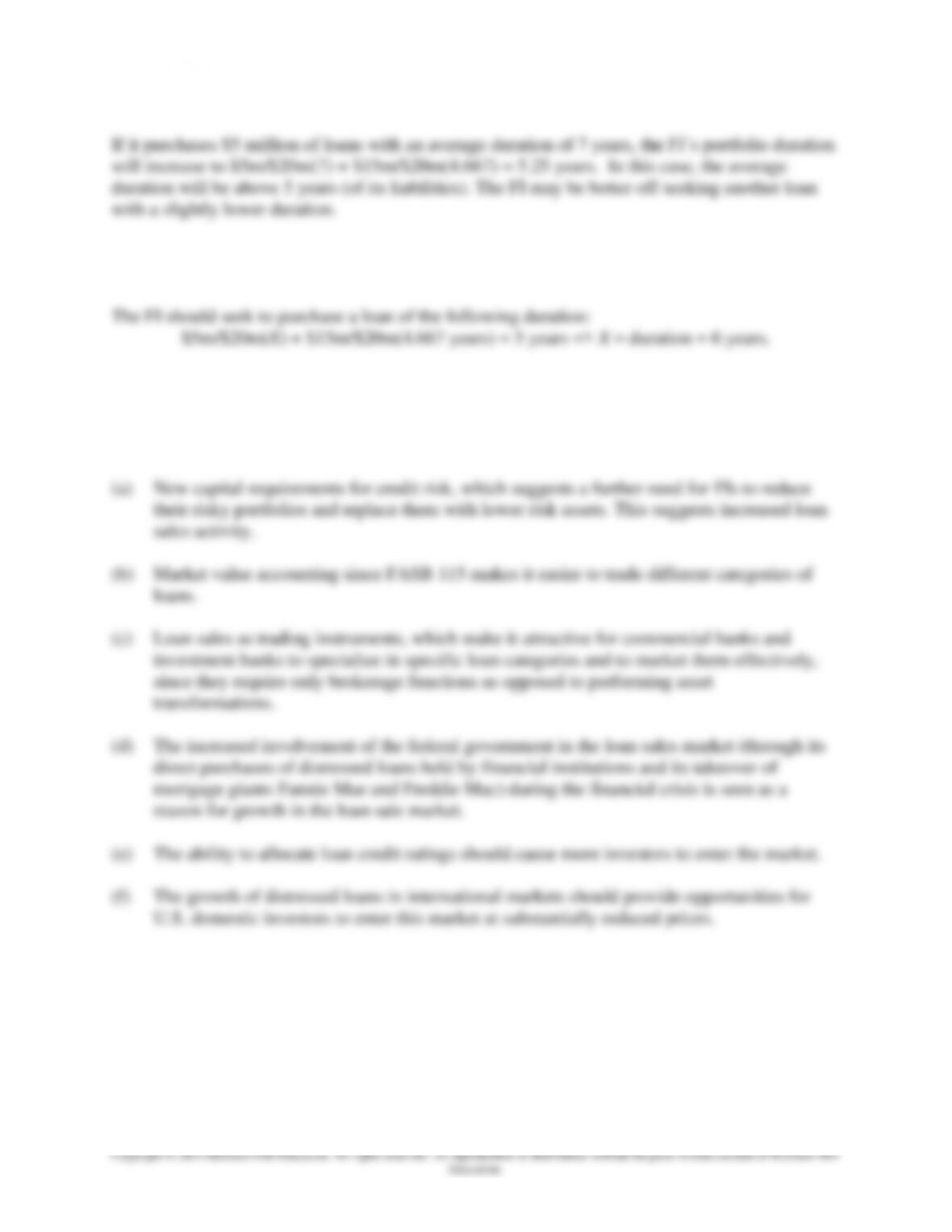
15. An FI is planning the purchase of a $5 million loan to raise the existing average duration of
its assets from 3.5 years to 5 years. It currently has total assets worth $20 million, $5
million in cash (0 duration) and $15 million in loans. All the loans are fairly priced.
a. Assuming it uses the cash to purchase the loan, should the FI purchase the loan if its
duration is seven years?
Chapter 25 – Loan Sales
25-7
b. What asset duration loans should it purchase in order to raise its average duration to
five years?
16. In addition to hedging credit risk, what are five factors that are expected to encourage loan
sales in the future? Discuss the impact of each factor.
The reasons for an increase in loan sales, apart from hedging credit risk, include: