Chapter 24 – Swaps
24-1
Solutions for End-of-Chapter Questions and Problems: Chapter Twenty-Four
1. Explain the similarity between a swap and a forward contract.
2. Forward, futures, and option contracts had been used by FIs to hedge risk for many years
before swaps were invented. If FIs already had these hedging instruments, why did they
need swaps?
Although similar in many ways, the following distinguishing characteristics cause the
instruments to be differentiated:
(a) A swap can be viewed as a portfolio of forward contracts with different maturity dates.
Since cash flows on forward contracts are symmetric, the same can be said of swaps. This
is in contrast to options, whose cash flows are asymmetric (truncated either on the positive
or negative side depending upon the position).
Chapter 24 – Swaps
24-2
Education.
3. Distinguish between a swap buyer and a swap seller. In which markets does each have the
comparative advantage?
4. An insurance company owns $50 million of floating-rate bonds yielding LIBOR plus 1
percent. These loans are financed with $50 million of fixed-rate guaranteed investment
contracts (GICs) costing 10 percent. A bank has $50 million of auto loans with a fixed rate
of 14 percent. The loans are financed with $50 million of CDs at a variable rate of LIBOR
plus 4 percent.
a. What is the risk exposure of the insurance company?
b. What is the risk exposure of the bank?
c. What would be the cash flow goals of each company if they were to enter into a swap
arrangement?
d. Which FI would be the buyer and which FI would be the seller in the swap?
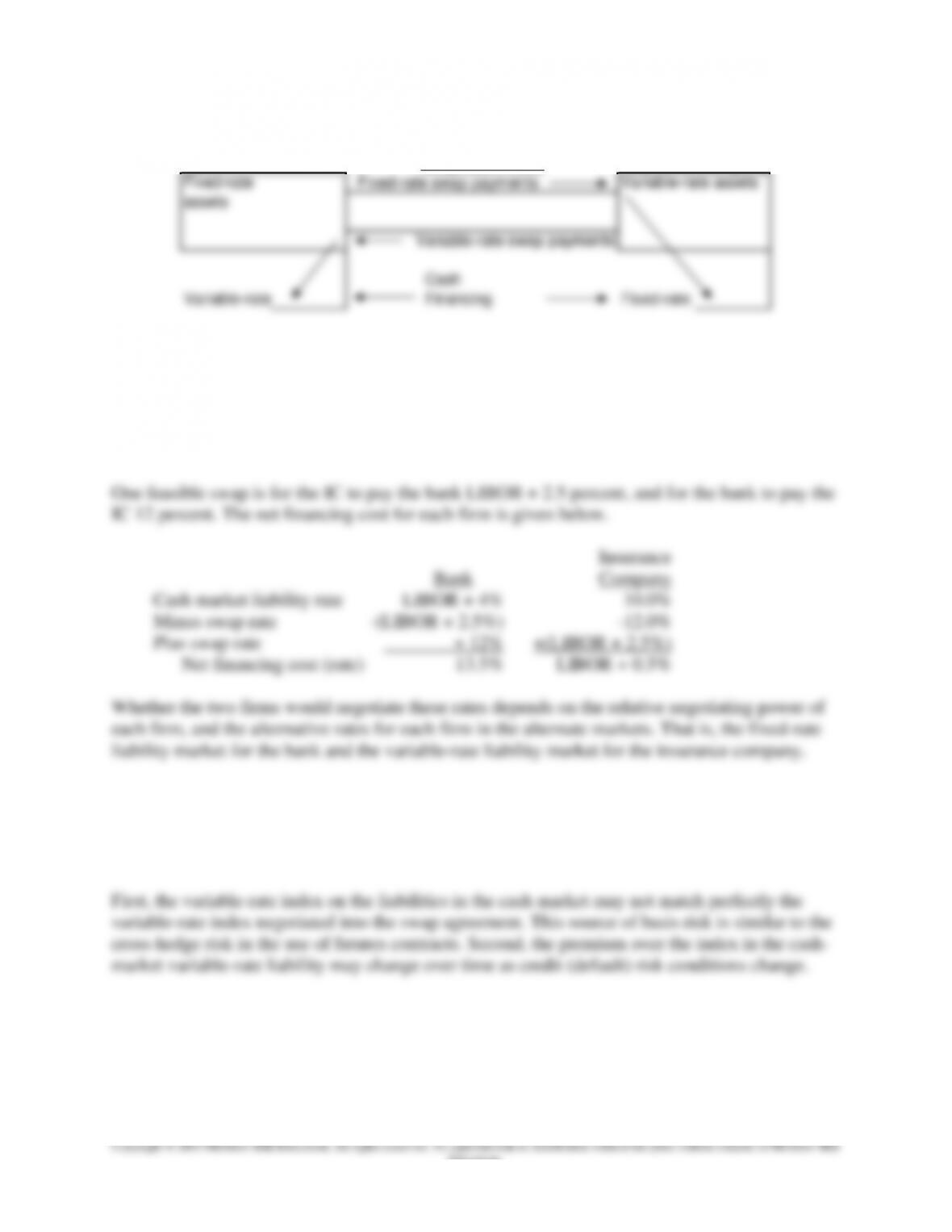
e. Diagram the direction of the relevant cash flows for the swap arrangement.
Chapter 24 – Swaps
Bank
Insurance Company
Fixed-rate Fixed-rate swap payments Variable-rate assets
assets
Variable-rate swap payments
Cash
Variable-rate Financing Fixed-rate
Swap Cash Flows
f. What are reasonable cash flow amounts, or relative interest rates, for each of the
payment streams?
Determining a set of reasonable interest rates involves an analysis of the benefits to each FI. That
is, does each FI pay lower interest rates with the swap than contractually obligated without the
swap? Clearly, the direction of the cash flows will help reduce interest rate risk.
5. In a swap arrangement, the variable-rate swap cash flow streams often do not fully hedge
the variable-rate cash flow streams from the balance sheet due to basis risk.
a. What are the possible sources of basis risk in an interest rate swap?
b. How could the failure to achieve a perfect hedge be realized by the swap buyer?
Chapter 24 – Swaps
24-4
Education.
c. How could the failure to achieve a perfect hedge be realized by the swap seller?
6. A commercial bank has $200 million of four-year maturity floating-rate loans yielding the
T-bill rate plus 2 percent. These loans are financed with $200 million of four-year maturity
fixed-rate deposits costing 9 percent. The commercial bank can issue four-year variable-
rate deposits at the T-bill rate plus 1.5 percent. A savings bank has $200 million of four-
year maturity mortgages with a fixed rate of 13 percent. They are financed with $200
million of four-year maturity CDs with a variable rate of the T-bill rate plus 3 percent. The
savings bank can issue four-year long-term debt at 12.5 percent.
a. Discuss the type of interest rate risk each FI faces.
b. Propose a swap that would result in each FI having the same type of asset and liability
cash flows.
c. Show that this swap would be acceptable to both parties.
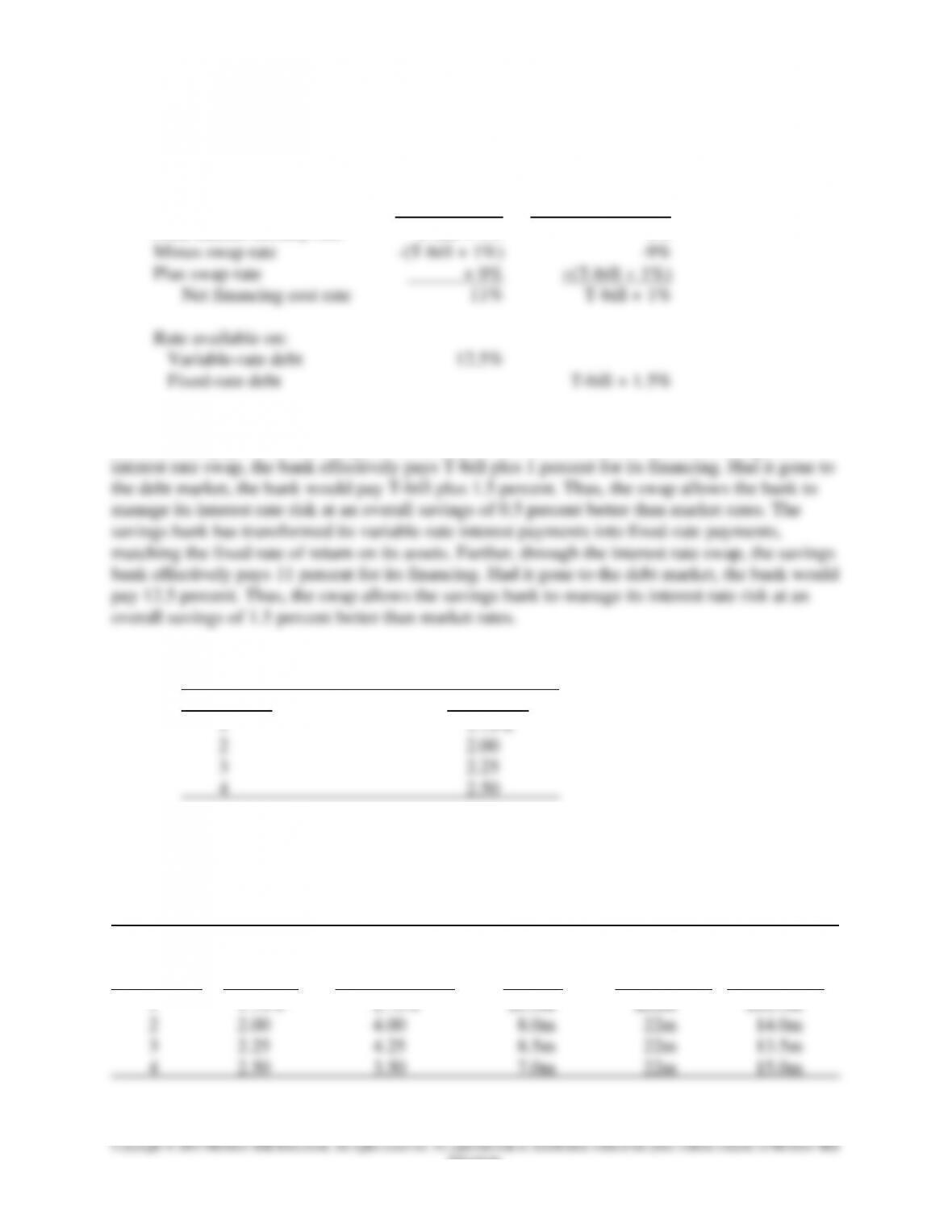
The swap flows are shown below.
Chapter 24 – Swaps
24-5
Education.
Given these patterns of cash flows associated with the swap, the commercial bank and savings
bank will realize the following financing costs.
Savings Bank Commercial Bank
Cash market liability rate T-bill + 3% 9%
As a result of the swap, the bank has transformed its four-year, fixed-rate interest payments into
variable-rate payments, matching the variability of returns on its assets. Further, through the
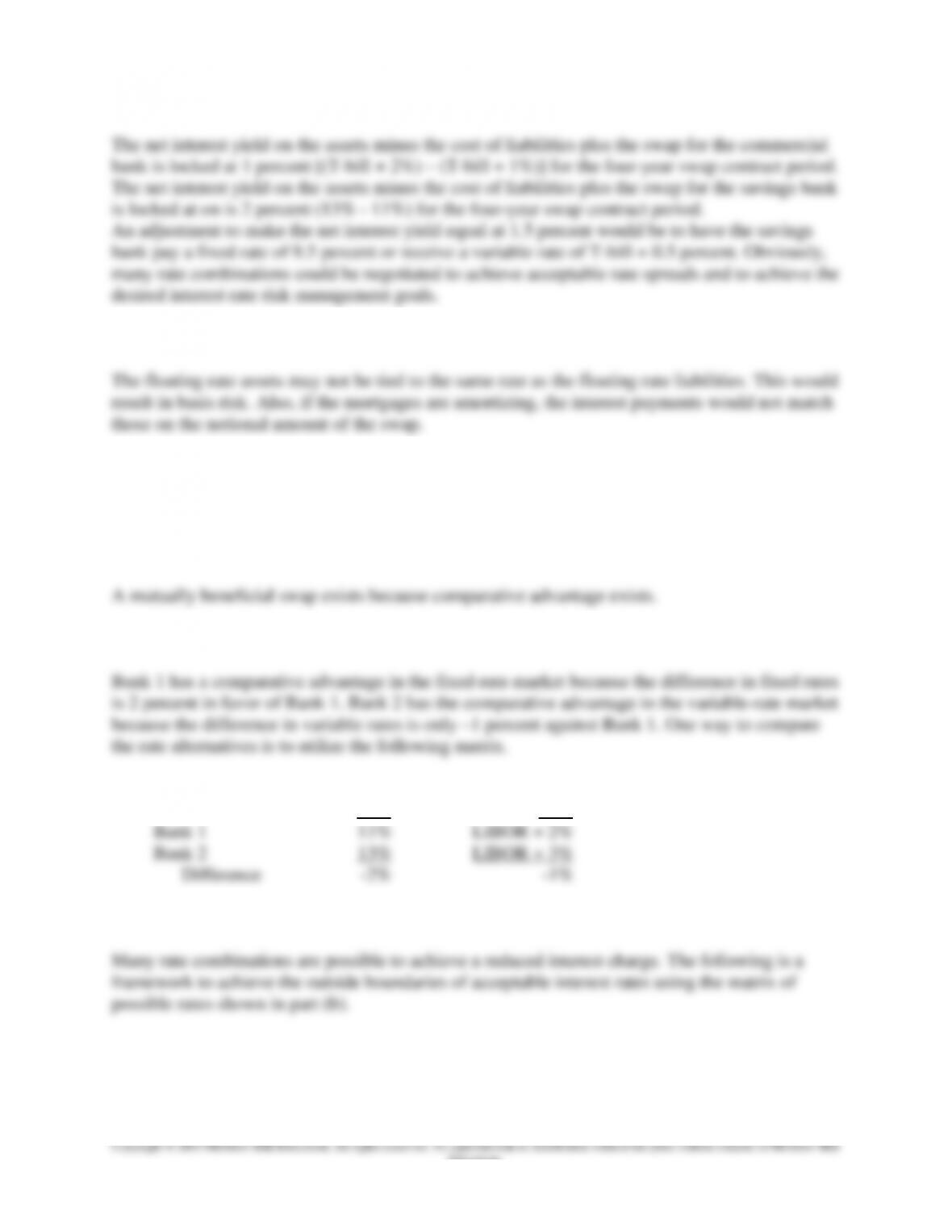
d. The realized T-bill rates over the four-year contract period are as follows:
End of Year T-bill Rate
Calculate the realized cash flows on the swap and the net interest yield for the savings
bank and the commercial bank over the contract period.
The realized cash flows on the swap agreement are as follows:
Cash Cash Net payment
Payment payment by made by
End of Year T-bill rate T-bill rate + 1% by bank savings bank savings bank
Chapter 24 – Swaps
24-6
Education.
e. What are some of the practical difficulties in arranging this swap?
7. Bank 1 can issue five-year CDs at an annual rate of 11 percent fixed or at a variable rate of
LIBOR plus 2 percent. Bank 2 can issue five-year CDs at an annual rate of 13 percent fixed
or at a variable rate of LIBOR plus 3 percent.
a. Is a mutually beneficial swap possible between the two banks?
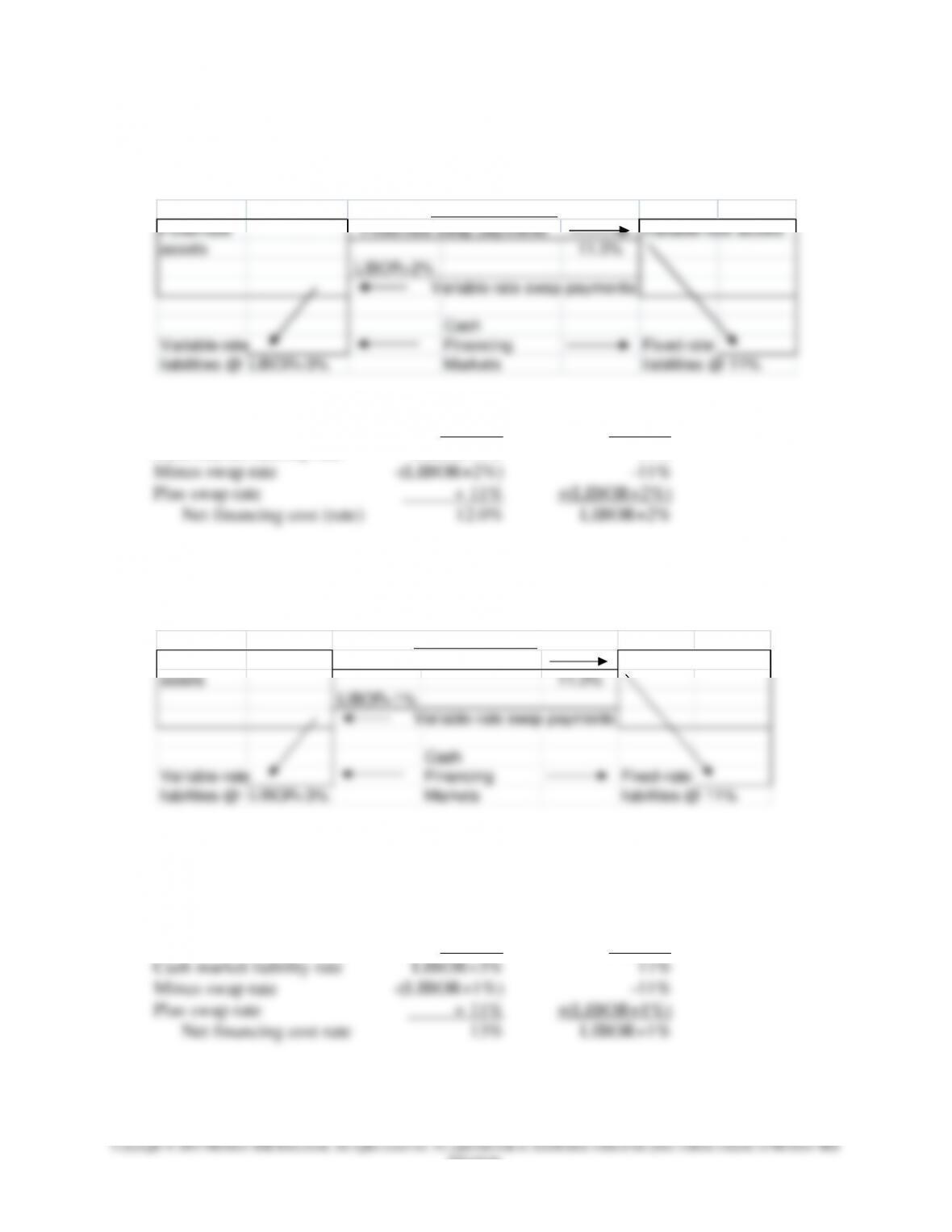
b. Where is the comparative advantage of the two banks?
Fixed Variable
Rate Rate
c. What is an example of a feasible swap?
Chapter 24 – Swaps
Using the rates shown for Bank 1 as the negotiated swap rates will give the entire interest rate
advantage to Bank 2. The diagram and payoff matrix below verifies this case.
The relative payoffs are given below:
Bank 2 Bank 1
Cash market liability rate LIBOR+3% 11%
Bank 1 is paying the rate it could achieve in the variable rate market. Thus, Bank 1 receives no
benefit to these swap rates. Now consider the rates shown for Bank 2 in the matrix of rates in
part (b).
In this case, Bank 2 is receiving the exact rate it owes on the liabilities and it is paying the rate
necessary if it was in the fixed-rate market. Bank 1 receives the entire 1 percent benefit as it is
paying net 1 percent less than it would need to pay in the variable-rate market.
The relative payoffs are given below:
Bank 2 Bank 1
Bank 2 Bank 1
Fixed–rate Fixed-rate swap payments Variable-rate assets
assets 11.0%
LIBOR+2%
Variable-rate swap payments
Cash
Variable-rate Financing Fixed–rate
liabilities @
LIBOR+3% Markets liabilities @ 11%
Swap Cash Flows
Bank 2 Bank 1
Fixed-rate Fixed-rate swap payments Variable–rate assets
assets 11.0%
LIBOR+1%
Variable–rate swap payments
Cash
Variable–rate Financing Fixed-rate
liabilities @ L
LIBOR+3% Markets liabilities @ 11%
Swap Cash Flows
Chapter 24 – Swaps
24-8
Education.
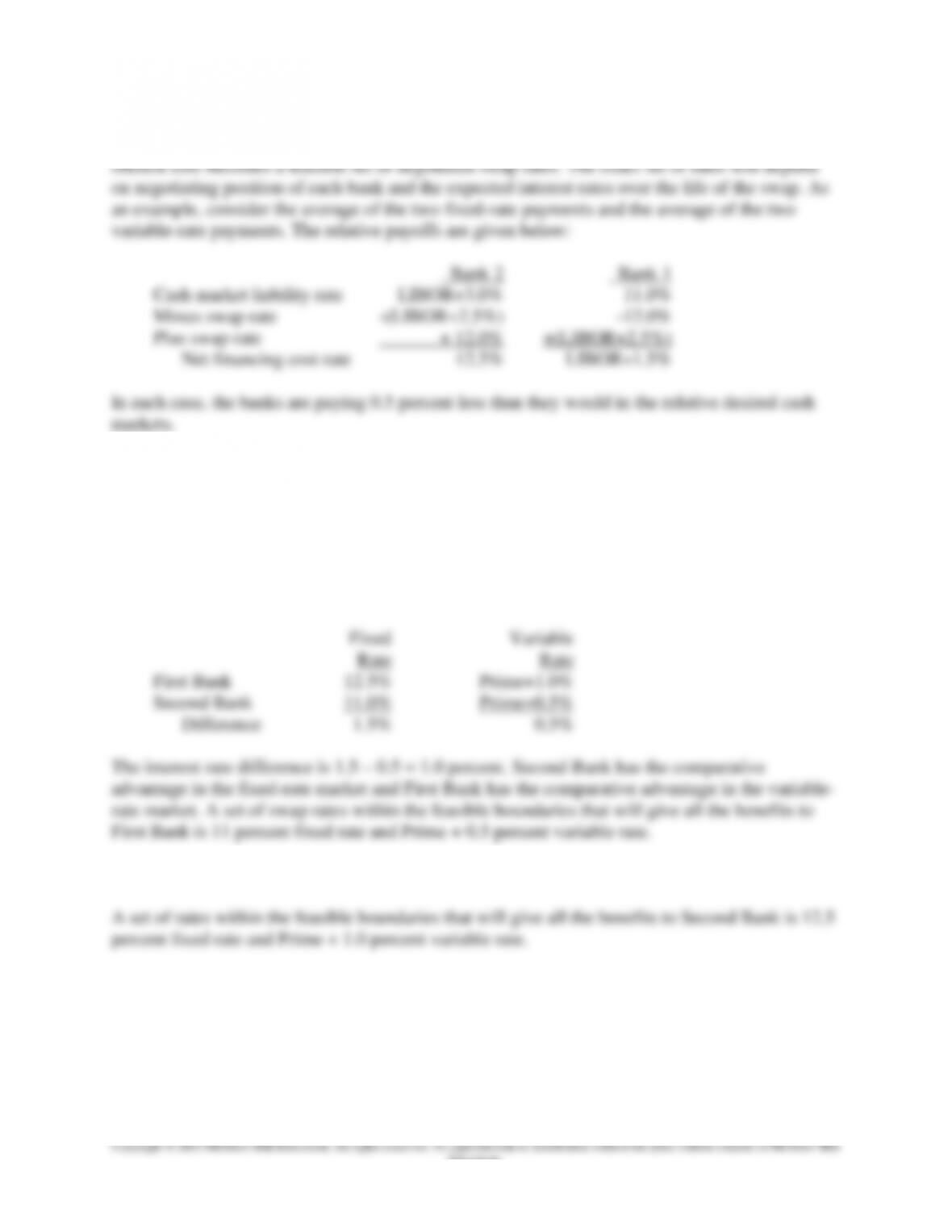
Any swap rate combination between these two boundaries that yields a total saving in combined
8. First Bank can issue one-year, floating-rate CDs at prime plus 1 percent or fixed-rate CDs
at 12.5 percent. Second Bank can issue one-year, floating-rate CDs at prime plus 0.5
percent or fixed-rate at 11.0 percent.
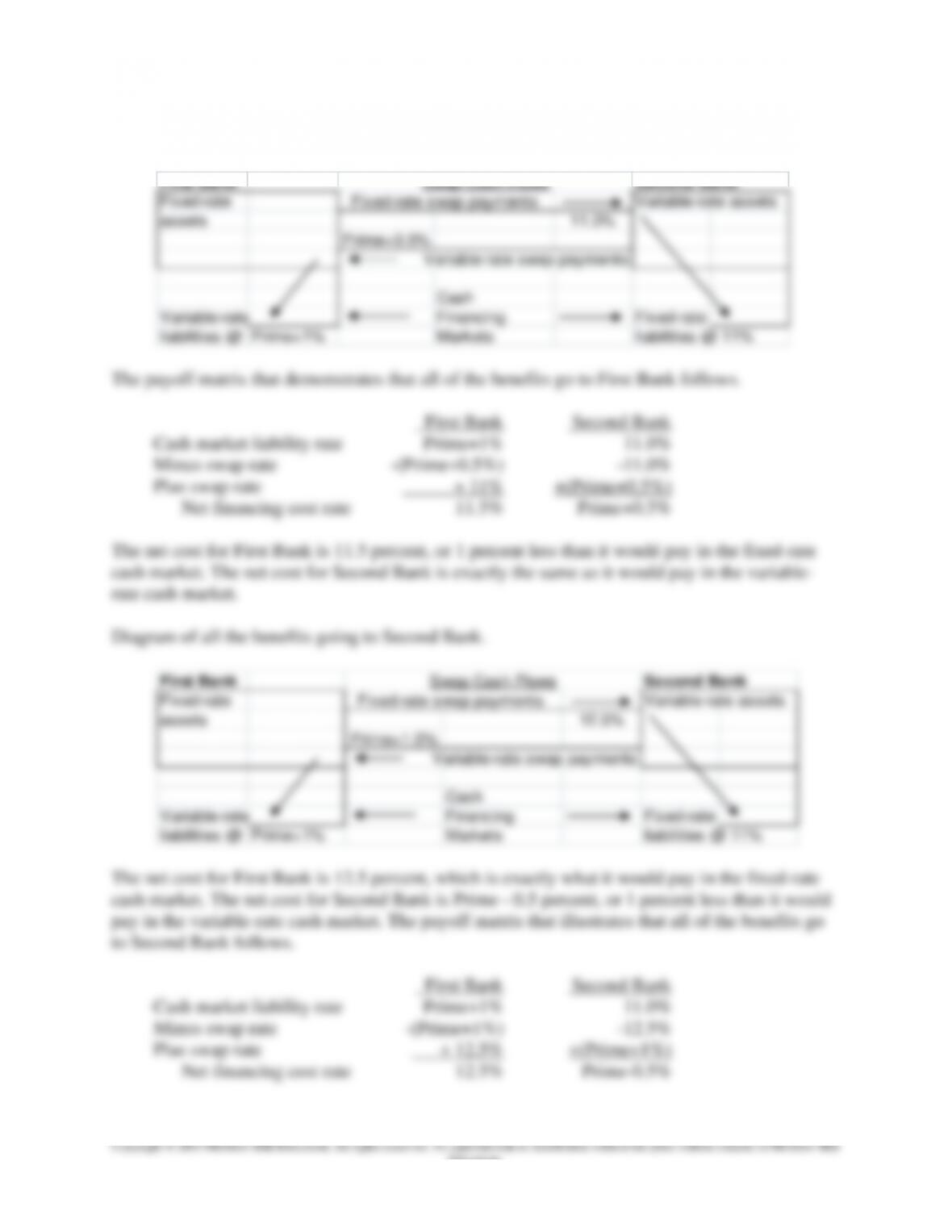
a. What is a feasible swap with all of the benefits going to First Bank?
The possible interest rate alternatives faced by each firm are given below:
b. What is a feasible swap with all of the benefits going to Second Bank?
c. Diagram each situation.
Chapter 24 – Swaps
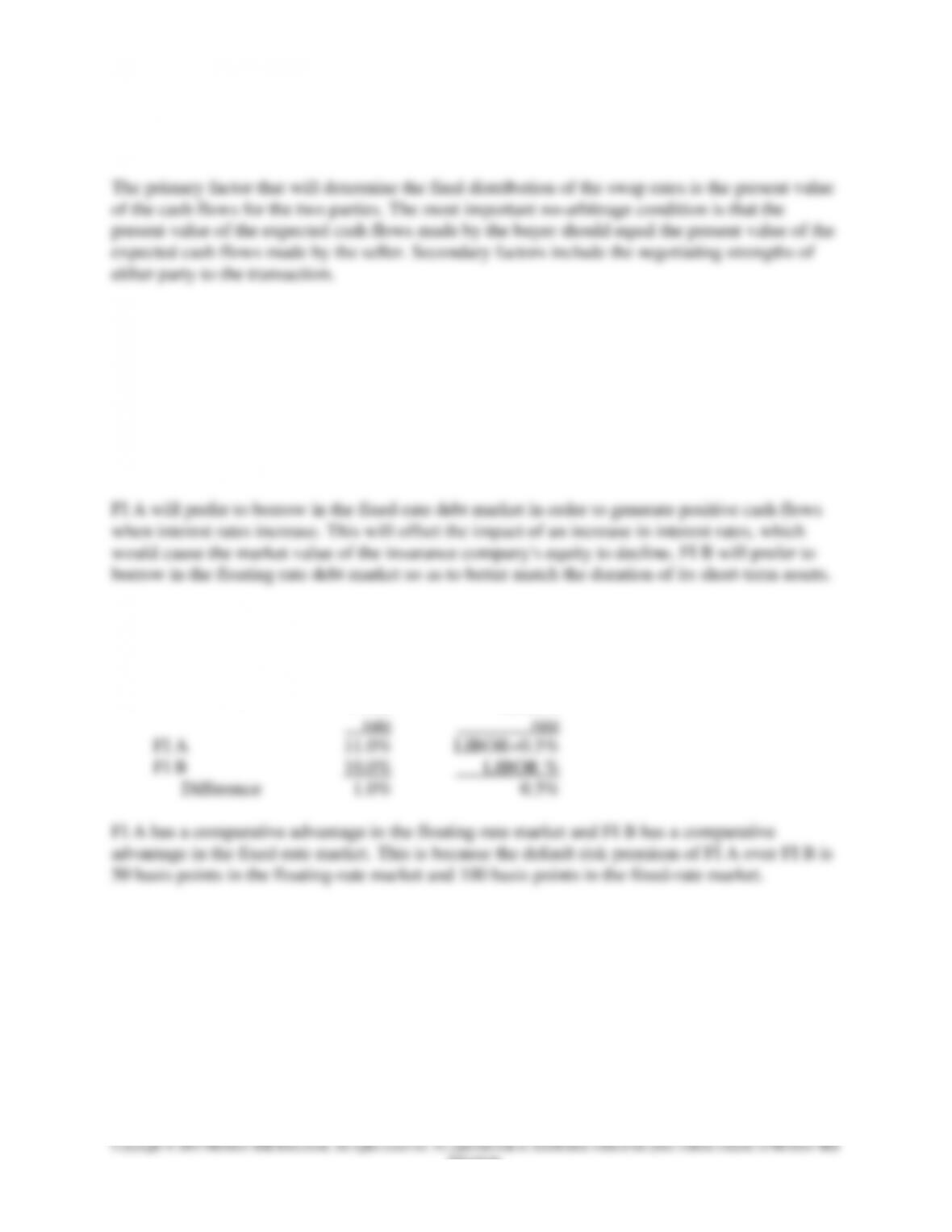
Diagram of all the benefits going to First Bank.
First Bank Second Bank
Fixed–rate Fixed-rate swap payments Variable-rate assets
assets 11.0%
Prime+0.5%
Variable-rate swap payments
Cash
Variable-rate Financing Fixed–rate
liabilities @
Prime+1% Markets liabilities @ 11%
Swap Cash Flows
Chapter 24 – Swaps
24–10
Education.
d. What factors will determine the final swap arrangement?
9. Two multinational FIs enter their respective debt markets to issue $100 million of two-year
notes. FI A can borrow at a fixed annual rate of 11 percent or a floating rate of LIBOR plus
50 basis points, repriced at the end of the year. FI B can borrow at a fixed annual rate of 10
percent or a floating rate of LIBOR, repriced at the end of the year.
a. If FI A is a positive duration gap insurance company and FI B is a money market
mutual fund, in what market(s) should each firm borrow so as to reduce its interest rate
risk exposure?
b. In which debt market does FI A have a comparative advantage over FI B?
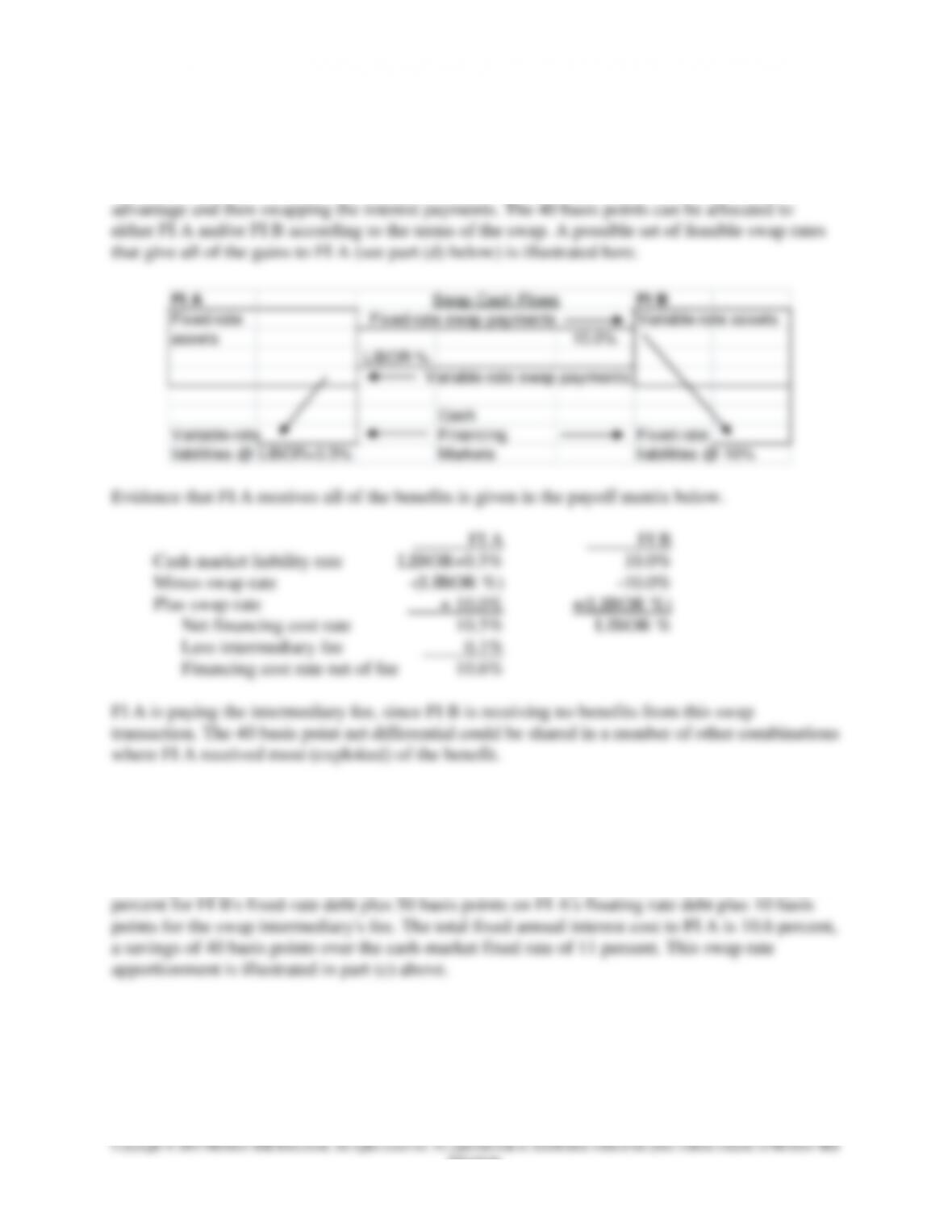
The matrix of possible interest rates is given below.
Fixed Variable
c. Although FI A is riskier than FI B and therefore must pay a higher rate in both the
fixed-rate and floating-rate markets, there are possible gains to trade. Set up a swap to
exploit FI A’s comparative advantage over FI B. What are the total gains from the
swap? Assume a swap intermediary fee of 10 basis points.
Chapter 24 – Swaps
The total gains to the swap are 50 basis points (the price differential on FI A’s default risk
premium over FI B) less 10 basis points (the swap intermediary fee). Both FI A and B can
exploit this price differential by issuing debt in the debt market in which they have comparative
d. The gains from the swap can be apportioned between FI A and FI B through
negotiation. What terms of swap would give all the gains to FI A? What terms of swap
would give all the gains to FI B?
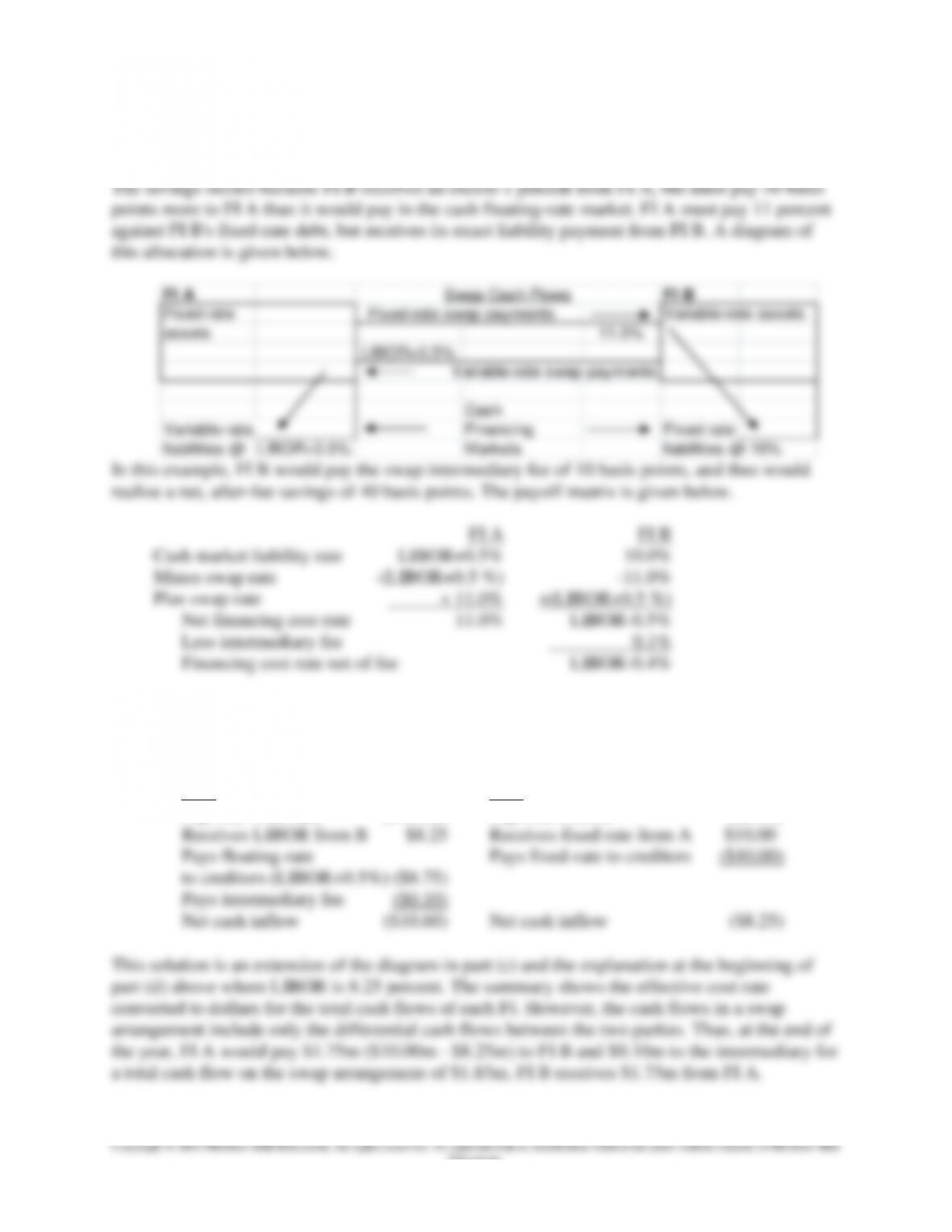
All the gains go to FI A if FI B pays LIBOR for FI A’s floating rate debt. Then FI A must pay 10
Chapter 24 – Swaps
All the gains go to FI B if FI A pays 11 percent for FI B’s fixed-rate, 10 percent debt. Then FI B
pays LIBOR plus 50 basis points on FI A’s floating rate debt for a net savings of 50 basis points.
e. Assume swap pricing that allocates all gains from the swap to FI A. If FI A buys the
swap from FI B and pays the swap intermediary’s fee, what are the realized net cash
flows if LIBOR is 8.25 percent?
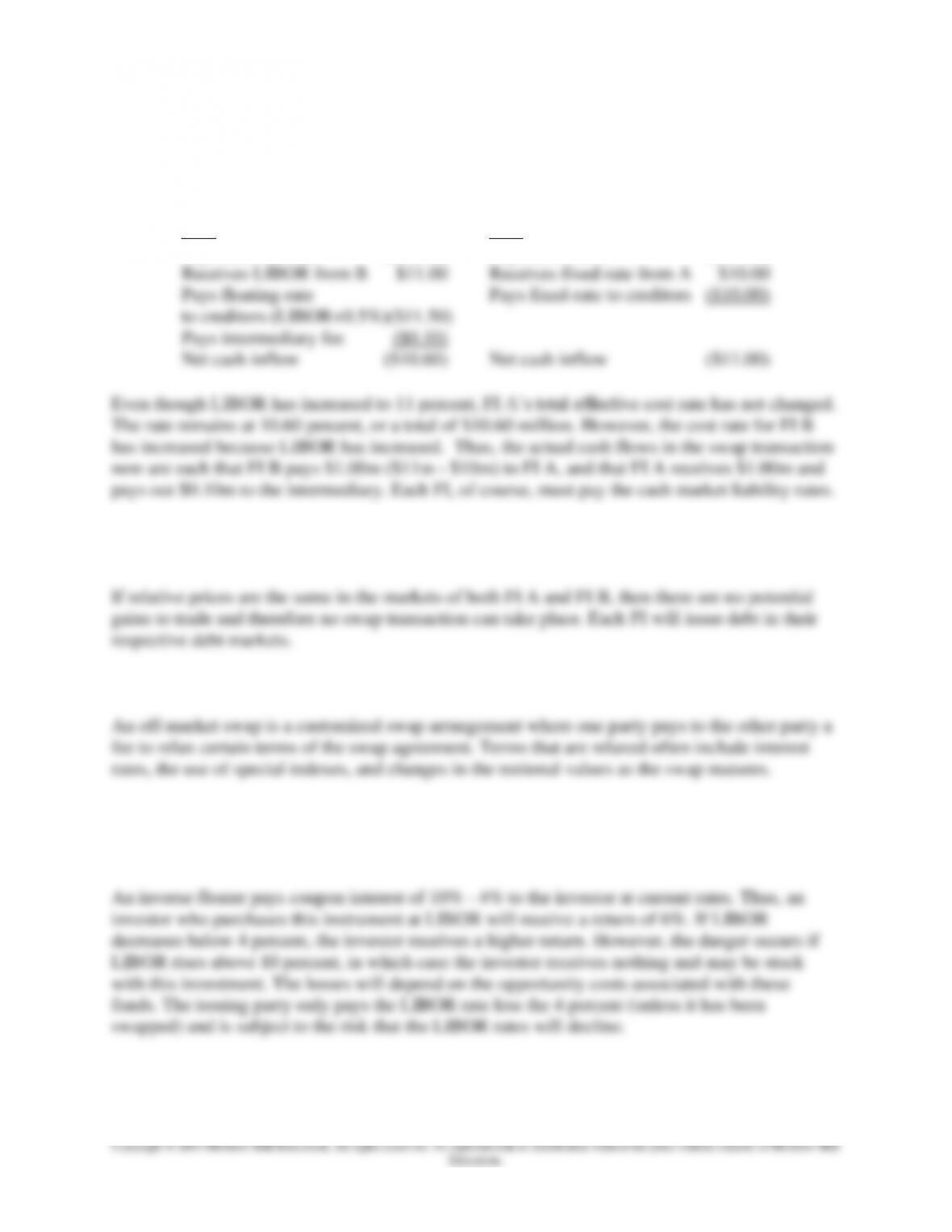
FI A (in millions of dollars) FI B
Pays out fixed rate ($10.00) Pays out LIBOR ($8.25)
Chapter 24 – Swaps
24–13
f. If FI A buys the swap in part (e) from FI B and pays the swap intermediary’s fee, what
are the realized net cash flows if LIBOR is 11 percent? Be sure to net swap payments
against cash market payments for both FIs.
FI A (in millions of dollars) FI B
Pays out fixed rate ($10.00) Pays out LIBOR ($11.00)
g. If all barriers to entry and pricing inefficiencies between FI A’s debt markets and FI B’s
debt markets were eliminated, how would that affect the swap transaction?
10. What are off-market swap arrangements? How are these arrangements negotiated?
11. Describe how an inverse floater works to the advantage of an investor who receives coupon
payments of 10 percent minus LIBOR if LIBOR is currently at 4 percent. When is it a
disadvantage to the investor? Does the issuing party bear any risk?
Chapter 24 – Swaps
24–14
12. An FI has $500 million of assets with a duration of nine years and $450 million of
liabilities with a duration of three years. The FI wants to hedge its duration gap with a swap
that has fixed-rate payments with a duration of six years and floating-rate payments with a
duration of two years. What is the optimal amount of the swap to effectively macrohedge
against the adverse effect of a change in interest rates on the value of the FI’s equity?
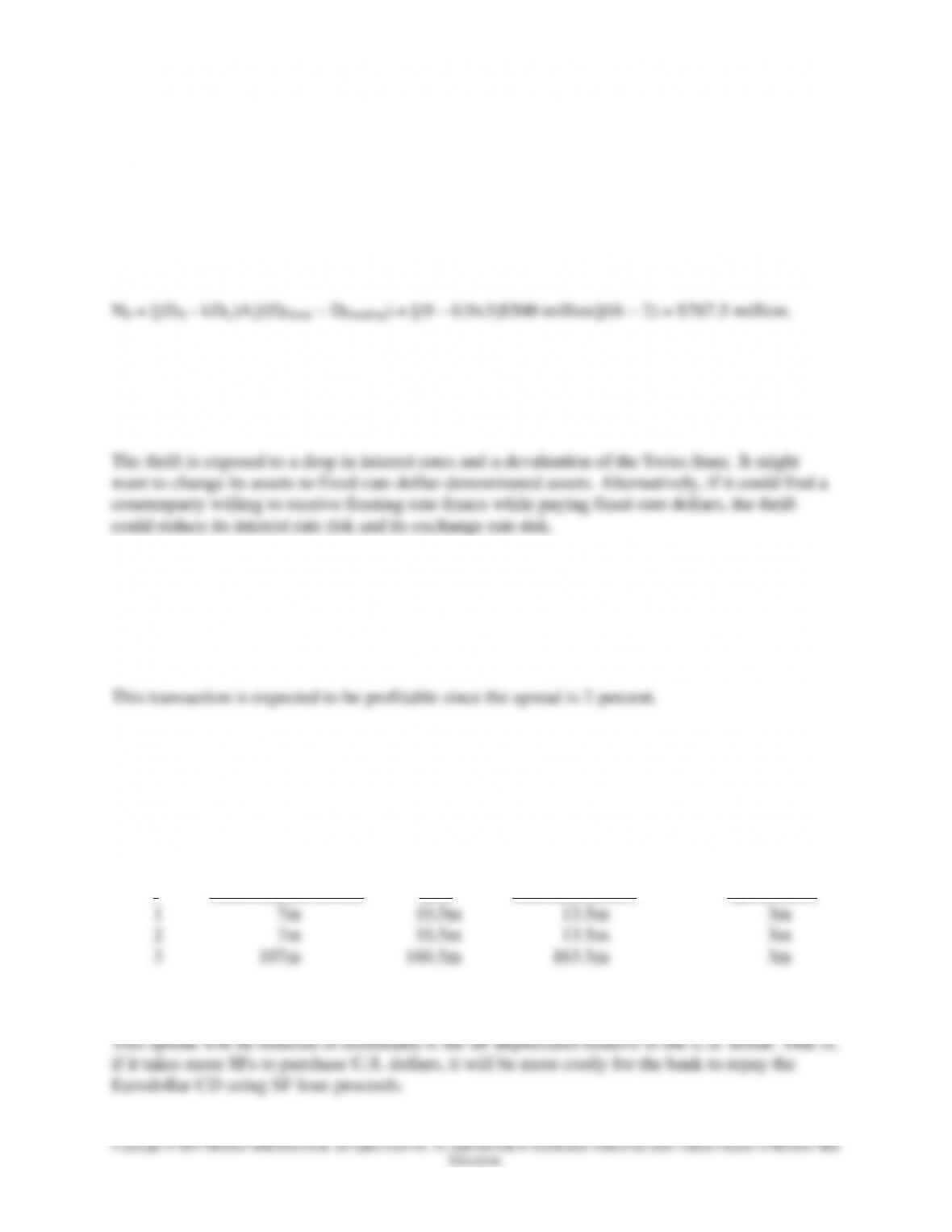
Using the formula,
13. A U.S. thrift has most of its assets in the form of Swiss franc-denominated floating-rate
loans. Its liabilities consist mostly of fixed-rate dollar-denominated CDs. What type of
currency risk and interest rate risk does this FI face? How might it use a swap to eliminate
some of these risks?
14. A Swiss bank issues a $100 million, three-year Eurodollar CD at a fixed annual rate of 7
percent. The proceeds of the CD are lent to a Swiss company for three years at a fixed rate
of 9 percent. The spot exchange rate is SF1.50/$.
a. Is this expected to be a profitable transaction?
b. What are the cash flows if exchange rates are unchanged over the next three years?
The 2 percent spread on $100 million (SF150 million) is $2 million. Converting into Swiss
francs at the spot exchange rate yields an annual expected cash flow of SF3 million. The cash
flows are as follows:
Eurodollar CD Swiss loan
t Cash Outflow (US$) (SF) cash inflow (SF) Spread (SF)
c. What is the risk exposure of the bank’s underlying cash position?