Chapter 23 – Options, Caps, Floors, and Collars
23–15
Copyright © 2014 McGraw-Hill Education. All rights reserved. No reproduction or distribution without the prior written consent
of McGraw-Hill Education.
BDx x
A]x
D
k –
D
[
=
NLA
p
= [6.5 – 4.5(0.80)] x $200,000,000/[(-0.3) x (-7.0) x (96,000)]
= 2,876.98 or 2,877 contracts
c. If interest rates increase 50 basis points, what will be the change in value of the
equity of the FI?
d. What will be the change in value of the T-bond option hedge position?
e. If put options on T-bonds are selling at a premium of $1.25 per face value of
$100, what is the total cost of hedging using options on T-bonds?
f. Diagram the spot market conditions of the equity and the option hedge.
g. What must be the change in interest rates before the change in value of the
balance sheet (equity) will offset the cost of placing the hedge?
h. How much must interest rates change before the profit on the hedge will exactly
cover the cost of placing the hedge?
i. Given your answer in part (g), what will be the net gain or loss to the FI?
Chapter 23 – Options, Caps, Floors, and Collars
23–16
21. A mutual fund plans to purchase $10 million of 20-year T-bonds in two months.
The bonds are yielding 7.68 percent. These bonds have a duration of 11 years. The
mutual fund is concerned about interest rates changing over the next two months
and is considering a hedge with a two-month option on a T-bond futures contract.
Two-month calls with a strike price of 105 are priced at 1-25, and puts of the same
maturity and exercise price are quoted at 2-09. The delta of the call is 0.5 and the
delta of the put is -0.7. The current price of a deliverable T-bond is $103.2500 per
$100 of face value, its duration is nine years, and its yield to maturity is 7.68
percent.
a. What type of option should the mutual fund purchase?
b. How many options should it purchase?
250,103$x 9x 5.0
B x D x
c. What is the cost of these options?
d. If rates change +/-50 basis points, what will be the impact on the price of the
desired T-bonds?
e. What will be the effect on the value of the hedge if rates change +/– 50 basis
points?
f. Diagram the effects of the hedge and the spot market value of the desired T-
bonds.
Chapter 23 – Options, Caps, Floors, and Collars
23–17
Copyright © 2014 McGraw-Hill Education. All rights reserved. No reproduction or distribution without the prior written consent
of McGraw-Hill Education.
The profit profile of the call option hedge is given in Figure 23-1, and the profile of a
long bond is shown in Figure 23-5. The profit profile of the call option is less than the
bond by the amount of the premium, but the call option profile illustrates less opportunity
for loss.
g. What must be the change in interest rates to cause the change in value of the
purchased T-bonds to exactly offset the cost of placing the hedge?
22. An FI must make a single payment of 500,000 Swiss francs in six months at the
maturity of a CD. The FI’s in-house analyst expects the spot price of the franc to
remain stable at the current $0.80/SF. But as a precaution, the analyst is concerned
that it could rise as high as $0.85/SF or fall as low as $0.75/SF. Because of this
uncertainty, the analyst recommends that the FI hedge the CD payment using either
options or futures. Six-month call and put options on the Swiss franc with an
exercise price of $0.80/SF are trading at 4 cents and 2 cents per SF, respectively. A
six-month futures contract on the Swiss franc is trading at $0.80/SF.
a. Should the analyst be worried about the dollar depreciating or appreciating?
b. If the FI decides to hedge using options, should the FI buy put or call options to
hedge the CD payment? Why?
c. If futures are used to hedge, should the FI buy or sell Swiss franc futures to
hedge the payment? Why?
Chapter 23 – Options, Caps, Floors, and Collars
23–18
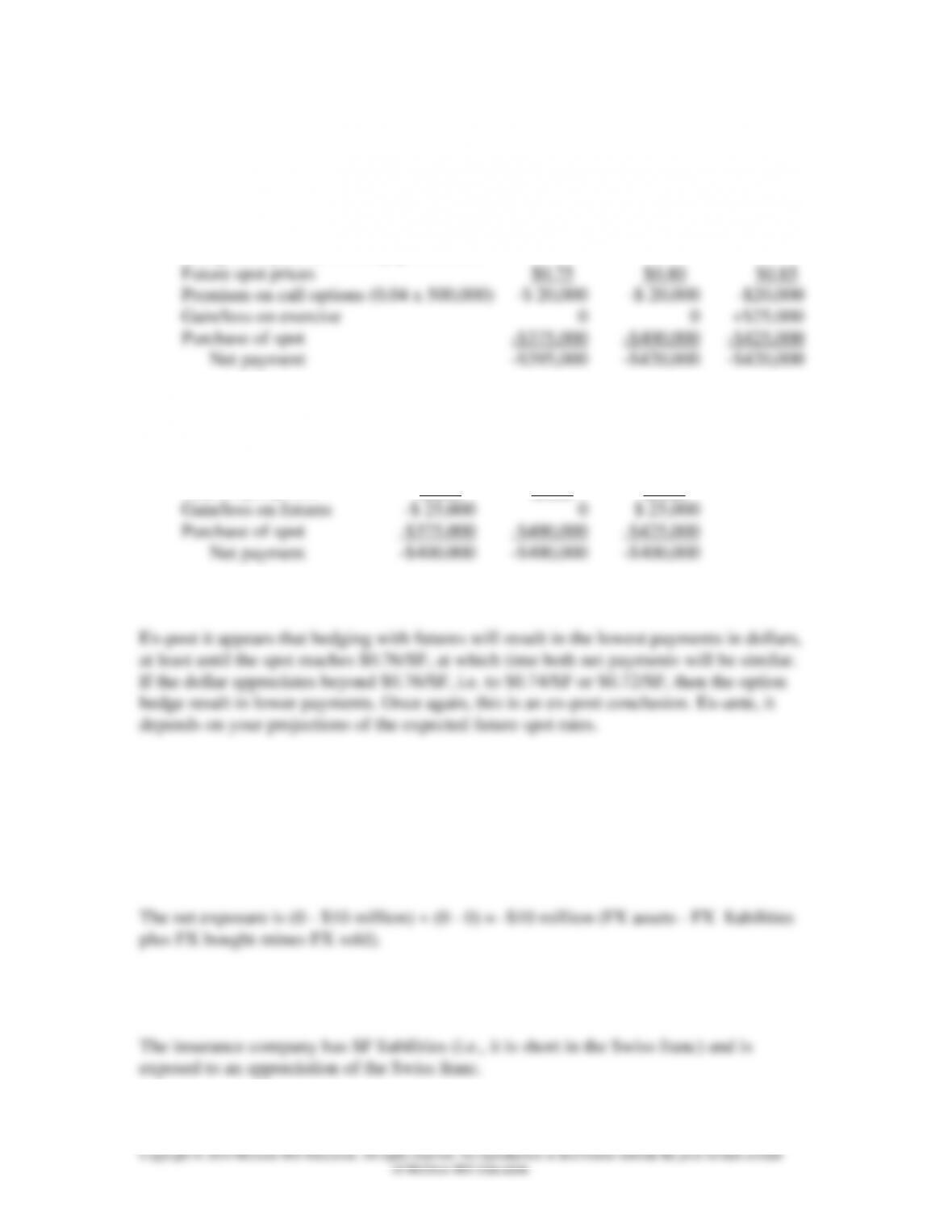
d. What will be the net payment on the CD if the selected call or put options are
used to hedge the payment? Assume the following three scenarios: the spot
price in six months will be $0.75, $0.80 or $0.85/SF. Also assume that the
options will be exercised.
Using call options, the net payments are:
e. What will be the net payment if futures had been used to hedge the CD
payment? Use the same three scenarios as in part (d).
Using futures, the net payments are:
Future Spot prices $0.75 $0.80 $0.85
f. Which method of hedging is preferable after the fact?
23. An American insurance company issued $10 million of one-year, zero-coupon GICs
(guaranteed investment contracts) denominated in Swiss francs at a rate of 5
percent. The insurance company holds no SF-denominated assets and has neither
bought nor sold francs in the foreign exchange market.
a. What is the insurance company’s net exposure in Swiss francs?
b. What is the insurance company’s risk exposure to foreign exchange rate
fluctuations?
Chapter 23 – Options, Caps, Floors, and Collars
23–19
c. How can the insurance company use futures to hedge the risk exposure in part
(b)? How can it use options to hedge?
d. If the strike price on SF options is $0.6667/SF and the spot exchange rate is
$0.6452/SF, what is the intrinsic value (on expiration) of a call option on Swiss
francs? What is the intrinsic value (on expiration) of a Swiss franc put option?
(Note: Swiss franc futures options traded on the Chicago Mercantile Exchange
are set at SF125,000 per contract.)
e. If the June delivery call option premium is 0.32 cents per franc and the June
delivery put option is 10.7 cents per franc, what is the dollar premium cost per
contract? Assume that today’s date is April 15.
f. Why is the call option premium lower than the put option premium?
24. An FI has made a loan commitment of SF10 million that is likely to be taken down
in six months. The current spot exchange rate is $0.60/SF.
a. Is the FI exposed to the dollar depreciating or the dollar appreciating? Why?
b. If the FI decides to hedge using SF futures, should it buy or sell SF futures?
Chapter 23 – Options, Caps, Floors, and Collars
23–20
c. If the spot rate six months from today is $0.64/SF, what dollar amount is needed
in six months if the loan is drawn down?
d. A six-month SF futures contract is available for $0.61/SF. What is the net
amount needed at the end of six months if the FI has hedged using the SF10
million of futures contract? Assume futures prices are equal to spot prices at the
time of payment, that is, at maturity.
e. If the FI decides to use options to hedge, should it purchase call or put options?
f. Call and put options with an exercise price of $0.61/SF are selling for $0.02 and
$0.03 per SF, respectively. What would be the net amount needed by the FI at
the end of six months if it had used options instead of futures to hedge this
exposure?
25. What is a credit spread call option?
26. What is a digital default option?
27. How do the cash flows to the lender for a credit spread call option hedge differ from
the cash flows for a digital default option spread?
Chapter 23 – Options, Caps, Floors, and Collars
23–21
Copyright © 2014 McGraw-Hill Education. All rights reserved. No reproduction or distribution without the prior written consent
of McGraw-Hill Education.
In both cases, the maximum loss to the call option purchaser is the amount of the
premium paid for the option. The digital default option has a one-time, lump-sum cash
payment at the time the loan defaults. The payoff for the credit spread option increases as
the default risk increases. See Figures 23-17 and 23-18 for a visual illustration of the
payoff profiles.
28. What is a catastrophe call spread option? How do the cash flows of this option
affect the buyer of the option?
29. What are caps? Under what circumstances would the buyer of a cap receive a
payoff?
30. What are floors? Under what circumstances would the buyer of a floor receive a
payoff?
31. What are collars? Under what circumstances would an FI use a collar?
Chapter 23 – Options, Caps, Floors, and Collars
23–22
32. How is buying a cap similar to buying a call option on interest rates?
33. Under what balance sheet circumstances would it be desirable to sell a floor to help
finance a cap? When would it be desirable to sell a cap to help finance a floor?
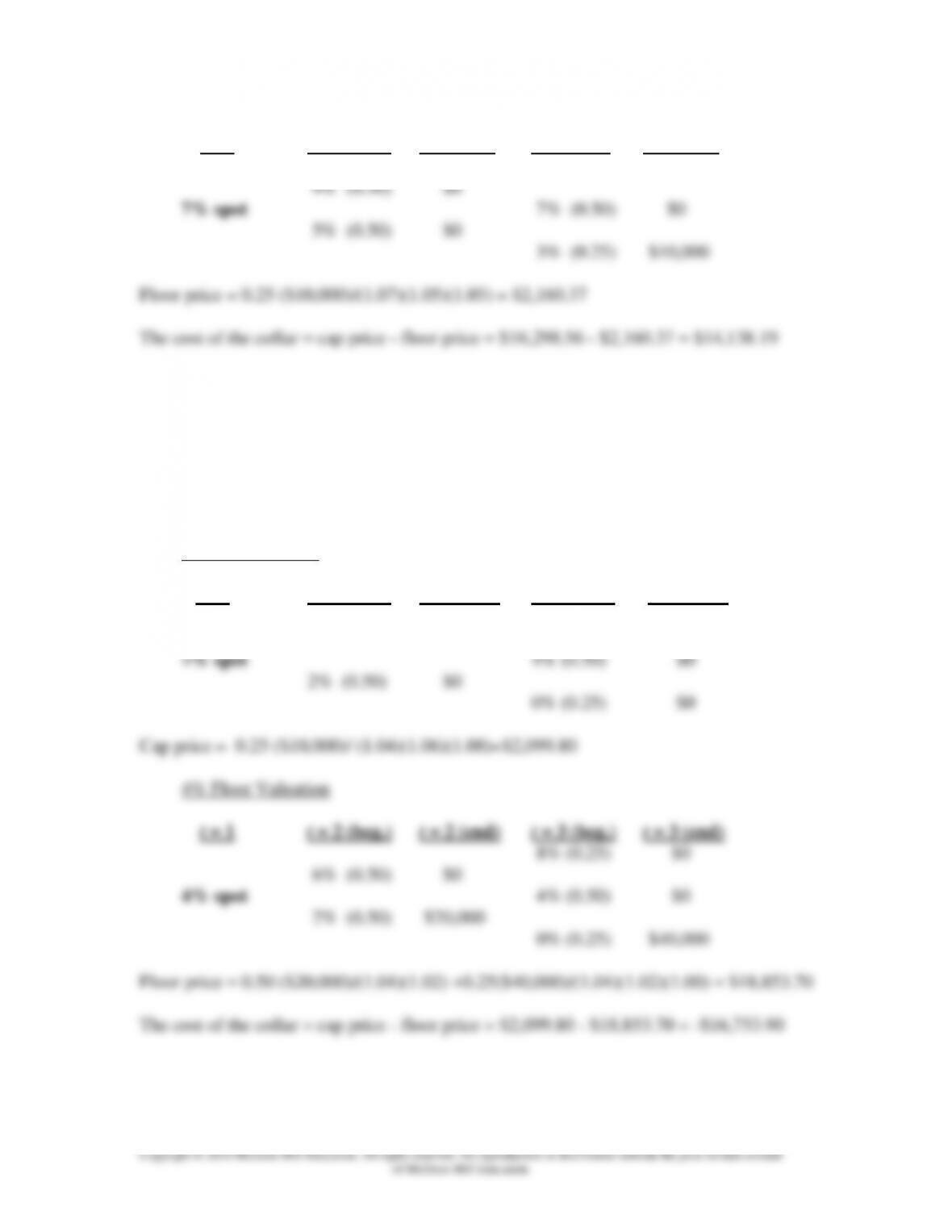
34. Use the following information to price a three-year collar by purchasing an in-the-
money cap and writing an out-of-the-money floor. Assume a binomial options
pricing model with an equal probability of interest rates increasing 2 percent or
decreasing 2 percent per year. Current rates are 7 percent, the cap rate is 7 percent,
and the floor rate is 4 percent. The notional value is $1 million. All interest
payments are annual payments as a percent of notional value, and all payments are
made at the end of year 2 and the end of year 3.
7% Cap Valuation
t = 1 t = 2 (beg.) t = 2 (end) t = 3 (beg.) t = 3 (end)
11% (0.25) $40,000
9% (0.50) $20,000
4% Floor Valuation
Chapter 23 – Options, Caps, Floors, and Collars
23–23
t = 1 t = 2 (beg.) t = 2(end) t = 3(beg.) t = 3(end)
11% (0.25) $0
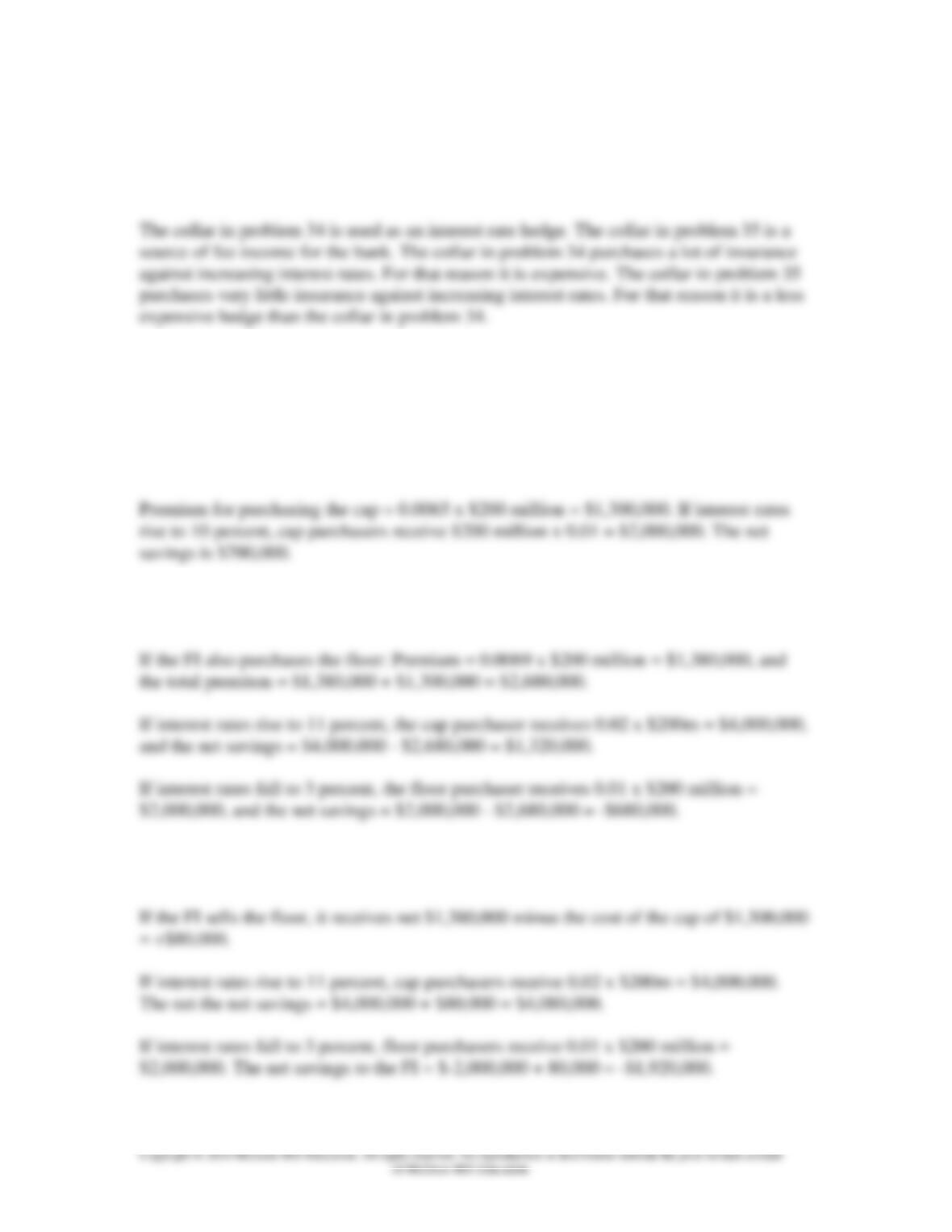
35. Use the following information to price a three-year collar by purchasing an out-of-
the-money cap and writing an in-the-money floor. Assume a binomial options
pricing model with an equal probability of interest rates increasing 2 percent or
decreasing 2 percent per year. Current rates are 4 percent, the cap rate is 7 percent,
and the floor rate is 4 percent. The notional value is $1 million. All interest
payments are annual payments as a percent of notional value, and all payments are
made at the end of year 2 and the end of year 3.
7% Cap Valuation
t = 1 t = 2 (beg.) t = 2 (end) t = 3 (beg.) t = 3 (end)
8% (0.25) $10,000
6% (0.50) $0
Chapter 23 – Options, Caps, Floors, and Collars
23–24
36. Contrast the total cash flows associated with the collar position in question 34
against the collar in question 35. Do the goals of FIs that utilize the collar in
question 34 differ from those that put on the collar in question 35? If so, how?
37. An FI has purchased a $200 million cap of 9 percent at a premium of 0.65 percent
of face value. A $200 million floor of 4 percent is also available at a premium of
0.69 percent of face value.
a. If interest rates rise to 10 percent, what is the amount received by the FI? What
are the net savings after deducting the premium?
b. If the FI also purchases a floor, what are the net savings if interest rates rise to
11 percent? What are the net savings if interest rates fall to 3 percent?
c. If, instead, the FI sells (writes) the floor, what are the net savings if interest rates
rise to 11 percent? What if they fall to 3 percent?
Chapter 23 – Options, Caps, Floors, and Collars
23–25
d. What amount of floors should the FI sell in order to compensate for its
purchases of caps, given the above premiums?
38. What credit risk exposure is involved with buying caps, floors, and collars for
hedging purposes?
Integrated Mini Case: Hedging Interest Rate Risk with Futures versus Options
On January 4, 2015, an FI has the following balance sheet (rates = 10 percent)
Assets Liabilities/Equity
A 200m DA = 6 years L 170m DL = 4 years
E 30m
DGAP = [6 – (170/200)4] = 2.6 years > 0
The FI manager thinks rates will increase by 0.75 percent in the next three months. If this
happens, the equity value will change by:
mE 200)]4(6[ 200
170
−−=
455,545,3$
10.1
0075.0 −=
The FI manager will hedge this interest rate risk with either futures contracts or option
contracts.
If the FI uses futures, it will select June T-bonds to hedge. The duration on the T-bonds
underlying the contract is 14.5 years, and the T-bonds are selling at a price of $114.34375
per $100, or $114,343.75. T-bond futures rates, currently 9 percent, are expected to
increase by 1.25 percent over the next three months.
If the FI uses options, it will buy puts on 15-year T-bonds with a June maturity, an
exercise price of 113, and an option premium of 1
64
36
percent. The spot price on the T-
bond underlying the option is $135.71875 per $100 of face value. The duration on the T-
bonds underlying the options is 14.5 years, and the delta of the put options is -0.75.
Managers expect these T-bond rates to increase by 1.24 percent from 7.875 percent in the
next three months.
Chapter 23 – Options, Caps, Floors, and Collars
23–26
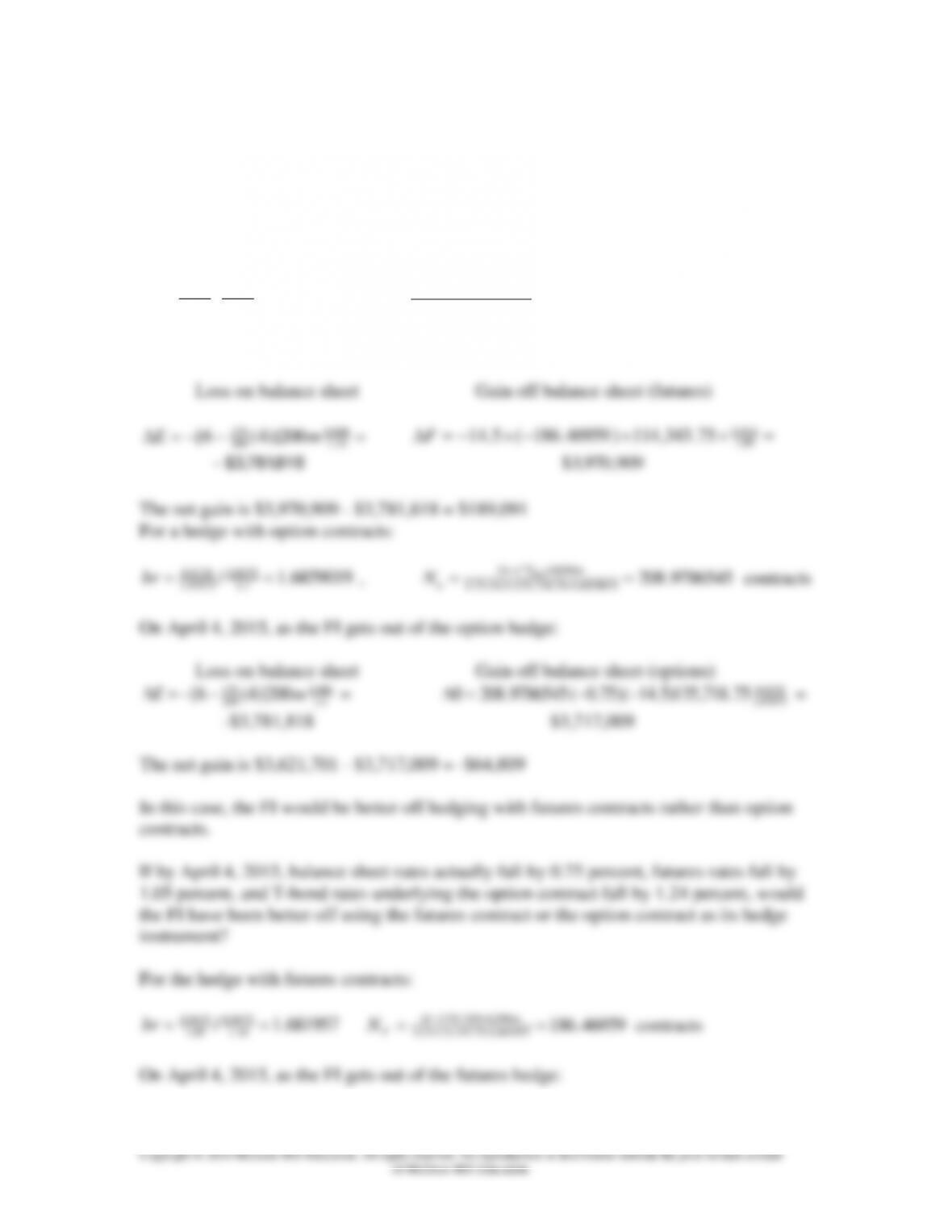
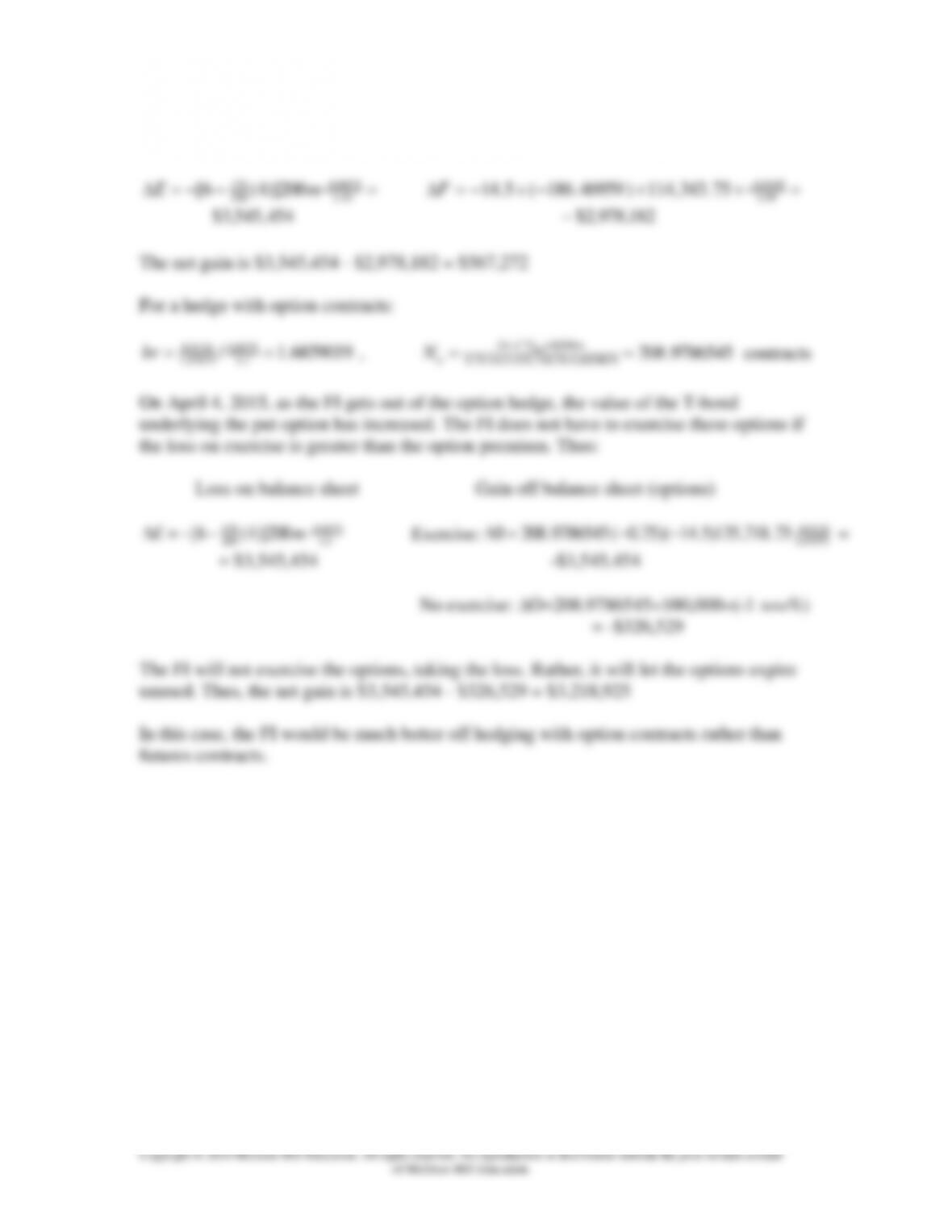
If by April 4, 2015, balance sheet rates increase by 0.8 percent, futures rates by 1.4
percent, and T-bond rates underlying the option contract by 1.3 percent, would the FI
have been better off using the futures contract or the option contract as its hedge
instrument?
For the hedge with futures contracts:
681957.1/ 10.1
0075.0
09.1
0125.0 ==
br
46959.186
681957.175.343,1145.14
200]4)200/170(6[ ==
−m
F
N
contracts
On April 4, 2015, as the FI gets out of the futures hedge:
Chapter 23 – Options, Caps, Floors, and Collars
23–27
Loss on balance sheet Gain off balance sheet (futures)