Chapter 23 – Options, Caps, Floors, and Collars
23-1
Solutions to End-of-Chapter Questions and Problems: Chapter Twenty Three
1. How does using options differ from using forward or futures contracts?
2. What is a call option?
3. What must happen to interest rates for the purchaser of a call option on a bond to
make money? How does the writer of the call option make money?
4. What is a put option?
5. What must happen to interest rates for the purchaser of a put option on a bond to
make money? How does the writer of the put option make money?
23-2
6. Consider the following:
a. What are the two ways to use call and put options on T-bonds to generate
positive cash flows when interest rates decline? Verify your answer with a
diagram.
b. Under what balance sheet conditions would an FI use options on T-bonds to
hedge its assets and/or liabilities against interest rate declines?
c. Is it more appropriate for FIs to hedge against a decline in interest rates with
long calls or short puts?
7. In each of the following cases, identify what risk the manager of an FI faces and
whether the risk should be hedged by buying a put or a call option.
a. A commercial bank plans to issue CDs in three months.
Chapter 23 – Options, Caps, Floors, and Collars
23-3
Copyright © 2014 McGraw-Hill Education. All rights reserved. No reproduction or distribution without the prior written consent
of McGraw-Hill Education.
The bank faces the risk that interest rates will increase. The bank should buy a put option.
If rates rise, the CDs can be issued only at a lower price. But, the increase in interest rates
also lowers the price of the security underlying the put option. Thus, the bank can
purchase the underlying security and the gain from the option exercise will offset the loss
in value from the lower issue value of the CDs the bank experiences in the spot market.
b. An insurance company plans to buy bonds in two months.
c. A thrift plans to sell Treasury securities next month.
d. A U.S. bank lends to a French company with the loan payable in euros.
e. A mutual fund plans to sell its holding of stock in a British company.
f. A finance company has assets with a duration of six years and liabilities with a
duration of 13 years.
Chapter 23 – Options, Caps, Floors, and Collars
23-4
8. Consider an FI that wishes to use bond options to hedge the interest rate risk in the
bond portfolio.
a. How does writing call options hedge the risk when interest rates decrease?
b. Will writing call options fully hedge the risk when interest rates increase?
Explain.
c. How does buying put options reduce the losses on the bond portfolio when
interest rates rise?
d. Diagram the purchase of a bond call option against the combination of a bond
investment and the purchase of a bond put option.
Chapter 23 – Options, Caps, Floors, and Collars
23-5
9. What are the regulatory reasons why FIs seldom write options?
10. What are the problems of using the Black-Scholes option pricing model to value
bond options? What is meant by the term pull-to-par?
11. An FI has purchased a two-year, $1,000 par value zero-coupon bond for $867.43.
The FI will hold the bond to maturity unless it needs to sell the bond at the end of
one year for liquidity purposes. The current one-year interest rate is 7 percent and
the one-year rate in one year is forecast to be either 8.04 percent or 7.44 percent
with equal likelihood. The FI wishes to buy a put option to protect itself against a
capital loss if the bond needs to be sold in one year.
a. What is the yield on the bond at the time of purchase?
b. What is the market-determined, implied one-year rate one year before maturity?
c. What is the expected sale price if the bond has to be sold at the end of one year?
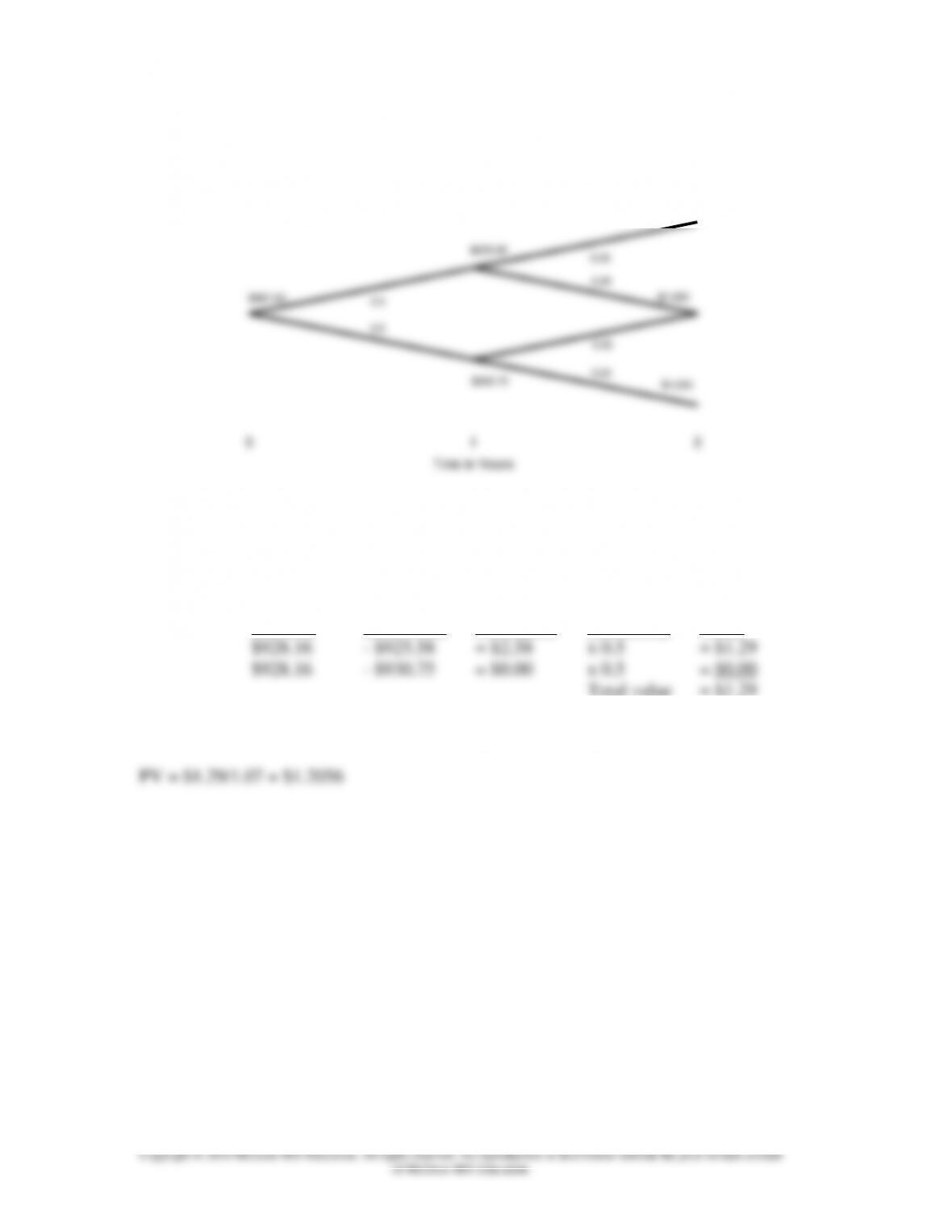
d. Diagram the bond prices over the two-year horizon.
Chapter 23 – Options, Caps, Floors, and Collars
23-6
Binomial Model of Bond Prices
Problem 25-11.d
0 1 2
Time in Years
$867.43
$925.58
$930.75
$1,000
$1,000
$1,000
0.5
0.5
0.25
0.25
0.25
0.25
e. If the FI buys a put option with an exercise price equal to your answer in part
(c), what will be its value at the end of one year?
Put Option Value of Weighted
Exercise Bond Price Put Option Probability Value
Total value = $1.29
f. What should be the premium on the put option today?
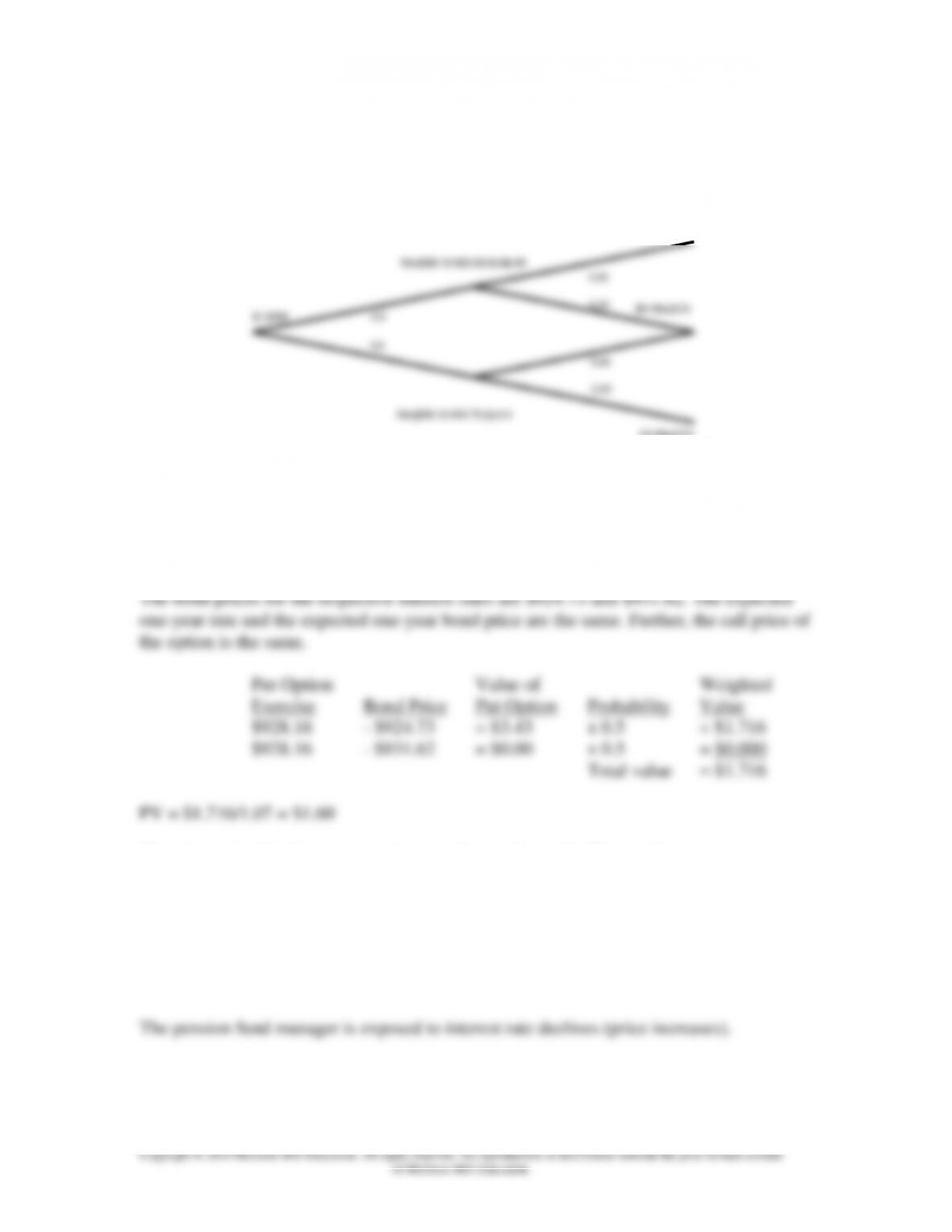
g. Diagram the value for the put option on the two-year, zero-coupon bond.
Chapter 23 – Options, Caps, Floors, and Collars
23-7
Binomial Model of Bond Prices
Problem 25-11.g
0 1 2
Time in Years
$1.2056
Max[928.16-925.58,0]=$2.58
Max[928.16-930.75,0]=0.0
$0=Max(0,0)
0.5
0.5
0.25
0.25
0.25
0.25
$0=Max(0,0)
$0=Max(0,0)
h. What would have been the premium on the option if the one-year interest rates
at the end of one year were expected to be 8.14 percent and 7.34 percent?
12. A pension fund manager anticipates the purchase of a 20-year, 8 percent coupon
Treasury bond at the end of two years. Interest rates are assumed to change only
once every year at year-end, with an equal probability of a 1 percent increase or a 1
percent decrease. The Treasury bond, when purchased in two years, will pay
interest semiannually. Currently, the Treasury bond is selling at par.
a. What is the pension fund manager’s interest rate risk exposure?
Chapter 23 – Options, Caps, Floors, and Collars
23-8
b. How can the pension fund manager use options to hedge this interest rate risk
exposure?
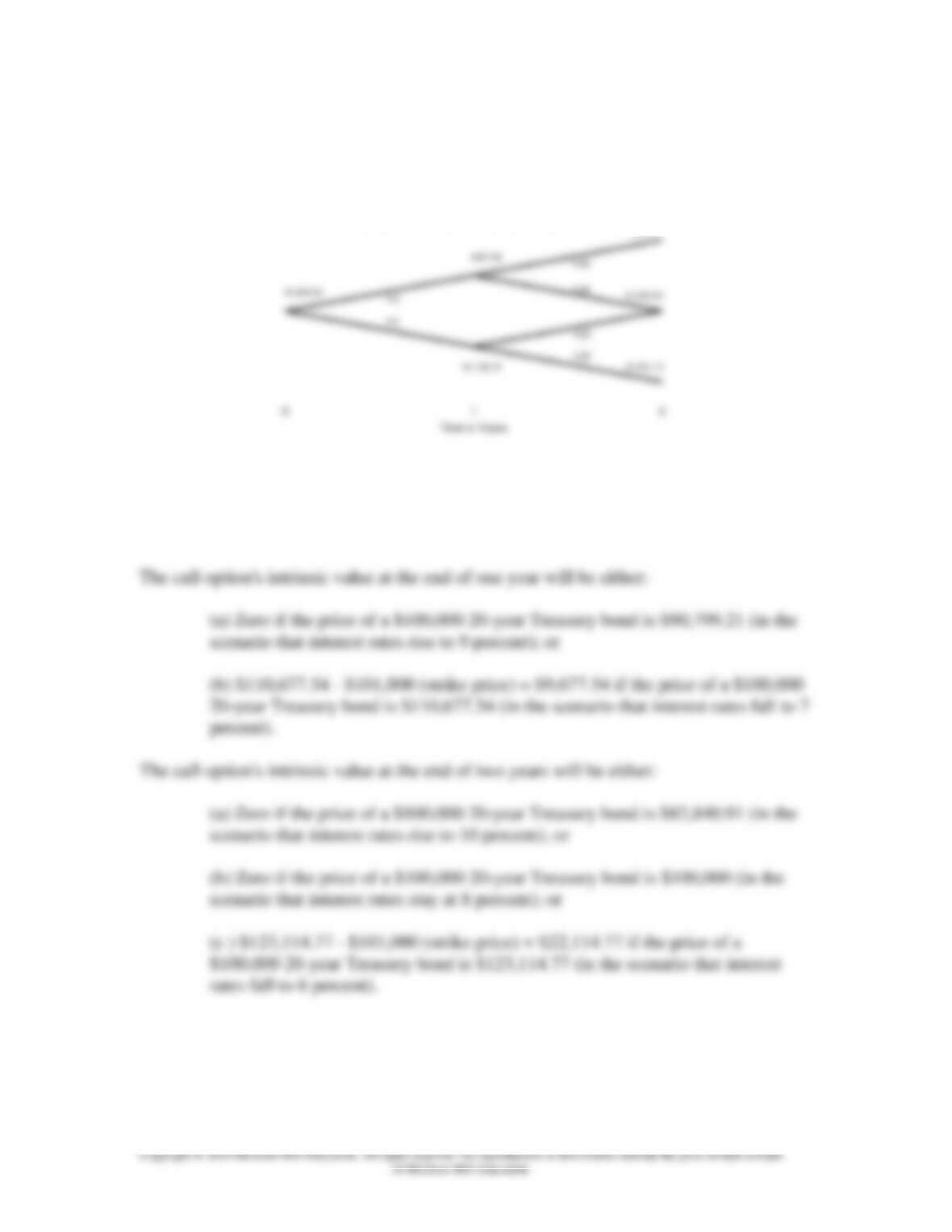
c. What prices are possible on the 20-year T-bonds at the end of year 1 and year 2?
Chapter 23 – Options, Caps, Floors, and Collars
23-9
d. Diagram the prices over the two-year period.
0 1 2
Time in Years
$1,000.00
$907.99
$1,106.78
$828.41
$1,000.00
$1,231.15
0.5
0.5
0.25
0.25
0.25
0.25
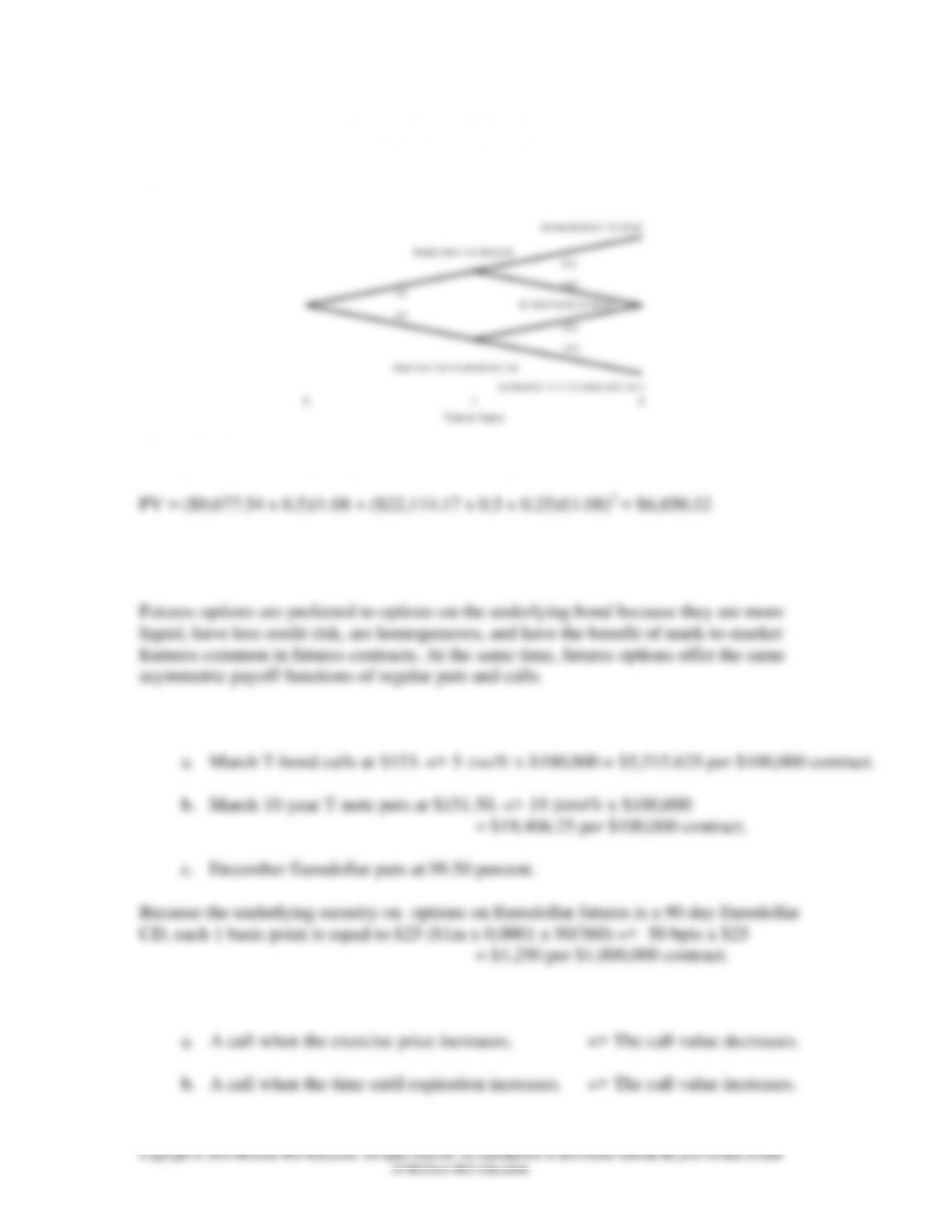
e. If options on $100,000, 20-year, 8 percent coupon Treasury bonds (both puts and
calls) have a strike price of 101, what are the possible (intrinsic) values of the
option position at the end of year 1 and year 2?
Chapter 23 – Options, Caps, Floors, and Collars
23–10
f. Diagram the possible option values.
0 1 2
Time in Years
Max[90,799.21-101,000,0]=$0
Max[110,677.54-101,000,0]=9,677.54
$0=Max(82,840.91-101,000,0)
0.5
0.5
0.25
0.25
0.25
0.25
$0=Max(123,114.77-101,000,0)=$22,114.77
$0=Max(100,000-101,000,0)
g. What is the option premium? (Use an 8 percent discount factor.)
13. Why are options on interest rate futures contracts preferred to options on cash
instruments in hedging interest rate risk?
14. Consider Figure 23-13. What are the prices paid for the following futures options:
15. Consider Figure 23-13 again. What happens to the price of the following?
Chapter 23 – Options, Caps, Floors, and Collars
23–11
Copyright © 2014 McGraw-Hill Education. All rights reserved. No reproduction or distribution without the prior written consent
of McGraw-Hill Education.
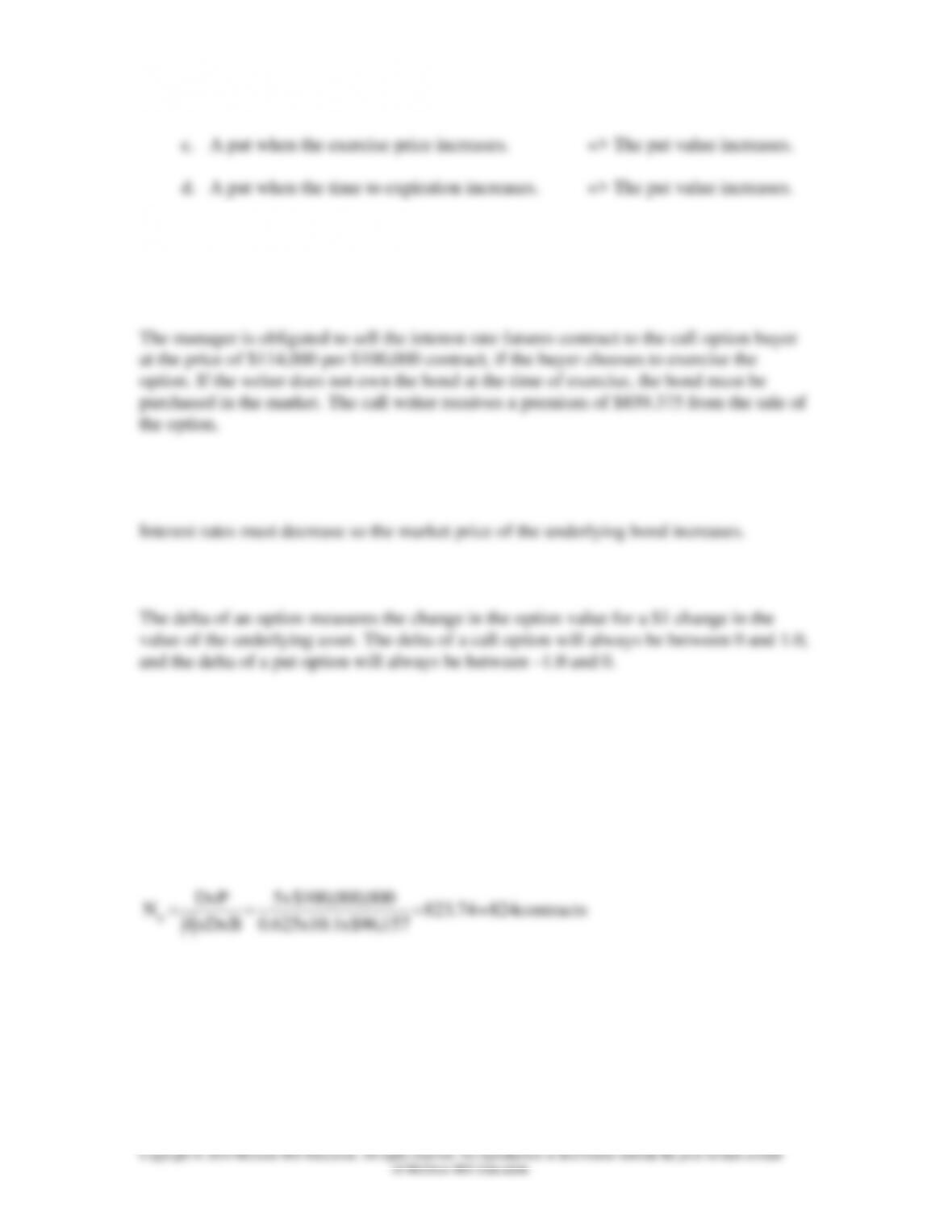
c. A put when the exercise price increases. => The put value increases.
d. A put when the time to expiration increases. => The put value increases.
16. An FI manager writes a call option on a T-bond futures contract with an exercise
price of 11400 at a quoted price of 0-55.
a. What type of opportunities or obligations does the manager have?
b. In what direction must interest rates move to encourage the call buyer to
exercise the option?
17. What is the delta of an option ()?
18. An FI has a $100 million portfolio of six-year Eurodollar bonds that have an 8
percent coupon. The bonds are trading at par and have a duration of five years. The
FI wishes to hedge the portfolio with T-bond options that have a delta of -0.625.
The underlying long-term Treasury bonds for the option have a duration of 10.1
years and trade at a market value of $96,157 per $100,000 of par value. Each put
option has a premium of $3.25 per $100 of face value.
a. How many bond put options are necessary to hedge the bond portfolio?
157,96$x1.10x625.0
xDxB
b. If interest rates increase 100 basis points, what is the expected gain or loss on
the put option hedge?
Chapter 23 – Options, Caps, Floors, and Collars
23–12
Copyright © 2014 McGraw-Hill Education. All rights reserved. No reproduction or distribution without the prior written consent
of McGraw-Hill Education.
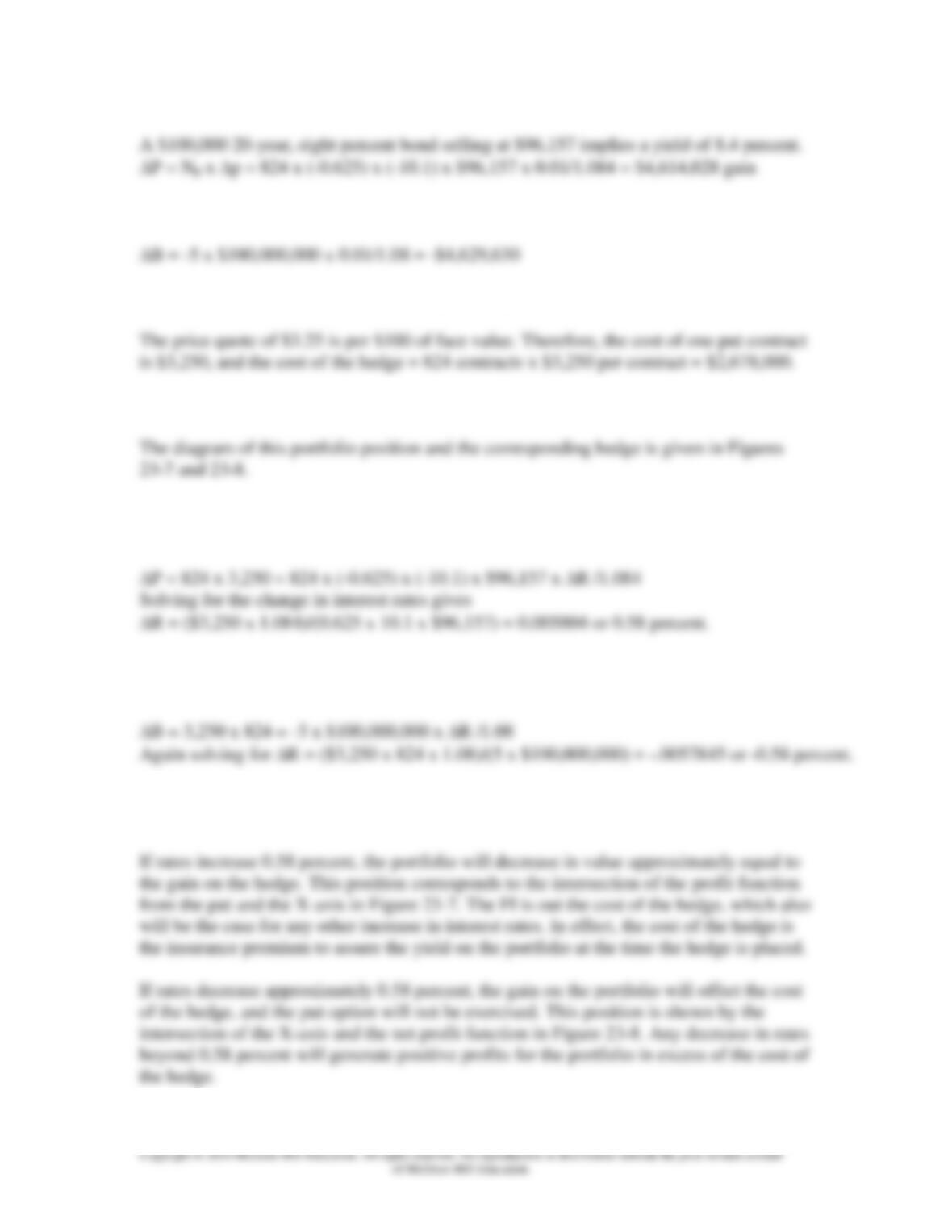
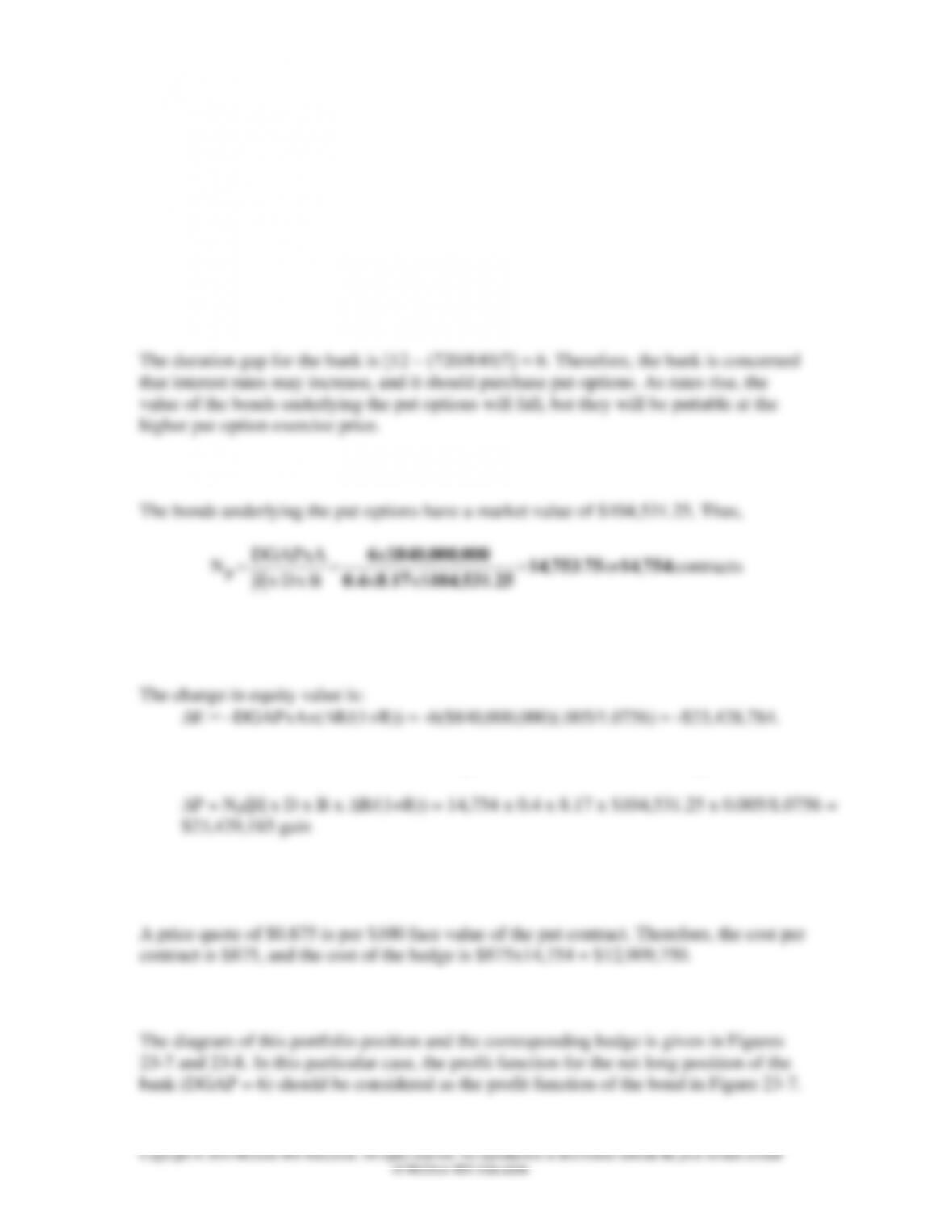
A $100,000 20-year, eight percent bond selling at $96,157 implies a yield of 8.4 percent.
P = Np x p = 824 x (-0.625) x (-10.1) x $96,157 x 0.01/1.084 = $4,614,028 gain
c. What is the expected change in market value on the bond portfolio?
d. What is the total cost of placing the hedge?
e. Diagram the payoff possibilities.
f. How far must interest rates move before the payoff on the hedge will exactly
offset the cost of placing the hedge?
g. How far must interest rates move before the gain on the bond portfolio will
exactly offset the cost of placing the hedge?
h. Summarize the gain, loss, and cost conditions of the hedge on the bond portfolio
in terms of changes in interest rates.
Chapter 23 – Options, Caps, Floors, and Collars
23–13
19. Corporate Bank has $840 million of assets with a duration of 12 years and liabilities
worth $720 million with a duration of seven years. Assets and liabilities are
yielding 7.56 percent. The bank is concerned about preserving the value of its
equity in the event of an increase in interest rates and is contemplating a
macrohedge with interest rate options. The call and put options have a delta () of
0.4 and –0.4, respectively. The price of an underlying T-bond is 104.53125 (104
68/128), its duration is 8.17 years, and its yield to maturity is 7.56 percent.
a. What type of option should Corporate Bank use for the macrohedge?
b. How many options should be purchased?
.,$x.x.
BxDx
2553110417840
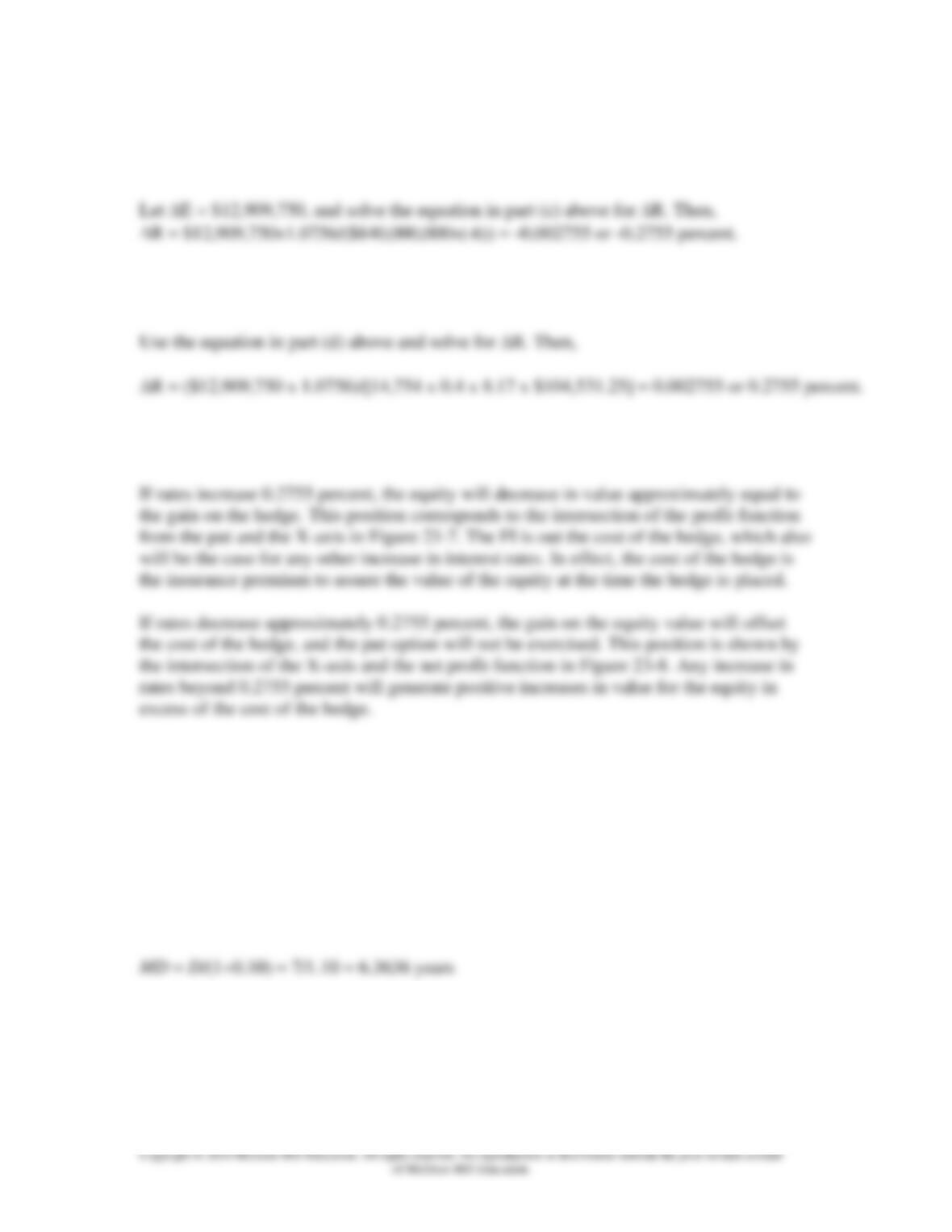
c. What is the effect on the economic value of the equity if interest rates rise 50
basis points?
d. What will be the effect on the hedge if interest rates rise 50 basis points?
e. What will be the cost of the hedge if each option has a premium of $0.875 per
$100 of face value?
f. Diagram the economic conditions of the hedge.
Chapter 23 – Options, Caps, Floors, and Collars
23–14
g. How much must interest rates move against the hedge for the increased value of
the bank to offset the cost of the hedge?
h. How much must interest rates move in favor of the hedge, or against the balance
sheet, before the payoff from the hedge will exactly cover the cost of the hedge?
i. Formulate a management decision rule regarding the implementation of the
hedge.
20. An FI has a $200 million asset portfolio that has an average duration of 6.5 years.
The average duration of its $160 million in liabilities is 4.5 years. Assets and
liabilities are yielding 10 percent. The FI uses put options on T-bonds to hedge
against unexpected interest rate increases. The average delta () of the put options
has been estimated at -0.3 and the average duration of the T-bonds is seven years.
The current market value of the T-bonds is $96,000.
a. What is the modified duration of the T-bonds if the current level of interest rates
is 10 percent?
b. How many put option contracts should the FI purchase to hedge its exposure
against rising interest rates? The face value of the T-bonds is $100,000.