Chapter 22 – Futures and Forwards
23. An FI is planning to hedge its $100 million bond instruments with a cross hedge using
Eurodollar interest rate futures. How would the FI estimate
br = [Rf/(1+Rf) / R/(1+R)]
to determine the exact number of Eurodollar futures contracts to hedge?
24. Village Bank has $240 million worth of assets with a duration of 14 years and liabilities
worth $210 million with a duration of 4 years. In the interest of hedging interest rate risk,
Village Bank is contemplating a macrohedge with interest rate T-bond futures contracts
now selling for 102-21 (32nds). The T-bond underlying the futures contract has a duration
of nine years. If the spot and futures interest rates move together, how many futures
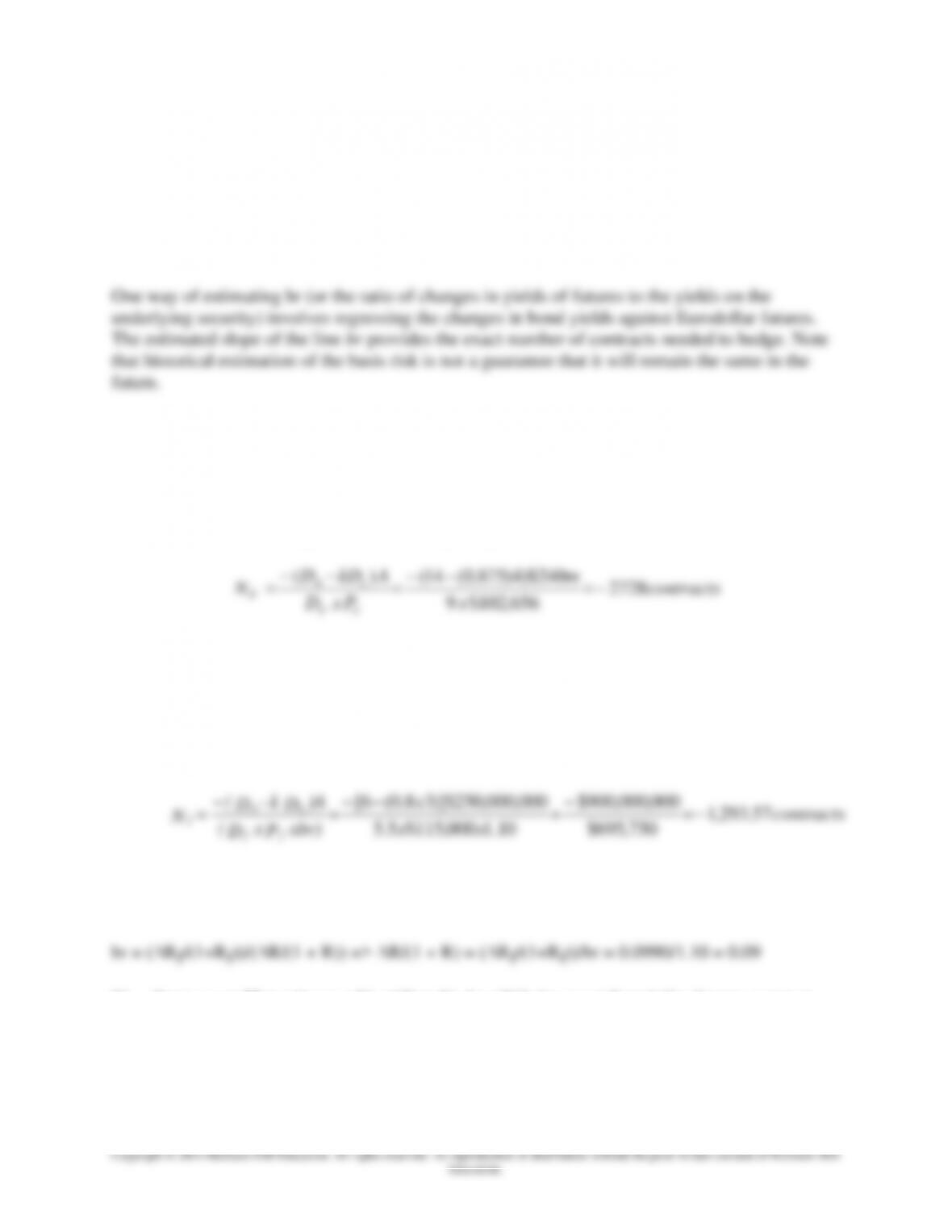
contracts must Village Bank sell to fully hedge the balance sheet?
x
PxD
FF
F2728
656,102$9
25. Assume an FI has assets of $250 million and liabilities of $200 million. The duration of the
assets is six years and the duration of the liabilities is three years. The price of the futures
contract is $115,000 and its duration is 5.5 years.
a. What number of futures contracts is needed to construct a perfect hedge if br = 1.10?
Chapter 22 – Futures and Forwards
22–14
Copyright © 2014 McGraw-Hill Education. All rights reserved. No reproduction or distribution without the prior written consent of McGraw-Hill
Education.
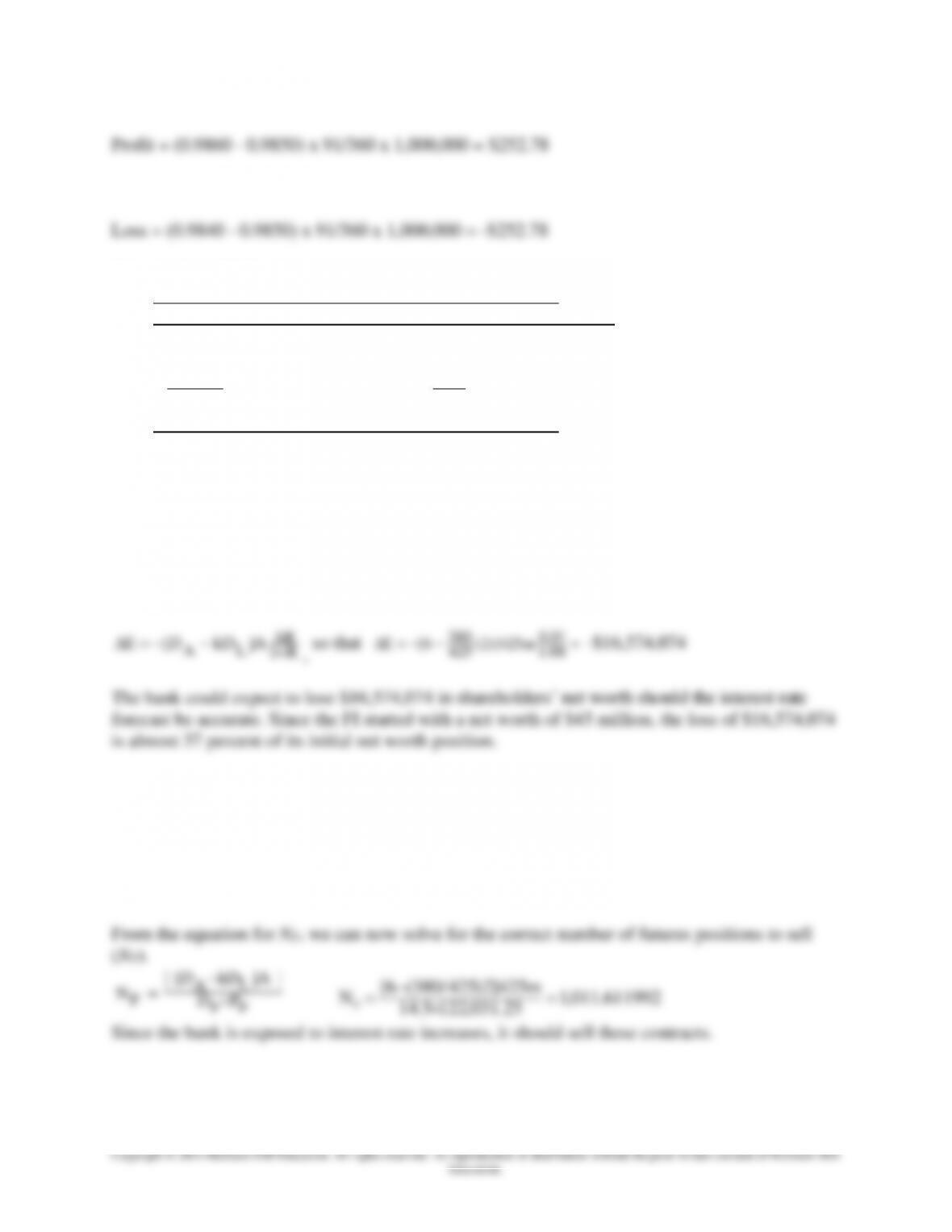
Profit = (0.9860 – 0.9850) x 91/360 x 1,000,000 = $252.78
b. What is the loss or gain if the price at reversal is 98.40?
27. Dudley Hill Bank has the following balance sheet:
Assets (in millions) Liabilities and Equity (in millions)
A $425 L $380
E 45
.
$425 $425
Further, DA = 6 years
DL = 2 years
The bank manager receives information from an economic forecasting unit that interest
rates are expected to rise from 8 to 9 percent over the next six months.
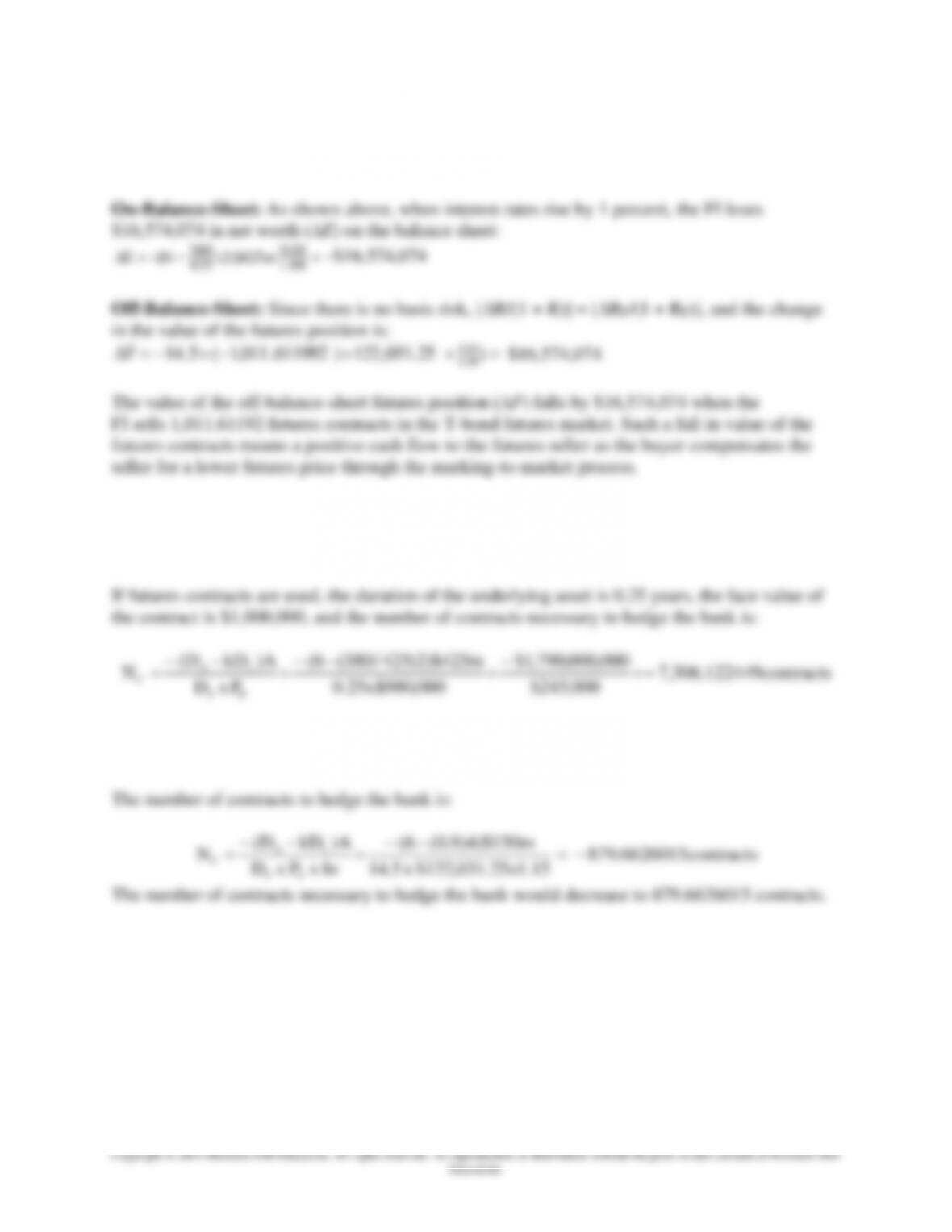
a. Calculate the potential loss to Dudley Hill’s net worth (E) if the forecast of rising rates
proves to be true.
b. Suppose the manager of Dudley Hill Bank wants to hedge this interest rate risk with T-
bond futures contracts. The current futures price quote is $122.03125 per $100 of face
value for the benchmark 20-year, and the minimum contract size is $100,000, so PF
equals $122,031.25. The duration of the deliverable bond is 14.5 years. That is, DF =
14.5 years. How many futures contracts will be needed? Should the manager buy or sell
these contracts? Assume no basis risk.
Chapter 22 – Futures and Forwards
22–15
c. Verify that selling T-bond futures contracts will indeed hedge the FI against a sudden
increase in interest rates from 8 to 9 percent, a 1 percent, interest rate shock.
d. If the bank had hedged with Eurodollar futures contracts that had a market value of $98
per $100 of face value, how many futures contracts would have been necessary to
hedge fully the balance sheet?
000,245$
000,980$x25.0
PxD
FF
F−=
e. How would your answer for part (b) change if the relationship of the price sensitivity of
futures contracts to the price sensitivity of underlying bonds were br = 1.15?
f. Verify that selling T-bond futures contracts will indeed hedge the FI against a sudden
increase in interest rates from 8 to 9 percent, a 1 percent, interest rate shock. Assume
the yield on the T-bond underlying the futures contract is 8.45 percent as the bank
enters the hedge, and rates rise by 1.154792 percent.
Chapter 22 – Futures and Forwards
22–16
Copyright © 2014 McGraw-Hill Education. All rights reserved. No reproduction or distribution without the prior written consent of McGraw-Hill
Education.
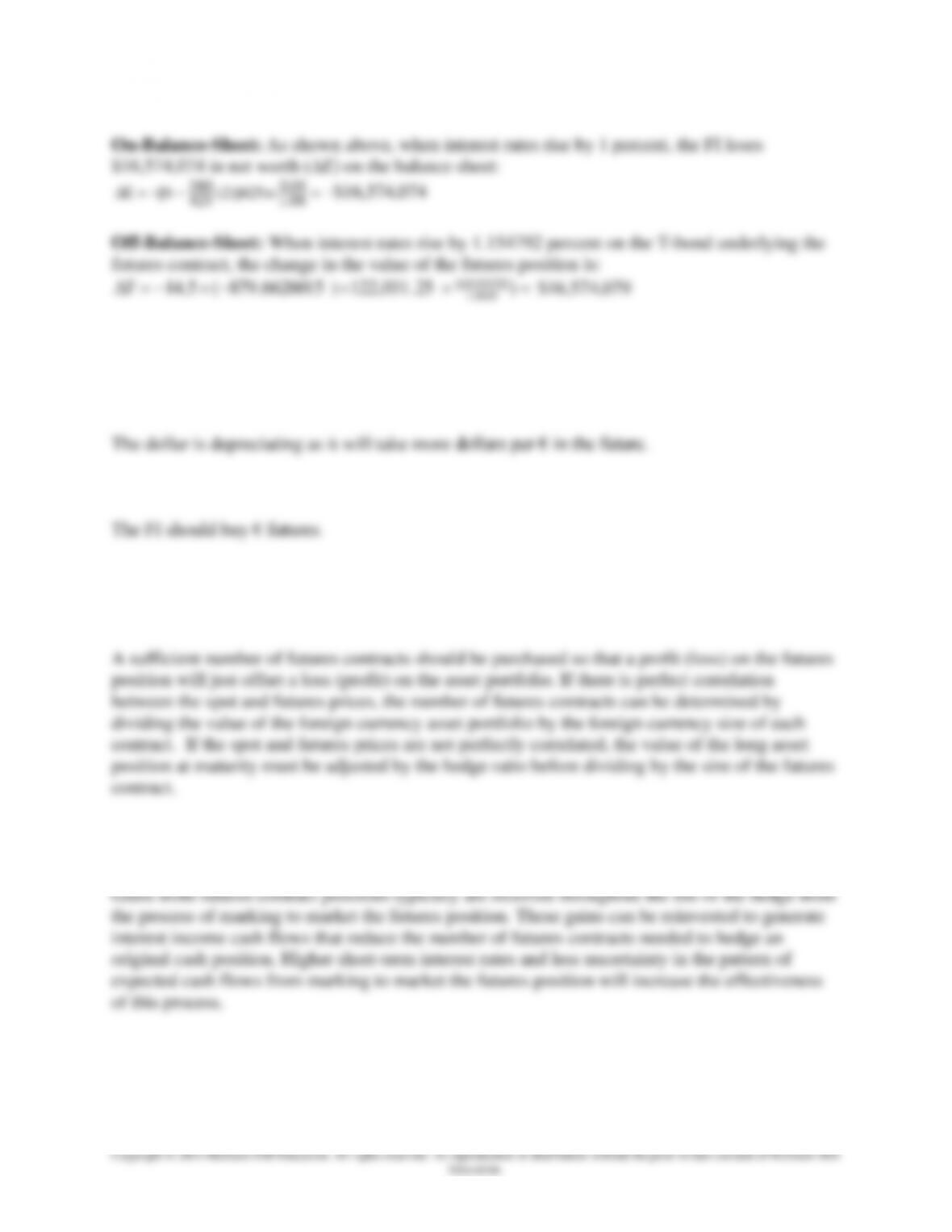
On-Balance-Sheet: As shown above, when interest rates rise by 1 percent, the FI loses
$16,574,074 in net worth (∆E) on the balance sheet:
=−−= 08.1
01.0
m425)]2(
425
380
6[E
-$16,574,074
Off-Balance-Sheet: When interest rates rise by 1.154792 percent on the T-bond underlying the
futures contract, the change in the value of the futures position is:
=−−= ) 25.031,122) 6626015.879(14.5ΔF 1.0845
0.01154792
$16,574,079
28. An FI has an asset investment in euros. The FI expects the exchange rate of $/€ to increase
by the maturity of the asset.
a. Is the dollar appreciating or depreciating against the euro?
b. To fully hedge the investment, should the FI buy or sell euro futures contracts?
c. If there is perfect correlation between changes in the spot and futures contracts, how
should the FI determine the number of contracts necessary to hedge the investment
fully?
29. What is meant by tailing the hedge? What factors allow an FI manager to tail the hedge
effectively?
Chapter 22 – Futures and Forwards
22–17
Education.
30. What does the hedge ratio measure? Under what conditions is this ratio valuable in
determining the number of futures contracts necessary to hedge fully an investment in
another currency?
31. What technique is commonly used to estimate the hedge ratio? What statistical measure is
an indicator of the confidence that should be placed in the estimated hedge ratio? What is
the interpretation if the estimated hedge ratio is greater than 1? Less than 1?
32. An FI has assets denominated in British pounds of $125 million and pound liabilities of
$100 million. The exchange rate of dollars for pounds is currently $1.60/£.
a. What is the FI’s net exposure?
b. Is the FI exposed to a dollar appreciation or depreciation?
c. How can the FI use futures or forward contracts to hedge its FX rate risk?
d. If a futures contract is currently trading at $1.55/£, what is the number of futures
contracts that must be utilized to fully hedge the FI‘s currency risk exposure? Assume
the contract size on the British pound futures contract is £62,500.
Chapter 22 – Futures and Forwards
22–18
e. If the British pound exchange rate falls from $1.60/£ to $1.50/£, what will be the
impact on the FI’s cash position?
f. If the British pound futures exchange rate falls from $1.55/£ to $1.45/£, what will be
the impact on the FI’s futures position?
The gain on the short futures hedge is:
g. Using the information in parts (e) and (f ), what can you conclude about basis risk?
33. An FI is planning to hedge its one-year, 100 million Swiss franc (SF)-denominated loan
against exchange rate risk. The current spot rate is $0.60/SF. A 1-year SF futures contract
is currently trading at $0.58/SF. SF futures are sold in standardized units of SF125,000.
a. Should the FI be worried about the SF appreciating or depreciating?
b. Should the FI buy or sell futures to hedge against exchange rate risk exposure?
c. How many futures contracts should the FI buy or sell if a regression of past changes in
the spot exchange rates on changes in future exchange rates generates an estimated
slope of 1.4?
d. Show exactly how the FI is hedged if it repatriates its principal of SF100 million at
year-end, the spot exchange rate of SF at year-end is $0.55/SF, and the forward
exchange rate is $0.5443/SF.
Chapter 22 – Futures and Forwards
22–19
Education.
34. A U.S. FI has a long position in £75,500,000 assets funded with U.S. dollar denominated
liabilities. The FI manager is concerned about the £ appreciating relative to the dollar and is
considering a hedge of this FX risk using £ futures contracts. The manager has regressed
recent changes in spot £ exchange rates on changes in £ futures contracts. The resulting
regression equation is: ΔSt = 0.09 + 1.5ΔFt. Further, the Cov(ΔSt, ΔFt) was found to be
0.06844, σΔSt = 0.3234, and σΔft = 0.2279. Pound futures contracts are sold in standardized
units of £62,500. Calculate the number of futures contracts needed to hedge the risk of the
£75,500,000 asset. Calculate the hedging effectiveness of these futures contracts. To what
extent can the manager have confidence that the correct hedge ratio is being used to hedge
the FI’s FX risk position?
FI’s FX risk position.
35. An FI has made a loan commitment of SF10 million that is likely to be taken down in six
months. The current spot rate is $0.60/SF.
a. Is the FI exposed to the dollar’s depreciating or appreciating relative to the SF? Why?
b. If the spot rate six months from today is $0.64/SF, what amount of dollars is needed if
the loan is taken down and the FI is unhedged?
c. If the FI decides to hedge using SF futures, should it buy or sell SF futures?
Chapter 22 – Futures and Forwards
22–20
d. A six-month SF futures contract is available for $0.61/SF. What net amount would be
needed to fund the loan at the end of six months if the FI had hedged using the SF10
million futures contract? Assume that futures prices are equal to spot prices at the time
of payment (i.e., at maturity).
36. A U.S. FI has assets denominated in Swiss francs (SF) of 75 million and liabilities of 125
million. The spot rate is $0.6667/SF, and one-year futures are available for $0.6579/SF.
a. What is the FI’s net exposure?
b. Is the FI exposed to dollar appreciation or depreciation relative to the SF?
c. If the SF spot rate changes from $0.6667/SF to $0.6897/SF, how will this impact the
FI’s currency exposure? Assume no hedging.
d. What is the number of futures contracts necessary to fully hedge the currency risk
exposure of the FI? The contract size is SF125,000 per contract.
e. If the SF futures exchange rate falls from $0.6579/SF to $0.6349/SF, what will be the
impact on the FI’s futures position?
37. What is a credit forward? How is it structured?
Chapter 22 – Futures and Forwards
22–21
Education.
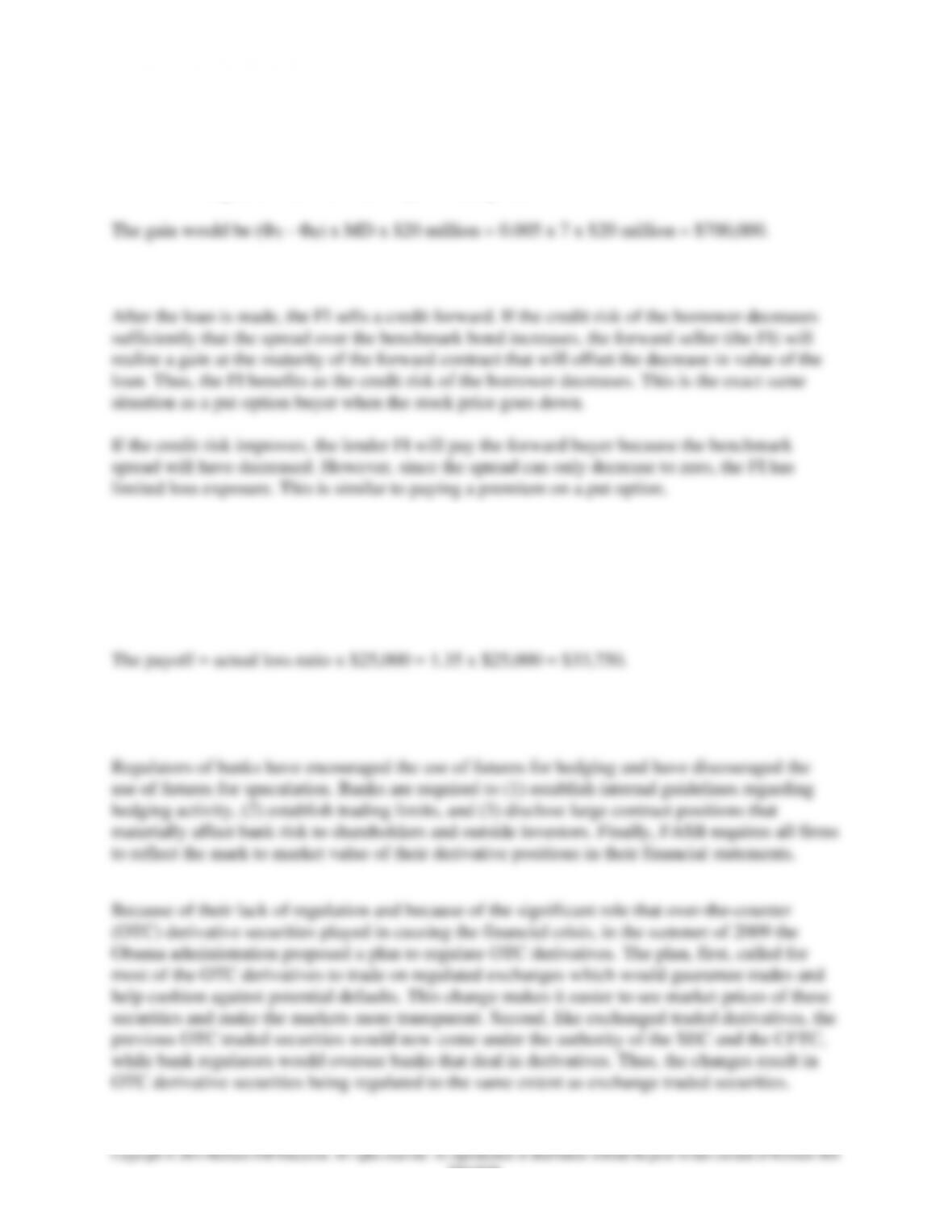
38. What is the gain on the purchase of a $20 million credit forward contract with a modified
duration of seven years if the credit spread between a benchmark Treasury bond and a
borrowing firm’s debt decreases by 50 basis points?
39. How is selling a credit forward similar to buying a put option?
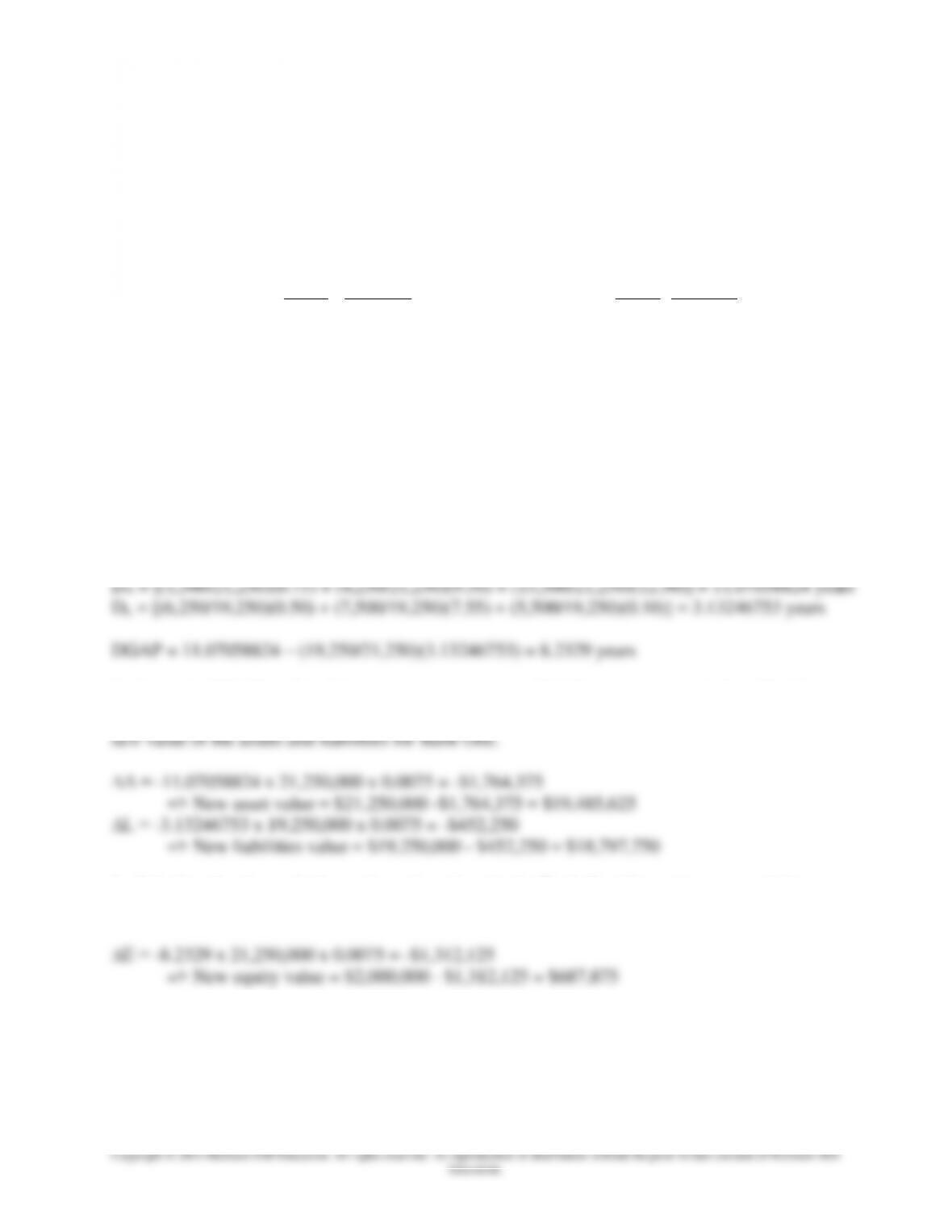
40. A property-casualty (PC) insurance company has purchased catastrophe futures contracts to
hedge against losses during the hurricane season. At the time of purchase, the market
expected a loss ratio of 0.75. After processing claims from a severe hurricane, the PC
actually incurred a loss ratio of 1.35. What amount of profit did the PC make on each
$25,000 futures contract?
41. What is the primary goal of regulators in regard to the use of futures by FIs? What
guidelines have regulators given banks for trading in futures and forwards?
Chapter 22 – Futures and Forwards
22–22
Integrated Mini Case: HEDGING INTEREST RATE RISK WITH FUTURES CONTRACTS
Use the following December 31, 2014 market value balance sheet for Bank One to answer the
questions below.
Assets (in thousands of $s) Liabilities/Equity (in thousands of $s)
Value Duration Value Duration
T-bills $1,500 0.75 NOW accounts $ 6,250 0.50
T-bonds 4,250 9.50 CDs 7,500 7.55
Loans 15,500 12.50 Federal funds 5,500 0.10
Equity 2,000
The bank’s manager thinks rates will increase by 0.50 percent in the next 3 months. To hedge
this interest rate risk the manager will use June T-bond futures contracts. The T-bonds
underlying the futures contracts have a maturity = 15 years, a duration = 14.25 years, and a price
= 108-10 or $108,312.50. Assume that interest rate changes in the futures market relative to the
cash market are such that br = 0.885.
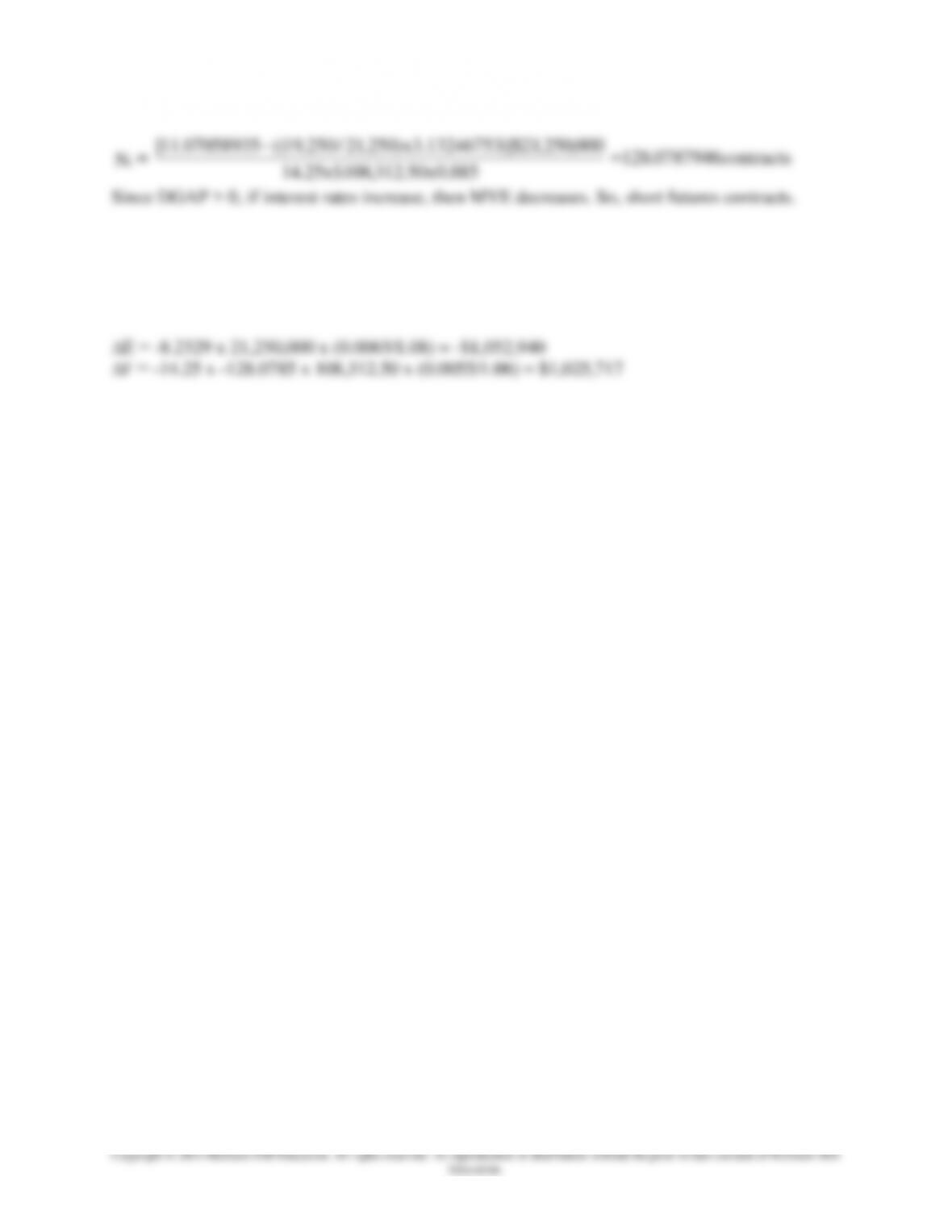
1. Calculate the leverage adjusted duration gap (DGAP) for Bank One.
2. Using the DGAP model, if interest rates on assets and liabilities increase such that RA/(1 +
RA) = RL/(1 +RL) = 0.0075, calculate the change in the value of assets and liabilities and the
3. Calculate the change in the market value of equity for Bank One if rates increase such that
R/(1 +R) = 0.0075.
4. Calculate the correct number of futures contracts needed to hedge the bank’s interest rate risk
(do not round to the nearest whole contract). Make sure you specify whether you should enter the
hedge with a short or long futures position.
Chapter 22 – Futures and Forwards
22–23
Copyright © 2014 McGraw-Hill Education. All rights reserved. No reproduction or distribution without the prior written consent of McGraw-Hill
Education.
contracts0787946.128
885.0x50.312,108$x25.14
000,250,21)]$13246753.3x)250,21/250,19((07058935.11[
=
Nf=
−
Since DGAP > 0, if interest rates increase, then MVE decreases. So, short futures contracts.
5. Calculate the change in the bank’s market value of equity and the change in the value of the
T-bond futures position for the bank if interest rates increase by 0.55 percent from the current
rate of 6 percent on the T-bonds and increase 0.65 percent from the current rate of 8 percent on
the balance sheet assets and liabilities.