Chapter 22 – Futures and Forwards
22-1
Solutions for End-of-Chapter Questions and Problems: Chapter Twenty-Two
1. What are derivative contracts? What is the value of derivative contracts to the managers of
FIs? Which type of derivative contracts had the highest notional value outstanding among
all U.S. banks as of June 2012?
2. What are some of the major differences between futures and forward contracts? How do
these contracts differ from spot contracts?
A spot contract is an exchange of cash, or immediate payment, for financial assets, or any other
type of assets, at the time the agreement to transact business is made, i.e., at time 0. Futures and
3. What is a naive hedge? How does a naive hedge protect an FI from risk?
A hedge involves protecting the price of or return on an asset from adverse changes in price or
Chapter 22 – Futures and Forwards
22-2
4. An FI holds a 15-year, $10 million par value bond that is priced at 104 with a yield to
maturity of 7 percent. The bond has a duration of eight years, and the FI plans to sell it after
two months. The FI’s market analyst predicts that interest rates will be 8 percent at the time
of the desired sale. Because most other analysts are predicting no change in rates, two-
at 96.2243 and selling the bonds to the counterparty at 104 under the terms of the forward
5. Contrast the position of being short with that of being long in futures contracts.
To be short in futures contracts means that you have agreed to sell the underlying asset at a
6. Suppose an FI purchases a Treasury bond futures contract at 95.
a. What is the FI’s obligation at the time the futures contract is purchased?
b. If an FI purchases this contract, in what kind of hedge is it engaged?
c. Assume that the Treasury bond futures price falls to 94. What is the loss or gain?
Chapter 22 – Futures and Forwards
22-3
d. Assume that the Treasury bond futures price rises to 97. Mark-to-market the position.
7. Long Bank has assets that consist mostly of 30-year mortgages and liabilities that are short-
term demand and time deposits. Will an interest rate futures contract the bank buys add to
or subtract from the bank’s risk?
8. In each of the following cases, indicate whether it would be appropriate for an FI to buy or
sell a forward contract to hedge the appropriate risk.
a. A commercial bank plans to issue CDs in three months.
b. An insurance company plans to buy bonds in two months.
c. A savings bank is going to sell Treasury securities it holds in its investment portfolio
next month.
d. A U.S. bank lends to a French company. The loan is payable in euros.
e. A finance company has assets with a duration of six years and liabilities with a duration
of 13 years.
Chapter 22 – Futures and Forwards
22-4
9. The duration of a 20-year, 8 percent coupon Treasury bond selling at par is 10.292 years.
The bond’s interest is paid semiannually, and the bond qualifies for delivery against the
Treasury bond futures contract.
a. What is the modified duration of this bond?
b. What is the impact on the Treasury bond price if market interest rates increase 50 basis
points?
c. If you sold a Treasury bond futures contract at 95 and interest rates rose 50 basis points,
what would be the change in the value of your futures position?
d. If you purchased the bond at par and sold the futures contract, what would be the net
value of your hedge after the increase in interest rates?
10. What are the differences between a microhedge and a macrohedge for a FI? Why is it
generally more efficient for FIs to employ a macrohedge than a series of microhedges?
A microhedge uses a derivative contract such as a forward or futures contract to hedge the risk
exposure of a specific transaction, while a macrohedge is a hedge of the duration gap of the
Chapter 22 – Futures and Forwards
22-5
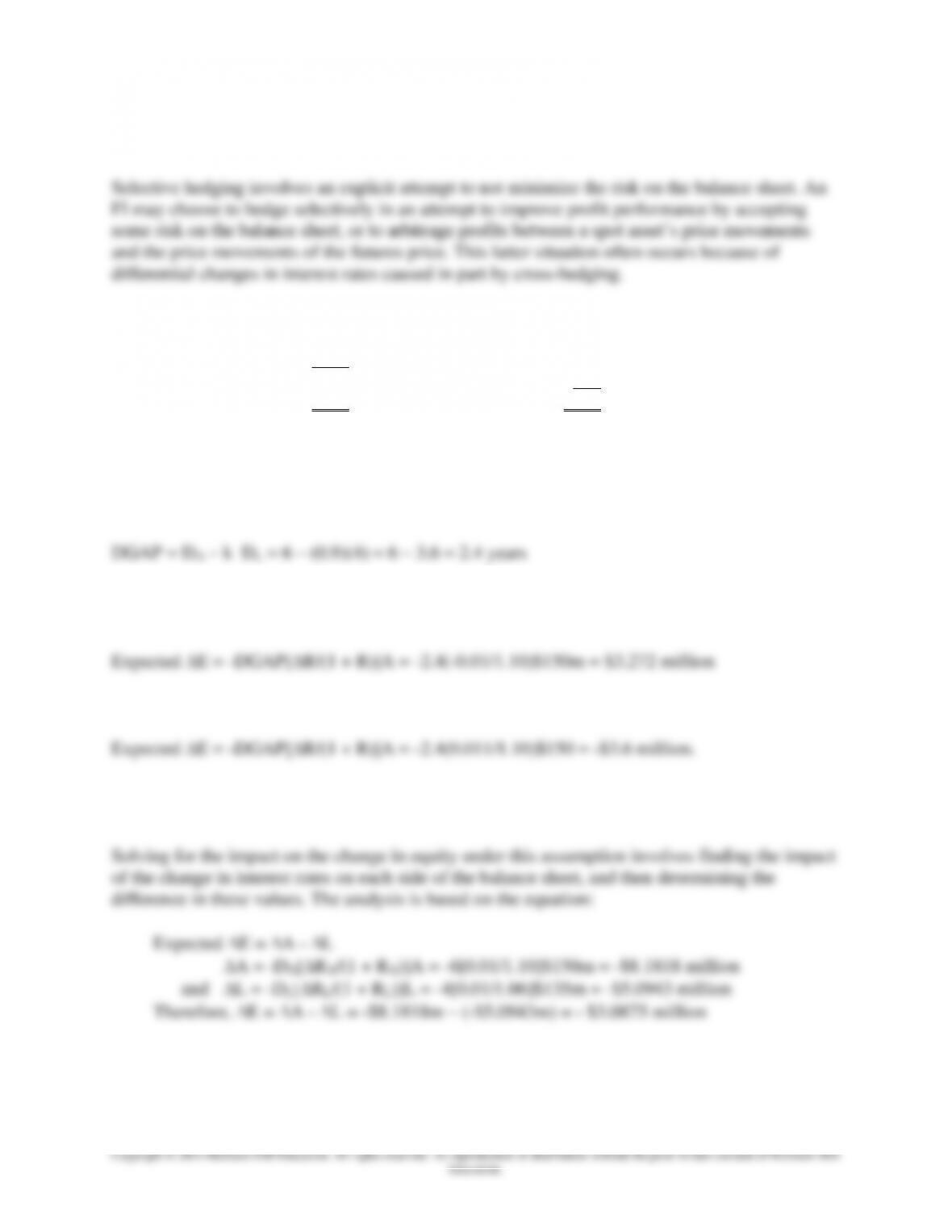
11. What are the reasons why an FI may choose to hedge selectively its portfolio?
12. Hedge Row Bank has the following balance sheet (in millions):
Assets $150 Liabilities $135
Equity 15
Total $150 Total $150
The duration of the assets is six years and the duration of the liabilities is four years. The
bank is expecting interest rates to fall from 10 percent to 9 percent over the next year.
a. What is the duration gap for Hedge Row Bank?
b. What is the expected change in net worth for Hedge Row Bank if the forecast is
accurate?
c. What will be the effect on net worth if interest rates increase 110 basis points?
d. If the existing interest rate on the liabilities is 6 percent, what will be the effect on net
worth of a 1 percent increase in interest rates?
13. For a given change in interest rates, why is the sensitivity of the price of a Treasury bond
futures contract greater than the sensitivity of the price of a Treasury bill futures contract?
Chapter 22 – Futures and Forwards
22-6
Copyright © 2014 McGraw-Hill Education. All rights reserved. No reproduction or distribution without the prior written consent of McGraw-Hill
Education.
The price sensitivity of a futures contract depends on the duration of the asset underlying the
contract. In the case of a T-bill contract, the duration is 0.25 years. In the case of a T-bond
contract, the duration is much longer.
14. What is the meaning of the Treasury bond futures price quote 101-130?
15. What is meant by fully hedging the balance sheet of an FI?
16. Tree Row Bank has assets of $150 million, liabilities of $135 million, and equity of $15
million. The asset duration is six years and the duration of the liabilities is four years.
Market interest rates are 10 percent. Tree Row Bank wishes to hedge the balance sheet with
Eurodollar futures contracts, which currently have a price quote of $96 per $100 face value
for the benchmark three-month Eurodollar CD underlying the contract. The current rate on
three-month Eurodollar CDs is 4.0 percent and the duration of these contracts is 0.25 years.
a. Should the bank go short or long on the futures contracts to establish the correct
macrohedge?
b. Assuming no basis risk, how many contracts are necessary to fully hedge the bank?
The number of contracts to hedge the bank is:
000,000,1$x96.0x25.0
PxD
FF
F−=
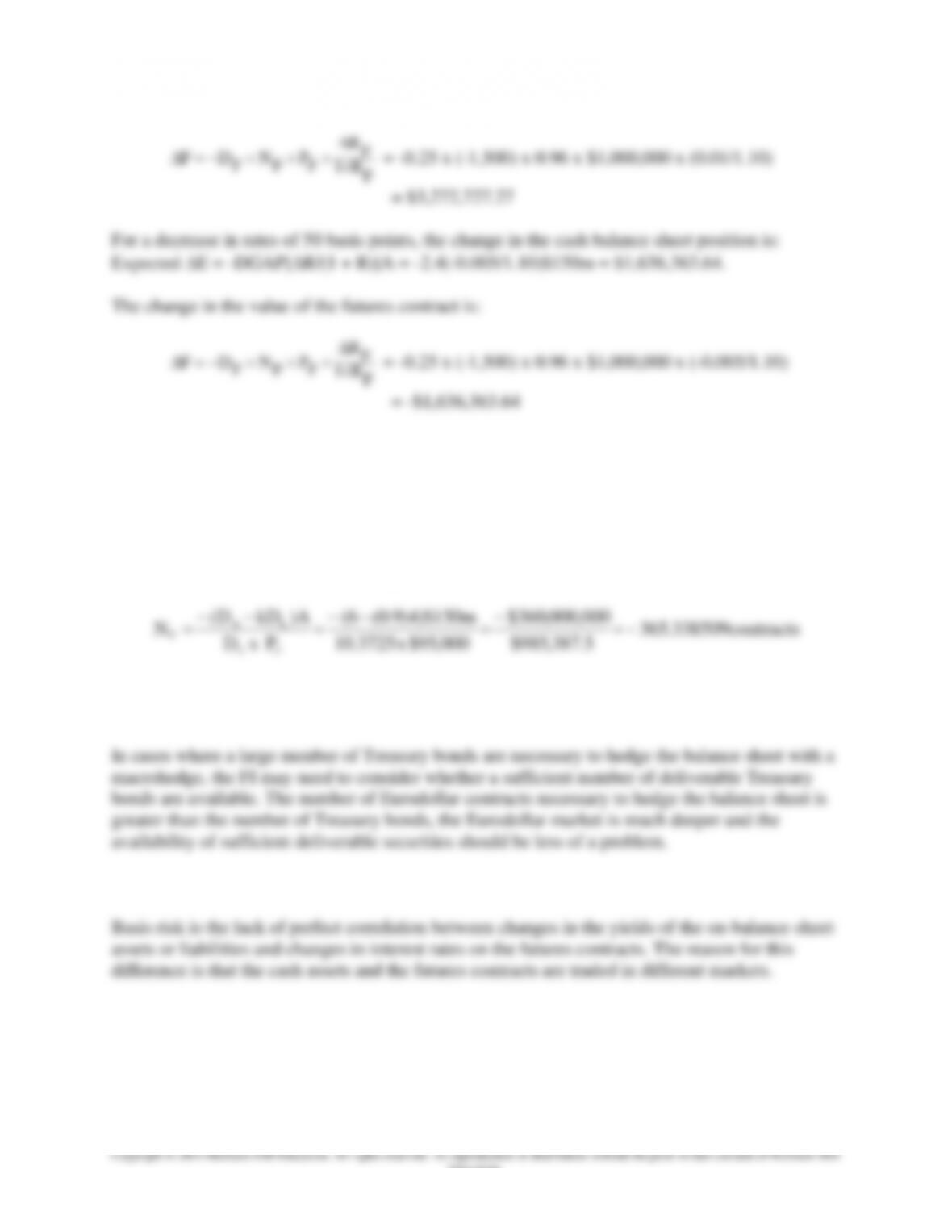
c. Verify that the change in the futures position will offset the change in the cash balance
sheet position for a change in market interest rates of plus 100 basis points and minus
50 basis points.
Chapter 22 – Futures and Forwards
22-7
Education.
d. If the bank had hedged with Treasury bond futures contracts that had a market value of
$95 per $100 of face value, a yield of 8.5295 percent, and a duration of 10.3725 years,
how many futures contracts would have been necessary to hedge fully the balance
sheet? Assume no basis risk.
If Treasury bond futures contracts are used, the face value of the contract is $100,000, and the
number of contracts necessary to hedge the bank is:
5.387,985$
000,95$x3725.10
P xD
FF
F−=
e. What additional issues should be considered by the bank in choosing between
Eurodollar or T-bond futures contracts?
17. What is basis risk? What are the sources of basis risk?
18. How would your answer for part (b) in problem 16 change if the relationship of the price
sensitivity of futures contracts to the price sensitivity of underlying bonds were br = 0.92?
The number of contracts to hedge the bank is:
Chapter 22 – Futures and Forwards
22-8
Copyright © 2014 McGraw-Hill Education. All rights reserved. No reproduction or distribution without the prior written consent of McGraw-Hill
Education.
contracts434783.630,1
92.0x000,000,1$x96.0x25.0
m150)$4)9.0(6(
br x PxD
A)kDD(
N
FF
LA
F−=
−−
=
−−
=
The number of contracts necessary to hedge the bank would increase to 1,630.434783 contracts.
19. Reconsider Tree Row Bank in problem 16 but assume that the cost rate on the liabilities is
6 percent. On-balance-sheet rates are expected to increase by 100 basis points. Further,
assume there is basis risk such that rates on three-month Eurodollar CDs are expected to
change by 0.10 times the rate change on assets and liabilities. That is, RF = 0.10 x R.
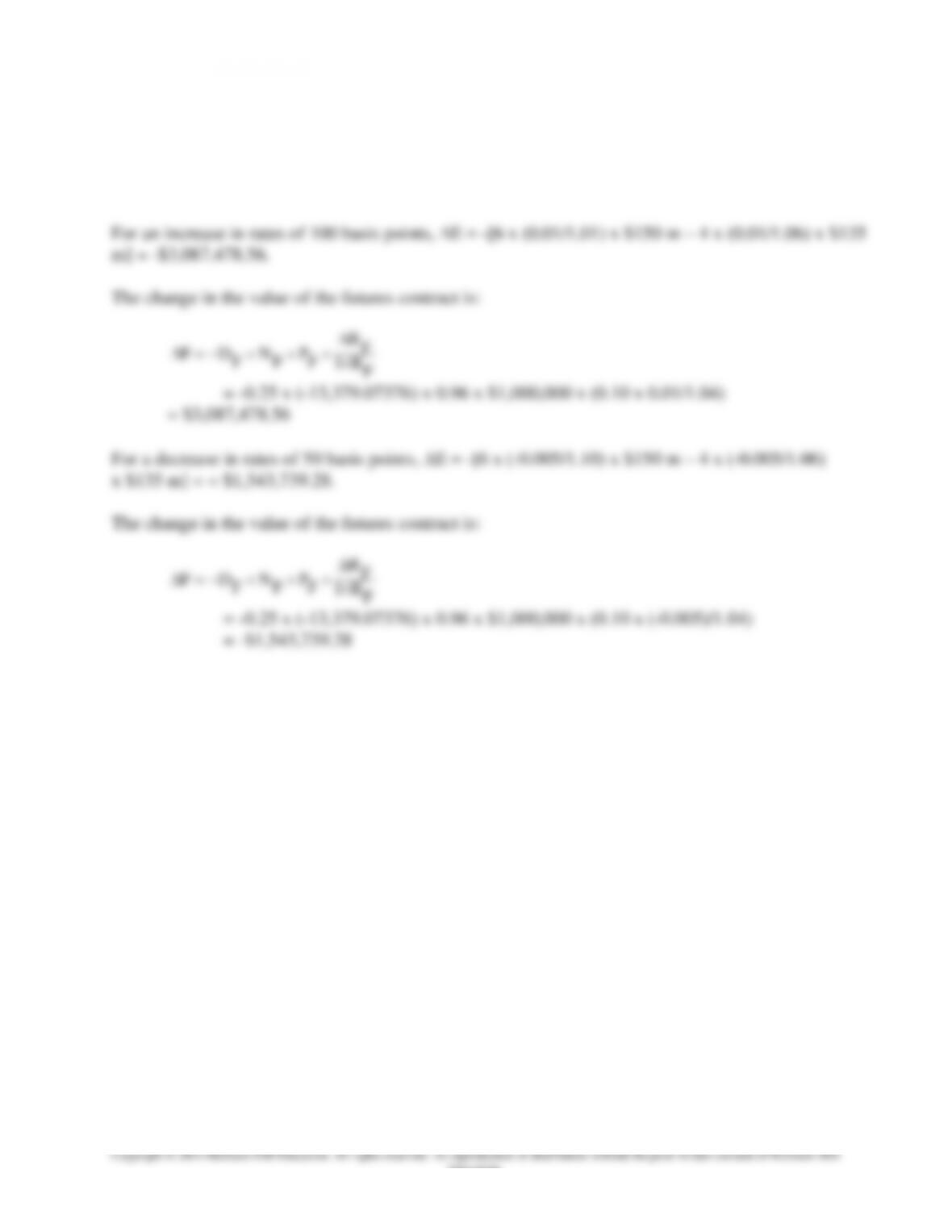
a. How many contracts are necessary to fully hedge the bank?
Chapter 22 – Futures and Forwards
22-9
Education.
b. Verify that the change in the futures position will offset the change in the cash balance
sheet position for a change in market interest rates of plus 100 basis points and minus
50 basis points.
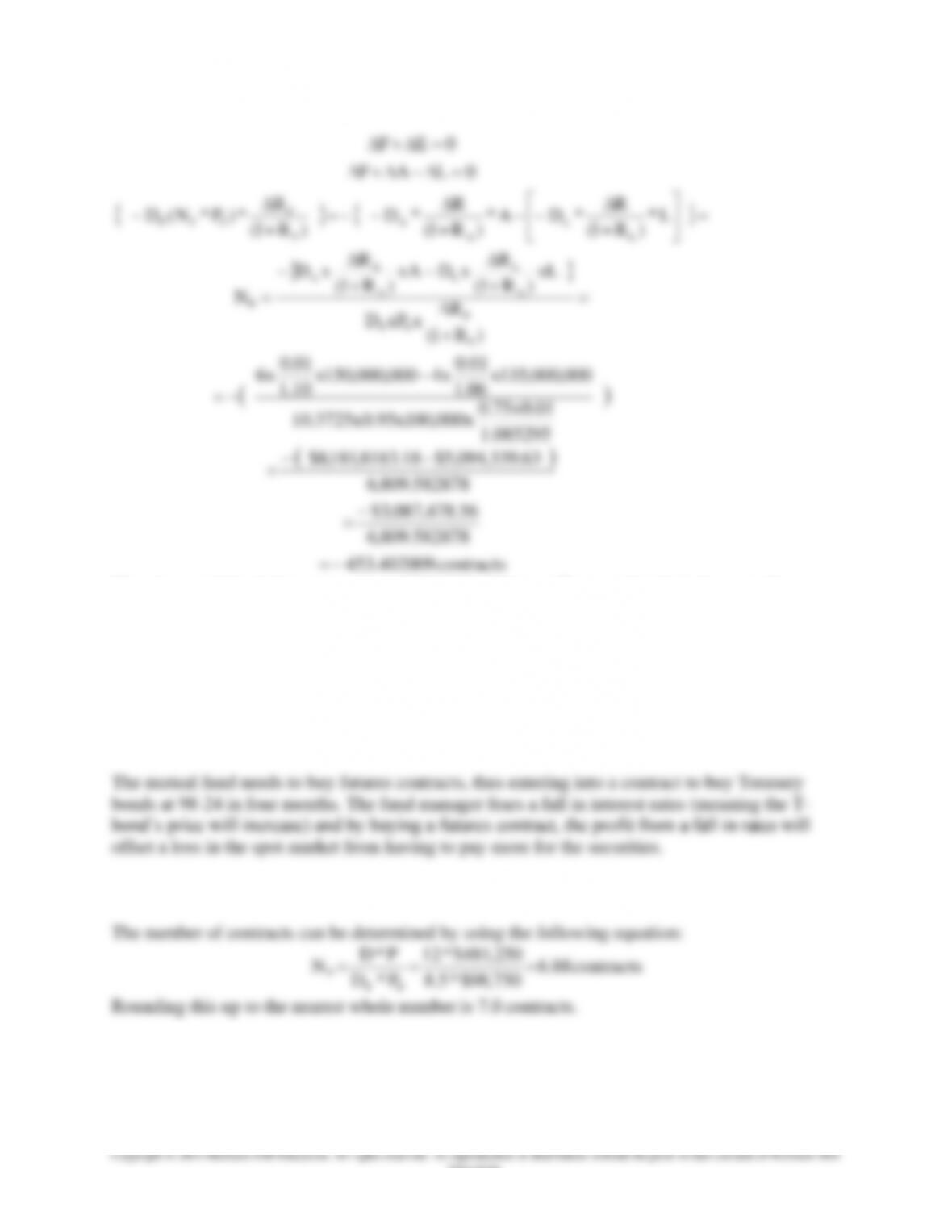
c. If the bank had hedged with Treasury bond futures contracts that had a market value of $95
per $100 of face value, a yield to maturity of 8.5295 percent, and a duration of 10.3725
years, how many futures contracts would have been necessary to fully hedge the balance
sheet? Assume there is basis risk such that rates on T-bonds are expected to change by 0.75
times the rate change on assets and liabilities. That is, RF = 0.75 x R.
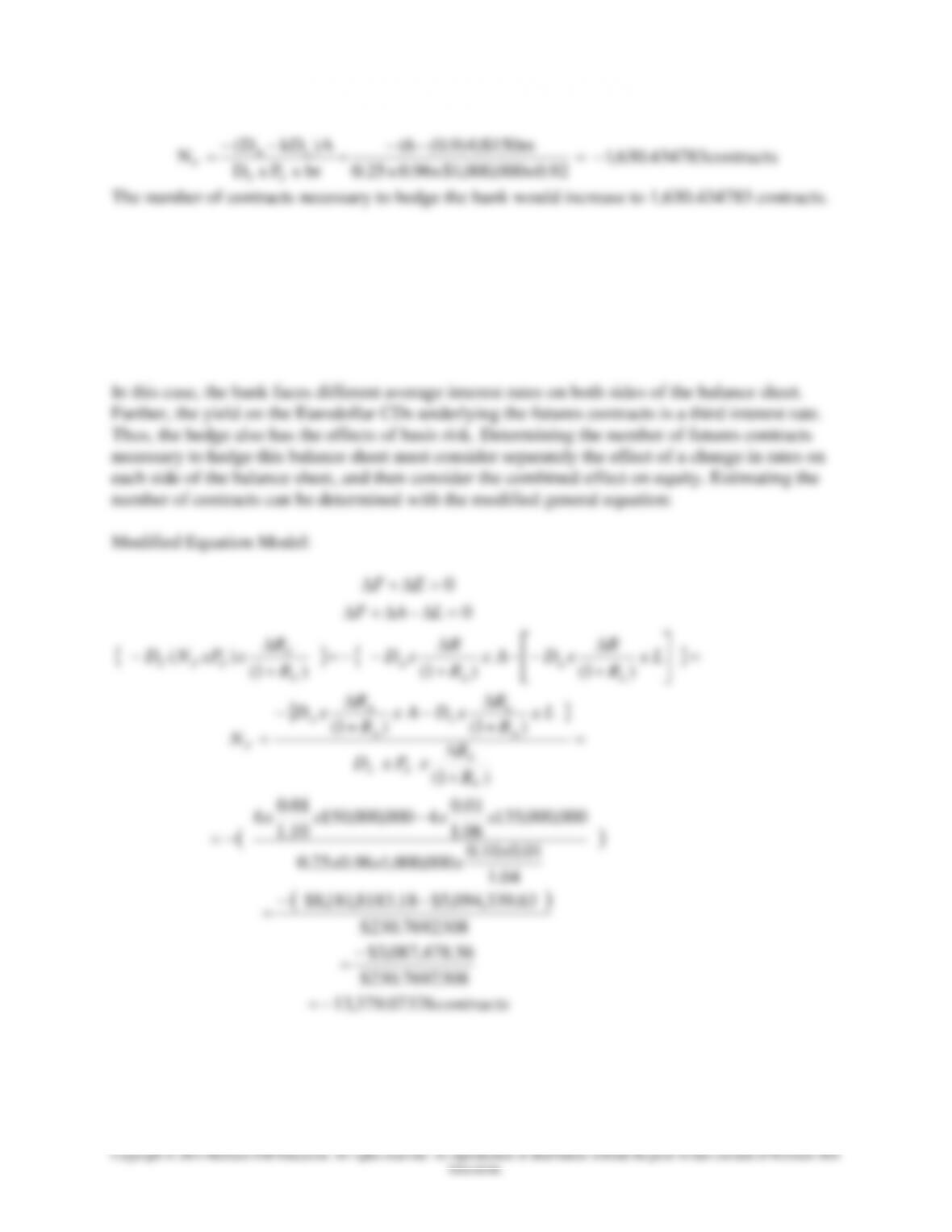
Estimating the number of contracts can be determined with the modified general equation:
Modified Equation Model:
Chapter 22 – Futures and Forwards
22–10
Education.
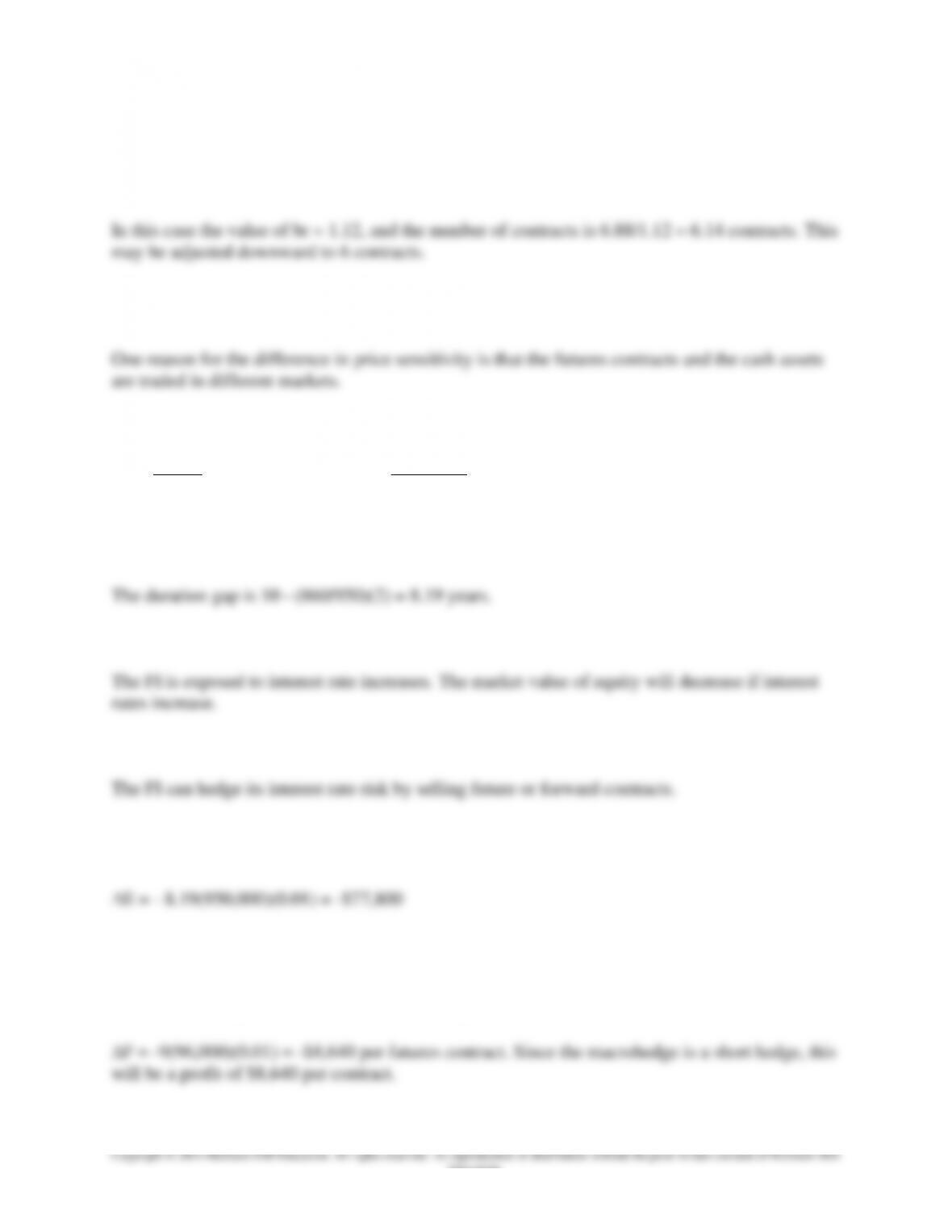
b. How many contracts should be used?
Chapter 22 – Futures and Forwards
22–11
Education.
c. If the implied rate on the deliverable bond in the futures market moves 12 percent more
than the change in the discounted spot rate, how many futures contracts should be used
to hedge the portfolio?
d. What causes futures contracts to have a different price sensitivity than the assets in the
spot markets?
21. Consider the following balance sheet (in millions) for an FI:
Assets Liabilities
Duration = 10 years $950 Duration = 2 years $860
Equity 90
a. What is the FI’s duration gap?
b. What is the FI’s interest rate risk exposure?
c. How can the FI use futures and forward contracts to put on a macrohedge?
d. What is the impact on the FI‘s equity value if the relative change in interest rates is an
increase of 1 percent? That is, R/(1+R) = 0.01.
e. Suppose that the FI macrohedges using Treasury bond futures that are currently priced
at 96. What is the impact on the FI’s futures position if the relative change in all interest
rates is an increase of 1 percent? That is, R/(1+R) = 0.01. Assume that the deliverable
Treasury bond has a duration of nine years.
Chapter 22 – Futures and Forwards
22–12
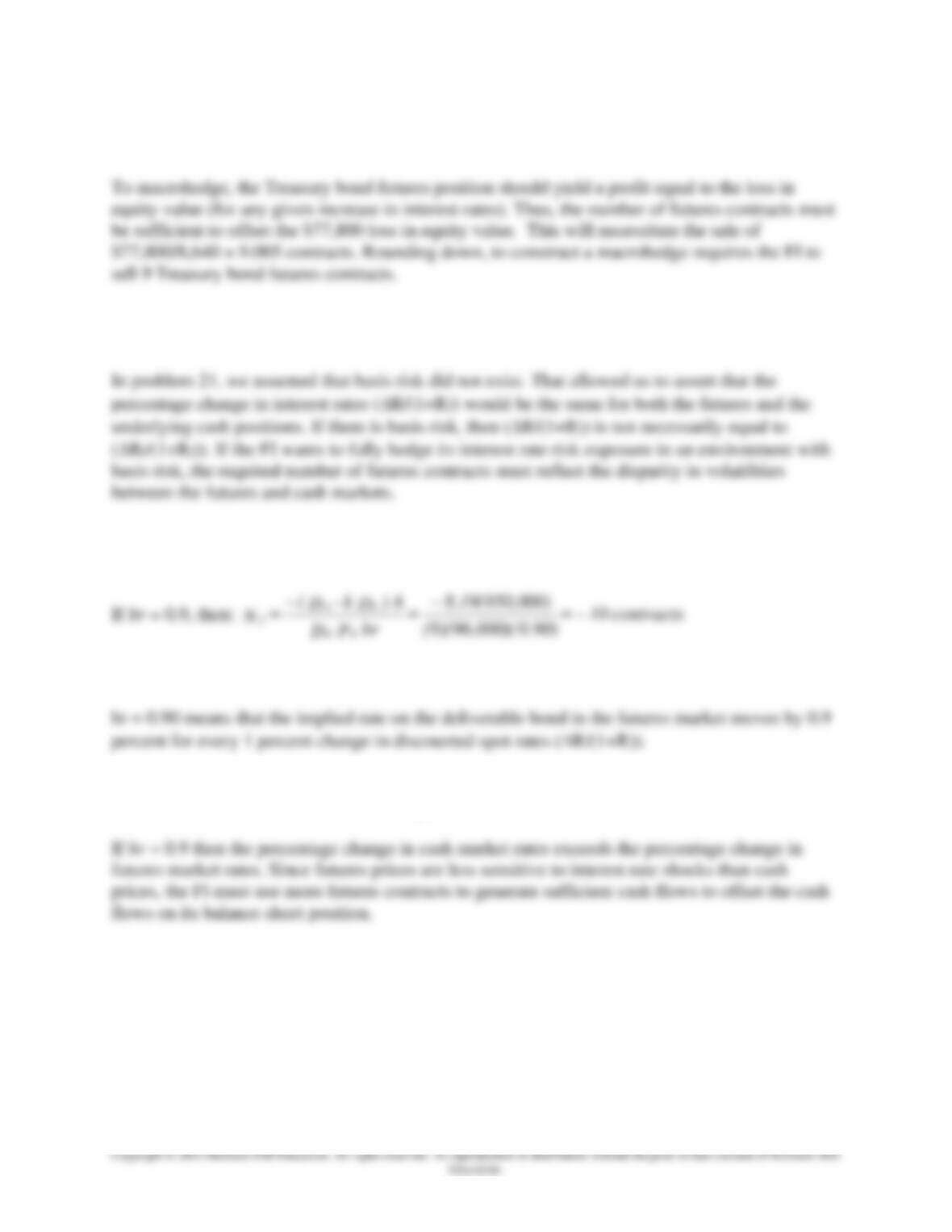
f. If the FI wants to macrohedge, how many Treasury bond futures contracts does it need?
22. Refer again to problem 21. How does consideration of basis risk change your answers to
problem 21?
a. Compute the number of futures contracts required to construct a macrohedge if
[Rf/(1+Rf) / R/(1+R)] = br = 0.90
.90))((9)(96,000
br
P
D
FF
0
b. Explain what is meant by br = 0.90.
c. If br = 0.90, what information does this provide on the number of futures contracts
needed to construct a macrohedge?