Chapter 21 – Product and Geographic Expansion
21-1
Solutions for End-of-Chapter Questions and Problems: Chapter Twenty One
1. How does product segmentation reduce the profitability and risk of FIs? How does it
increase the profitability and risk of FIs?
2. What general prohibition regarding the activities of commercial banking and investment
banking did the Glass-Steagall Act impose?
3. What restrictions were placed on Section 20 subsidiaries of U.S. commercial banks that
made investment banking activities other than those permitted by the Glass-Steagall Act
less attractive? How did this differ from banking activities in other countries?
Chapter 21 – Product and Geographic Expansion
21-2
4. Explain in general terms what impact the Financial Services Modernization Act of 1999
should have on the strategic implementation of section 20 activities.
5. What types of insurance products were commercial banks permitted to offer before 1999?
How did the Financial Services Modernization Act of 1999 change this? How have
nonbanks managed to exploit the loophole in the Bank Holding Company Act of 1956 and
engage in banking activities? What law closed this loophole? How did insurance
companies circumvent this law?
6. The Financial Services Modernization Act of 1999 allows banks to own controlling
interests in nonfinancial companies. What are the two restrictions on such ownership?
Chapter 21 – Product and Geographic Expansion
21-3
7. What is shadow banking? How does the shadow banking system differ from the traditional
banking system?
More recently activities of nonfinancial service firms that perform banking services has been
termed shadow banking. Shadow banks include finance companies, money market deposit funds,
structured investment vehicles (SIVs), asset-backed paper vehicles, credit hedge funds, asset-
backed commercial paper (ABCP) conduits, limited-purpose finance companies, and credit
hedge funds. As of the end of 2011, worldwide total assets managed by the shadow banking
Chapter 21 – Product and Geographic Expansion
21-4
Education.
8 What are the differences in the risk implications of a firm commitment securities offering
versus a best-efforts offering?
9. An FI is underwriting the sale of 1 million shares of Ultrasonics, Inc., and is quoting a bid-
ask price of $6.00-$6.50.
a. What are the fees earned by the FI if a firm commitment method is used to underwrite
the securities?
b. What are the fees if the FI uses the best-efforts method and a commission of 50 basis
points is charged?
c. How would your answer be affected if the FI manages to sell the shares only at $5.50
using the firm commitment method? The commission for best efforts is still 50 basis
points.
10. A Section 20 affiliate agrees to underwrite a debt issue for one of its clients. It has
suggested a firm commitment offering for issuing 100,000 shares of stock. The FI quotes a
bid-ask spread of $97-$97.50 to its customer on the issue date.
a. What are the total underwriting fees generated if all the issue is sold? If only 60 percent
is sold?
Chapter 21 – Product and Geographic Expansion
21-5
Education.
b. Instead of taking a chance that only 60 percent of the shares will be sold on the issue
date, the FI suggests a price of $95 to the issuing firm. The FI quotes a bid-ask rate of
$95-$95.40 and sells 100 percent of the issue. From the FI’s perspective, which price is
better if it expects to sell the remaining 40 percent at the bid price of $97 under the first
quote?
11. What are three ways that the failure of a securities affiliate in a holding company
organizational form could negatively affect a bank affiliate? How has the Fed attempted to
prevent a breakdown of the firewalls between bank and nonbank affiliates in these
situations?
Chapter 21 – Product and Geographic Expansion
21-6
12. What role does bank activity diversification play in the ability of a bank to exploit
economies of scale and scope? What remains as the limitation to creating potentially
greater benefits?
13. What six conflicts of interest have been identified as potential roadblocks to the expansion
of banking powers into the financial services area?
The six conflicts of interest are (1) the incentive interest of the salesperson to sell rather than to
Chapter 21 – Product and Geographic Expansion
21-7
14. Under what circumstances could the existence of deposit insurance provide an advantage to
banks in competing with other traditional securities firms?
15. In what ways does the current regulatory structure argue against providing additional
securities powers to the banking industry? Does this issue concern only banks?
The regulatory structure for most banks is multilayered and complex. The efficiency of the
overlapping structure is questionable from a public policy perspective because of the waste of
monitoring and surveillance resources as well as the inherent coordination problems. Further,
these problems may become magnified in times of financial distress regardless of the source,
causing potentially serious negative effects to occur for shareholders, customers, and the general
financial system.
Chapter 21 – Product and Geographic Expansion
21-8
16. How do limitations on domestic geographic diversification affect an FI’s profitability?
17. How are insurance companies able to offer services in states beyond their state of
incorporation?
18. In what way did the Garn-St. Germain Act and FIRREA provide incentives for the
expansion of interstate branching?
19. What is an interstate banking pact?
20. How did the provisions of the Riegle-Neal Interstate Banking and Branching Efficiency
Act of 1994 allow for full interstate banking? What are the expected profit performance
effects of interstate banking? What has been the impact on the structure of the banking and
financial services industry?
Chapter 21 – Product and Geographic Expansion
21-9
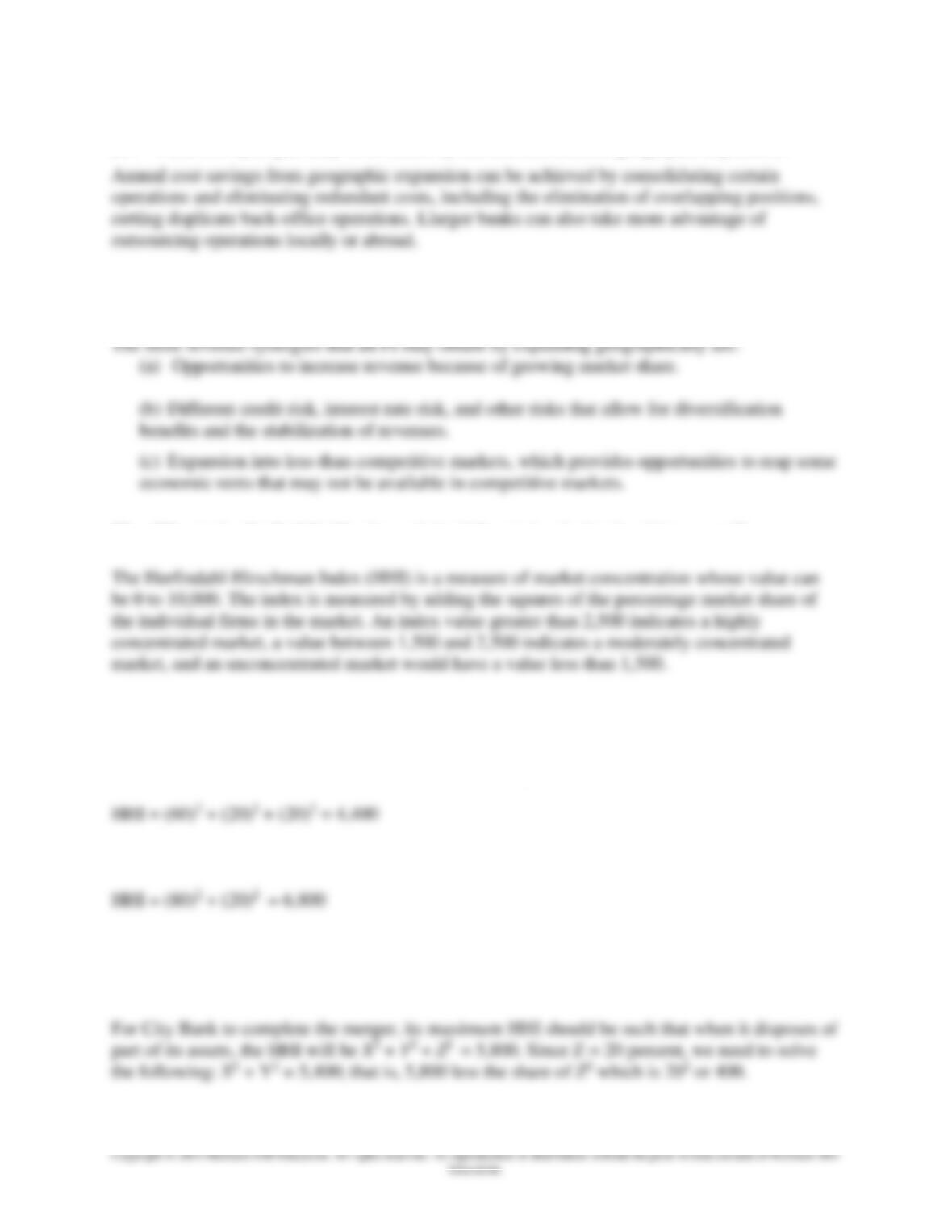
21. What cost synergies may be obtained by an FI from domestic geographic expansion?
22. What are the three revenue synergies that may be obtained by an FI from domestic
geographic expansion?
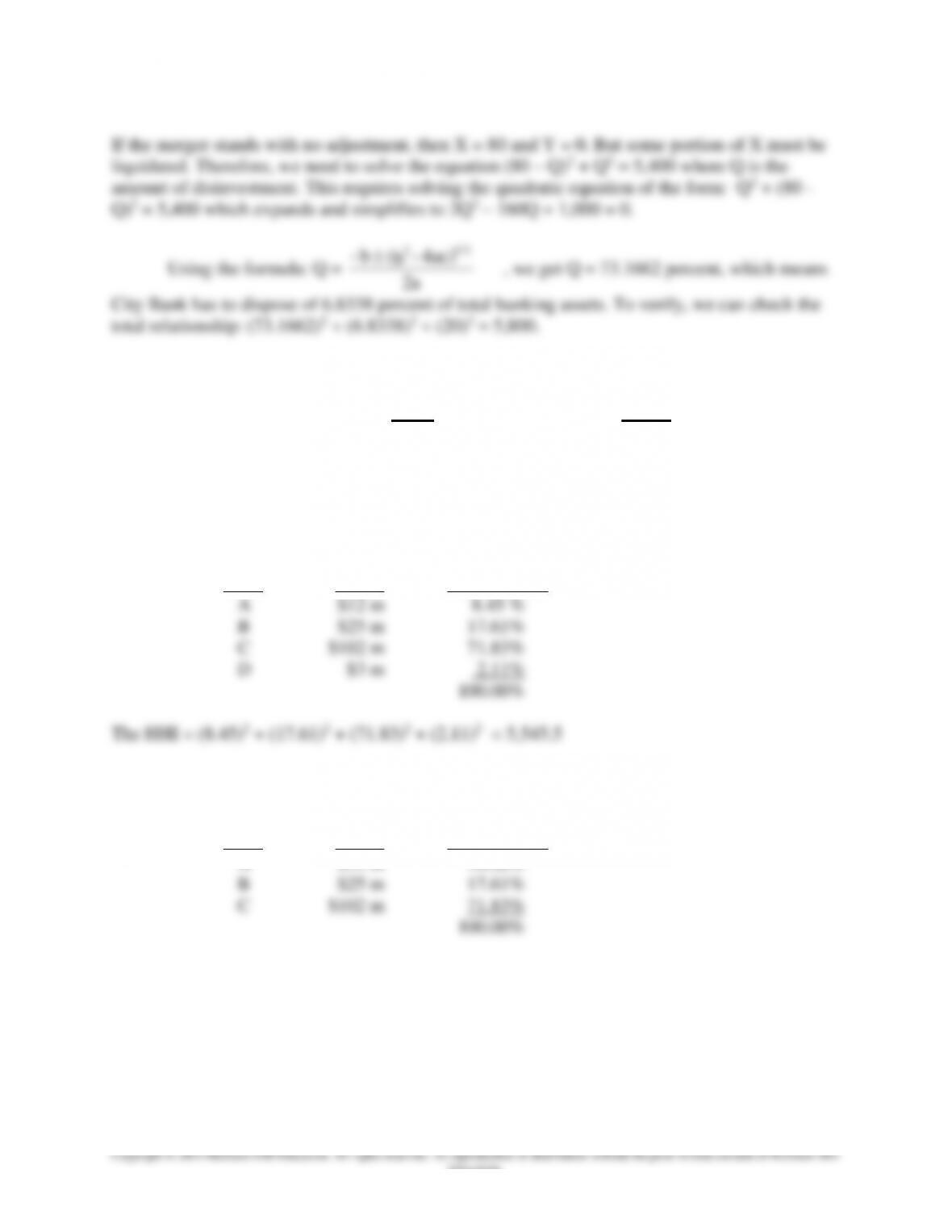
23. What is the Herfindahl-Hirschman Index? How is it calculated and interpreted?
24. City Bank currently has a 60 percent market share in banking services, followed by
NationsBank with 20 percent and State Bank with 20 percent.
a. What is the concentration ratio as measured by the Herfindahl-Hirschman Index (HHI)?
b. If City Bank acquires State Bank, what will be the new HHI?
c. Assume the Justice Department will allow mergers as long as the changes in HHI do
not exceed 1,400. What is the minimum amount of assets that City Bank will have to divest
after it merges with State Bank?
Chapter 21 – Product and Geographic Expansion
21–10
Education.
25. The Justice Department has been asked to review a merger request for a market with the
following four FI’s.
Bank Assets
A $12 million
B 25 million
C 102 million
D 3 million
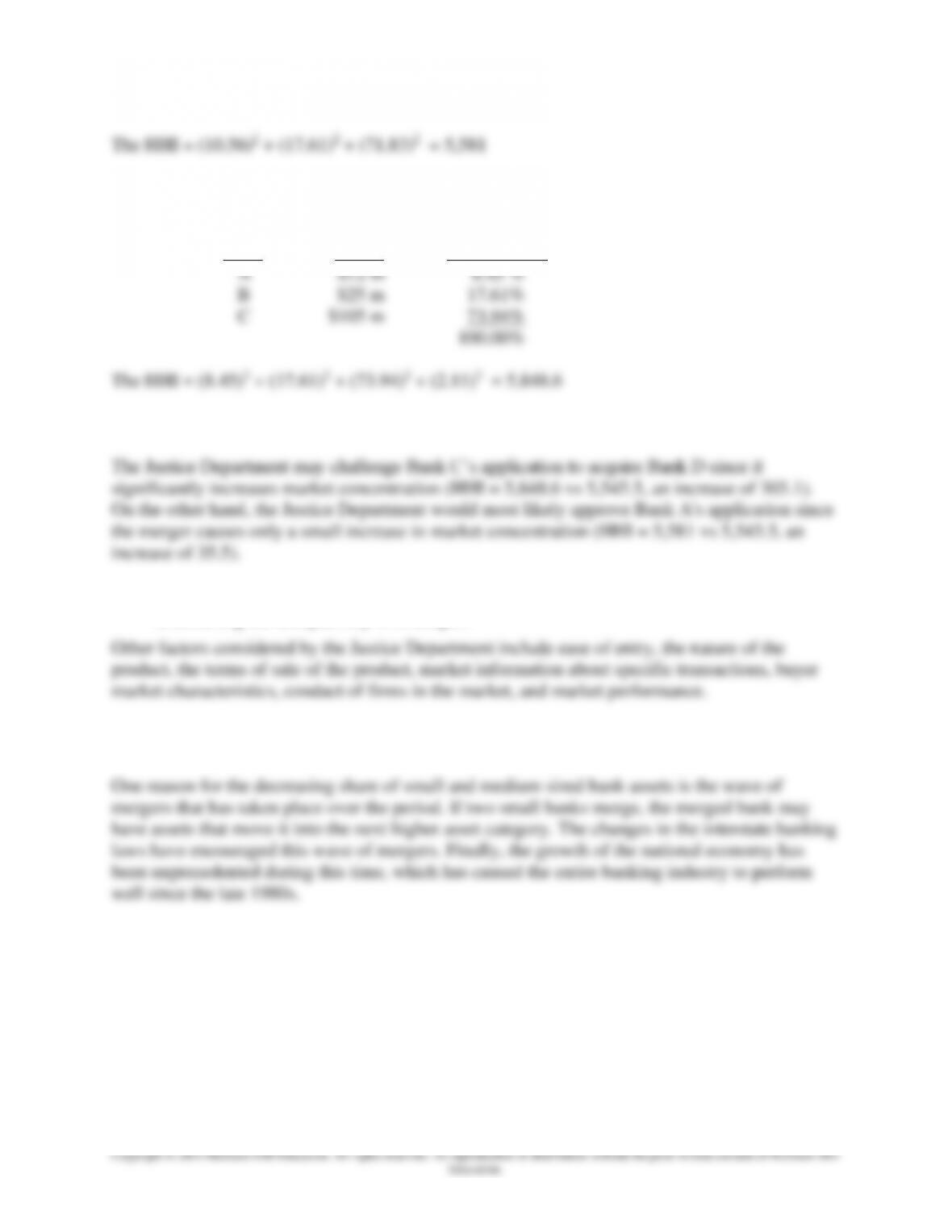
a. What is the HHI for the existing market?
Bank Assets Market Share
b. If Bank A acquires Bank D, what will be the impact on the market’s level of
concentration?
Bank Assets Market Share
A $15 m 10.56%
Chapter 21 – Product and Geographic Expansion
21–11
Copyright © 2014 McGraw-Hill Education. All rights reserved. No reproduction or distribution without the prior written consent of McGraw-Hill
Education.
The HHI = (10.56)2 + (17.61)2 + (71.83)2 = 5,581
c. If Bank C acquires Bank D, what will be the impact on the market’s level of
concentration?
Bank Assets Market Share
d. What is likely to be the Justice Department’s response to the two merger applications?
26. What factors other than market concentration does the Justice Department consider in
determining the acceptability of a merger?
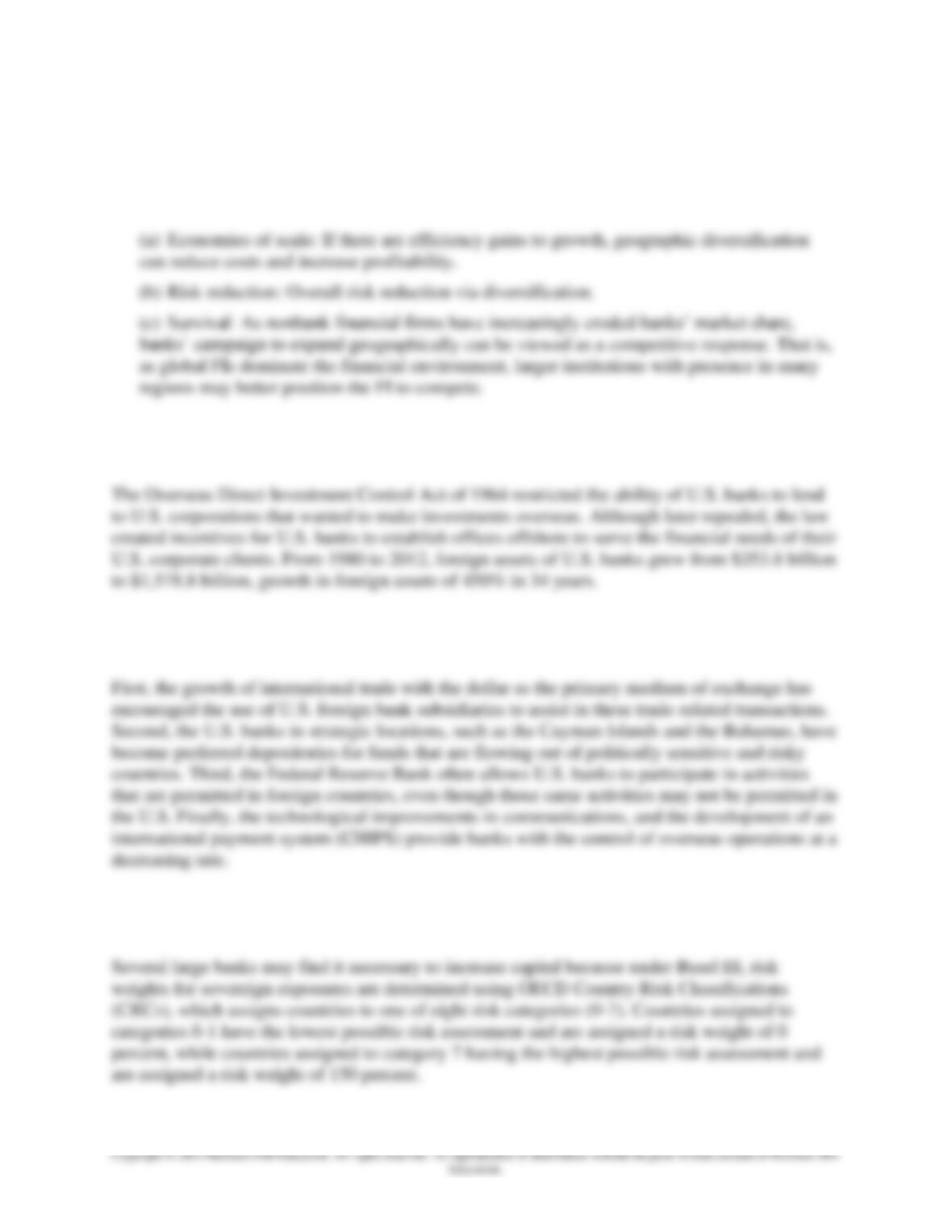
27. What are some plausible reasons for the percentage of assets of small and medium sized
banks decreasing and the percentage of assets of large banks increasing since 1984?
Chapter 21 – Product and Geographic Expansion
21–12
28. What are some of the benefits for banks engaging in geographic expansion?
The benefits to geographic diversification are:
29. How did the Overseas Direct Investment Control Act of 1964 assist in the growth of global
banking activities? How much growth in foreign assets occurred from 1980 to 2012?
30. Identify and explain the impact of at least four factors that have encouraged global U.S.
bank expansion.
31. What is the expected impact of the implementation of Basel III risk-based capital
requirements on the international activities of some major U.S. banks?
Chapter 21 – Product and Geographic Expansion
21–13
32. What effect have the problems of emerging market economies in the late 1990s and 2000s
had on the global expansion of traditional banking activities by U.S. banks?
33. What is the European Community (EC) Second Banking Directive? What impact has the
Second Banking Directive had on the competitive banking environment of Europe?
34. What factors affected the proportion of U.S. banking assets that were controlled by foreign
banks during the 1990s through 2012?
Chapter 21 – Product and Geographic Expansion
21–14
35. What was the fundamental philosophical focus of the International Banking Act (IBA) of
1978?
36. What events led to the passage of the Foreign Bank Supervision Enhancement Act
(FBSEA) of 1991? What was the main objective of this legislation?
37. What were the main features of FBSEA? How did FBSEA encourage cooperation with the
home country regulator? What was the effect of the FBSEA on the Federal Reserve and on
the foreign banks?
Chapter 21 – Product and Geographic Expansion
21–15
Copyright © 2014 McGraw-Hill Education. All rights reserved. No reproduction or distribution without the prior written consent of McGraw-Hill
Education.
Clearly the authority of the Federal Reserve over the foreign banks was increased. Further, the
regulatory burden and the costs of entry by foreign banks into the United States also increased.
38. What are the major advantages of international expansion to FIs? Explain how each
advantage can affect the operating performance of FIs?
39. What are the difficulties of expanding globally? How can each of these difficulties create
negative effects on the operating performance of FIs?