
Chapter 20 – Capital Adequacy
20–15
Education.
commercial paper 100 100 $30 million
27. How does the leverage ratio test impact the stringency of regulatory monitoring of DI
capital positions?
28. Third Bank has the following balance sheet (in millions), with the risk weights in
parentheses.
Assets Liabilities and Equity
Cash (0%) $21 Deposits $176
OECD interbank deposits (20%) 25 Subordinated debt (5 years) 2
Mortgage loans (50%) 70 Cumulative preferred stock 2
Consumer loans (100%) 70 Equity 5
Reserve for loan losses (1)
Total Assets $185 Total liabilities and equity $185
The cumulative preferred stock is qualifying and perpetual. In addition, the bank has $30
million in performance-related standby letters of credit (SLCs) to a public corporation, $40
million in two-year forward FX contracts that are currently in the money by $1 million, and
$300 million in six-year interest rate swaps that are currently out of the money by $2
million. Credit conversion factors follow:
Performance-related standby LCs 50%
1- to 5-year foreign exchange contracts 5%
1- to 5-year interest rate swaps 0.5%
5- to 10-year interest rate swaps 1.5%
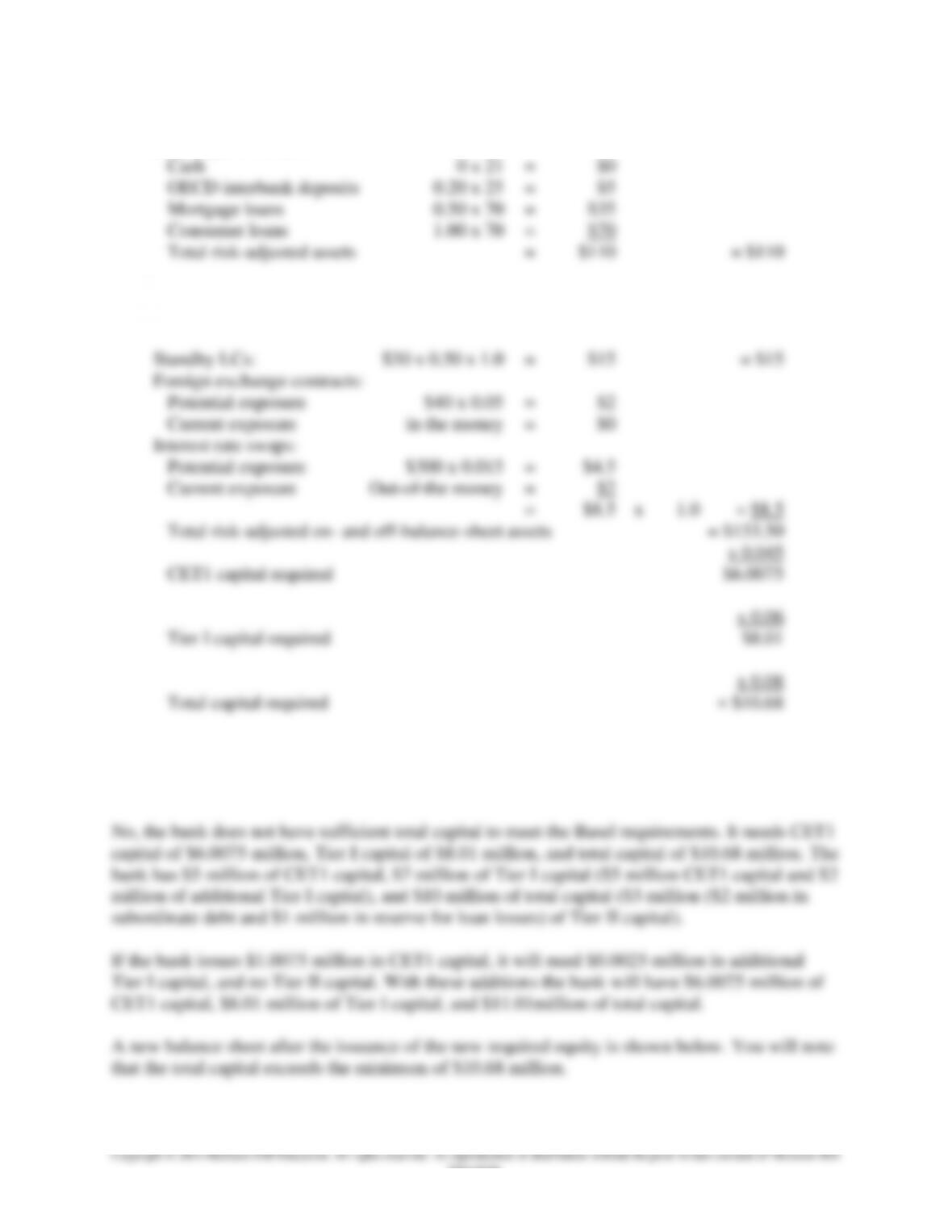
a. What are the risk-adjusted on-balance-sheet assets of the bank as defined under the
Basel Accord?
Chapter 20 – Capital Adequacy
20–16
Education.
Risk-adjusted assets:
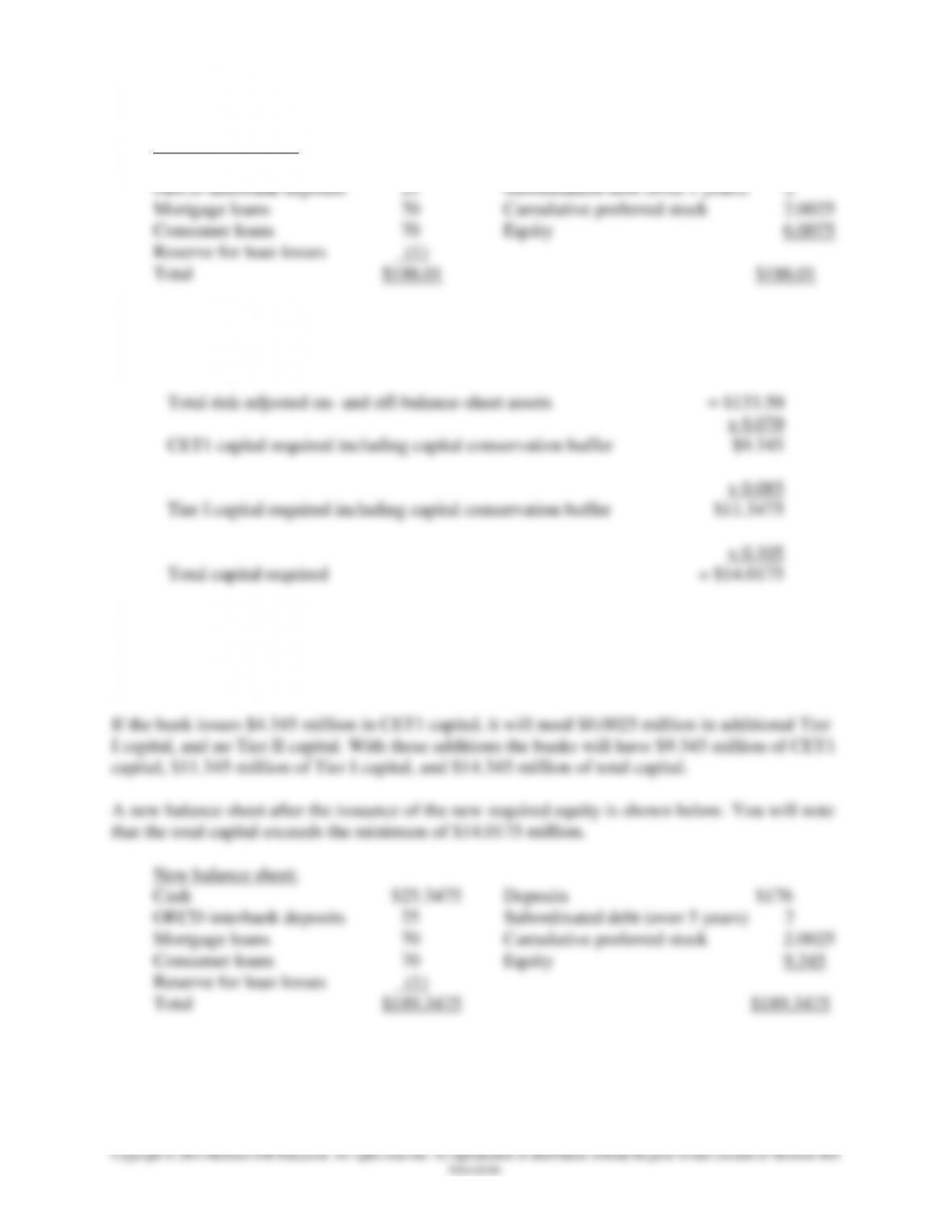
b. To be adequately capitalized, what are the CET1, Tier I, and total capital required for
both off- and on-balance-sheet assets?
c. Disregarding the capital conservation buffer, does the bank have enough capital to meet
the Basel requirements? If not, what minimum CET1, additional Tier 1, or total capital
does it need to meet the requirement?
Chapter 20 – Capital Adequacy
20–17
New balance sheet:
Cash $22.01 Deposits $176
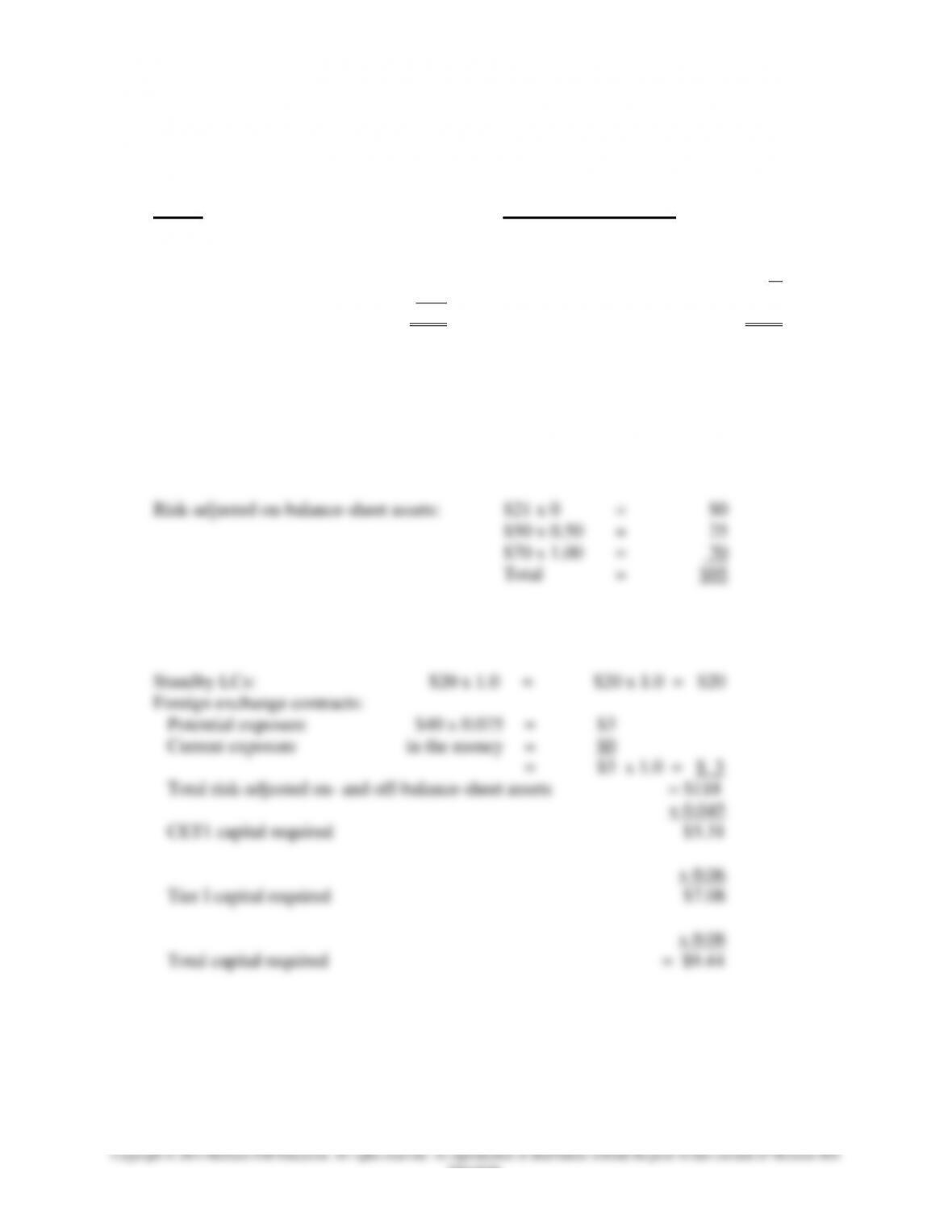
d. Does the bank have enough capital to meet the Basel requirements, including the capital
conservation buffer requirement? If not, what minimum CET1, additional Tier 1, or total
capital does it need to meet the requirement?
No, the bank does not have sufficient total capital to meet the Basel requirements. It needs CET1
capital of $9.345 million, Tier I capital of $11.3475 million, and total capital of $14.0175
million. The bank has $5 million of CET1 capital, $7 million of Tier I capital, and $10 million of
total capital.
Chapter 20 – Capital Adequacy
20–18
Education.
29. Third Fifth Bank has the following balance sheet (in millions), with the risk weights in
parentheses.
Assets Liabilities and Equity
Cash (0%) $21 Deposits $133
Mortgage loans (50%) 50 Subordinated debt (> 5 years) 1
Consumer loans (100%) 70 Equity 6
Reserve for loan losses (1)
Total assets $140 Total Liabilities and equity $140
In addition, the bank has $20 million in commercial direct-credit substitute standby letters
of credit to a public corporation and $40 million in 10-year FX forward contracts that are in
the money by $1 million.
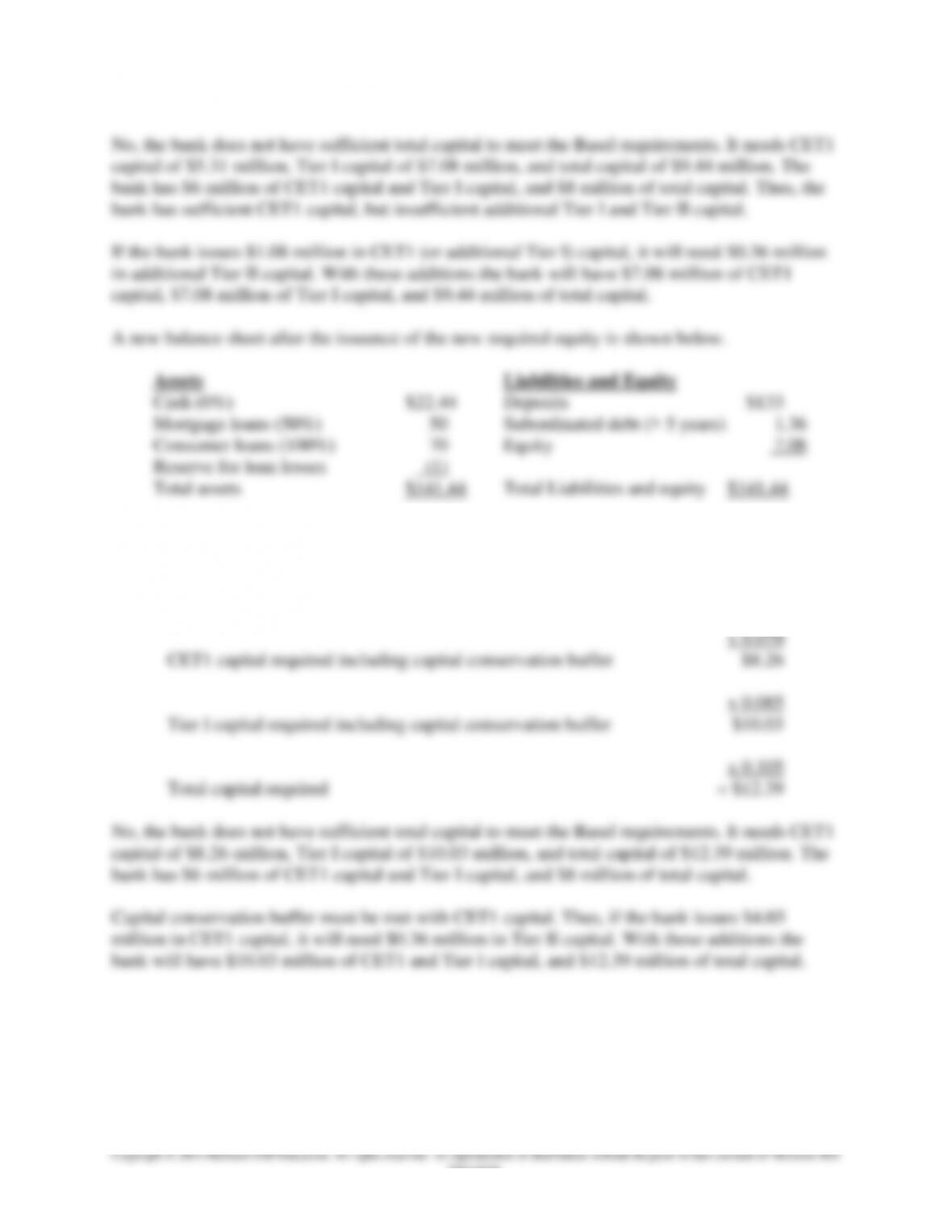
a. What are the risk-adjusted on-balance-sheet assets of the bank as defined under the
Basel III?
b. What is the CET1, Tier I, and total capital required for both off- and on-balance-sheet
assets?
c. Disregarding the capital conservation buffer, does the bank have sufficient capital to
meet the Basel requirements? How much in excess? How much short?
Chapter 20 – Capital Adequacy
20–19
Education.
d. Does the bank have enough capital to meet the Basel requirements, including the capital
conservation buffer requirement? If not, what minimum CET1, additional Tier 1, or total
capital does it need to meet the requirement?
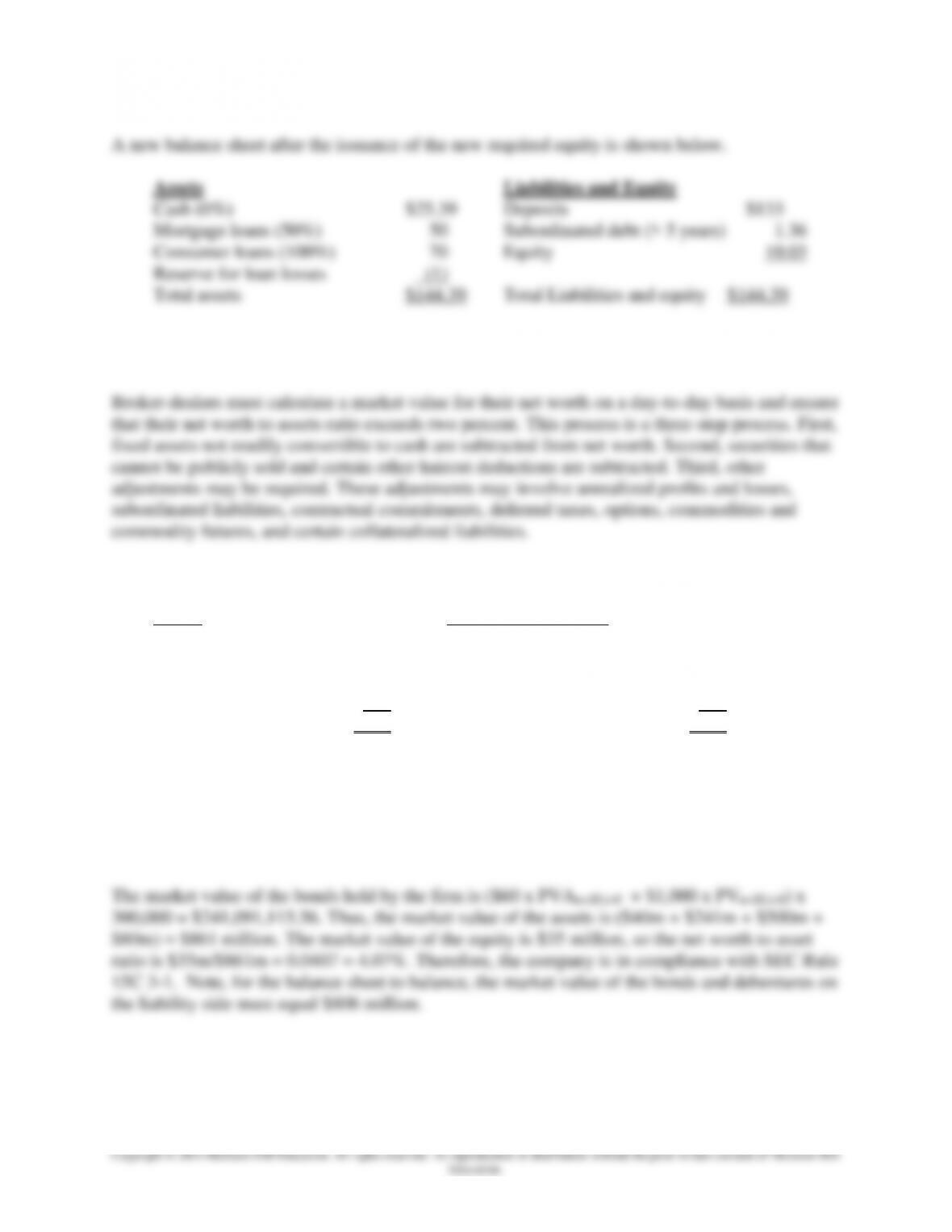
Total risk-adjusted on- and off-balance-sheet assets = $118
Chapter 20 – Capital Adequacy
20–20
Copyright © 2014 McGraw-Hill Education. All rights reserved. No reproduction or distribution without the prior written consent of McGraw-Hill
Education.
A new balance sheet after the issuance of the new required equity is shown below.
Assets Liabilities and Equity
Cash (0%) $25.39 Deposits $133
Mortgage loans (50%) 50 Subordinated debt (> 5 years) 1.36
Consumer loans (100%) 70 Equity 10.03
Reserve for loan losses (1)
Total assets $144.39 Total Liabilities and equity $144.39
30. According to SEC Rule 15C 3-1, what adjustments must securities firms make in the
calculation of the book value of net worth?
31. A securities firm has the following balance sheet (in millions):
Assets Liabilities and Equity
Cash $40 Five-day commercial paper $20
Debt securities 300 Bonds 550
Equity securities 500 Debentures 300
Other assets 60 Equity 30
Total assets $900 Total liabilities and equity $900
The debt securities have a coupon rate of 6 percent, 20 years remaining until maturity, and
trade at a yield of 8 percent. The equity securities have a market value equal to book value,
and the other assets represent building and equipment which was recently appraised at $80
million. The company has 1 million shares of stock outstanding and its price is $35 per
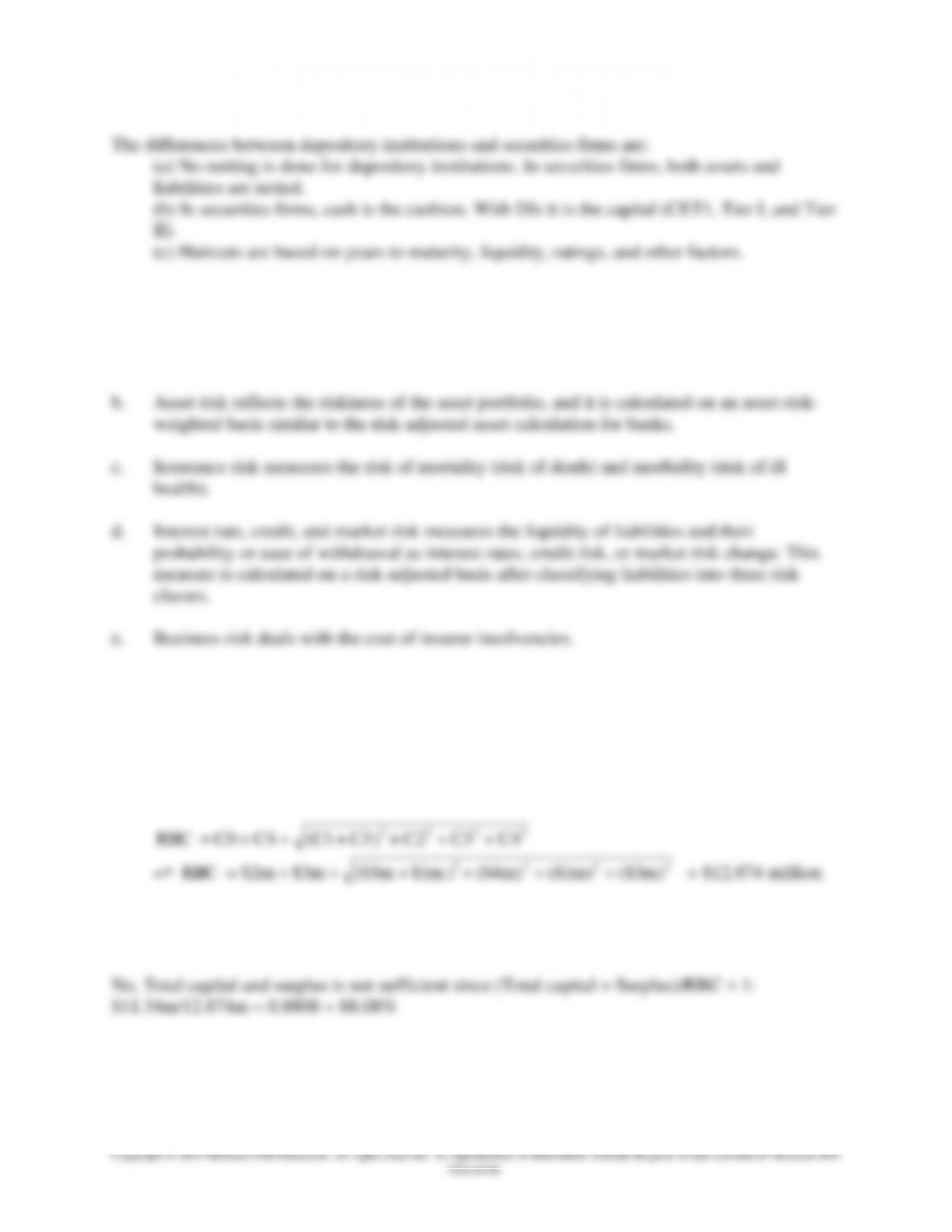
share. Is this company in compliance with SEC Rule 15C 3-1?

Chapter 20 – Capital Adequacy
20–21
Education.
32. An investment bank specializing in fixed-income assets has the following balance sheet (in
millions). Amounts are in market values, and all interest rates are annual unless indicated
otherwise.
Assets Liabilities and Equity
Cash $0.5 5% 1-year Eurodollar deposits $5.0
8% 10-year Treasury-notes 6% 2-year subordinated debt
semi-annual (par = $16.0) 15.0 (par = $10.0) 10.0
Equity 0.5
Total assets $15.5 Total liabilities and equity $15.5
Assume that the haircut for all assets is 15 basis points and for all liabilities, 25 basis points
(per year).
a. Does the investment bank have sufficient liquid capital to cushion any unexpected
losses per the net capital rule?
b. What should the FI do to maintain the net minimum required liquidity?
c. How does the net capital rule for investment banks differ from the capital requirements
imposed on commercial banks and other depository institutions?
Chapter 20 – Capital Adequacy
20–22
Copyright © 2014 McGraw-Hill Education. All rights reserved. No reproduction or distribution without the prior written consent of McGraw-Hill
Education.
The differences between depository institutions and securities firms are:
(a) No netting is done for depository institutions. In securities firms, both assets and
liabilities are netted.
(b) In securities firms, cash is the cushion. With DIs it is the capital (CET1, Tier I, and Tier
II).
(c) Haircuts are based on years to maturity, liquidity, ratings, and other factors.
33. Identify and define the five risk categories incorporated into the life insurance risk-based
capital model.
a. Asset risk–affiliate is the risk of default of assets for affiliated investments.
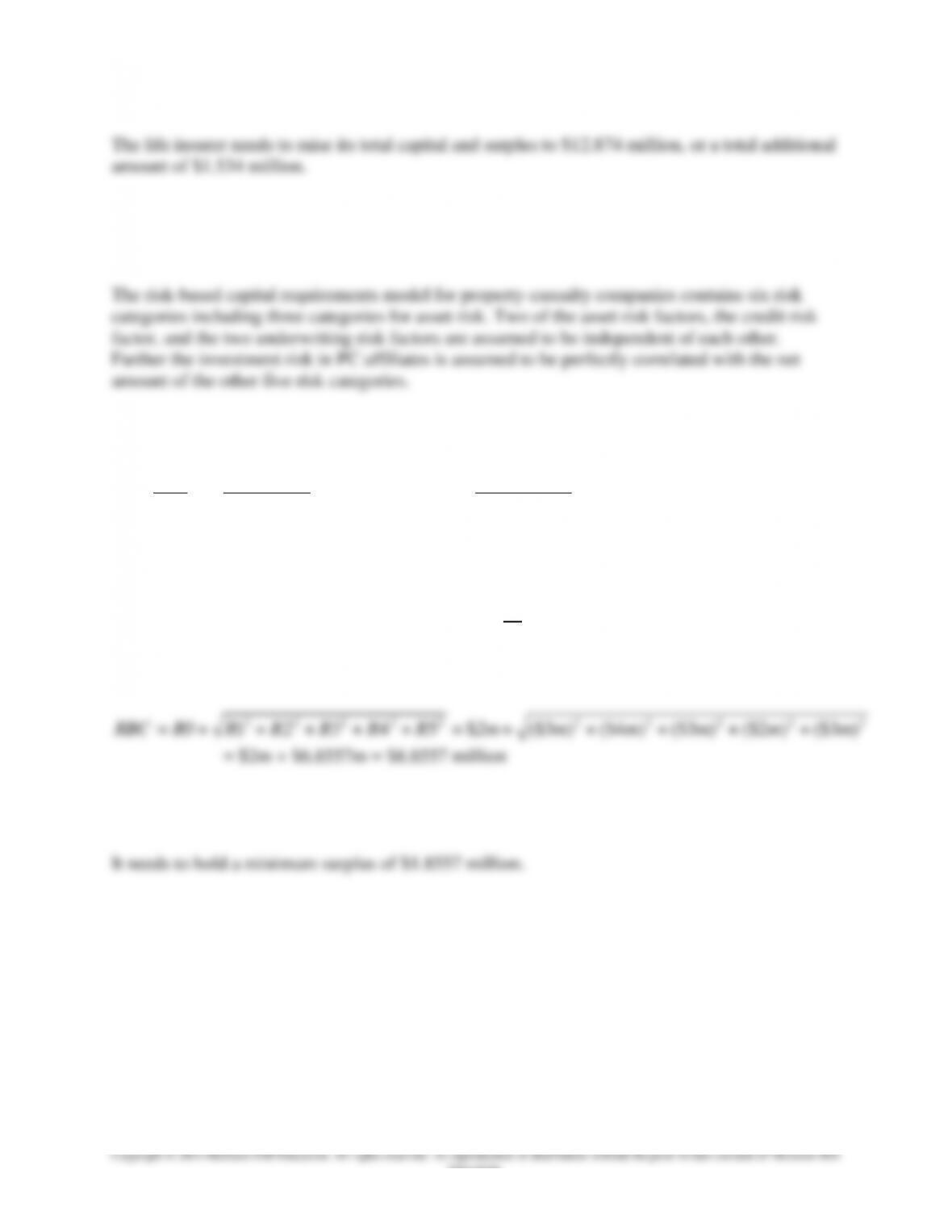
34. A life insurance company has estimated capital requirements for each of the following risk
classes: asset risk-affiliate (C0) = $2 million, asset risk-other (C1) = $5 million, insurance
risk (C2) = $4 million, interest rate, credit, market risk (C3) = $1 million, and business risk
(C4) = $3 million.
a. What is the required risk-based capital for the life insurance company?
b. If the total surplus and capital held by the company is $11.34 million, does it meet the
minimum requirements?
c. How much capital must be raised to meet the minimum requirements?
Chapter 20 – Capital Adequacy
20–23
Education.
35. How do the risk categories in the risk-based capital model for property-casualty insurance
companies differ from those of life insurance companies? What are the assumed
relationships between the risk categories in the model?
36. A property-casualty insurance company has estimated the following required charges for its
various risk classes (in millions):
Risk Description RBC Charge
R0 Affiliated P/C $2
R1 Fixed income 3
R2 Common stock 4
R3 Reinsurance 3
R4 Loss adjustment expense 2
R5 Written premiums 3
Total $17
a. What is the RBC charge as per the model recommended by the NAIC?
b. If the firm currently has $7 million in capital, what should be its surplus to meet the
minimum capital requirement?

Chapter 20 – Capital Adequacy
20–24
Education.
Integrated Mini Case: Calculating Capital Requirements
A bank’s balance sheet information is shown below (in $000).
Used for answers to 1-4
On Balance Sheet Items Face Value Weight Value
Cash $121,600 0% $0
Short-term government securities (<92 days.) 5,400 0% $0
Long-term government securities (>92 days) 414,400 0% $0
Federal Reserve stock 9,800 0% $0
Repos secured by federal agencies 159,000 20% $31,800
Claims on U.S. depository institutions 937,900 20% $187,580
Loans to foreign banks, OECD CRC rated 2 1,640,000 20% $328,000
General obligations municipals 170,000 20% $34,000
Claims on or guaranteed by federal agencies 26,500 20% $5,300
Municipal revenue bonds 112,900 50% $56,450
Residential mortgages,
category 1, loan-to-value ratio 75% 5,000,000 50% $2,500,000
Commercial loans 4,667,669 100% $4,667,669
Loans to sovereigns, OECD CRC rated 3. 11,600 50% $5,800
Premises and equipment 455,000 100% $455,000
Conversion Face Credit-Equivalent Risk-Adjusted
Off Balance Sheet Items: Factor Value Amount Asset Value
U.S. Government Counterparty
Loan commitments:
< 1 year 20% $300 $60 $0
1-5 year 50% 1,140 570 0
Standby letters of credit:
Performance-related 50% 200 100 0
Direct-credit substitute 100% 100 100 0
U.S. Depository Institutions Counterparty
Loan commitments:
< 1 year. 20% 100 20 4
> 1 year 50% 3,000 1,500 1300
Standby letters of credit:
Performance-related 50% 200 100 20
Direct-credit substitute 100% 56,400 56,400 11,280
Commercial letters of credit: 20% 400 80 16

Chapter 20 – Capital Adequacy
20–25
State and Local Government Counterparty
(revenue municipals)
Loan commitments:
>1 year 50% 100 50 25
Standby letters of credit:
Performance-related 50% 135,400 67,700 33,850
Corporate Customer Counterparty
Loan commitments:
< 1 year 20% 3,212,400 642,480 642,480
>1 year 50% 3,046,278 1,523,139 1,523,139
Standby letters of credit:
Performance-related 50% 101,543 50,772 50,772
Direct-credit substitute 100% 490,900 490,900 490,9000
Commercial letters of credit: 20% 78,978 15,796 15,796
Sovereign Counterparty
Loan commitments, OECD CRC rated 1:
< 1 year 20% 110,500 22,100 0
>1 year 50% 1,225,400 612,700 0
Sovereign Counterparty
Loan commitments, OECD CRC rated 2:
< 1 year 20% 85,000 17,000 3,400
>1 year 50% 115,500 57,750 11,500
Sovereign Counterparty
Loan commitments, OECD CRC rated 7:
>1 year. 50% 30,000 15,000 22,500
Interest rate market contracts:
(current exposure assumed to be zero.)
< 1 year (notional amount) 0% 2,000 0 0
> 1-5 year (notional amount) 0.5% 5,000 25 25
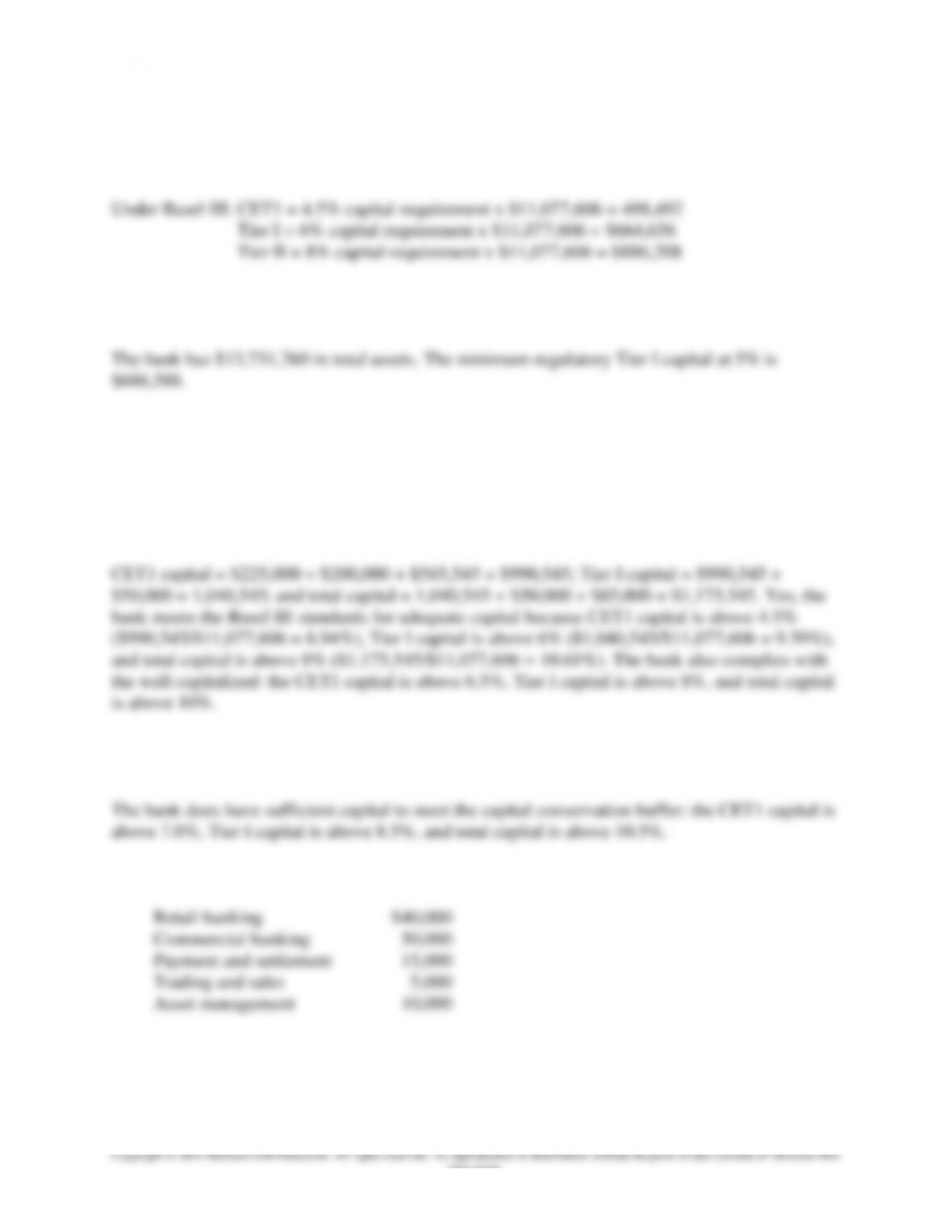
1. What is the bank’s risk-adjusted asset base under Basel III?
The risk-adjusted asset base under Basel III is:
Chapter 20 – Capital Adequacy
20–26
Education.
2. To be adequately capitalized, what are the bank’s CET1, Tier I, and total risk-based capital
requirements under Basel III?
3. Using the leverage ratio requirement, what is the minimum regulatory capital required to
keep the bank in the well-capitalized zone?
4. Disregarding the capital conservation buffer, what is the bank’s capital adequacy level
(under Basel III) if the par value of its equity is $225,000, surplus value of equity is
$200,000, retained earnings is $565,545, qualifying perpetual preferred stock is $50,000,
subordinate debt is $50,000, and loan loss reserve is $85,000? Does the bank meet Basel
(CET1, Tier I, and Tier II) adequate capital standards? Does the bank comply with the
well-capitalized leverage ratio requirement?
5. Does the bank have enough capital to meet the Basel requirements, including the capital
conservation buffer requirement?
6. The bank’s various lines of business produced the following gross income:
Chapter 20 – Capital Adequacy
20–27
What is the add-on to capital for operational risk? Does the bank have sufficient capital to
cover this add-on and remain adequately capitalized, while meeting the capital
conservation buffer?