Chapter 19 – Deposit Insurance and Other Liability Guarantees
19-1
Solutions for End-of-Chapter Questions and Problems: Chapter Nineteen
1. What is a contagious run? What are some of the potentially serious adverse social welfare
effects of a contagious run? Do all types of FIs face the same risk of contagious runs?
2. How does federal deposit insurance help mitigate the problem of bank runs. What other
elements of the safety net are available to DIs in the United States?
3. What major changes did the Financial Institutions Reform, Recovery, and Enforcement Act
of 1989 make to the FDIC and the FSLIC?
4. Contrast the two views on, or reasons why, depository institution insurance funds can
become insolvent.
Chapter 19 – Deposit Insurance and Other Liability Guarantees
19-2
5. What is moral hazard? How did the fixed-rate deposit insurance program of the FDIC
contribute to the moral hazard problem of the savings association industry? What other
changes in the savings association environment during the 1980s encouraged the developing
instability of the industry?
6. How does a risk-based insurance program solve the moral hazard problem of excessive risk
taking by FIs? Is an actuarially fair premium for deposit insurance always consistent with a
competitive banking system?
7. What are three suggested ways a deposit insurance contract could be structured to reduce
moral hazard behavior?
Chapter 19 – Deposit Insurance and Other Liability Guarantees
19-3
Education.
8. What are some ways of imposing stockholder discipline to prevent FI managers from
engaging in excessive risk taking?
9. How is the provision of deposit insurance by the FDIC similar to the FDIC’s writing a put
option on the assets of a DI that buys the insurance? What two factors drive the premium of
the option?
10. What four factors were provided by FDICIA as guidelines to assist the FDIC in the
establishment of risk-based deposit insurance premiums? What happened to the level of
deposit insurance premiums in the late 1990s and early 2000s? Why?
Chapter 19 – Deposit Insurance and Other Liability Guarantees
19-4
Education.
11. What is capital forbearance? How does a policy of forbearance potentially increase the
costs of financial distress to the insurance fund as well as the stockholders?
12. Under what conditions may the implementation of minimum capital guidelines, either risk-
based or non-risk-based, fail to impose stockholder discipline as desired by the regulators?
13. Why did the fixed-rate deposit insurance system fail to induce insured and uninsured
depositors to impose discipline on risky DIs in the United States in the 1980s?
Chapter 19 – Deposit Insurance and Other Liability Guarantees
19-5
Education.
The fixed-rate deposit insurance system understandably provided no incentives to depositors to
discipline the actions of DIs since they were completely insured for deposits of up to $100,000
per account per DI. Uninsured depositors also had few incentives to monitor the activities of DIs
because regulators had been reluctant to close down failing DIs, especially larger DIs. This is
because of the anticipated widespread social implications. As a result, both insured and
uninsured depositors were usually protected against DI losses, reducing the incentives to monitor
the actions of DIs.
a. How is it possible to structure deposits in a DI to reduce the effects of the insured
ceiling?
b. What are brokered deposits? Why are brokered deposits considered more risky than
nonbrokered deposits by DI regulators?
c. What trade-offs were weighed in the decision to leave the deposit insurance ceiling at
$100,000 in 2005 and then increase the ceiling to $250,000?
14. What changes did the Federal Deposit Insurance Reform Act of 2005 make to the deposit
insurance cap?
Chapter 19 – Deposit Insurance and Other Liability Guarantees
19-6
Education.
15. What is the too-big-to-fail doctrine? What factors caused regulators to act in a way that
caused this doctrine to evolve?
16. What are some of the essential features of the FDICIA of 1991 with regard to the resolution
of failing DIs?
The FDICIA of 1991 made it very difficult for regulators to delay the closing of failing DIs
unless the danger of a systemic risk can be shown. They are expected to use the least cost
resolution (LCR) strategy to close down DIs, and shareholders and uninsured depositors are
expected to bear the brunt of the loss. Unlike in prior years, the FDIC only subsidizes if the
liquidated assets are not sufficient to cover the insured deposits. The General Accounting Office
has also been authorized to audit failure resolutions used by regulators to ensure that the least
cost strategy has been adopted.
a. What is the least-cost resolution (LCR) strategy?
b. When can the systemic risk exemption be used as an exception to the LCR policy of DI
closure methods?
c. What procedural steps must be taken to gain approval for using the systemic risk
exemption?

Chapter 19 – Deposit Insurance and Other Liability Guarantees
19-7
Education.
d. What are the implications to the other DIs in the economy of the implementation of this
exemption?
17. What is the primary goal of the FDIC when employing the LCR strategy?
a. How is the insured depositor transfer method implemented in the process of failure
resolution?
b. Why does this method of failure resolution encourage uninsured depositors to more
closely monitor the strategies of DI managers?
18. The following is a balance sheet of a commercial bank (in millions of dollars).
Assets Liabilities and Equity
Cash $ 5 Insured deposits $30
Loans 40 Uninsured deposits 10
Equity 5
Total assets $45 Total liabilities and equity $45
Chapter 19 – Deposit Insurance and Other Liability Guarantees
19-8
Education.
The bank experiences a run on its deposits after it declares it will write off $10 million of
its loans as a result of nonpayment. The bank has the option of meeting the withdrawals by
first drawing down its cash and then by selling off its loans. A fire sale of the remaining
loans in one day can be accomplished at a 10 percent discount. They can be sold at a 5
percent discount if sold in two days. The full market value will be obtained if they are sold
after two days.
a. What is the amount of loss to the insured depositors if a run on the bank occurs on the
first day? On the second day?
b. What amount do the uninsured depositors lose if the FDIC uses the insured depositor
transfer method to close the bank immediately? The assets will be sold in two days.
19. A bank with insured deposits of $55 million and uninsured deposits of $45 million has
assets valued at only $75 million. What is the cost of failure resolution to insured
depositors, uninsured depositors, and the FDIC if an insured depositor transfer method is
used?
20. A commercial bank has $150 million in assets at book value. The insured and uninsured
deposits are valued at $75 million and $50 million, respectively, and the book value of
equity is $25 million. As a result of loan defaults, the market value of the assets has
decreased to $120 million. What is the cost of failure resolution to insured depositors,
uninsured depositors, shareholders, and the FDIC if an insured depositor transfer method is
used.
Chapter 19 – Deposit Insurance and Other Liability Guarantees
19-9
Copyright © 2014 McGraw-Hill Education. All rights reserved. No reproduction or distribution without the prior written consent of McGraw-Hill
Education.
Under the insured depositor transfer method, all losses will be borne by shareholders, followed
by uninsured depositors, before the FDIC takes any loss. Thus, in this example, neither the
insured depositors nor the FDIC lose under the insured depositor transfer method. Uninsured
depositors receive $45 million (= $120m – $75m) equal to the cash (received from the sale of the
bank’s assets) remaining after insured depositors have been paid in full. This results in a loss of
$5 million (= $50m – $45m) for the uninsured depositors. Shareholders will lose $25 million.
21. In what ways did FDICIA enhance the regulatory discipline to help reduce moral hazard
behavior? What has the operational impact of these directives been?
22. Match the following policies with their intended consequences:
Policies:
a. Lower FDIC insurance levels
b. Stricter reporting standards
c. Risk-based deposit insurance
Consequences:
1. Increased stockholder discipline
2. Increased depositor discipline
3. Increased regulator discipline

Chapter 19 – Deposit Insurance and Other Liability Guarantees
19–10
Education.
23. How does the Federal Reserve’s discount window serve as an alternative to deposit
insurance as a lender of last resort facility to financial institutions? What changes occurred
in 2008 that expanded the scope of coverage for the Fed’s discount window?
Traditionally, the Fed has provided a discount window facility to meet the short-term,
nonpermanent liquidity needs of DIs. For example, suppose a DI has an unexpected deposit drain
close to the end of a reserve requirement period and cannot meet its reserve target. It can seek to
borrow from the Fed’s discount window facility. However, in January 2003, the Fed
implemented changes to its discount window lending that increased the cost of borrowing but
Chapter 19 – Deposit Insurance and Other Liability Guarantees
19–11
24. Why is access to the discount window of the Fed less of a deterrent to bank runs than
deposit insurance?
Although banks have access to the discount window in the event of DI runs, this is less effective
than deposit insurance because:
Chapter 19 – Deposit Insurance and Other Liability Guarantees
19–12
Education.
d. If the DI ultimately fails, the Fed will have to compensate the FDIC for incremental losses.
25. How do insurance guaranty funds differ from deposit insurance? What impact do these
differences have on the incentive for insurance policyholders to engage in a contagious run
on an insurance company?
26. What was the purpose of the establishment of the Pension Benefit Guaranty Corporation
(PBGC)?
a. How does the PBGC differ from the FDIC in its ability to control risk?
b. How were the 1994 Retirement Protection Act and the Deficit Reduction Act of 2005
expected to reduce the deficits experienced by the PBGC?
Chapter 19 – Deposit Insurance and Other Liability Guarantees
19–13
27. What changes did the Federal Deposit Insurance Reform Act of 2005 make to the deposit
insurance assessment scheme for DIs?
The Federal Deposit Insurance Reform Act of 2005 instituted a deposit insurance premium
scheme, effective January 1, 2007 and revised in April 2009 and April 2011, that combined
examination ratings, financial ratios, and for large banks (with total assets greater than $10
Chapter 19 – Deposit Insurance and Other Liability Guarantees
19–14
28. Under the Federal Deposit Insurance Reform Act of 2005, how is a Category I deposit
insurance premium determined?
Within Risk Category I, the final rule combines CAMELS component ratings with financial ratios
to determine an institution’s assessment rate. For Risk Category I institutions, each of six
financial ratios component ratings is multiplied by a corresponding pricing multiplier, as listed in

Chapter 19 – Deposit Insurance and Other Liability Guarantees
19–15
Education.
29. Webb Bank has a composite CAMELS rating of 2, a total risk-based capital ratio of 10.2
percent, a Tier I risk-based capital ratio of 5.2 percent, and a Tier I leverage ratio of 4.8
percent. What deposit insurance risk category does the bank fall into, and what is the
bank’s deposit insurance assessment rate?
30. Million Bank has a composite CAMELS rating of 2, a total risk-based capital ratio of 9.8
percent, a Tier I risk-based capital ratio of 5.8 percent, and a Tier I leverage ratio of 4.9
percent. The average total assets of the bank equal $500 million and average Tier I equity
equal $24.5 million. What deposit insurance risk category does the bank fall into? What is
the bank’s deposit insurance assessment rate and the dollar value of deposit insurance
premiums?
31. Two depository institutions have composite CAMELS ratings of 1 or 2 and are “well
capitalized.” Thus, each institution falls into the FDIC Risk Category I deposit insurance
assessment scheme. Further, the institutions have the following financial ratios and
CAMELS ratings:
Institution A Institution B
Tier I leverage ratio (%) 8.62 7.75
Loans past due 30-89
pays/gross assets (%) 0.45 0.56
Nonperforming
assets/gross
assets (%) 0.35 0.50
Net loan charge-offs
/gross assets (%) 0.28 0.32
Net Income before
taxes/risk-weighted
assets (%) 2.15 1.86
Adjusted brokered
deposits ratio (%) 0.00 15.56
CAMELS Components:
C 1 1
A 2 2
M 1 2
E 2 3
L 1 1
Chapter 19 – Deposit Insurance and Other Liability Guarantees
19–16
Education.
S 2 1
Calculate the initial deposit insurance assessment for each institution.
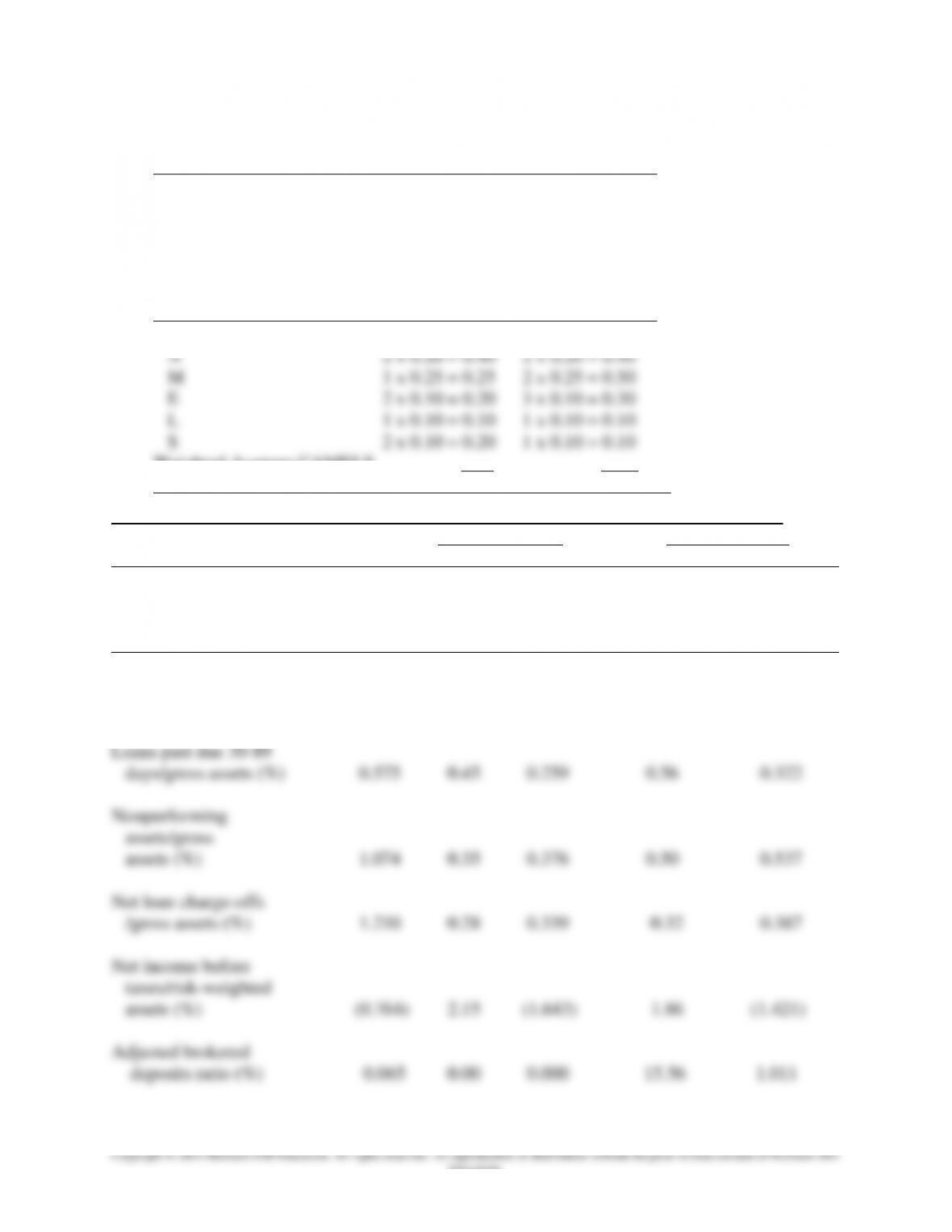
To determine the deposit insurance assessment for each institution, we set up the following
tables:
CAMELS Components:
C 1 x 0.25 = 0.25 1 x 0.25 = 0.25
Weighted Average CAMELS .
Component 1.40 1.65
Base Assessment Rates for Two Institutions
A B C D E F
Institution A Institution B
Contribution Contribution
Risk to Risk to
Pricing Measure Assessment Measure Assessment
Multiplier Value Rate Value Rate
Uniform Amount 4.861 4.861 4.861
Tier I leverage ratio (%) (0.056) 8.62 (0.483) 7.75 (0.434)

Chapter 19 – Deposit Insurance and Other Liability Guarantees
19–17
Education.
32. Two depository institutions have composite CAMELS ratings of 1 or 2 and are “well
capitalized.” Thus, each institution falls into the FDIC Risk Category I deposit insurance
assessment scheme. Institution A has average total assets of $750 million and average Tier
I equity of $75 million. Institution B has average total assets of $1 billion and average Tier
I equity of $110 million. Institution A has no unsecured debt or brokered deposits.
Institution B has no unsecured debt and an asset growth rate over the last four years of 8
percent. Further, the institutions have the following financial ratios and CAMELS ratings:
Institution A Institution B
Tier I leverage ratio (%) 10.25 7.00
Loans past due 30-89
days/gross assets (%) 0.60 0.82
Nonperforming
assets/gross
assets (%) 0.45 0.90
Net loan charge-offs
/gross assets (%) 0.08 0.25
Net income before
taxes/risk-weighted
assets (%) 2.40 1.65
Adjusted brokered
deposits ratio (%) 0.00 25.89
CAMELS Components:
C 1 2
A 1 1
M 1 1
E 2 1
L 1 3
S 2 3
Calculate the deposit insurance assessment and the dollar value of the deposit insurance
premium for each institution.
Chapter 19 – Deposit Insurance and Other Liability Guarantees
19–18
Education.
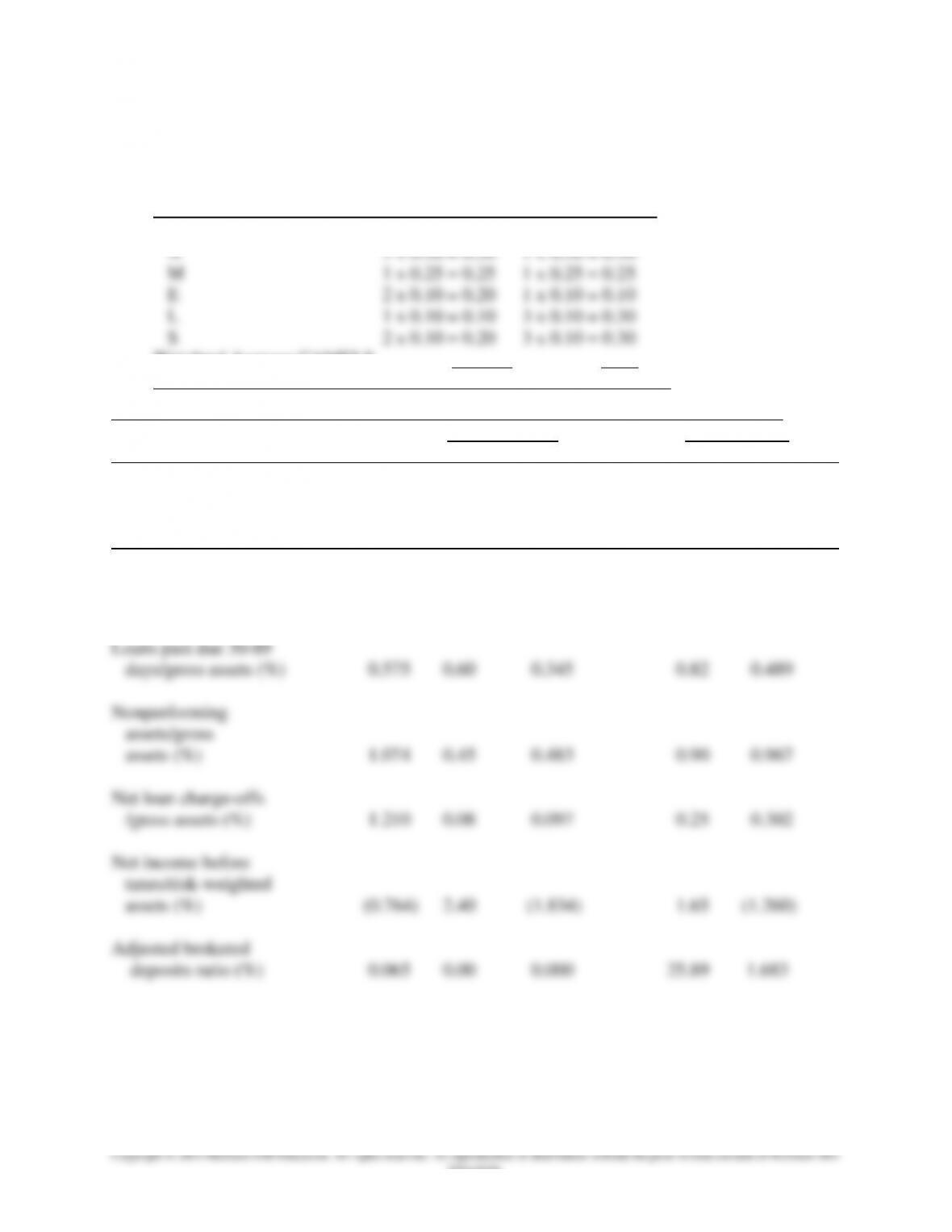
To determine the deposit insurance assessment for each institution, we set up the following
tables:
CAMELS Components:
C 1 x 0.25 = 0.25 2 x 0.25 = 0.50
Weighted Average CAMELS .
Component 1.20 1.65
Base Assessment Rates for Two Institutions
A B C D E F
Institution A Institution B
Contribution Contribution
Risk to Risk to
Pricing Measure Assessment Measure Assessment
Multiplier Value Rate Value Rate
Uniform Amount 4.861 4.861 4.861
Tier I leverage ratio (%) (0.056) 10.25 (0.574) 7.00 (0.392)
Chapter 19 – Deposit Insurance and Other Liability Guarantees
19–19
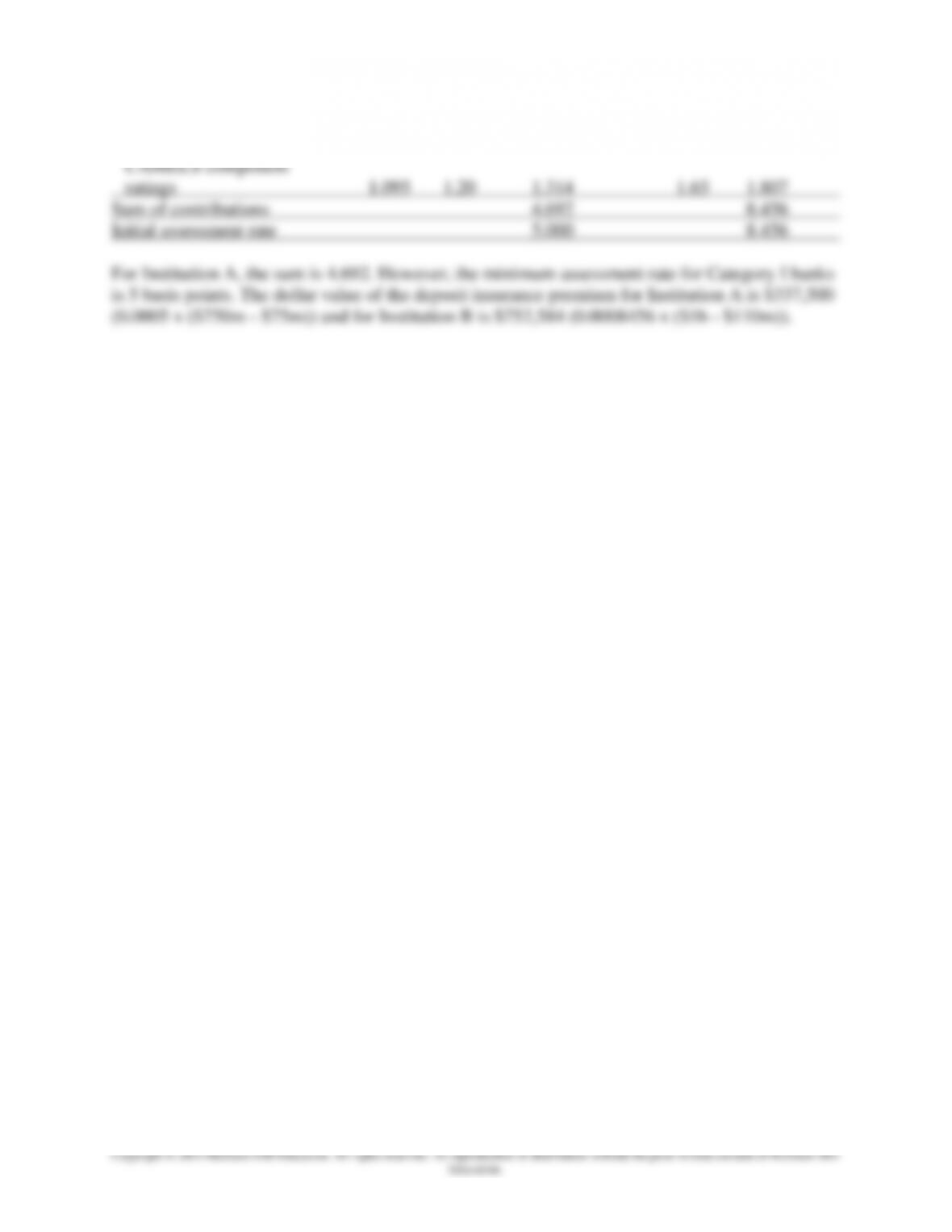
Weighted average