
Chapter 18 – Liability and Liquidity Management
18-1
Solutions for End-of-Chapter Questions and Problems: Chapter Eighteen
1. What are the benefits and costs to an FI of holding large amounts of liquid assets? Why are
Treasury securities considered good examples of liquid assets?
2. How is an FI’s liability and liquidity risk management problem related to the maturity of its
assets relative to its liabilities?
3. Consider the assets (in millions) of two banks, A and B. Both banks are funded by $120
million in deposits and $20 million in equity. Which bank has a stronger liquidity position?
Which bank probably has a higher profit?
Bank A Asset Bank B Assets
Cash $10 Cash $20
Treasury securities 40 Consumer loans 30
Chapter 18 – Liability and Liquidity Management
18-2
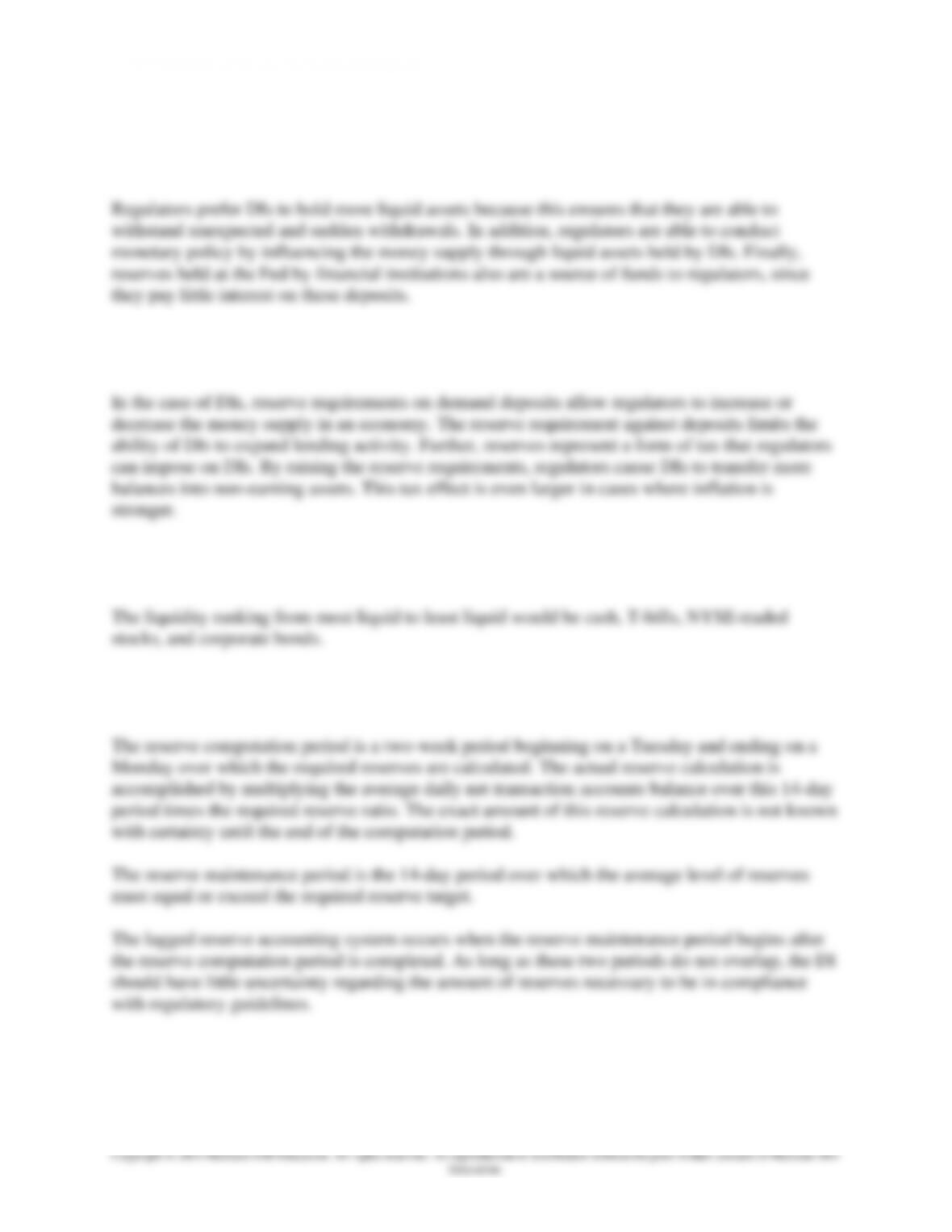
4. What concerns motivate regulators to require DIs to hold minimum amounts of liquid
assets?
5. How do liquid asset reserve requirements enhance the implementation of monetary policy?
How are reserve requirements a tax on DIs?
6. Rank these financial assets according to their liquidity: cash, corporate bonds, NYSE–
traded stocks, and T-bills.
7. Define the reserve computation period, the reserve maintenance period, and the lagged
reserve accounting system.

Chapter 18 – Liability and Liquidity Management
18-3
8. City Bank has estimated that its average daily net transaction accounts deposit balance over
the recent 14-day reserve computation period was $225 million. The average daily balance
with the Fed over the 14-day maintenance period was $9 million, and the average daily
balance of vault cash over the two-week computation period was $7.5 million.
a. Under the rules effective in 2012, what is the amount of average daily reserves required
to be held during the reserve maintenance period for these net transaction accounts
balances?
b. What is the average daily balance of reserves held by the bank over the maintenance
period? By what amount were the average reserves held higher or lower than the
required reserves?
c. If the bank had transferred $20 million of its deposits every Friday over the two-week
computation period to one of its offshore facilities, what would be the revised average
daily reserve requirement?
9. Assume that the 14-day reserve computation period for problem (8) above extended from
May 18 through May 31.
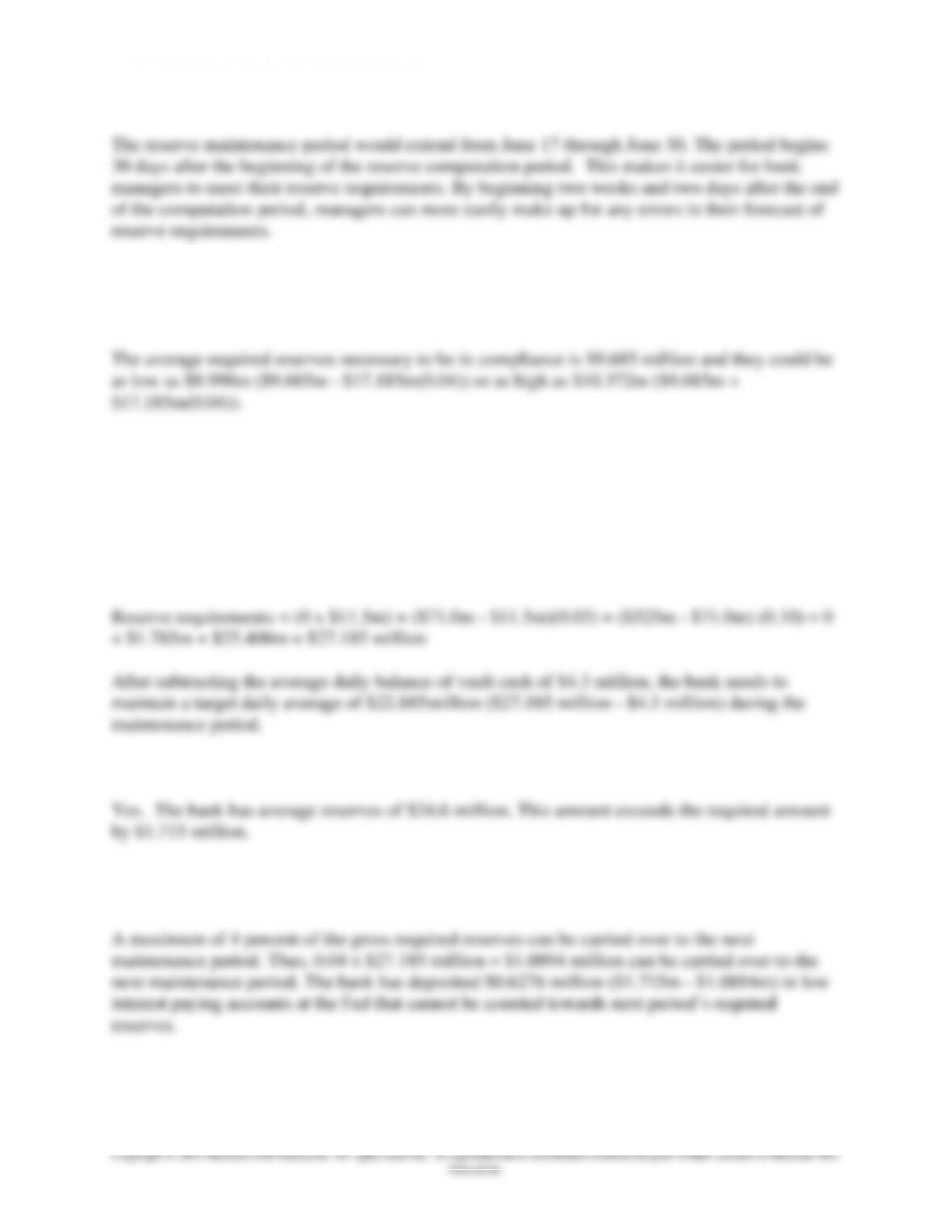
a. What is the corresponding reserve maintenance period under the rules effective in
2012?
Chapter 18 – Liability and Liquidity Management
18-4
b. Given your answers to parts (a) and (b) of problem (8), what would the average
required reserves need to be for the maintenance period for the bank to be in reserve
compliance?
10. The average daily net transaction accounts deposit balance of a local bank during the most
recent reserve computation period is $325 million. The amount of average daily reserves at
the Fed during the reserve maintenance period is $24.60 million, and the average daily
vault cash corresponding to the maintenance period is $4.3 million.
a. What is the average daily reserve balance required to be held by the bank during the
maintenance period?
b. Is the bank in compliance with the reserve requirements?
c. What amount of reserves can be carried over to the next maintenance period either as
excess or shortfall?

Chapter 18 – Liability and Liquidity Management
18-5
d. If the local bank has an opportunity cost of 6 percent and deposits at the Fed pay 0.5
percent, what is the effect on the income statement from this reserve period?
11. The following net transaction accounts and cash reserves at the Fed have been documented
by a bank for computation of its reserve requirements (in millions) under lagged reserve
accounting.
Monday Tuesday Wednesday Thursday Friday
April 10th 11th 12th 13th 14th
Net transaction
accounts $200 $300 $250 $280 $260
Reserves at Fed 20 22 21 18 27
Monday Tuesday Wednesday Thursday Friday
17th 18th 19th 20th 21th
Net transaction
accounts $280 $300 $270 $260 $250
Reserves at Fed 20 35 21 18 28
Monday Tuesday Wednesday Thursday Friday
24th 25th 26th 27th 28th
Net transaction
accounts $240 $230 $250 $260 $270
Reserves at Fed 19 19 21 19 24
Monday Tuesday Wednesday Thursday Friday
May 1st 2nd 3rd 4th 5th
Net transaction
accounts $200 $300 $250 $280 $260
Reserves at Fed 20 22 21 18 27
Monday Tuesday Wednesday Thursday Friday
8th 9th 10th 11th 12th
Net transaction
accounts $280 $300 $270 $260 $250
Reserves at Fed 20 35 21 18 27
Monday Tuesday Wednesday Thursday Friday
15th 16th 17th 18th 19th
Net transaction
accounts $240 $230 $250 $260 $270
Reserves at Fed 20 35 21 18 28

Chapter 18 – Liability and Liquidity Management
18-6
Monday Tuesday Wednesday Thursday Friday
22th 23th 24th 25th 26th
Net transaction
accounts $200 $300 $250 $280 $260
Reserves at Fed 19 19 21 19 24
The average vault cash for the computation period has been estimated to be $1 million per day.
a. What level of average daily reserves is required to be held by the bank during the
maintenance period, May 11 – 24?
b. Is the bank in compliance with the requirements?
c. What amount of required reserves can be carried over to the following computation period?
d. If the average cost of funds to the bank is 8 percent per year and deposits at the Fed pay
0.5 percent, what is the effect on the income statement for this bank for this reserve
period?

Chapter 18 – Liability and Liquidity Management
18-7
12. In July of 1998 the lagged reserve accounting (LRA) system replaced a contemporaneous
reserve accounting (CRA) system as the method of reserve calculation for DIs.
a. Contrast a contemporaneous reserve accounting (CRA) system with a lagged reserve
accounting (LRA) system.
b. Under which accounting system, CRA or LRA, are DI reserves higher? Why?
c. Under which accounting system, CRA or LRA, is DI uncertainty higher? Why?
Chapter 18 – Liability and Liquidity Management
18-8
Education.
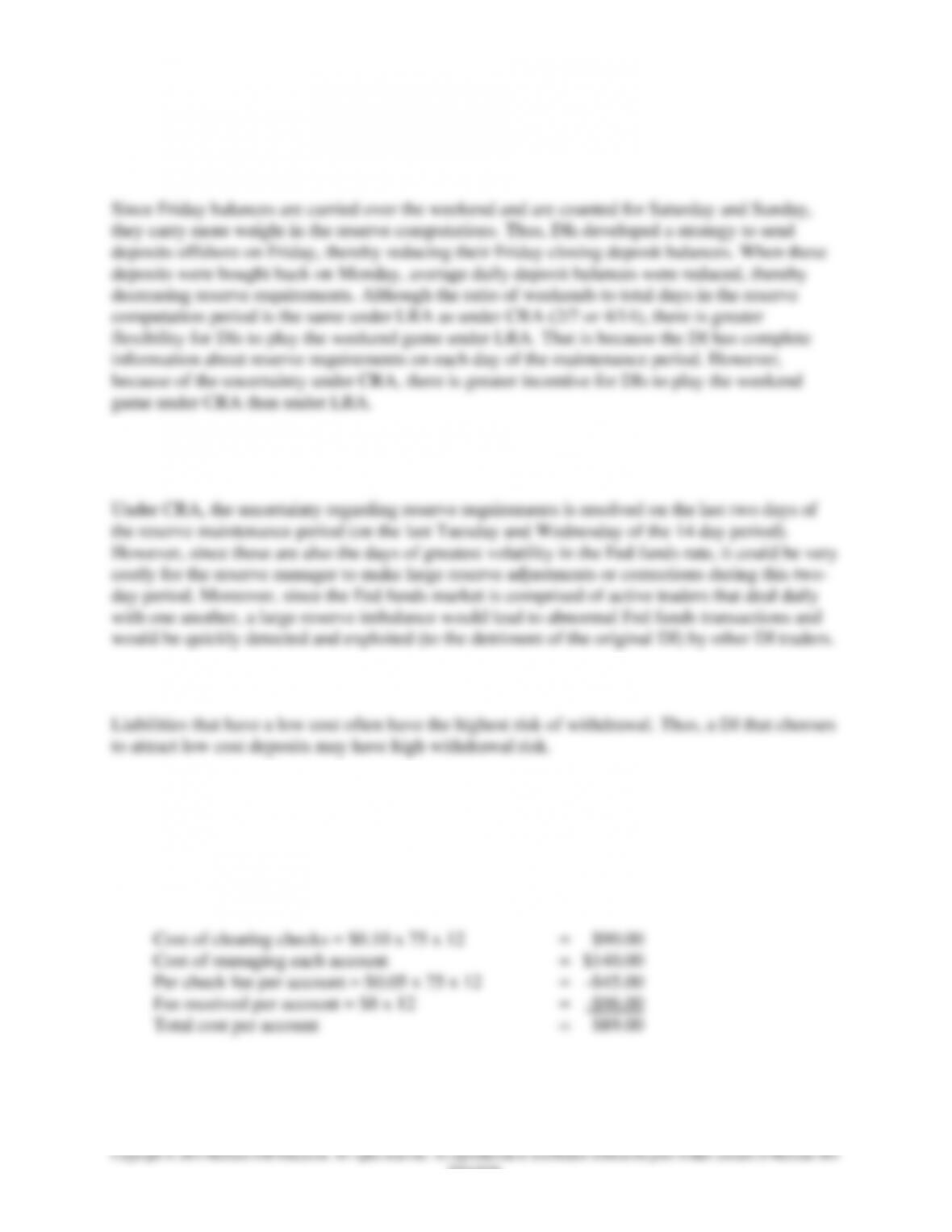
13. What is the “weekend game”? Contrast the DI’s ability and incentive to play the weekend
game under LRA as opposed to CRA.
14. Under CRA, when is the uncertainty about the reserve requirement resolved? Discuss the
feasibility of making large reserve adjustments during this period of complete information.
15. What is the relationship between funding cost and funding or withdrawal risk?
16. An FI has estimated the following annual costs for its demand deposits: management cost
per account = $140, average account size = $1,500, average number of checks processed
per account per month = 75, cost of clearing a check = $0.10, fees charged to customer per
check = $0.05, and average fee charged per customer per month = $8.
a. What is the implicit interest cost of demand deposits for the FI?

Chapter 18 – Liability and Liquidity Management
18-9
Education.
b. If the FI has to keep an average of 8 percent of demand deposits as required reserves
with the Fed paying no interest, what is the implicit interest cost of demand deposits for
the FI?
c. What should be the per-check fee charged to customers to reduce the implicit interest
costs to 3 percent? Ignore the reserve requirements.
17. A NOW account requires a minimum balance of $750 for interest to be earned at an annual
rate of 4 percent. An account holder has maintained an average balance of $500 for the first
six months and $1,000 for the remaining six months. The account holder writes an average
of 60 checks per month and pays $0.02 per check, although it costs the bank $0.05 to clear
a check.
a. What average return does the account holder earn on the account?
b. What is the average return if the bank lowers the minimum balance to $400?
c. What is the average return if the bank pays interest only on the amount in excess of
$400? Assume that the minimum required balance is $400.

Chapter 18 – Liability and Liquidity Management
18–10
d. How much should the bank increase its check fee to the account holder to ensure that
the average interest it pays on this account is 5 percent? Assume that the minimum
required balance is $750.
18. Rank the following liabilities, with respect, first, to funding risk and second to funding
cost:
Funding Risk Funding Cost
a. Money market deposit account. 8 4
b. Demand deposits. 11 1
c. Certificates of deposit. 7 5
d. Federal funds. 5 7
e. Bankers’ acceptances. 3 9
f. Eurodollar deposits. 2 10
g. NOW accounts. 10 2
h. Wholesale CDs. 6 6
i. Passbook savings. 9 3
j. Repos. 4 8
k. Commercial paper. 1 11
The rankings above are not meant to be definitively precise, but are made to illustrate that the
funding cost and the funding risk are inversely related. For example, demand deposits usually are
considered to be the least-cost source of funding, but they also are easily withdrawn from the FI.
On the other hand, repos, wholesale CDs, and fed funds are not liquid during their term, but can
be extremely liquid at maturity if the FI has any kind of financial distress. The cost of each of
these types of funds is directly linked to money market conditions. The contrast between funding
risk and funding cost for several of the liabilities is discussed below:
Chapter 18 – Liability and Liquidity Management
18–11
Copyright © 2014 McGraw-Hill Education. All rights reserved. No reproduction or distribution without the prior written consent of McGraw-Hill
Education.
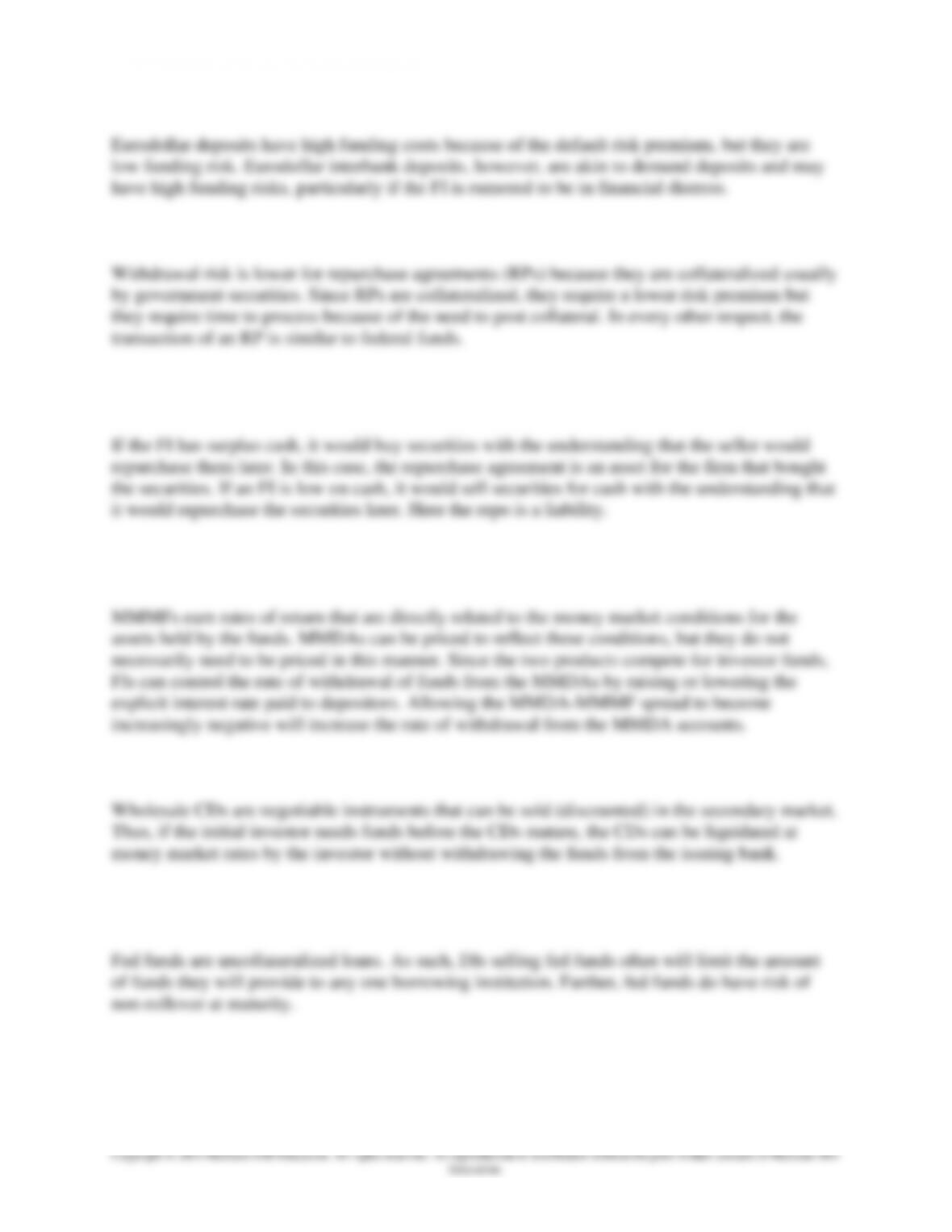
Eurodollar deposits have high funding costs because of the default risk premium, but they are
low funding risk. Eurodollar interbank deposits, however, are akin to demand deposits and may
have high funding risks, particularly if the FI is rumored to be in financial distress.
19. How is the withdrawal risk different for federal funds and repurchase agreements?
20. How does the cash balance, or liquidity, of an FI determine the types of repurchase
agreements into which it will enter?
21. How does the cost of MMMFs differ from the cost of MMDAs? How is the spread useful
in managing the withdrawal risk of MMDAs?
22. Why do wholesale CDs have minimal withdrawal risk to the issuing FI?
23. What characteristics of fed funds may constrain a DI’s ability to use fed funds to expand its
liquidity quickly?

Chapter 18 – Liability and Liquidity Management
18–12
24. What does a low fed funds rate indicate about the level of DI reserves? Why does the fed
funds rate have higher-than-normal variability around the last two days in the reserve
maintenance period?
25. What trends have been observed between 1960 and 2012 in regard to liquidity and liability
structures of commercial banks? What changes have occurred in the management of assets
that may cause the measured trends to be overstated?
26. What are the primary methods that insurance companies can use to reduce their exposure to
liquidity risk?