Chapter 17 – Technology and Other Operational Risks
17-1
Education.
Solutions for End-of-Chapter Questions and Problems: Chapter Seventeen
1. Explain how technological improvements can increase an FI’s interest and noninterest
income and reduce interest and noninterest expenses. Use some specific examples.
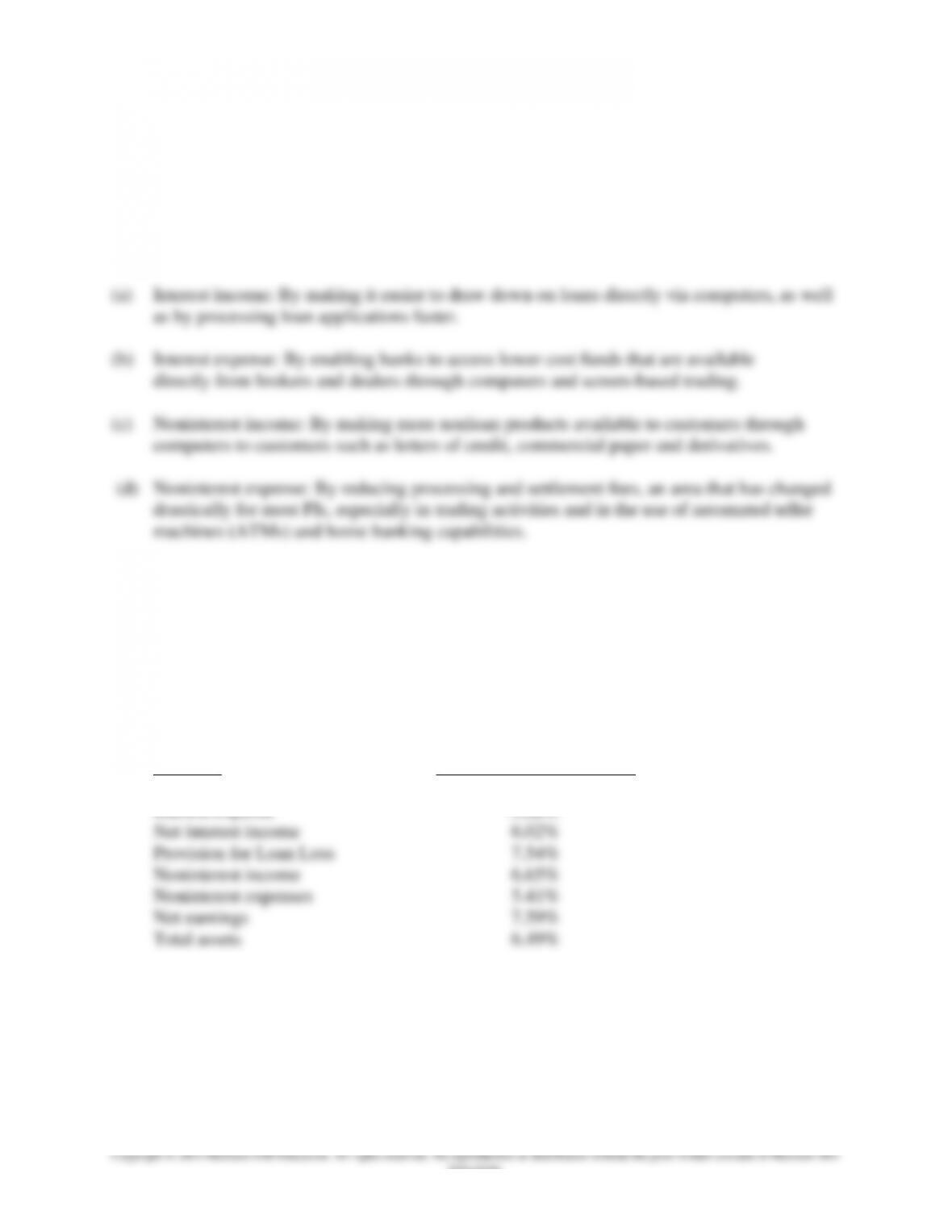
Technological improvements in the services provided by financial intermediaries help increase
income and reduce costs in several ways:
2. Table 17-1 shows data on earnings, expenses, and assets for all insured banks. Calculate the
annual growth rates in the various income, expense, earnings, and asset categories from
1991 to 2010. If part of the growth rates in assets, earnings, and expenses can be attributed
to technological change, in what areas of operating performance has technological change
appeared to have the greatest impact? What growth rates are more likely to be caused by
economy-wide economic activity?
Growth rates through the end of 2010:
Category Twenty-Year Growth Rate
Interest income 2.58%
Interest expense -3.08%
Chapter 17 – Technology and Other Operational Risks
17-2
Education.
3. Compare the effects of technology on an FI’s wholesale operations with the effects of
technology on an FI’s retail operations. Give some specific examples.
4. What are some of the risks inherent in being the first to introduce a financial innovation?
5. The operations department of a major FI is planning to reorganize several of its back-office
functions. Its current operating expense is $1.5 million, of which $1 million is for staff
expenses. The FI uses a 12 percent cost of capital to evaluate cost-saving projects.
a. One way of reorganizing is to outsource a portion of its data entry functions. This will
require an initial investment of approximately $500,000 after taxes. The FI expects to
save $150,000 in annual operating expenses after taxes for the next seven years. Should
it undertake this project?
Chapter 17 – Technology and Other Operational Risks
17-3
b. Another option is to automate the entire process by installing new state-of-the-art
computers and software. The FI expects to realize more than $500,000 per year in after-
tax savings, but the initial investment will be approximately $3 million. In addition, the
life of this project is limited to seven years, at which time new computers and software
will need to be installed. Using this seven-year planning horizon, should the FI invest in
this project? What level of after-tax savings would be necessary to make this plan
comparable in value creation to the plan in part (a)?
6. City Bank upgrades its computer equipment every five years to keep up with changes in
technology. Its next upgrade is two years from today and is budgeted to cost $1 million.
Management is considering moving up the date by two years to install some new
computers with breakthrough software that could generate significant cost savings. The
cost for this new equipment also is $1 million. What should be the savings per year to
justify moving up the planned update by two years? Assume a cost of capital of 15 percent
7. Identify and discuss three benefits of technology in generating revenue for FIs?
8. Distinguish between economies of scale and economies of scope.
Chapter 17 – Technology and Other Operational Risks
17-4
9. What information on the operating costs of FIs does the measurement of economies of
scale provide? If economies of scale exist, what implications do they have for regulators?
10. What are diseconomies of scale? What are the risks of large-scale technological
investments, especially to large FIs? Why are small FIs willing to outsource production to
large FIs against which they are competing? Why are large FIs willing to accept outsourced
production from smaller FI competition?
11. What information on the operating costs of FIs is provided by the measurement of
economies of scope? What implications do economies of scope have for regulators?
12. Buy Bank had $130 million in assets and $20 million in expenses before the acquisition of
Sell Bank, which had assets of $50 million and expenses of $10 million. After the merger,
the bank had $180 million in assets and $35 million in costs. Did this acquisition generate
either economies of scale or economies of scope for Buy Bank?
Chapter 17 – Technology and Other Operational Risks
17-5
13. A commercial bank with assets of $2 billion and expenses of $200 million has acquired an
investment banking firm subsidiary with assets of $40 million and expenses of $15 million.
After the acquisition, the expenses of the bank are $180 million and the expenses of the
subsidiary are $20 million. Does the resulting merger reflect economies of scale or
economies of scope?
14. What are diseconomies of scope? How could diseconomies of scope occur?
15. A survey of a local market has provided the following average cost data: Mortgage Bank A
(MBA) has assets of $3 million and an average cost of 20 percent. Life Insurance Company
B (LICB) has assets of $4 million and an average cost of 30 percent. Corporate Pension
Fund C (CPFC) has assets of $4 million and an average cost of 25 percent. For each firm,
average costs are measured as a proportion of assets. MBA is planning to acquire LICB and
CPFC with the expectation of reducing overall average costs by eliminating the duplication
of services.
a. What should be the average cost after acquisition for the bank to justify this merger?
b. If MBA plans to reduce operating costs by $500,000 after the merger, what will be the
average cost of the new firm?
Chapter 17 – Technology and Other Operational Risks
17-6
16. What is the difference between the production approach and the intermediation approach to
estimating costs functions of FIs?
17. What are some of the conclusions of empirical studies on economies of scale and scope?
How important is the impact of cost reductions on total average costs? What are X-
inefficiencies? What role do these factors play in explaining cost differences among FIs?
18. Why does the United States lag behind most other industrialized countries in the proportion
of annual electronic noncash transactions per capita? What factors probably will be
important in causing the gap to decrease?
19. What are the differences between the Fedwire and CHIPS payment systems?
Chapter 17 – Technology and Other Operational Risks
17-7
20. What is a daylight overdraft? How do an FI’s overdraft risks incurred during the day differ
for each of the two competing electronic payment systems, Fedwire and CHIPS? What
provision has been taken by the members of CHIPS to introduce an element of insurance
against the settlement risk problem?
21. How does Regulation F of the 1991 FDICIA reduce the problem of daylight overdraft risk?
22. Why do FIs in the United States face a higher degree of international technology risk than
do the FIs in other countries?
23. What has been the impact of rapid technological improvements in the electronic payment
systems on crime and fraud risk?
Chapter 17 – Technology and Other Operational Risks
17-8
24. What are usury ceilings? How does technology create regulatory risk?
25. How has technology altered the competition risk of FIs?
26. What actions has the BIS taken to protect depository institutions from insolvency due to
operational risk?