Chapter 16 – Off-Balance-Sheet Risk
16-1
Education.
Solutions for End-of-Chapter Questions and Problems: Chapter Sixteen
1. Classify the following items as (1) on-balance-sheet assets, (2) on-balance-sheet liabilities,
(3) off-balance-sheet assets, (4) off-balance-sheet liabilities, or (5) capital account.
Classification
a. Loan commitments. 3
b. Loan loss reserves. 5
c. Letter of credit. 2
2. How does one distinguish between an off-balance-sheet asset and an off-balance-sheet
liability?
3. Contingent Bank has the following balance sheet in market value terms (in millions of
dollars):
Assets Liabilities and Equity
Chapter 16 – Off-Balance-Sheet Risk
16-2
4. Why are contingent assets and liabilities like options? What is meant by the delta of an
option? What is meant by the term notional value?
5. An FI has purchased options on bonds with a notional value of $500 million and has sold
options on bonds with a notional value of $400 million. The purchased options have a delta
of 0.25 and the sold options have a delta of 0.30. What is (a) the contingent asset value of
this position, (b) the contingent liability value of this position, and (c) the contingent
market value of net worth?
6. What factors explain the growth of off-balance-sheet activities in the 1980s through the
2000s among U.S. FIs?
Chapter 16 – Off-Balance-Sheet Risk
16-3
7. What role does Schedule L play in reporting off-balance-sheet activities? Refer to Table
16-4. What was the annual growth rate over the 21-year period 1992-2012 in the notional
value of off-balance-sheet items compared with on-balance-sheet items? Which
contingencies have exhibited the most rapid growth?
The following information from Table 16-4 reflects the most significant OBS items in terms of
notional value:
Annual Growth
OBS Item Rate (%)
Commitments to lend 6.98%
Future and forward contracts on interest rates 14.00
8. What are the characteristics of a loan commitment that an FI may make to a customer? In
what manner and to whom is the commitment an option? What are the various possible
pieces of the option premium? When does the option or commitment become an on-
balance-sheet item for the FI and the borrower?
Chapter 16 – Off-Balance-Sheet Risk
16-4
9. A FI makes a loan commitment of $2.5 million with an up-front fee of 50 basis points and a
back-end fee of 25 basis points on the unused portion of the loan. The takedown on the
loan is 50 percent and takedown occurs at the beginning of the year.
a. What total fees does the FI earn when the loan commitment is negotiated?
b. What are the total fees earned by the FI at the end of the year, that is, in future value
terms? Assume the cost of capital for the FI is 6 percent.
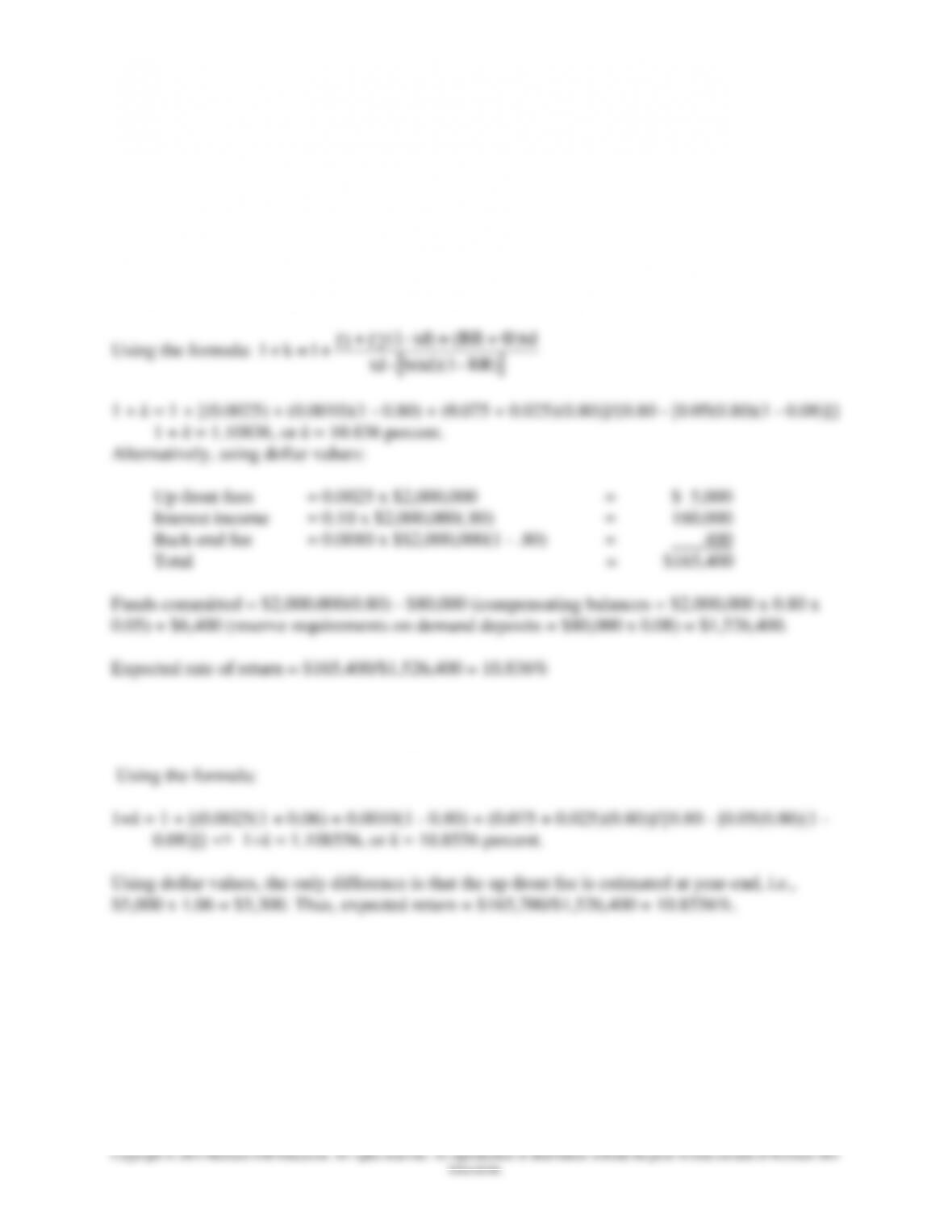
10. Use the following information on a one-year loan commitment to calculate the return on
the loan commitment.
BR = FI’s base interest on the loans = 8%
Chapter 16 – Off-Balance-Sheet Risk
16-5
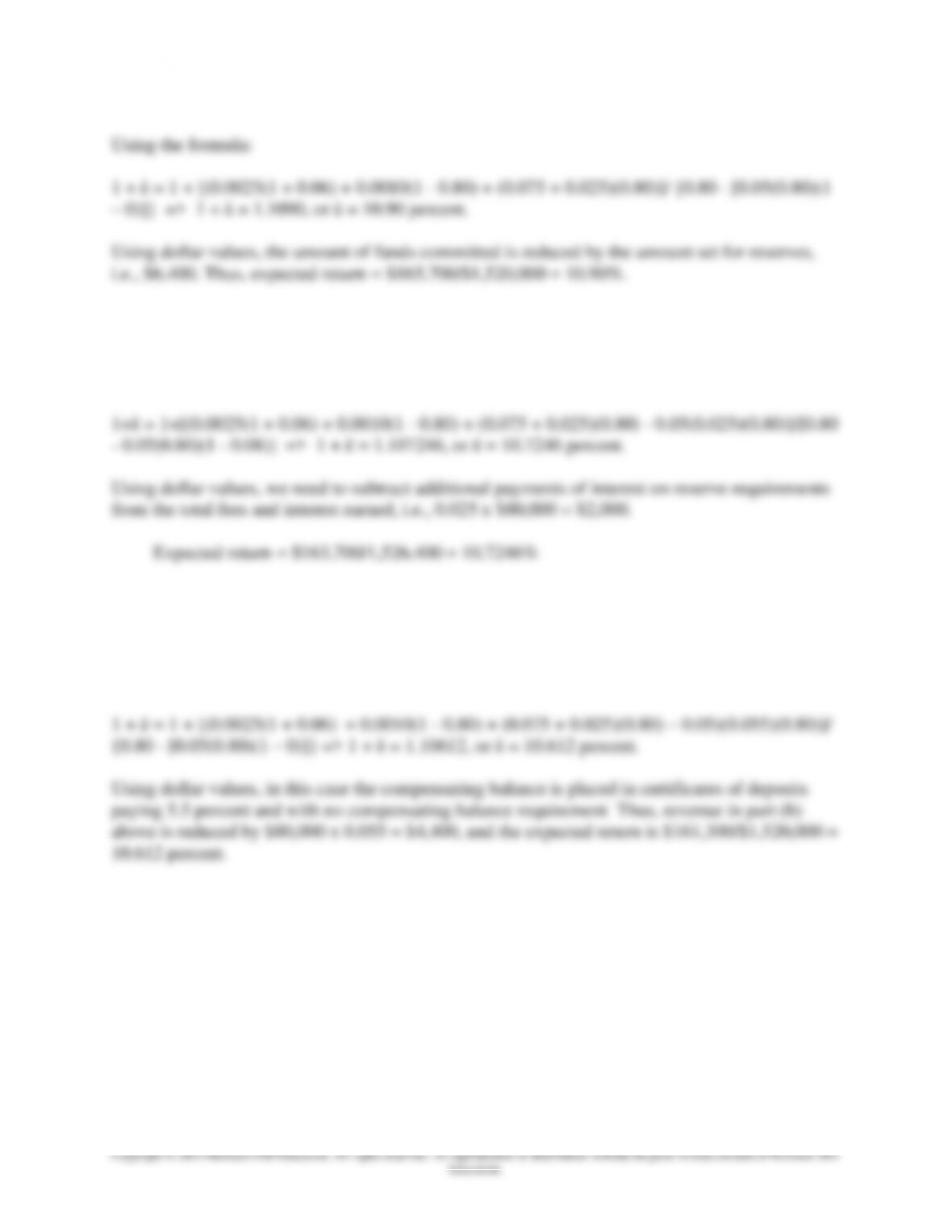
11. A FI has issued a one-year loan commitment of $2 million for an up-front fee of 25 basis
points. The back-end fee on the unused portion of the commitment is 10 basis points. The
FI’s base rate on loans is 7.5 percent and loans to this customer carry a risk premium of 2.5
percent. The FI requires a compensating balance on loans of 5 percent in the form of
demand deposits. Reserve requirements on demand deposits are 8 percent. The customer is
expected to draw down 80 percent of the commitment at the beginning of the year.
a. What is the expected return on the loan without taking future values into consideration?
b. What is the expected return using future values? That is, the net fee and interest income
are evaluated at the end of the year when the loan is due?
c. How is the expected return in part (b) affected if the reserve requirements on demand
deposits are zero?
Chapter 16 – Off-Balance-Sheet Risk
16-6
d. How is the expected return in part (b) affected if compensating balances are paid a
nominal interest rate of 2.5 percent?
Using the formula:
e. What is the expected return using future values, but with the compensating balance
placed in certificates of deposit that have an interest rate of 5.5 percent and no reserve
requirements, rather than in demand deposits?
Using the formula:
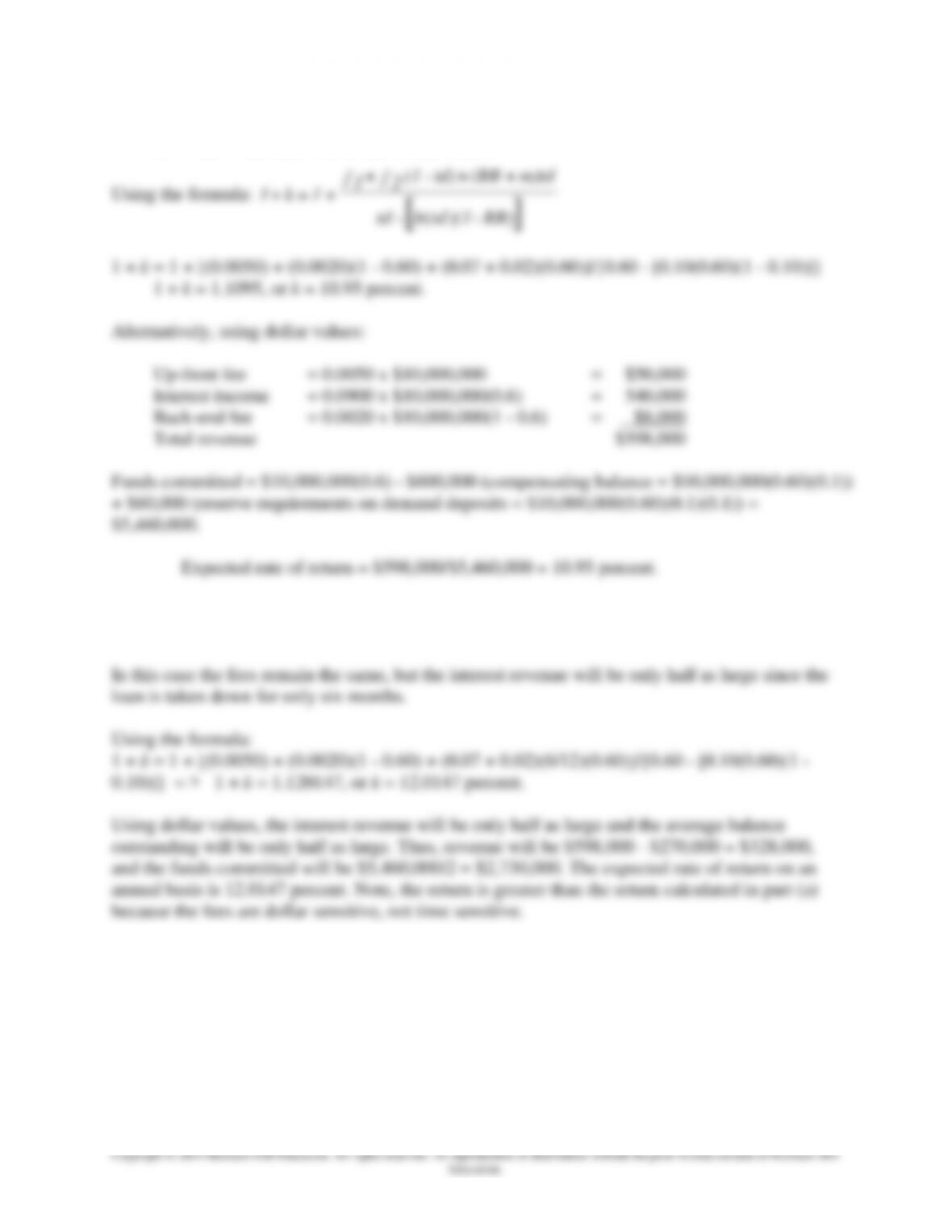
12. Suburb Bank has issued a one-year loan commitment of $10 million for an up-front fee of
50 basis points. The back-end fee on the unused portion of the commitment is 20 basis
points. The bank’s base rate on loans is 7 percent, and loans to this customer carry a risk
premium of 2 percent. The bank requires a compensating balance on loans of 10 percent to
be placed in demand deposits and must maintain reserve requirements on demand deposits
of 10 percent. The customer is expected to draw down 60 percent of the commitment at the
beginning of the year.
Chapter 16 – Off-Balance-Sheet Risk
16-7
a. What is the expected return on this loan?
m)td +(BR + td) –(1
f2
+
f1
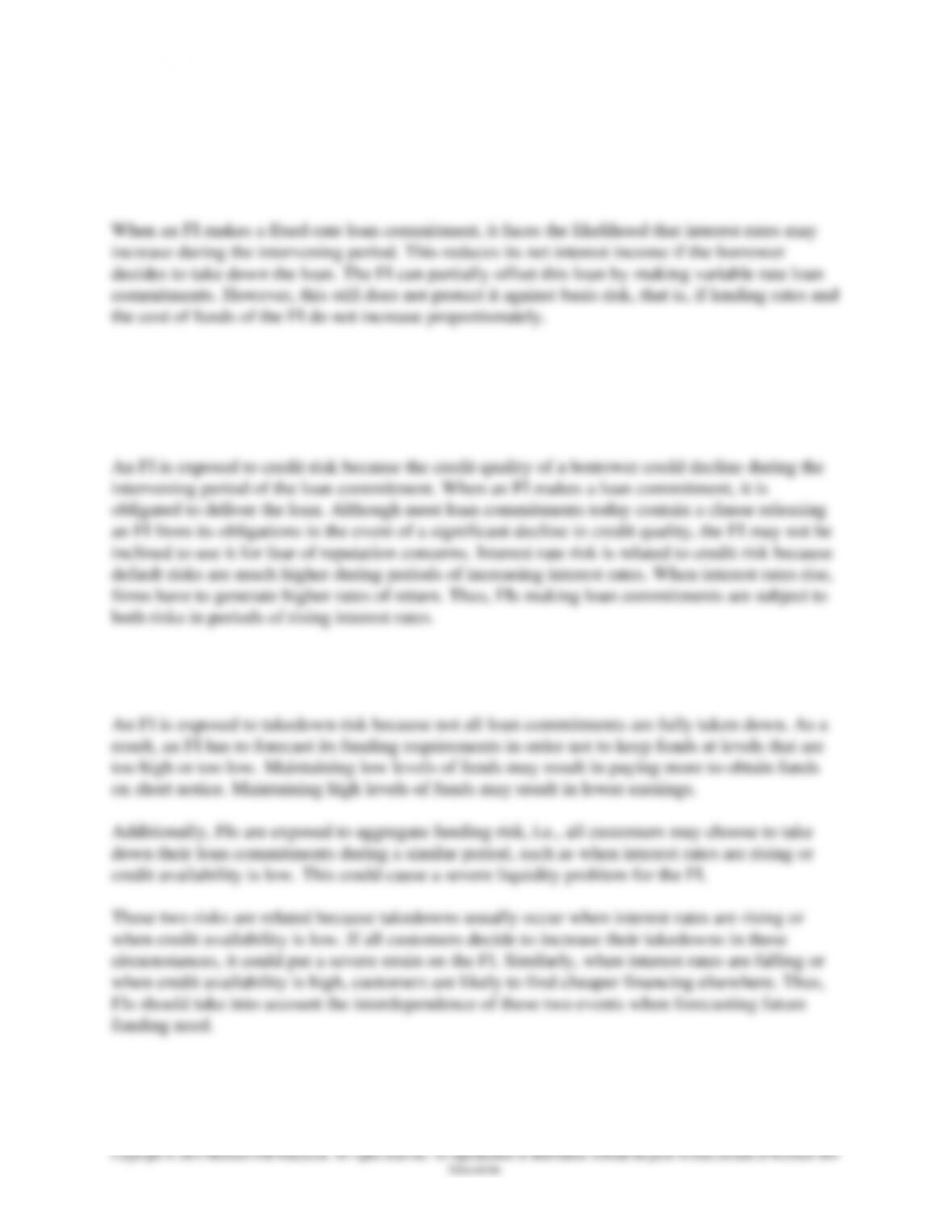
b. What is the expected annual return on the loan if the draw-down on the commitment
does not occur until at the end of six months?
Chapter 16 – Off-Balance-Sheet Risk
16-8
13. How is an FI exposed to interest rate risk when it makes loan commitments? In what way
can an FI control for this risk? How does basis risk affect the implementation of the control
for interest rate risk?
14. How is an FI exposed to credit risk when it makes loan commitments? How is credit risk
related to interest rate risk? What control measure is available to an FI for the purpose of
protecting against credit risk? What is the realistic opportunity to implement this control
feature?
15. How is an FI exposed to takedown risk and aggregate funding risk? How are these two
contingent risks related?
Chapter 16 – Off-Balance-Sheet Risk
16-9
Education.
16. Do the contingent risks of interest rate, takedown, credit, and aggregate funding tend to
increase the insolvency risk of an FI? Why or why not?
17. What is a letter of credit? How is a letter of credit like an insurance contract?
Like most insurance contracts, a letter of credit is a guarantee. It essentially gives the holder the
18. A German bank issues a three-month letter of credit on behalf of its German customer who
is planning to import $100,000 worth of goods from the United States. The bank charges an
up-front fee of 100 basis points.
a. What up-front fee does the bank earn? How is this fee recorded on the bank’s income
statement?
b. If the U.S. exporter decides to discount this letter of credit after it has been accepted by
the German bank, how much will the exporter receive, assuming that the interest rate
currently is 5 percent and that 90 days remain before maturity? (Hint: To discount a
security, use the time value of money formula, PV = FV [(1 – (interest rate x (days to
maturity/365))].)
c. What risk does the German bank incur by issuing this letter of credit?
19. How do standby letters of credit differ from commercial letters of credit? With what other
types of FI products do SLCs compete? What types of FIs can issue SLCs?
Chapter 16 – Off-Balance-Sheet Risk
16–10
Education.
20. A corporation is planning to issue $1 million of 270-day commercial paper for an effective
yield of 5 percent. The corporation expects to save 30 basis points on the interest rate by
using either an SLC or a loan commitment as collateral for the issue.
a. What are the net savings to the corporation if a bank agrees to provide a 270-day SLC
for an up-front fee of 20 basis points (of the face value of the loan commitment) to back
the commercial paper issue?
b. What are the net savings to the corporation if a bank agrees to provide a 270-day loan
commitment to back the issue? The bank will charge 10 basis points for an up-front fee
and 10 basis points for a back-end fee for any unused portion of the loan. Assume the
loan is not needed and that the fees are on the face value of the loan commitment.
c. Should the corporation be indifferent to the two alternative collateral methods at the
time the commercial paper is issued?
21. Explain how the use of derivative contracts such as forwards, futures, swaps, and options
creates contingent credit risk for an FI. Why do OTC contracts carry more contingent credit
risk than do exchange-traded contracts? How is the default risk of OTC contracts related to
the time to maturity and the price and rate volatilities of the underlying assets?
Chapter 16 – Off-Balance-Sheet Risk
16–11
Copyright © 2014 McGraw-Hill Education. All rights reserved. No reproduction or distribution without the prior written consent of McGraw-Hill
Education.
Credit risk occurs because of the potential for the counterparty to default on payment obligations,
a situation that would require the FI to replace the contract at current market prices and rates.
OTC contracts typically are non-standardized or unique contracts that do not have external
guarantees from an organized exchange. Defaults on these contracts usually will occur when the
FI stands to gain and the counterparty stands to lose, i.e., when the contract is hedging the risk
exactly as the FI hoped. Thus, default risk is higher when the volatility of the underlying asset is
higher.
22. What is meant by when-issued trading? Explain how forward purchases of when-issued
government T-Bills can expose FIs to contingent interest rate risk.
23. Distinguish between loan sales with and without recourse. Why would FIs want to sell
loans with recourse? Explain how loan sales can leave FIs exposed to contingent interest
rate risks.
24. The manager of Shakey Bank sends a $2 million funds transfer payment message via
CHIPS to the Trust Bank at 10 AM. Trust Bank sends a $2 million funds transfer message
via CHIPS to Hope Bank later that same day. What type of risk is inherent in this
transaction? How will the risk become reality?
Chapter 16 – Off-Balance-Sheet Risk
16–12
Education.
25. Explain how settlement risk is incurred in the interbank payment mechanism and how it is
another form of off-balance-sheet risk.
26. What is the difference between a one-bank holding company and a multibank holding
company? How does the principle of corporate separateness ensure that a bank is safe from
the failure of its affiliates?
27. Discuss how the failure of an affiliate can affect the holding company or its affiliates even
if the affiliates are structured separately.
28. Defend the statement that although off-balance-sheet activities expose FIs to several forms
of risks, they also can alleviate the risks of FIs.
Chapter 16 – Off-Balance-Sheet Risk
16–13
Education.
Integrated Mini Case: Calculating Income on Off-Balance-Sheet Activities
Dudley National has issued the following off-balance-sheet items:
• A one-year loan commitment of $1 million with an up-front fee of 40 basis points. The
back-end fee on the unused portion of the commitment is 55 basis points. The bank’s base
rate on loans is 8 percent, and loans to this customer carry a risk premium of 2 percent. The
bank requires a compensating balance on this loan of 10 percent to be placed in demand
deposits and must maintain reserve requirements on demand deposits of 8 percent. The
customer is expected to draw down 75 percent of the commitment at the beginning of the
year.
• A one-year loan commitment of $500,000 with an up-front fee of 25 basis points. The
back-end fee on the unused portion of the commitment is 30 basis points. Loans to this
customer carry a risk premium of 2.5 percent. The bank will not require a compensating
balance on this loan. The customer is expected to draw down 90 percent of the commitment
at the beginning of the year.
• A three-month commercial letter of credit on behalf of one of its AA-rated customers who
is planning to import $400,000 worth of goods from the Germany. The bank charges an up-
front fee of 75 basis points on commercial letters of credit to AA-rated customers.
• A standby letter of credit to one its A-rated customers who is planning to issue $5 million
of 270-day commercial paper for an effective yield of 5 percent. The corporation expects to
save 50 basis points on the interest rate by using the SLC. The bank charges an up-front fee
of 40 basis points on SLCs to A-rated customers to back the commercial paper issue?
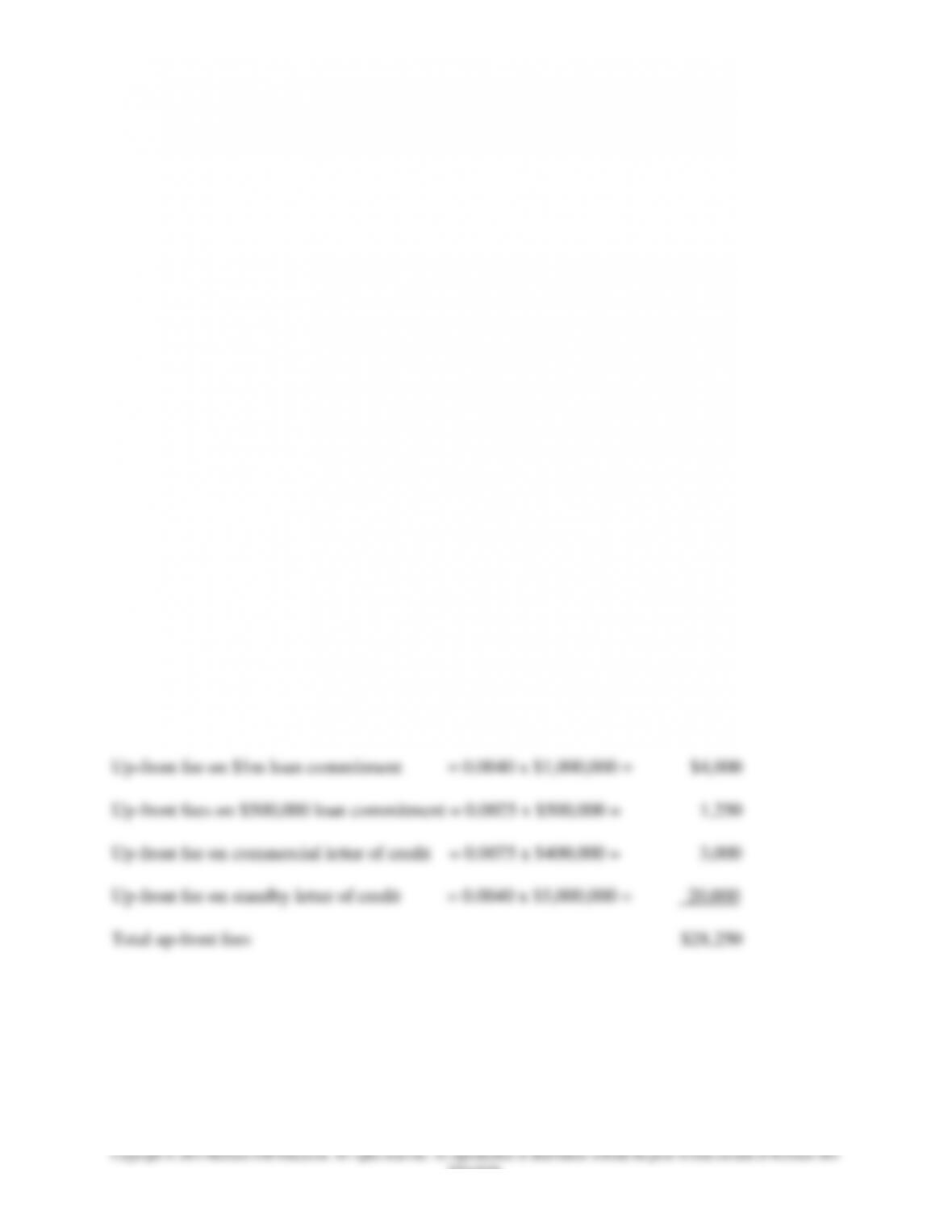
a. What up-front fees does the bank earn on each of these?
b. What other income does the bank earn on these off-balance-sheet activities?
Chapter 16 – Off-Balance-Sheet Risk
16–14
Copyright © 2014 McGraw-Hill Education. All rights reserved. No reproduction or distribution without the prior written consent of McGraw-Hill
Education.
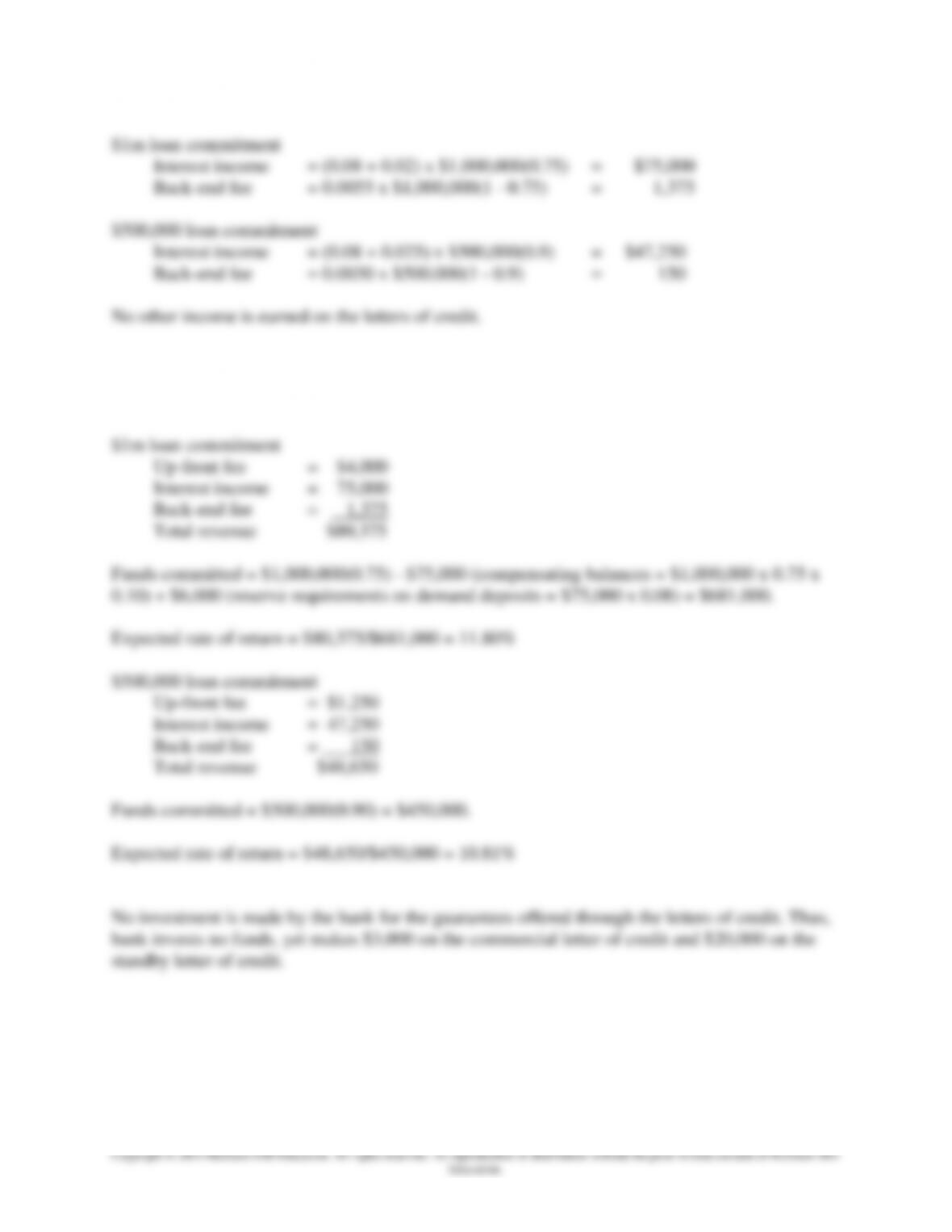
$1m loan commitment
Interest income = (0.08 + 0.02) x $1,000,000(0.75) = $75,000
Back-end fee = 0.0055 x $1,000,000(1 – 0.75) = 1,375
$500,000 loan commitment
Interest income = (0.08 + 0.025) x $500,000(0.9) = $47,250
Back-end fee = 0.0030 x $500,000(1 – 0.9) = 150
No other income is earned on the letters of credit.
c. Calculate the returns on each of the off-balance-sheet activities assuming that the
takedowns on the loan commitments are at the expected percentage and the customers
holding the letters of credit do not default on their obligations.