Chapter 15 – Market Risk
15–13
Education.
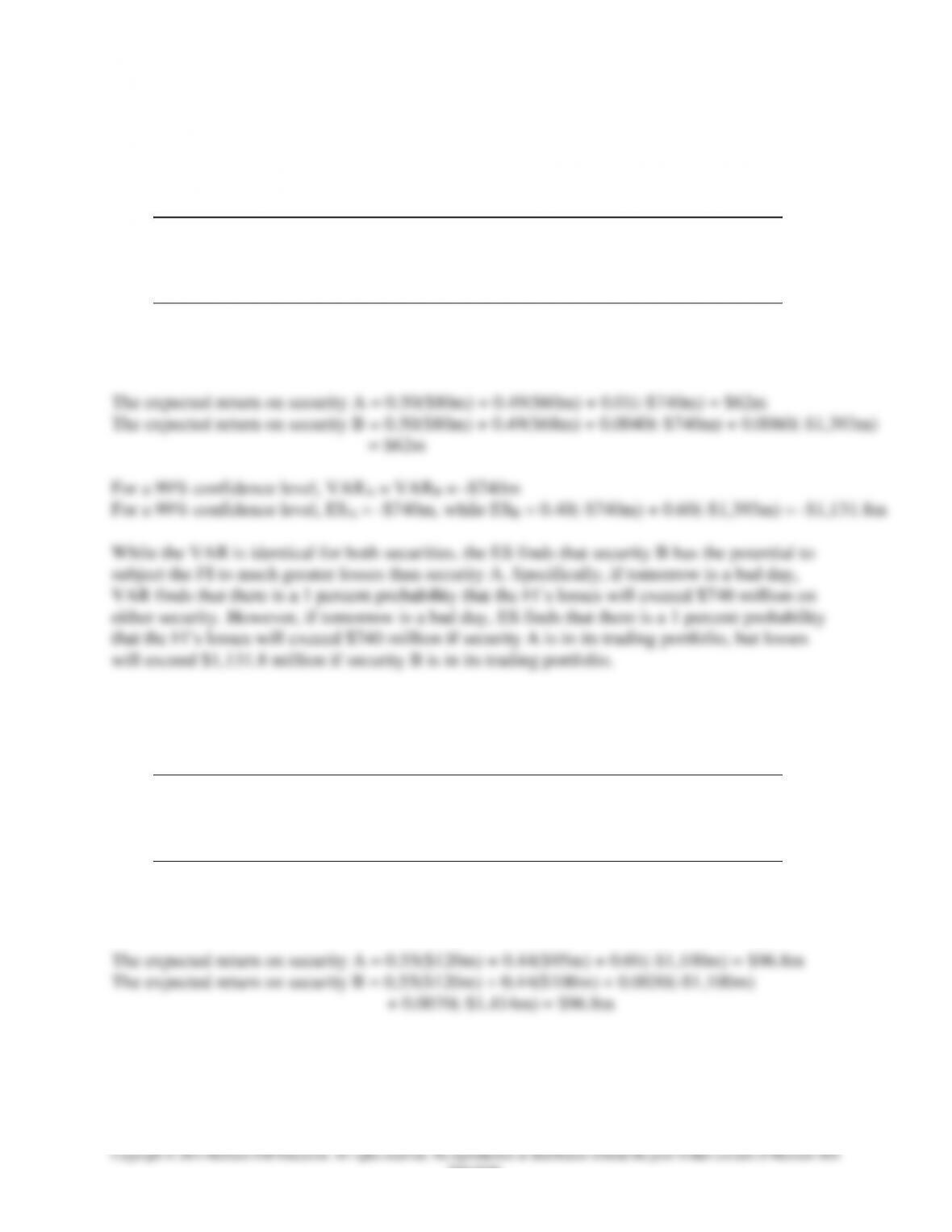
25. Consider the following discrete probability distribution of payoffs for two securities, A and
B, held in the trading portfolio of an FI:
Probability A Probability B
50.00% $80m 50.00% $80m
49.00 60m 49.00 68m
1.00 -740m 0.40 -740m
0.60 -1,393m
Which of the two securities will add more market risk to the FI’s trading portfolio
according to the VAR and ES measures?
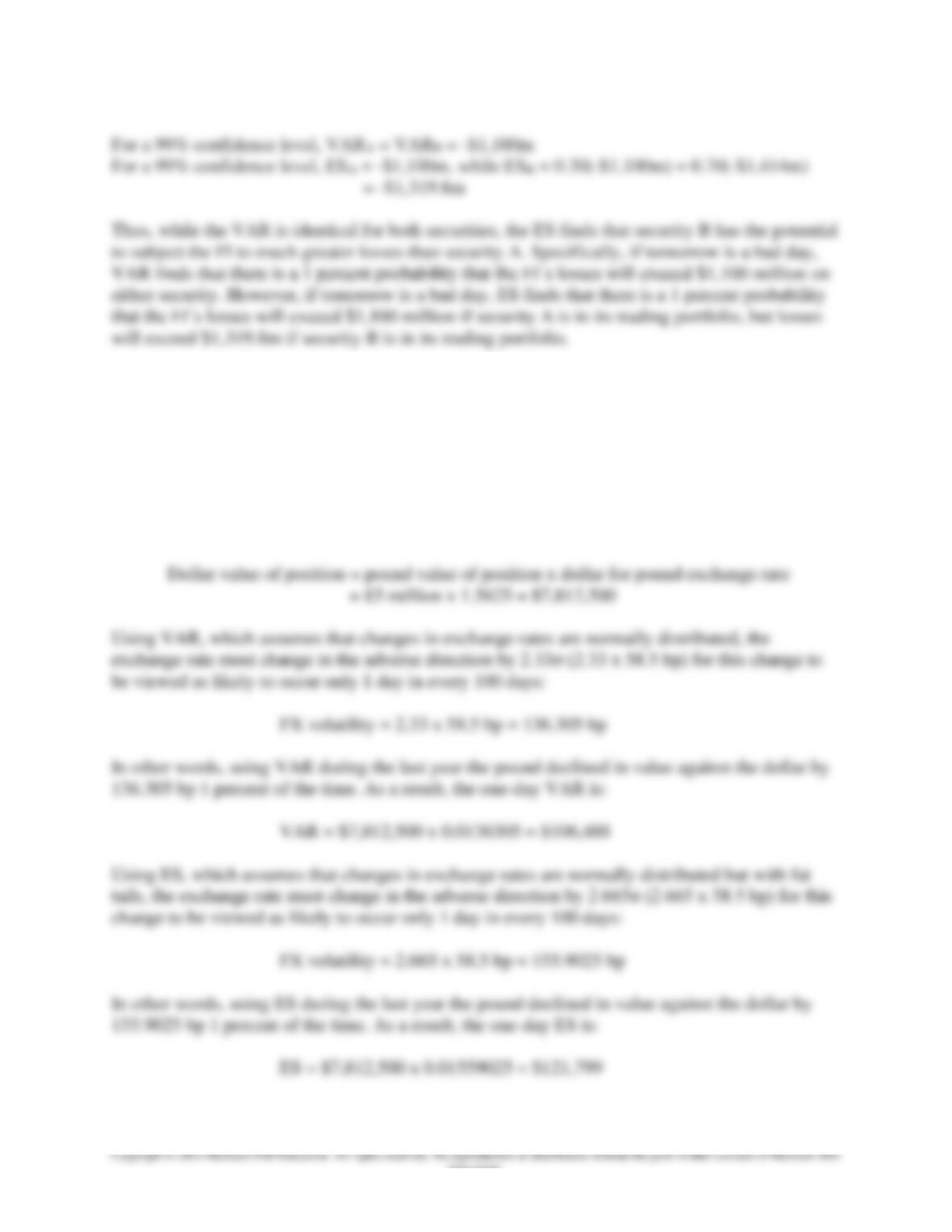
26. Consider the following discrete probability distribution of payoffs for two securities, A and
B, held in the trading portfolio of an FI:
Probability A Probability B
55.00% $120m 55.00% $120m
44.00 95m 44.00 100m
1.00 -1,100m 0.30 -1,100m
0.70 -1,414m
Which of the two securities will add more market risk to the FI’s trading portfolio
according to the VAR and ES measures?
Chapter 15 – Market Risk
15–14
Education.
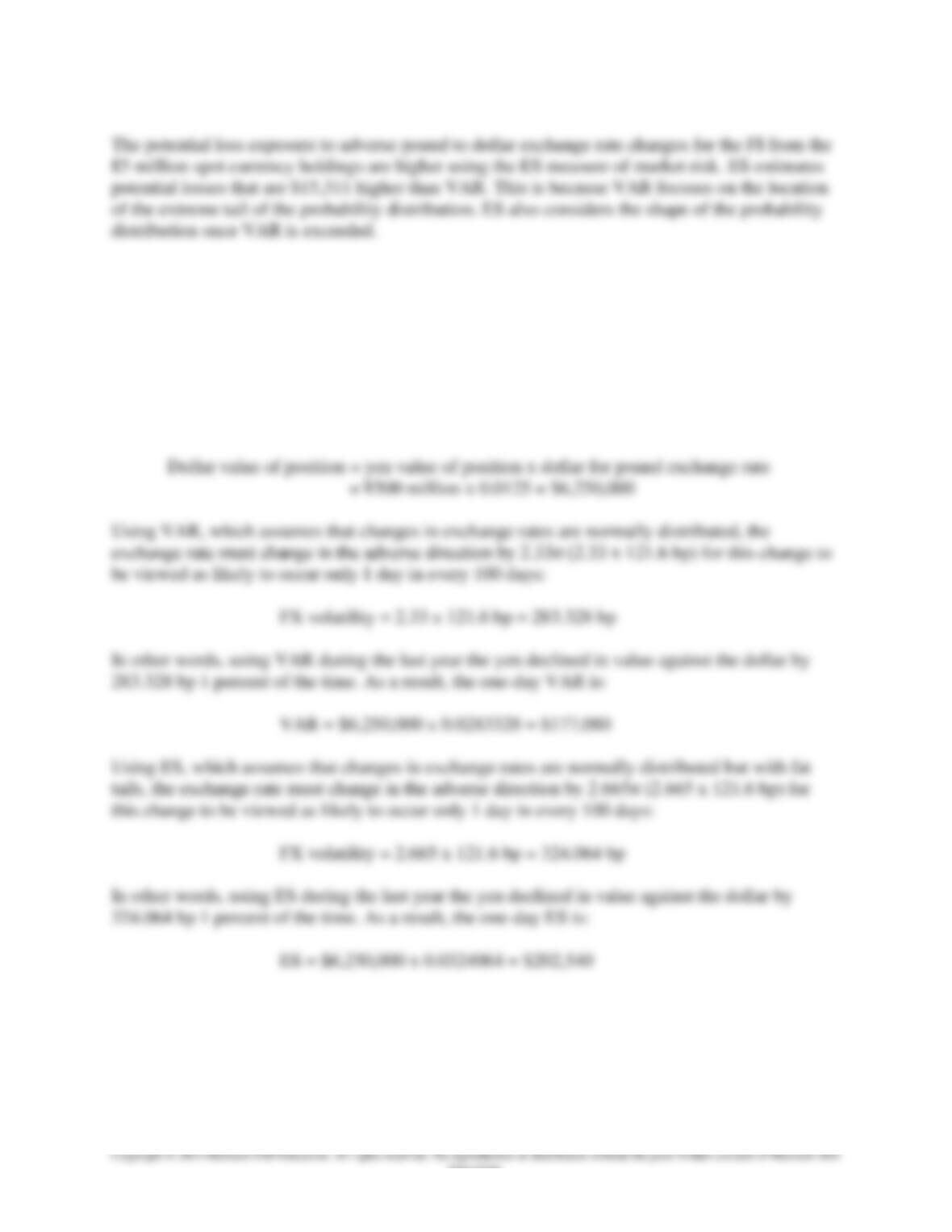
27. An FI has ₤5 million in its trading portfolio on the close of business on a particular day.
The current exchange rate of pounds for dollars is ₤0.6400/$, or dollars for pounds is
$1.5625, at the daily close. The volatility, or standard deviation (σ), of daily percentage
changes in the spot ₤/$ exchange rate over the past year was 58.5 bp. The FI is interested in
adverse moves – bad moves that will not occur more than 1 percent of the time, or 1 day in
every 100. Calculate the one-day VAR and ES from this position.
The first step is to calculate the dollar value position:
Chapter 15 – Market Risk
15–15
Education.
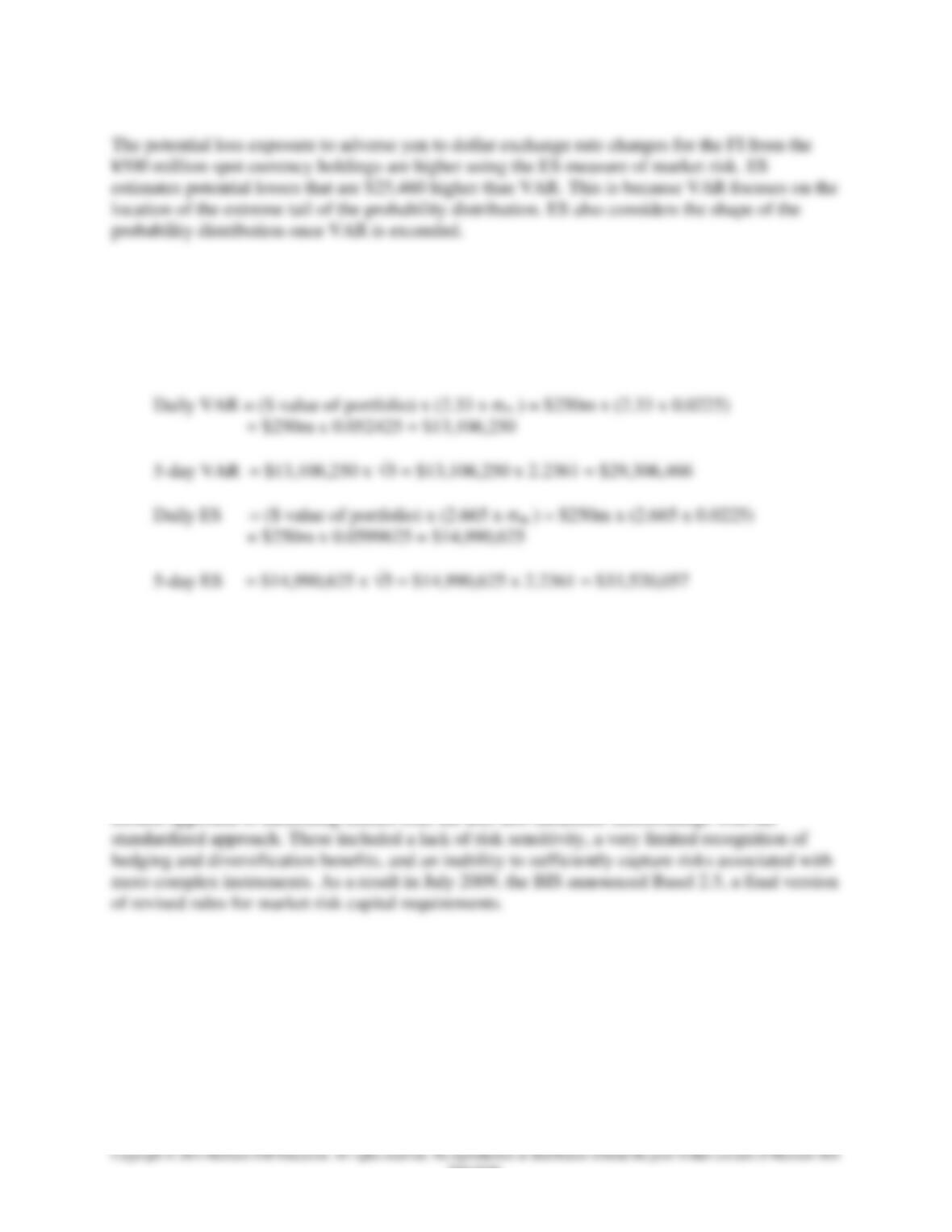
28. An FI has ¥500 million in its trading portfolio on the close of business on a particular day.
The current exchange rate of yen for dollars is ¥80.00/$, or dollars for yen is $0.0125, at
the daily close. The volatility, or standard deviation (σ), of daily percentage changes in the
spot ¥/$ exchange rate over the past year was 121.6 bp. The FI is interested in adverse
moves – bad moves that will not occur more than 1 percent of the time, or 1 day in every
100. Calculate the one-day VAR and ES from this position.
The first step is to calculate the dollar value position:
Chapter 15 – Market Risk
15–16
Education.
29. Bank of Hawaii’s stock portfolio has a market value of $250 million. The beta of the
portfolio approximates the market portfolio, whose standard deviation (m) has been
estimated at 2.25 percent. What are the five-day VAR and ES of this portfolio using
adverse rate changes in the 99th percentile?
30. Despite the fact that market risk capital requirements have been imposed on FIs since the
1990s, huge losses in value were recorded from losses incurred in FIs’ trading portfolios.
Why did this happen? What changes to capital requirements did regulators propose to
prevent such losses from reoccurring?
During the financial crisis, losses due to market risk were significantly higher than the minimum
market risk capital requirements under BIS Basel I and Basel II rules. The financial crisis
exposed a number of shortcomings in the way market risk was being measured in accordance
with Basel II rules. Although the crisis largely exposed problems with the large-bank internal
models approach to measuring market risk, the BIS also identified shortcomings with the
Chapter 15 – Market Risk
15–17
Education.
31. In its trading portfolio, an FI holds 10,000 Exxon Mobil (XOM) shares at a share price of
$86.50 and has sold 5,000 General Electric (GE) shares under a forward contract that
Chapter 15 – Market Risk
15–18
Education.
Step 1. Assign each instrument to applicable risk factors
From Table 15-8, hedgeable risk factors for these equities include level I worldwide equity
index, level II equity index by broad industry category, and level III movements in the prices of
XOM Gross GE Gross Total size of
Level Equity risk risk position risk position net risk position
I Worldwide equity index $865,000 -$102,500 $762,500
Chapter 15 – Market Risk
15–19
Education.
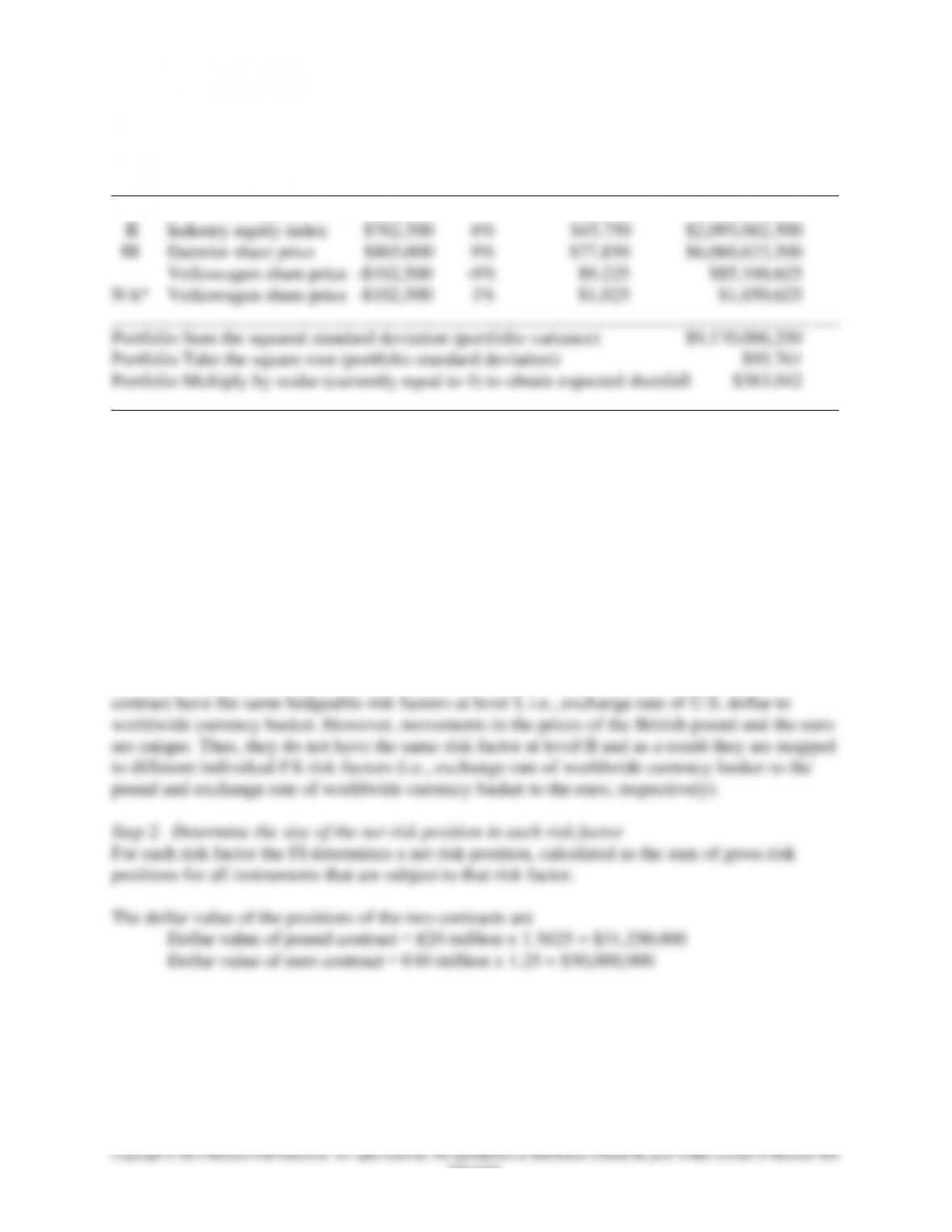
Standard Square of the
Net risk Standard deviation of standard deviation
Level Equity risk position deviation net risk position net risk position
I Worldwide equity index $762,500 4% $30,500 $930,250,000
32. In its trading portfolio, a U.S. FI is long ₤20 million worth of pound FX forward contracts
and has sold €40 million of euro FX forward contracts that mature in one year. The current
exchange rate of dollars for pounds is $1.5625 and the exchange rate of euros for pounds is
$1.25 at the daily close. The shift risk factor (i.e., standard deviation) for level 1 risk factor
is 5 percent, for level II risk factor for pounds is 8 percent, and for level II risk factors for
euros is 12 percent. Using the risk factors listed in Table 15-8, calculate the market risk
capital charge on these securities.
Step 1. Assign each instrument to applicable risk factors
From Table 15-8, hedgeable risk factors for these FX contracts include level I exchange rate of
U.S. currency to worldwide currency basket, and level II exchange rate of worldwide currency
basket to respective foreign currency. The pound FX forward contract and the euro FX forward
Chapter 15 – Market Risk
15–20
Education.
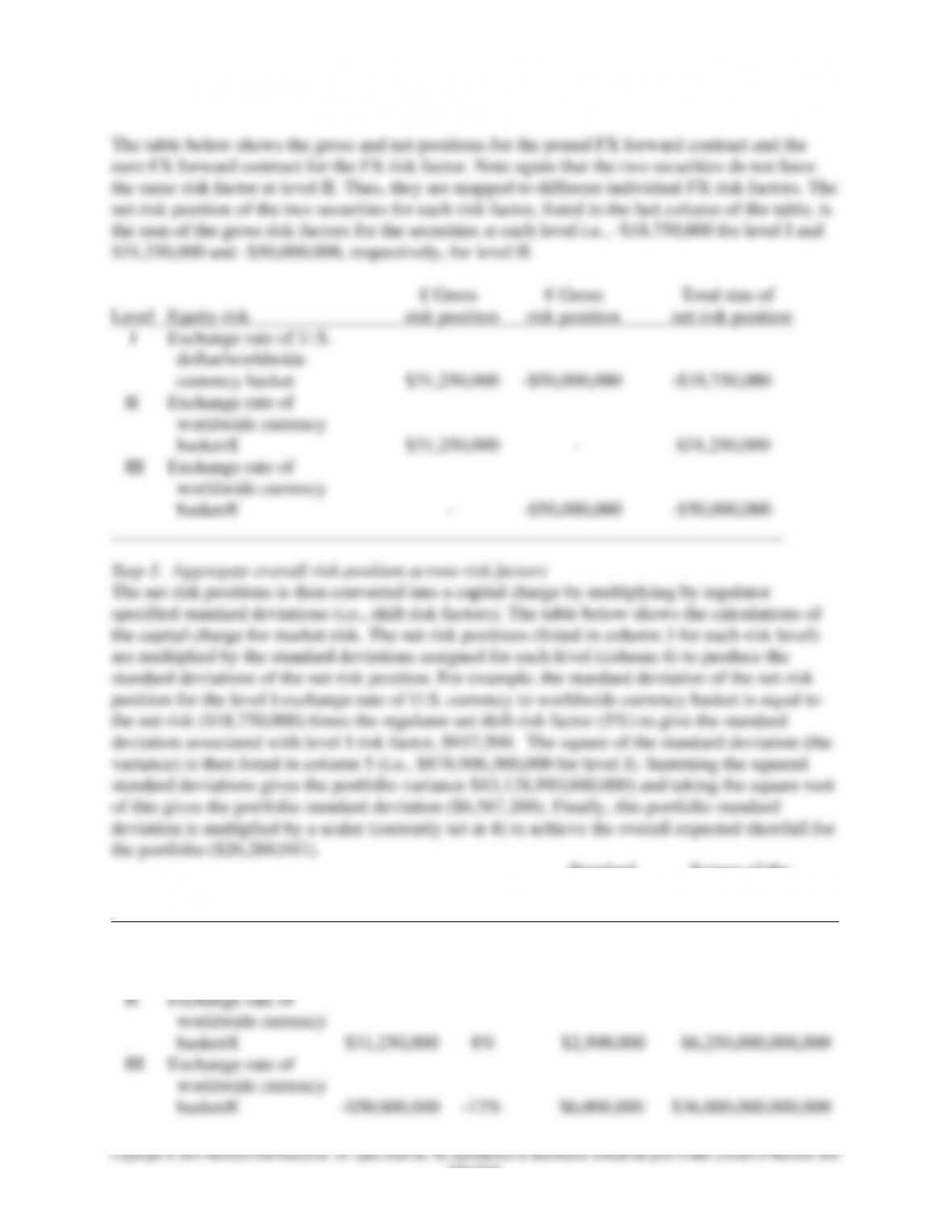
Standard Square of the
Net risk Standard deviation of standard deviation
Level Equity risk position deviation net risk position net risk position
I Exchange rate of U.S.
dollar/worldwide
currency basket -$18,750,000 5% $937,500 $878,906,300,000
Chapter 15 – Market Risk
15–21
Education.
33. Suppose an FI’s portfolio VAR for the previous 60 days was $3 million and stressed VAR
for the previous 60 days was $8 million using the 1 percent worst case (or 99th percentile).
Calculate the minimum capital charge for market risk for this FI.
Integrated Mini Case: Calculating DEAR on an FI’s Trading Portfolio
An FI wants to obtain the DEAR on its trading portfolio. The portfolio consists of the following
securities.
Fixed-income securities:
i) The FI has a $1 million position in a six-year zero bonds with a face value of $1,543,302. The
bond is trading at a yield to maturity of 7.50 percent. The historical mean change in daily yields
is 0.0 percent, and the standard deviation is 22 basis points.
ii) The FI also holds a 12-year zero bond with a face value of $1,000,000. The bond is trading at
a yield to maturity of 6.75 percent. The price volatility if the potential adverse move in yields is
65 basis points.
Foreign exchange contracts:
The FI has a €2.0 million long trading position in spot euros at the close of business on a particular
day. The exchange rate is €0.80/$1, or $1.25/€, at the daily close. Looking back at the daily
changes in the exchange rate of the euro to dollars for the past year, the FI finds that the volatility
or standard deviation (σ) of the spot exchange rate was 55.5 basis points (bp).

Chapter 15 – Market Risk
15–22
Education.
Equities:
The FI holds a $2.5 million trading position in stocks that reflect the U.S. stock market index
(e.g., the S&P 500). The β = 1. Over the last year, the standard deviation of the stock market
index was 175 basis points.
Correlations (ρij) among Assets
___________________________________________________________________________________________ _
Six-year zero-coupon 12-year zero-coupon €/$ U.S. stock index
Six-year, zero-coupon – 0.75 -0.2 0.40
12-year, zero-coupon – – -0.3 0.45
€/$ – – – 0.25
U.S. stock index – – – –
Calculate the DEAR of this trading portfolio.
Solution:
Fixed-income securities:
i) MD = D/(1 + R) = 6/(1.075) = 5.581395
=> Potential adverse move in yield at 5 percent = 1.65 = 1.65 x 0.0022 = .00363
ii) Dollar value of position = $1m./(1 + 0.0675)12 = $456,652. The modified duration of these
bonds is:
Foreign exchange contracts:
Dollar equivalent value of € position = FX position x ($/€ spot exchange rate)
= €3.5 million x $ per unit of foreign currency

Chapter 15 – Market Risk
15–23
Equities:
Portfolio DEAR:
Using the correlation matrix along with the individual asset DEARs the risk (or standard
deviation) of the whole (four-asset) trading portfolio is: