Chapter 15 – Market Risk
15-1
Education.
Solutions for End-of-Chapter Questions and Problems: Chapter Fifteen
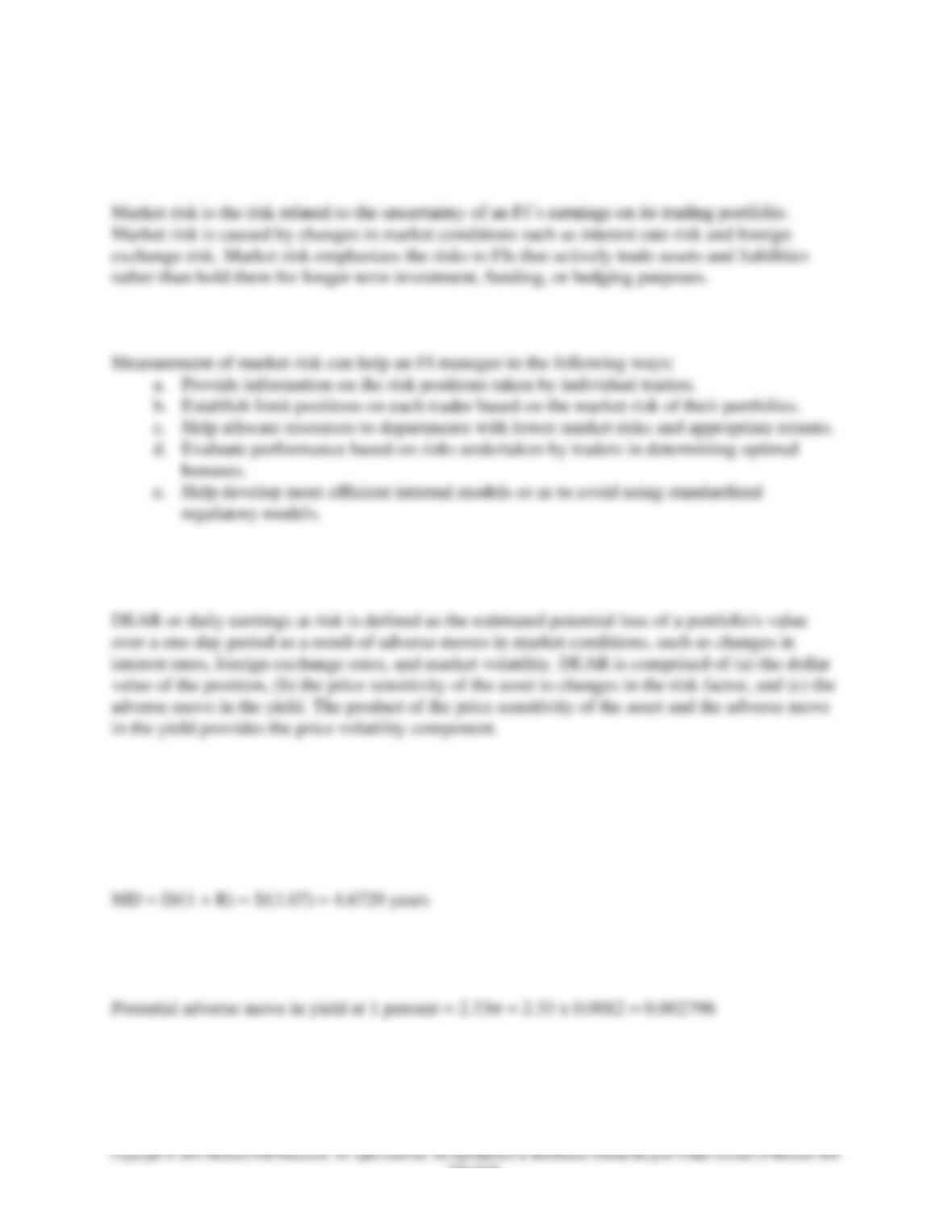
1. What is meant by market risk?
2. Why is the measurement of market risk important to the manager of a financial institution?
3. What is meant by daily earnings at risk (DEAR)? What are the three measurable
components? What is the price volatility component?
4. Follow Bank has a $1 million position in a five-year, zero-coupon bond with a face value
of $1,402,552. The bond is trading at a yield to maturity of 7.00 percent. The historical
mean change in daily yields is 0.0 percent and the standard deviation is 12 basis points.
a. What is the modified duration of the bond?
b. What is the maximum adverse daily yield move given that we desire no more than a 1
percent chance that yield changes will be greater than this maximum?
c. What is the price volatility of this bond?
Chapter 15 – Market Risk
15-2
Copyright © 2014 McGraw-Hill Education. All rights reserved. No reproduction or distribution without the prior written consent of McGraw-Hill
Education.
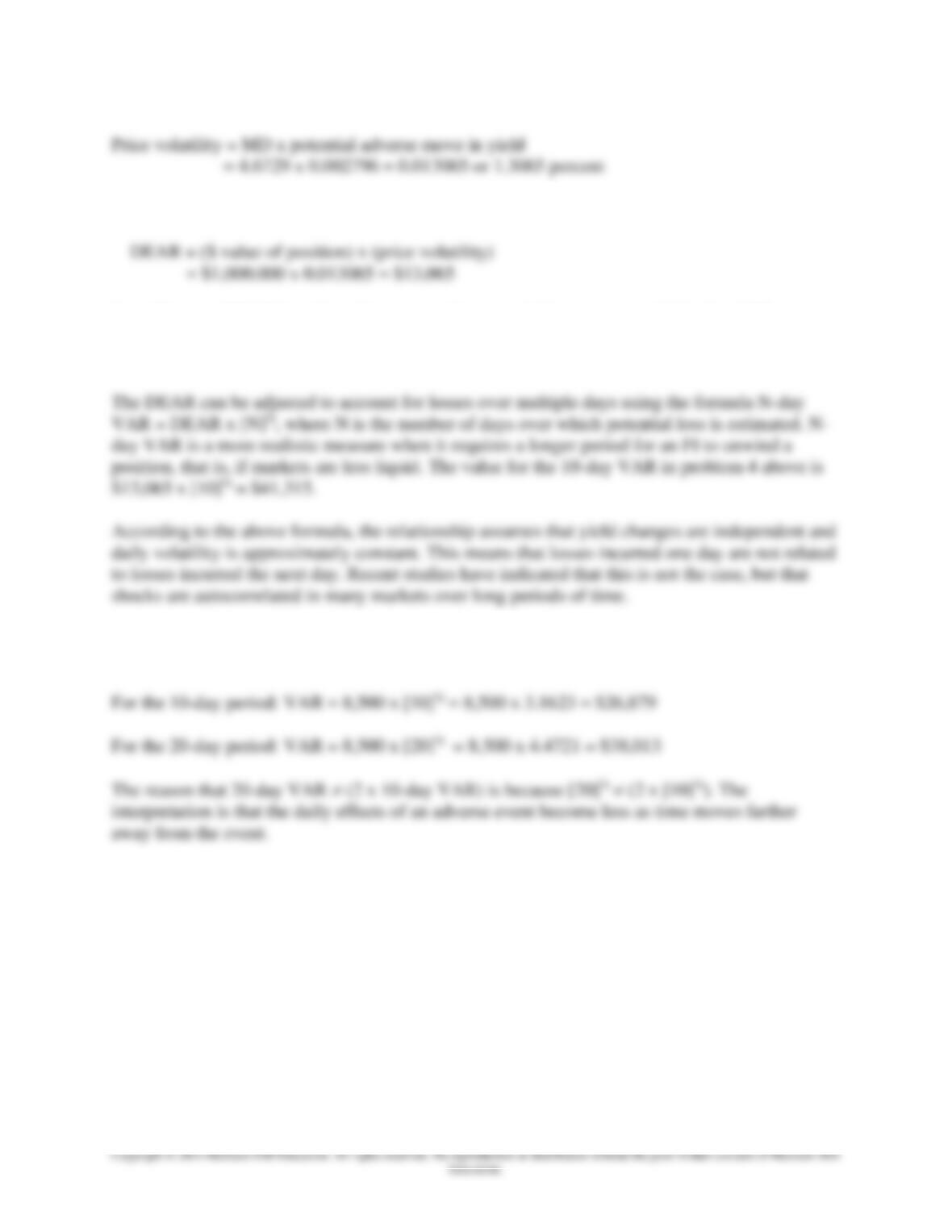
Price volatility = MD x potential adverse move in yield
= 4.6729 x 0.002796 = 0.013065 or 1.3065 percent
d. What is the daily earnings at risk for this bond?
5. How can DEAR be adjusted to account for potential losses over multiple days? What
would be the VAR for the bond in problem 4 for a 10-day period? What statistical
assumption is needed for this calculation? Could this treatment be critical?
6. The DEAR for a bank is $8,500. What is the VAR for a 10-day period? A 20-day period?
Why is the VAR for a 20-day period not twice as much as that for a 10-day period?
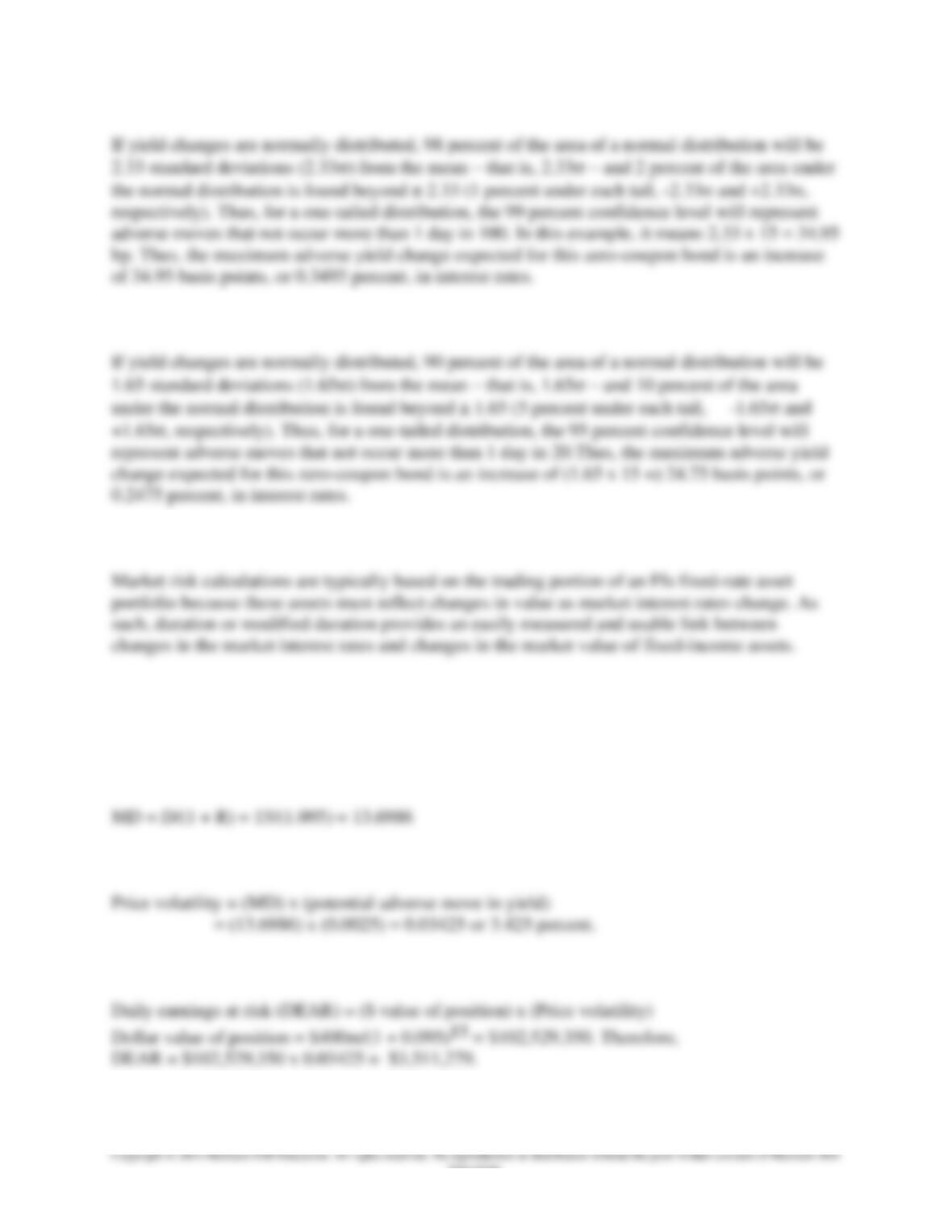
7. The mean change in the daily yields of a 15-year, zero-coupon bond has been five basis
points (bp) over the past year with a standard deviation of 15 bp. Use these data and
assume that the yield changes are normally distributed.
a. What is the highest yield change expected if a 99 percent confidence limit is required;
that is, adverse moves will not occur more than 1 day in 100?
Chapter 15 – Market Risk
15-3
Education.
b. What is the highest yield change expected if a 95 percent confidence limit is required?
8. In what sense is duration a measure of market risk?
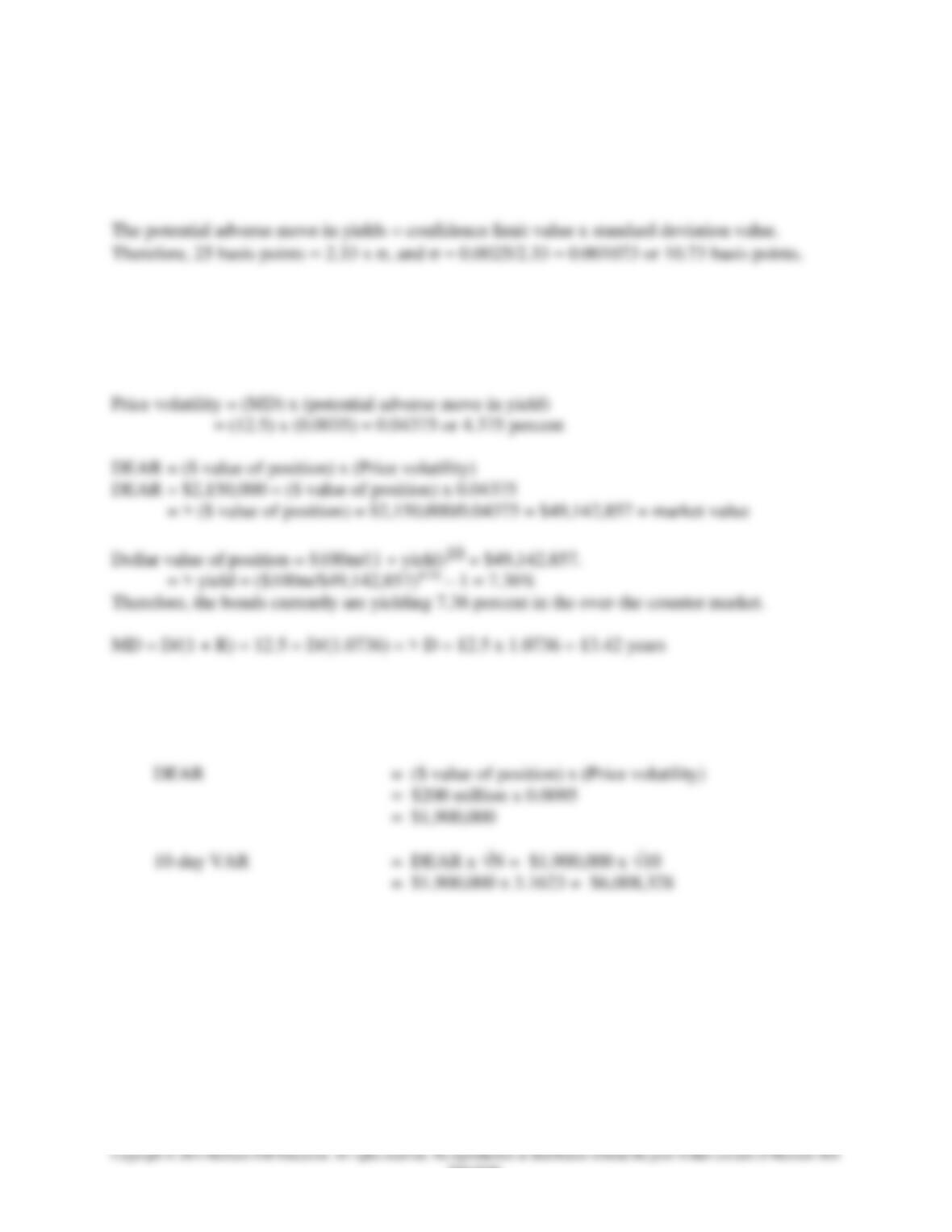
9. Bank Alpha has an inventory of AAA-rated, 15-year zero-coupon bonds with a face value
of $400 million. The bonds currently are yielding 9.5 percent in the over-the-counter
market.
a. What is the modified duration of these bonds?
b. What is the price volatility if the potential adverse move in yields is 25 basis points?
c. What is the DEAR?
Chapter 15 – Market Risk
15-4
Education.
d. If the price volatility is based on a 99 percent confidence limit and a mean historical
change in daily yields of 0.0 percent, what is the implied standard deviation of daily
yield changes?
10. Bank Beta has an inventory of AAA-rated, 10-year zero-coupon bonds with a face value of
$100 million. The modified duration of these bonds is 12.5 years, the DEAR is $2,150,000,
and the potential adverse move in yields is 35 basis points. What is the market value of the
bonds, the yield on the bonds, and the duration of the bonds?
11. Bank Two has a portfolio of bonds with a market value of $200 million. The bonds have an
estimated price volatility of 0.95 percent. What are the DEAR and the 10-day VAR for
these bonds?
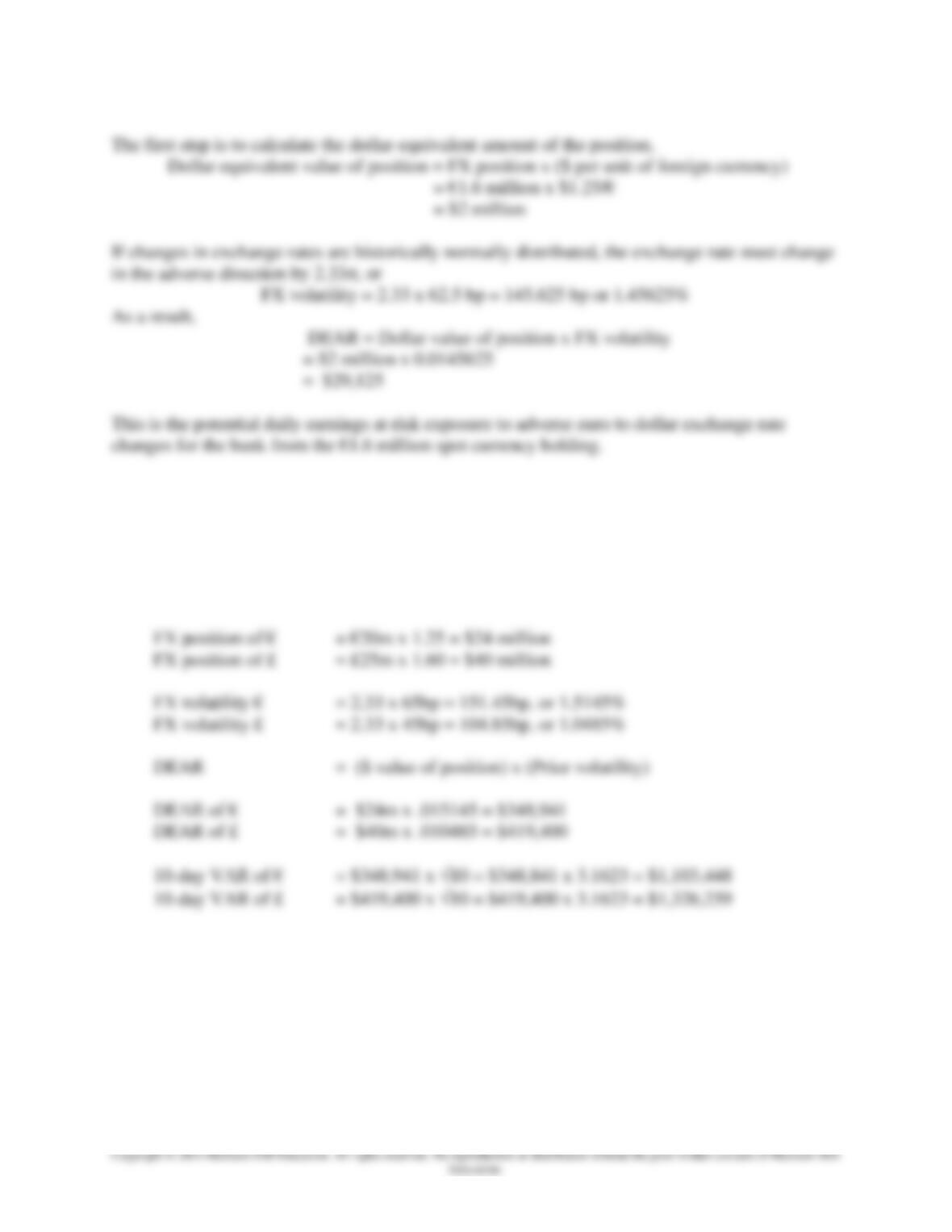
12. Suppose that an FI has a €1.6 million long trading position in spot euros at the close of
business on a particular day. Looking back at the daily percentage changes in the exchange
rate of the €/$ for the past year, the volatility or standard deviation (σ) of daily percentage
changes in the €/$ spot exchange rate was 62.5 basis points (bp). Calculate the FI’s daily
earnings at risk from this position (i.e., adverse moves in the FX markets with respect to the
value of the euro against the dollar will not occur more than 1 percent of the time, or 1 day
in every 100 days) if the spot exchange rate is €0.80/$1, or $1.25/€, at the daily close.
Chapter 15 – Market Risk
15-5
Copyright © 2014 McGraw-Hill Education. All rights reserved. No reproduction or distribution without the prior written consent of McGraw-Hill
Education.
The first step is to calculate the dollar-equivalent amount of the position.
Dollar equivalent value of position = FX position x ($ per unit of foreign currency)
= €1.6 million x $1.25/€
= $2 million
If changes in exchange rates are historically normally distributed, the exchange rate must change
in the adverse direction by 2.33σ, or
FX volatility = 2.33 x 62.5 bp = 145.625 bp or 1.45625%
As a result,
DEAR = Dollar value of position x FX volatility
= $2 million x 0.0145625
= $29,125
This is the potential daily earnings at risk exposure to adverse euro to dollar exchange rate
changes for the bank from the €1.6 million spot currency holding.
13. Bank of Southern Vermont has determined that its inventory of 20 million euros (€) and 25
million British pounds (£) is subject to market risk. The spot exchange rates are $1.25/€
and $1.60/£, respectively. The σ’s of the spot exchange rates of the € and £, based on the
daily changes of spot rates over the past six months, are 65 bp and 45 bp, respectively.
Determine the bank’s 10-day VAR for both currencies. Use adverse rate changes in the 99th
percentile.
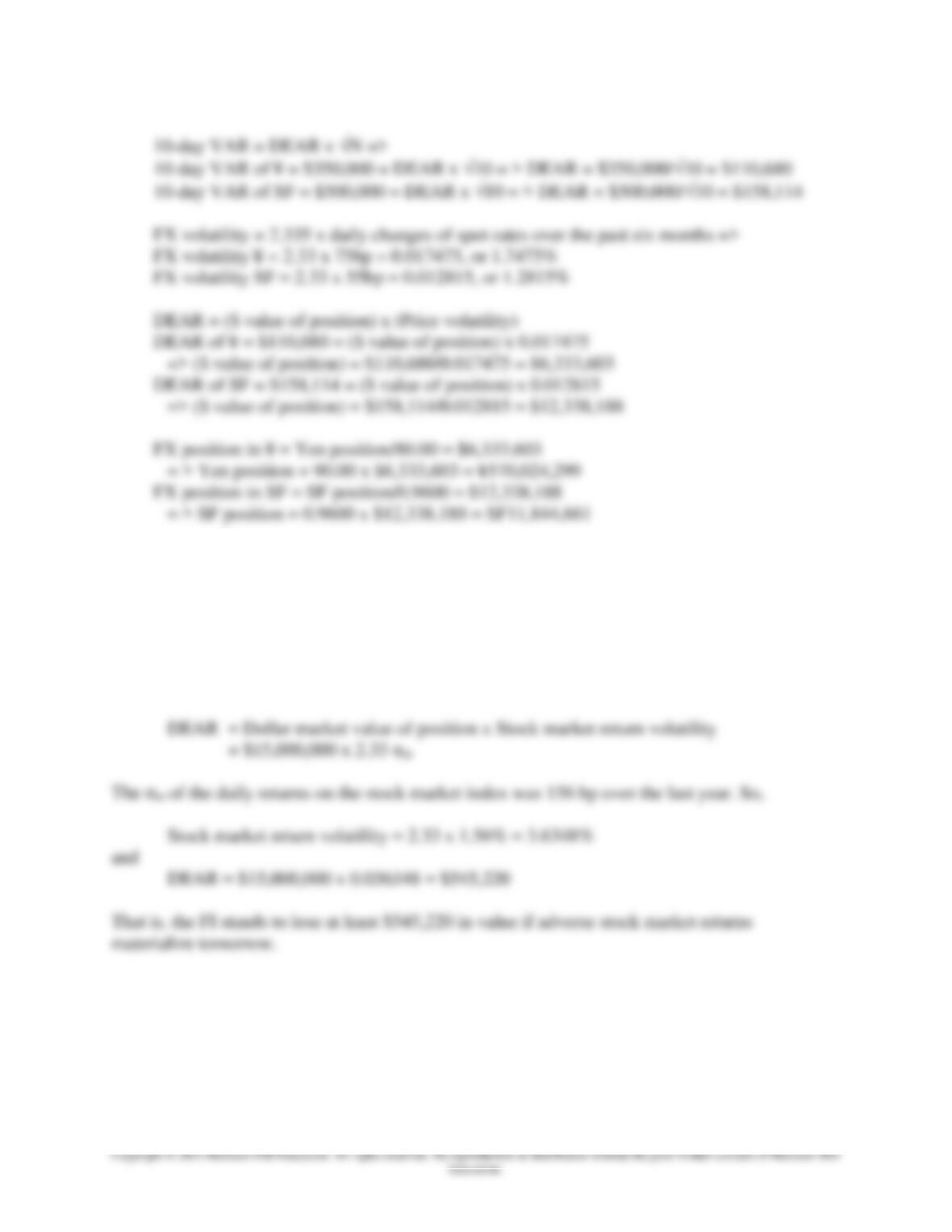
14. Bank of Bentley has determined that its inventory of yen (¥) and Swiss franc (SF)
denominated securities is subject to market risk. The spot exchange rates are ¥80.00/$ and
SF0.9600/$, respectively. The σ’s of the spot exchange rates of the ¥ and SF, based on the
daily changes of spot rates over the past six months, are 75 bp and 55 bp, respectively.
Using adverse rate changes in the 99th percentile, the 10-day VARs for the two currencies,
¥ and SF, are $350,000 and $500,000, respectively. Calculate the yen and Swiss franc-
denominated value positions for Bank of Bentley.
Chapter 15 – Market Risk
15-6
15. Suppose that an FI holds a $15 million trading position in stocks that reflect the U.S. stock
market index (e.g., the S&P 500). Over the last year, the σm of the daily returns on the stock
market index was 156 bp. Calculate the DEAR for this portfolio of stocks using a 99
percent confidence limit.
Since the portfolio of stocks reflect the U.S. stock market index, the β = 1. Thus, the DEAR for
equities is:
16. Bank of Alaska’s stock portfolio has a market value of $10 million. The beta of the
portfolio approximates the market portfolio, whose standard deviation (m) has been
estimated at 1.5 percent. What is the five-day VAR of this portfolio using adverse rate
changes in the 99th percentile?

Chapter 15 – Market Risk
15-7
Copyright © 2014 McGraw-Hill Education. All rights reserved. No reproduction or distribution without the prior written consent of McGraw-Hill
Education.
DEAR = ($ value of portfolio) x (2.33 x m ) = $10m x (2.33 x 0.015)
= $10m x 0.03495 = $349,500
5-day VAR = $349,500 x 5 = $349,500 x 2.2361 = $781,506
17. Jeff Resnick, vice president of operations at Choice Bank, is estimating the aggregate daily
DEAR of the bank’s portfolio of assets consisting of loans (L), foreign currencies (FX),
and common stock (EQ). The individual DEARs are $300,700, $274,000, and $126,700
respectively. If the correlation coefficients (ij) between L and FX, L and EQ, and FX and
EQ are 0.3, 0.7, and 0.0, respectively, what is the DEAR of the aggregate portfolio?
219,533$000,626,322,284$
)700,126)($000,274)($0.0(2)700,126)($700,300)($7.0(2
)000,274)($700,300)($3.0(2700,126$000,274$700,300$
)DEARxDEARx2(
)DEARxDEARx2(
)DEARxDEARx2(
)DEAR()DEAR()DEAR(
portfolioDEAR
5.0
5.0
222
5.0
EQFXEQ,FX
EQLEQ,L
FXLFX,L
2
EQ
2
FX
2
L
==
++
+++
+
+
+
++
=
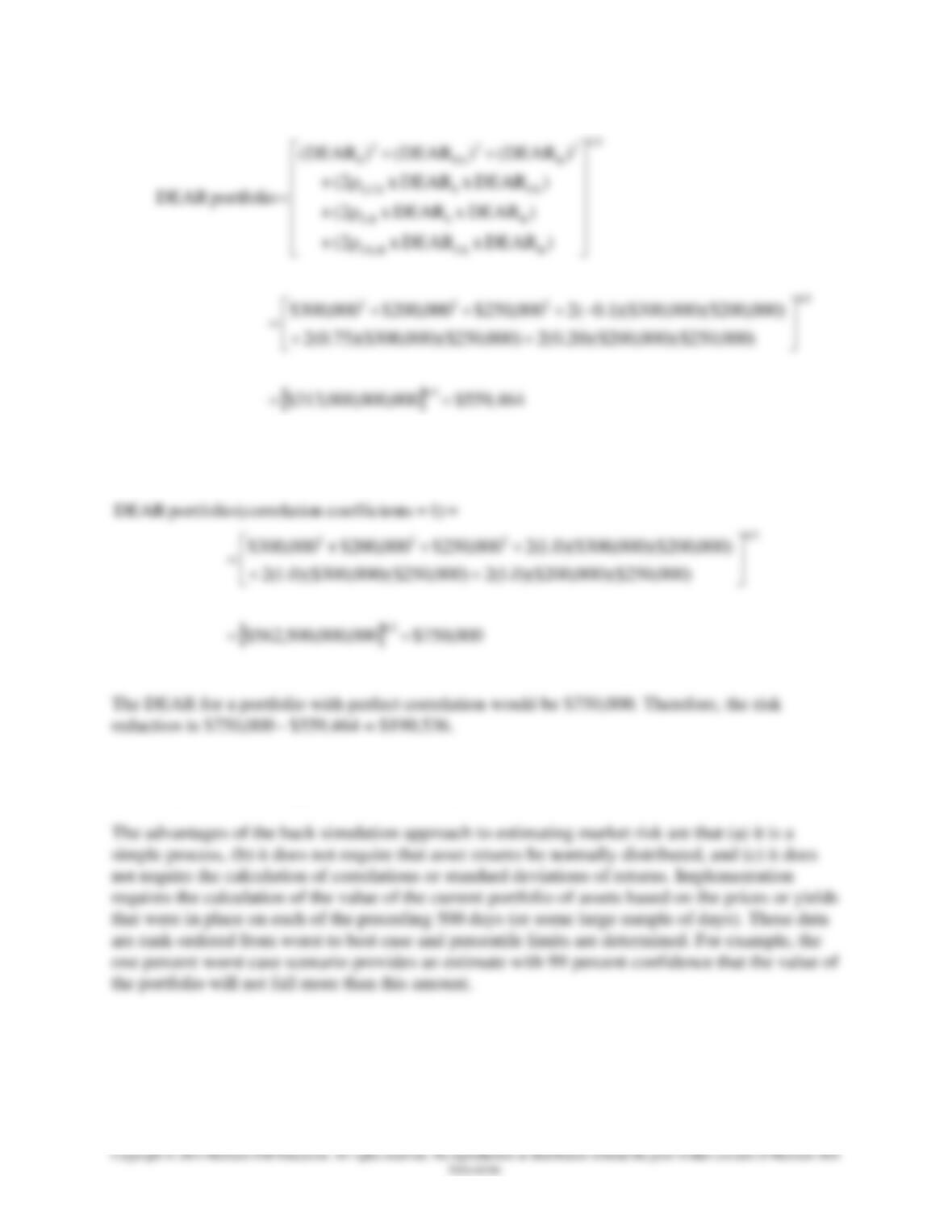
18. Calculate the DEAR for the following portfolio with the correlation coefficients and then
with perfect positive correlation between various asset groups.
Estimated
Assets DEAR (S,FX) (S,B) (FX,B)
Stocks (S) $300,000 -0.10 0.75 0.20
Foreign Exchange (FX) 200,000
Bonds (B) 250,000
Chapter 15 – Market Risk
15-8
464,559$000,000,000,313$
)000,250)($000,200)($20.0(2)000,250)($000,300)($75.0(2
)000,200)($000,300)($1.0(2000,250$000,200$000,300$
)DEARxDEARx2(
)DEARxDEARx2(
)DEARxDEARx2(
)DEAR()DEAR()DEAR(
portfolioDEAR
5.0
5.0
222
5.0
BFXB,FX
BSB,S
FXSFX,S
2
B
2
FX
2
S
==
++
−+++
+
+
+
++
=
What is the amount of risk reduction resulting from the lack of perfect positive correlation
between the various assets groups?
000,750$000,000,500,562$
)000,250)($000,200)($0.1(2)000,250)($000,300)($0.1(2
)000,200)($000,300)($0.1(2000,250$000,200$000,300$
)1tscoefficien ncorrelatio(portfolioDEAR
5.0
5.0
222
==
++
+++
=
==
The DEAR for a portfolio with perfect correlation would be $750,000. Therefore, the risk
reduction is $750,000 – $559,464 = $190,536.
19. What are the advantages of using the back simulation approach to estimate market risk?
Explain how this approach would be implemented.
Chapter 15 – Market Risk
15-9
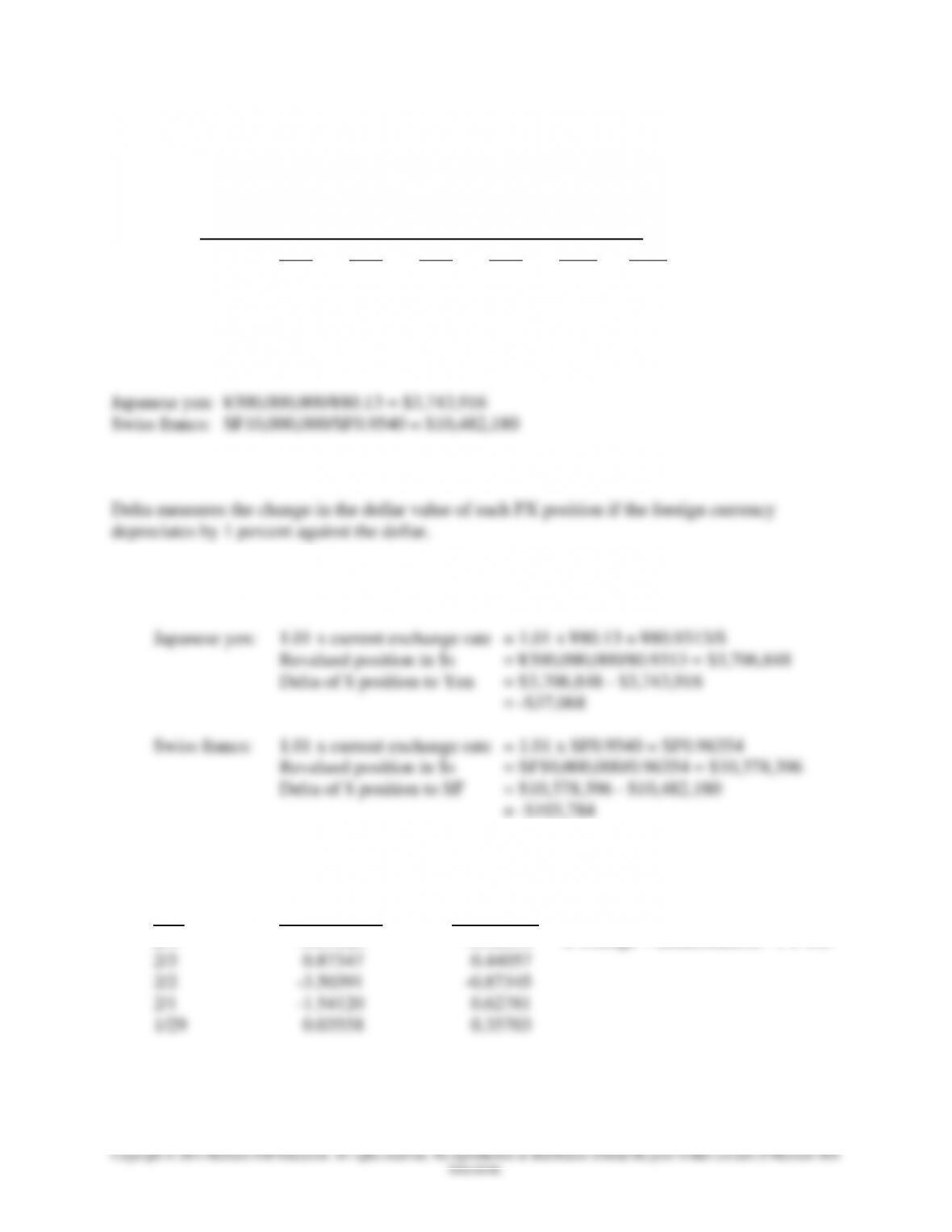
20. Export Bank has a trading position in Japanese yen and Swiss francs. At the close of
business on February 4, the bank had ¥300 million and SF10 million. The exchange rates
for the most recent six days are given below:
Exchange Rates per U.S. Dollar at the Close of Business
2/4 2/3 2/2 2/1 1/29 1/28
Japanese yen 80.13 80.84 80.14 83.05 84.35 84.32
Swiss francs 0.9540 0.9575 0.9533 0.9617 0.9557 0.9523
a. What is the foreign exchange (FX) position in dollar equivalents using the FX rates on
February 4?
b. What is the definition of delta as it relates to the FX position?
c. What is the sensitivity of each FX position; that is, what is the value of delta for each
currency on February 4?
d. What is the daily percentage change in exchange rates for each currency over the five-
day period?
Day Japanese yen: Swiss franc
2/4 -0.87828 -0.36554 % Change = (Ratet/Ratet-1) – 1 x 100
Chapter 15 – Market Risk
15–10
Education.
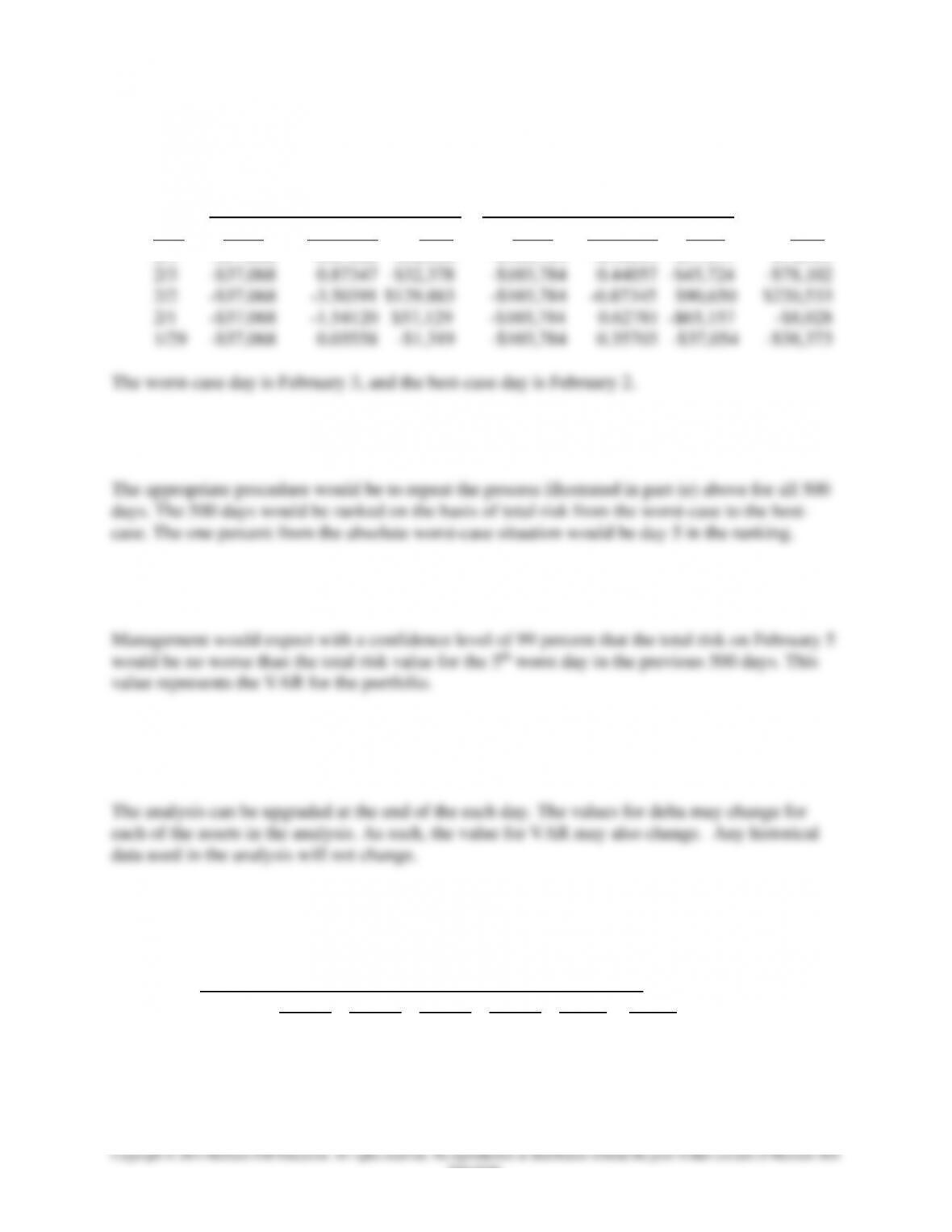
e. What is the total risk faced by the bank on each day? What is the worst-case day?
What is the best-case day?
Japanese yen Swiss francs Total
Day Delta % Rate Risk Delta % Rate Risk Risk
2/4 -$37,068 -0.87828 $32,556 -$103,784 -0.36554 $37,937 $70,493
f. Assume that you have data for the 500 trading days preceding February 4. Explain how
you would identify the worst-case scenario with a 99 percent degree of confidence?
g. Explain how the 1 percent value at risk (VAR) position would be interpreted for
business on February 5.
h. How would the simulation change at the end of the day on February 5? What variables
and/or processes in the analysis may change? What variables and/or processes will not
change?
21. Export Bank has a trading position in euros and Australian dollars. At the close of business
on October 20, the bank had €20 million and A$30 million. The exchange rates for the
most recent six days are given below:
Exchange Rates per U.S. Dollar at the Close of Business
10/20 10/19 10/18 10/17 10/16 10/15
Euros 0.8000 0.7970 0.7775 0.7875 0.7950 0.8115
Australian $s 0.9700 0.9550 0.9800 0.9655 0.9505 0.9460
Chapter 15 – Market Risk
15–11
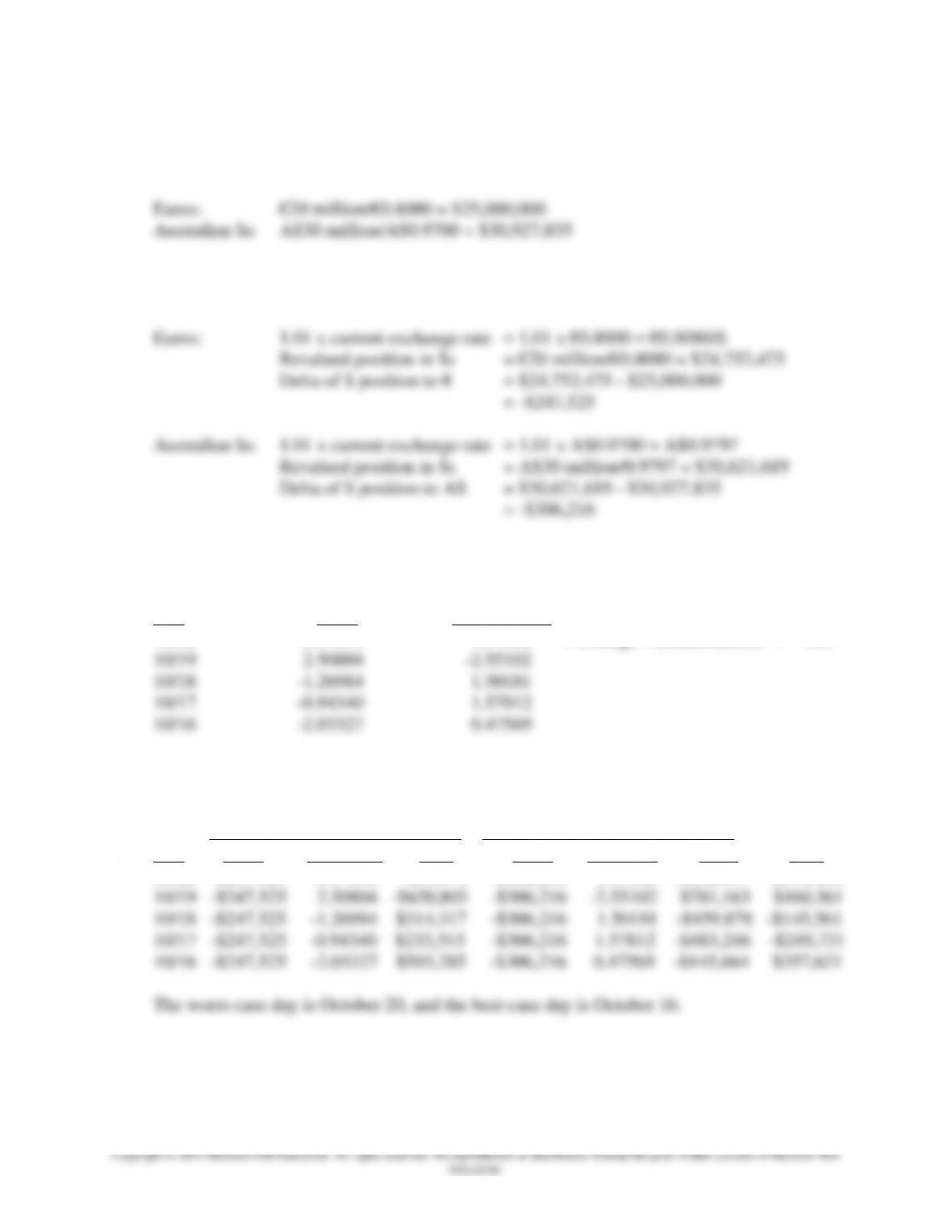
a. What is the foreign exchange (FX) position in dollar equivalents using the FX rates on
October 20?
b. What is the sensitivity of each FX position; that is, what is the value of delta for each
currency on October 20?
c. What is the daily percentage change in exchange rates for each currency over the five-
day period?
Day Euro: Australian $s
10/20 0.37641 1.57068 % Change = (Ratet/Ratet-1) – 1 * 100
d. What is the total risk faced by the bank on each day? What is the worst-case day?
What is the best-case day?
Euro Australian $s Total
Day Delta % Rate Risk Delta % Rate Risk Risk
10/20 -$247,525 0.37641 -$93,171 -$306,216 1.57068 -$480,967 -$574,138
Chapter 15 – Market Risk
15–12
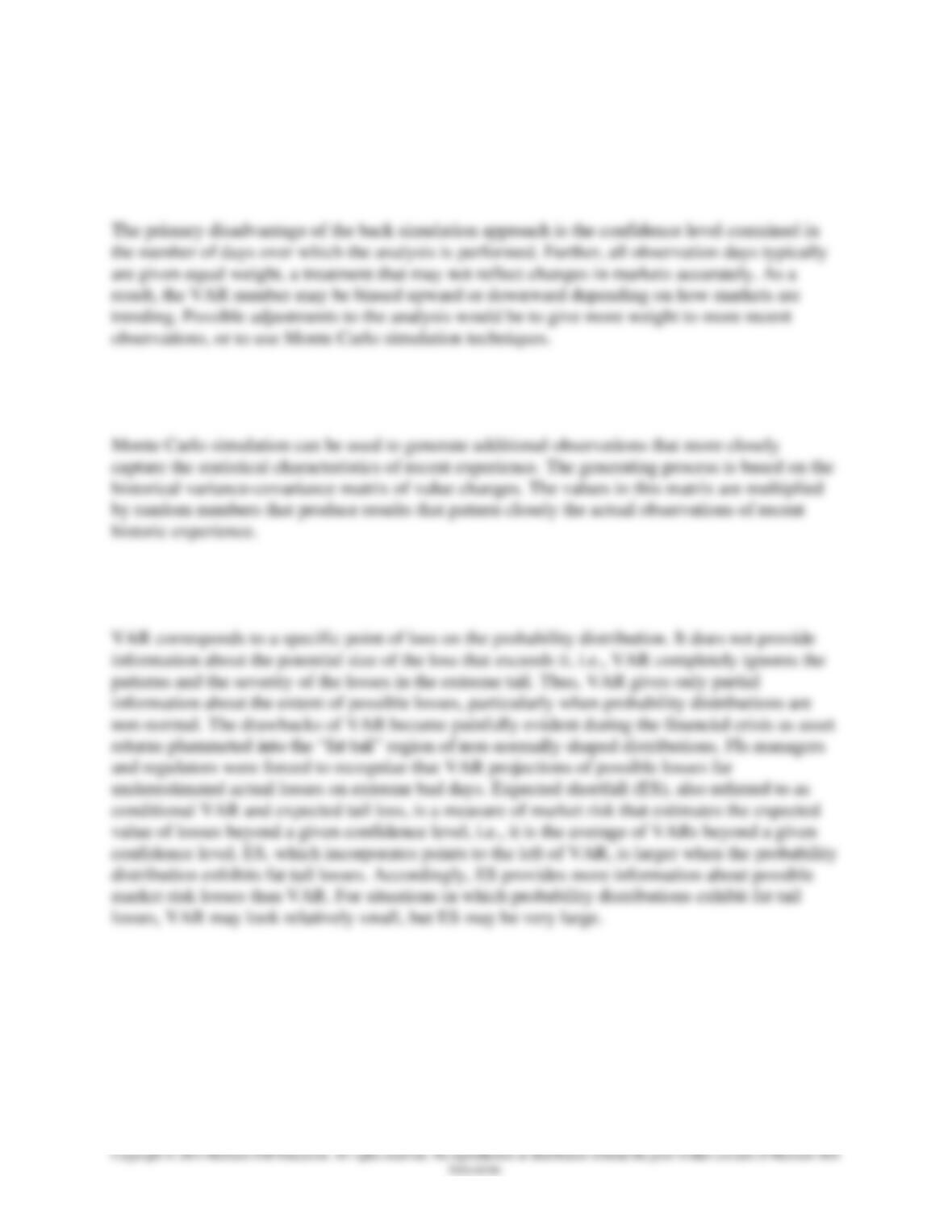
22. What is the primary disadvantage to the back simulation approach in measuring market
risk? What effect does the inclusion of more observation days have as a remedy for this
disadvantage? What other remedies can be used to deal with the disadvantage?
23. How is Monte Carlo simulation useful in addressing the disadvantages of back simulation?
What is the primary statistical assumption underlying its use?
24. What is the difference between VAR and expected shortfall (ES) as measure of market
risk?