Chapter 14 – Sovereign Risk
14-1
Solutions for End-of-Chapter Questions and Problems: Chapter Fourteen
1. What risks are incurred in making loans to borrowers based in foreign countries?
Explain.
When making loans to borrowers in foreign countries, two risks need to be considered.
2. What is the difference between debt rescheduling and debt repudiation?
Debt repudiation refers to a situation of outright default where the borrower refuses to
3. Identify and explain at least four reasons that rescheduling debt in the form of loans
is easier than rescheduling debt in the form of bonds.
The reasons that it is easier to reschedule debt in the form of bank loans than bonds
include:
Chapter 14 – Sovereign Risk
14-2
Copyright © 2014 McGraw-Hill Education. All rights reserved. No reproduction or distribution without the prior written consent of
McGraw-Hill Education.
d) In the case of post-war loans, governments were reluctant to allow banks to fail.
This meant that they would also be actively involved in the rescheduling process by
either directly providing subsidies to prevent repudiations or providing incentives to
international agencies like the IMF and World Bank to provide other forms of
grants and aid.
4. What three country risk assessment models are available to investors? How is each
model compiled?
5. What types of variables normally are used in a CRA Z-score model? Define the
following ratios and explain how each is interpreted in assessing the probability of
rescheduling.
The models typically use micro- and macroeconomic variables that are considered
important in explaining the probability of a country’s credit rescheduling.
Chapter 14 – Sovereign Risk
14-3
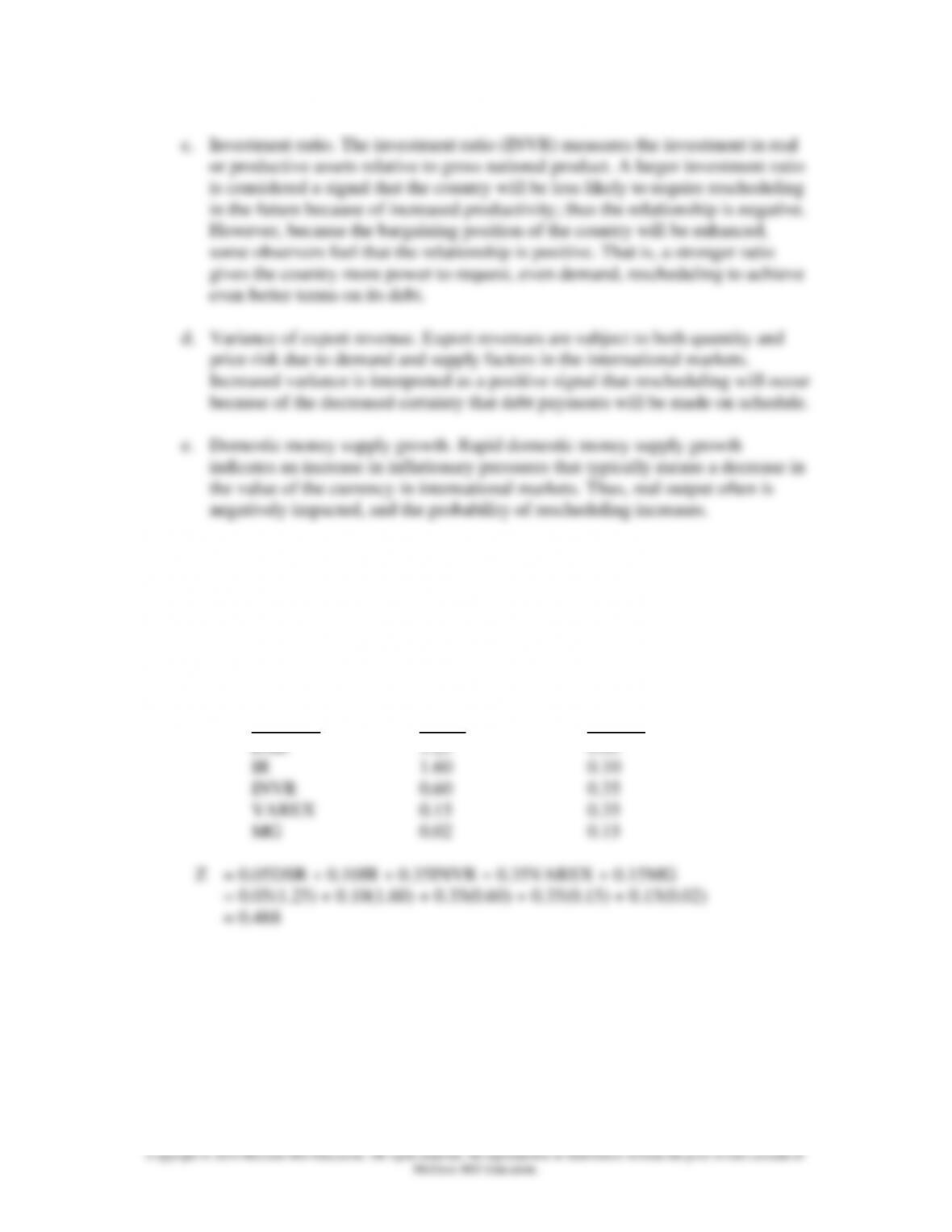
6. An FI manager has calculated the following values and weights to assess the credit
risk and likelihood of having to reschedule a loan. From the Z-score calculated
using these weights and values, is the manager likely to approve the loan?
Validation tests of the Z-score model indicated that scores below 0.500 were likely
to be nonreschedulers, while scores above 0.700 indicated a likelihood of
rescheduling. Scores between 0.500 and 0.700 do not predict well.
Country
Variable Value Weight
DSR 1.25 0.05
This score classifies the borrower as a probable nonrescheduler.
Chapter 14 – Sovereign Risk
14-4
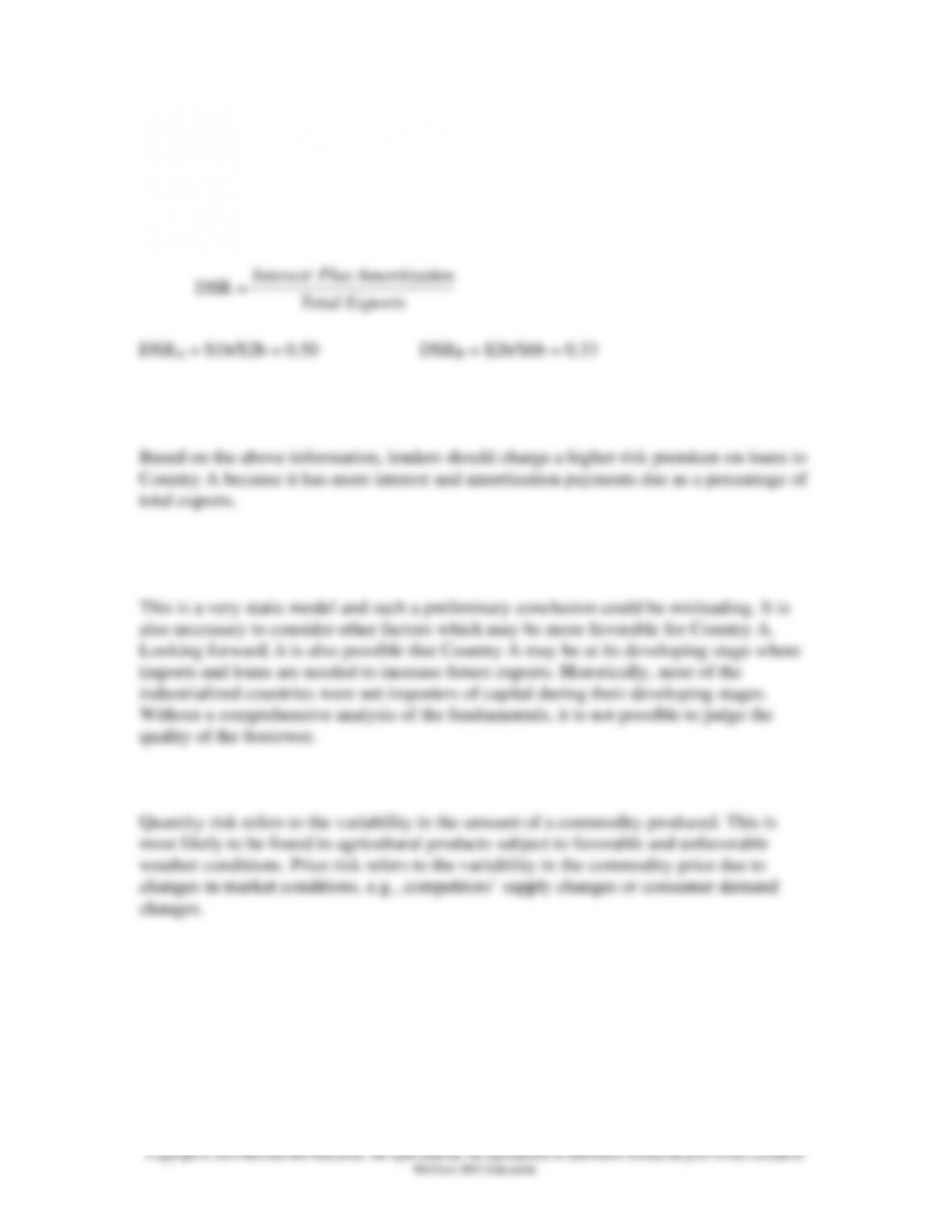
7. Countries A and B have exports of $2 billion and $6 billion, respectively. The total
interest and amortization on foreign loans for both countries are $1 billion and $2
billion, respectively.
a. What is the debt service ratio (DSR) for each country?
b. Based only on this ratio, to which country should lenders charge a higher risk
premium?
c. What are the shortcomings of using only these ratios to determine your answer
in part (b)?
8. How do price and quantity risks affect the variability of a country’s export revenue?

Chapter 14 – Sovereign Risk
14-5
9. Explain the following relation:
p = f (IR, INVR)
+, + or –
p = Probability of rescheduling
IR = Total imports/Total foreign exchange reserves
INVR = Real investment/GNP
This relation states that the probability of a country’s rescheduling of its foreign debt is a
positive function of IR, but it may be positively or negatively related to INVR:
10. What shortcomings are introduced by using traditional CRA models and
techniques? In each case, what adjustments are made in the estimation techniques to
compensate for the problems?
The following six items often are listed as problems in using these statistical models.
First, measuring the variables accurately and in a timely manner often is difficult because
of data accessibility. These errors are further impacted by normal forecast errors that
occur with the use of statistical models.

Chapter 14 – Sovereign Risk
14-6
11. What is systematic risk in terms of sovereign risk? Which of the variables often
used in statistical models tend to have high systematic risk? Which variables tend to
have low systematic risk?
12. The average 2ER (or VAREX = variance of export revenue) of a group of countries
has been estimated at 20 percent. The individual VAREXes of two countries in the
group, the Netherlands and Singapore, have been estimated at 15 percent and 28
percent, respectively. The regression of individual country VAREX on average
VAREX provides the following beta (coefficient) estimates:
H = Beta of the Netherlands = 0.80
S = Beta of Singapore = 0.20.
a. Based only on the VAREX estimates, which country should be charged a higher
risk premium? Explain.
Chapter 14 – Sovereign Risk
14-7
Copyright © 2014 McGraw-Hill Education. All rights reserved. No reproduction or distribution without the prior written consent of
McGraw-Hill Education.
Based on the VAREX measure alone, risk premiums should be lower for loans made to
the Netherlands because its VAREX is lower than Singapore’s. VAREX measures the
volatility of the export revenues and is one measure of the ability of countries to repay
foreign debt.
b. If FIs include systematic risk in their estimation of risk premiums, how would
your conclusions to part (a) be affected? Explain.
13. What are the benefits and costs of rescheduling to the following?
a. A borrower.
b. A lender.
Chapter 14 – Sovereign Risk
14-8
14. Who are the primary sellers of LDC and EM debt? Who are the buyers? Why are
FIs often both sellers and buyers of LDC and EM debt in the secondary markets?
15. Identify and describe the three market segments of the secondary market for LDC
And EM debt.
16. What are the risks to an investing company participating in a debt-for-equity swap?

Chapter 14 – Sovereign Risk
14-9
17. Chase Bank holds a $200 million loan to Argentina. The loans are being traded at
bid-offer prices of 91-93 per 100 in the London secondary market.
a. If Chase has an opportunity to sell this loan to an investment bank at a 7 percent
discount, what are the savings after taxes compared with the revenue from
selling the loan in the secondary market? Assume the tax rate is 40 percent.
b. The investment bank in turn sells the debt at a 6 percent discount to a real estate
company planning to build apartment complexes in Argentina. What is the
profit after taxes to the investment bank?
c. The real estate company converts this loan into pesos under a debt-for-equity
swap organized by the Argentinian government. The official rate for dollar to
peso conversion is P1.05/$1. The free market rate is P1.10/$1. How much did
the real estate company save by investing in Argentina through the debt-for-
equity swap program as opposed to directly investing $200 million using the
free market rates?
d. How much would Chase benefit from doing a local currency debt-for-equity
swap itself? Why does the bank not do this swap?

Chapter 14 – Sovereign Risk
14–10
Copyright © 2014 McGraw-Hill Education. All rights reserved. No reproduction or distribution without the prior written consent of
McGraw-Hill Education.
Chase is not allowed to participate in real equity purchases in other countries by Federal
Reserve Regulation K, nor is it allowed to engage in commerce in other countries.
Further, a long-term pesos-denominated position on the balance sheet may create more
credit, liquidity, and foreign exchange risk than the benefits are worth.
18. Zlick Company plans to invest $20 million in Chile to expand its subsidiary’s
manufacturing output. Zlick has two options. It can convert the $20 million at the
current exchange rate of 410 pesos to a dollar (i.e., P410/$1), or it can engage in a
debt-for-equity swap with its bank, City Bank, by purchasing Chilean debt and then
swapping that debt into Chilean equity investments.
a. If City Bank quotes bid-offer prices of 94-96 for Chilean loans, what is the bank
expecting to receive from Zlick Corporation (ignore taxes)? Why would City
Bank want to dispose of this loan?
b. If Zlick decides to purchase the debt from City Bank and convert it to equity, it
will have to exchange it at the official rate of P400/$1. Is this option better than
investing directly in Chile at the free market rate of P410/$1?
c. What official exchange rate will cause Zlick to be indifferent between the two
options?
Chapter 14 – Sovereign Risk
14–11
19. What is concessionality in the process of rescheduling a loan?
20. Which variables typically are negotiation points in a multiyear restructuring
agreement (MYRA)? How do changes in these variables provide benefits to the
borrower and to the lender?
21. How would the restructuring, such as rescheduling, of sovereign bonds affect the
interest rate risk of the bonds? Is it possible that such restructuring would cause the
FI’s cost of capital to not change? Explain.
22. A bank is in the process of renegotiating a sovereign loan. The principal
outstanding is $50 million and is to be paid back in two installments of $25 million
each, plus interest of 8 percent. The new terms will stretch the loan out to five years
with only interest payments of 6 percent, no principal payments, for the first three
years. The principal will be paid in the last two years in payments of $25 million
along with the interest. The cost of funds for the bank is 6 percent for both the old
loan and the renegotiated loan. An up-front fee of 1 percent is to be included for the
renegotiated loan.

Chapter 14 – Sovereign Risk
14–12
a. What is the present value of the existing loan for the bank?
The present value of the loan prior to rescheduling is:
b. What is the present value of the rescheduled loan for the bank?
c. Is the concessionality positive or negative for the bank?
23. A bank is in the process of renegotiating a three-year nonamortizing loan. The
principal outstanding is $20 million, and the interest rate is 8 percent. The new
terms will extend the loan to 10 years at a new interest rate of 6 percent. The cost of
funds for the bank is 7 percent for both the old loan and the renegotiated loan. An
up-front fee of 50 basis points is to be included for the renegotiated loan.
a. What is the present value of the existing loan for the bank?
b. What is the present value of the rescheduled loan for the bank?
c. What is the concessionality for the bank?
d. What should be the up-front fee to make the concessionality zero?

Chapter 14 – Sovereign Risk
14–13
24. A $20 million loan outstanding to the Nigerian government is currently in arrears
with City Bank. After extensive negotiations, City Bank agrees to reduce the
interest rates from 10 percent to 6 percent and to lengthen the maturity of the loan
to 10 years from the present 5 years remaining to maturity. The principal of the loan
is to be paid at maturity. There will no grace period and the first interest payment is
expected at the end of the year.
a. If the cost of funds is 5 percent for the bank, what is the present value of the
loan prior to the rescheduling?
b. What is the present value of the rescheduled loan to the bank?
c. What is the concessionality of the rescheduled loan if the cost of funds remains
at 5 percent and an up-front fee of 5 percent is charged?
d. What up-front fee should the bank charge to make the concessionality equal
zero?
25. A bank was expecting to receive $100,000 from a loan issued to the Spanish
government. Since Spain has problems repaying the loan immediately, the bank
extends the loan for another year at the same interest rate of 10 percent. However,
in the rescheduling agreement, the bank reserves the right to exercise an option for
receiving the payment in British pounds, equal to €87,813, converted at the current
exchange rate of €0.7983/$.
a. If the cost of funds to the bank is also assumed to be 10 percent, what is the
value of this option built into the agreement if only two possible exchange rates
are expected at the end of the year, €0.8467/$ or €0.7499/$, with equal
probability?
Chapter 14 – Sovereign Risk
14–14
Copyright © 2014 McGraw-Hill Education. All rights reserved. No reproduction or distribution without the prior written consent of
McGraw-Hill Education.
Without the option, the amount expected at the end of the year = $110,000. If the euro
depreciates to €0.8467/$, the amount received by the bank is the maximum of $110,000,
or €87,813/0.8467 = $103,712.06. If the euro appreciates to €0.7499/$, the amount
received by the bank is the maximum of $110,000, or €87,813/0.7499 = $117,099.61.
With the option, the expected amount received is 0.50($110,000) + 0.50($117,099.61) =
$113,549.81. The present value of the option is $113,549.81 – $110,000 = $3,549.81/1.1
= $3,227.10
b. How would your answer differ, if the probability of the exchange rate being
€0.8467/$ is 70 percent and that of €0.7499/$ is 30 percent?
c. Does the currency option have more or less value as the volatility of the
exchange rate increases?
26. What are the major benefits and costs of loan sales to an FI?
The benefits of loan sales to an FI:

Chapter 14 – Sovereign Risk
14–15
27. What are the major costs and benefits of converting loans to bonds for an FI?