Chapter 13 – Foreign Exchange Risk
13–16
Education.
At the end of the year, the FI must pay the pound CD holders their principal and interest, €160
million (1.07) = €171.20 million.
11.2% – 8.624% = 2.576%
20. Suppose that instead of funding the $200 million investment in 10 percent German loans
with CDs issued in Germany, the FI manager in problem 19 hedges the foreign exchange
risk on the German loans by immediately selling its expected one-year euro loan proceeds
in the forward FX market. The current forward one-year exchange rate between dollars and
euros is $1.20/€1.
a. Calculate the return on the FI’s investment portfolio (including the hedge) and the net
interest margin for the FI over the year.
13–17
Education.
5.84% – 4.00% = 1.84%
b. Will the net return be affected by changes in the dollar for euro spot foreign exchange
21. North Bank has been borrowing in the U.S. markets and lending abroad, thus incurring
foreign exchange risk. In a recent transaction, it issued a one-year, $2 million CD at 6
percent and funded a loan in euros at 8 percent. The spot rate for the euro was €1.45/$1 at
the time of the transaction.
a. Information received immediately after the transaction closing indicated that the euro
will change to €1.47/$1 by year-end. If the information is correct, what will be the
realized spread on the loan inclusive of principal? What should have been the bank
interest rate on the loan to maintain the 2 percent spread?
b. The bank had an opportunity to sell one-year forward euros at €1.46/$1. What would
have been the spread on the loan if the bank had hedged forward its foreign exchange
exposure?
Chapter 13 – Foreign Exchange Risk
13–18
Education.
c. What would have been an appropriate change in loan rates to maintain the 2 percent
spread if the bank intended to hedge its exposure using the forward contracts?
To maintain a 2 percent spread: €2.9m(1 + x)/1.46 = $2.16m => x = 8.74 percent
The bank should increase the loan rate to 8.74 percent and hedge with the sale of forward €s to
maintain a 2 percent spread.
22. A bank purchases a six-month, $1 million Eurodollar deposit at an annual interest rate of
6.5 percent. It invests the funds in a six-month Swedish krone AA-rated bond paying 7.5
percent per year. The current spot rate is $0.18/SK1.
a. The six-month forward rate on the Swedish krone is being quoted at $0.1810/SK1.
What is the net spread earned on this investment if the bank covers its foreign exchange
exposure using the forward market?
b. What forward rate will cause the spread to be only 1 percent per year?
c. Explain how forward and spot rates will both change in response to the increased
spread?
Chapter 13 – Foreign Exchange Risk
13–19
d. Why will a bank still be able to earn a spread of 1 percent knowing that interest rate
parity usually eliminates arbitrage opportunities created by differential rates?
23. How does the lack of perfect correlation of economic returns between international
financial markets affect the risk-return opportunities for FIs holding multicurrency assets
and liabilities? Refer to Table 13-6. Which country pairings seem to have the highest
correlation of stock returns before and during the financial crisis?
Kingdome-Japan.
Chapter 13 – Foreign Exchange Risk
13–20
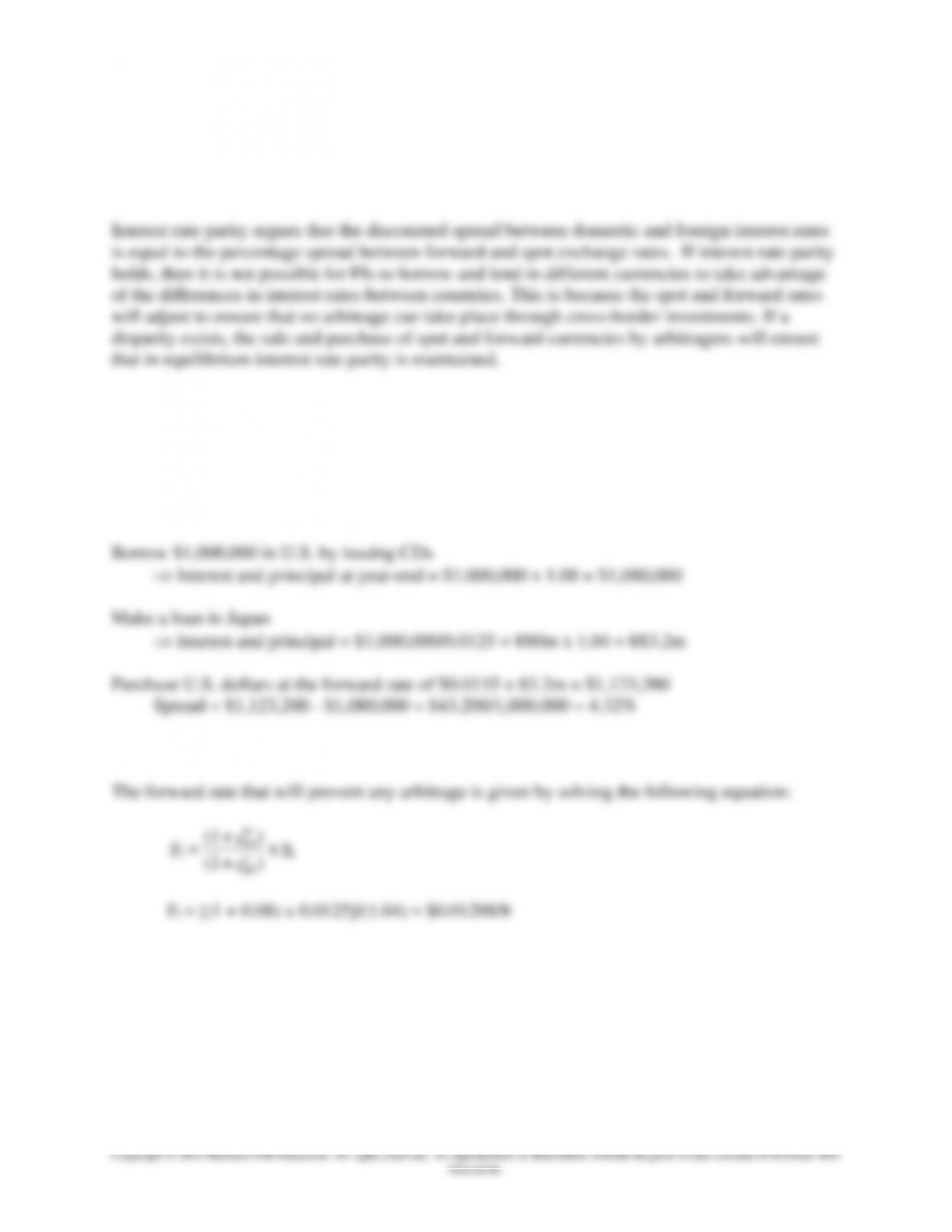
24. What is the purchasing power parity theorem?
25. Suppose that the current spot exchange rate of U.S. dollars for Australian dollars, SUS$/A$,
is 1.0277 (i.e., $1.0277 can be received for 1 Australian dollar). The price of Australian-
produced goods increases by 5 percent (i.e., inflation in Australia, IPA, is 5 percent), and
the U.S. price index increases by 3 percent (i.e., inflation in the United States, IPUS, is 3
percent). Calculate the new spot exchange rate of U.S. dollars for Australian dollars that
should result from the differences in inflation rates.
Chapter 13 – Foreign Exchange Risk
13–21
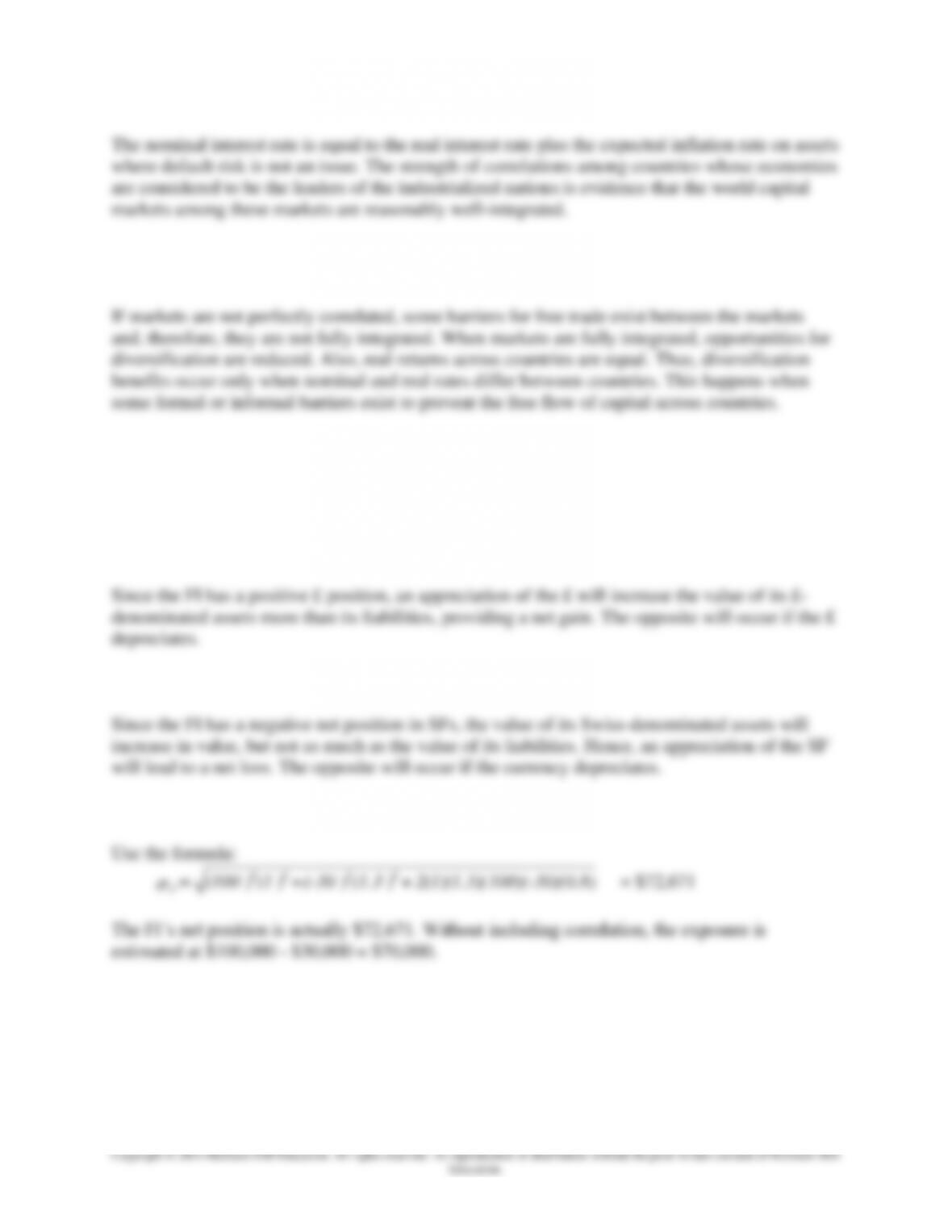
26. Explain the concept of interest rate parity? What does this concept imply about the long–
run profit opportunities from investing in international markets? What market conditions
must prevail for the concept to be valid?
27. Assume that annual interest rates are 8 percent in the United States and 4 percent in Japan.
An FI can borrow (by issuing CDs) or lend (by purchasing CDs) at these rates. The spot
rate is $0.0125/¥.
a. If the forward rate is $0.0135/¥, how could the FI arbitrage using a sum of $1million?
What is the expected spread?
b. What forward rate will prevent an arbitrage opportunity?
28. What is the relationship between the real interest rate, the expected inflation rate, and the
nominal interest rate on fixed-income securities in any particular country? What factors
may be the reasons for the relatively high correlation coefficients?
Chapter 13 – Foreign Exchange Risk
13–22
Copyright © 2014 McGraw-Hill Education. All rights reserved. No reproduction or distribution without the prior written consent of McGraw-Hill
Education.
The nominal interest rate is equal to the real interest rate plus the expected inflation rate on assets
where default risk is not an issue. The strength of correlations among countries whose economies
are considered to be the leaders of the industrialized nations is evidence that the world capital
markets among these markets are reasonably well-integrated.
29. What is economic integration? What impact does the extent of economic integration of
international markets have on the investment opportunities for FIs?
30. An FI has $100,000 of net positions outstanding in British pounds (£) and -$30,000 in
Swiss francs (SF). The standard deviation of the net positions as a result of exchange rate
changes is 1 percent for the SF and 1.3 percent for the £. The correlation coefficient
between the changes in exchange rates of the £ and the SF is 0.80.
a. What is the risk exposure to the FI of fluctuations in the £/$ rate?
b. What is the risk exposure to the FI of fluctuations in the SF/$ rate?
c. What is the risk exposure if both the £ and the SF positions are combined?
31. A money market mutual fund manager is looking for some profitable investment
opportunities and observes the following one-year interest rates on government securities
and exchange rates: rUS = 12%, rUK = 9%, S = $1.50/£1, F = $1.60/£1, where S is the spot
exchange rate and F is the forward exchange rate. Which of the two types of government
securities would constitute a better investment?

Chapter 13 – Foreign Exchange Risk
13–23
Education.
Integrated Mini Case: Foreign Exchange Risk Exposure
Suppose that a U.S. FI has the following assets and liabilities:
Assets Liabilities
$500 million $1,000 million
U.S. loans (one year) U.S. CDs (one year)
in dollars in dollars
$300 million equivalent
U.K. loans (one year)
(loans made in pounds)
$200 million equivalent
Turkish loans (one year)
(loans made in Turkish lira)
The promised one-year U.S. CD rate is 4 percent, to be paid in dollars at the end of the year; the
one-year, default risk–free loans in the United States are yielding 6 percent; default risk–free
one-year loans are yielding 8 percent in the United Kingdom; and default risk–free one-year
loans are yielding 10 percent in Turkey. The exchange rate of dollars for pounds at the beginning
of the year is $1.6/£1, and the exchange rate of dollars for Turkish lira at the beginning of the
year is $0.5533/TRY1.
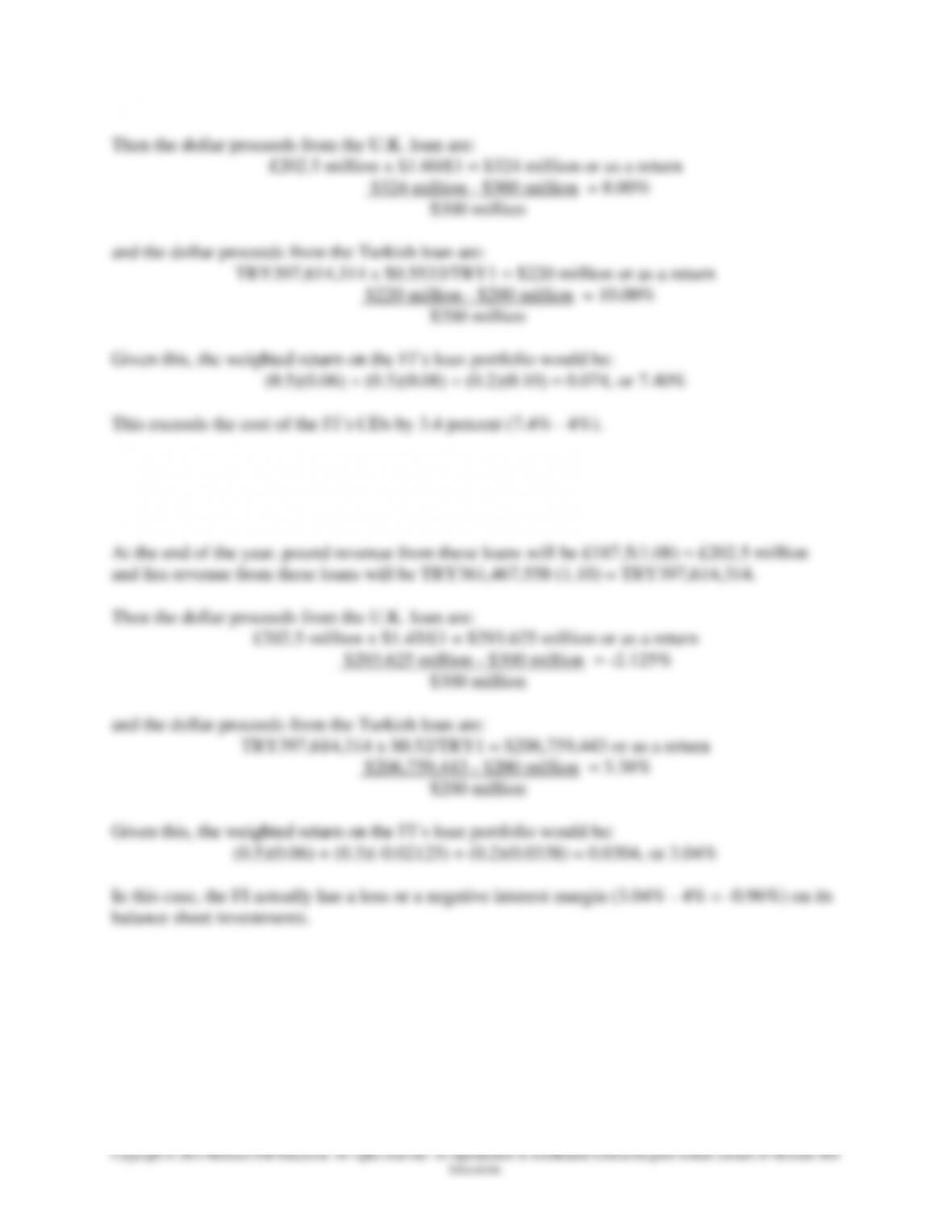
1. Calculate the dollar proceeds from the FI’s loan portfolio at the end of the year, the return on
the FI’s loan portfolio, and the net interest margin for the FI if the spot foreign exchange rate has
not changed over the year.
Chapter 13 – Foreign Exchange Risk
13–24
Copyright © 2014 McGraw-Hill Education. All rights reserved. No reproduction or distribution without the prior written consent of McGraw-Hill
Education.
Then the dollar proceeds from the U.K. loan are:
£202.5 million x $1.60/£1 = $324 million or as a return
$324 million – $300 million = 8.00%
$300 million
and the dollar proceeds from the Turkish loan are:
TRY397,614,314 x $0.5533/TRY1 = $220 million or as a return
$220 million – $200 million = 10.00%
$200 million
Given this, the weighted return on the FI’s loan portfolio would be:
(0.5)(0.06) + (0.3)(0.08) + (0.2)(0.10) = 0.074, or 7.40%
This exceeds the cost of the FI’s CDs by 3.4 percent (7.4% – 4%).
2. Calculate the dollar proceeds from the FI’s loan portfolio at the end of the year, the return on
the FI’s loan portfolio, and the net interest margin for the FI if the pound spot foreign exchange
rate falls to $1.45/£1 and the lira spot foreign exchange rate falls to $0.52/TRY1 over the year.
3. Calculate the dollar proceeds from the FI’s loan portfolio at the end of the year, the return on
the FI’s loan portfolio, and the net interest margin for the FI if the pound spot foreign exchange
rate rises to $1.70/£1 and the lira spot foreign exchange rate rises to $0.58/TRY1 over the year.
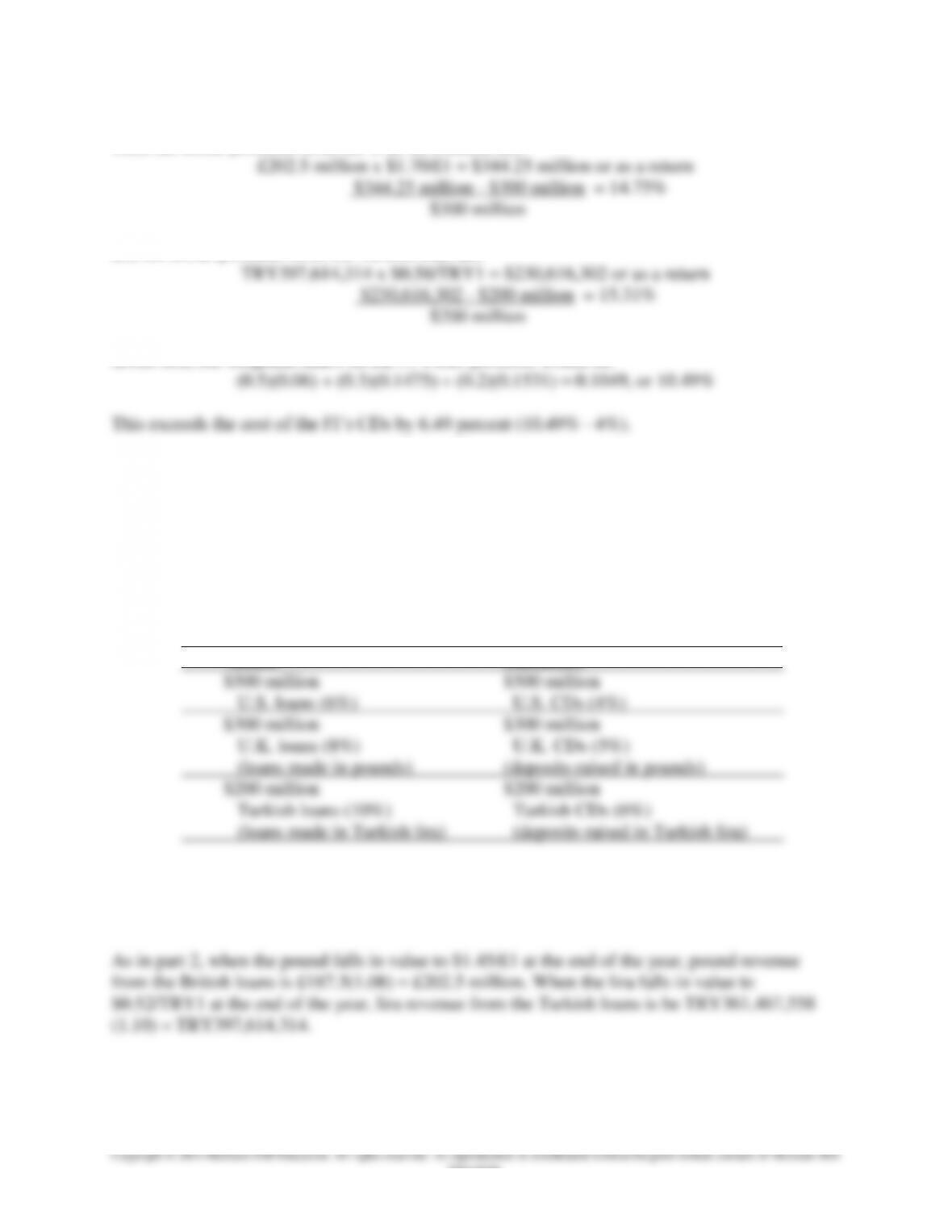
At the end of the year, pound revenue from these loans will be £187.5(1.08) = £202.5 million
and lira revenue from these loans will be TRY361,467,558 (1.10) = TRY397,614,314.
Chapter 13 – Foreign Exchange Risk
13–25
Education.
Then the dollar proceeds from the U.K. investment are:
and the dollar proceeds from the Turkish loan are:
Given this, the weighted return on the FI’s loan portfolio would be:
4. Suppose that instead of funding the $300 million investment in 8 percent British loans with
U.S. CDs, the FI manager funds the British loans with $300 million equivalent one-year pound
CDs at a rate of 5 percent and that instead of funding the $200 million investment in 10 percent
Turkish loans with U.S. CDs, the FI manager funds the Turkish loans with $200 million
equivalent one-year Turkish lira CDs at a rate of 6 percent. What will the FI’s balance sheet look
like after these changes have been made?
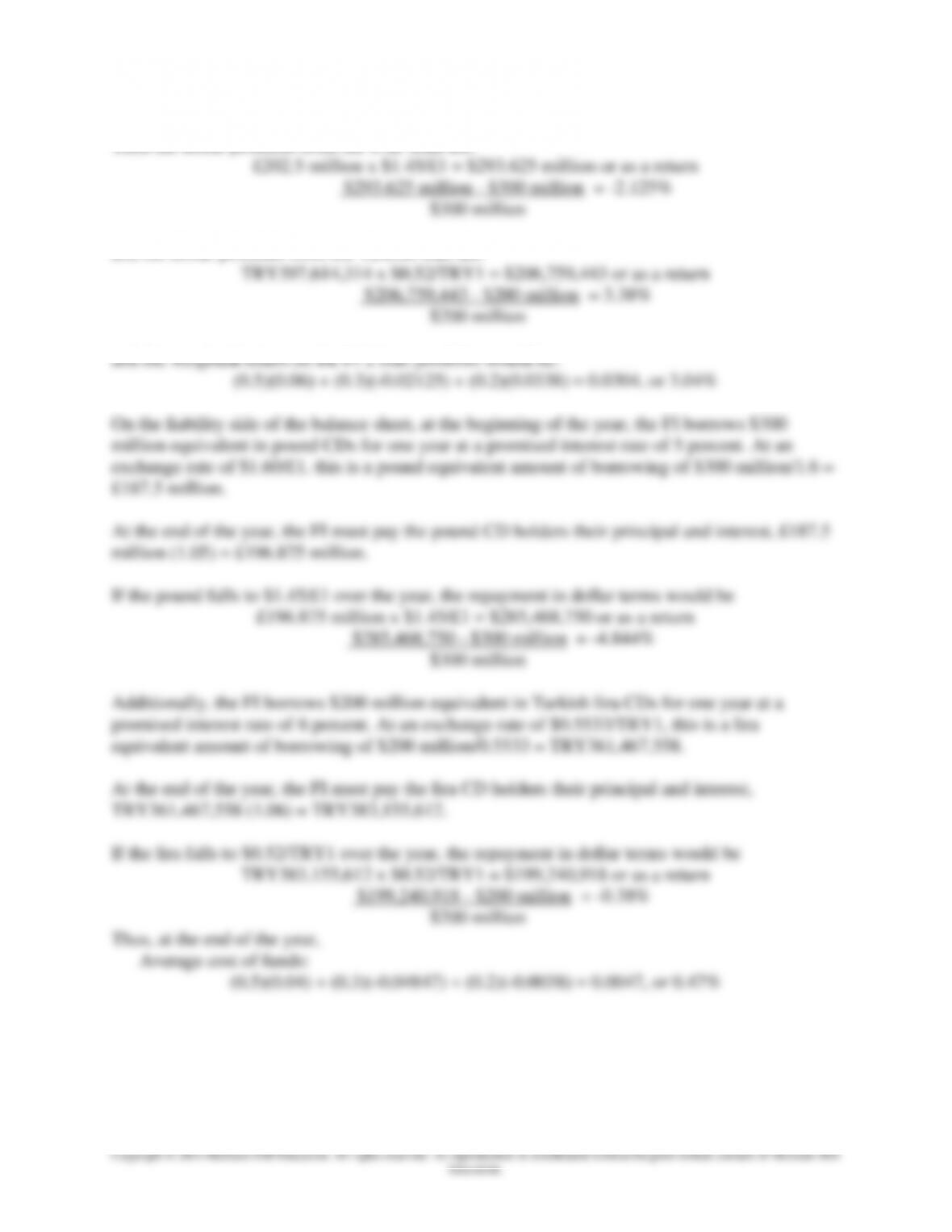
The balance sheet of the FI would be as follows:
Assets Liabilities
5. Using the information in part 4, calculate the return on the FI’s loan portfolio, the average cost
of funds, and the net interest margin for the FI if the pound spot foreign exchange rate falls to
$1.45/£1 and the lira spot foreign exchange rate falls to $0.52/TRY1 over the year.
Chapter 13 – Foreign Exchange Risk
13–26
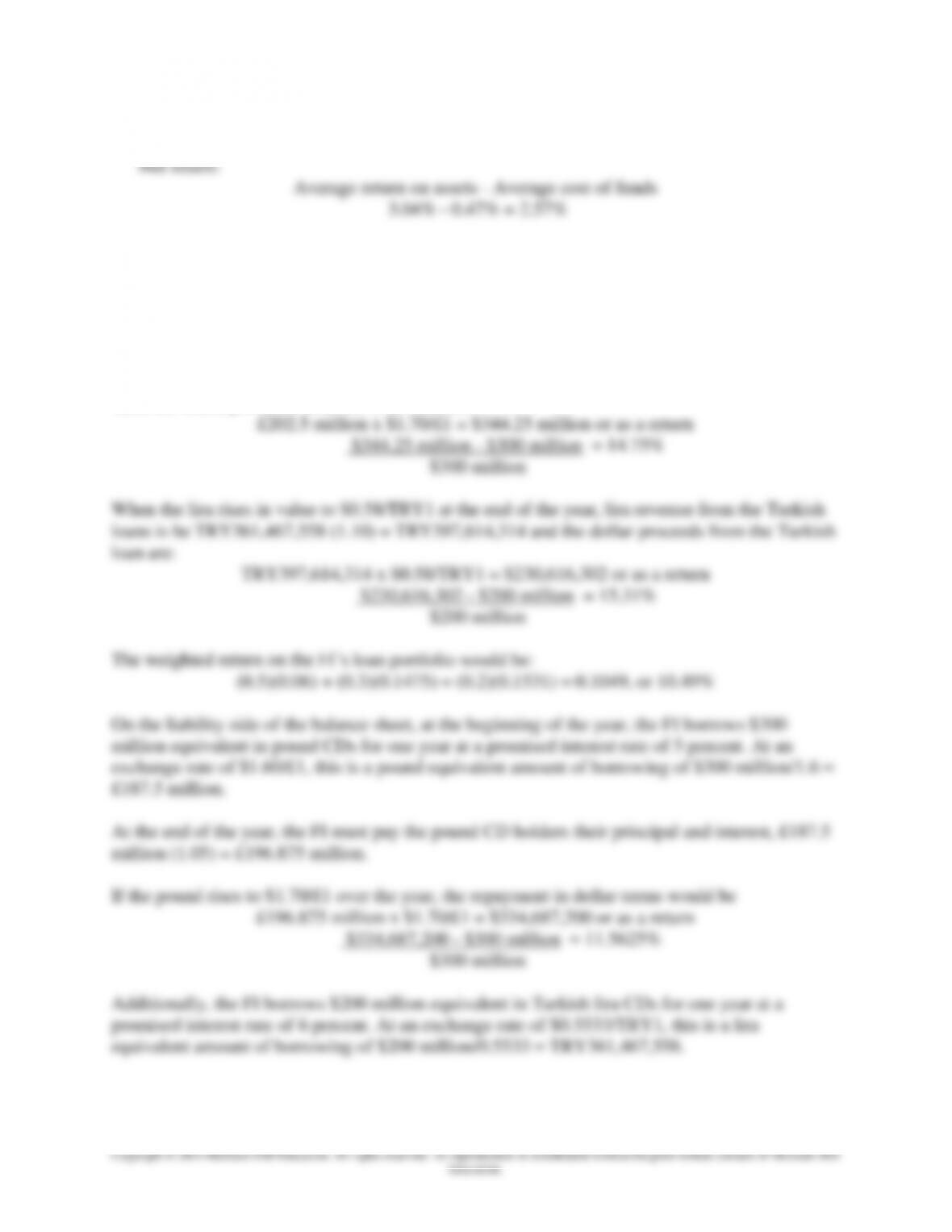
Then the dollar proceeds from the U.K. loan are:
and the dollar proceeds from the Turkish loan are:
Chapter 13 – Foreign Exchange Risk
13–27
6. Using the information in part 4, calculate the return on the FI’s loan portfolio, the average cost
of funds, and the net interest margin for the FI if the pound spot foreign exchange rate rises to
$1.70/£1 and the lira spot foreign exchange rate falls to $0.58/TRY1 over the year.
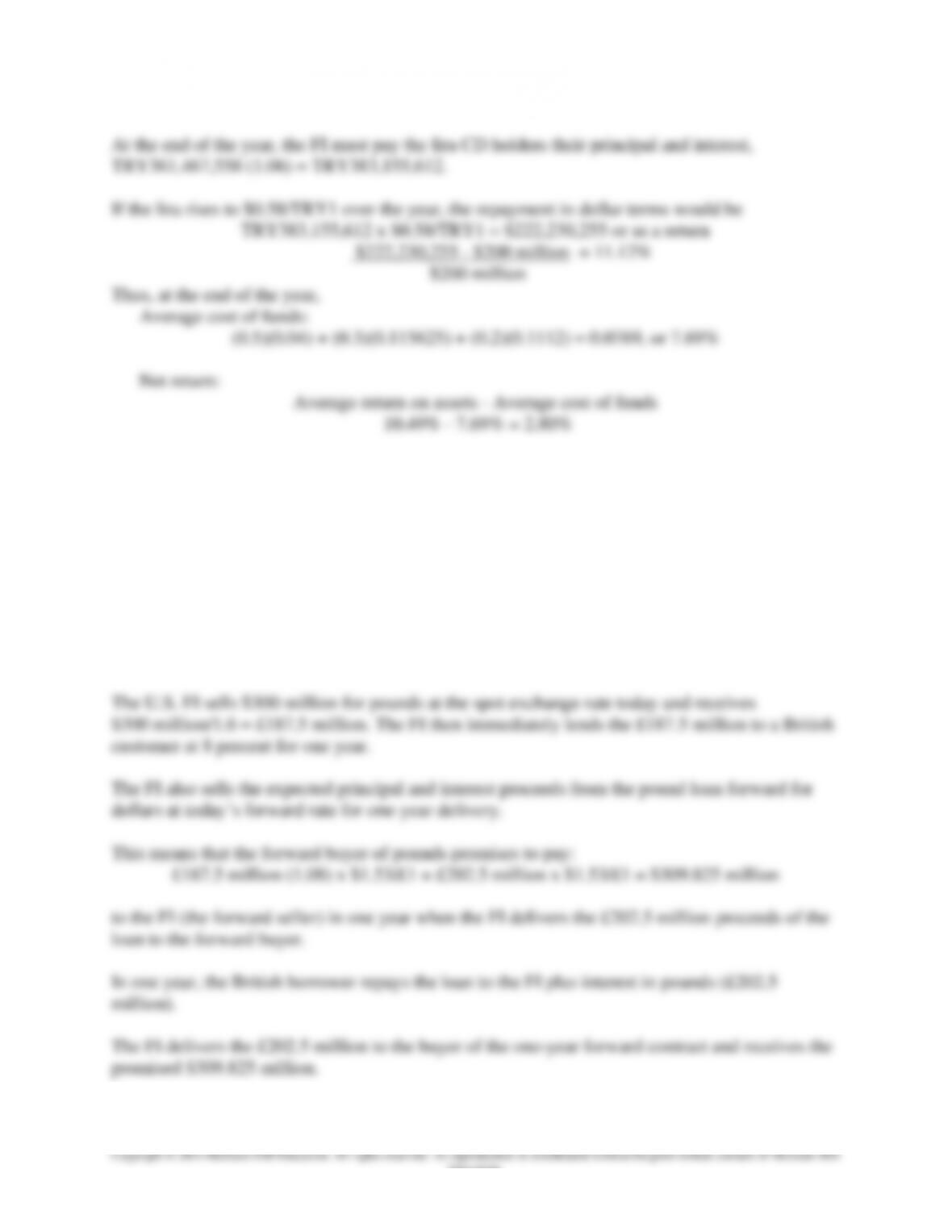
As in part 3, when the pound rises in value to $1.70/£1 at the end of the year, pound revenue
from the British loans is £187.5(1.08) = £202.5 million.
Then the dollar proceeds from the U.K. loan are:
Chapter 13 – Foreign Exchange Risk
13–28
Education.
7. Suppose that instead of funding the $300 million investment in 8 percent British loans with
CDs issued in the United Kingdom, the FI manager hedges the foreign exchange risk on the
British loans by immediately selling its expected one-year pound loan proceeds in the forward
FX market. The current forward one-year exchange rate between dollars and pounds is
$1.53/£1. Additionally, instead of funding the $200 million investment in 10 percent Turkish
loans with CDs issued in the Turkey, the FI manager hedges the foreign exchange risk on the
Turkish loans by immediately selling its expected one-year lira loan proceeds in the forward FX
market. The current forward one-year exchange rate between dollars and Turkish lira is
$0.5486/TRY1. Calculate the return on the FI’s investment portfolio (including the hedge) and
the net interest margin for the FI over the year.
Chapter 13 – Foreign Exchange Risk
13–29
Copyright © 2014 McGraw-Hill Education. All rights reserved. No reproduction or distribution without the prior written consent of McGraw-Hill
Education.
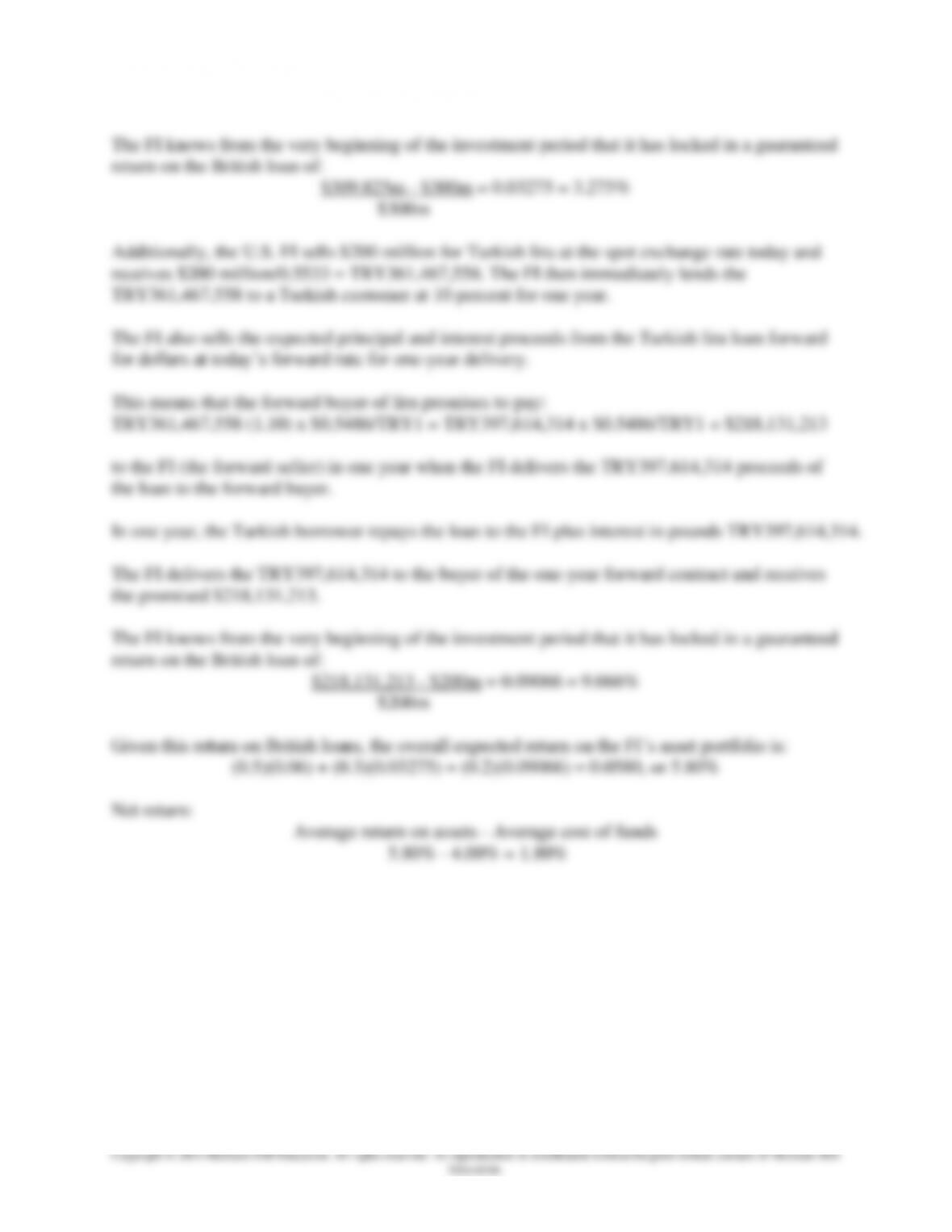
The FI knows from the very beginning of the investment period that it has locked in a guaranteed
return on the British loan of:
$309.825m – $300m = 0.03275 = 3.275%
$300m
Additionally, the U.S. FI sells $200 million for Turkish lira at the spot exchange rate today and
receives $200 million/0.5533 = TRY361,467,558. The FI then immediately lends the
TRY361,467,558 to a Turkish customer at 10 percent for one year.
The FI also sells the expected principal and interest proceeds from the Turkish lira loan forward
for dollars at today’s forward rate for one-year delivery.
This means that the forward buyer of lira promises to pay:
TRY361,467,558 (1.10) x $0.5486/TRY1 = TRY397,614,314 x $0.5486/TRY1 = $218,131,213
to the FI (the forward seller) in one year when the FI delivers the TRY397,614,314 proceeds of
the loan to the forward buyer.
In one year, the Turkish borrower repays the loan to the FI plus interest in pounds TRY397,614,314.
The FI delivers the TRY397,614,314 to the buyer of the one-year forward contract and receives
the promised $218,131,213.
The FI knows from the very beginning of the investment period that it has locked in a guaranteed
return on the British loan of:
$218,131,213 – $200m = 0.09066 = 9.066%
$200m
Given this return on British loans, the overall expected return on the FI’s asset portfolio is:
(0.5)(0.06) + (0.3)(0.03275) + (0.2)(0.09066) = 0.0580, or 5.80%
Net return:
Average return on assets – Average cost of funds
5.80% – 4.00% = 1.80%