Chapter 13 – Foreign Exchange Risk
13-1
Solutions for End-of-Chapter Questions and Problems: Chapter Thirteen
1. What are four FX risks faced by FIs?
2. What is the spot market for FX? What is the forward market for FX? What is the position
of being net long in a currency?
3. Refer to Table 13-1.
a. What was the spot exchange rate of Canadian dollars for U.S. dollars on July 4, 2012?
b. What was the six-month forward exchange rate of Japanese yen for U.S. dollars on
July 4, 2012?
c. What was the three-month forward exchange rate of U.S. dollars for Swiss francs on July
4, 2012?
4. Refer to Table 13-1.
a. On June 4, 2012, you purchased a British pound-denominated CD by converting $1
million to pounds at a rate of 0.6435 pounds for U.S. dollars. It is now July 4, 2012. Has
the U.S. dollar appreciated or depreciated in value relative to the pound?
b. Using the information in part (a), what is your gain or loss on the investment in the CD?
Assume no interest was been paid on the CD.
Chapter 13 – Foreign Exchange Risk
13-2
Education.
5. On July 4, 2012, you convert $500,000 U.S. dollars to Japanese yen in the spot foreign
exchange market and purchase a one-month forward contract to convert yen into dollars.
How much will you receive in U.S. dollars at the end of the month? Use the data in Table
13-1 for this problem.
6. X-IM Bank has ¥14 million in assets and ¥23 million in liabilities and has sold ¥8 million
in foreign currency trading. What is the net exposure for X-IM? For what type of exchange
rate movement does this exposure put the bank at risk?
7. What two factors directly affect the profitability of an FI’s position in a foreign currency?
8. The following are the foreign currency positions of an FI, expressed in the foreign currency.
Currency Assets Liabilities FX Bought FX Sold
Swiss franc (SF) SF134,394 SF53,758 SF10,752 SF16,127
British pound (£) £30,488 £13,415 £9,146 £12,195
Japanese yen (¥) ¥7,075,472 ¥2,830,189 ¥1,132,075 ¥8,301,887
The exchange rate of dollars per SFs is 0.9301, of dollars per British pounds is 1.6400, and
of dollars per yen is 0.010600.
Chapter 13 – Foreign Exchange Risk
13-3
The following are the foreign currency positions converted to dollars.
Currency Assets Liabilities FX Bought FX Sold
Swiss franc (SF) $125,000 $50,000 $10,000 $15,000
British pound (£) $50,000 $22,001 $14,999 $20,000
Japanese yen (¥) $75,000 $30,000 $12,000 $88,000
a.What is the FI’s net exposure in Swiss francs stated in SF and in $s?
b. What is the FI’s net exposure in British pounds stated in £ and in $s?
c. What is the FI’s net exposure in Japanese yen stated in ¥s and in $s?
d. What is the expected loss or gain if the SF exchange rate appreciates by 1 percent?
State you answer in SFs and $s.
e. What is the expected loss or gain if the £ exchange rate appreciates by 1 percent? State
you answer in £s and $s.
f. What is the expected loss or gain if the ¥ exchange rate appreciates by 2 percent? State
you answer in ¥s and $s.
Chapter 13 – Foreign Exchange Risk
13-4
Education.
9. What are the four FX trading activities undertaken by FIs? How do FIs profit from these
activities?
10. City Bank issued $200 million of one-year CDs in the United States at a rate of 6.50
percent. It invested part of this money, $100 million, in the purchase of a one-year bond
issued by a U.S. firm at an annual rate of 7 percent. The remaining $100 million was
invested in a one-year Brazilian government bond paying an annual interest rate of 8
percent. The exchange rate at the time of the transaction was Brazilian real 0.50/$1.
a. What will be the net return on this $200 million investment in bonds if the exchange
rate between the Brazilian real and the U.S. dollar remains the same?
b. What will be the net return on this $200 million investment if the exchange rate
changes to real 0.4167/$1?
Chapter 13 – Foreign Exchange Risk
13-5
Education.
c. What will be the net return on this $200 million investment if the exchange rate
changes to real 0.625/$1?
11. Sun Bank USA purchased a 16 million one-year euro loan that pays 12 percent interest
annually. The spot rate of U.S. dollars per euro is 1.25. Sun Bank has funded this loan by
accepting a British pound-denominated deposit for the equivalent amount and maturity at
an annual rate of 10 percent. The current spot rate of U.S. dollars per British pound is 1.60.
a. What is the net interest income earned in dollars on this one-year transaction if the spot
rates of U.S. dollars per euro and U.S. dollars per British pound at the end of the year
are 1.35 and 1.70?
b. What should be the spot rate of U.S. dollars per British pound at the end of the year in
order for the bank to earn a net interest margin of 4 percent?
c. Does your answer to part (b) imply that the dollar should appreciate or depreciate
against the pound?
Chapter 13 – Foreign Exchange Risk
13-6
Copyright © 2014 McGraw-Hill Education. All rights reserved. No reproduction or distribution without the prior written consent of McGraw-Hill
Education.
The dollar should depreciate against the pound. Each pound gives fewer dollars.
d. What is the total effect on net interest income and principal of this transaction given the
end-of-year spot rates in part (a)?
12. Bank USA just made a one-year $10 million loan that pays 10 percent interest annually.
The loan was funded with a Swiss franc-denominated one-year deposit at an annual rate of
6 percent. The current spot rate is SF1.05/$1.
a. What will be the net interest income in dollars on the one-year loan if the spot rate at
the end of the year is SF1.03/$1?
b. What will be the net interest return on assets?
c. What is the total effect on net interest income and principal of this transaction given the
end-of-year spot rates in part (a)?
d. How far can the SF/$ appreciate before the transaction will result in a loss for Bank
USA?
Chapter 13 – Foreign Exchange Risk
13-7
13. What motivates FIs to hedge foreign currency exposures? What are the limitations to
hedging foreign currency exposures?
FIs hedge to manage their exposure to currency risks, not to eliminate it. As in the case of
14. What are the two primary methods of hedging FX risk for an FI? What two conditions are
necessary to achieve a perfect hedge through on-balance-sheet hedging? What are the
advantages and disadvantages of off-balance-sheet hedging in comparison to on-balance-
sheet hedging?
For currency risk, forward contracts are available for the majority of currencies at a variety of
delivery dates. Moreover, since the forward contract is negotiated over the counter, the
counterparties have maximum flexibility to set terms and conditions.
Disadvantages of off-balance-sheet FX Hedging:
Chapter 13 – Foreign Exchange Risk
13-8
Education.
15. Suppose that a U.S. FI has the following assets and liabilities:
Assets Liabilities
$100 million $200 million
U.S. loans (one year) U.S. CDs (one year)
year; the one-year, default risk–free loans in the United States are yielding 6 percent; and
default risk–free one-year loans are yielding 12 percent in the United Kingdom. The
exchange rate of dollars for pounds at the beginning of the year is $1.6/£1.
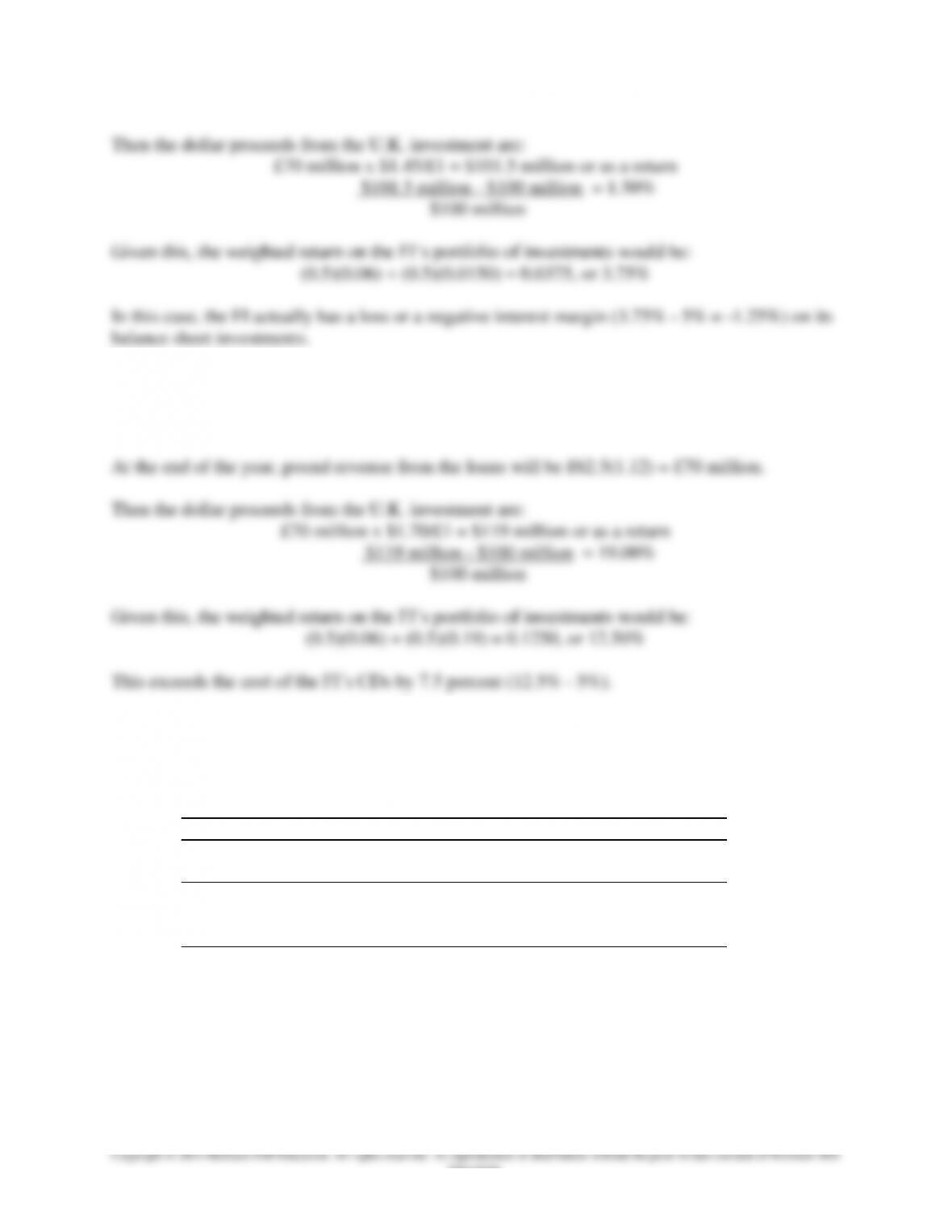
a. Calculate the dollar proceeds from the UK investment at the end of the year, the return
on the FI’s investment portfolio, and the net interest margin for the FI if the spot
foreign exchange rate has not changed over the year.
b. Calculate the dollar proceeds from the UK investment at the end of the year, the return
on the FI’s investment portfolio, and the net interest margin for the FI if the spot
foreign exchange rate falls to $1.45/£1 over the year.
Chapter 13 – Foreign Exchange Risk
13-9
Education.
c. Calculate the dollar proceeds from the UK investment at the end of the year, the return
on the FI’s investment portfolio, and the net interest margin for the FI if the spot
foreign exchange rate rises to $1.70/£1 over the year.
16. Suppose that instead of funding the $100 million investment in 12 percent British loans
with U.S. CDs, the FI manager in problem 15 funds the British loans with $100 million
equivalent one-year pound CDs at a rate of 8 percent. Now the balance sheet of the FI
would be as follows:
Assets Liabilities
$100 million $100 million
U.S. loans (6%) U.S. CDs (5%)
$100 million $100 million
U.K. loans (12%) U.K. CDs (8%)
(loans made in pounds) (deposits raised in pounds)
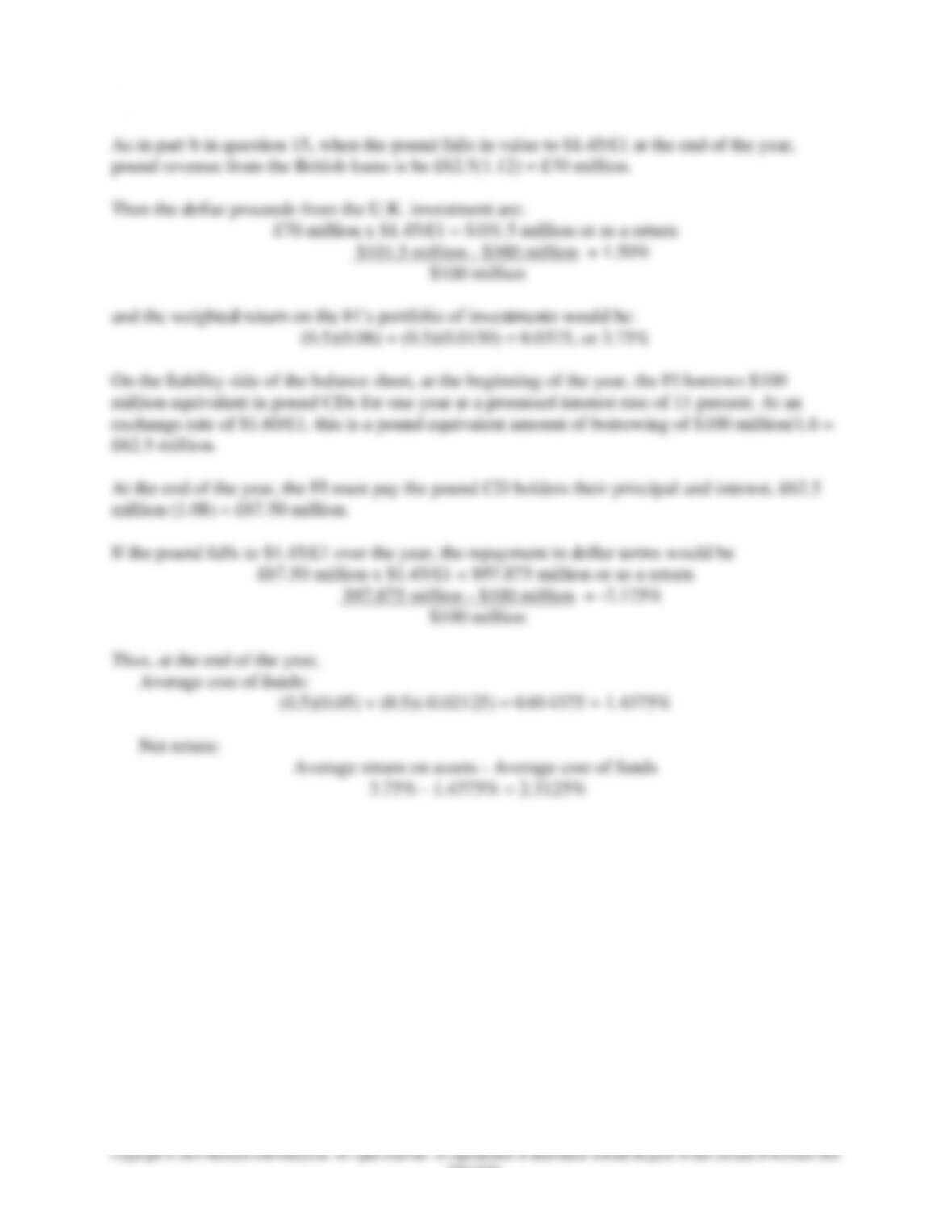
a. Calculate the return on the FI’s investment portfolio, the average cost of funds, and the
net interest margin for the FI if the spot foreign exchange rate falls to $1.45/£1 over the
year.
Chapter 13 – Foreign Exchange Risk
13–10
Education.
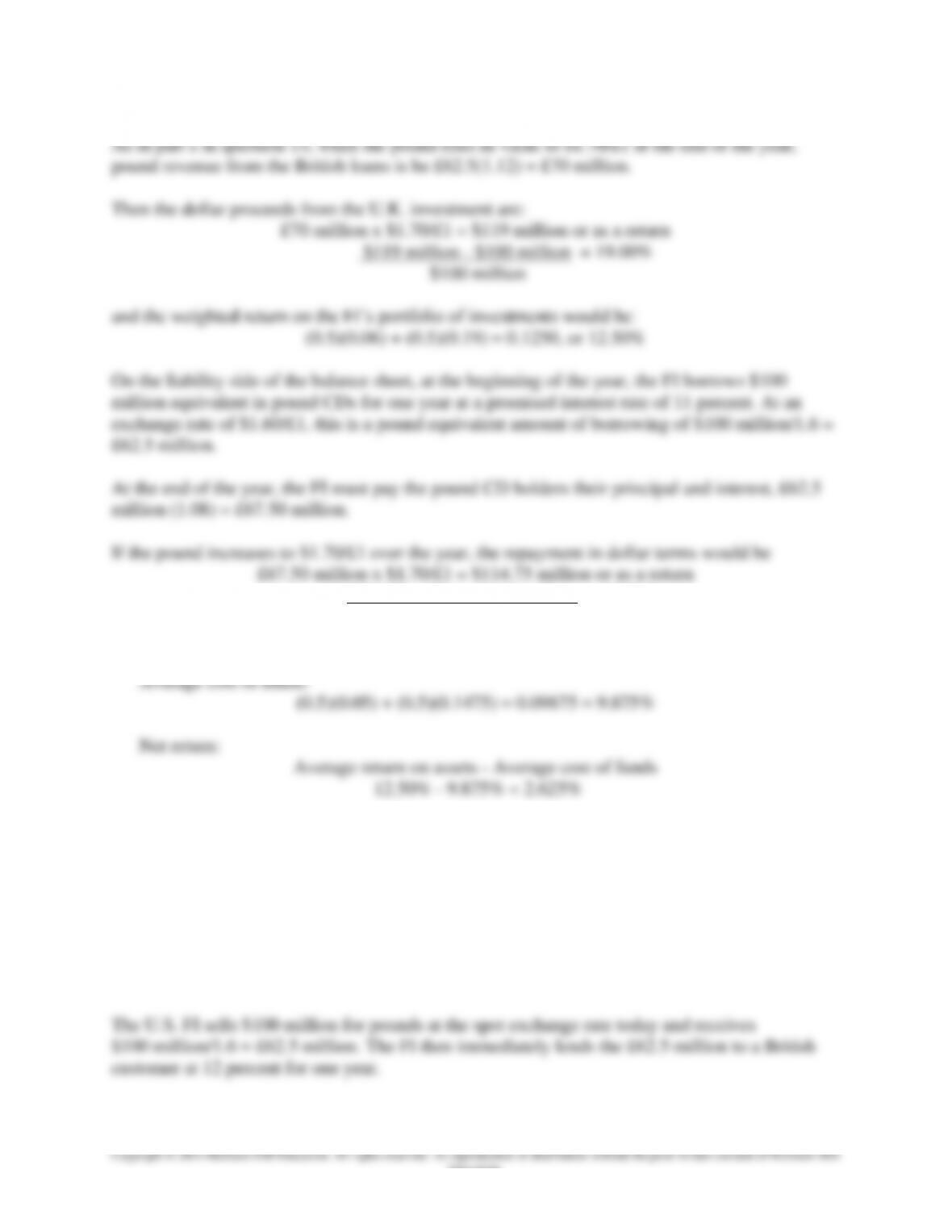
b. Calculate the return on the FI’s investment portfolio, the average cost of funds, and the
net interest margin for the FI if the spot foreign exchange rate rises to $1.70/£1 over the
year.
Chapter 13 – Foreign Exchange Risk
13–11
Education.
$114.75 million – $100 million = 14.75%
$100 million
Thus, at the end of the year,
17. Suppose that instead of funding the $100 million investment in 12 percent British loans
with CDs issued in the United Kingdom, the FI manager in problem 16 hedges the foreign
exchange risk on the British loans by immediately selling its expected one-year pound loan
proceeds in the forward FX market. The current forward one-year exchange rate between
dollars and pounds is $1.53/£1.
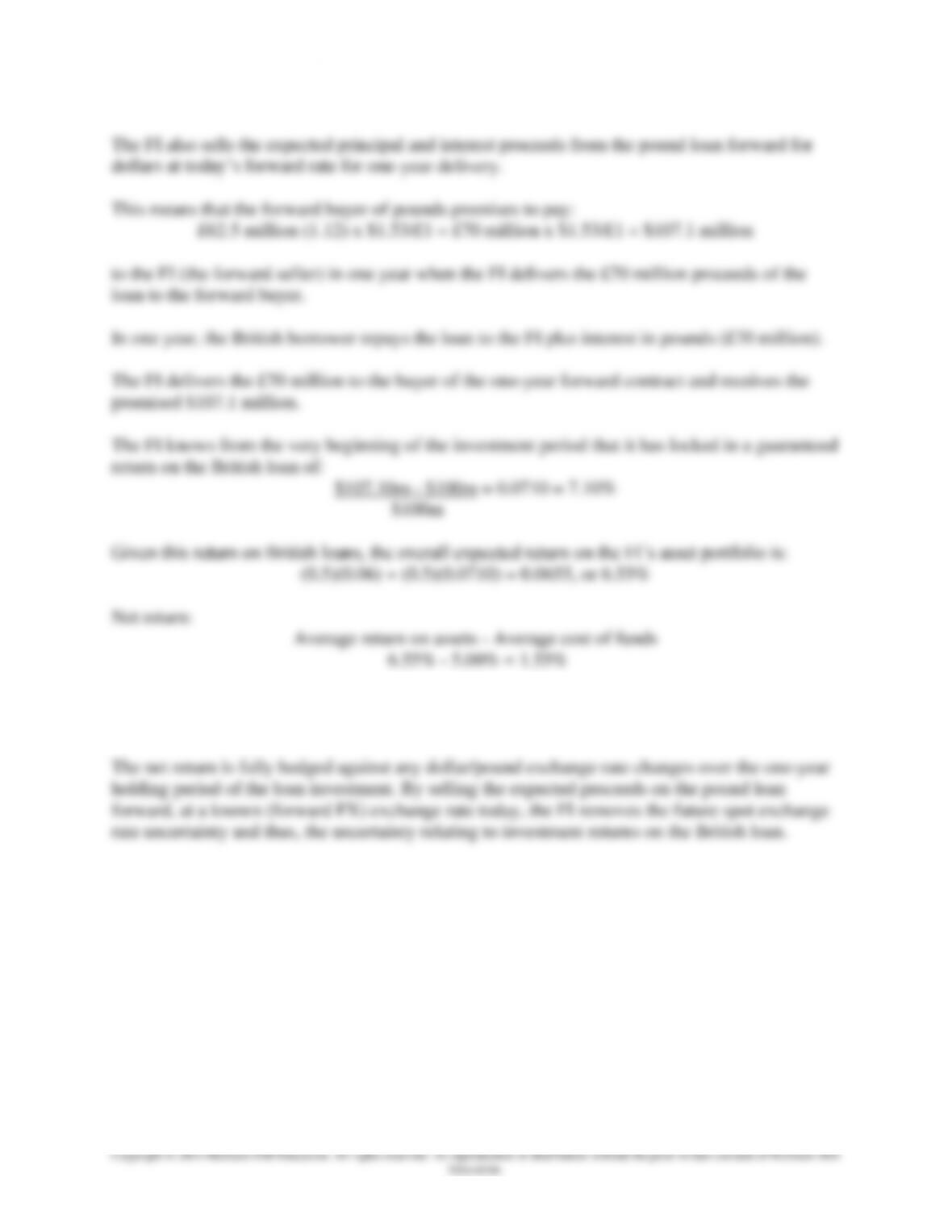
a. Calculate the return on the FI’s investment portfolio (including the hedge) and the net
interest margin for the FI over the year.
Chapter 13 – Foreign Exchange Risk
13–12
Copyright © 2014 McGraw-Hill Education. All rights reserved. No reproduction or distribution without the prior written consent of McGraw-Hill
Education.
The FI also sells the expected principal and interest proceeds from the pound loan forward for
dollars at today’s forward rate for one-year delivery.
This means that the forward buyer of pounds promises to pay:
£62.5 million (1.12) x $1.53/£1 = £70 million x $1.53/£1 = $107.1 million
to the FI (the forward seller) in one year when the FI delivers the £70 million proceeds of the
loan to the forward buyer.
In one year, the British borrower repays the loan to the FI plus interest in pounds (£70 million).
The FI delivers the £70 million to the buyer of the one-year forward contract and receives the
promised $107.1 million.
The FI knows from the very beginning of the investment period that it has locked in a guaranteed
return on the British loan of:
$107.10m – $100m = 0.0710 = 7.10%
$100m
Given this return on British loans, the overall expected return on the FI’s asset portfolio is:
(0.5)(0.06) + (0.5)(0.0710) = 0.0655, or 6.55%
Net return:
Average return on assets – Average cost of funds
6.55% – 5.00% = 1.55%
b. Will the net return be affected by changes in the dollar for pound spot foreign exchange
rate at the end of the year?
Chapter 13 – Foreign Exchange Risk
13–13
Education.
18. Suppose that a U.S. FI has the following assets and liabilities:
Assets Liabilities
$300 million $500 million
U.S. loans (one year) U.S. CDs (one year)
in dollars in dollars
$200 million equivalent
German loans (one year)
(loans made in euros)
The promised one-year U.S. CD rate is 4 percent, to be paid in dollars at the end of the
year; the one-year, default risk–free loans in the United States are yielding 6 percent; and
default risk–free one-year loans are yielding 10 percent in Germany. The exchange rate of
dollars for euros at the beginning of the year is $1.25/€1.
a. Calculate the dollar proceeds from the German loan at the end of the year, the return on
the FI’s investment portfolio, and the net interest margin for the FI if the spot foreign
exchange rate has not changed over the year.
b. Calculate the dollar proceeds from the German loan at the end of the year, the return on
the FI’s investment portfolio, and the net interest margin for the FI if the spot foreign
exchange rate falls to $1.15/€1 over the year.
Chapter 13 – Foreign Exchange Risk
13–14
Education.
c. Calculate the dollar proceeds from the German loan at the end of the year, the return on
the FI’s investment portfolio, and the net interest margin for the FI if the spot foreign
exchange rate rises to $1.35/€1 over the year.
19. Suppose that instead of funding the $200 million investment in 10 percent German loans
with U.S. CDs, the FI manager in problem 18 funds the German loans with $200 million
equivalent one-year euro CDs at a rate of 7 percent. Now the balance sheet of the FI would
be as follows:
Assets Liabilities
$300 million $300 million
U.S. loans (6%) U.S. CDs (4%)
$200 million $200 million
German loans (10%) German CDs (7%)
(loans made in euros) (deposits raised in euros)
a. Calculate the return on the FI’s investment portfolio, the average cost of funds, and the
net interest margin for the FI if the spot foreign exchange rate falls to $1.15/€1 over the
year.
Chapter 13 – Foreign Exchange Risk
13–15
Copyright © 2014 McGraw-Hill Education. All rights reserved. No reproduction or distribution without the prior written consent of McGraw-Hill
Education.
and the weighted return on the FI’s portfolio of investments would be:
(300m/500m)(0.06) + (200m/500m)(0.0120) = 0.0408, or 4.08%
On the liability side of the balance sheet, at the beginning of the year, the FI borrows $200
million equivalent in euro CDs for one year at a promised interest rate of 7 percent. At an
exchange rate of $1.25/€1, this is a euro equivalent amount of borrowing of $200 million/1.25 =
€160 million.
At the end of the year, the FI must pay the pound CD holders their principal and interest, €160
million (1.07) = €171.20 million.
If the euro falls to $1.15/€1 over the year, the repayment in dollar terms would be
€171.20 million x $1.15/€1 = $196.88 million or as a return
$196.88 million – $200 million = -1.56%
$200 million
Thus, at the end of the year,
Average cost of funds:
(300m/500m)(0.04) + (200m/500m)(-0.0156) = 0.01776, or 1.776%
Net return:
Average return on assets – Average cost of funds
4.08% – 1.776% = 2.304%
b. Calculate the return on the FI’s investment portfolio, the average cost of funds, and the
net interest margin for the FI if the spot foreign exchange rate rises to $1.35/€1 over the
year.