Chapter 12 – Liquidity Risk
12-1
Solutions for End-of-Chapter Questions and Problems: Chapter Twelve
1. How does the degree of liquidity risk differ for different types of financial institutions?
2. What are the two reasons liquidity risk arises? How does liquidity risk arising from the
liability side of the balance sheet differ from liquidity risk arising from the asset side of the
balance sheet? What is meant by fire-sale prices?
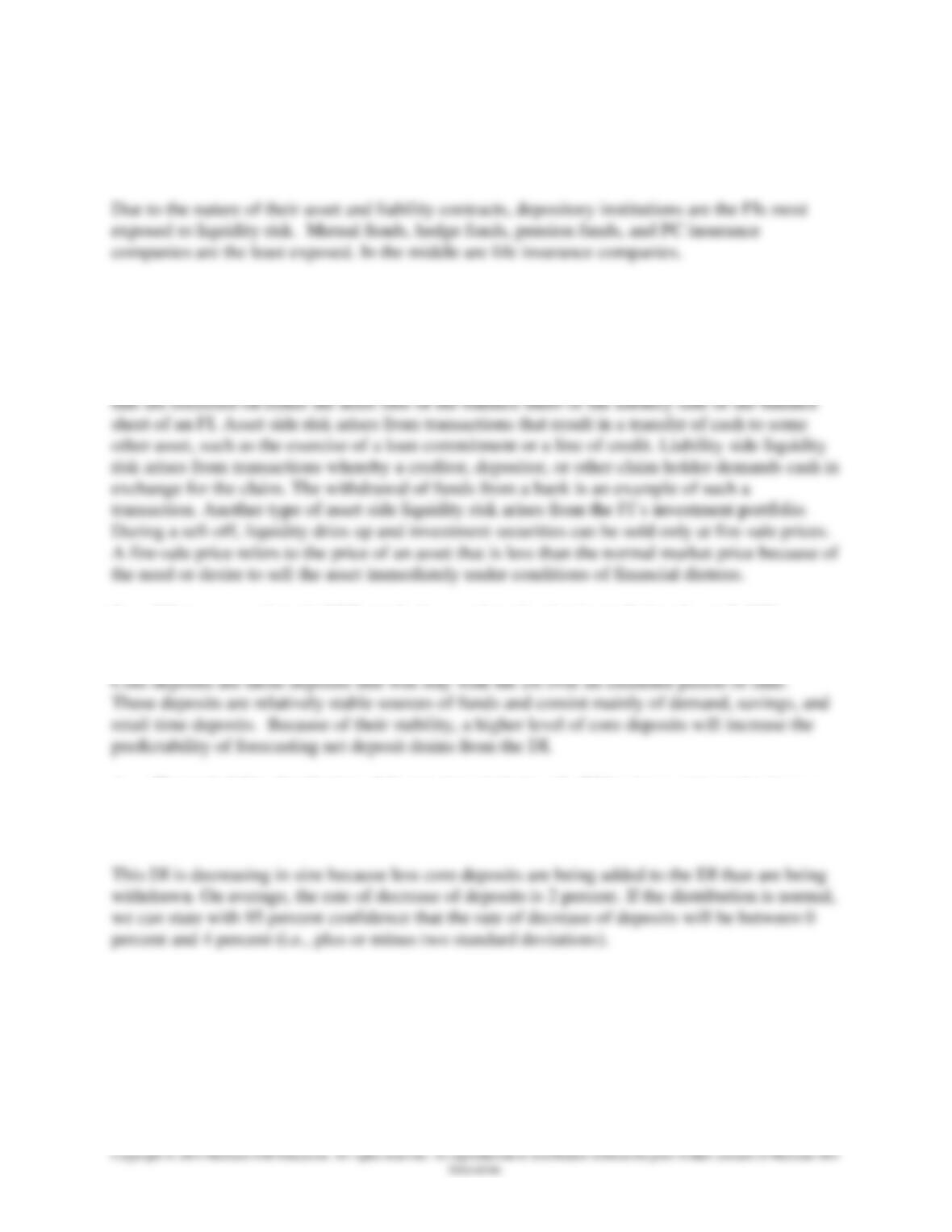
Liquidity risk occurs because of situations that develop from economic and financial transactions
3. What are core deposits? What role do core deposits play in predicting the probability
distribution of net deposit drains?
4. The probability distribution of the net deposit drains of a DI has been estimated to have a
mean of 2 percent and a standard deviation of 1 percent. Is this DI increasing or decreasing
in size? Explain.
Chapter 12 – Liquidity Risk
12-2
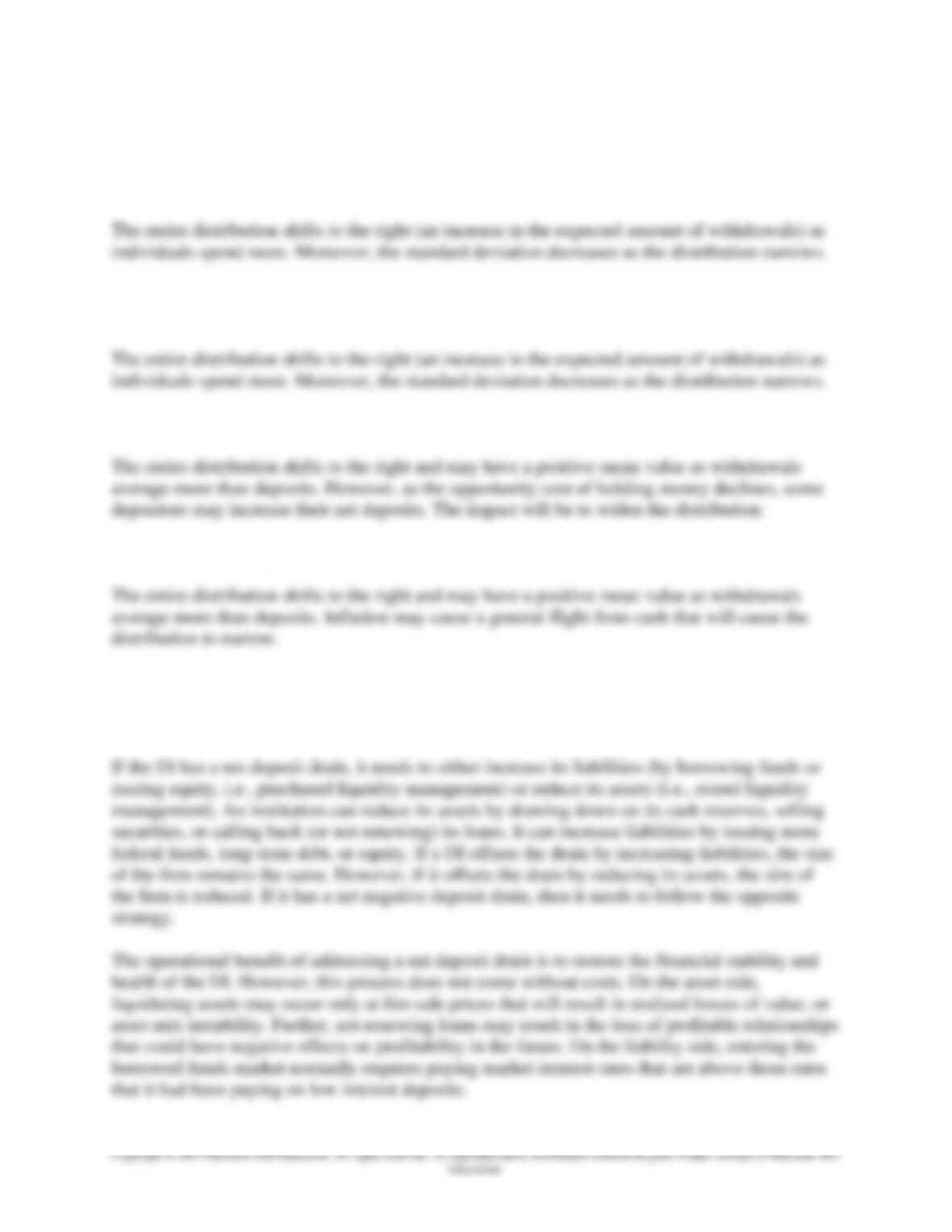
5. How is the DI’s distribution pattern of net deposit drains affected by the following?
a. The holiday season.
b. Summer vacations.
c. A severe economic recession.
d. Double-digit inflation.
6. What are two ways a DI can offset the liquidity effects of a net deposit drain of funds?
How do the two methods differ? What are the operational benefits and costs of each
method?
Chapter 12 – Liquidity Risk
12-3
Education.
7. What are two ways a DI can offset the effects of asset-side liquidity risk such as the
drawing down of a loan commitment?
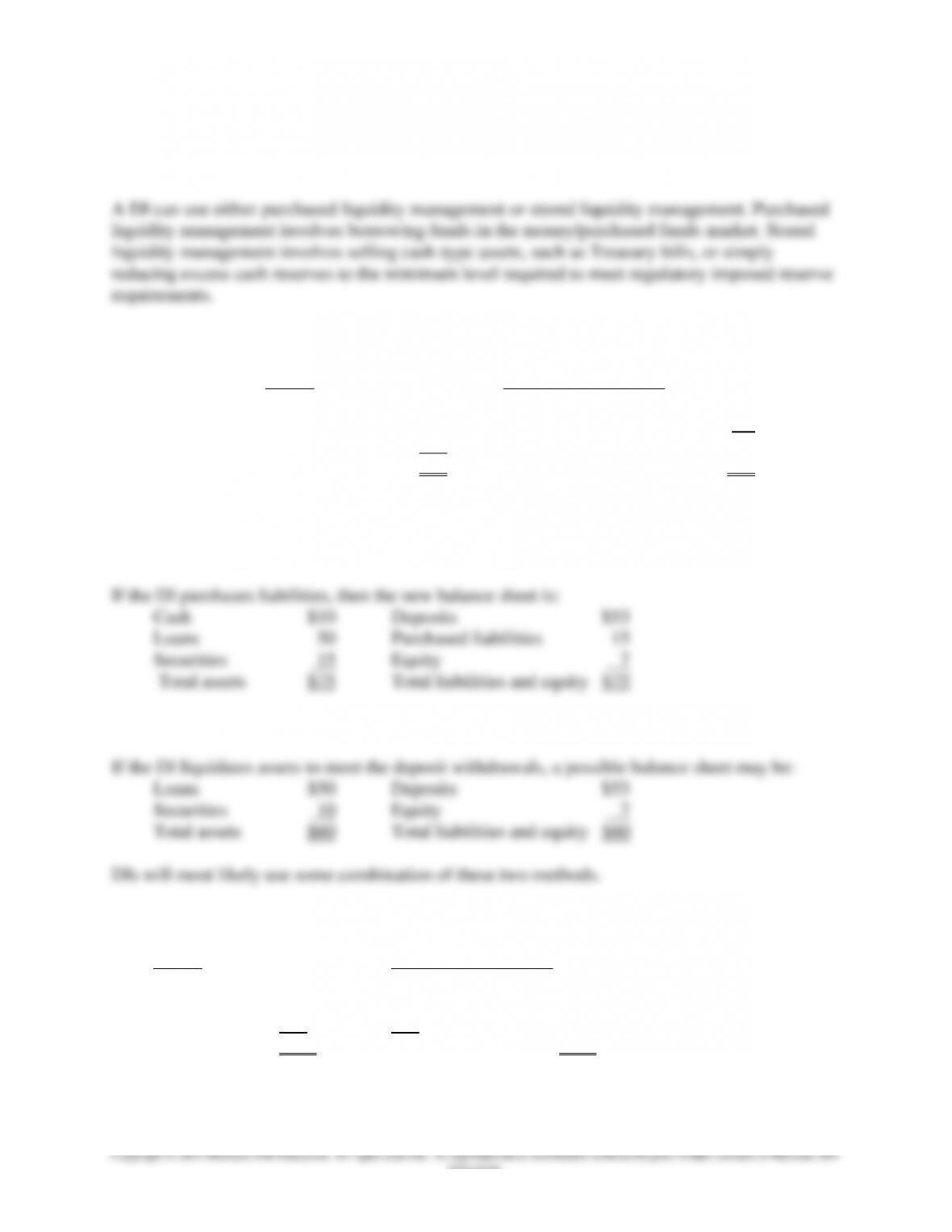
8. A DI with the following balance sheet (in millions) expects a net deposit drain of $15
million.
Assets Liabilities and Equity
Cash $10 Deposits $68
Loans 50 Equity 7
Securities 15
Total assets $75 Total liabilities and equity $75
Show the DI’s balance sheet if the following conditions occur:
a. The DI purchases liabilities to offset this expected drain.
b. The stored liquidity management method is used to meet the expected drain.
9. AllStarBank has the following balance sheet (in millions):
Assets Liabilities and Equity
Cash $30 Deposits $110
Loans 90 Borrowed funds 40
Securities 50 Equity 20
Total assets $170 Total liabilities and equity $170
Chapter 12 – Liquidity Risk
12-4
Education.
AllStarBank’s largest customer decides to exercise a $15 million loan commitment. How will the
new balance sheet appear if AllStar uses the following liquidity risk strategies?
a. Stored liquidity management.
b. Purchased liquidity management.
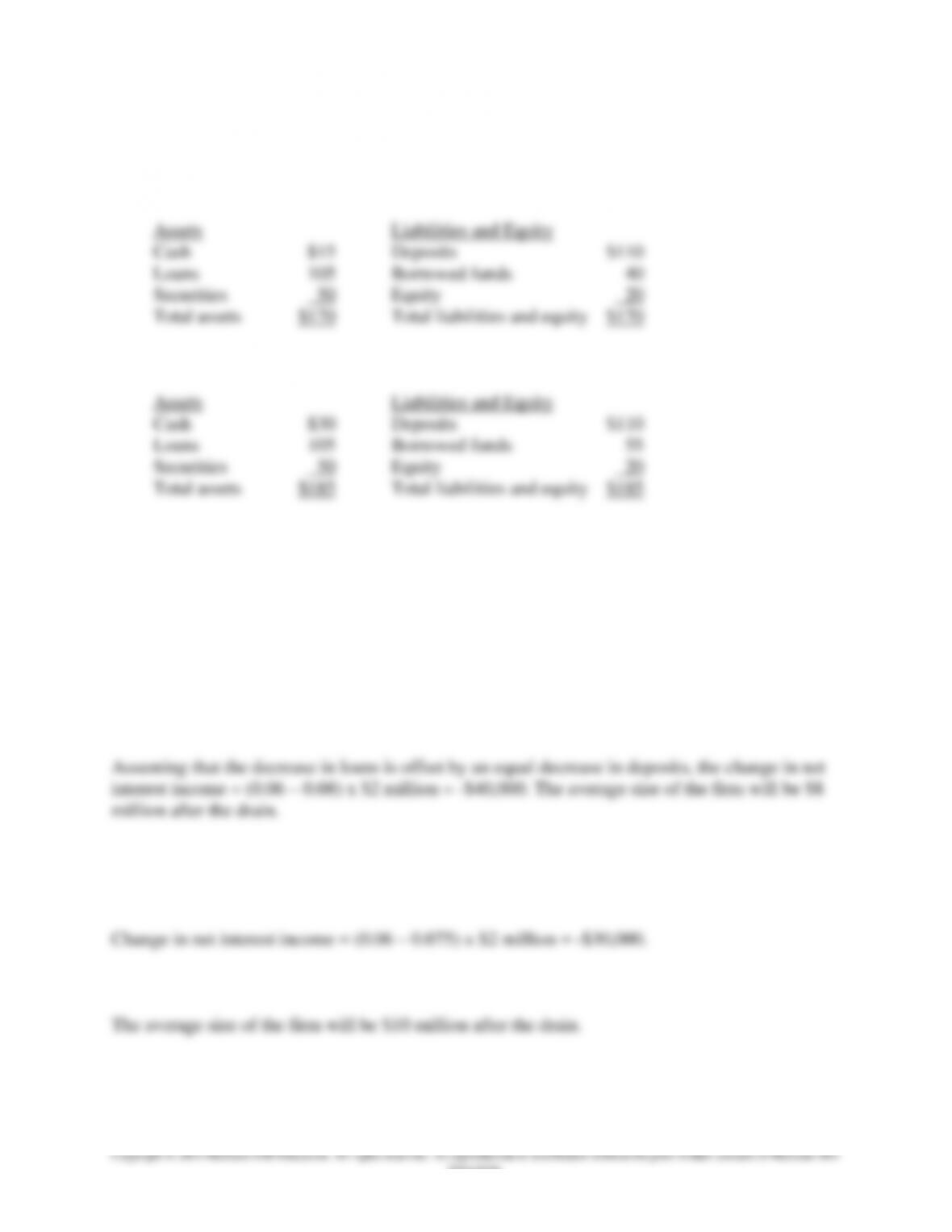
10. A DI has assets of $10 million consisting of $1 million in cash and $9 million in loans. The
DI has core deposits of $6 million, subordinated debt of $2 million, and equity of $2
million. Increases in interest rates are expected to cause a net drain of $2 million in core
deposits over the year?
a. The average cost of deposits is 6 percent and the average yield on loans is 8 percent.
The DI decides to reduce its loan portfolio to offset this expected decline in deposits.
What will be the effect on net interest income and the size of the DI after the
implementation of this strategy?
b. If the interest cost of issuing new short-term debt is expected to be 7.5 percent, what
would be the effect on net interest income of offsetting the expected deposit drain with
an increase in interest-bearing liabilities?
c. What will be the size of the DI after the drain if the DI uses this strategy?
Chapter 12 – Liquidity Risk
12-5
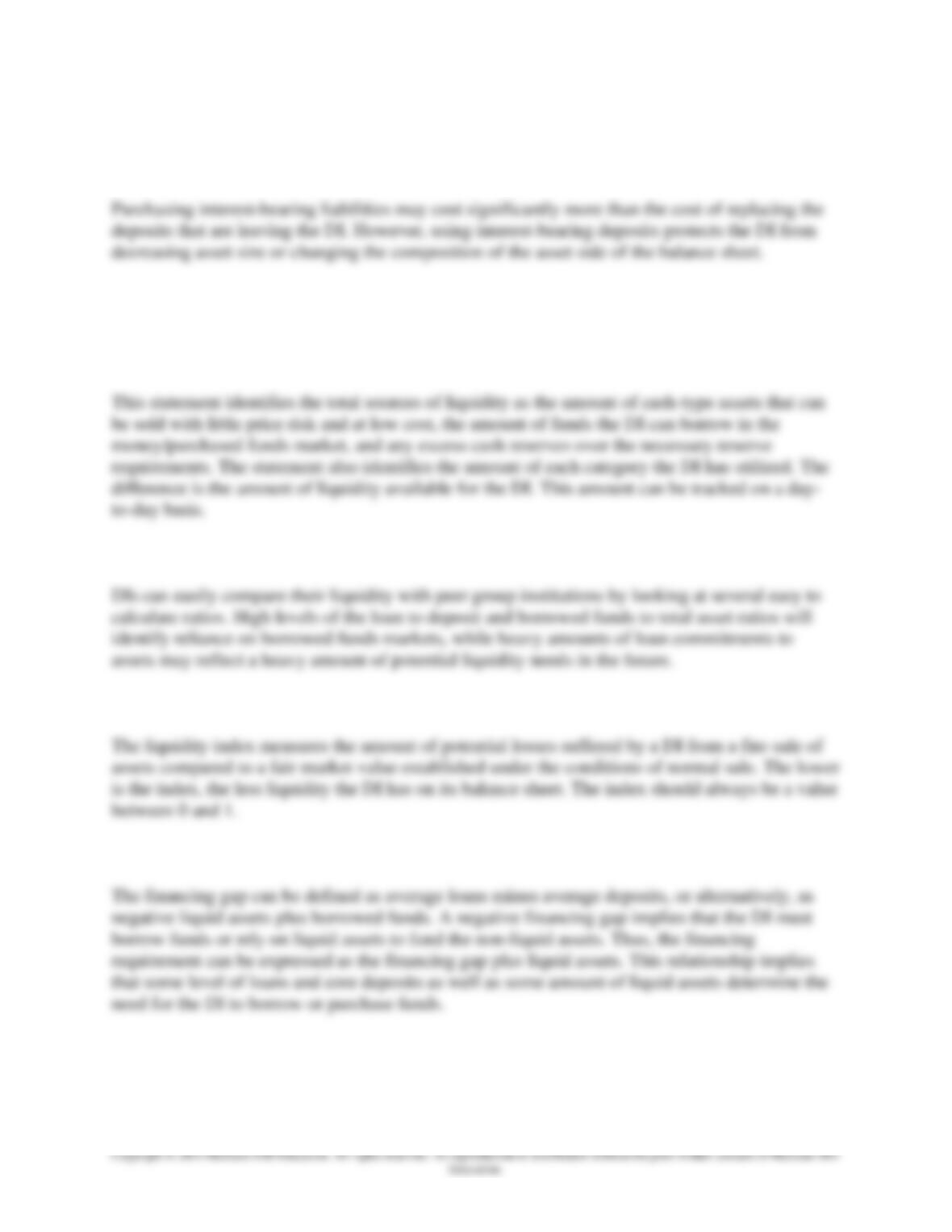
d. What dynamic aspects of DI management would support a strategy of replacing the
deposit drain with interest-bearing liabilities?
11. Define each of the following four measures of liquidity risk. Explain how each measure
would be implemented and utilized by a DI.
a. Sources and uses of liquidity.
b. Peer group ratio comparisons.
c. Liquidity index.
d. Financing gap and financing requirement.
12-6
Copyright © 2014 McGraw-Hill Education. All rights reserved. No reproduction or distribution without the prior written consent of McGraw-Hill
Education.
12. A DI has $10 million in T-bills, a $5 million line of credit to borrow in the repo market,
and $5 million in excess cash reserves (above reserve requirements) with the Fed. The DI
currently has borrowed $6 million in fed funds and $2 million from the Fed’s discount
window to meet seasonal demands.
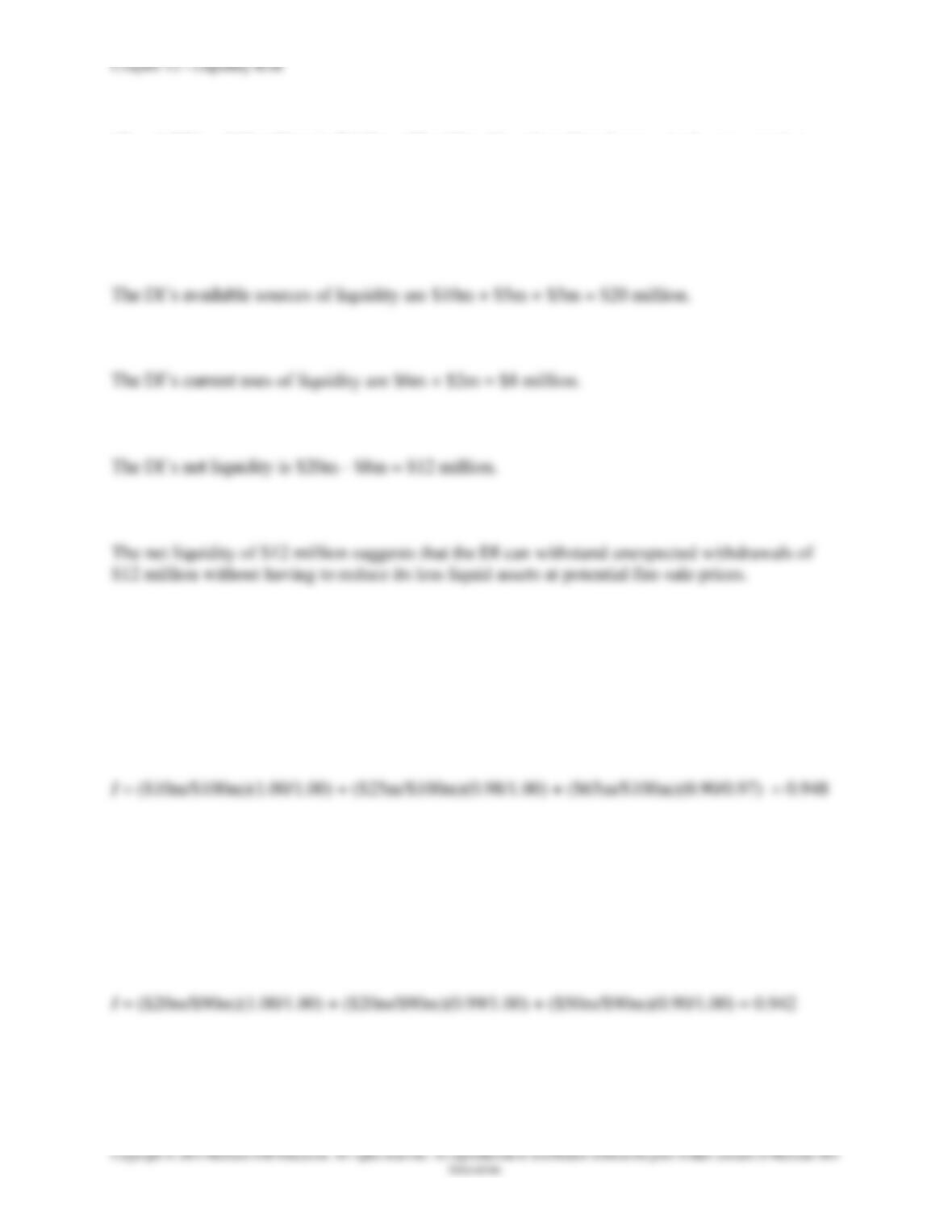
a. What is the DI’s total available (sources of) liquidity?
b. What is the DI’s current total uses of liquidity?
c. What is the net liquidity of the DI?
d. What conclusions can you derive from the result?
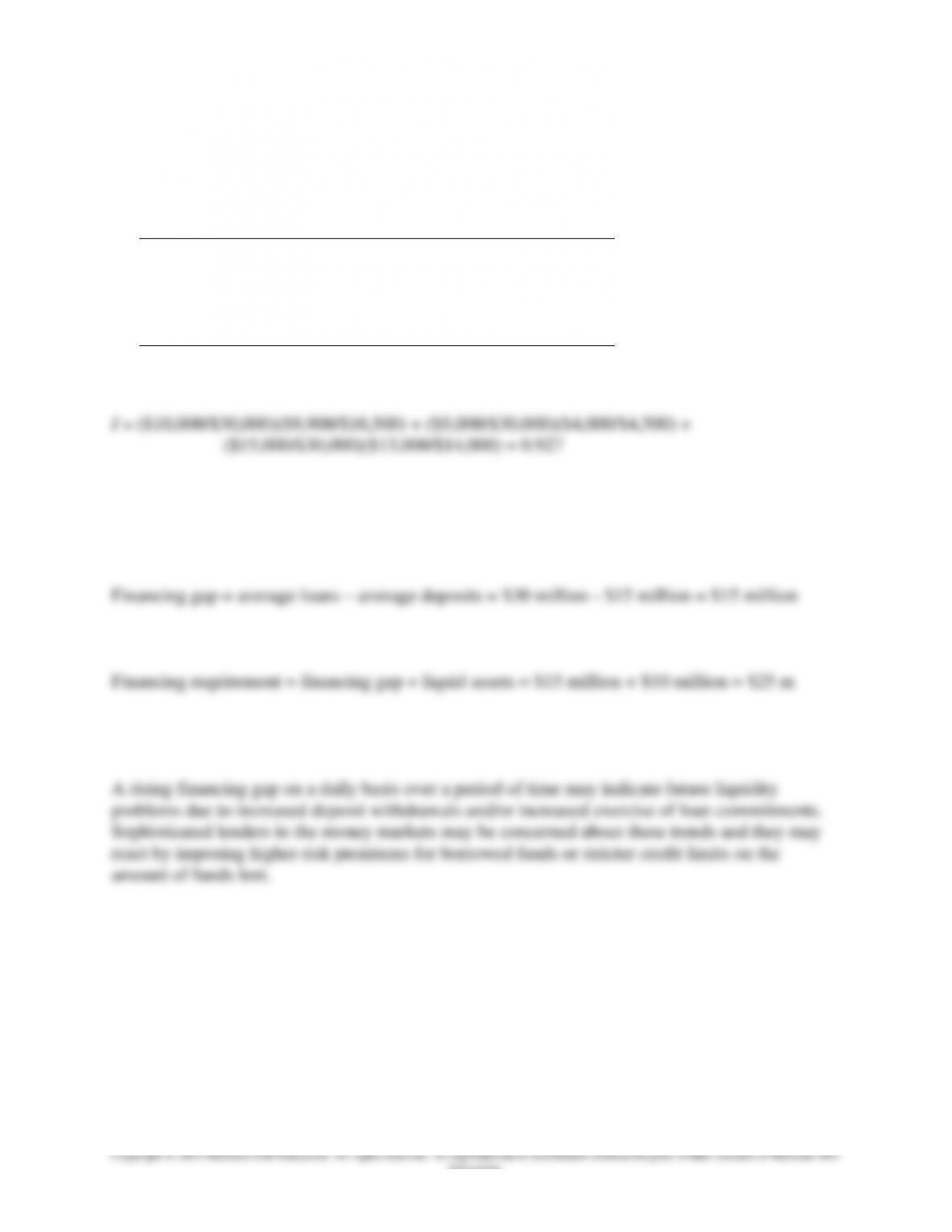
13. A DI has the following assets in its portfolio: $10 million in cash reserves with the Fed,
$25 million in T-bills, and $65 million in mortgage loans. If the DI has to liquidate the
assets today, it will receive only $98 per $100 of face value of the T-bills and $90 per $100
of face value of the mortgage loans. Liquidation at the end of one month (closer to
maturity) will produce $100 per $100 of face value of the T-bills and $97 per $100 of face
value of the mortgage. Calculate the one-month liquidity index for this DI using the above
information.
14. A DI has the following assets in its portfolio: $20 million in cash reserves with the Fed,
$20 million in T-bills, and $50 million in mortgage loans. If the assets need to be liquidated
at short notice, the DI will receive only 99 percent of the fair market value of the T-bills
and 90 percent of the fair market value of the mortgage loans. Liquidation at the end of one
month (closer to maturity) will produce $100 per $100 of face value of the T-bills and the
mortgage loans. Calculate the liquidity index using the above information.
Chapter 12 – Liquidity Risk
12-7
Education.
15. Conglomerate Corporation has acquired Acme Corporation. To help finance the takeover,
Conglomerate will liquidate the overfunded portion of Acme’s pension fund. The face
values and current and one-year future liquidation values of the assets that will be
liquidated are given below:
Liquidation Values
Asset Face Value t = 0 t = 1 year
IBM stock $10,000 $9,900 $10,500
GE bonds 5,000 4,000 4,500
Treasury securities 15,000 13,000 14,000
Calculate the one-year liquidity index for these securities.
16. Plainbank has $10 million in cash and equivalents, $30 million in loans, and $15 in core
deposits.
a. Calculate the financing gap.
b. What is the financing requirement?
c. How can the financing gap be used in the day-to-day liquidity management of the
bank?
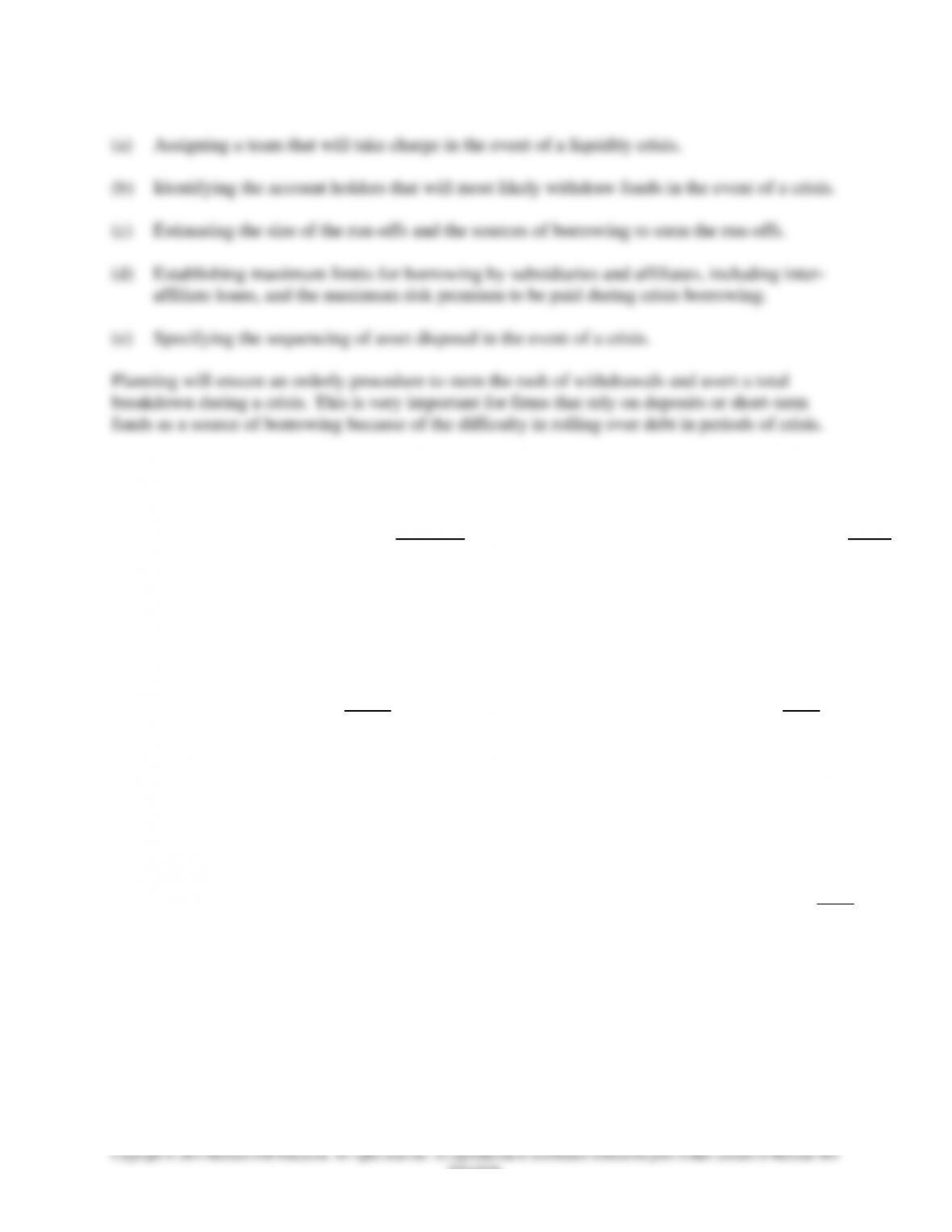
17. How can an FI’s liquidity plan help reduce the effects of liquidity shortages? What are the
components of a liquidity plan?
A liquidity plan requires forward planning so that an optimal mix of funding can be implemented
to reduce costs and unforeseen withdrawals. In general, a plan could incorporate the following:
Chapter 12 – Liquidity Risk
12-8
Education.
18. Central Bank has the following balance sheet (in millions of dollars).
Liquidity Run-off
Assets level Liabilities and Equity factor
Cash $ 20 Level 1 Stable retail deposits $190 3%
Deposits at the Fed 30 Level 1 Less stable retail deposits 70 10
Treasury bonds 145 Level 1 CDs maturing in 6 months 100 0
Qualifying marketable securities 50 Level 1 Unsecured wholesale funding from:
GNMA bonds 60 Level 2A Stable small business deposits 125 5
Loans to AA- corporations 540 Level 2A Less stable small business deposits 100 10
Mortgages 285 Nonfinancial corporates 450 75
Premises 35 Equity 130
Total $1,165 Total $1,165
Cash inflows over the next 30 days from the bank’s performing assets are $7.5 million.
Calculate the LCR for Central Bank.
The liquidity coverage ratio for Central Bank is calculated as follows:
Level 1 assets = $20 + $30 + $145 + $50 = 245
Level 2 assets = ($60 + $540) x 0.85 = $510.00 Capped at 40% of Level 1 = $245 x 0.40 = 98
Stock of highly liquid assets $343
Chapter 12 – Liquidity Risk
12-9
19. WallsFarther Bank has the following balance sheet (in millions of dollars).
Liquidity Run-off
Assets level Liabilities and Equity factor
Cash $ 12 Level 1 Stable retail deposits $ 55 3%
Deposits at the Fed 19 Level 1 Less stable retail deposits 20 10
Treasury securities 125 Level 1 Unsecured wholesale funding from:
GNMA securities 94 Level 2A Stable small business deposits 80 5
Loans to AA rated corporations 138 Level 2A Less stable small business deposits 49 10
Loans to BB rated corporations 106 Level 2B Nonfinancial corporates 250 75
Premises 20 Equity 60
Total $514 Total $514
Cash inflows over the next 30 days from the bank’s performing assets are $5.5 million.
Calculate the LCR for WallsFarther Bank.
The liquidity coverage ratio for WallsFarther Bank is calculated as follows:
Chapter 12 – Liquidity Risk
12–10
Copyright © 2014 McGraw-Hill Education. All rights reserved. No reproduction or distribution without the prior written consent of McGraw-Hill
Education.
Total cash inflows over next 30 days 5.50
Total net cash outflows over next 30 days $194.55
Liquidity coverage ratio = $218.4m/$194.55m = 112.26%. The bank is in compliance with
liquidity requirements based on the LCR.
20. FirstBank has the following balance sheet (in millions of dollars).
Required stable Available stable
Funding funding
Assets factor Liabilities and Equity factor
Cash $ 12 0% Stable retail deposits $ 55 90%
Deposits at the Fed 19 5 Less stable retail deposits 20 80
Treasury securities 125 5 Unsecured wholesale funding from:
GNMA securities 94 20 Stable small business deposits 80 90
Loans to A rated corporations 138 65 Less stable small business deposits 49 80
(maturity > 1 year) Nonfinancial corporates 250 50
Loans to B rated corporations 106 50
(maturity < 1 year)
Premises 20 100 Equity 60 100
Total $514 Total $514
Calculate the NSFR for FirstBank.
Chapter 12 – Liquidity Risk
12–11
21. BancTwo has the following balance sheet (in millions of dollars).
Required stable Available stable
funding funding
Assets factor Liabilities and Equity factor
Cash $ 20 0% Stable retail deposits $190 90%
Deposits at the Fed 30 5 Less stable retail deposits 70 80
Treasury bonds 145 5 CDs maturing in 6 months 100 0
Qualifying marketable securities 50 0 Unsecured wholesale funding from:
(maturity < 1 year) Stable small business deposits 125 90
FNMA bonds 60 20 Less stable small business deposits 100 80
Loans to AA- corporations 540 65 Nonfinancial corporates 450 50
(maturity > 1 year) Equity 130 100
Mortgages (unencumbered) 285 65 Total $1,165
Premises 35 100
Total $1,165
Calculate the NSFR for BancTwo.
22. What is a bank run? What are some possible withdrawal shocks that could initiate a bank
run? What feature of the demand deposit contract provides deposit withdrawal momentum
that can result in a bank run?
Chapter 12 – Liquidity Risk
12–12
23. The following is the balance sheet of a DI (in millions):
Assets Liabilities and Equity
Cash $ 2 Demand deposits $50
Loans 50
Premises and equipment 3 Equity 5
Total $55 Total $55
The asset-liability management committee has estimated that the loans, whose average
interest rate is 6 percent and whose average life is three years, will have to be discounted at
10 percent if they are to be sold in less than two days. If they can be sold in 4 days, they
will have to be discounted at 8 percent. If they can be sold later than a week, the DI will
receive the full market value. Loans are not amortized; that is, principal is paid at maturity.
a. What will be the price received by the DI for the loans if they have to be sold in two
days. In four days?
b. In a crisis, if depositors all demand payment on the first day, what amount will they
receive? What will they receive if they demand to be paid within the week? Assume no
deposit insurance.
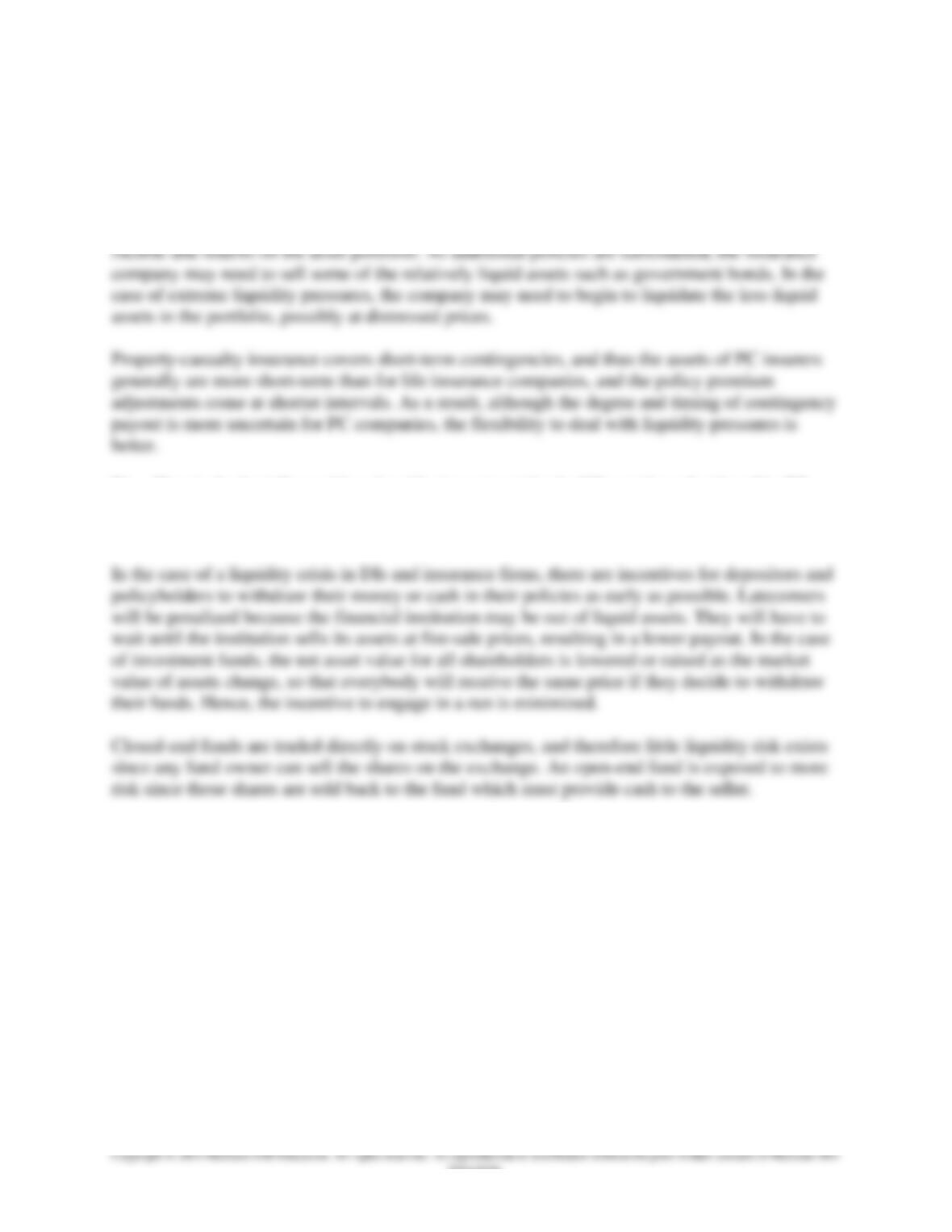
24. What government safeguards are in place to reduce liquidity risk for DIs?
Chapter 12 – Liquidity Risk
12–13
Education.
25. What are the levels of defense against liquidity risk for a life insurance company? How
does liquidity risk for a property-casualty insurer differ from that for a life insurance
company?
The initial defense against liquidity risk for life insurance companies is the amount of premium
26. How is the liquidity problem faced by investment funds different from that faced by DIs
and insurance companies? How does the liquidity risk of an open-end mutual fund compare
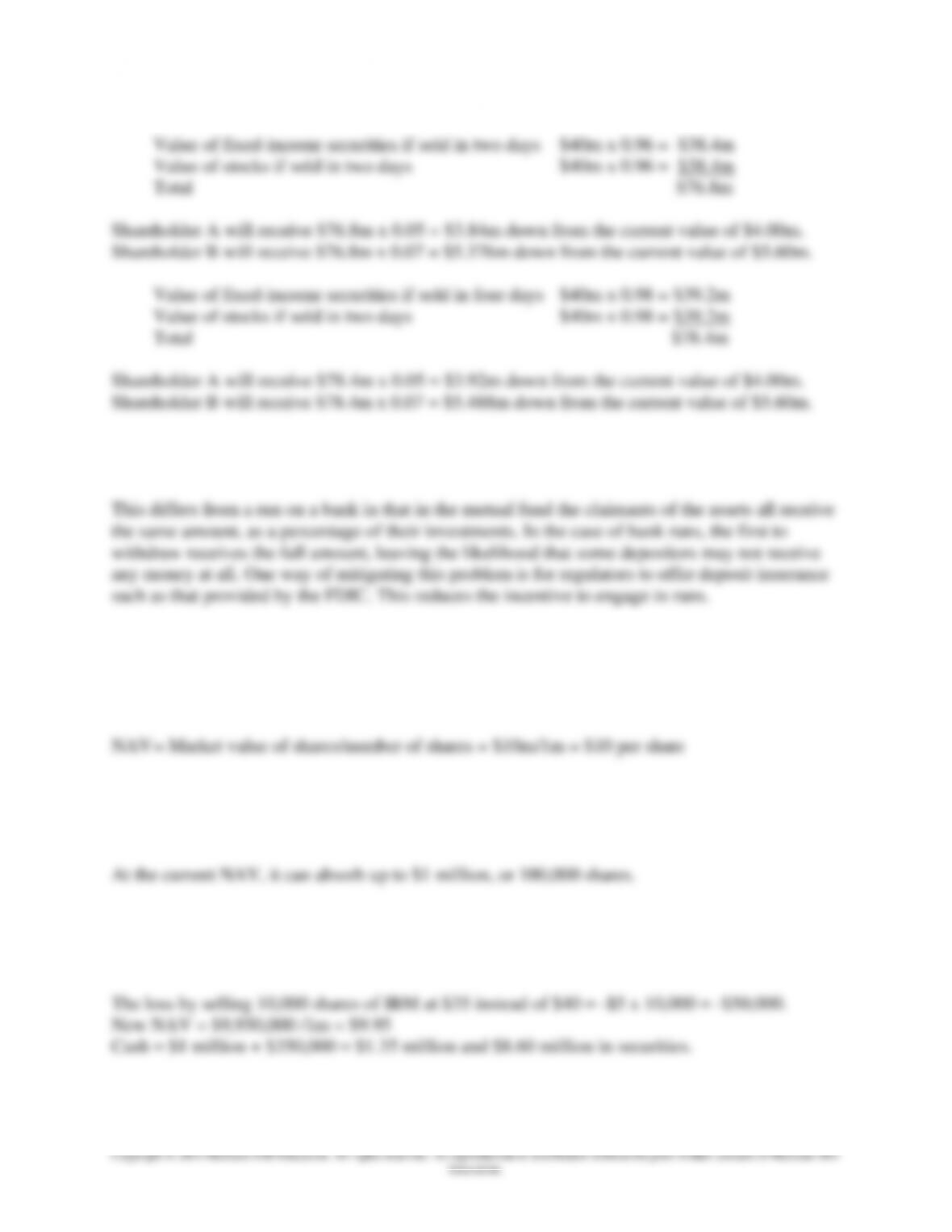
with that of a closed-end fund?
27. A mutual fund has the following assets in its portfolio: $40 million in fixed-income
securities and $40 million in stocks at current market values. In the event of a liquidity
crisis, the fund can sell the assets at a 96 percent of market value if they are disposed of in
two days. The fund will receive 98 percent if the assets are disposed of in four days. Two
shareholders, A and B, own 5 percent and 7 percent of equity (shares), respectively.
a. Market uncertainty has caused shareholders to sell their shares back to the fund. What
will the two shareholders receive if the mutual fund must sell all of the assets in two
days? In four days?
Chapter 12 – Liquidity Risk
12–14
b. How does this situation differ from a bank run? How have bank regulators mitigated
the problem of bank runs?
28. A mutual fund has $1 million in cash and $9 million invested in securities. It currently has 1
million shares outstanding.
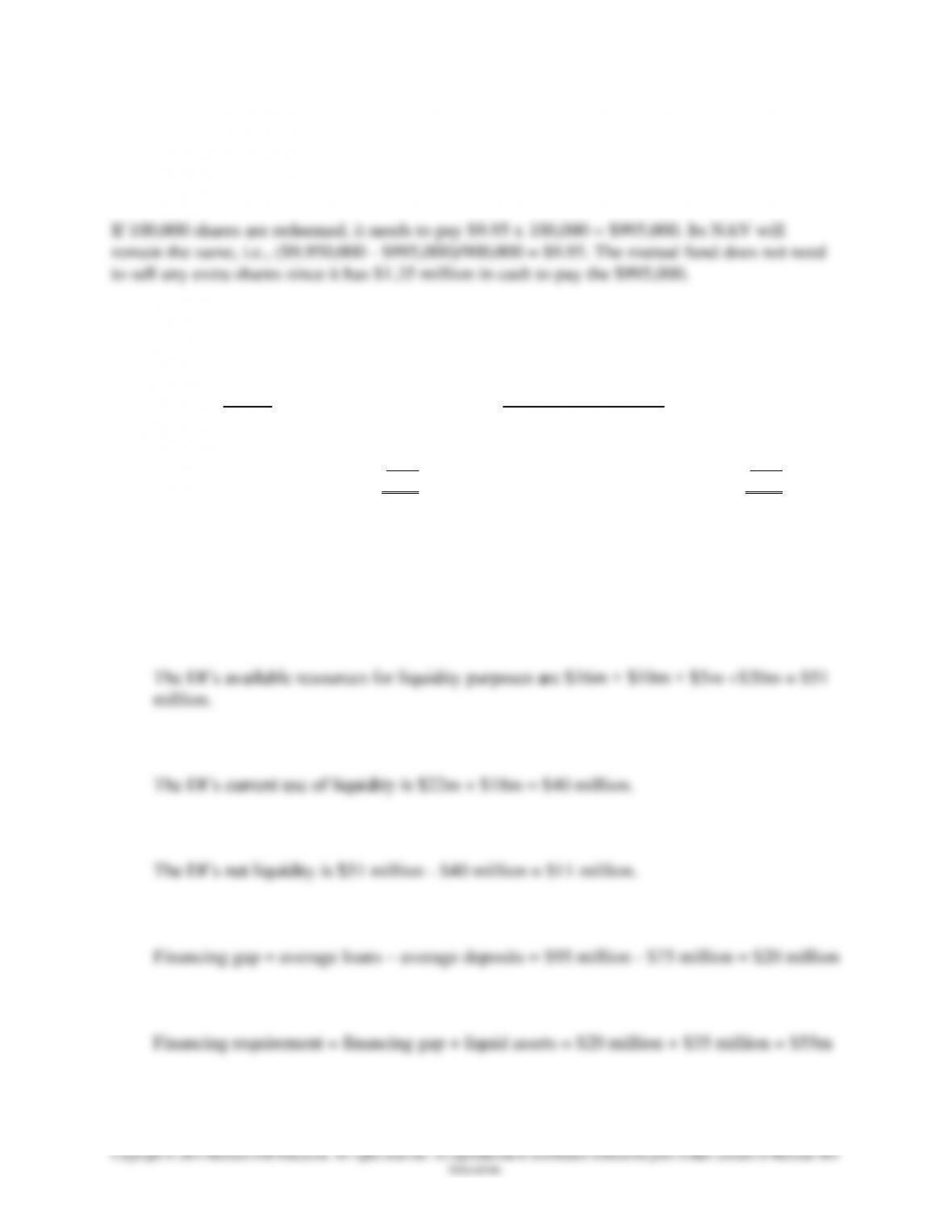
a. What is the net asset value (NAV) of this fund?
b. Assume that some of the shareholders decide to cash in their shares of the fund. How
many shares at its current NAV can the fund take back without resorting to a sale of
assets?
c. As a result of anticipated heavy withdrawals, the fund sells 10,000 shares of IBM stock
currently valued at $40. Unfortunately, it receives only $35 per share. What is the net
asset value after the sale? What are the cash assets of the fund after the sale?
Chapter 12 – Liquidity Risk
12–15
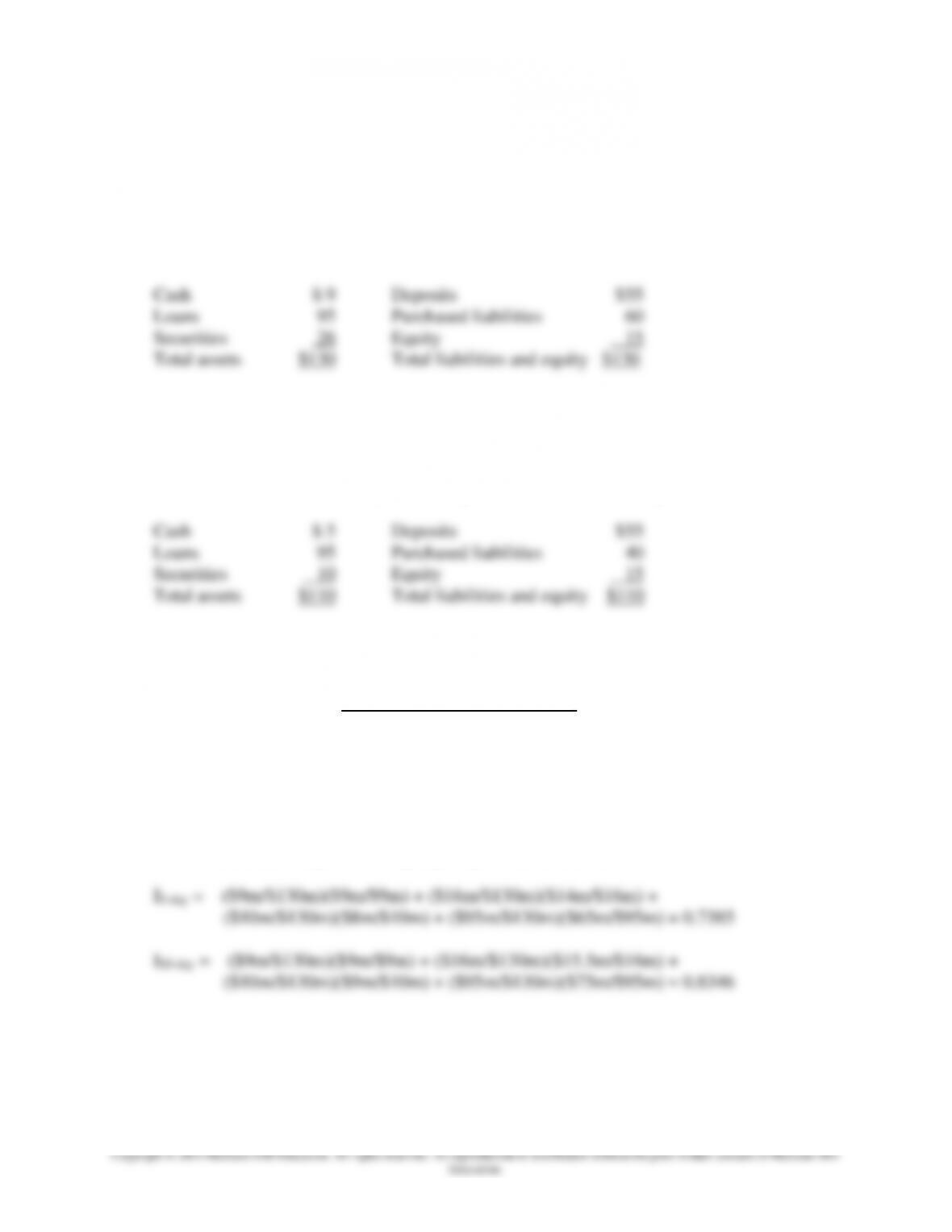
d. Assume that after the sale of IBM shares, 100,000 shares are sold back to the fund.
What is the current NAV? Is there a need to sell more securities to meet this
redemption?
Integrated Mini Case: Measuring Liquidity Risk
A DI has the following balance sheet (in millions).
Assets Liabilities and Equity
Cash $9 Deposits $75
Loans 95 Purchased funds 40
Securities 26 Equity 15
Total assets $130 Total liabilities and equity $130
The DI’s securities portfolio includes $16 million in T-bills and $10 million in GNMA securities.
The DI has a $20 million line of credit to borrow in the repo market and $5 million in excess
cash reserves (above reserve requirements) with the Fed. The DI currently has borrowed $22
million in Fed funds and $18 million from the Fed discount window to meet seasonal demands.
1. What is the DI’s total available (sources of) liquidity?
2. What is the DI’s current total uses of liquidity?
3. What is the net liquidity of the DI?
4. Calculate the financing gap.
5. What is the financing requirement?
Chapter 12 – Liquidity Risk
12–16
6. The DI expects a net deposit drain of $20 million. Show the DI’s balance sheet if the
following conditions occur:
a. The DI purchases liabilities to offset this expected drain.
If the DI purchases liabilities, then the new balance sheet is:
b. The stored liquidity management method is used to meet the expected drain (the DI
does not want the cash balance to fall below $5 million, and securities can be sold at
their fair value).
If the DI uses reserve asset adjustment, a possible balance sheet may be:
7. In the event of an unexpected and severe drain on deposits in the next 3 days, and 10
days, the DI will liquidate assets in the following manner:
Liquidation Values ($ millions)
Asset Fair Value t = 3 days t = 10 days
Cash $ 9 $ 9 $ 9
Treasury bills 16 14 15.5
GNMAs 10 8 9
Loans 95 65 75
Calculate the 3-day and 10-day liquidity index for the DI.