
Chapter 10 – Credit Risk: Individual Loan Risk
10–15
Education.
b. What is the implied probability of default on A-rated bonds over the next 93 days?
Over 175 days?
c. What is the implied default probability on an 82-day A-rated bond to be issued in 93
days?
33. What is the mortality rate of a bond or loan? What are some of the problems with using a
mortality rate approach to determine the probability of default of a given bond issue?
34. The following is a schedule of historical defaults (yearly and cumulative) experienced by
an FI manager on a portfolio of commercial and mortgage loans.
Years after Issuance
Loan Type 1 Year 2 Years 3 Years 4 Years 5 Years
Commercial:
Annual default 0.00% ______ 0.50% ______ 0.30%
Cumulative default ______ 0.10% ______ 0.80% ______
Mortgage:
Annual default 0.10% 0.25% 0.60% ______ 0.80%
Cumulative default ______ ______ ______ 1.64% ______
a. Complete the blank spaces in the table.

Chapter 10 – Credit Risk: Individual Loan Risk
10–16
Education.
b. What are the probabilities that each type of loan will not be in default after 5 years?
c. What is the measured difference between the cumulative default (mortality) rates for
commercial and mortgage loans after four years?
35. The table below shows the dollar amounts of outstanding bonds and corresponding default
amounts for every year over the past five years. Note that the default figures are in
millions, while those outstanding are in billions. The outstanding figures reflect default
amounts and bond redemptions.
Years after Issuance
Loan Type 1 Year 2 Years 3 Years 4 Years 5 Years
A-rated: Annual default (millions) 0 0 0 $ 1 $ 2
Outstanding (billions) $100 $95 $93 $91 $88
B-rated: Annual default (millions) 0 $ 1 $ 2 $ 3 $ 4
Outstanding (billions) $100 $94 $92 $89 $85
Chapter 10 – Credit Risk: Individual Loan Risk
10–17
Education.
C-rated: Annual default (millions) $ 1 $ 3 $ 5 $ 5 $ 6
Outstanding (billions) $100 $97 $90 $85 $79
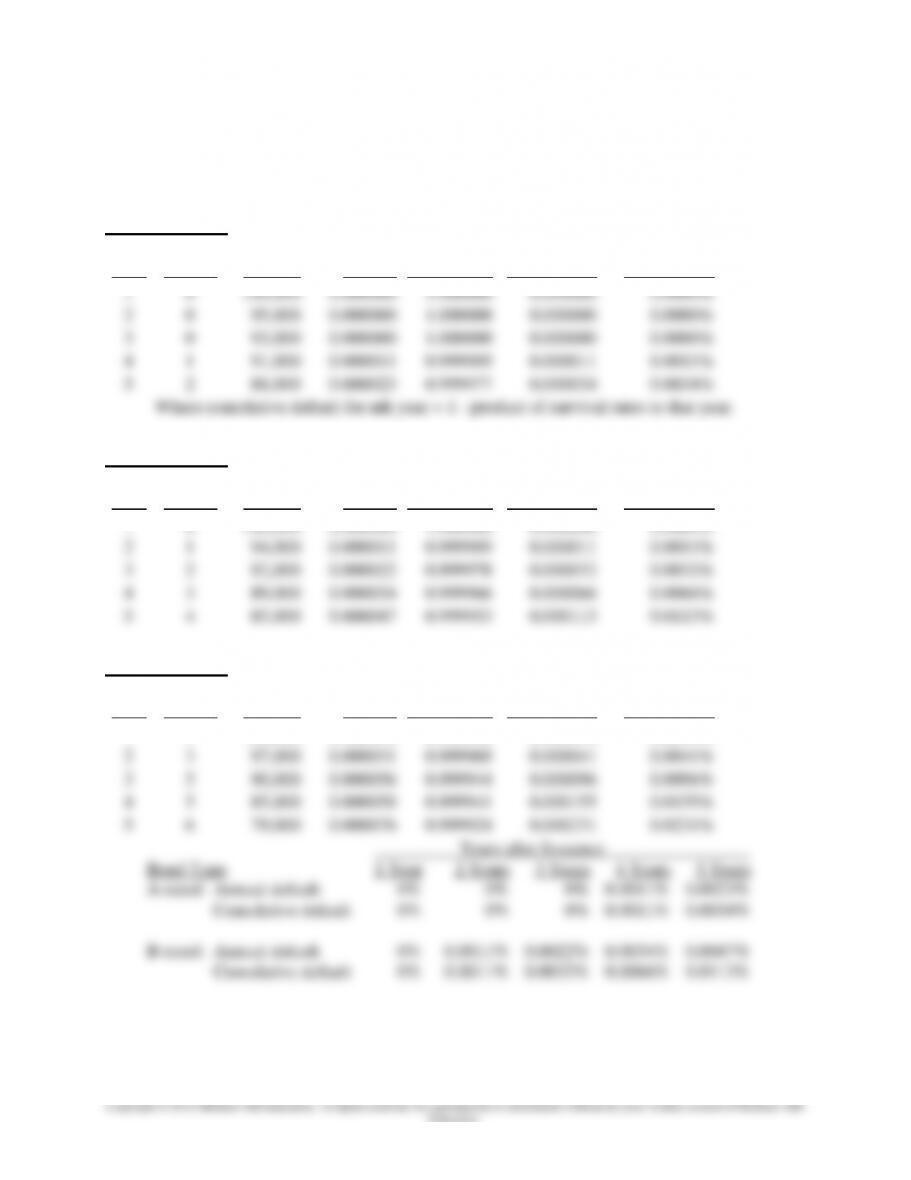
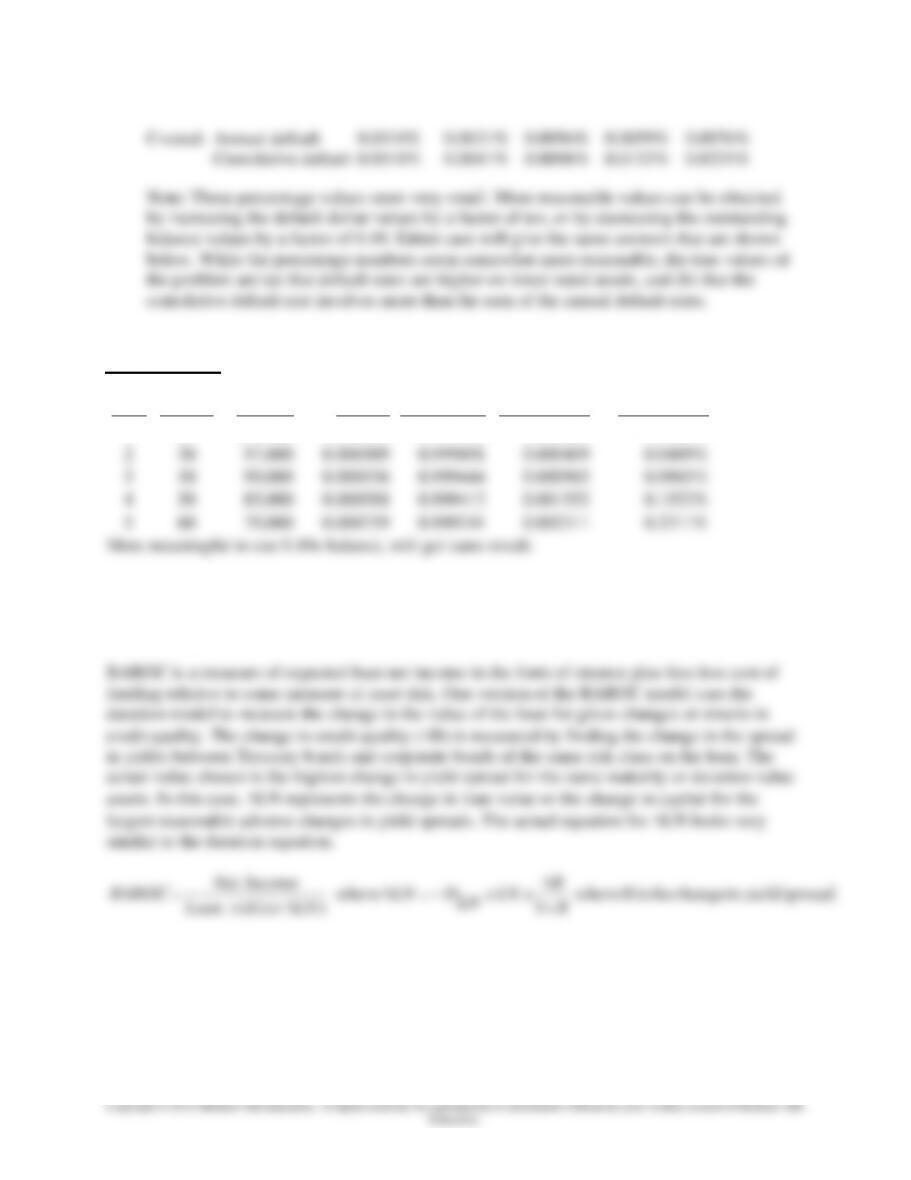
a. What are the annual and cumulative default rates of the above bonds?
A-rated Bonds
Millions
Millions
Annual
Survival =
Cumulative
% Cumulative
Year
Default
Balance
Default
1 – An. Def.
Default Rate
Default Rate
1
0
100,000
0.000000
1.000000
0.000000
0.0000%
2
0
95,000
0.000000
1.000000
0.000000
0.0000%
3
0
93,000
0.000000
1.000000
0.000000
0.0000%
4
1
91,000
0.000011
0.999989
0.000011
0.0011%
5
2
88,000
0.000023
0.999977
0.000034
0.0034%
Where cumulative default for nth year = 1 – product of survival rates to that year.
B-rated Bonds
Millions
Millions
Annual
Survival =
Cumulative
% Cumulative
Year
Default
Balance
Default
1 – An. Def.
Default Rate
Default Rate
1
0
100,000
0.000000
1.000000
0.000000
0.0000%
2
1
94,000
0.000011
0.999989
0.000011
0.0011%
3
2
92,000
0.000022
0.999978
0.000032
0.0032%
4
3
89,000
0.000034
0.999966
0.000066
0.0066%
5
4
85,000
0.000047
0.999953
0.000113
0.0113%
C-rated Bonds
Millions
Millions
Annual
Survival =
Cumulative
% Cumulative
Year
Default
Balance
Default
1 – An. Def.
Default Rate
Default Rate
1
1
100,000
0.000010
0.999990
0.000010
0.0010%
2
3
97,000
0.000031
0.999969
0.000041
0.0041%
3
5
90,000
0.000056
0.999944
0.000096
0.0096%
4
5
85,000
0.000059
0.999941
0.000155
0.0155%
5
6
79,000
0.000076
0.999924
0.000231
0.0231%
Chapter 10 – Credit Risk: Individual Loan Risk
10–18
Copyright © 2014 McGraw-Hill Education. All rights reserved. No reproduction or distribution without the prior written consent of McGraw-Hill
Education.
C-rated: Annual default 0.0010% 0.0031% 0.0056% 0.0059% 0.0076%
Cumulative default 0.0010% 0.0041% 0.0096% 0.0155% 0.0231%
Note: These percentage values seem very small. More reasonable values can be obtained
by increasing the default dollar values by a factor of ten, or by decreasing the outstanding
balance values by a factor of 0.10. Either case will give the same answers that are shown
below. While the percentage numbers seem somewhat more reasonable, the true values of
the problem are (a) that default rates are higher on lower rated assets, and (b) that the
cumulative default rate involves more than the sum of the annual default rates.
C-rated Bonds
Test with 10x default.
Millions
Millions
Annual
Survival =
Cumulative
% Cumulative
Year
Default
Balance
Default
1 – An. Def.
Default Rate
Default Rate
1
10
100,000
0.000100
0.999900
0.000100
0.0100%
2
30
97,000
0.000309
0.999691
0.000409
0.0409%
3
50
90,000
0.000556
0.999444
0.000965
0.0965%
4
50
85,000
0.000588
0.999412
0.001552
0.1552%
5
60
79,000
0.000759
0.999241
0.002311
0.2311%
More meaningful to use 0.10x balance, will get same result.
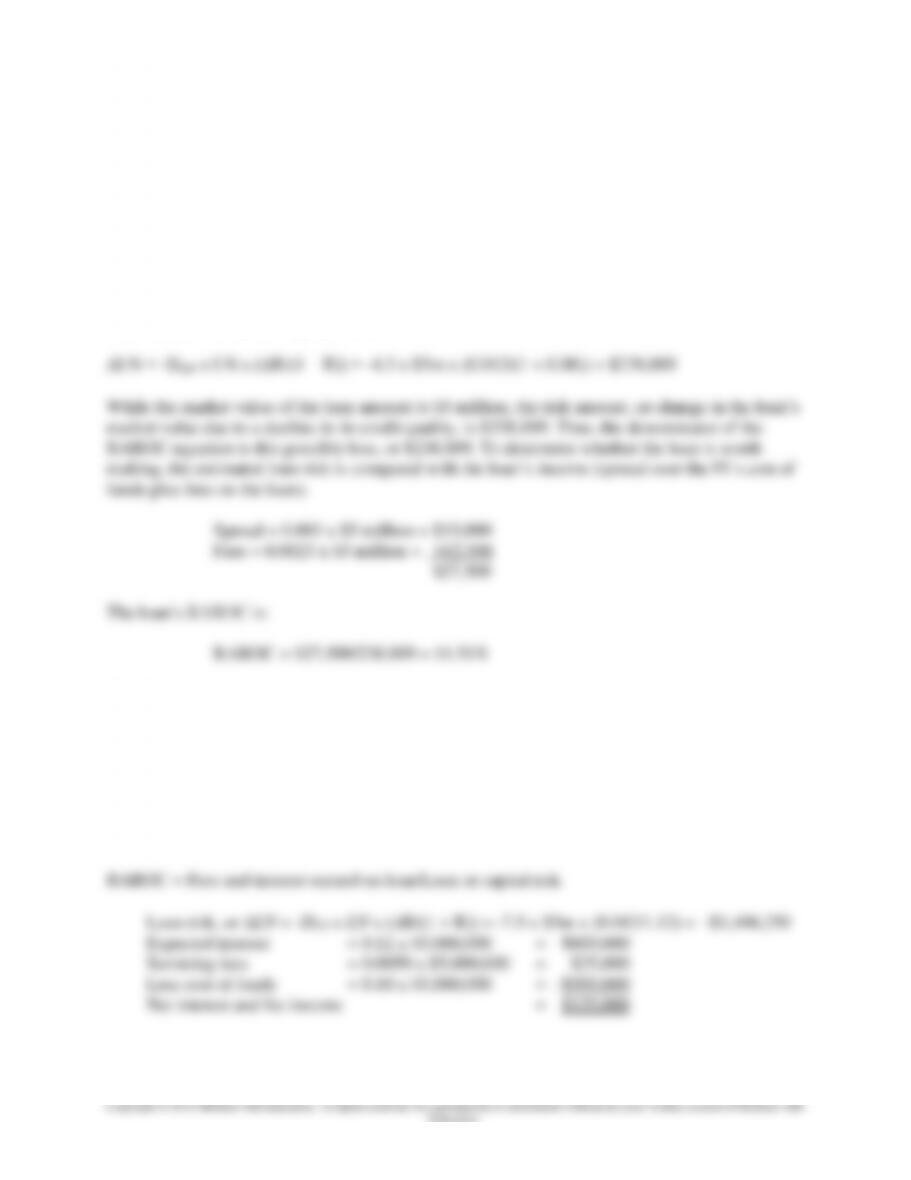
36. What is RAROC? How does this model use the concept of duration to measure the risk
exposure of a loan? How is the expected change in the credit risk premium measured?
What precisely is LN in the RAROC equation?
Chapter 10 – Credit Risk: Individual Loan Risk
10–19
Education.
37. An FI wants to evaluate the credit risk of a $5 million loan with a duration of 4.3 years to a
AAA borrower. There are currently 500 publicly traded bonds in that class (i.e., bonds
issued by firms with a AAA rating). The current average level of rates (R) on AAA bonds
is 8 percent. The largest increase in credit risk premiums on AAA loans, the 99 percent
worst-case scenario, over the last year was equal to 1.2 percent (i.e., only 6 bonds out of
500 had risk premium increases exceeding the 99 percent worst case). The projected (one-
year) spread on the loan is 0.3 percent and the FI charges 0.25 percent of the face value of
the loan in fees. Calculate the capital at risk and the RAROC on this loan.
The estimate of loan (or capital) risk is:
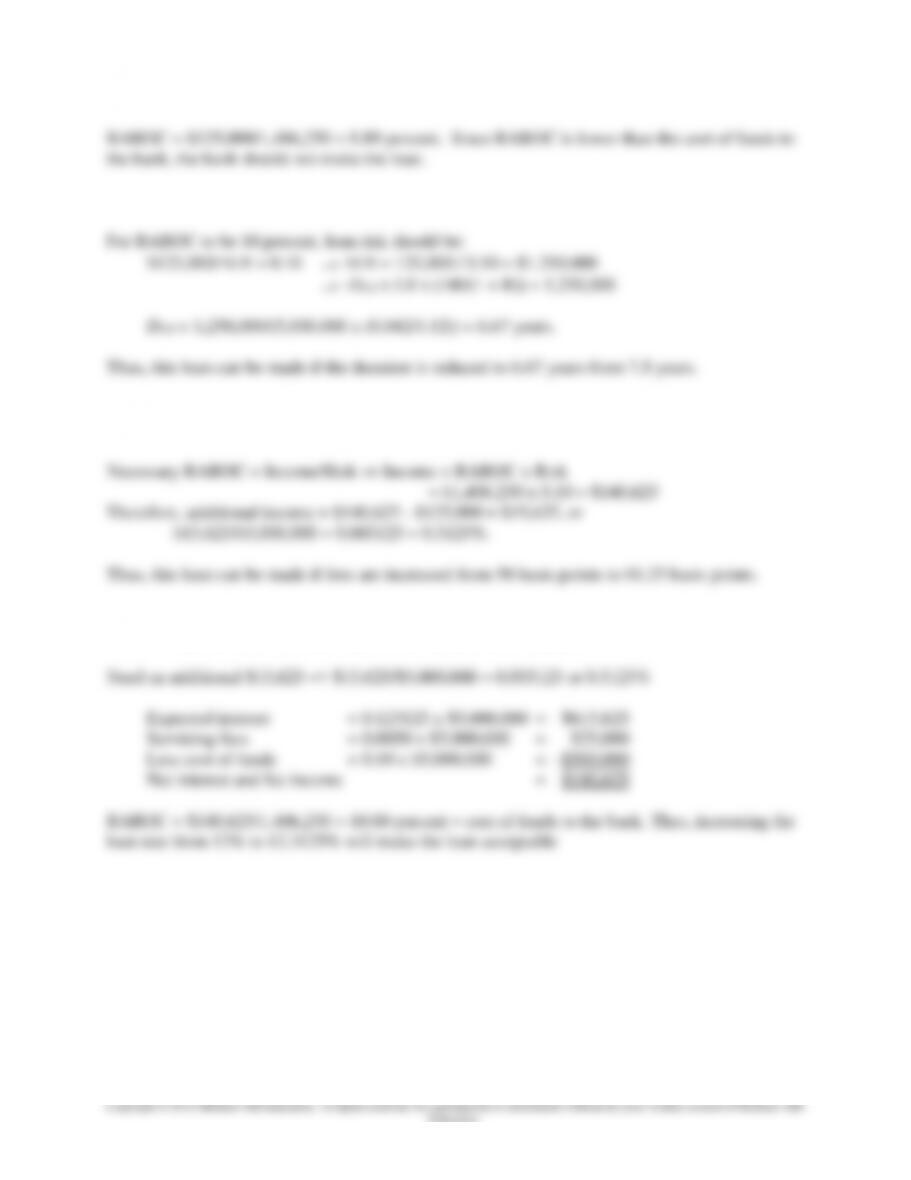
38. A bank is planning to make a loan of $5,000,000 to a firm in the steel industry. It expects to
charge a servicing fee of 50 basis points. The loan has a maturity of 8 years with a duration
of 7.5 years. The cost of funds (the RAROC benchmark) for the bank is 10 percent. The
bank has estimated the maximum change in the risk premium on the steel manufacturing
sector to be approximately 4.2 percent, based on two years of historical data. The current
market interest rate for loans in this sector is 12 percent.
a. Using the RAROC model, determine whether the bank should make the loan?
Chapter 10 – Credit Risk: Individual Loan Risk
10–20
Education.
b. What should be the duration in order for this loan to be approved?
c. Assuming that duration cannot be changed, how much additional interest and fee
income will be necessary to make the loan acceptable?
d. Given the proposed income stream and the negotiated duration, what adjustment in the
loan rate would be necessary to make the loan acceptable?
39. Calculate the value of and interest rate on a loan using the option model and the following
information.
Face value of loan (B) = $500,000
Length of time remaining to loan maturity (τ) = 4 years
Risk-free rate (i) = 4%
Borrower’s leverage ratio (d) = 60%
Standard deviation of the rate of change in the value of the underlying assets = 15%
Chapter 10 – Credit Risk: Individual Loan Risk
10–21
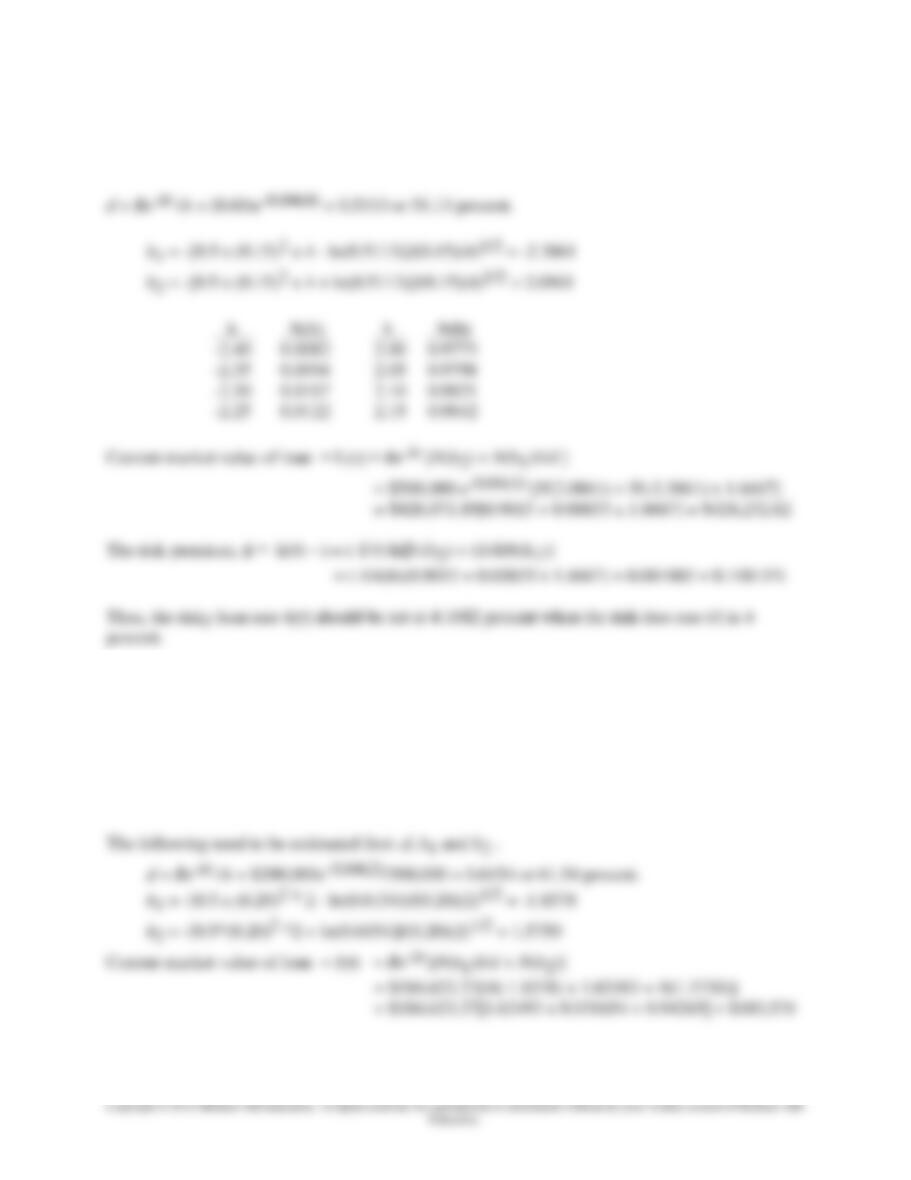
Substituting these values into the equations for h1 and h2 and solving for the areas under the
standardized normal distribution, we find that:
40. A firm is issuing a two-year loan in the amount of $200,000. The current market value of
the borrower’s assets is $300,000. The risk-free rate is 4 percent and the standard deviation
of the rate of change in the underlying assets of the borrower is 20 percent. Using an
options framework, determine the following:
a. The current market value of the loan.
b. The risk premium to be charged on the loan.

Chapter 10 – Credit Risk: Individual Loan Risk
10–22
Copyright © 2014 McGraw-Hill Education. All rights reserved. No reproduction or distribution without the prior written consent of McGraw-Hill
Education.
The risk premium, ϕ = k(τ) – i = (-1/τ) ln[N(h2) + (1/d)N(h1)]
= (-½)ln[0.94265 + 1.62493 x 0.031654] = 0.002966 = 0.2966%
41. A firm has assets of $200,000 and total debts of $175,000. With an option pricing model,
the implied volatility of the value of the firm’s assets is estimated at $10,730. Under the
Moody’s Analytics method, what is the expected default frequency (assuming a normal
distribution for assets)?
42. Carman County Bank (CCB) has a $5 million face value outstanding adjustable-rate loan to
a company that has a leverage ratio of 80 percent. The current risk-free rate is 6 percent and
the time to maturity on the loan is exactly ½ year. The asset risk of the borrower, as
measured by the standard deviation of the rate of change in the value of the underlying
assets, is 12 percent. The normal density function values are given below.
h N(h) h N(h)
-2.55 0.0054 2.50 0.9938
-2.60 0.0047 2.55 0.9946
-2.65 0.0040 2.60 0.9953
-2.70 0.0035 2.65 0.9960
-2.75 0.0030 2.70 0.9965
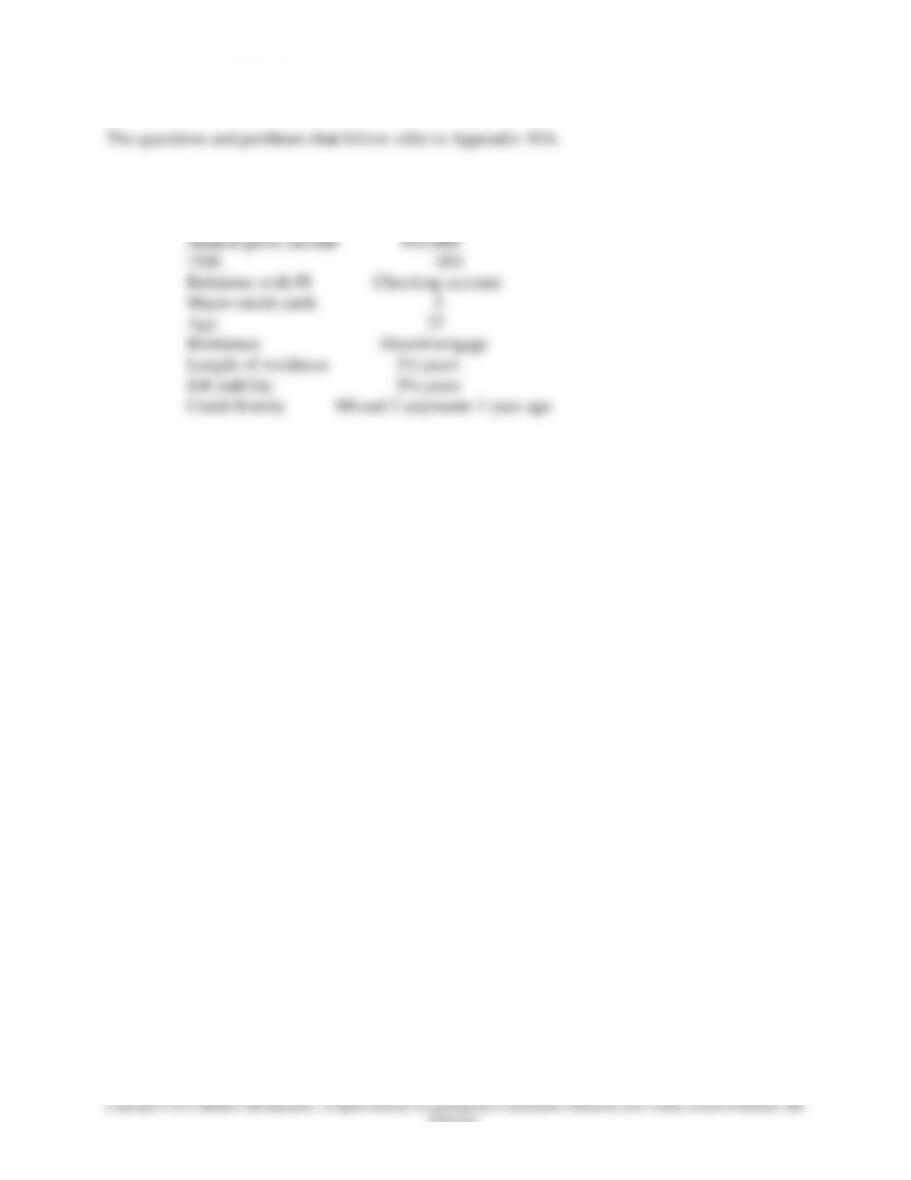
a. Use the Merton option valuation model to determine the market value of the loan.
b. What should be the interest rate for the last six months of the loan?
Chapter 10 – Credit Risk: Individual Loan Risk
10–23
Education.
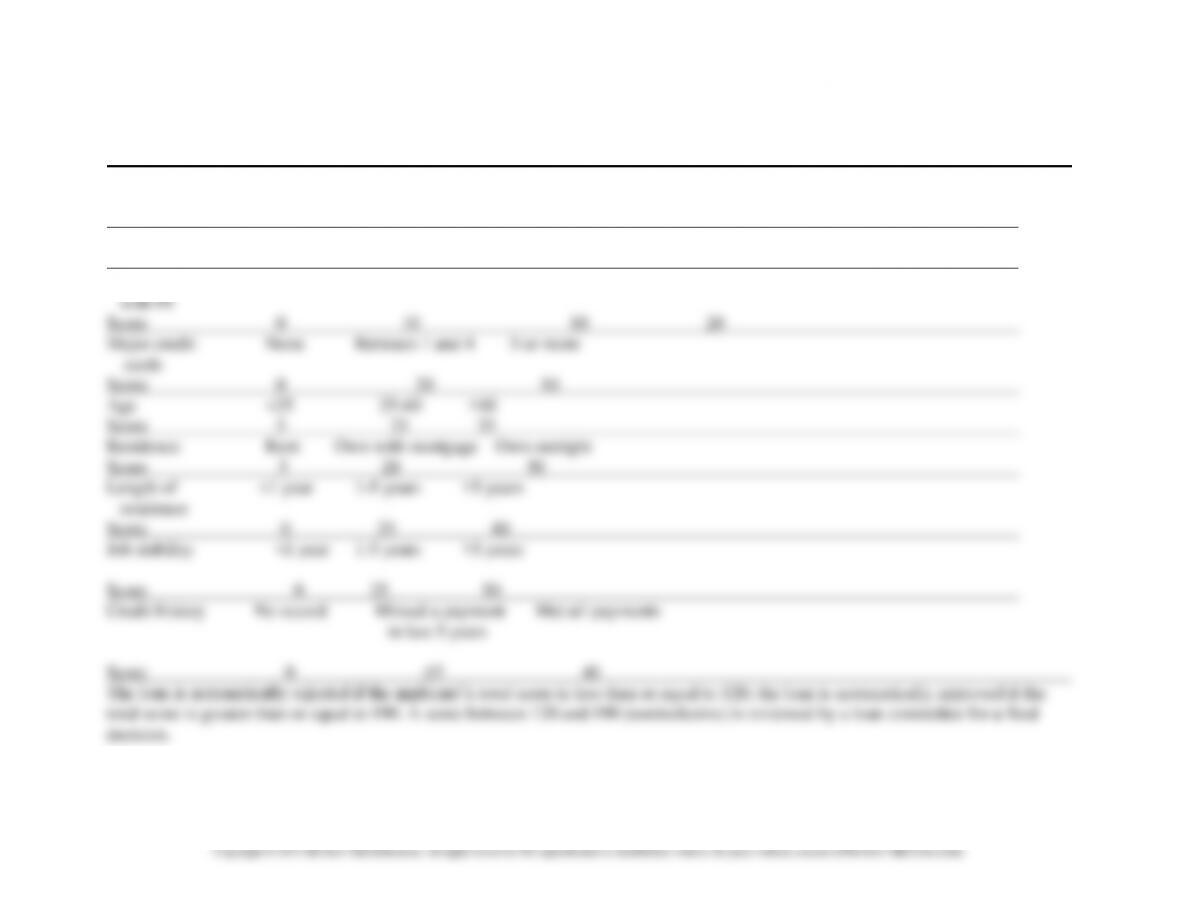
43. Suppose you are a loan officer at Carbondale Local Bank. Joan Doe listed the following
information on her mortgage application.
Characteristic Value
Chapter 10 – Credit Risk: Individual Loan Risk
10–24
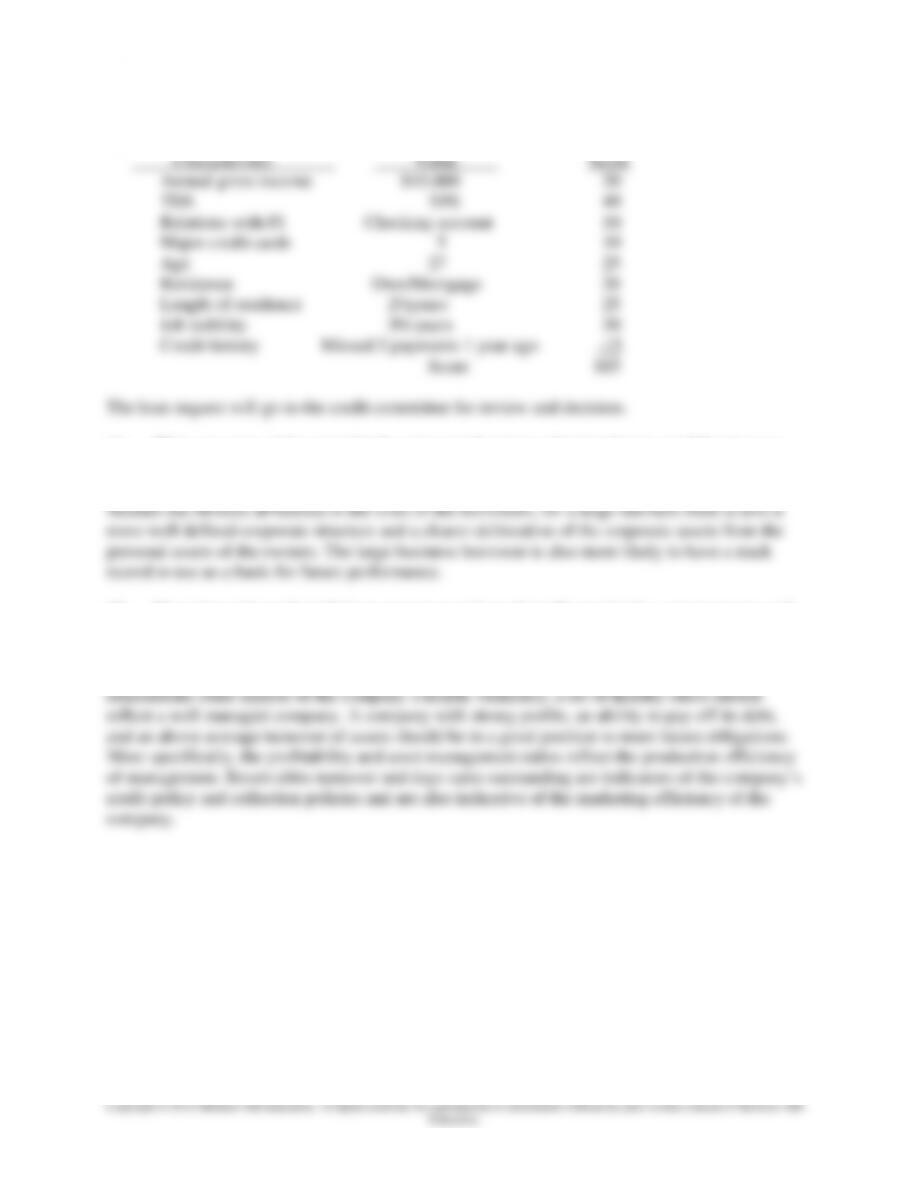
Use the information below to determine whether or not Joan Doe should be approved for a mortgage from your bank.
Characteristic Characteristic Values and Weights
Annual gross <$10,000 $10,000-$25,000 $25,000-$50,000 $50,000-$100,000 >$100,000
income
Score 0 10 20 35 60
TDS >50% 35%-50% 15%-35% 5%-15% <5%
Score -10 0 20 40 60
Relations None Checking account Savings account Both
Chapter 10 – Credit Risk: Individual Loan Risk
10–25
Jane Doe=s credit score is calculated as follows:
44. What are some of the special risks and considerations when lending to small businesses
rather than large businesses?
45. How does ratio analysis help to answer questions about the production, management, and
marketing capabilities of a prospective borrower?
Although financial ratios are normally thought to represent financial health, they also

Chapter 10 – Credit Risk: Individual Loan Risk
10–26
Education.
46. Consider the following company balance sheet and income statement.
Balance Sheet:
Assets Liabilities and Equity
Cash $4,000 Accounts payable $30,000
Accounts receivable 52,000 Notes payable 12,000
Inventory 40,000 Total current liabilities 42,000
Total current assets 96,000 Long-term debt 36,000
Fixed assets 44,000 Equity 62,000
Total assets $140,000 Total liabilities and equity $140,000
Income Statement
Sales (all on credit) $200,000
Cost of goods sold 130,000
Gross margin 70,000
Selling and administrative expenses 20,000
Depreciation 8,000
EBIT 42,000
Interest expense 4,800
Earning before tax 37,200
Taxes 11,160
Net income $26,040
For this company, calculate the following:
a. Current ratio.
96,000/42,000 = 2.2857X
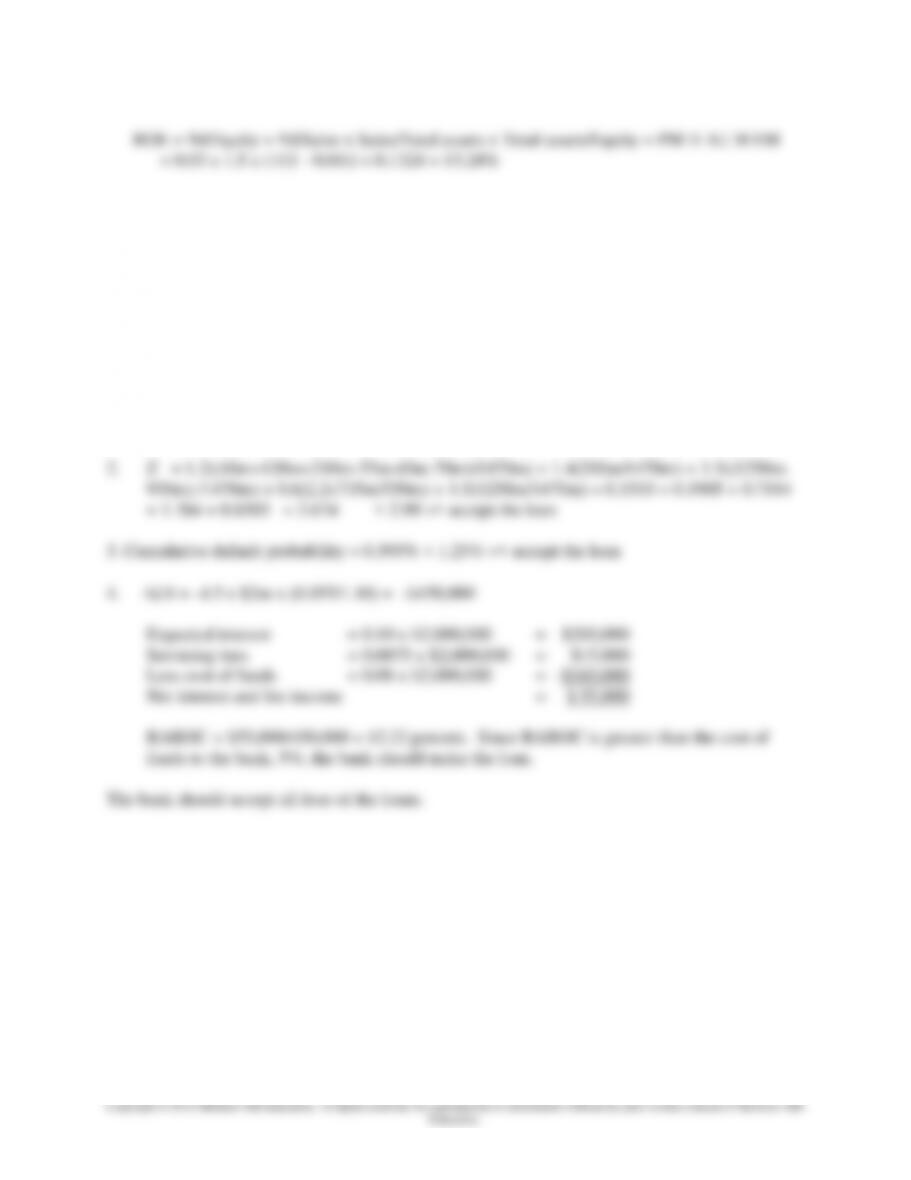
47. Industrial Corporation has an income-to-sales (profit margin) ratio of 0.03, a sales to assets
(asset utilization) ratio of 1.5, and a debt to asset ratio of 0.66. What is Industrial’s return
on equity?
Chapter 10 – Credit Risk: Individual Loan Risk
10–27
Copyright © 2014 McGraw-Hill Education. All rights reserved. No reproduction or distribution without the prior written consent of McGraw-Hill
Education.
ROE = NI/Equity = NI/Sales x Sales/Total assets x Total assets/Equity = PM AU EM
= 0.03 x 1.5 x (1/(1 – 0.66)) = 0.1324 = 13.24%
Answer to Integrated Mini Case: Loan Analysis
Loan:
1. PD = -0.08(2.15) + 0.15(0.45) + 1.25(0.13) – 0.45(0.12) = 0.004 = 0.4% < 0.5% => accept the loan