Chapter 10 – Credit Risk: Individual Loan Risk
10-1
Solutions for End-of-Chapter Questions and Problems: Chapter Ten
1. Why is credit risk analysis an important component of FI risk management? What recent
activities by FIs have made the task of credit risk assessment more difficult for both FI
managers and regulators?
2. Differentiate between a secured and an unsecured loan. Who bears most of the risk in a
fixed-rate loan? Why would FI managers prefer to charge floating rates, especially for
longer-maturity loans?
3. How does a spot loan differ from a loan commitment? What are the advantages and
disadvantages of borrowing through a loan commitment?
Chapter 10 – Credit Risk: Individual Loan Risk
10-2
4. Why is commercial lending declining in importance in the U.S.? What effect does this
decline have on overall commercial lending activities?
Commercial bank lending has been declining in importance because of disintermediation, a
5. What are the primary characteristics of residential mortgage loans? Why does the ratio of
adjustable-rate mortgages to fixed-rate mortgages in the economy vary over an interest rate
cycle? When would the ratio be highest?
6. What are the two major classes of consumer loans at U.S. banks? How do revolving loans
differ from nonrevolving loans?
Consumer loans can be classified as either nonrevolving or revolving loans. Automobile loans
10-3
Copyright © 2014 McGraw-Hill Education. All rights reserved. No reproduction or distribution without the prior written consent of McGraw-Hill
Education.
7. Why are rates on credit card loans generally higher than rates on car loans?
Car loans are backed by collateral (the car), while credit card loans are not. Thus, in the event of
8. What are compensating balances? What is the relationship between the amount of
compensating balance requirement and the return on the loan to the FI?
9. Suppose that a bank does the following:
1. Sets a loan rate on a prospective loan at 8 percent (where BR = 5% and ϕ = 3%).
2. Charges a 1/10 percent (or 0.10 percent) loan origination fee to the borrower.
3. Imposes a 5 percent compensating balance requirement to be held as noninterest-bearing
demand deposits.
4. Pays reserve requirements of 10 percent imposed by the Federal Reserve on the bank’s
1 + k = 1 + 0.0010 + (0.05 + 0.03) = 1 + 0.081 = 1.0848 or k = 8.48%
1 – [(0.05)(0.9)] 0.955
10. County Bank offers one-year loans with a stated rate of 9 percent, but requires a
compensating balance of 10 percent. What is the true cost of this loan to the borrower?
10.59 percent and 11.25 percent, respectively. Note that as the compensating balance rate
increases by a constant amount, the true cost of the loan increases at an increasing rate.
10-4
Copyright © 2014 McGraw-Hill Education. All rights reserved. No reproduction or distribution without the prior written consent of McGraw-Hill
Education.
11. Metrobank offers one-year loans with a 9 percent stated or base rate, charges a 0.25 percent
loan origination fee, imposes a 10 percent compensating balance requirement, and must
hold a 6 percent reserve requirement at the Federal Reserve. The loans typically are repaid
at maturity.
a. If the risk premium for a given customer is 2.5 percent, what is the simple promised
interest return on the loan?
b. What is the contractually promised gross return on the loan per dollar lent?
906.0
)]06.01(1.0[1
)]RR1(b[1
−−
−−
c. Which of the fee items has the greatest impact on the gross return?
12. Why are most retail borrowers charged the same rate of interest, implying the same risk
premium or class? What is credit rationing? How is it used to control credit risks with
respect to retail and wholesale loans?
Chapter 10 – Credit Risk: Individual Loan Risk
10-5
Education.
13. Why could a lender’s expected return be lower when the risk premium is increased on a
loan? In addition to the risk premium, how can a lender increase the expected return on a
wholesale loan? A retail loan?
14. What are covenants in a loan agreement? What are the objectives of covenants? How can
these covenants be negative? Positive?
15. Identify and define the borrower-specific and market-specific factors that enter into the
credit decision. What is the impact of each type of factor on the risk premium?
The borrower-specific factors are:
a. Which of these factors is more likely to adversely affect small businesses rather than
large businesses in the credit assessment process by lenders?
Chapter 10 – Credit Risk: Individual Loan Risk
10-6
Education.
b. How does the existence of a high debt ratio typically affect the risk of the borrower?
c. Why is the volatility of the earnings stream of a borrower important to a lender?
16. Why is the degree of collateral as specified in the loan agreement of importance to a
lender? If the book value of the collateral is greater than or equal to the amount of the loan,
is the credit risk of a lender fully covered? Why, or why not?
17. Why are FIs consistently interested in the expected level of economic activity in the
markets in which they operate? Why is monetary policy of the Federal Reserve System
important to FIs?
18. What are the purposes of credit scoring models? How do these models assist an FI manager
to better administer credit?
Chapter 10 – Credit Risk: Individual Loan Risk
10-7
Copyright © 2014 McGraw-Hill Education. All rights reserved. No reproduction or distribution without the prior written consent of McGraw-Hill
Education.
The models use data on observed economic and financial borrower characteristics to assist an FI
manager in (a) identifying factors of importance in explaining default risk, (b) evaluating the
relative degree of importance of these factors, (c) improving the pricing of default risk, (d)
screening bad loan applicants, and (e) more efficiently calculating the necessary reserves to
protect against future loan losses.
19. Suppose there were two factors influencing the past default behavior of borrowers: the
leverage or debt–assets ratio (D/A) and the profit margin ratio (PM). Based on past default
(repayment) experience, the linear probability model is estimated as:
20. Suppose the estimated linear probability model used by an FI to predict business loan
applicant default probabilities is PD = 0.03X1 + 0.02X2 – 0.05X3 + error, where X1 is the
borrower’s debt/equity ratio, X2 is the volatility of borrower earnings, and X3 = 0.10 is the
borrower’s profit ratio. For a particular loan applicant, X1 = 0.75, X2 = 0.25, and X3 = 0.10.
a. What is the projected probability of default for the borrower?
b. What is the projected probability of repayment if the debt/equity ratio is 2.5?
c. What is a major weakness of the linear probability model?
Chapter 10 – Credit Risk: Individual Loan Risk
10-8
21. Describe how a linear discriminant analysis model works. Identify and discuss the
criticisms which have been made regarding the use of this type of model to make credit risk
evaluations.
22. Suppose that the financial ratios of a potential borrowing firm take the following values:
Working capital/total assets ratio (X1) = 0.75
Retained earnings/total assets ratio (X2) = 0.10
Earnings before interest and taxes/total assets ratio (X3) = 0.05
Market value of equity/book value of long-term debt ratio (X4) = 0.10
Sales/total assets ratio (X5) = 0.65
Calculate the Altman’s Z-score for the borrower in question. How is this number a sign of
the borrower’s default risk?

Chapter 10 – Credit Risk: Individual Loan Risk
10-9
Education.
23. MNO Inc., a publicly traded manufacturing firm in the United States, has provided the
following financial information in its application for a loan. All numbers are in thousands
of dollars.
Assets Liabilities and Equity
Cash $ 20 Accounts payable $ 30
Accounts receivables 90 Notes payable 90
Inventory 90 Accruals 30
Long-term debt 150
Plant and equipment 500 Equity (ret. earnings = $22) 400
Total assets $700 Total liabilities and equity $700
Also assume sales = $500,000 ; cost of goods sold = $360,000; and the market value of
equity is equal to the book value.
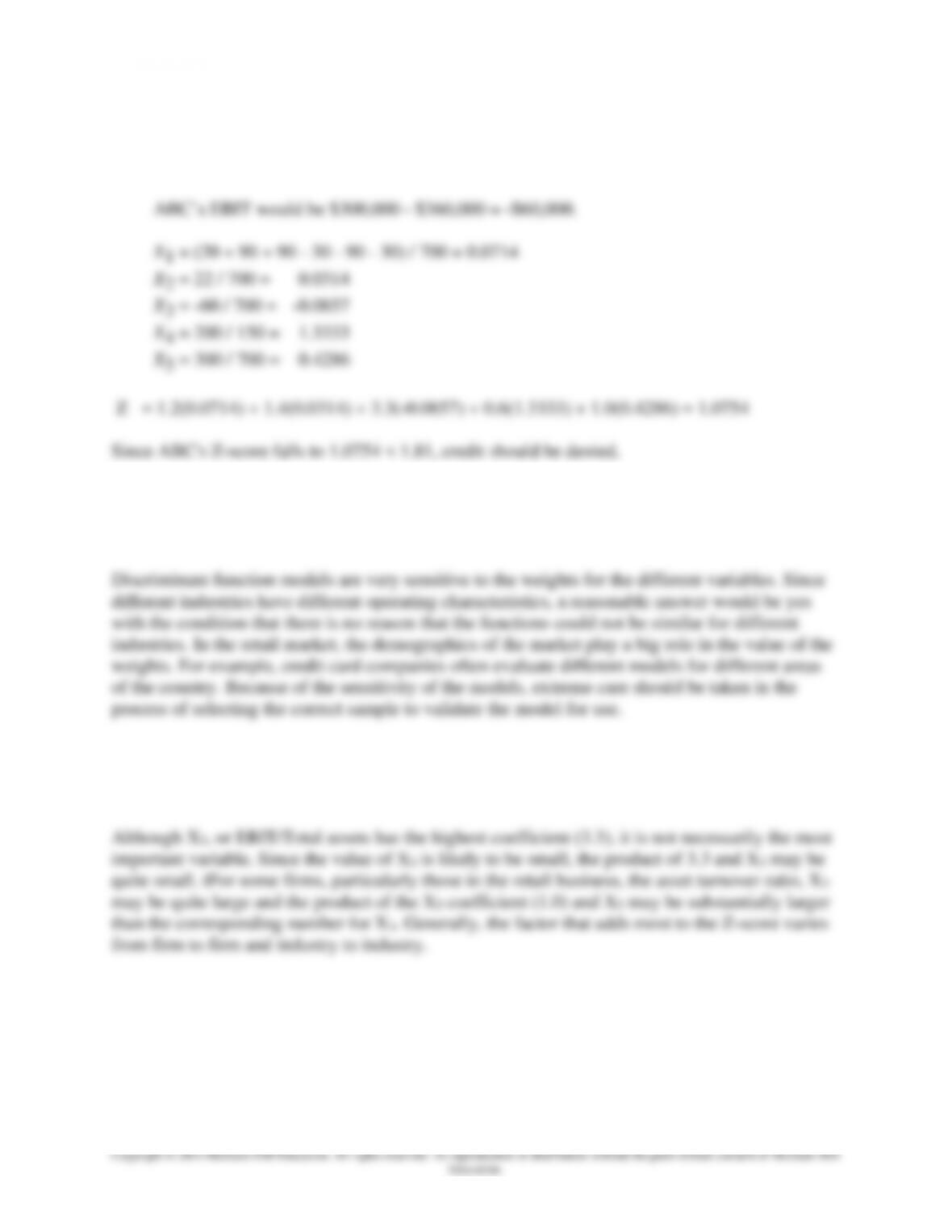
a. What is the Altman discriminant function value for MNO Inc.? Recall that:
b. Based on the Altman’s Z-score only, should you approve MNO Inc.’s application to
your bank for a $500,000 capital expansion loan?
Chapter 10 – Credit Risk: Individual Loan Risk
10–10
c. If sales for MNO were $300,000, the market value of equity was only half of book
value, and all other values are unchanged, would your credit decision change?
d. Would the discriminant function change for firms in different industries? Would the
function be different for manufacturing firms in different geographic sections of the
country? What are the implications for the use of these types of models by FIs?
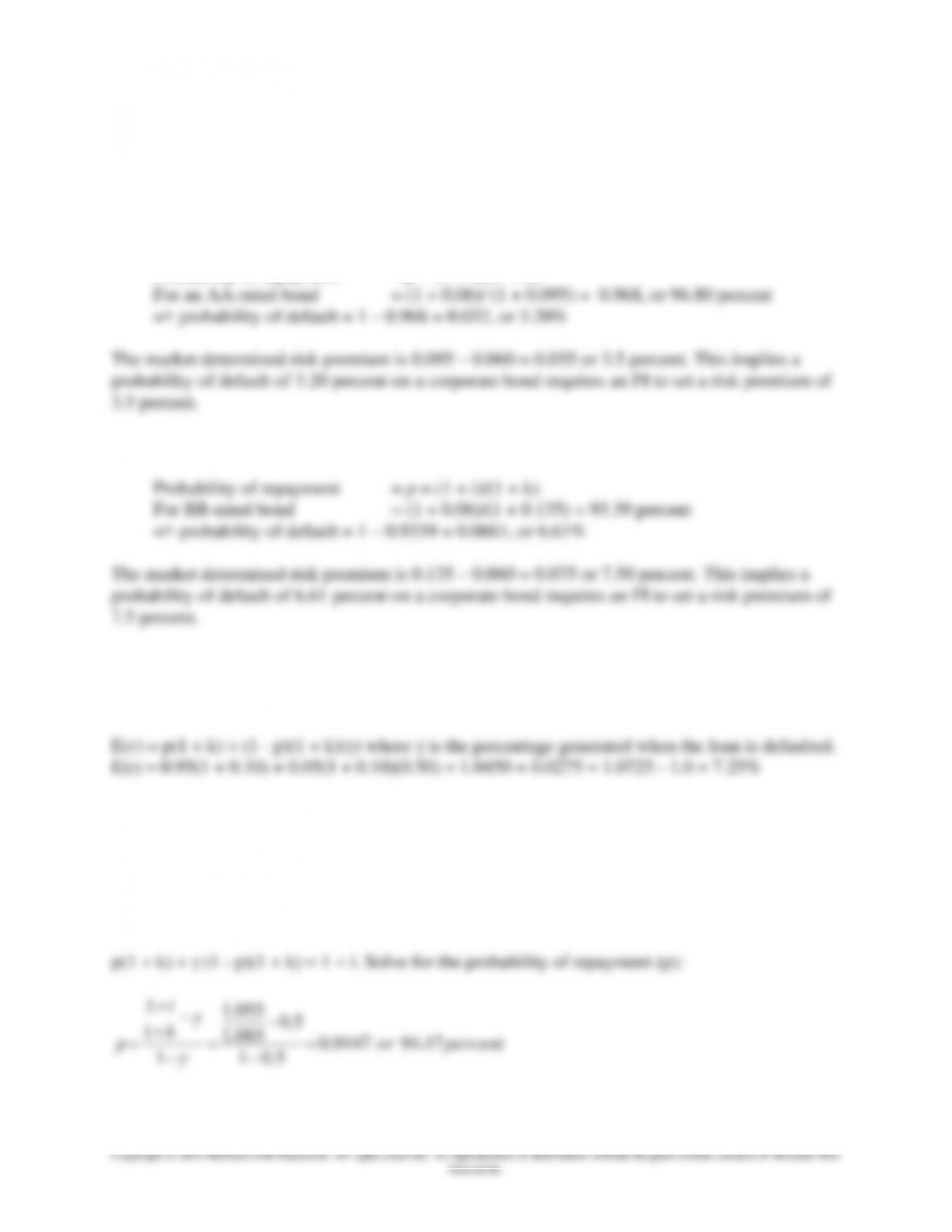
24. Consider the coefficients of Altman’s Z-score. Can you tell by the size of the coefficients
which ratio appears most important in assessing the creditworthiness of a loan applicant?
Explain.
Chapter 10 – Credit Risk: Individual Loan Risk
10–11
25. If the rate on one-year Treasury strips currently is 6 percent, what is the repayment
probability for each of the following two securities? Assume that if the loan is defaulted, no
payments are expected. What is the market-determined risk premium for the corresponding
probability of default for each security?
a. One-year AA-rated zero coupon bond yielding 9.5 percent.
Probability of repayment = p = (1 + i)/(1 + k)
b. One-year BB-rated zero coupon bond yielding 13.5 percent.
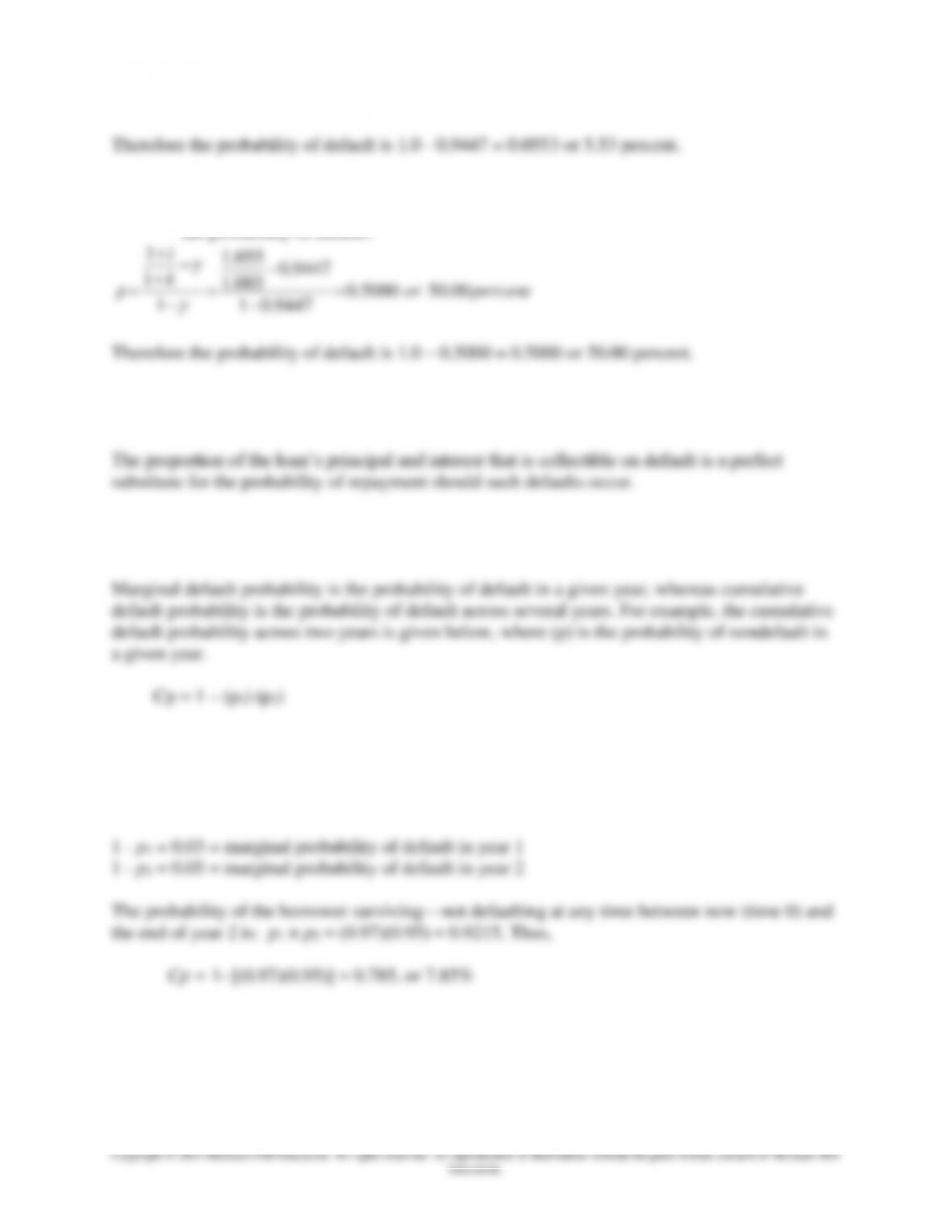
26. A bank has made a loan charging a base lending rate of 10 percent. It expects a probability
of default of 5 percent. If the loan is defaulted, the bank expects to recover 50 percent of its
money through the sale of its collateral. What is the expected return on this loan?
27. Assume a one-year Treasury strip is currently yielding 5.5 percent and an AAA-rated
discount bond with similar maturity is yielding 8.5 percent.
a. If the expected recovery from collateral in the event of default is 50 percent of principal
and interest, what is the probability of repayment of the AAA-rated bond? What is the
probability of default?
5.01
1
−
−
Chapter 10 – Credit Risk: Individual Loan Risk
10–12
Copyright © 2014 McGraw-Hill Education. All rights reserved. No reproduction or distribution without the prior written consent of McGraw-Hill
Education.
Therefore the probability of default is 1.0 – 0.9447 = 0.0553 or 5.53 percent.
b. What is the probability of repayment of the AAA-rated bond if the expected recovery
from collateral in the case of default is 94.47 percent of principal and interest? What is
the probability of default?
percentor
k
i
p00.50 5000.0
9447.01
9447.0
085.1
055.1
1
1
1
=
−
−
=
−
−
+
+
=
Therefore the probability of default is 1.0 – 0.5000 = 0.5000 or 50.00 percent.
c. What is the relationship between the probability of default and the proportion of
principal and interest that may be recovered in the case of default on the loan?
28. What is meant by the phrase marginal default probability? How does this term differ from
cumulative default probability? How are the two terms related?
29. Suppose an FI manager wants to find the probability of default on a two-year loan. For the
one-year loan, 1 – p1 = 0.03 is the marginal and total or cumulative probability (Cp) of
default in year 1. For the second year, suppose that 1 – p2 = 0.05. Calculate the cumulative
probability of default over the next two years.

Chapter 10 – Credit Risk: Individual Loan Risk
10–13
Education.
30. From the Treasury strip yield curve, the current required yields on one- and two-year
Treasuries are i1 = 4.65 percent and i2 = 5.50 percent, respectively. Further, the current
yield curve indicates that appropriate one-year discount bonds are yielding k1 = 8.5 percent,
and two-year bonds are yielding k2 = 10.25 percent.
a. Calculate the one-year forward rate on the Treasuries and the corporate bond.
b. Using the current and forward one-year rates, calculate the marginal probability of
repayment on the corporate bond in years 1 and 2, respectively.
c. Calculate the cumulative probability of default on the corporate bond over the next two
years.
31. Calculate the term structure of default probabilities over three years using the following
spot rates from the Treasury strip and corporate bond (pure discount) yield curves. Be sure
to calculate both the annual marginal and the cumulative default probabilities.
Spot 1 Year Spot 2 Year Spot 3 Year
Treasury strips 5.0% 6.1% 7.0%
BBB-rated bonds 7.0 8.2 9.3

Chapter 10 – Credit Risk: Individual Loan Risk
10–14
The notation used for implied forward rates on Treasuries is f1 = forward rate from period 1 to
period 2 and on corporate bonds is c1 = forward rate from period 1 to period 2.
Treasury strips BBB-rated debt
32. The bond equivalent yields for U.S. Treasury and A-rated corporate bonds with maturities
of 93 and 175 days are given below:
93 Days 175 Days
U.S. Treasury 8.07% 8.11%
A-rated corporate 8.42% 8.66%
Spread 0.35% 0.55%
a. What are the implied forward rates for both an 82-day Treasury and an 82-day A-rated
bond beginning in 93 days? Use daily compounding on a 365-day year basis.