Chapter 01 – Why Are Financial Institutions Special?
1-1
Solutions for End-of-Chapter Questions and Problems: Chapter One
1. What are five risks common to all financial institutions?
2. Explain how economic transactions between household savers of funds and corporate users
of funds would occur in a world without financial institutions.
In a world without FIs the users of corporate funds in the economy would have to directly
3. Identify and explain three economic disincentives that would dampen the flow of funds
between household savers of funds and corporate users of funds in an economic world
without financial institutions.
4. Identify and explain the two functions FIs perform that would enable the smooth flow of
funds from household savers to corporate users.
FIs serve as conduits between users and savers of funds by providing a brokerage function and
Chapter 01 – Why Are Financial Institutions Special?
1-2
Education.
5. In what sense are the financial claims of FIs considered secondary securities, while the
financial claims of commercial corporations are considered primary securities? How does
the transformation process, or intermediation, reduce the risk, or economic disincentives, to
6. Explain how financial institutions act as delegated monitors. What secondary benefits often
accrue to the entire financial system because of this monitoring process?
By putting excess funds into financial institutions, individual investors give to the FIs the
7. What are five general areas of FI specialness that are caused by providing various services
to sectors of the economy?
First, FIs collect and process information more efficiently than individual savers. Second, FIs
8. What are agency costs? How do FIs solve the information and related agency costs
experienced when household savers invest directly in securities issued by corporations?
1-3
Education.
9. How do large financial institutions solve the problem of high information collection costs
for lenders, borrowers, and financial markets?
10. How do FIs alleviate the problem of liquidity risk faced by investors who wish to buy
securities issued by corporations?
11. How do financial institutions help individual savers diversify their portfolio risks? Which
type of financial institution is best able to achieve this goal?
12. How can financial institutions invest in high-risk assets with funding provided by low-risk
liabilities from savers?
13. How can individual savers use financial institutions to reduce the transaction costs of
investing in financial assets?
1-4
Copyright © 2014 McGraw-Hill Education. All rights reserved. No reproduction or distribution without the prior written consent of McGraw-Hill
Education.
designed to deal in large volumes typically are more efficient than those activities designed for
small volumes.
14. What is maturity intermediation? What are some of the ways in which the risks of maturity
intermediation are managed by financial institutions?
If net borrowers and net lenders have different optimal time horizons, FIs can service both
15. What are five areas of institution-specific FI specialness and which types of institutions are
most likely to be the service providers?
First, commercial banks and other depository institutions are key players for the transmission of
16. How do depository institutions such as commercial banks assist in the implementation and
transmission of monetary policy?
17. What is meant by credit allocation regulation? What social benefit is this type of regulation
intended to provide?
Chapter 01 – Why Are Financial Institutions Special?
1-5
18. Which intermediaries best fulfill the intergenerational wealth transfer function? What is
this wealth transfer process?
19. What are two of the most important payment services provided by financial institutions? To
what extent do these services efficiently provide benefits to the economy?
20. What is denomination intermediation? How do FIs assist in this process?
Denomination intermediation is the process whereby small investors are able to purchase pieces
21. What is negative externality? In what ways do the existence of negative externalities justify
the extra regulatory attention received by financial institutions?
22. If financial markets operated perfectly and costlessly, would there be a need for financial
institutions?
1-6
Education.
23. Why are FIs among the most regulated sectors in the world? When is the net regulatory
burden positive?
FIs are required to enhance the efficient operation of the economy. Successful financial
institutions provide sources of financing that fund economic growth opportunities that ultimately
24. What forms of protection and regulation do regulators of FIs impose to ensure their safety
and soundness?
Regulators have issued several guidelines to insure the safety and soundness of FIs:
25. In the transmission of monetary policy, what is the difference between inside money and
Chapter 01 – Why Are Financial Institutions Special?
1-7
26. What are some examples of credit allocation regulation? How can this attempt to create
social benefits create costs to a private institution?
27. What is the purpose of the Home Mortgage Disclosure Act? What are the social benefits
desired from the legislation? How does the implementation of this legislation create a net
28. What legislation has been passed specifically to protect investors who use investment
banks directly or indirectly to purchase securities? Give some examples of the types of
29. How do regulations regarding barriers to entry and the scope of permitted activities affect
the charter value of financial institutions?
Chapter 01 – Why Are Financial Institutions Special?
1-8
30. What reasons have been given for the growth of investment companies at the expense of
“traditional” banks and insurance companies?
The recent growth of investment companies can be attributed to two major factors:
a. Investors have demanded increased access to direct investment in securities markets.
31. What events resulted in banks’ shift from the traditional banking model of “originate and
hold” to a model of “originate and distribute?”
As FIs adjusted to regulatory changes brought about by the likes of the FSM Act, one result was
a dramatic increase in systemic risk of the financial system, caused in large part by a shift in the
Chapter 01 – Why Are Financial Institutions Special?
1-9
Education.
32. How did the boom in the housing market in the early and mid-2000s exacerbate FI’s
transition away from their role as specialists in risk measurement and management?
The boom (“bubble”) in the housing markets began building in 2001, particularly after the
terrorist attacks of 9/11. The immediate response by regulators to the terrorist attacks was to
on loans that they originated. Thus, as long as the borrower did not default within the first
33. What are the tools used by the Federal Reserve to implement monetary policy?
The tools used by the Federal Reserve to implement its monetary policy include open market
operations, the discount rate, and reserve requirements. Open market operations are the Federal
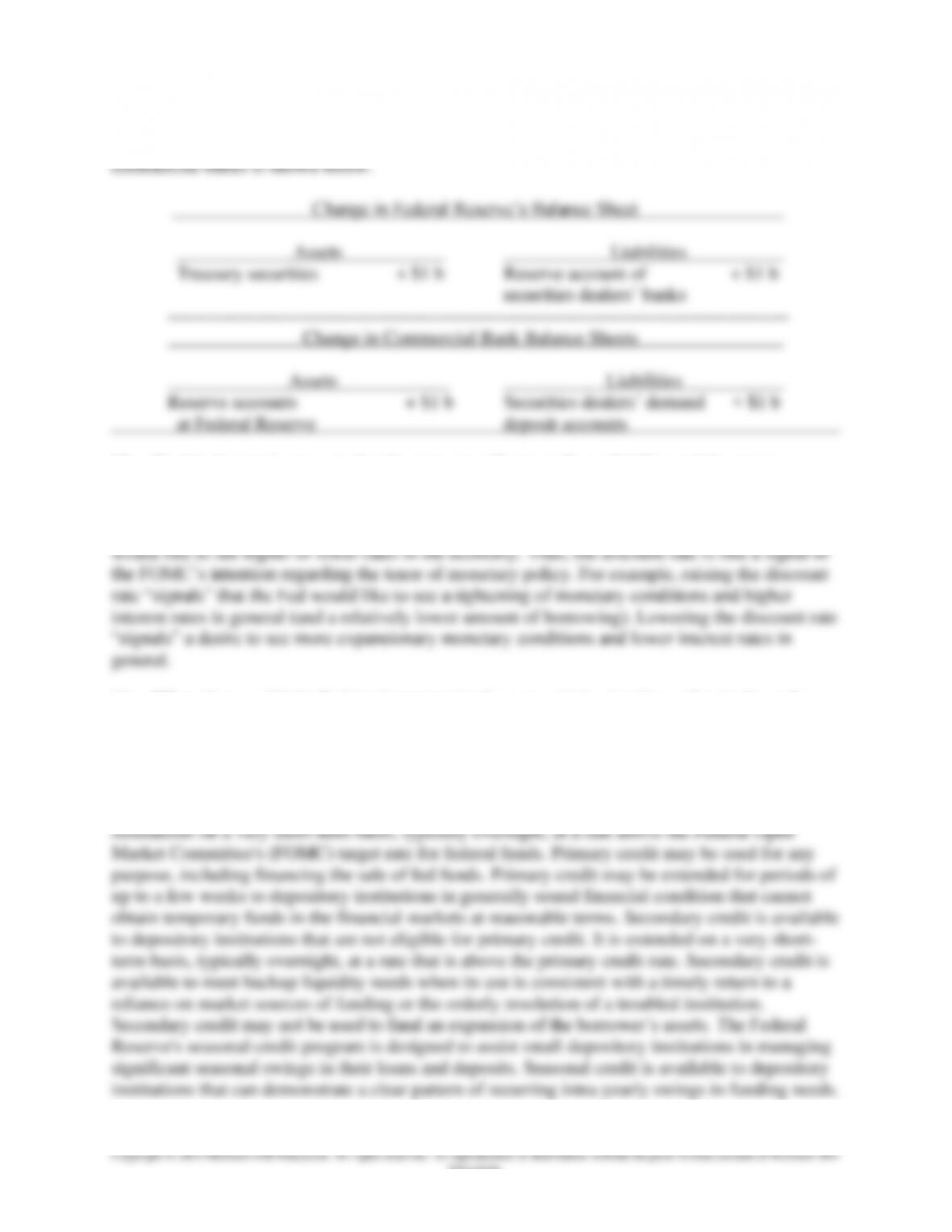
34. Suppose the Federal Reserve instructs the Trading Desk to purchase $1 billion of securities.
Show the result of this transaction on the balance sheets of the Federal Reserve System and
commercial banks.
Chapter 01 – Why Are Financial Institutions Special?
1-10
Education.
For the purchase of $1 billion in securities, the balance sheet of the Federal Reserve System and
35. Explain how a decrease in the discount rate affects credit availability and the money
supply.
Changing the discount rate signals to the market and the economy that the Federal Reserve
36. What changes did the Fed implement to its discount window lending policy in the early
2000s?
In January 2003, the Fed implemented changes to its discount window lending that increased the
cost of borrowing but eased the terms. Specifically, three lending programs are now offered
through the Feds discount window. Primary credit is available to generally sound depository
1-11
Education.
2003. Loans to troubled banks would cost 1.5 percent above the fed funds rate. The changes
were not intended to change the Fed’s use of the discount window to implement monetary
policy, but significantly increase the discount rate while making it easier to get a discount
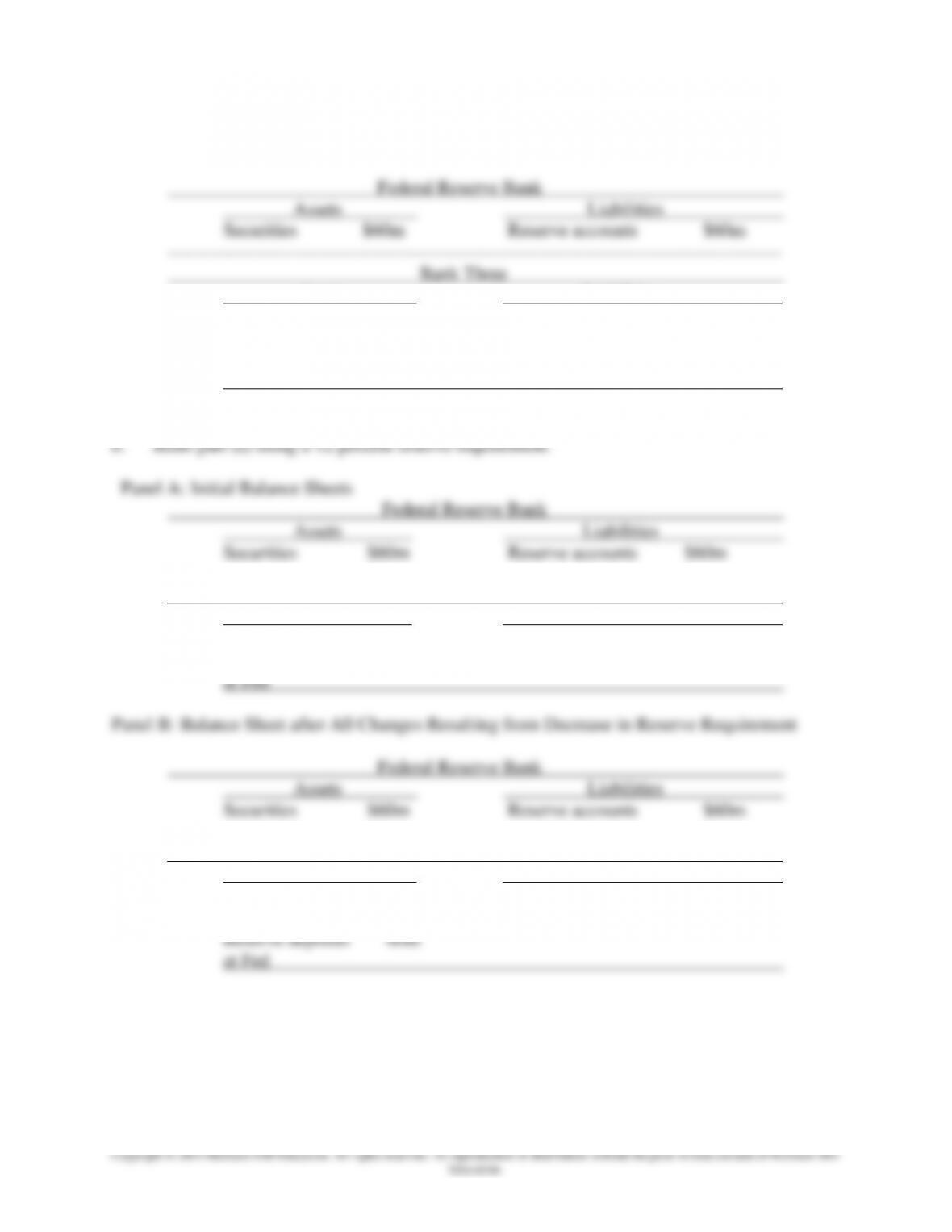
37. Bank Three currently has $600 million in transaction deposits on its balance sheet. The
Federal Reserve has currently set the reserve requirement at 10 percent of transaction
deposits.
a. Suppose the Federal Reserve decreases the reserve requirement to 8 percent. Show the
Chapter 01 – Why Are Financial Institutions Special?
1-12
Panel B: Balance Sheet after All Changes Resulting from Decrease in Reserve Requirement
Assets Liabilities
Loans $690m Transaction deposits $750m
($750m – $60m) ($60m x 0.08)
Reserve deposits 60m
at Fed
—————————————-—————————————————–
Bank Three
Assets Liabilities
Loans $540m Transaction deposits $600m
Reserve deposits 60m
—————————————-———————————————————–
Bank Three
Assets Liabilities
Loans $440m Transaction deposits $500m
($500m – $60m) ($60m x 0.12)
1-13
Education.
38. Which of the monetary tools available to the Federal Reserve is most often used? Why?
The Federal Reserve uses mainly open market operations to implement its monetary policy.
Adjustments to the discount rate are rarely used because it is difficult for the Fed to predict
changes in bank discount window borrowing when the discount rate changes and because in
39. Describe how expansionary activities conducted by the Federal Reserve impact credit
availability, the money supply, interest rates, and security prices. Do the same for
contractionary activities.
Expansionary Activities: We described three monetary policy tools that the Fed can use to
to foreign goods. Eventually, U.S. exports increase. The increase in spending from all of these
market participants results in economic expansion, stimulates additional real production, and
may cause inflation to rise. Ideally, the expansionary policies of the Fed are meant to be
conducive to real economic expansion (economic growth, full employment, sustainable
Chapter 01 – Why Are Financial Institutions Special?
1-14
Copyright © 2014 McGraw-Hill Education. All rights reserved. No reproduction or distribution without the prior written consent of McGraw-Hill
Education.
Contractionary Activities: We also described three monetary policy tools that the Fed can use to
decrease the money supply. These include open market sales, discount rate increases, and reserve
requirement increases. All else constant, when the Federal Reserve sells securities in the open
market, reserve accounts of banks (and the money base) decrease. When the Fed raises the
discount rate, interest rates generally increase in the open market. Finally, an increase in the
reserve requirement, all else constant, results in a decrease in excess reserves for all banks. In all
three cases, interest rates will tend to rise. Higher interest rates discourage credit availability and
borrowing. Economic participants spend less when funds are expensive. Households, business,
and governments are less likely to invest in fixed assets. Households decrease their purchases of
durable goods. State and local government spending decreases. Finally, a decrease in domestic
interest rates relative to foreign rates may result in an increase in the (foreign) exchange value
(rate) of the dollar. As the dollar’s exchange rate increases, U.S. goods become relatively
expensive compared to foreign goods. Eventually, U.S. exports decrease. The decrease in
spending from all of these market participants results in economic contraction, (depressing
additional real production) and causes prices to fall (causing the rate of inflation to fall).