Chapter 02 – Asset Classes and Financial Instruments
CHAPTER 02
ASSET CLASSES AND FINANCIAL INSTRUMENTS
1. Common stock is an ownership share in a publicly held corporation. Common
shareholders have voting rights and may receive dividends. Preferred stock represents
2. While the DJIA has 30 large corporations in the index, it does not represent the
3. Money market securities are short-term, relatively low risk, and highly liquid. Also,
4. The major components of the money market are Treasury bills, certificates of deposit,
5. American Depository Receipts, or ADRs, are certificates traded in U.S. markets that
represent ownership in shares of a foreign company. Investors may also purchase
6. The coupons paid by municipal bonds are exempt from federal income tax and from
7. The London Interbank Offer Rate (LIBOR) is the rate at which large banks in London
8. General obligation bonds are backed by the taxing power of the local governments,
9. Corporations may exclude 70% of dividends received from domestic corporations in
the computation of their taxable income.
10. Limited liability means that the most shareholders can lose in event of the failure of
11. (a) A repurchase agreement is the sale of a security with a commitment to repurchase
12. Money market securities are referred to as “cash equivalents” because of their great
liquidity. The prices of money market securities are very stable, and they can be
converted to cash (i.e., sold) on very short notice and with very low transaction costs.
© 2013 by McGraw-Hill Education. This is proprietary material solely for authorized instructor use. Not authorized for sale or distribution
in any manner. This document may not be copied, scanned, duplicated, forwarded, distributed, or posted on a website, in whole or part.
2-1
Chapter 02 – Asset Classes and Financial Instruments
13. Equivalent taxable yield =
Rate on municipal bond
1 - Tax rate
=
r m
1 - t
=
.0 675
1 - 0. 35
=
14. After-tax yield = Rate on the taxable bond x (1 - Tax rate)
a. The taxable bond. With a zero tax bracket, the after-tax yield for the taxable
b. The taxable bond. The after-tax yield for the taxable bond is: 0.05 x (1 – 0.10)
c. Neither. The after-tax yield for the taxable bond is: 0.05 x (1 – 0.20) = 0.4 or
d. The municipal bond. The after-tax yield for the taxable bond is: 0.05 x (1 –
15. The after-tax yield on the corporate bonds is: 0.09 x (1 – 0.30) = 0.063 or 6.3%.
16. Using the formula of Equivalent taxable yield (r) =
r m
1 - t
, we get:
a. r =
0.0 4
1 - 0
= 0.04 or 4.00%
b. r =
0.0 4
1 - 0. 10
= 0.0444 or 4.44%
c. r =
0.0 4
1 - 0. 20
= 0.05 or 5.00%
d. r =
0.0 4
1 - 0. 30
= 0.0571 or 5.71%
17.
a. You would have to pay the asked price of:
b. The coupon rate is 4.25%, implying coupon payments of $42.5 annually or,
c. Given the asked price and coupon rate, we can calculate current yield with the
formula:
© 2013 by McGraw-Hill Education. This is proprietary material solely for authorized instructor use. Not authorized for sale or distribution
in any manner. This document may not be copied, scanned, duplicated, forwarded, distributed, or posted on a website, in whole or part.
2-2
Chapter 02 – Asset Classes and Financial Instruments
Annual coupon income
Price
18.
a. The closing price today is $75.60, which is $0.97 above yesterday’s price.
Therefore, yesterday’s closing price was: $75.60 - $0.97 = $74.63.
19.
a. At t = 0, the value of the index is: ($90 + $50 + $100)/3 = 80
V 0
b. In the absence of a split, stock C would sell for $110, and the value of the
index would be the average price of the individual stocks included in the
index: ($95 + $45 + $110)/3 = $83.33.
c. The rate of return is zero. The value of the index remains unchanged since the
return on each stock separately equals zero.
20.
a. Total market value at t = 0 is:
($90 x 100) + ($50 x 200) + ($200 x 100) = $39,000
V 1
V 0
b. The return on each stock is as follows:
RA =
V 1
V 0
- 1 = ($95/$90) – 1 = 0.0556 or 5.56%
© 2013 by McGraw-Hill Education. This is proprietary material solely for authorized instructor use. Not authorized for sale or distribution
in any manner. This document may not be copied, scanned, duplicated, forwarded, distributed, or posted on a website, in whole or part.
2-3
Chapter 02 – Asset Classes and Financial Instruments
V 1
21. The fund would require constant readjustment since every change in the price of a
stock would bring the fund asset allocation out of balance.
22. In this case, the value of the divisor will increase by an amount necessary to maintain
the index value on the day of the change. For example, if the index was comprised of
23. Bank discount of 87 days: 0.034 x
87 days
360 days
= 0.008217
$9,917.83 x 87 days
365 days
24.
a. The higher coupon bond: The 10-year T-bond with a 10% coupon
b. The call with the lower exercise price: The call with the exercise price of $35
25.
a. The December maturity futures price is $6.37 per bushel. If the contract
closes at $6.43 per bushel in December, your profit / loss on each contract (for
b. There are 487,465 contracts outstanding, representing 2,437,325,000 bushels
of corn.
26.
a. Yes. As long as the stock price at expiration exceeds the exercise price, it
makes sense to exercise the call.
© 2013 by McGraw-Hill Education. This is proprietary material solely for authorized instructor use. Not authorized for sale or distribution
in any manner. This document may not be copied, scanned, duplicated, forwarded, distributed, or posted on a website, in whole or part.
2-4
V 1
Chapter 02 – Asset Classes and Financial Instruments
b. Yes, exercise.
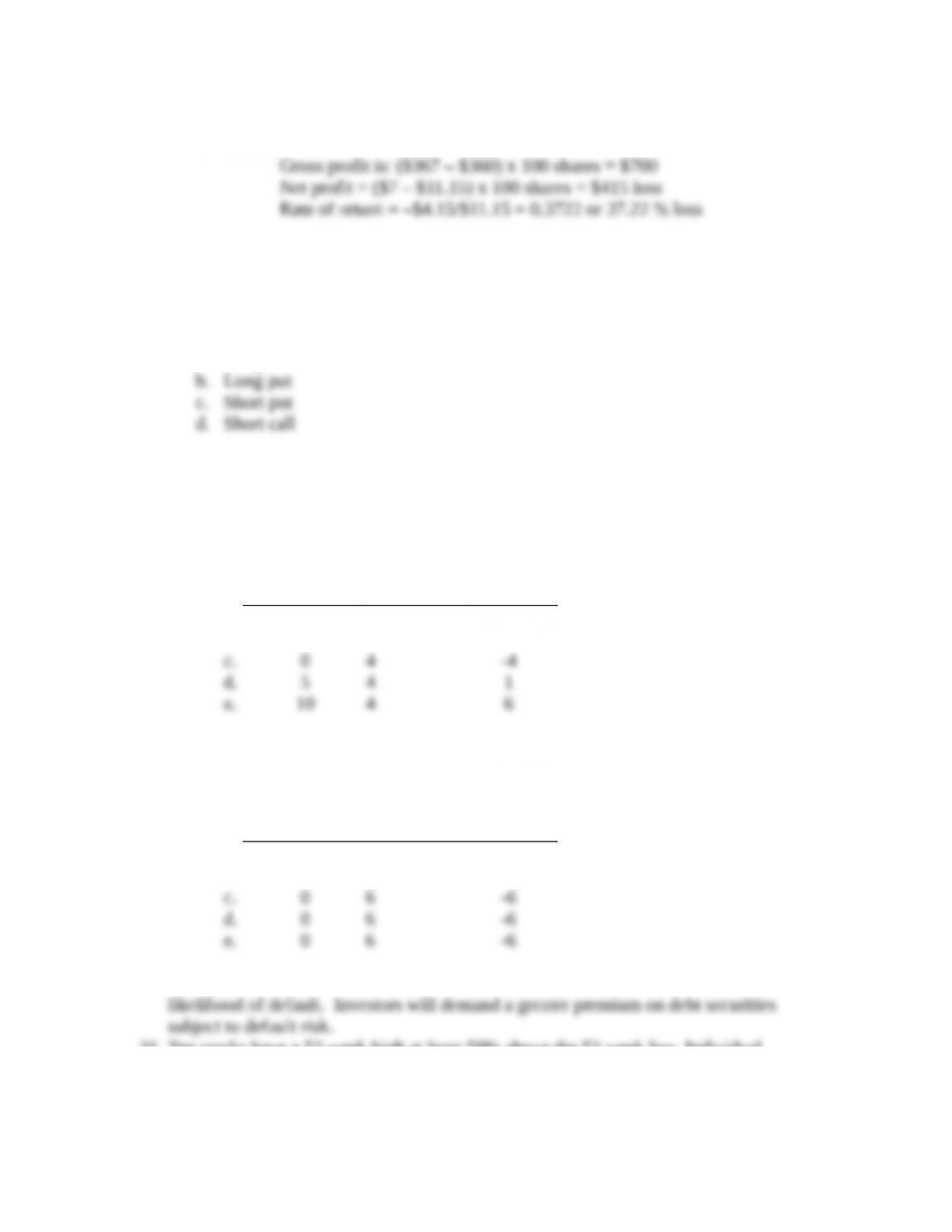
c. A put with an exercise price of $355 would expire worthless for any stock
price equal to or greater than $355. An investor in such a put would have a
rate of return over the holding period of –100%.
27.
a. Long call
28. There is always a chance that the option will expire in the money. Investors will pay
something for this chance of a positive payoff.
29. Long call for $4:
Value of call
at expiration Initial Cost Profit
a. 0 4 -4
b. 0 4 -4
Long put for $6:
Value of put
at expiration Initial Cost Profit
a. 10 6 4
b. 5 6 -1
30. The spread will widen. Deterioration of the economy increases credit risk, that is, the
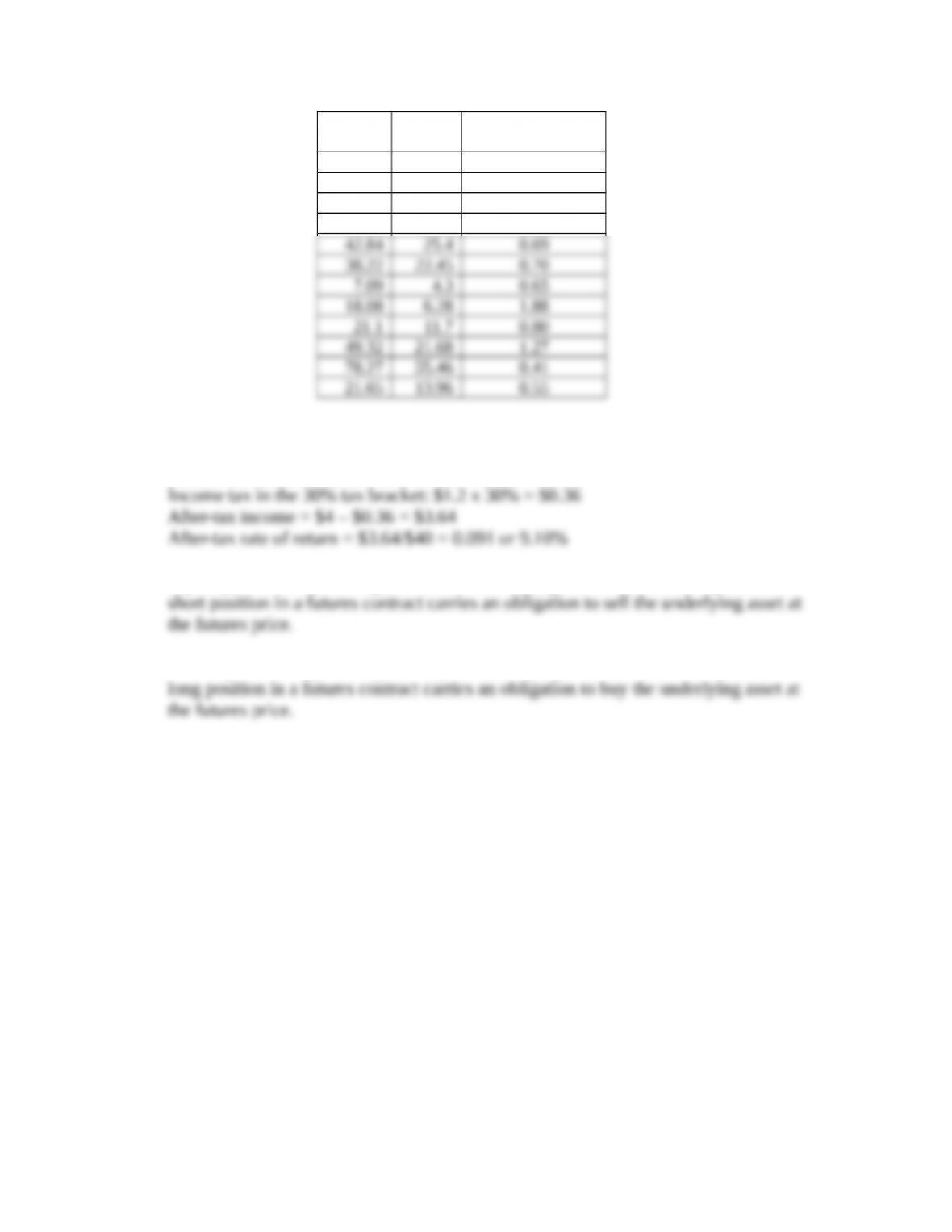
31. Ten stocks have a 52 week high at least 50% above the 52 week low. Individual
stocks are much more volatile than a group of stocks.
© 2013 by McGraw-Hill Education. This is proprietary material solely for authorized instructor use. Not authorized for sale or distribution
in any manner. This document may not be copied, scanned, duplicated, forwarded, distributed, or posted on a website, in whole or part.
2-5
Chapter 02 – Asset Classes and Financial Instruments
52-wk
high
52-wk
low
Price ratio
(High-Low)/Low
18.93 11.65 0.62
23.73 16.62 0.43
88.7 44.24 1.00
43.39 22.89 0.90
32. The total before-tax income is $4. The corporations may exclude 70% of dividends
received from domestic corporations in the computation of their taxable income; the
taxable income is therefore: $4 x 30% = $1.20.
33. A put option conveys the right to sell the underlying asset at the exercise price. A
34. A call option conveys the right to buy the underlying asset at the exercise price. A
CFA 1
Answer: c. Taxation
© 2013 by McGraw-Hill Education. This is proprietary material solely for authorized instructor use. Not authorized for sale or distribution
in any manner. This document may not be copied, scanned, duplicated, forwarded, distributed, or posted on a website, in whole or part.
2-6