CHAPTER 01
INVESTMENTS: BACKGROUND AND ISSUES
1Equity is a lower-priority claim and represents an ownership share in a corporation,
2The primary asset has a claim on the real assets of a firm, whereas a derivative asset
3Asset allocation is the allocation of an investment portfolio across broad asset classes.
4Agency problems are conflicts of interest between managers and stockholders. They can
5Real assets are assets used to produce goods and services. Financial assets are claims on
6Investment bankers are firms specializing in the sale of new securities to the public,
typically by underwriting the issue. Commercial banks accept deposits and lend the
money to other borrowers. After the Glass-Steagall Act was repealed in 1999, some
7
a Toyota creates a real asset—the factory. The loan is a financial asset that is created in
the transaction.
8
a No. The real estate in existence has not changed, only the perception of its value has.
b Yes. The financial asset value of the claims on the real estate has changed, and thus the
9
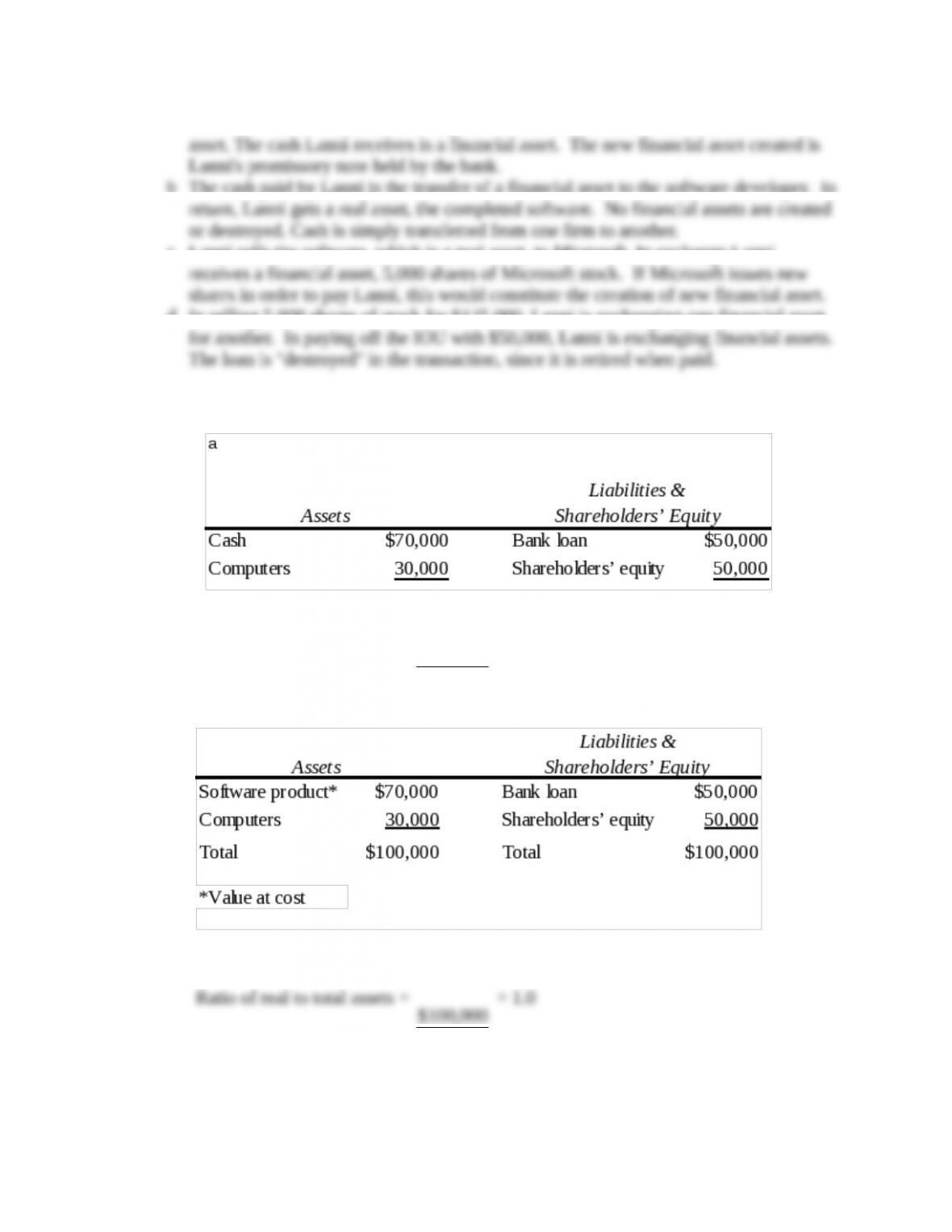
a The bank loan is a financial liability for Lanni. Lanni’s IOU is the bank’s financial
b The cash paid by Lanni is the transfer of a financial asset to the software developer. In
c Lanni sells the software, which is a real asset, to Microsoft. In exchange Lanni
d In selling 5,000 shares of stock for $125,000, Lanni is exchanging one financial asset
10
a
Ratio of real to total assets =
000,100$
000,30$
= 0.3
b
Ratio of real to total assets =
000,100$
000,100$
= 1.0
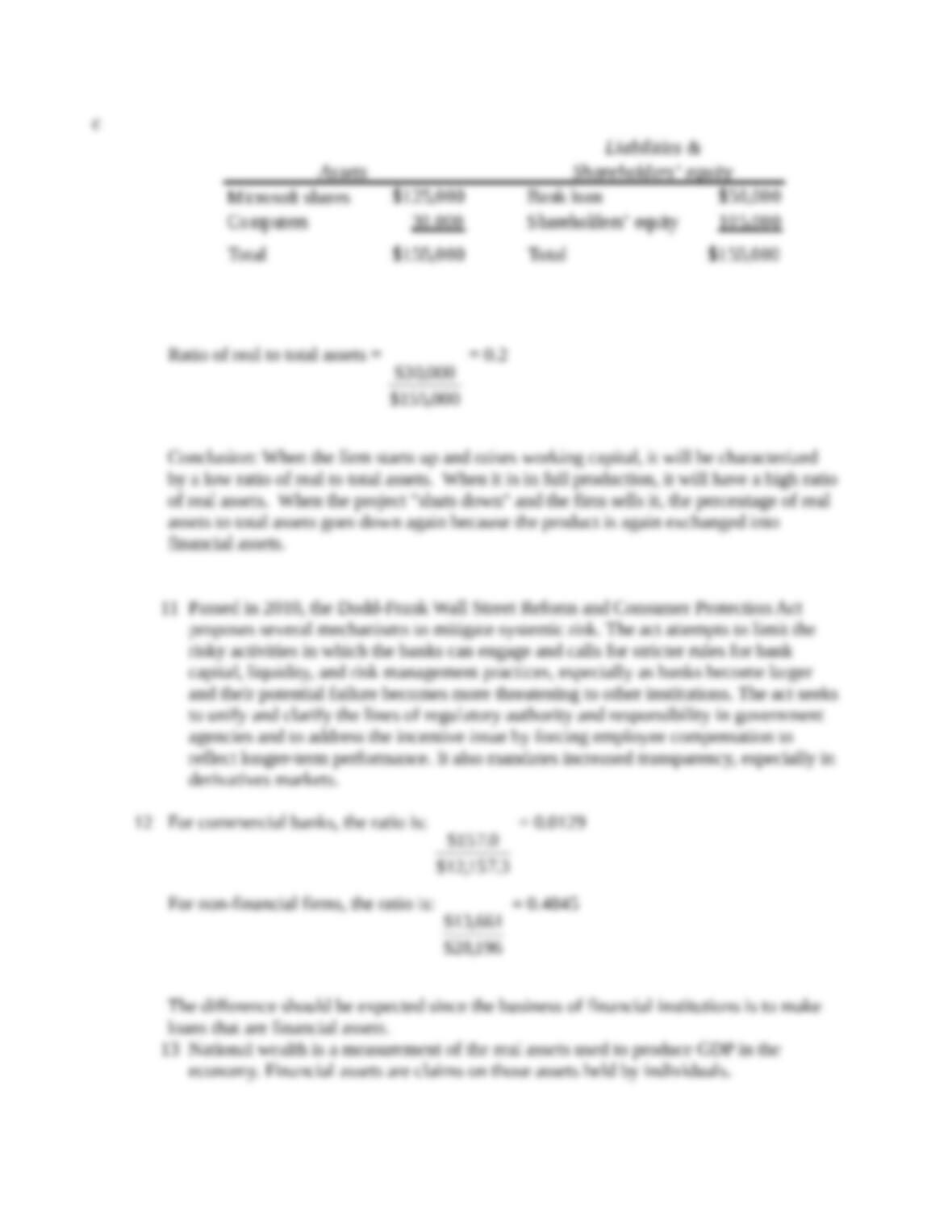
c
Ratio of real to total assets =
000,155$
000,30$
= 0.2
Conclusion: When the firm starts up and raises working capital, it will be characterized
by a low ratio of real to total assets. When it is in full production, it will have a high ratio
of real assets. When the project “shuts down” and the firm sells it, the percentage of real
11 Passed in 2010, the Dodd-Frank Wall Street Reform and Consumer Protection Act
proposes several mechanisms to mitigate systemic risk. The act attempts to limit the
risky activities in which the banks can engage and calls for stricter rules for bank
capital, liquidity, and risk management practices, especially as banks become larger
12 For commercial banks, the ratio is:
3.157,12$
0.157$
= 0.0129
13 National wealth is a measurement of the real assets used to produce GDP in the
economy. Financial assets are claims on those assets held by individuals.
Financial assets owned by households represent their claims on the real assets of the
issuers, and thus show up as wealth to households. Their interests in the issuers, on the
14
a A fixed salary means compensation is (at least in the short run) independent of the
firm’s success. This salary structure does not tie the manager’s immediate
compensation to the success of the firm, and thus allows the manager to envision and
b A salary paid in the form of stock in the firm means the manager earns the most when
shareholder wealth is maximized. When the stock must be held for five years, the
manager has less of an incentive to manipulate the stock price. This structure is most
c When executive salaries are linked to firm profits, the firm creates incentives for
managers to contribute to the firm’s success. However, this may also lead to earnings
15 Even if an individual investor has the expertise and capability to monitor and improve the
managers’ performance, the payoffs would not be worth the effort, since his ownership in
a large corporation is so small compared to that of institutional investors. For example, if
the individual investor owns $10,000 of IBM stock and can increase the value of the firm
16 Since the traders benefited from profits but did not get penalized by losses, they were
encouraged to take extraordinary risks. Since traders sell to other traders, there also
17 Securitization requires access to a large number of potential investors. To attract these
investors, the capital market needs:
1 A safe system of business laws and low probability of confiscatory
taxation/regulation;
18 Progress in securitization facilitates the shifting of default risk from the intermediates
to the investors of such a security. Since the intermediates no longer bear the default
risk, their role and motivation in assessing and monitoring the quality of the borrowers
is mitigated. For example, when the national market in mortgage-backed securities
19 Mutual funds accept funds from small investors and invest, on behalf of these
investors, in the national and international securities markets.
to buy securities of large corporations.
20 Even if the firm does not need to issue stock in any particular year, the stock market is
still important to the financial manager. The stock price provides important
information about how the market values the firm’s investment projects. For example,
if the stock price rises considerably, managers might conclude that the market believes
the firm’s future prospects are bright. This might be a useful signal to the firm to
proceed with an investment such as an expansion of the firm’s business.
21 Treasury bills serve a purpose for investors who prefer a low-risk investment. The
lower average rate of return compared to stocks is the price investors pay for
22 You should be skeptical. If the author actually knows how to achieve such returns, one
must question why the author would then be so ready to sell the secret to others. Financial
markets are very competitive; one of the implications of this fact is that riches do not