
Chapter 09 – Risk Management: Asset-Backed Securities, Loan Sales, Credit Standbys, and Credit Derivatives
9-1
CHAPTER 9
RISK MANAGEMENT: ASSET-BACKED SECURITIES, LOAN SALES, CREDIT
STANDBYS, AND CREDIT DERIVATIVES
Goal of This Chapter: The purpose of this chapter is to learn about some of the newer financial
instruments that financial institutions have used in recent years to help reduce their risk exposure
and, in some cases, to aid in generating new sources of fee income and in raising new funds to
make loans and investments.
Key Topics in This Chapter
• The Securitization Process
• Securitization’s Impact and Risks
• Sales of Loans: Nature and Risks
• Standby Credits: Pricing and Risks
• Credit Derivatives and CDOs—Benefits and Risks
Chapter Outline
I. Introduction
II. Securitizing Loans and Other Assets
A. Nature of Securitization
B. The Securitization Process
C. Advantages and Disadvantages of Securitization
D. The Beginnings of Securitization—The Home Mortgage Market
1. Collateralized Mortgage Obligations (CMOs)
2. Home Equity Loans
3. Loan-Backed Bonds
E. Examples of Other Assets That Have Been Securitized
F. The Impact of Securitization upon Lending Institutions
G. Regulators’ Concerns about Securitization
III. Sales of Loans to Raise Funds and Reduce Risk
A. Nature of Loan Sales
B. Forms of Loan Sales
1. Participation Loan
2. Assignments
3. Loan Strip
C. Reasons behind Loan Sales
D. The Risks in Loan Sales
IV. Standby Credit Letters to Reduce the Risk of Nonpayment or Nonperformance
A. The Nature of Standby Letter of Credit (Contingent Obligations)
B. Types of Standby Credit Letters
1. Performance Guarantees
2. Default Guarantees
C. Advantages of Standbys

Chapter 09 – Risk Management: Asset-Backed Securities, Loan Sales, Credit Standbys, and Credit Derivatives
9-2
D. Reasons for Rapid Growth of Standbys
E. The Structure of SLCs
F. The Value and Pricing of Standby Letters
G. Sources of Risk with Standbys
H. Regulatory Concerns about SLCs
I. Research Studies on Standbys, Loan Sales, and Securitizations
V. Credit Derivatives: Contracts for Reducing Credit Risk Exposure on the Balance Sheet
A. An Alternative to Securitization
B. Credit Swaps
C. Credit Options
D. Credit Default Swaps (CDSs)
E. Credit-Linked Notes
F. Collateralized Debt Obligations (CDOs)
G. Risks Associated with Credit Derivatives
VI. Summary of the Chapter
Concept Checks
9-1. What does securitization of assets mean?
Securitization involves the pooling of groups of earning assets and removing those pooled assets
9-2. What kinds of assets are most amenable to the securitization process?
9-3. What advantages does securitization offer to the lending institutions?
Securitization gives lending institutions the opportunity to use their assets as sources of funds
and, in particular, to remove lower-yielding assets from the balance sheet to be replaced with
higher-yielding assets.

Chapter 09 – Risk Management: Asset-Backed Securities, Loan Sales, Credit Standbys, and Credit Derivatives
9-4. What risks of securitization should the managers of lending institutions be aware of?
Lending institutions often have to use the highest-quality assets in the securitization process
which means the remainder of the portfolio may become more risky, on average, increasing the
9-5. Suppose that a bank securitizes a package of its loans that bears a gross annual interest
yield of 13 percent. The securities issued against the loan package promise interested investors
an annualized yield of 8.25 percent. The expected default rate on the packaged loans is 3.5
percent. The bank agrees to pay an annual fee of 0.35 percent to a security dealer to cover the

9-4
9-7. What are the risks of using loan sales as a significant source of funding for banks and
other financial institutions?
The lenders may find themselves selling off their highest quality loans, leaving their loan
9-8. What is loan servicing?
9-9. How can loan servicing be used to increase income?
9-10. What are standby credit letters? Why have they grown so rapidly in recent years?
Standby credit letters are promises of the issuer to a lender to pay off an obligation of its
customer, in case that customer cannot pay. It can also be in the form of a guarantee that a
9-11. Who are the principal parties to a standby credit agreement?
The principal parties to a standby credit agreement are the issuing bank or any other financial

Chapter 09 – Risk Management: Asset-Backed Securities, Loan Sales, Credit Standbys, and Credit Derivatives
9-5
9-12. What risks accompany a standby credit letter for (a) the issuer and (b) the beneficiary?
Standbys present the issuer with the danger that the customer whose credit the issuer has
9-13 How can a lending institution mitigate the risks inherent in issuing standby credit letters?
1. Frequently renegotiating the terms of any loans extended to customers who have SLCs,
exposure.
3. Selling participations in standbys in order to share risk with other lending institutions.
9-14. Why were credit derivatives developed? What advantages do they have over loan sales
and securitizations, if any?
9-15. What is a credit swap? For what kinds of situations was it developed?
9-16. What is a total return swap? What advantages does it offer the swap beneficiary
institution?

9-6
9-17. How do credit options work? What circumstances result in the option contract paying
off?
A credit option helps guard against losses in the value of a credit asset or helps offset higher
9-18. When is a credit default swap useful? Why?
A credit default swap is related to a credit option where a lender may seek of a dealer willing to
write a put option on a portfolio of assets or a credit swap on a particular loan where the other
9-19. Of what use are credit-linked notes?
A credit-linked note allows the issuer of a note to lower the coupon payments if some significant
9-20. What are Collateralized Debt Obligations (CDOs)? How do they differ from other credit
derivatives?
9-21. What risks do credit derivatives pose for financial institutions using them? In your
opinion what should regulators do about the recent rapid growth of this market, if anything?
Answer:
Chapter 09 – Risk Management: Asset-Backed Securities, Loan Sales, Credit Standbys, and Credit Derivatives
These types of instruments are relatively new and the markets for these instruments are relatively
Problems
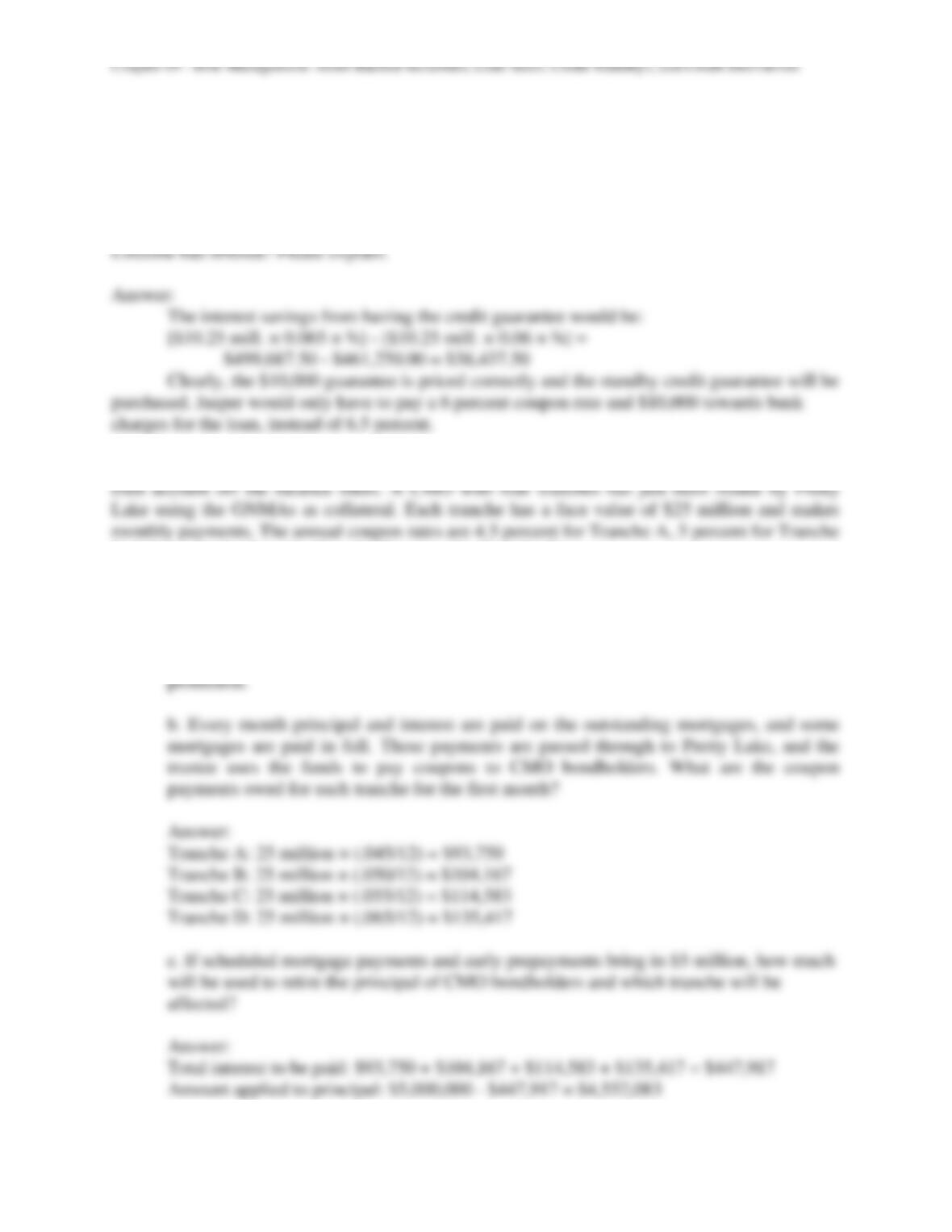
9-1. GoodLife National Bank placed a group of 10,000 consumer loans bearing an average
expected gross annual yield of 6 percent in a package to be securitized. The investment bank
advising GoodLife estimates that the securities will sell at a slight discount from par that results
in a net interest cost to the issuer of 4.0 percent. Based on recent experience with similar types of
9-8
9-2. Jasper Corporation is requesting a loan for repair of some assembly-line equipment in the
amount of $10.25 million. The nine-month loan is priced by Farmers Financial Corporation at a
6.5 percent rate of interest. However, the finance company tells Jasper that if it obtains a suitable
credit guarantee the loan will be priced at 6 percent. Lifetime Bank agrees to sell Jasper a
standby credit guarantee for $10,000. Is Jasper likely to buy the standby credit guarantee
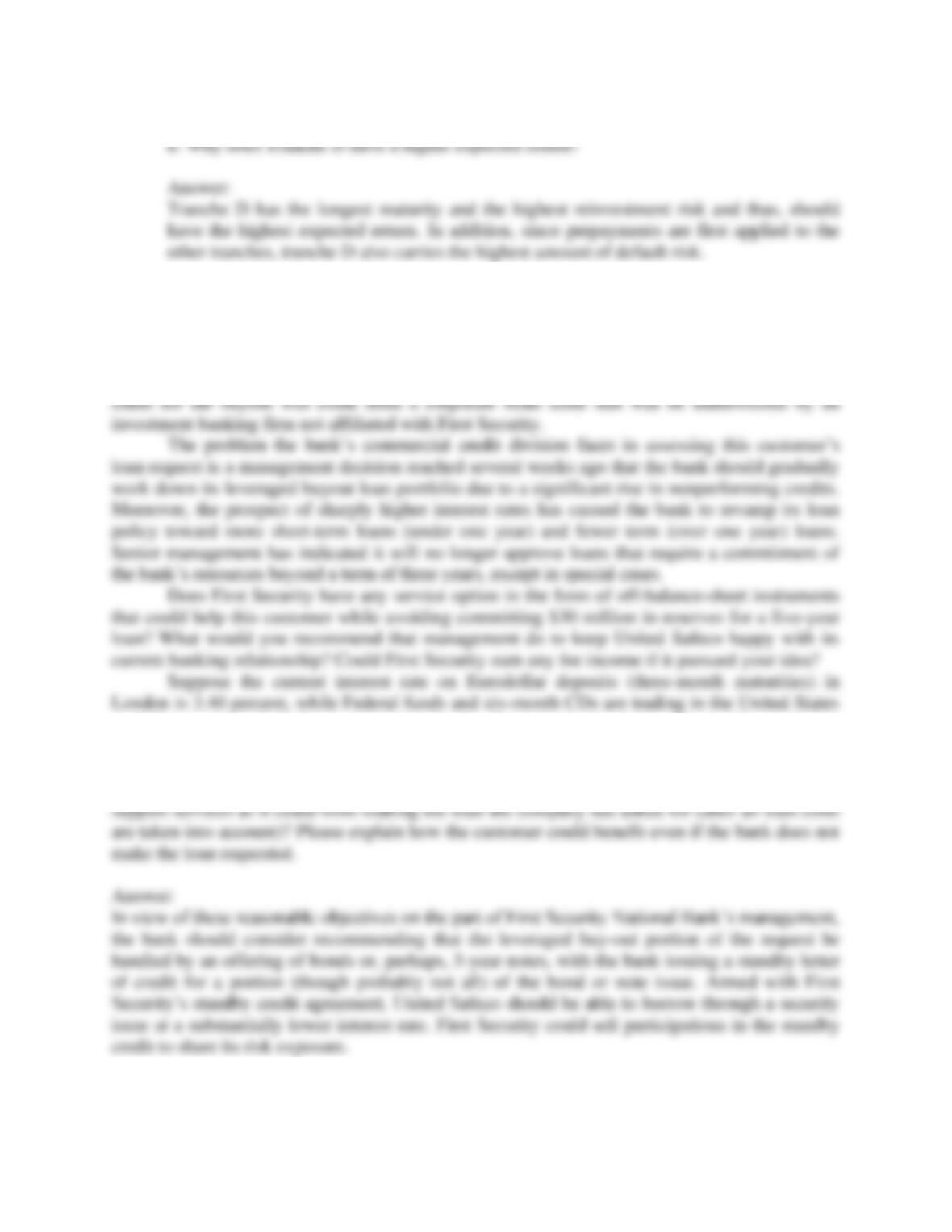
9-3. The Pretty Lake Bank Corp. has placed $100 million of GNMA-guaranteed securities in a
B, 5.5 percent for Tranche C, and 6.5 percent for Tranche D.
a. Which tranche has the shortest maturity, and which tranche has the most prepayment
protection?
Answer: Tranche A has the shortest maturity and tranche D has the most prepayment
Chapter 09 – Risk Management: Asset-Backed Securities, Loan Sales, Credit Standbys, and Credit Derivatives
9-9
Tranche A will be affected by the reduction in principal.
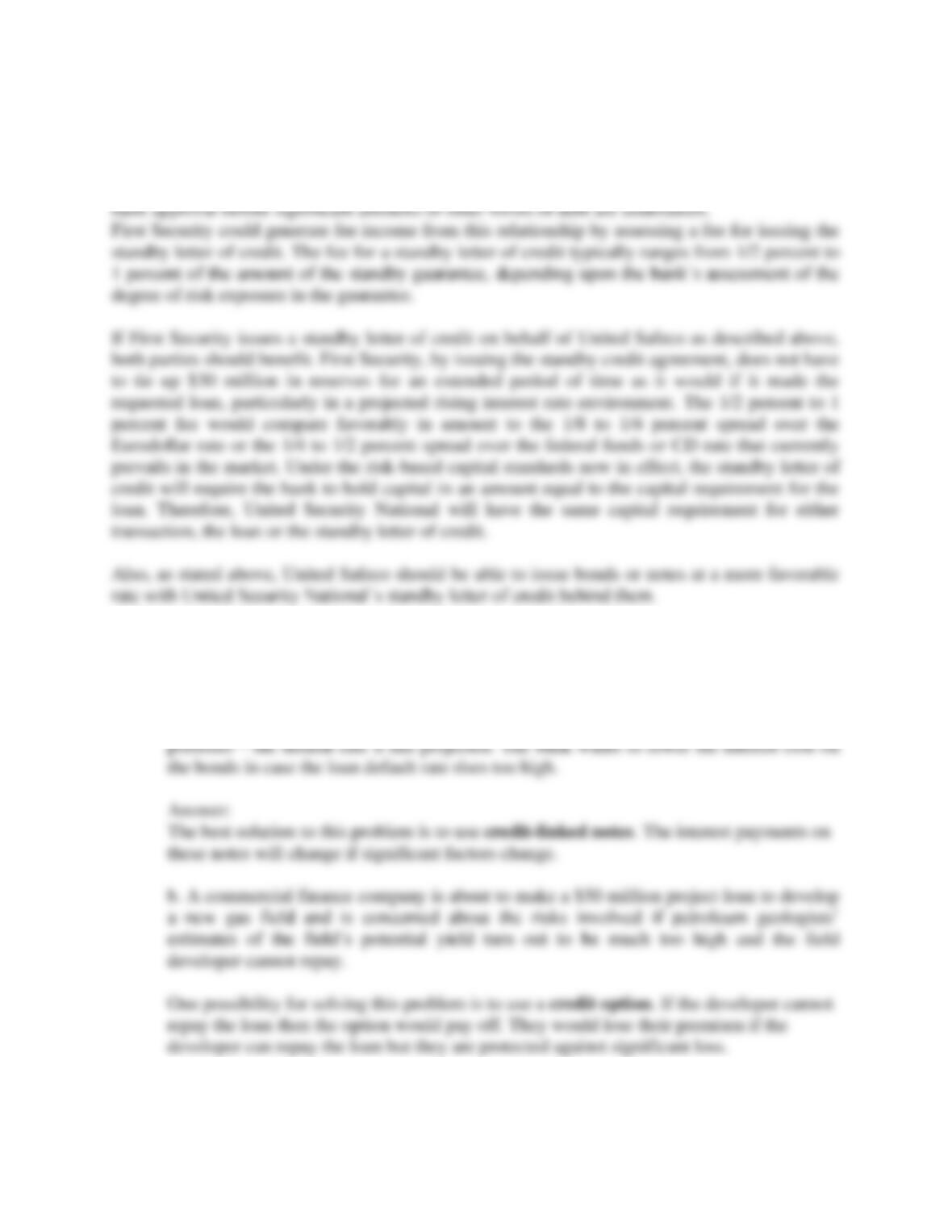
9-4. First Security National Bank has been approached by a long-standing customer, United
Safeco Industries, for a $30 million term loan for five years to purchase new stamping machines
that would further automate the company’s assembly line in the manufacture of metal toys and
containers. The company also plans to use at least half the loan proceeds to facilitate its buyout
of Calem Corp., which imports and partially assembles video recorders and cameras. Additional
at 3.57 percent and 3.19 percent, respectively. Term loans to comparable quality corporate
borrowers are trading at one-eighth to one-quarter percentage point above the three-month
Eurodollar rate or one-quarter to one-half point over the secondary-market CD rate. Is there a
way First Security could earn at least as much fee income by providing United Safeco with
Chapter 09 – Risk Management: Asset-Backed Securities, Loan Sales, Credit Standbys, and Credit Derivatives
9-10
For the portion of the loan that calls for the purchase of new assembly-line equipment,
management might seriously consider proposing a shorter-term loan for about one-third to one-
half the total amount requested by Safeco. This loan would be secured by a pledge of the new
equipment plus sufficient covenants to insure the maintenance of adequate liquidity and require
9-5. What type of credit derivatives contract would you recommend for each of the following
situations:
a. A bank plans to issue a group of bonds backed by a pool of credit card loans but fears
that the default rate on these credit card loans will rise well above 6 percent of the
Chapter 09 – Risk Management: Asset-Backed Securities, Loan Sales, Credit Standbys, and Credit Derivatives
9-11
c. A bank holding company plans to offer new bonds in the open market next month, but
knows that the company’s credit rating is being reevaluated by credit-rating agencies.
The holding company wants to avoid paying sharply higher credit costs if its rating is
lowered by the investigating agencies.