
Chapter 08 – Risk Management: Financial Futures, Options, Swaps, and Other Hedging Tools
8-1
CHAPTER 8
RISK MANAGEMENT: FINANCIAL FUTURES, OPTIONS, SWAPS, AND OTHER
HEDGING TOOLS
Goal of This Chapter: The purpose of this chapter is to examine how financial futures, option,
and swap contracts, as well as selected other asset-liability management techniques can be
employed to help reduce a bank’s/firm’s potential exposure to loss as market conditions change.
We will also discover how swap contracts and other hedging tools can generate additional
revenues for banks by providing risk-hedging services to their customers.
Key Topics in this Chapter
• The Use of Derivatives
• Financial Futures Contracts: Purpose and Mechanics
• Short and Long Hedges
• Interest-Rate Options: Types of Contracts and Mechanics
• Interest-Rate Swaps
• Regulations and Accounting Rules
• Caps, Floors, and Collars
Chapter Outline
I. Introduction
II. Uses of Derivative Contracts Among FDIC-Insured Banks
III. Financial Futures Contracts: Promises of Future Security Trades at a Preset Price
A. Background on Financial Futures
B. Purpose of Financial Futures Trading
C. The Short Hedge in Futures
D. The Long Hedge in Futures
1. Using Long and Short Hedges to Protect Income and Value
2. Basis Risk
3. Basis Risk with a Short Hedge
4. Basis Risk with a Long Hedge
5. Number of Futures Contracts Needed
IV. Interest-Rate Options
V. Regulations and Accounting Rules for Bank Futures and Options Trading
VI. Interest-Rate Swaps
VII. Caps, Floors, and Collars
A. Interest-Rate Caps
B. Interest-Rate Floors
C. Interest-Rate Collars
VIII. Summary of the Chapter
Chapter 08 – Risk Management: Financial Futures, Options, Swaps, and Other Hedging Tools
8-2
Concept Checks
8-1. What are financial futures contracts? Which financial institutions use futures and other
derivatives for risk management?
8-2. How can financial futures help financial service firms deal with interest rate risk?
Financial futures allow banks and other financial institutions to deal with interest rate risk by
8-3. What is a long hedge in financial futures? A short hedge?
A long hedger offsets risk by buying financial futures contracts before the time new deposits are
expected to flow in and interest rates are expected to decline. This helps institution to hedge
against an opportunity risk when a loan is to be made, or when securities are to be added to the
8-4. What futures transactions would most likely be used in a period of rising interest rates?
8-5. How do you interpret the quotes for financial futures in The Wall Street Journal?
Chapter 08 – Risk Management: Financial Futures, Options, Swaps, and Other Hedging Tools
8-3
futures contracts on three-month Eurodollar time deposits, the 30-day Federal funds futures
8-6. A futures contract on Eurodollar deposits is currently selling at an interest yield of 4
percent).
8-7. Suppose a bank wishes to sell $150 million in new deposits next month. Interest rates
today on comparable deposits stand at 8 percent but are expected to rise to 8.25 percent next
month. Concerned about the possible rise in borrowing costs, management wishes to use a
8-8. What kind of futures hedge would be appropriate in each of the following situations?
a. A financial firm fears that rising deposit interest rates will result in losses on fixed-rate
loans.

Chapter 08 – Risk Management: Financial Futures, Options, Swaps, and Other Hedging Tools
8-4
e. Falling interest yields on floating-rate loans could be at least partially offset by a long
8-9. Explain what is involved in a put option.
A put option allows its holder to sell securities to the option writer at a specified price. The buyer
buyer.
8-10. What is a call option?
A call option permits the option holder to purchase specific securities at a guaranteed price from
8-11. What is an option on a futures contract?
For standardized exchange-traded interest-rate options, most of the activities occur using options
on futures, referred to as the futures options market.
8-12. What information do T-bond and Eurodollar futures option quotes contain?
The U.S. Treasury bond and the Eurodollar futures option grant the options buyer the right to a

Chapter 08 – Risk Management: Financial Futures, Options, Swaps, and Other Hedging Tools
8-5
8-13. Suppose market interest rates were expected to rise. What type of option would normally
be used?
8-14. If market interest rates were expected to fall, what type of option would a financial
institution’s manager be likely to employ?
8-15. What rules and regulations have recently been imposed on the use of futures, options, and
other derivatives? What does the Financial Accounting Standards Board (FASB) require publicly
traded firms to do in accounting for derivative transactions?
Each bank has to implement a proper risk management system comprised of (1) policies and
8-16. What is the purpose of an interest-rate swap?
Swaps are often employed to deal with asset-liability maturity mismatches. The purpose of an
8-17. What are the principal advantages and disadvantages of interest-rate swaps?
The principal advantage of an interest-rate swap is the reduction of interest-rate risk of both
Chapter 08 – Risk Management: Financial Futures, Options, Swaps, and Other Hedging Tools
8-6
also easy to carry out, usually negotiated and agreed to over the telephone or via e-mail through a
8-18. How can a financial institution get itself out of an interest-rate swap agreement?
8-19. How can financial-service providers make use of interest-rate caps, floors, and collars to
generate revenue and help manage interest rate risk?
Banks and other financial institutions can generate revenue by charging up-front fees for interest-
8-20. Suppose a bank enters into an agreement to make a $10 million, three-year floating-rate
loan to one of its best corporate customers at an initial rate of 8 percent. The bank and its
customer agree to a cap and a floor arrangement in which the customer reimburses the bank if
8-7
8-1. You hedged your bank’s exposure to declining interest rates by buying one June Treasury
bond futures contract at the opening price on April 10, as presented in Exhibit 8-2. It is now
Tuesday, June 10, and you discover that on Monday, June 9, June T-bond futures opened at 115-
8-2 Use the quotes of Eurodollar futures contracts traded on the Chicago Mercantile
Exchange as shown below to answer the following questions:
Open
High
Low
Settle
Chg
High
Lifetime
Low
Open Int
High/Low
Eurodollar (CME)-$1,000,000; pts. of 100%
Jun 08
97.2725
97.2875
97.2025
97.2150
−.0520
98.2550
Low
91.6800
1,264,397
Jly 08
97.2150
97.2250
97.0900
97.1200
−.1150
98.1850
97.0300
13,725
Aug 08
97.1200
97.1200
96.9500
96.9850
−.2150
98.2200
96.9500
2,929
Sep 08
97.1600
97.1850
96.8300
96.8850
−.2850
98.3350
91.6800
1,453,920
Dec 08
96.9750
97.0050
96.5500
96.6050
−.3800
98.2650
91.5700
1,384,300
Mar 09
96.8850
96.9200
96.4000
96.4550
−.4400
98.1850
91.5750
1,229,271
Jun 09
96.6900
96.7350
96.2200
96.2600
−.4500
98.0000
91.3100
985,412
Sep 09
96.4600
96.4900
96.0200
96.0450
−.4200
97.7700
91.2600
817,642
Dec 09
96.1650
96.2000
95.7750
95.8000
−.3700
97.5050
91.1600
607,401
Mar 10
95.9500
95.9850
95.5900
95.6150
−.3350
97.2750
91.4850
474,017
Chapter 08 – Risk Management: Financial Futures, Options, Swaps, and Other Hedging Tools
8-8
($1,000,000 × [1 − ((3.265 ÷ 100) × 90/360)] × 15 = $14,877,562.50
Value at settlement:
8-3. What kind of futures or options hedges would be called for in the following situations?
a. Market interest rates are expected to increase and your financial firm’s asset-liability
managers expect to liquidate a portion of their bond portfolio to meet customers’ demands for
funds in the upcoming quarter.
The financial firm can expect a lower price when they sell their bond portfolio if the interest
Chapter 08 – Risk Management: Financial Futures, Options, Swaps, and Other Hedging Tools
8-9
d. Monarch National Bank has interest-sensitive assets greater than interest-sensitive
liabilities by $24 million. If interest rates fall (as suggested by data from the Federal Reserve
Board) the bank’s net interest margin may be squeezed due to the decrease in loan and security
revenue.
8-4. Your financial firm needs to borrow $500 million by selling time deposits with 180-day
maturities. If interest rates on comparable deposits are currently at 3.5 percent, what is the cost of
issuing these deposits? Suppose interest rates rise to 4.5 percent. What then will be the cost of
these deposits? What position and types of futures contract could be used to deal with this cost
increase?
Marginal deposit interest cost = Amount of new deposits to be issued × Annual interest rate ×
Maturity of deposit in days
Annual interest rate × 360
At a rate of 3.5 percent, the interest cost is:
30
$500 million × 0.035 × = $8,750,000
360
At a rate of 4.5 percent, the interest cost would be:
30
$500 million × 0.045 × = $11,250,000
360
A short hedge could be used based upon Eurodollar time deposits, Federal funds futures
contracts, or LIBOR futures contract.
8-5. In response to the above scenario, management sells 500, 90-day Eurodollar time
deposits futures contracts trading at an index price of 98. Interest rates rise as anticipated and
Chapter 08 – Risk Management: Financial Futures, Options, Swaps, and Other Hedging Tools
8-10
your financial firm offsets its position by buying 500 contracts at an index price of 96.98. What
type of hedge is this? What before-tax profit or loss is realized from the futures position?
The profit on the completion of sale and purchase of futures can be calculated as follows:
8-6. It is March and Cavalier Financial Services Corporation is concerned about what an
increase in interest rates will do to the value of its bond portfolio. The portfolio currently has a
market value of $101.1 million, and Cavalier’s management intends to liquidate $1.1 million in
bonds in June to fund additional corporate loans. If interest rates increase to 6 percent, the bond
will sell for $1 million with a loss of $100,000. Cavalier’s management sells 10 June Treasury
Chapter 08 – Risk Management: Financial Futures, Options, Swaps, and Other Hedging Tools
d. Illustrate how the dollar return is related to the change in the basis from initiation to
8-7. By what amount will the market value of a Treasury bond futures contract change if
interest rates rise from 5 to 5.25 percent? The underlying Treasury bond has a duration of 10.48
1 + 0.005
8-8. Morning View National Bank reports that its assets have a duration of 7 years and its
10.36 years. Morning View’s latest financial report shows total assets of $100 million and
liabilities of $88 million. Approximately how many futures contracts will the bank need to cover
its overall exposure?
assets liabilities
Total liability
D D Total assets
Total assets
Numberof future contracts needed = Duration of the underlying security named in the futures contract
Pr
−
ice of the futures contract
Number of futures contracts needed =
88
7 – × 1.75 × $100,000,000
100
10.36 × $112,531.25
= 468.338
Therefore, the bank needs to sell approximately 468 contracts to hedge the duration gap.
8-9 You hedged your financial firm’s exposure to declining interest rates by buying one
September call on Treasury bond futures at the premium quoted on April 15 as referenced in
Exhibit 8-4.
Chapter 08 – Risk Management: Financial Futures, Options, Swaps, and Other Hedging Tools
8-12
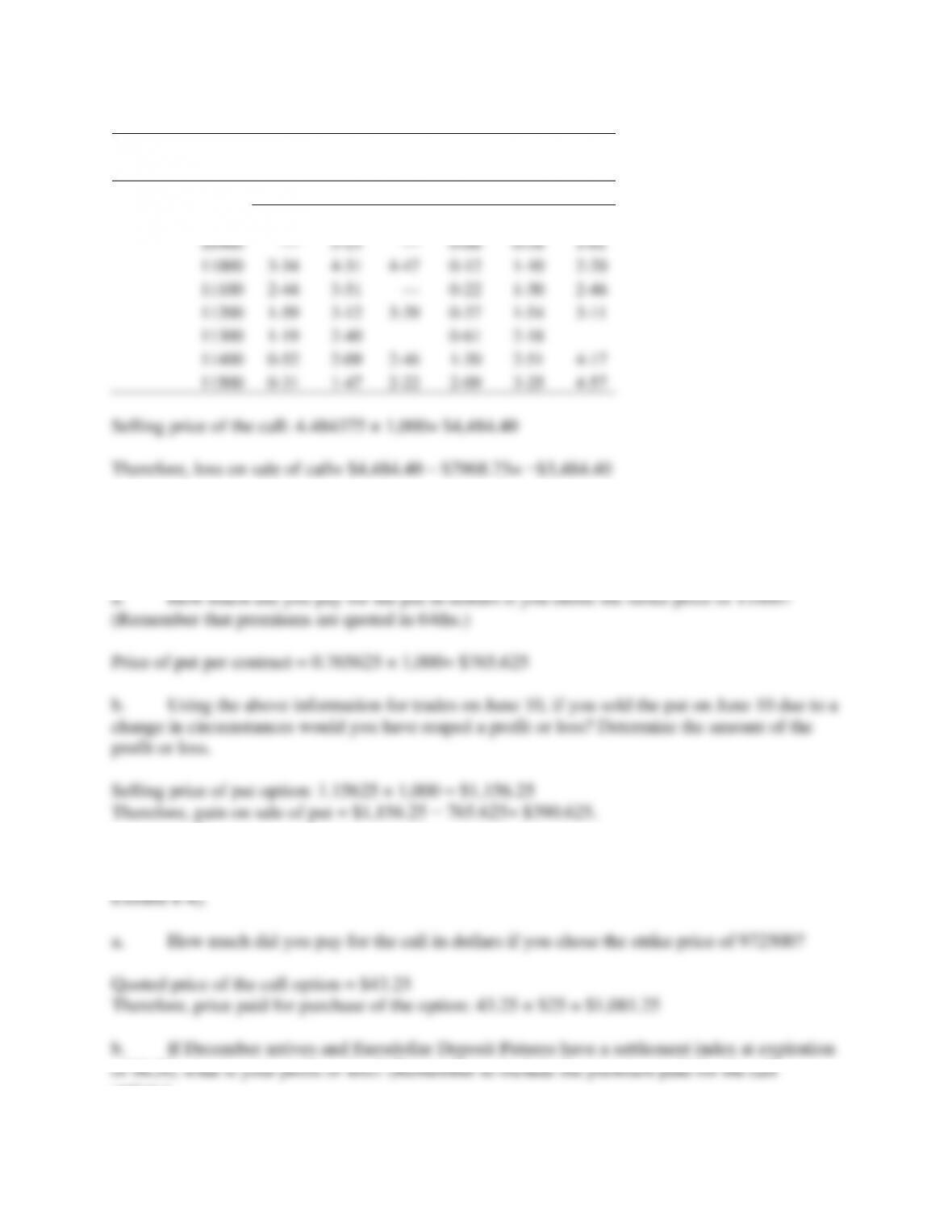
US TREASURY BONDS (CBOT)
$100,000, pts & 64ths of 100 pct
Calls
Puts
Strike Price
Jul
Sep
Dec
Jul
Sep
Dec
10900
—
5-15
—
0-06
0-58
1-61
11000
3-34
4-31
4-47
0-12
1-10
2-20
11100
2-44
3-51
—
0-22
1-30
2-46
11200
1-59
3-12
3-39
0-37
1-54
3-11
11300
1-19
2-40
—
0-61
2-18
—
11400
0-52
2-09
2-46
1-30
2-51
4-17
11500
0-31
1-47
2-22
2-09
3-25
4-57
Selling price of the call: 4.484375 × 1,000= $4,484.40
Therefore, loss on sale of call= $4,484.40 – $7968.75= −$3,484.40
8-10 Refer to the information given for problem 9. You hedged your financial firm’s exposure
to increasing interest rates by buying one September put on Treasury bond futures at the
premium quoted for April 15 of the same year (see Exhibit 8-4).
8-11. You hedged your thrift institution’s exposure to declining interest rates by buying one
December call on Eurodollar deposit futures at the premium quoted earlier on April 15 (see
option.)
Chapter 08 – Risk Management: Financial Futures, Options, Swaps, and Other Hedging Tools
8-13
8-12. You hedged your financial firm’s exposure to increasing interest rates by buying one
December put on Eurodollar deposit futures at the premium quoted earlier on April 15 (see
of 96.50, what is your profit or loss? (Remember to include the premium paid for the put option.)
8-13. A bank is considering the use of options to deal with a serious funding cost problem.
Deposit interest rates have been rising for six months, currently averaging 5 percent, and are
expected to climb as high as 6.75 percent over the next 90 days. The bank plans to issue $60
million in new money market deposits in about 90 days. It can buy put or call options on 90 day
8-14. Hokie Savings wants to purchase a portfolio of home mortgage loans with an expected
5.5 percent range. Treasury bond options are available today at a quote of 10,900 (i.e., $109,000
Chapter 08 – Risk Management: Financial Futures, Options, Swaps, and Other Hedging Tools
8-14
per $100,000 contract), upon payment of a $700 premium, and are forecast to drop to $99,000
8-15. A savings and loan’s credit rating has just slipped, and half of its assets are long term
mortgages. It offers to swap interest payments with a money center bank in a $100 million deal.
The bank can borrow short term at LIBOR (3 percent) and long term at 3.95 percent. The S&L
must pay LIBOR plus 1.5 percent on short term debt and 7 percent on long term debt. Show how
these parties could put together a swap deal that benefits both of them.
8-15
8-16. A financial firm plans to borrow $100 million in the money market at a current interest
rate of 4.5 percent. However, the borrowing rate will float with market conditions. To protect
itself, the firm has purchased an interest-rate cap of 5 percent to cover this borrowing. If money
market interest rates on these funds sources suddenly rise to 5.5 percent as the borrowing begins,
( )
1
= 0.055 – 0.05 × 100,000,000 × = $41,666.67
12
8-17. Suppose that Gwynn’s Island Savings Association has recently granted a loan of $2
million to Oyster Farms at prime plus 0.5 percent for six months. In return for granting Oyster
Farms an interest-rate cap of 6.5 percent on its loan, this thrift has received from this customer a
floor rate on the loan of 5 percent. Suppose that, as the loan is about to start, the prime rate
12