Chapter 07 – Risk Management for Changing Interest Rates: Asset-Liability Management and Duration Techniques
7-1
CHAPTER 7
RISK MANAGEMENT FOR CHANGING INTEREST RATES: ASSET-LIABILITY
MANAGEMENT AND DURATION TECHNIQUES
Goals of This Chapter: The purpose of this chapter is to explore the options bankers have today
for dealing with risk–especially the risk of loss due to changing interest rates–and to see how a
bank’s management can coordinate the management of its assets with the management of its
liabilities in order to achieve the institution’s goals.
Key Topics In This Chapter
• Asset, Liability, and Funds Management
• Market Rates and Interest Rate Risk
• The Goals of Interest Rate Hedging
• Interest-Sensitive Gap Management
• Duration Gap Management
• Limitations of Interest Rate Risk Management Techniques
Chapter Outline
I. Introduction: The Necessity for Coordinating Bank Asset and Liability Management
Decisions
II. Asset-Liability Management Strategies
A. Asset Management Strategy
B. Liability Management Strategy
C. Funds Management Strategy
III. Interest Rate Risk: One of the Greatest Management Challenges
A. Forces Determining Interest Rates
B. The Measurement of Interest Rates
1. Yield to Maturity
2. Bank Discount Rate
C. The Components of Interest Rates
1. Risk Premiums
2. Yield Curves
3. The Maturity Gap and the Yield Curve
D. Responses to Interest Rate Risk
1. Asset-Liability Committee (ALCO)
IV. One of the Goals of Interest Rate Hedging: Protect the Net Interest Margin
A. The Net Interest Margin
B. Interest-Sensitive Gap Management as a Risk-Management Tool
1. Asset-Sensitive Gap
2. Liability-Sensitive Gap
3. Dollar Interest-Sensitive Gap
4. Relative Interest Sensitive Gap

Chapter 07 – Risk Management for Changing Interest Rates: Asset-Liability Management and Duration Techniques
7-2
5. Interest Sensitivity Ratio
6. Computer-Based Techniques
7. Cumulative Gap
8. Strategies in Gap Management
C. Problems with Interest-Sensitive GAP Management
V. The Concept of Duration as a Risk-Management Tool
A. Definition of Duration
B. Calculation of Duration
C. Net Worth and Duration
D. Price Sensitivity to Changes in Interest Rates and Duration
E. Convexity and Duration
VI. Using Duration to Hedge Against Interest Rate Risk
A. Duration Gap
1. Dollar Weighted Duration of Assets
2. Dollar Weighted Duration of Liabilities
3. Positive Duration Gap
4. Negative Duration Gap
B. Change in the Bank’s Net Worth
VII The Limitations of Duration Gap Management
VIII. Summary of the Chapter
Concept Checks
7-1. What do the following terms mean: Asset management? Liability management? Funds
management?
Asset management refers to a banking strategy where management has control over the
allocation of bank assets but believes the bank’s sources of funds (principally deposits) are
7-2. What factors have motivated financial institutions to develop funds management
techniques in recent years?

Chapter 07 – Risk Management for Changing Interest Rates: Asset-Liability Management and Duration Techniques
7-3
7-3. What forces cause interest rates to change? What kinds of risk do financial firms face
when interest rates change?
Interest rates are determined, not by individual banks, but by the collective borrowing and
lending decisions of thousands of participants in the money and capital markets. They are also
7-4. What makes it so difficult to correctly forecast interest rate changes?
Interest rates cannot be set by an individual bank or even by a group of banks. They are
determined by thousands of investors trading in the credit markets. Moreover, each market rate
7-5. What is the yield curve, and why is it important to know about its shape or slope?
The yield curve is the graphic picture of how interest rates vary with different maturities of loans
Chapter 07 – Risk Management for Changing Interest Rates: Asset-Liability Management and Duration Techniques
most of the short-term interest rates are attached to bank deposits and money market borrowings
(i.e., bank liabilities).
7-6. What is it that a lending institution wishes to protect from adverse movements in interest
rates?
Changes in market interest rates can damage a financial firm’s profitability by increasing its cost
7-7. What is the goal of hedging?
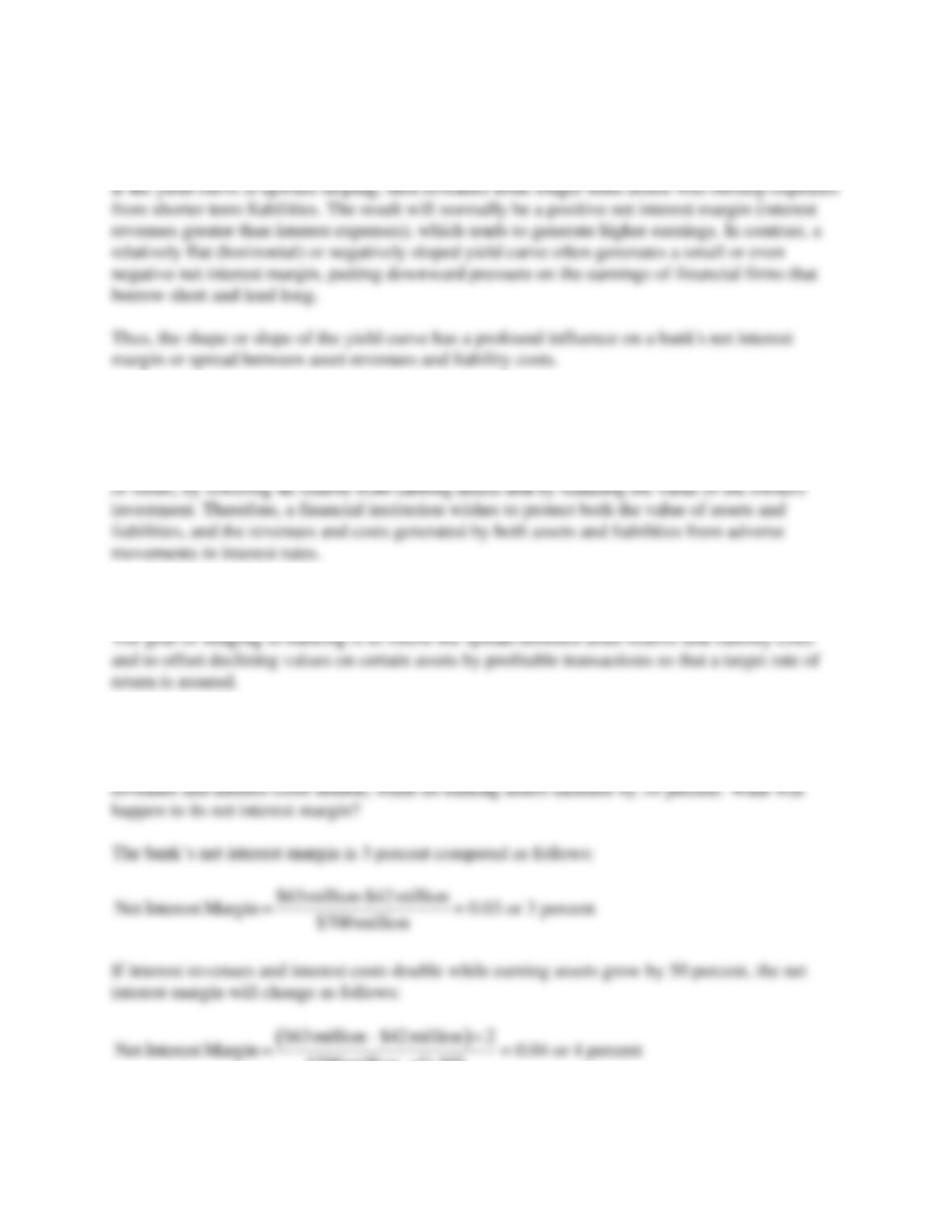
7-8. First National Bank of Bannerville has posted interest revenues of $63 million and
interest costs from all of its borrowings of $42 million. If this bank possesses $700 million in
total earning assets, what is First National’s net interest margin? Suppose the bank’s interest

Chapter 07 – Risk Management for Changing Interest Rates: Asset-Liability Management and Duration Techniques
7-5
Clearly the net interest margin increases—in this case by one third.
7-9. Can you explain the concept of gap management?
Gap management requires the management to perform analysis of the maturities and repricing
7-10 When is a financial firm asset sensitive? Liability sensitive?
A financial firm is asset sensitive when it has more interest-rate sensitive assets maturing or
7-11. Commerce National Bank reports interest-sensitive assets of $870 million and
interest-sensitive liabilities of $625 million during the coming month. Is the bank asset sensitive
or liability sensitive? What is likely to happen to the bank’s net interest margin if interest rates
7-12. Peoples’ Savings Bank has a cumulative gap for the coming year of + $135 million, and
interest rates are expected to fall by two and a half percentage points. Can you calculate the
expected change in net interest income that this thrift institution might experience? What change
7-13 How do you measure the dollar interest-sensitive gap? The relative interest-sensitive gap?
What is the interest sensitivity ratio?
The dollar interest-sensitive gap is measured by taking the repriceable (interest-sensitive) assets
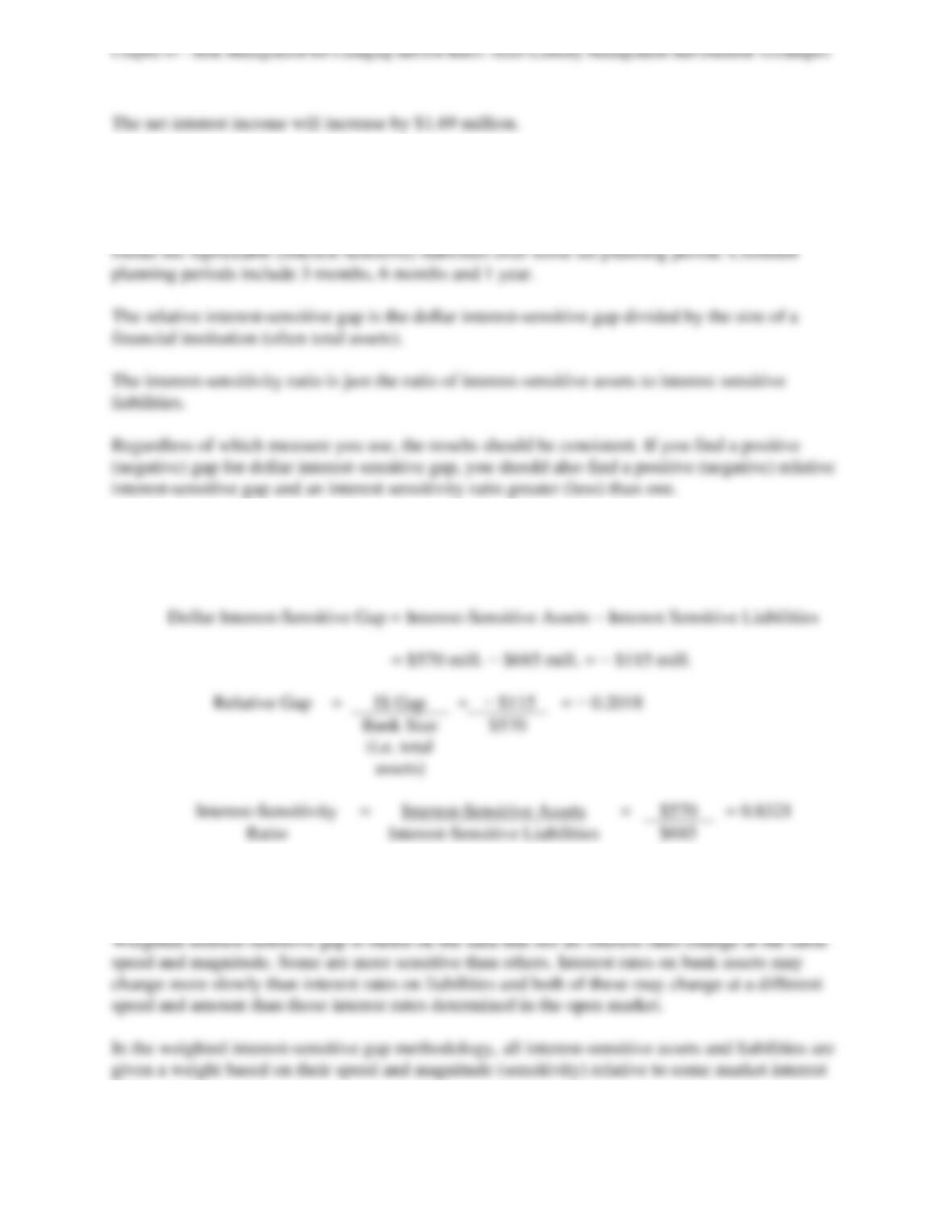
7-14 Suppose Carroll Bank and Trust reports interest-sensitive assets of $570 million and
interest-sensitive liabilities of $685 million. What is the bank’s dollar interest-sensitive gap? Its
relative interest-sensitive gap and interest-sensitivity ratio?

Chapter 07 – Risk Management for Changing Interest Rates: Asset-Liability Management and Duration Techniques
7-7
Fed Fund’s loans, for example, have an interest rate which is determined in the market and which
would have a weight of 1. All other loans, investments and deposits would have a weight based
7-16. What is duration?
risk.
7-17. How is a financial institution’s duration gap determined?
A bank’s duration gap is determined by taking the difference between the dollar-weighted
7-18. What are the advantages of using duration as an asset-liability management tool as
opposed to interest-sensitive gap analysis?
7-19. How can you tell if you are fully hedged using duration gap analysis?
You are fully hedged when the dollar weighted duration of the assets portfolio of the bank equals
Chapter 07 – Risk Management for Changing Interest Rates: Asset-Liability Management and Duration Techniques
7-8
7-20. What are the principal limitations of duration gap analysis? Can you think of some way
of reducing the impact of these limitations?
There are several limitations with duration gap analysis. It is often difficult to find assets and
liabilities of the same duration to fit into the financial-service institution’s portfolio. In addition,
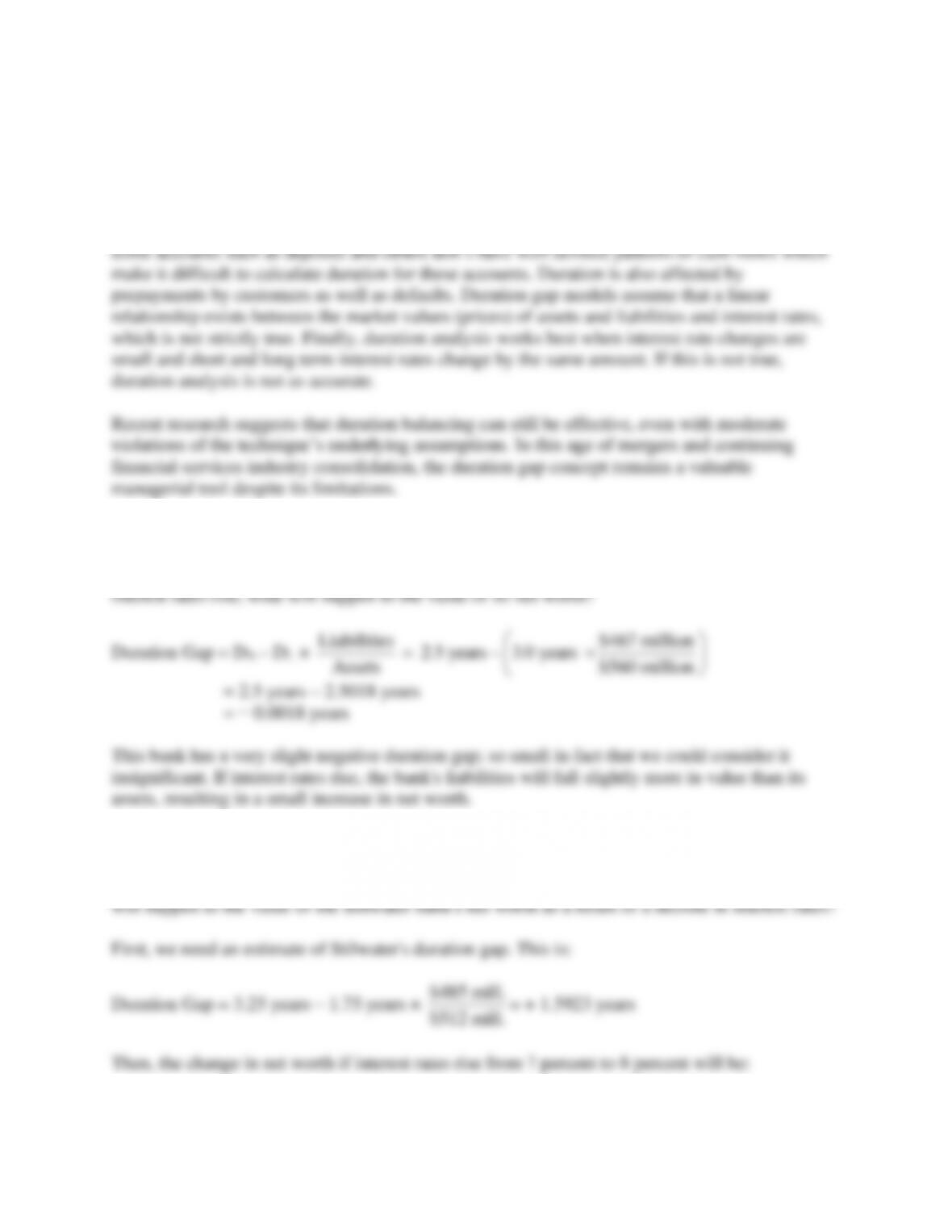
7-21. Suppose that a savings institution has an average asset duration of 2.5 years and an
average liability duration of 3.0 years. If the savings institution holds total assets of $560 million
and total liabilities of $467 million, does it have a significant leverage-adjusted duration gap? If
7-22. Stilwater Bank and Trust Company has an average asset duration of 3.25 years and an
average liability duration of 1.75 years. Its liabilities amount to $485 million, while its assets
total $512 million. Suppose that interest rates were 7 percent and then rise to 8 percent. What

Chapter 07 – Risk Management for Changing Interest Rates: Asset-Liability Management and Duration Techniques
7-9
Change in NW =
.01 .01
–3.25 years $512 mill – –1.75 years $485 mill.
(1 .07) (1 .07)
++
++
7-1. A government bond is currently selling for $1,195 and pays $75 per year in interest for
14 years when it matures. If the redemption value of this bond is $1,000, what is its yield to
7-2. Suppose the government bond described in problem 1 above is held for five years and
then the savings institution acquiring the bond decides to sell it at a price of $940. Can you figure
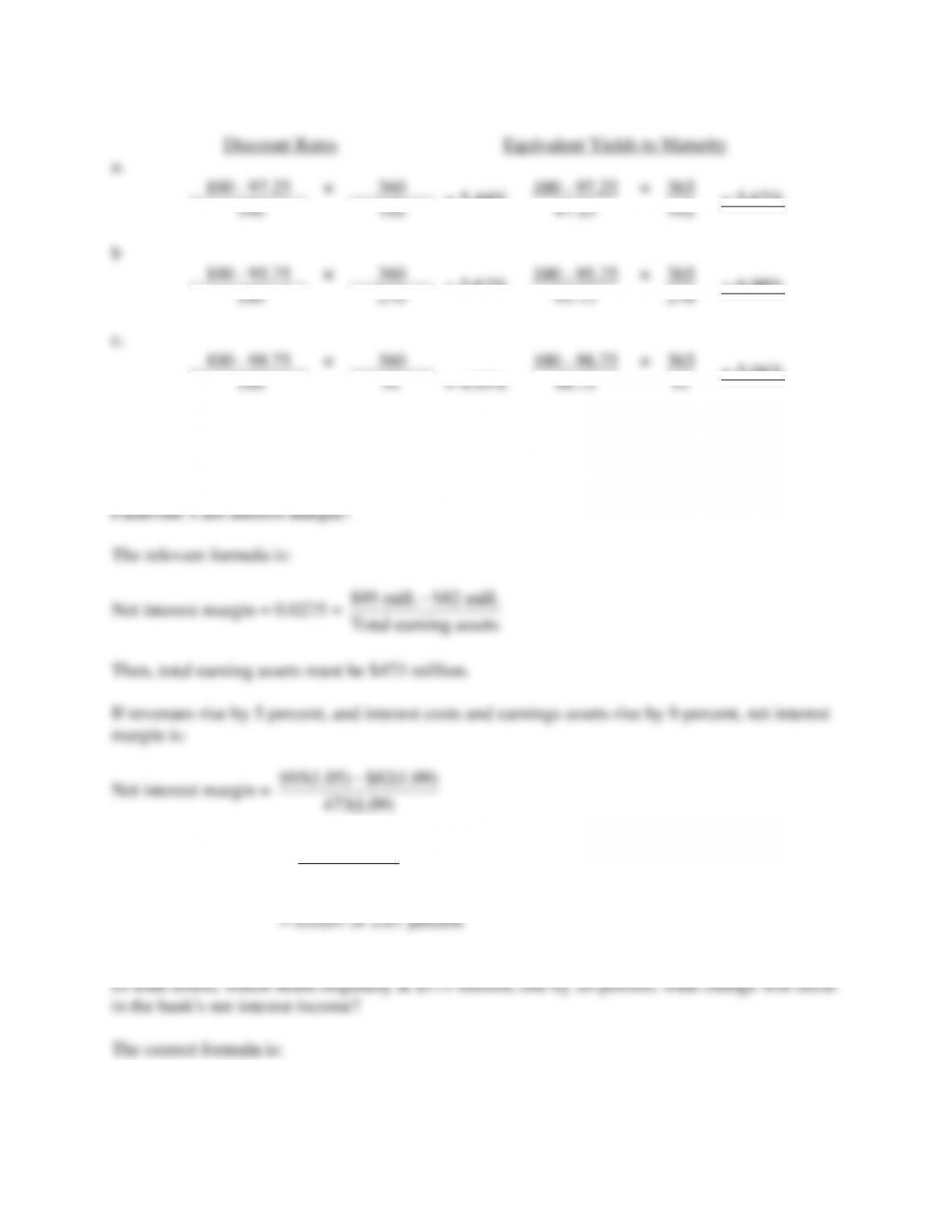
7-3. U.S. Treasury bills are available for purchase this week at the following prices (based
upon $100 par value) and with the indicated maturities:
a. $97.25, 182 days.
Chapter 07 – Risk Management for Changing Interest Rates: Asset-Liability Management and Duration Techniques
Chapter 07 – Risk Management for Changing Interest Rates: Asset-Liability Management and Duration Techniques
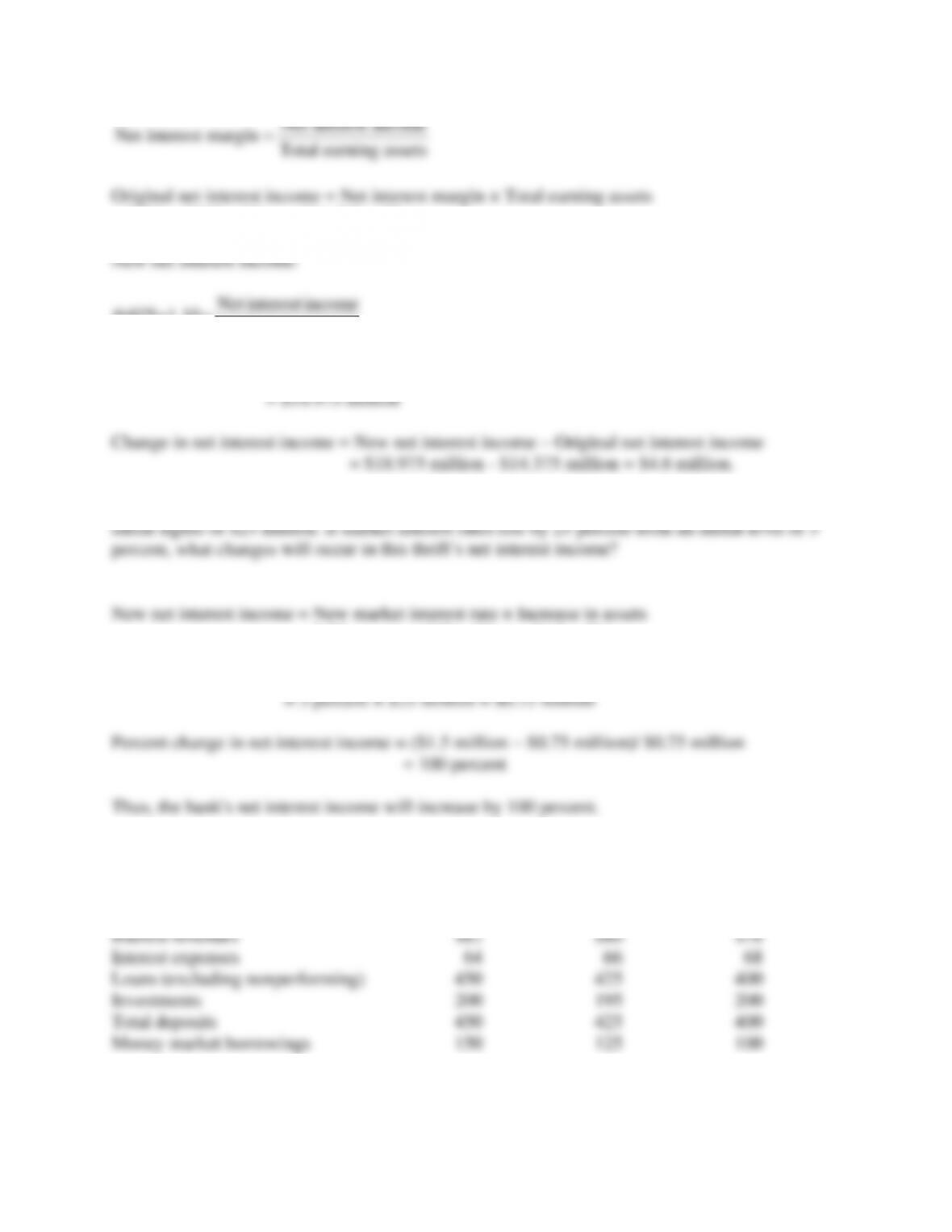
Net interest income
Net interest margin Total earning assets
=
Original net interest income = Net interest margin × Total earning assets
= 2.5% × $575 million = $14.375 million
Chapter 07 – Risk Management for Changing Interest Rates: Asset-Liability Management and Duration Techniques
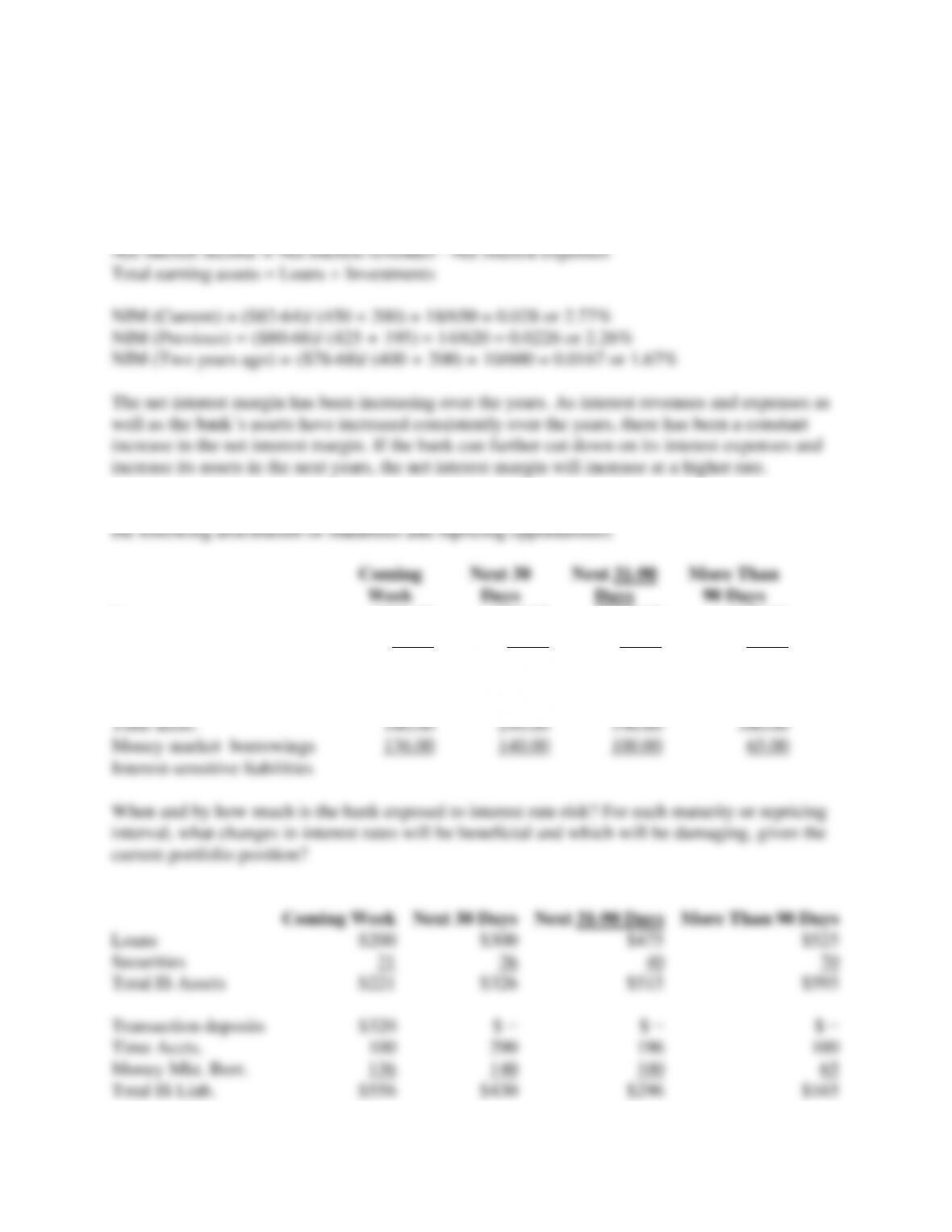
What has been happening to the bank’s net interest margin? What do you think caused the
changes you have observed? Do you have any recommendations for New Comers’ management
team?
Net interest margin (NIM) = Net interest income/Total earning assets
Where,
7-8 The First National Bank of Dogsville finds that its asset and liability portfolio contains
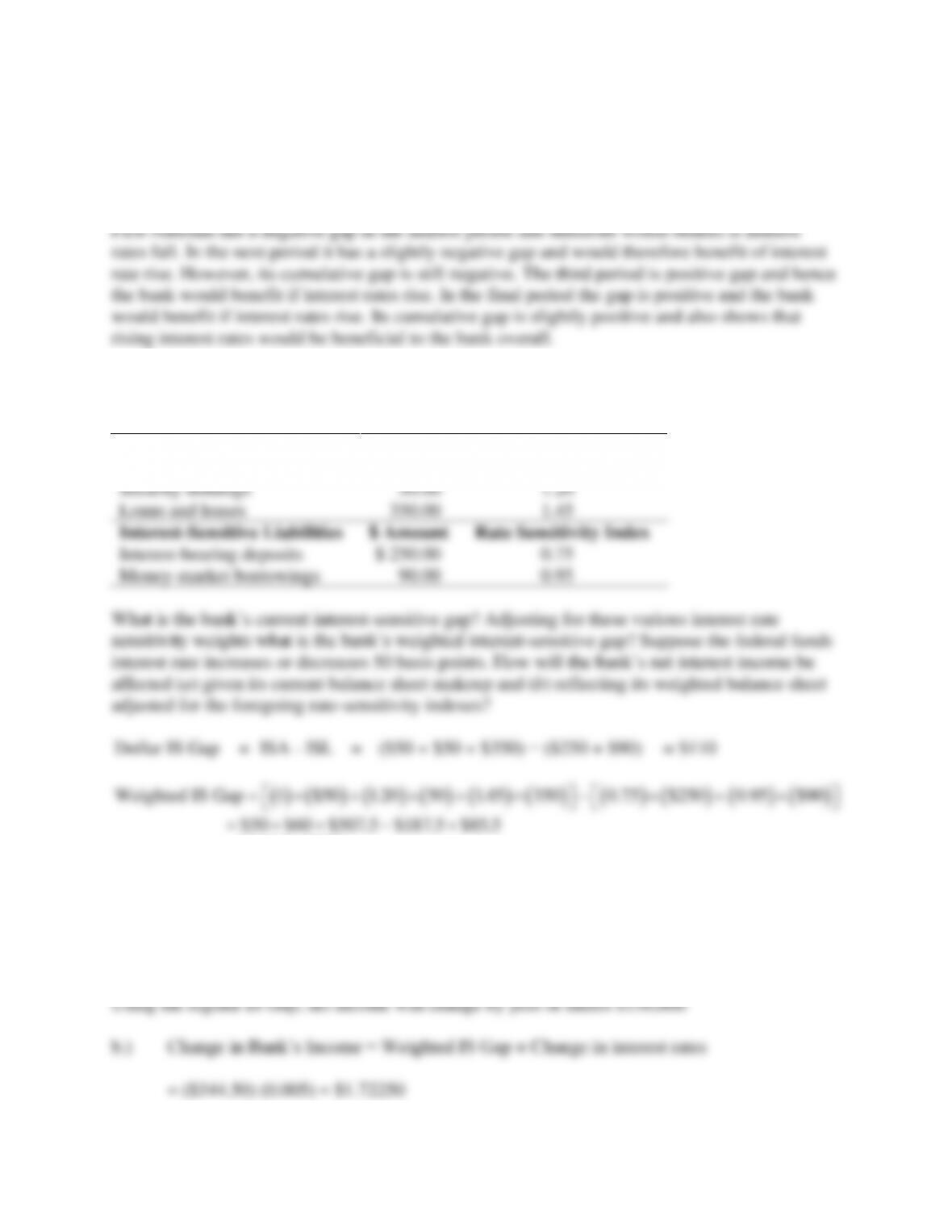
Chapter 07 – Risk Management for Changing Interest Rates: Asset-Liability Management and Duration Techniques
=
ISA – ISL
=
($50 + $50 + $350) − ($250 + $90)
= $110
GAP
−335
−104
+219
+430
Cumulative GAP
−335
−439
−220
+210
7-9 Sunset Savings Bank currently has the following interest-sensitive assets and liabilities
on its balance sheet with the interest-rate sensitivity weights noted.
Interest-Sensitive Assets
$ Amount
Rate Sensitivity Index
Federal fund loans
$ 50.00
1.00
Security holdings
50.00
1.20
Loans and leases
350.00
1.45
Interest-Sensitive Liabilities
$ Amount
Rate Sensitivity Index
Interest-bearing deposits
$ 250.00
0.75
Money-market borrowings
90.00
0.95
7-14
7-10 Sparkle Savings Association has interest-sensitive assets of $400 million, interest-
sensitive liabilities of $325 million, and total assets of $500 million. What is the bank’s dollar
interest-sensitive gap? What is Sparkle’s relative interest-sensitive gap? What is the value of its
interest-sensitivity ratio? Is it asset sensitive or liability sensitive? Under what scenario for
Relative IS Gap
=
ISA – ISL
=
$75
= 0.15
Bank Size
$500
Interest-Sensitivity Ratio
=
ISA
=
$400
= 1.23
ISL
$325
Here, the interest sensitivity gap is positive and asset sensitive as the interest sensitive assets are
greater than interest sensitive liabilities. Sparkle Savings Association, being an asset sensitive
financial firm, will have a positive relative IS gap and an interest-sensitivity ratio greater than 1.
In case of a positive IS gap, there will be a gain in net interest income if the market interest rates
are rising. For a positive IS gap, there will be a loss in net interest income, if the market interest
rates are falling.
7-11 Snowman Bank, N.A., has a portfolio of loans and securities expected to generate cash
inflows for the bank as follows:
Expected Cash Inflows of
Principal and Interest
Payments
Annual Period in Which Cash Receipts
Are Expected
$1,275,600
Current year
746,872
Two years from today
341,555
Three years from today
62,482
Four years from today
9,871
Five years from today
Deposits and money market borrowings are expected to require the following cash outflows:
Expected Cash Outflows of
Principal and Interest
Payments
Annual Period during Which Cash
Payments Must Be Made
$1,295,500
Current year
831,454
Two years from today
123,897
Three years from today
Chapter 07 – Risk Management for Changing Interest Rates: Asset-Liability Management and Duration Techniques
1,005
Four years from today
—–
Five years from today

Chapter 07 – Risk Management for Changing Interest Rates: Asset-Liability Management and Duration Techniques
7-12. Given the cash inflow and outflow figures in Problem 11 for Snowman Bank, N.A.,
suppose that interest rates began at a level of 4.25 percent and then suddenly rise to 4.75 percent.
If the bank has total assets of $20 billion and total liabilities of $18 billion, by how much would
1.6515 – 1.4657 ×
$18 bill.
$20 bill.
= 0.1163
The change in Snowman’s net worth would be calculated as:
Δr Δr

Chapter 07 – Risk Management for Changing Interest Rates: Asset-Liability Management and Duration Techniques
how much would Conway’s net worth change if, instead of rising, interest rates fell from 5
percent to 4.5 percent?
The key formula is:
Δr Δr

Chapter 07 – Risk Management for Changing Interest Rates: Asset-Liability Management and Duration Techniques
7-18
LL0 = 8 – D 1.351 or D 1.351 8 =
7-16 Blue Moon National Bank holds assets and liabilities whose average durations and dollar
amounts are as shown in this table:
Asset and Liability Items
Avg. Duration
(years)
Dollar Amount
(millions)
Investment Grade Bonds
15.00
$65.00
Commercial Loans
3.00
$400.00
Consumer Loans
7.00
$250.00
Deposits
1.25
$600.00
Nondeposit Borrowings
0.50
$50.00
What is the weighted average duration of Blue Moon’s asset portfolio and liability portfolio?
7-17 A government bond currently carries a yield to maturity of 6 percent and a market price
of $1,168.49. If the bond promises to pay $100 in interest annually for five years, what is its
current duration?

Chapter 07 – Risk Management for Changing Interest Rates: Asset-Liability Management and Duration Techniques
7-19
7-18 Carter National Bank holds $15 million in government bonds having a duration of 12