Chapter 05 – The Financial Statements of Banks and Their Principal Competitors
5-1
CHAPTER 5
THE FINANCIAL STATEMENTS OF BANKS AND THEIR PRINCIPAL
COMPETITORS
Goal of This Chapter: The purpose of this chapter is to acquaint the reader with the content,
structure and purpose of bank financial statements and to help managers understand how
information from bank financial statements can be used as tools to reveal how well their banks
are performing.
Key Topics in this Chapter
• An Overview of the Balance Sheets and Income Statements of Banks and Other
Financial Firms
• The Balance Sheet or Report of Condition
• Asset Items
• Liability Items
• Recent Expansion of Off-Balance Sheet Items
• The Problem of Book-Value Accounting and “Window Dressing”
• Components of the Income Statement: Revenues and Expenses
• Appendix: Sources of Information on the Financial-Services Industry
Chapter Outline
I. Introduction: The Statements Reviewed in This Chapter
II. An Overview of Balance Sheets and Income Statements
III. The Balance Sheet (Report of Condition)
A. The Principal Types of Accounts
B. Assets of the Banking Firm
1. Cash and Due from Depository Institutions
2. Investment Securities: The Liquid Portion
3. Investment Securities: The Income-Generating Portion
4. Trading Account Assets
5. Federal Funds Sold and Reverse Repurchase Agreements
6. Loans and Leases
7. Loan Losses
8. Specific and General Reserves
9. International Loan Reserves
10. Unearned Income
11. Nonperforming (Noncurrent) Loans

Chapter 05 – The Financial Statements of Banks and Their Principal Competitors
5-2
12. Bank Premises and Fixed Assets
13. Other Real Estate Owned (OREO)
14. Intangible and Miscellaneous (“Other”) Assets
C. Liabilities of the Banking Firm
1. Deposits
a. Noninterest-Bearing Demand Deposits
b. Savings Deposits
c. NOW Accounts
d. Money Market Deposit Accounts
e. Time Deposits
2. Borrowings from Nondeposit Sources
3. Equity Capital for the Banking Firm
a. Preferred Stock
b. Common Equity
D. Comparative Balance Sheet Ratios for Different Size Banks
E. Recent Expansion of Off-Balance-Sheet Items in Banking
F. The Problem of Book-Value Accounting
G. Auditing: Assuring Reliability of Financial Statements
IV. Components of the Income Statement (Report of Income)
A. Financial Flows and Stocks
1. Interest Income
2. Interest Expenses
3. Net Interest Income
4. Loan Loss Expense
5. Noninterest Income
6. Noninterest Expenses
7. Net Operating Income and Net Income
B. Comparative Income Statement Ratios for Different-Size Financial Firms
V. The Financial Statements of Leading Nonbank Financial Firms: A Comparison to Bank
Statements
VI. An Overview of Key Features of Financial Statements and Their Consequences
VII. Summary of the Chapter
Concept Checks
5-1. What are the principal accounts that appear on a bank’s balance sheet (Report of
Condition)?
5-2. Which accounts are most important and which are least important on the asset side of a
bank’s balance sheet?
Chapter 05 – The Financial Statements of Banks and Their Principal Competitors
5-3
The principal bank asset items from most important to least important are:
Rank Order Assets
1 Cash and Due from Depository Institutions
5-3. What accounts are most important on the liability side of a balance sheet?
The principal bank liability items from most important to least important are:
5-4. What are the essential differences among demand deposits, savings deposits, and time
deposits?
Demand deposits are regular checking accounts against which a customer can write unlimited
checks or make any number of personal withdrawals. Regular checking accounts do not bear
interest under current U.S. law and regulation.
Chapter 05 – The Financial Statements of Banks and Their Principal Competitors
5-4
5-5. What are primary reserves and secondary reserves, and what are they supposed to do?
Primary reserves consist of cash, including a bank’s vault cash and checkable deposits held with
other banks or any other funds such as reserves with the Federal Reserve banks that are
5-6. Suppose that a bank holds cash in its vault of $1.4 million, short-term government
securities of $12.4 million, privately issued money market instruments of $5.2 million, deposits
at the Federal Reserve banks of $20.1 million, cash items in the process of collection of $0.6
million, and deposits placed with other banks of $16.4 million. How much in primary reserves
5-7. What are off-balance-sheet items and why are they important to some financial firms?
Off-balance-sheet items are usually transactions that generate fee income for a bank (such as
5-5
5-8. Why are bank accounting practices under attack right now? In what ways could financial
institutions improve their accounting methods?
The traditional practice of banks has been to record the value of assets and liabilities at their
value on the day the accounts were originally created and not change those values over the life of
5-9. What accounts make up the Report of Income (income statement of a bank)?
The Report of Income includes all sources of bank revenue (loan income, investment security
5-10. In rank order, what are the most important revenue and expense items on a Report of
Income?
By dollar volume in most recent years the rank order of the revenue and expense items on a
bank’s Report of Income is:
5-11. What is the relationship between the provision for loan losses on a bank’s Report of
Income and the allowance for loan losses on its Report of Condition?
reserve).
Chapter 05 – The Financial Statements of Banks and Their Principal Competitors
5-6
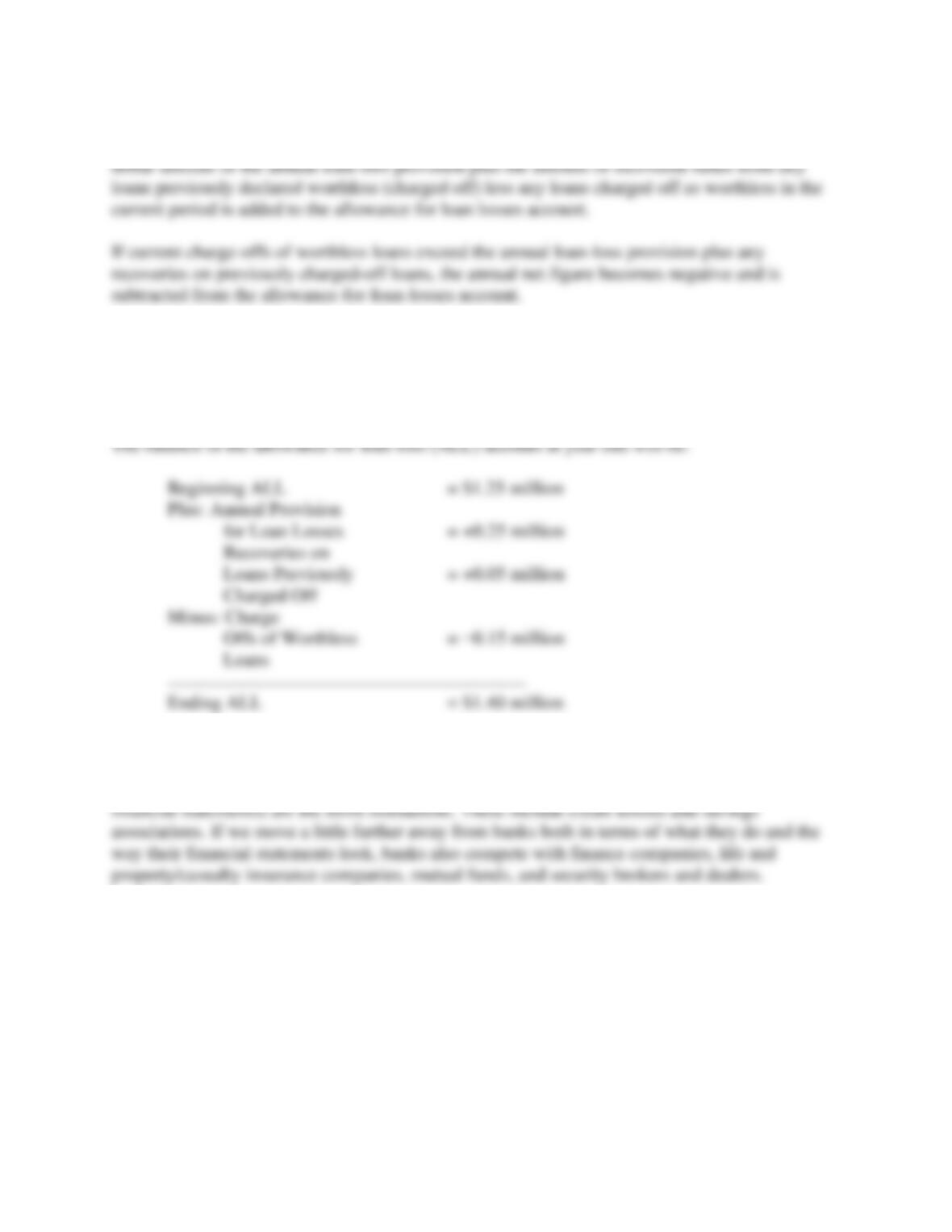
The allowance for loan losses is built up gradually over time by an annual noncash expense item
that is charged against the bank’s current income, known as the provision for loan losses. The
5-12. Suppose a bank has an allowance for loan losses of $1.25 million at the beginning of the
year, charges current income for a $250,000 provision for loan losses, charges off worthless
loans of $150,000, and recovers $50,000 on loans previously charged off. What will be the
balance in the allowance for loan losses at year-end?
5-13. Who are banking’s chief competitors in the financial-services marketplace?
The closest competitors of banks in recent years (at least in terms of the similarity of their
5-14. How do the financial statements of major nonbank financial firms resemble or differ from
bank financial statements? Why do these differences or similarities exist?
Chapter 05 – The Financial Statements of Banks and Their Principal Competitors
5-7
Banks have very similar financial statements to credit union and savings associations. The only
difference may be in the structure of their loan portfolio. Credit unions probably have more loans
to individuals and savings associations may have more real estate loans as well as loans to
5-15. What major trends are changing the content of the financial statements prepared by
financial firms?
The content of the financial statements of financial firms is changing for several reasons. One
trend that has affected the financial statements of financial firms is the call for those statements
5-16. What are the key features or characteristics of the financial statements of banks and
similar financial firms? What are the consequences of these statement features for managers of
Chapter 05 – The Financial Statements of Banks and Their Principal Competitors
5-8
and firms with large amount of operating leverage can face large fluctuations in net income and
earnings per share for small changes in revenues.
Financial-service firms do not have this problem. However, financial service firms have large
Problems
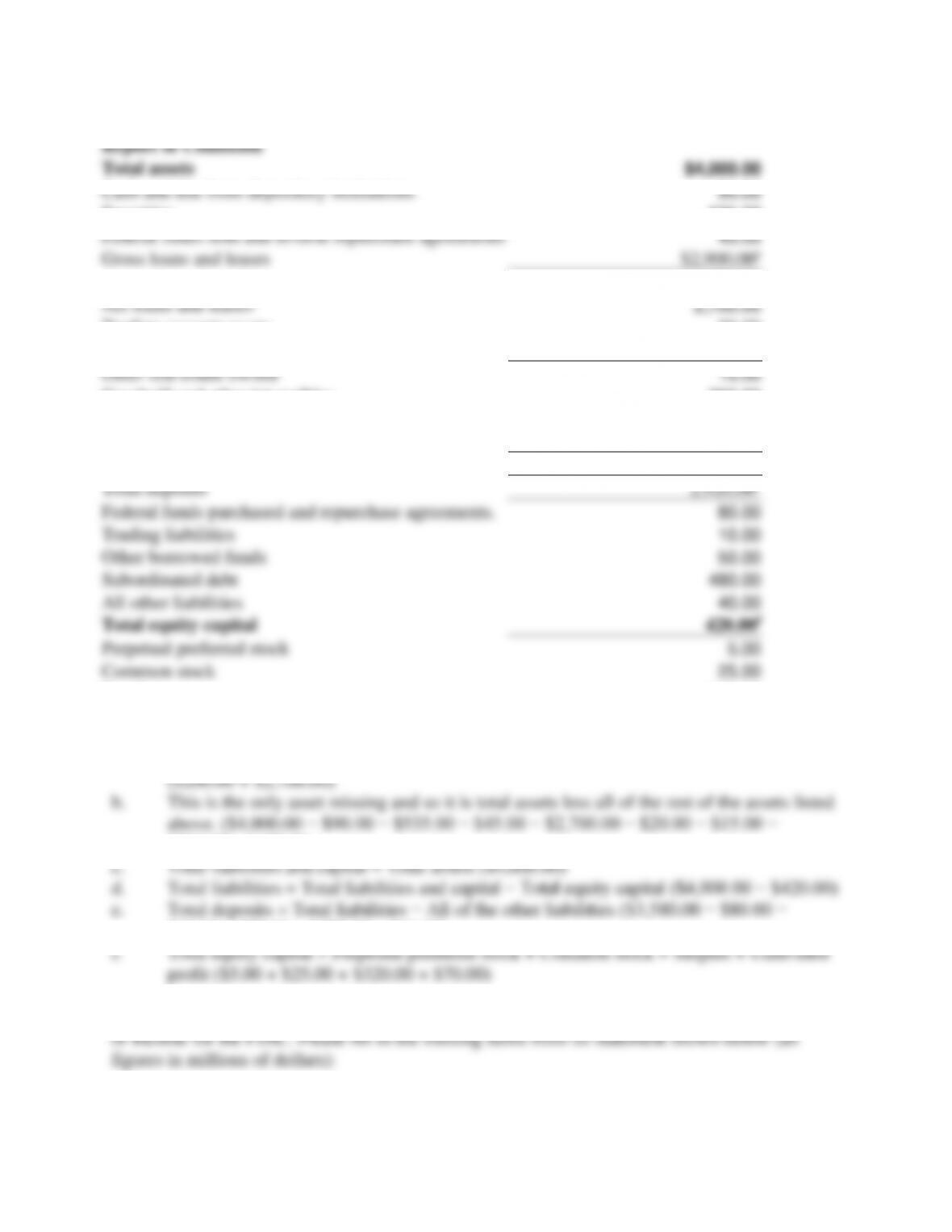
5-1. Norfolk National Bank has just submitted its Report of Condition to the FDIC. Please fill
Report of Condition
Total assets
$4,000.00
Cash and due from depository institutions
90.00
Securities
535.00
Federal funds sold and reverse repurchase agreements
45.00
Gross loans and leases
Loan loss allowance
200.00
Net loans and leases
2,700.00
Trading account assets
20.00
Bank premises and fixed assets
Other real estate owned
15.00
Goodwill and other intangibles
200.00
All other assets
175.00
Total liabilities and capital
Total liabilities
Total deposits
Federal funds purchased and repurchase agreements.
80.00
Trading liabilities
10.00
Other borrowed funds
50.00
Subordinated debt
480.00
All other liabilities
40.00
Total equity capital
Perpetual preferred stock
5.00
Common stock
25.00
Surplus
320.00
Undivided profits
70.00
Chapter 05 – The Financial Statements of Banks and Their Principal Competitors
5-9
Report of Condition
Total assets
$4,000.00
Cash and due from depository institutions
90.00
Securities
535.00
Federal funds sold and reverse repurchase agreements
45.00
Gross loans and leases
$2,900.00a
Loan loss allowance
200.00
Net loans and leases
2,700.00
Trading account assets
20.00
Bank premises and fixed assets
220.00b
Other real estate owned
15.00
Goodwill and other intangibles
200.00
All other assets
175.00
Total liabilities and capital
4,000.00c
Total liabilities
3,580.00d
Total deposits
2,920.00e
Federal funds purchased and repurchase agreements.
80.00
Trading liabilities
10.00
Other borrowed funds
50.00
Subordinated debt
480.00
All other liabilities
40.00
Total equity capital
420.00f
Perpetual preferred stock
5.00
Common stock
25.00
Surplus
320.00
Undivided profits
70.00
a. Gross loans and leases = Net loans and leases + Loan loss allowance
$200.00 − $175.00)
$10.00 − $50.00 − $480.00 − $40.00)
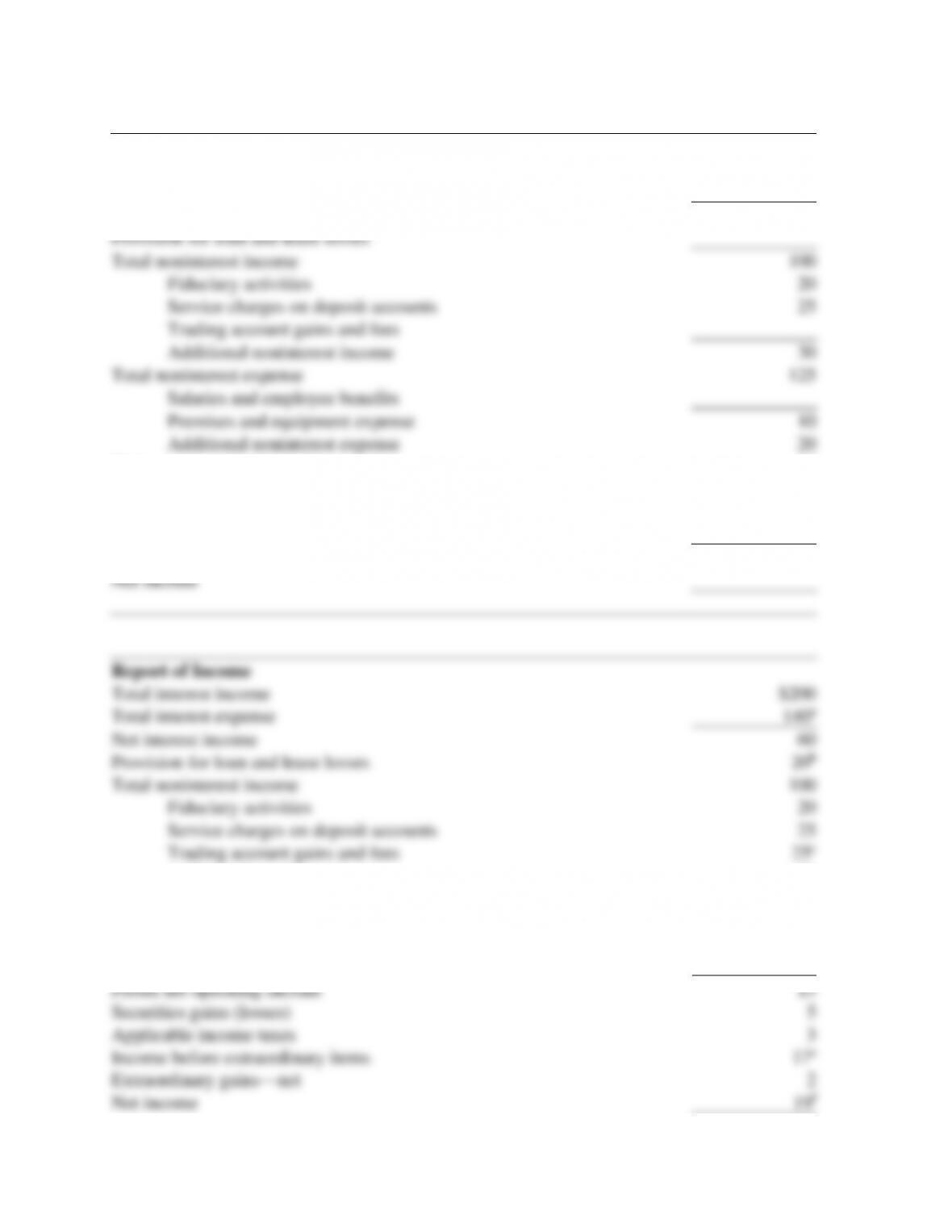
5-2. Along with the Report of Condition submitted above, Norfolk has also prepared a Report
Chapter 05 – The Financial Statements of Banks and Their Principal Competitors
5-10
Report of Income
Total interest income
$200
Total interest expense
Net interest income
60
Provision for loan and lease losses
Total noninterest income
100
Fiduciary activities
20
Service charges on deposit accounts
25
Trading account gains and fees
Additional noninterest income
30
Total noninterest expense
125
Salaries and employee benefits
Premises and equipment expense
10
Additional noninterest expense
20
Pretax net operating income
15
Securities gains (losses)
5
Applicable income taxes
3
Income before extraordinary items
Extraordinary gains—net
2
Net income
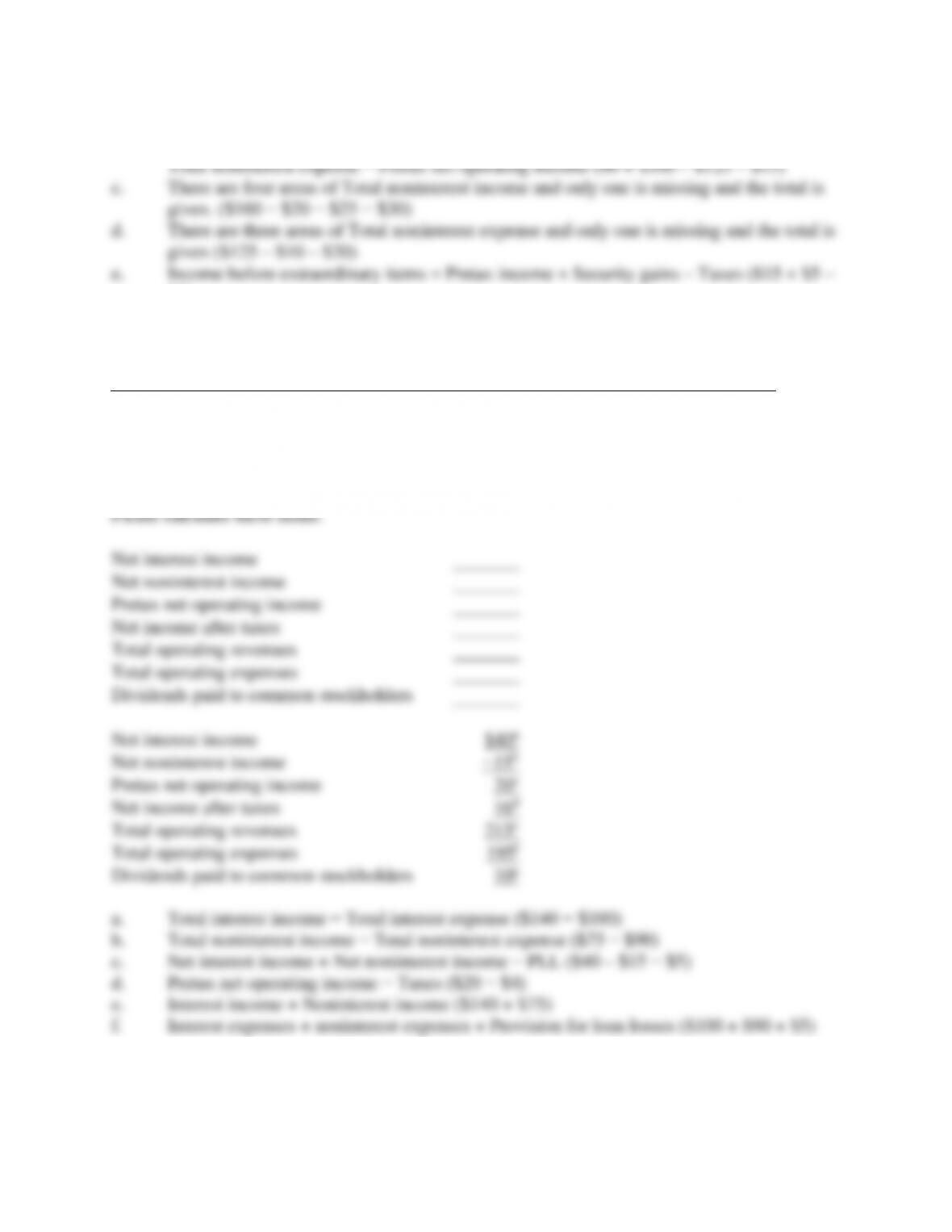
Report of Income
Total interest income
$200
Total interest expense
140a
Net interest income
60
Provision for loan and lease losses
20b
Total noninterest income
100
Fiduciary activities
20
Service charges on deposit accounts
25
Trading account gains and fees
25c
Additional noninterest income
30
Total noninterest expense
125
Salaries and employee benefits
95d
Premises and equipment expense
10
Additional noninterest expense
20
Pretax net operating income
15
Securities gains (losses)
5
Applicable income taxes
3
Income before extraordinary items
17e
Extraordinary gains—net
2
Net income
19f
Chapter 05 – The Financial Statements of Banks and Their Principal Competitors
5-11
a. Total interest expense = Total interest income − Net interest income ($200 − $60)
b. Provision for loan and lease losses = Net interest income + Total noninterest income −
$3)
f. Net income = Income before extraordinary items + Extraordinary gains—net ($17 + $2)
5-3. If you know the following figures:
Total interest income
$140
Provision for loan losses
$5
Total interest expenses
100
Income taxes
4
Total noninterest income
75
Increases in bank’s undivided profits
6
Total noninterest expenses
90
Net interest income
Net noninterest income
Pretax net operating income
Net income after taxes
Total operating revenues
Total operating expenses
Dividends paid to common stockholders
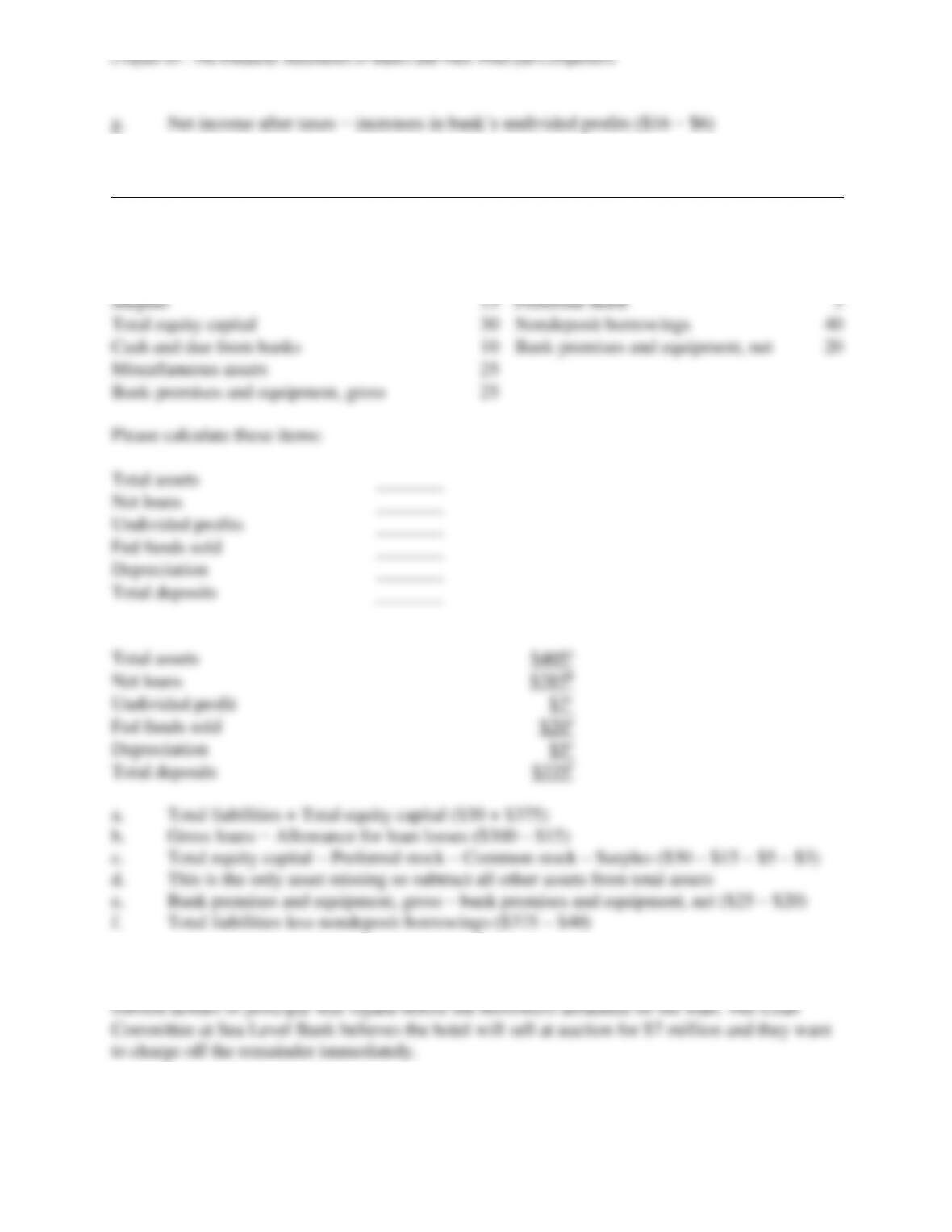
Net interest income
$40a
Net noninterest income
−15b
Pretax net operating income
20c
Net income after taxes
16d
Total operating revenues
215e
Total operating expenses
195f
Dividends paid to common stockholders
10g
5-12
5-4. If you know the following figures:
Gross loans
$300
Trading-account securities
$2
Allowance for loan losses
15
Other real estate owned
4
Investment securities
36
Goodwill and other intangibles
3
Common stock
5
Total liabilities
375
Surplus
15
Preferred stock
3
Total equity capital
30
Nondeposit borrowings
40
Cash and due from banks
10
Bank premises and equipment, net
20
Miscellaneous assets
25
Bank premises and equipment, gross
25
Total assets
Net loans
Undivided profits
Fed funds sold
Depreciation
Total deposits
Total assets
$405a
Net loans
$285b
Undivided profit
$7c
Fed funds sold
$20d
Depreciation
$5e
Total deposits
$335f
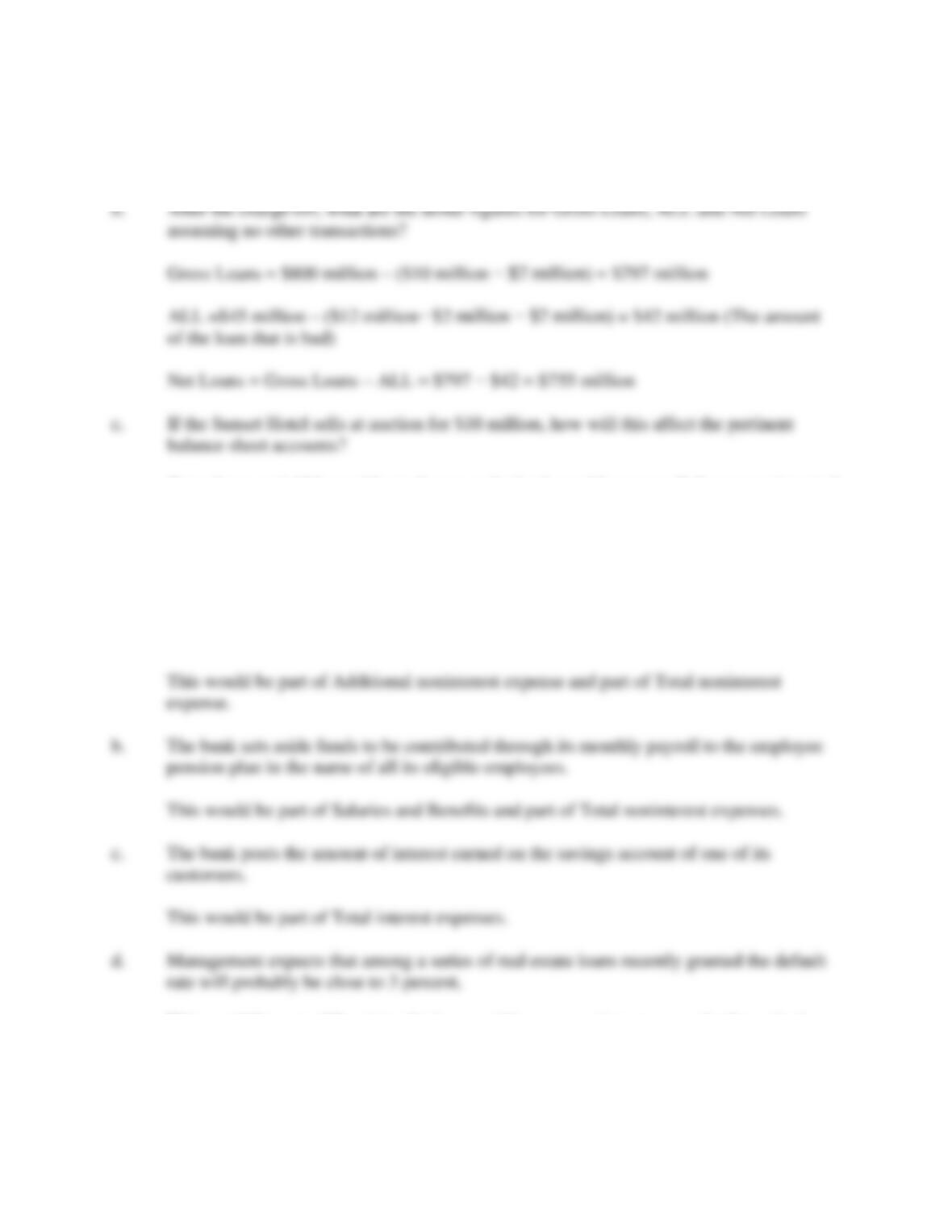
a. Total liabilities + Total equity capital ($30 + $375)
b. Gross loans − Allowance for loan losses ($300 – $15)
c. Total equity capital – Preferred stock – Common stock – Surplus ($30 – $15 – $5 – $3)
d. This is the only asset missing so subtract all other assets from total assets
e. Bank premises and equipment, gross – bank premises and equipment, net ($25 – $20)
f. Total liabilities less nondeposit borrowings ($375 – $40)
5-5. The Sea Level Bank has Gross Loans of $800 million with an ALL account of $45
million. Two years ago the bank made a loan for $12 million to finance the Sunset Hotel. Two
Chapter 05 – The Financial Statements of Banks and Their Principal Competitors
5-13
a. The dollar figure for Net Loans before the charge-off is _____.
Net Loans = Gross Loans –ALL = $800 − $45 = $755 million
earlier.
5-6. For each of the following transactions, which items on a bank’s statement of income and
expenses (Report of Income) would be affected?
a. Office supplies are purchased so the bank will have enough deposit slips and other
necessary forms for customer and employee use next week.
debts.
Chapter 05 – The Financial Statements of Banks and Their Principal Competitors
e. Mr. and Mrs. Harold Jones just purchased a safety deposit box to hold their stock
certificates and wills.
This would be part of Additional noninterest income and part of Total noninterest
income.
5-7. For each of the transactions described here, which of at least two accounts on a bank’s
balance sheet (Report of Condition) would be affected by each transaction?
Chapter 05 – The Financial Statements of Banks and Their Principal Competitors
c. The bank sells a new issue of common stock for $100,000 to investors living in its
community, and the proceeds of that sale are spent on the installation of new ATMs.
Gross Loans − $2,500
Total Deposits − $2,500
Cash and Due from Bank − $750,000
Gross Loans and Leases + 750,000
Cash and Due from Bank − $5,000,000
Federal Funds Sold +$5,000,000
Gross Loans −$1,000,000
ALL −$1,000,000
Total unused commitments
Standby letters of credit and foreign office
guarantees
(Amount conveyed to others)
Commercial letters of credit
Securities lent
Derivatives (total)
Notional amount of credit derivatives
22,000
Interest rate contracts
54,000
Foreign exchange rate contracts
Bank premises & equipment, gross
+$100,000
Common stock/surplus + $100,000
Chapter 05 – The Financial Statements of Banks and Their Principal Competitors
Total unused commitments
$8,000
guarantees
(Amount conveyed to others)
Commercial letters of credit
Securities lent
Derivatives (total)
Notional amount of credit derivatives
22,000
Interest rate contracts
54,000
Foreign exchange rate contracts
Contracts on other commodities and
equities
All other off – balance -sheet liabilities
Total off-balance-sheet items
Total assets (on-balance sheet)
12,000
Off-balance-sheet assets ÷ on-balance-sheet
assets
Effective tax rate
Interest on loans
Employee wages, salaries, and benefits
Interest earned on government bonds and notes
Provision for loan losses
Overhead expenses
Contracts on other commodities and
equities
$1,200
All other off – balance -sheet liabilities
49
Total off-balance-sheet items
Total assets (on-balance sheet)
$12,000
Off-balance-sheet assets ÷ on-balance-sheet
assets
Chapter 05 – The Financial Statements of Banks and Their Principal Competitors
5-17
Service charges paid by depositors
3
Security gains/losses
–7
Interest paid on federal funds purchased
5
Payment of dividends of $4 per share on 1
million outstanding shares to be made to
common stockholders
Interest paid to customers holding time and
savings deposits
40
Trust department fees
3
Total interest income
Interest on loans
$90
Int earned on government bonds and
notes
$9
Total
$99
Total interest expense
Interest paid on federal funds purchased
$5
Interest paid to customers time and
Savings deposits
$40
Total
$45
Net interest income
$54
Provision for loan loss
$5
Total noninterest income
Service charges paid by depositors
$3
Trust department fees
$3
Total
$6
Total noninterest expenses
Employee wages, salaries and benefits
$13
Overhead expenses
$3
Total
$16
Net noninterest income
($10)
Pretax income
$39
Taxes paid (28%)
$11
Securities gains/(losses)
($7)
Net income
$21
Less dividends
$4
Chapter 05 – The Financial Statements of Banks and Their Principal Competitors
Depreciation on premises and
equipment
Service charges on
deposits
Interest paid on money market
deposits
Securities gains or losses
Utility expense
Retained earnings from current income
$17
5-10. Which of these account items or entries would normally occur on a bank’s balance sheet
(Report of Condition) and which on a bank’s income and expense statement (Report of Income)?
Federal funds sold
Deposits due to banks
Addition to undivided profits
Leases of business equipment to customers
Credit card loans
Interest received on credit card loans
Utility expense
Fed funds purchased
Vault cash
Savings deposits
Allowance for loan losses
Provision for loan losses
Depreciation on premises and equipment
Service charges on deposits
Commercial and industrial loans
Undivided profits
Repayments of credit card loans
Mortgage owed on the bank’s buildings
Common stock
Other real estate owned
Interest paid on money market deposits
Securities gains or losses
Federal funds sold
Deposits due to bank
Credit card loans
Leases of business equipment
to customers
Vault cash
Savings deposit
Allowance for loan losses
Undivided profits
Commercial and Industrial
Loans
Mortgage owed on the bank’s
buildings
Repayments of credit card
loans
Other real estate owned
Common stock
Additions to undivided profits
Federal funds purchased
5-19
5-11 You were informed that a bank’s latest income and expense statement contained the
following figures (in $ millions):
Net interest income
$800
Net noninterest income
(500)
Pretax net operating income
372
Security gains
100
Increases in bank’s undivided
profits
200
Suppose you also were told that the bank’s total interest income is twice as large as its total
interest expense and its noninterest income is three-fourths of its noninterest expense. Imagine
that its provision for loan losses equals 3 percent of its total interest income, while its taxes
generally amount to 30 percent of its net income before income taxes. Calculate the following
items for this bank’s income and expense statement:
Total interest income (TII) and Total interest expense (TIE):
TII = 2 TIE and Net interest income = TII –TIE = $800 so:
2 TIE – TIE = $800
Hence, TIE = $800 and TII = 2 ($800) = $1,600
Total noninterest income (TNI) and Total noninterest expense (TNE):
TNI = 0.75TNE and Net noninterest income = TNI – TNE = – $500 so:
0.75TNE – TNE = – $500 – 0.25 (TNE) = $500.
PLL = 0.03×Total interest income = 0.03 × ($1,600) = $48
Income taxes:
Net income before taxes = Net interest income + Net noninterest income – PLL
Chapter 05 – The Financial Statements of Banks and Their Principal Competitors
5-20
5-12. Why do the financial statements issued by banks and by nonbank financial-service
providers look increasingly similar today? Which nonbank financial firms have balance sheets
and income statements that closely resemble those of commercial banks (especially community
banks)?
5-13 What principal types of assets and funds sources do nonbank thrifts (including savings
banks, savings and loans, and credit unions) draw upon? Where does the bulk of their revenue
5-14. How are the balance sheets and income statements of finance companies, insurers, and
securities firms similar to those of banks, and in what ways are they different? What might
explain the differences you observe?