
Chapter 04 – Establishing New Banks, Branches, ATMs, Telephone Services, and Websites
4-1
CHAPTER 4
ESTABLISHING NEW BANKS,
BRANCHES, ATMS,
TELEPHONE SERVICES,
AND WEBSITES
Goal of This Chapter: The purpose of this chapter is to learn how new banks are chartered by
state and federal authorities in the United States, to determine what makes a good site for a new
branch office, to recognize how the role of branch offices is changing, and to explore the
advantages and disadvantages of automated banking facilities.
Key Topics in This Chapter
• Chartering New Financial-Service Institutions
• The Performance of New Banks
• Establishing Full-Service Branches and In-Store Branching
• Establishing Limited-Service Facilities
• ATMs and Telephone Centers
• The Internet and Online Banking
Chapter Outline
I. Introduction
A. The Importance of Convenience and Timely Access to Customers
B. Service Options Available Today
1. Chartering New (De Novo) Financial Institutions
2. Establishing New Full-Service Branch Offices
3. Setting Up Limited-Service Facilities
II. Chartering a New ( De Novo ) Financial-Service Institution
III. The Bank Chartering Process in the United States
A. The Chartering Authorities in the U.S.
B. Benefits of Applying for a Federal (National) Charter
C. Benefits of Applying for a State Charter
IV. Questions Regulators Usually Ask the Organizers of a New (De Novo) Bank
V. Factors Weighing on the Decision to Seek a New Charter
A. External Factors
1. Level & Growth of Economic Activity
2. The Need for a new financial firm.
3. The Strength and Character of Competition in Supplying Financial
Services
Chapter 04 – Establishing New Banks, Branches, ATMs, Telephone Services, and Websites
4-2
B. Internal Factors
1. Qualifications and Contacts of the Organizers
2. Management Quality
3. Pledging of Capital to Cover the Cost of Filing a Charter Application and
Getting Underway
VI. Volume and Characteristics of New Charters
VII. How Well Do New Charters Perform?
Research Findings on New Bank Performance
VIII. Establishing Full-Service Branch Offices: Choosing Locations and Designing New
Branches
A. Advantages of Full-Service Branches
B. Trends in the Design of New Branches
C. Desirable Sites for New Branches
1. Expected Rate of Return
2. Geographic Diversification
D. Branch Regulation
E. The Changing Role of Financial-Service Branch Offices
F. In-Store Branching
IX. Establishing and Monitoring Automated Limited-Service Facilities (“Branchless
Banking”)
A. Point-of-Sale Terminals
B. Automated Tellers (ATMs)
1. History of ATMs
2. ATM Services
3. Advantages and Disadvantages of ATMs
4. The Decision to Install a New ATM
5. Example of the ATM Capital-Budgeting Decision
X. Banking in Homes, Offices, Stores, and on the Street
A. Telephone Banking and Call Centers
B. Internet Banking
1. Services Provided through the Internet
2. Challenges in Providing Internet Services
3. The Net and Customer Privacy and Security
XI. Financial-Service Facilities of the Future
XII. Summary of the Chapter
Chapter 04 – Establishing New Banks, Branches, ATMs, Telephone Services, and Websites
4-3
Concept Checks
4-1. Why is the physical presence of a bank still important to many customers despite recent
advances in long-distance communications technology?
Many customers still prefer the personal attention and personal service that contact with bank
4-2. Why is the creation (chartering) of new banks closely regulated? What about nonbank
financial firms?
4-3. What do you see as the principal benefits and costs of government regulation on the
prices.
4-4. Who charters new banks in the United States?
New banks are chartered by the banking commissions of the individual states or, at the federal
4-5. What key role does the FDIC play in the chartering process?
The FDIC exercises some control over state bank charter activity as well as federal charters
Chapter 04 – Establishing New Banks, Branches, ATMs, Telephone Services, and Websites
4-4
4-6. What are the advantages of having a national bank charter? A state bank charter?
The benefits of a national charter are:
a) It brings added prestige due to stricter regulatory standards that may help attract
deposits.
b) In times of trouble the technical assistance supplied to a struggling institution by
4-7. What kinds of information must the organizers of new national banks provide the
Comptroller of the Currency in order to get a charter? Why might this required information be
important?
The applicants for a national bank charter are required to submit a detailed business plan, which
4-8. Why do you think the organizers of a new financial firm are usually expected to put
together a detailed business plan, including marketing, management, and financial components?
4-5
4-9. What are the key factors the organizers of a new financial firm should consider before
1. External Factors
2. Internal Factors
a. Qualifications and contacts of the organizers
4-10. Where are most new banks chartered in the United States?
New charters tend to be concentrated in large urban areas where expected rates of return on the
4-11. How well do most new banks perform for the public and for their owners?
Most new banks succeed, especially those whose organizers can bring in new deposits and loan
banks.
4-12. Why is the establishment of new branch offices usually favored over the chartering of
new financial firms as a vehicle for delivering financial services?
Chapter 04 – Establishing New Banks, Branches, ATMs, Telephone Services, and Websites
4-6
4-13. What factors are often considered in evaluating possible sites for new branch offices?
Bankers first need to decide the goals and objectives of a new facility. Often this means
assessing whether the proposed new branch is aimed at selling one or more particular services,
such as deposits or loans, and also deciding how closely correlated cash flows and returns from
the new branch office may be with cash flows and returns from the other facilities operated by
4-14. What changes are occurring in the design of, and the roles played by, branch offices?
Please explain why these changes are occurring.
Bank branches are increasingly becoming selling platforms in which more and more fee-based
4-15. What laws and regulations affect the creation of new bank and thrift branches and the
closing of existing branches? What advantages and what problems can the closing of a branch
Chapter 04 – Establishing New Banks, Branches, ATMs, Telephone Services, and Websites
4-7
the industry without government approval, in the form of a charter, to operate. The types of
deposits and other financial instruments sold to the public to raise funds must be sanctioned by
each institution’s principal regulatory agency. The quality of loans and investments and the
4-16. What new and innovative sites have been selected for new branch offices in recent years?
Why have these sites been chosen by some financial firms? Do you have any ideas about other
sites that you believe should be considered?
4-17. What are POS terminals, and where are they usually located?
Point-of-sale terminals are set up to accommodate customer purchases of goods and services.
These computer terminals normally are located in supermarkets, gasoline stations, and similar
Chapter 04 – Establishing New Banks, Branches, ATMs, Telephone Services, and Websites
4-8
4-18. What services do ATMs provide? What are the principal limitations of ATMs as a service
provider? Should ATM carry fees? Why?
The earliest ATMs provided a convenient mechanism for cashing checks, making deposits, and
verifying checking account balances, often at hours when the full-service branch offices were
closed. Today, ATMs frequently provide a wide menu of old and new services, including bill
4-19. What are self-service terminals and what advantages do they have for financial
institutions and their customers?
Self-service terminals include ATMs and other computer-based limited-service facilities that
Chapter 04 – Establishing New Banks, Branches, ATMs, Telephone Services, and Websites
4-9
4-20. Why do many experts regard the telephone as a key instrument in the delivery of
financial services in the future? What advantages does the telephone have over other service-
delivery vehicles?
Many different services can be marketed, delivered, and verified at low cost via the phone. It is
4-21. What financial services are currently available on the Internet? What problems have been
encountered in trying to offer Internet-delivered services?
4-22. How can financial firms better promote Internet service options?
They need to emphasize the safety of their Internet services. They need to promote their home
Problems
4-1. A group of businesspeople from Scott Island are considering filing an application with
the state banking commission to charter a new bank. Due to a lack of current banking facilities
Chapter 04 – Establishing New Banks, Branches, ATMs, Telephone Services, and Websites
4-10
estimated 2 percent annually after year 1. If the organizers require a minimum of a 10 percent
annual rate of return on their investment of capital in the proposed new bank, are they likely to
proceed with their charter application given the above estimates?
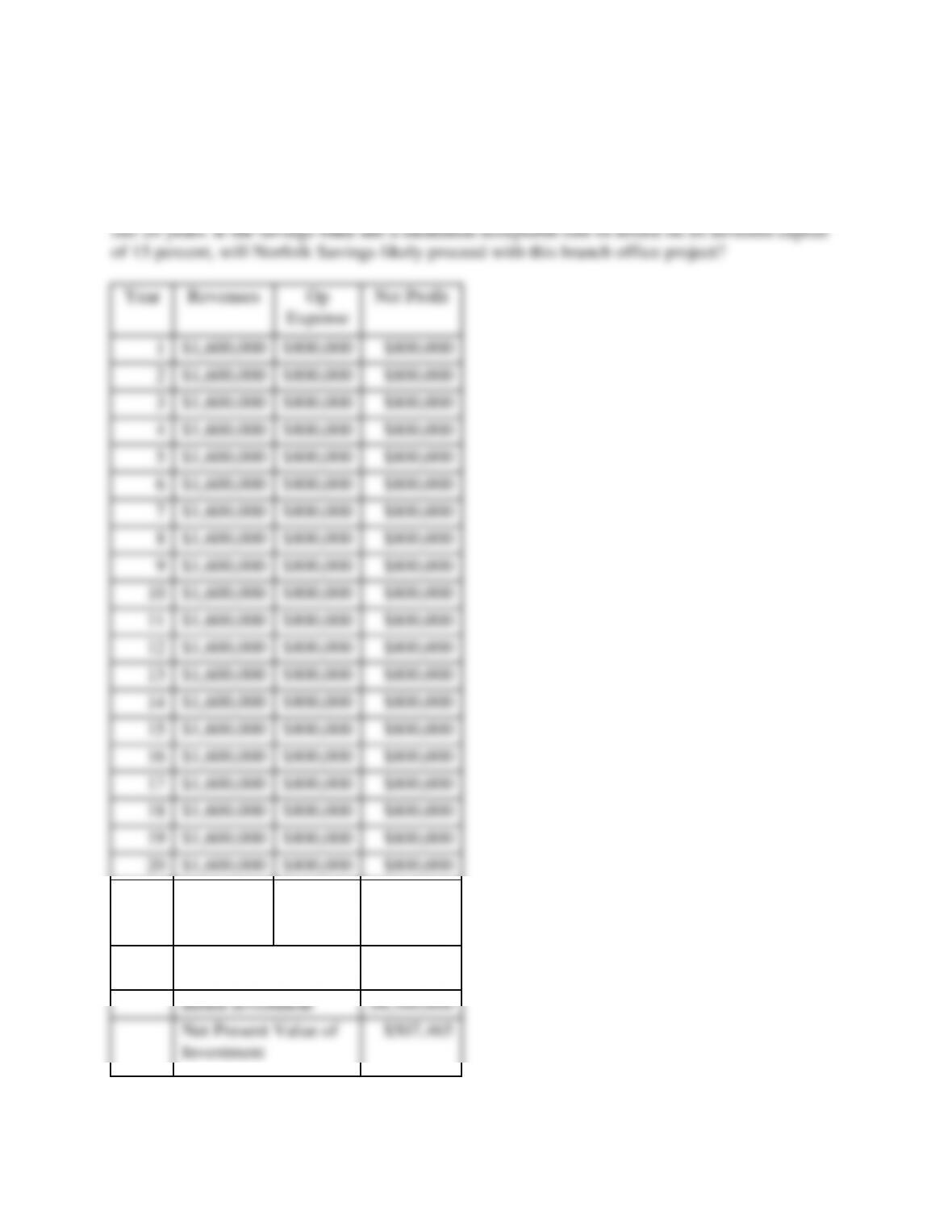
Year
Revenues
Op Expense
Net Profit
1
$400,000
$160,000
$240,000
2
$416,000
$163,200
$252,800
3
$432,640
$166,464
$266,176
4
$449,946
$169,793
$280,152
5
$467,943
$173,189
$294,754
6
$486,661
$176,653
$310,008
7
$506,128
$180,186
$325,942
8
$526,373
$183,790
$342,583
9
$547,428
$187,466
$359,962
10
$569,325
$191,215
$378,110
11
$592,098
$195,039
$397,059
12
$615,782
$198,940
$416,842
13
$640,413
$202,919
$437,494
14
$666,029
$206,977
$459,052
15
$692,671
$211,117
$481,554
16
$720,377
$215,339
$505,038
17
$749,192
$219,646
$529,547
18
$779,160
$224,039
$555,122
19
$810,327
$228,519
$581,807
20
$842,740
$233,090
$609,650
21
$876,449
$237,752
$638,698
22
$911,507
$242,507
$669,001
23
$947,968
$247,357
$700,611
24
$985,886
$252,304
$733,582
25
$1,025,322
$257,350
$767,972
Required
Rate of
Return
0.10
Present value of future
cash flows @ 10%
$3,329,203
Initial investment
$3,800,000
Net Present Value of
Investment
($470,797)
Given the above information, the organizers are not likely to proceed given that the net present
value of this investment is negative. The return they are going to earn is less than the 10% they
need to earn.
Chapter 04 – Establishing New Banks, Branches, ATMs, Telephone Services, and Websites
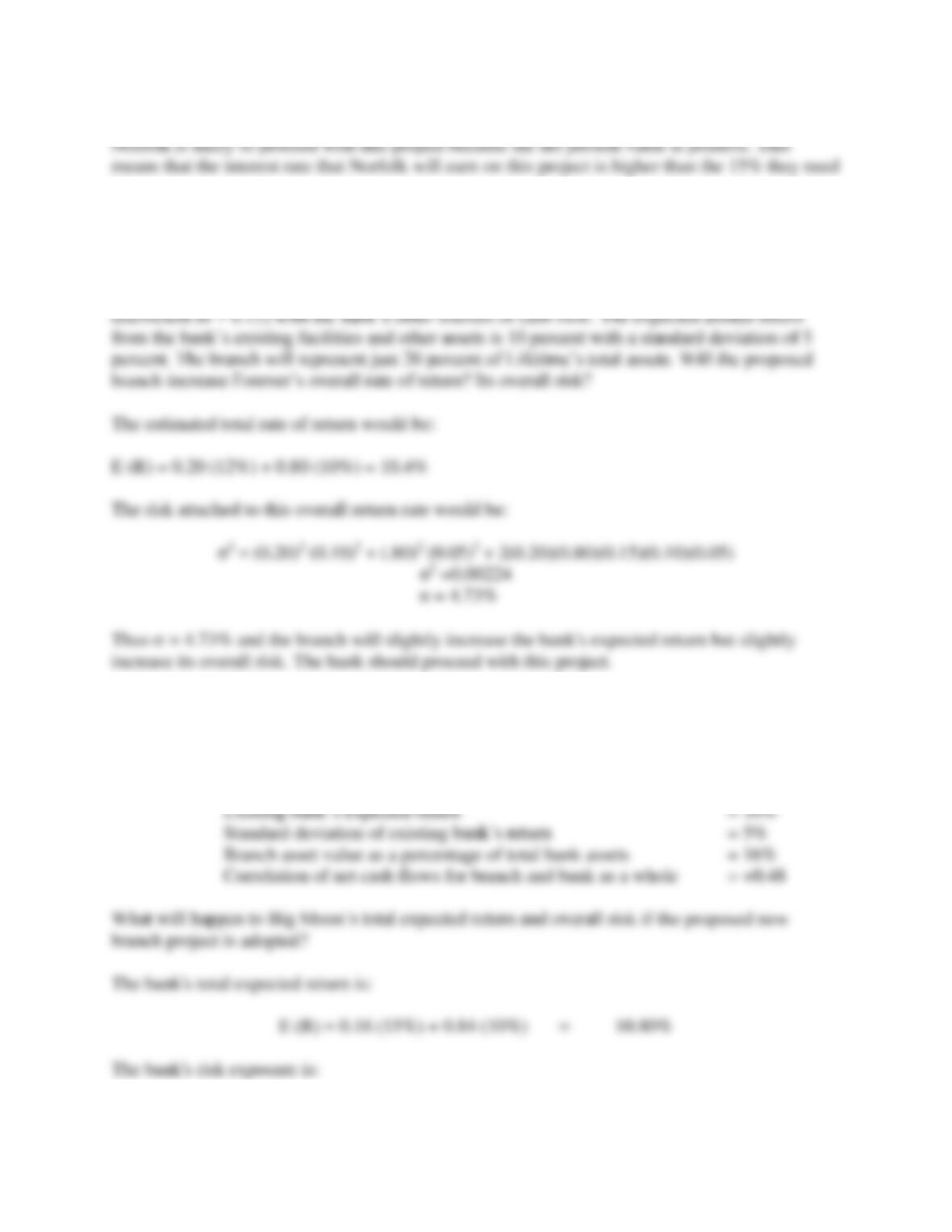
4-2. Norfolk Savings Bank is considering the establishment of a new branch office at the
corner of 49th Street and Hampton Boulevard. The savings association’s economics department
projects annual operating revenues of $1.6 million from fee income generated by service sales
and annual branch operating expenses of $800,000. The cost of procuring the property is $1.75
million and branch construction will total an estimated $2.75 million; the facility is expected to
Chapter 04 – Establishing New Banks, Branches, ATMs, Telephone Services, and Websites
4-12
to earn.
4-3. Forever Savings Bank estimates that building a new branch office in the newly developed
Washington township will yield an annual expected return of 12 percent with an estimated
standard deviation of 10 percent. The bank’s marketing department estimates that cash flows
from the proposed Washington branch will be mildly positively correlated (with a correlation
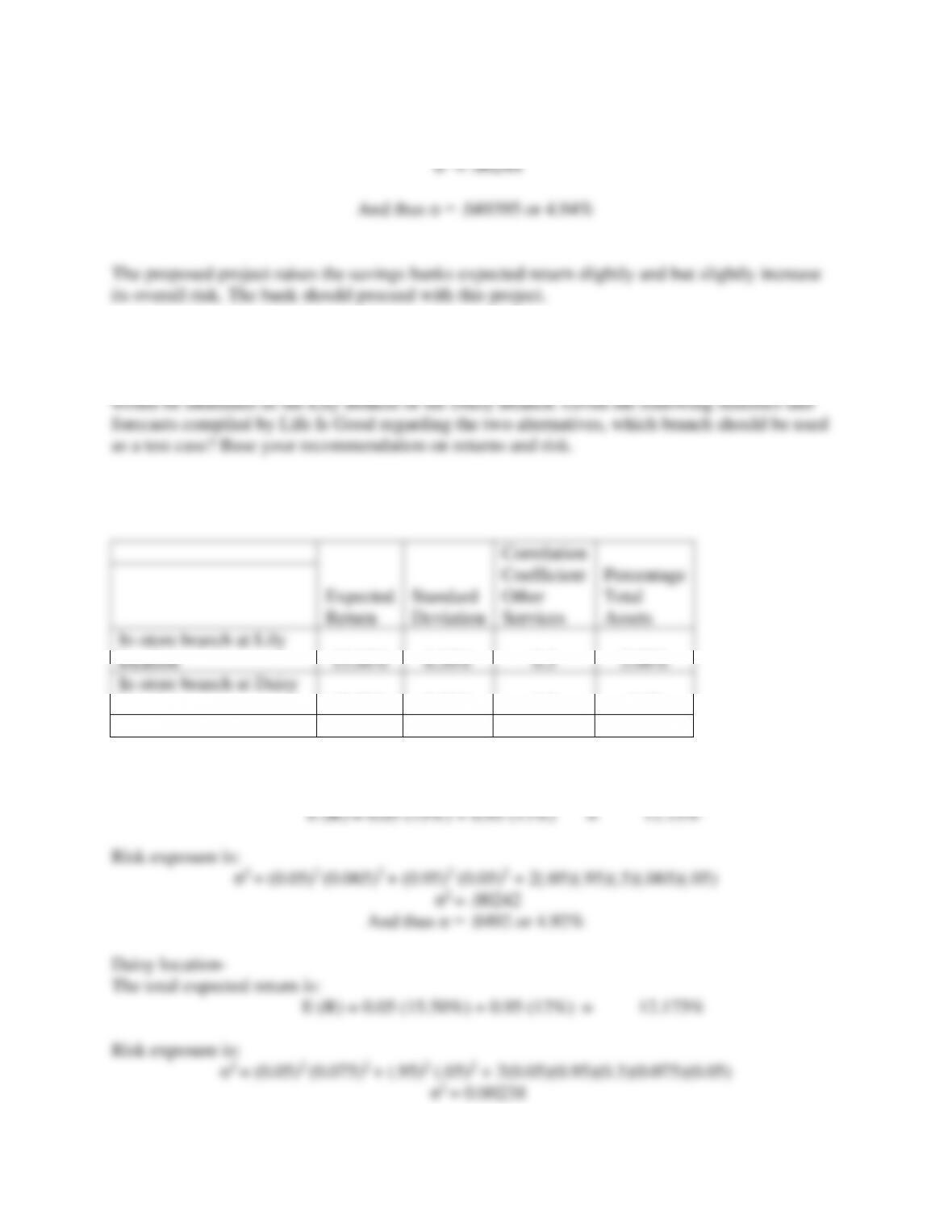
4-4. The following statistics and estimates were compiled by Big Moon Bank regarding a
proposed new branch office and the bank itself:
Branch office expected return = 15%
Standard deviation of branch return = 8%
Chapter 04 – Establishing New Banks, Branches, ATMs, Telephone Services, and Websites
σ2 = (.15)2 (.082 + (.85) 2 (.05)2 + 2(.15)(.85)(.48)(.08)(.05)
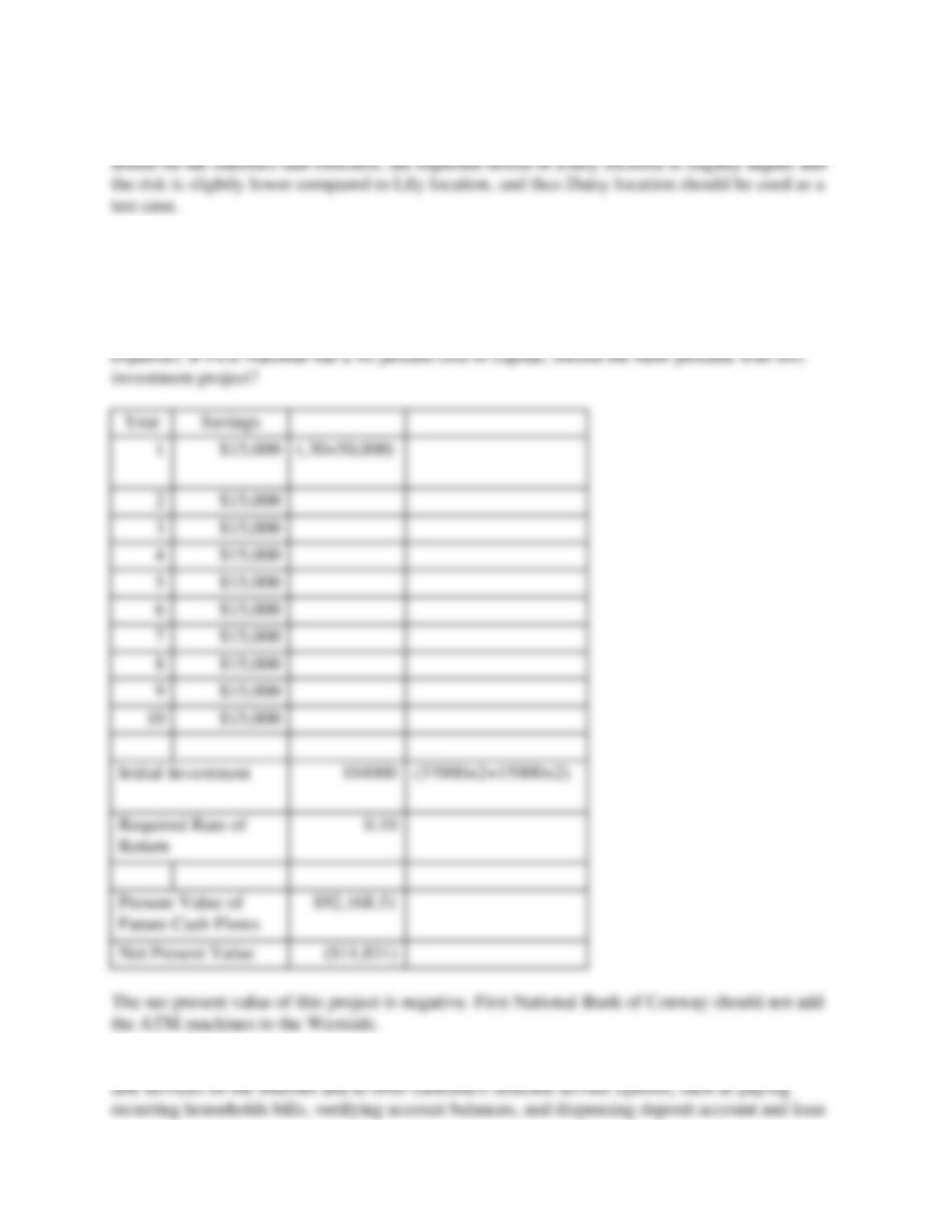
4-5 Life Is Good Financial Services has provided Good Things to Eat Groceries a proposal
for in-store branches in two of its four Davidson locations. Good Things to Eat counter proposed
opening one in-store branch in one of the two proposed locations as a test case. The locations
Expected
Return
Standard
Deviation
Correlation
Coefficient
Other
Services
Percentage
Total
Assets
In-store branch at Lily
location
15.00%
6.50%
0.5
5.00%
In-store branch at Daisy
location
15.50%
7.50%
0.3
5.00
Existing facilities
12.00
5.00
95.00
Lily location-
The total expected return is:
Chapter 04 – Establishing New Banks, Branches, ATMs, Telephone Services, and Websites
4-14
And thus σ = 0.04876 or 4.87%
4-6. First National Bank of Conway is considering installing two ATMs in its Southside
branch. The new machines are expected to cost $37,000 apiece. Installation costs will amount to
about $15,000 per machine. Each machine has a projected useful life of 10 years. Due to rapid
growth in the Southside district, these two machines are expected to handle 50,000 cash
transactions per year. On average, each cash transaction is expected to save 30 cents in teller
4-7. First State Security Bank is planning to set up its own Web page to advertise its location
Chapter 04 – Establishing New Banks, Branches, ATMs, Telephone Services, and Websites
4-15
application forms. What factors should First State take into account as it plans its own Web page
and Internet service menu? How can the bank effectively differentiate itself from other banks
currently present on the Internet? How might the bank be able to involve its own customers in