
Chapter 20 – International Banking and the Future of Banking and Financial Services
20-1
CHAPTER 20
INTERNATIONAL BANKING AND THE FUTURE OF BANKING AND FINANCIAL
SERVICES
Goal of the Chapter: The purpose of this chapter is to learn the different types of services
international banks offer to their customers and to discover the various forms of organizational
structures; a bank may adopt to conduct international business.
Key Topics in This Chapter
• Types of International Banking Organizations
• Regulation of International Banking
• Foreign Banking Activity in the United States
• Services Provided by International Banks
• Managing Currency Risk Exposure
• Challenges for International Banks in Foreign Markets
• The Future of Banking and Financial Services
Chapter Outline
I. Introduction
II. Types of International Banking Organizations
A. Representative Offices
B. Agency Offices
C. Branch Offices
D. Subsidiaries
E. Joint Ventures
F. Edge Act Corporations
G. Agreement Corporations
H. International Banking Facilities (IBFs)
I. Shell Branches
J. Export Trading Companies (ETCs)
III. Regulation of International Banking
A. Goals of International Banking Regulation
B. U.S. Banks’ Activities Abroad
C. Expansion and Regulation of Foreign Bank Activity in the United States
1. The International Banking Act of 1978
2. The Foreign Bank Supervision Enhancement Act of 1991
D. New Capital Regulation for Major Banks Worldwide
IV. Services Supplied by Banks in International Markets
A. Making Foreign Currencies Available to Customers
B. Hedging Against Foreign Currency Risk Exposure
1. Forward Contracts
2. Currency Futures Contracts
C. Other Tools for Reducing Currency Risks

Chapter 20 – International Banking and the Future of Banking and Financial Services
20-2
1. The Development of Currency Options
2. Currency Swaps
D. Supplying Customers with Short- and Long-Term Credit or Credit Guarantees
1. Note Issuance Facilities
2. Europaper
3. Issuing and Managing Depository Receipts
E. Supplying Payments and Thrift (Savings) Instruments to International Customers
1. Payments Services
2. Savings (Thrift) Services
F. Underwriting Customer Note and Bond Issues in the Eurobond Market
G. Protecting Customers against Interest Rate Risk
1. Interest-Rate Swaps
2. Interest-Rate Caps
3. Financial Futures and Options
H. Helping Customers Market Their Products through Export Trading Companies
V. Challenges for International Banks in Foreign Markets
A. Growing Customer Use of Securities Markets to Raise Funds in a More Volatile and
Risky World
B. Developing Better Methods for Assessing Risk in International Lending
1. International Loan Risks
2. Possible Solutions to Troubled International Loans
3. International Loan Risk Evaluation Systems
C. Adjusting to New Market Opportunities Created by Deregulation and New
International Agreements
1. Opportunities Created by NAFTA and CAFTA
2. Opportunities in the Expanding European Community
3. Opportunities in Asia as Barriers Erode
VI. The Future of Banking and Financial Services
A. Convergence
B. Consolidation
C. Survival of Smaller Community Financial-Service Institutions
D. Reaching the Mass Media
E. Invasion by Industrial and Retailing Companies
F. The Wal-Mart Challenge
G. Fighting for Ultimate Survival in a Global Financial System
VII. Summary of the Chapter
Concept Checks
20-1. What organizational forms do international banks use to reach their customers?
There are various forms of organizations that banks use to set up offices internationally. These
Chapter 20 – International Banking and the Future of Banking and Financial Services
20-3
generally offer a full line of banking services acting as a local office of a large full-service
providing corporation. Agency offices are more complete than representative offices which both
accept deposits and extend credit. Subsidiaries are separate legal entities that are owned by a
20-2. Why are there so many different types of international organizations in the financial
institutions’ sector?
20-3. What are the principal goals of international banking regulation?
The principal goals of international banking regulation include:
2. promoting stable growth in money and credit,
4. restricting the outflow of scarce capital, and
20-4. What were the key provisions of the U.S International Banking Act of 1978 and the
International Lending and Supervision Act of 1983?
Chapter 20 – International Banking and the Future of Banking and Financial Services
20-4
loans.
20-5. Explain what the Basel Agreement is and why it is so important.
The Basel Agreement is a negotiated agreement between bank regulatory authorities in the G-20
(1) to strengthen international banks, thereby strengthening public confidence in them, and
20-6. Describe the principal customer services supplied by international banks serving foreign
markets.
The principal customer services supplied by international banks are:
(2) helping customers hedge their currency risk exposure through the use of forward contracts,
(3) supplying customers with short and long-term credit or credit guarantees,
(5) underwriting customer note and bond issues in the Eurobond market,
(7) helping customers market their products through export trading companies.
20-7. What types of risk exposure do international banks strive to control in order to aid their
20-8. What is an NIF? A DR?
A note issuance facility (NIF) is a medium-term credit agreement between an international bank
and its larger corporate and governmental customers, where the customer is authorized to
Chapter 20 – International Banking and the Future of Banking and Financial Services
20-5
20-9. Of what benefit might NIFs and DRs be to international banks and their customers?
Both NIFs and DRs provide fee income to international banks, and allow the banks to offer
20-10. What are ETCs? What services do they provide, and what problems have they
encountered inside the United States?
20-11. What do the terms Europaper and Eurobonds refer to? Why are these instruments
important to international banks and to their customers?
Europapers consist of commercial papers issued by multinational corporations in the
20-12. What types of tools have international banks developed to help protect themselves and
their customers against currency and interest rate risk? How does each tool accomplish its
purpose?
Two of the most popular tools to hedge against currency risk include forward contracts and
Chapter 20 – International Banking and the Future of Banking and Financial Services
20-6
Banks also frequently use currency options to hedge exchange rate risks. Currency options give
the buyer the right but not the obligation to buy or sell a currency at a predetermined price, thus
20-13. This chapter focuses on several major problem areas that international banks must deal
world.
2. Developing better methods for assessing risk in international lending.
20-14. What different approaches to country-risk evaluation have international banks developed
include:
(1) the checklist approach, which lists economic and political factors believed to be significantly
correlated with loan risk,
(3) using market interest rates attached to deposits traded in the Eurocurrency markets to develop
implied risk premium measures for bank loan rates.
20-15. What different regions around the globe today appear to offer the greatest opportunities
for expansion for international banks? Why do you think this is so?
Chapter 20 – International Banking and the Future of Banking and Financial Services
20-7
The most promising areas for expansion lie in Asia, especially in fast growing countries like
China, India, and South Korea, just to name a few. The large population size of these countries
20-16. In looking at the future of the banking and financial-services industry, does it appear
likely that the powerful trends of convergence and consolidation will continue into the future?
Why or why not? Is this likely to occur at the same pace as in the past?
Empirical evidences suggest that convergence and consolidation will continue into the
20-17. What appears to be the future of community banking? What significant threats does
community banking seem to face?
The biggest impact on the expansion of large international banks is borne by smaller sized
community banks and credit unions. The future of community banks much depends on the speed
20-18. Are banking and commerce—financial and nonfinancial firms—on a collision course for
Chapter 20 – International Banking and the Future of Banking and Financial Services
20-8
It is very likely that financial and non-financial firms may be on the collision course in the
future. Nonfinancial companies have been exploring several avenues for expanding their current
beachhead in the financial-services industry for decades and this may be become the biggest
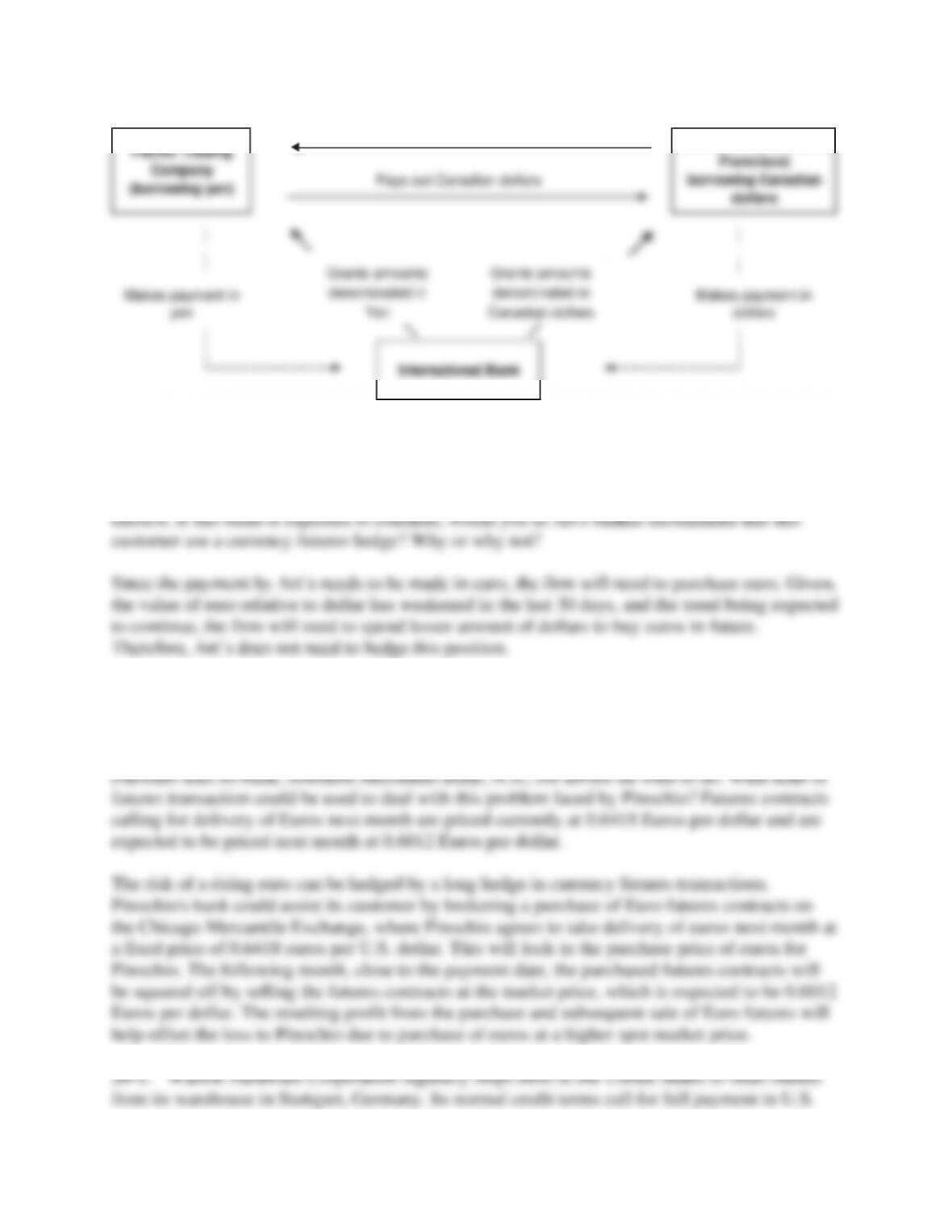
20-1. Pacific Trading Company purchased Canadian dollars yesterday in anticipation of a
purchase of electric equipment through a Canadian supply house. However, Pacific was
contacted this morning by a Japanese trading company that says equipment closer to its
specifications is available in 48 hours from an electronics manufacturer in Osaka. A phone call to
Chapter 20 – International Banking and the Future of Banking and Financial Services
20-9
Grants amounts
denominated in
Canadian dollars
Makes payment in
yen
Pays out yen
Pays out Canadian dollars
Pacific Trading
Company
(borrowing yen)
Furniture importer (San
Francisco)
borrowing Canadian
dollars
Makes payment in
dollars
International Bank
Grants amounts
denominated in
Yen
20-2. Art’s Sporting Goods ordered a shipment of soccer equipment from a manufacturer and
distributor in Munich. Payment for the shipment (which is valued at $3.5 million U.S.) must be
made in Euros that have changed in value in the last 30 days from 0.6423 euros/$ to 0.6673
20-3. Pinochio Corporation will import new wooden toys from a French manufacturer this
week at a price of 200 Euros per item for eventual distribution to retail stores. The current Euro-
dollar exchange rate is 0.6423 Euros per U.S. dollar. Payment for the shipment will be made by
Pinochio next month, but Euros are expected to appreciate significantly against the dollar.
Chapter 20 – International Banking and the Future of Banking and Financial Services
20–10
dollars for the hardware it ships within 90 days of the shipment date. However, Watson must
0.64 Euros per dollar. However, the local bank’s current forecast calls for the exchange rate to
rise to 0.70 Euros per dollar, so that Watson will receive substantially less in euros for each U.S.
dollar it receives in payment. Please explain how Watson, with the aid of its bank, could use
20-5. Johanna International Mercantile Corporation has made a $15 million investment in a
stamping mill located in northern Germany and fears a substantial decline in the Euro‘s spot price
of $1.56 per euro. Thus, if the dollar per euro rate drops to $1.50 as feared, the firm can purchase
20-6. Ebi International Bank of Japan holds U.S dollar denominated assets of $475 million and
dollar-denominated liabilities of $469 million, has purchased U.S. dollars in the currency
markets amounting to $75 million, and sold U.S. dollars totaling $50 million. What is Ebi’s net
20-7. Suppose that Canterbury Bank has a net long position in U.S. dollars of $12 million,

Chapter 20 – International Banking and the Future of Banking and Financial Services
20–11
Suppose the U.S. dollar’s exchange value rises against the pound. Is Canterbury likely to gain or
lose? Why?