
Chapter 19 – Acquisitions and Mergers in Financial– Services Management
19-1
CHAPTER 19
ACQUISITIONS AND MERGERS IN FINANCIAL- SERVICES MANAGEMENT
Goal of This Chapter: The purpose of this chapter is to understand why the financial services
industry undertakes so many mergers each year and to determine what legal, regulatory, and
economic factors should be considered when the management of a financial services provider
wants to pursue a merger. Key Topics in This Chapter
• Merger Trends in the United States and Abroad
• Motives for Merger
• Selecting a Suitable Merger Partner
• U.S. and European Merger Rules
• Making a Merger Successful
• Research on Merger Motives and Outcomes
Chapter Outline
I. Introduction
II. Mergers on the Rise
III. The Motives behind the Rapid Growth of Financial-Service Mergers
A. Profit Potential
B. Risk Reduction
C. Rescue of Failing Institutions
a. The Credit Crisis: Impact on Mergers
D. Tax and Market-Positioning Motives
E. The Cost Savings or Efficiency Motive
F. Mergers as a Device for Reducing Competition
G. Mergers as a Device for Maximizing Management’s Welfare (An Agency
Problem)
H. Other Merger Motives
I. Merger Motives That Executives and Employees Identify
IV. Selecting a Suitable Merger Partner
A. Merger Premium
B. Exchange Ratios
C. Dilution of Ownership
D. Dilution of Earnings
V. The Merger and Acquisition Route to Growth
VI. Methods of Consummating Merger Transactions
A. Pooling of Interests
B. Purchase Accounting
C. Purchase-of-Assets Method
D. Purchase-of-Stock Method
VII. Regulatory Rules for Bank Mergers in the United States

Chapter 19 – Acquisitions and Mergers in Financial– Services Management
19-2
A. Bank Merger Act of 1960
B. Competitive Effects of Mergers
C. The Public Benefits Test
D. Justice Department Guidelines
E. Herfindahl – Hirschman Index
F. The Merger Decision-Making Process by U.S. Federal Regulators
VIII. Merger Rules in Europe and Asia
IX. Making a Success of a Merger
X. Research Findings on the Impact of Financial-Service Mergers
A. The Financial and Economic Impact of Acquisitions and Mergers
B. Public Benefits from Mergers and Acquisitions
XI. Summary of the Chapter
Concept Checks
19-1. Exactly what is a merger?
Mergers simply mean the financial transactions that result in acquisition of one or more firms by
another institution. Here, the acquired firm (usually the smaller of the two) gives up its charter
19-2. Why are there so many mergers each year in the financial-services industries?
Many mergers and acquisitions have happened in the entire financial-service sector in recent
years. Many of these mergers have occurred because of lower legal barriers that previously
19-3. What factors seem to motivate most mergers?

Chapter 19 – Acquisitions and Mergers in Financial– Services Management
19-3
an expectation to gain higher salaries and employee benefits, greater job security, or greater
prestige from managing a larger firm.
1. The firm’s history, ownership, and management
3. The firm’s track record of growth and operating performance
5. The condition and prospects of the local economy served by the targeted institution
7. The comparative management styles of the merging organizations
9. Current personnel and employee benefits
11. Condition of the targeted institution’s physical assets
19-5. What factors must the regulatory authorities consider when deciding whether to approve
or deny a merger?
The federal supervisory agencies prefer to approve mergers that will enhance the financial
strength of the institutions involved as they encourage the need for improving management skills

Chapter 19 – Acquisitions and Mergers in Financial– Services Management
19-4
Along with these, the other factors that must be weighed to approve a merger include the
19-6. When is a market too concentrated to allow a merger to proceed? What could happen if a
merger were approved in an excessively concentrated market area?
1002)—a monopoly position, where the leading firm is the market’s sole supplier—to near zero
for unconcentrated markets.
As per the Department of Justice guidelines established in 1997, the Federal Reserve merger
19-7. What steps that management can take appear to contribute to the success of a merger?
Why do you think many mergers produce disappointing results?
There are several steps management can take to improve their chances of success of a merger.
• They can know themselves by thoroughly evaluating their own financial condition, track
record of performance, strengths and weaknesses of the markets it already serves, and

Chapter 19 – Acquisitions and Mergers in Financial– Services Management
19-5
for both anxious customers and employees who may fear interruption of service, loss of jobs,
19-8. What does recent research evidence tell us about the impact of most mergers in the
financial sector?
A recent study, which looked at the earnings impact of approximately 600 national bank
mergers, found no significant differences in profitability between merging and comparably sized
19-9. Does it appear that most mergers serve the public interest?
Most studies that have looked at this issue find few real public benefits. In fact, about one-third
banks changed their pricing policies. The most common change was a price increase following a
merger, particularly in checking account service fees, loan rates, deposit interest rates, and safe-
Chapter 19 – Acquisitions and Mergers in Financial– Services Management
Problems and Projects
19-1. Evaluate the impact of the following proposed mergers upon the postmerger earnings per
share of the combined organization:
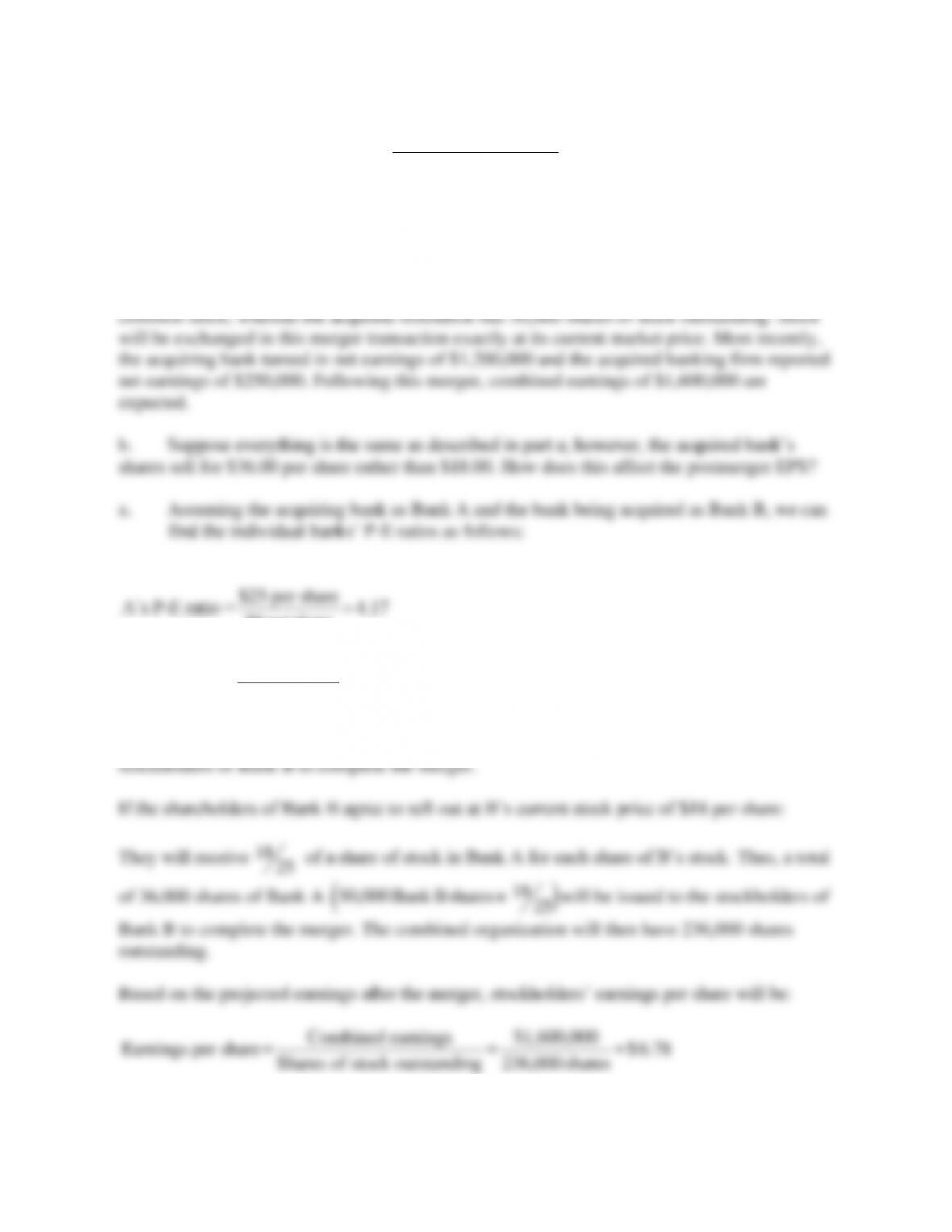
a. An acquiring bank reports that the current price of its stock is $25 per share and the bank
earns $6 per share for its stockholders; the acquired bank’s stock is selling for $18 per share and
that bank is earning $5 per share. The acquiring institution has issued 200,000 shares of
Chapter 19 – Acquisitions and Mergers in Financial– Services Management
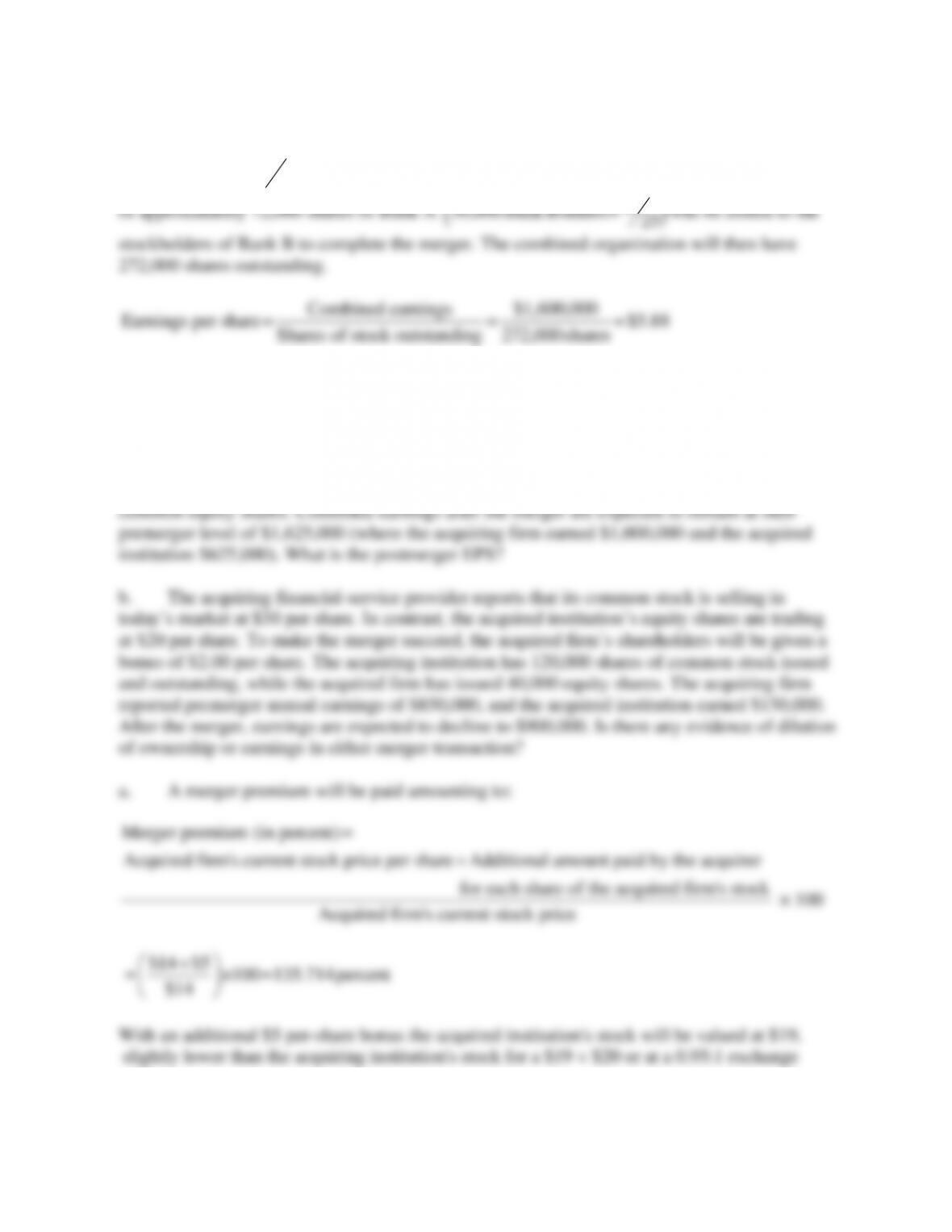
b. If the shareholders of Bank B agree to sell out at B’s current stock price of $36 per share:
They will receive
3625
of a share of stock in Bank A for each share of B’s stock. Thus, a total
36
Chapter 19 – Acquisitions and Mergers in Financial– Services Management
19-8
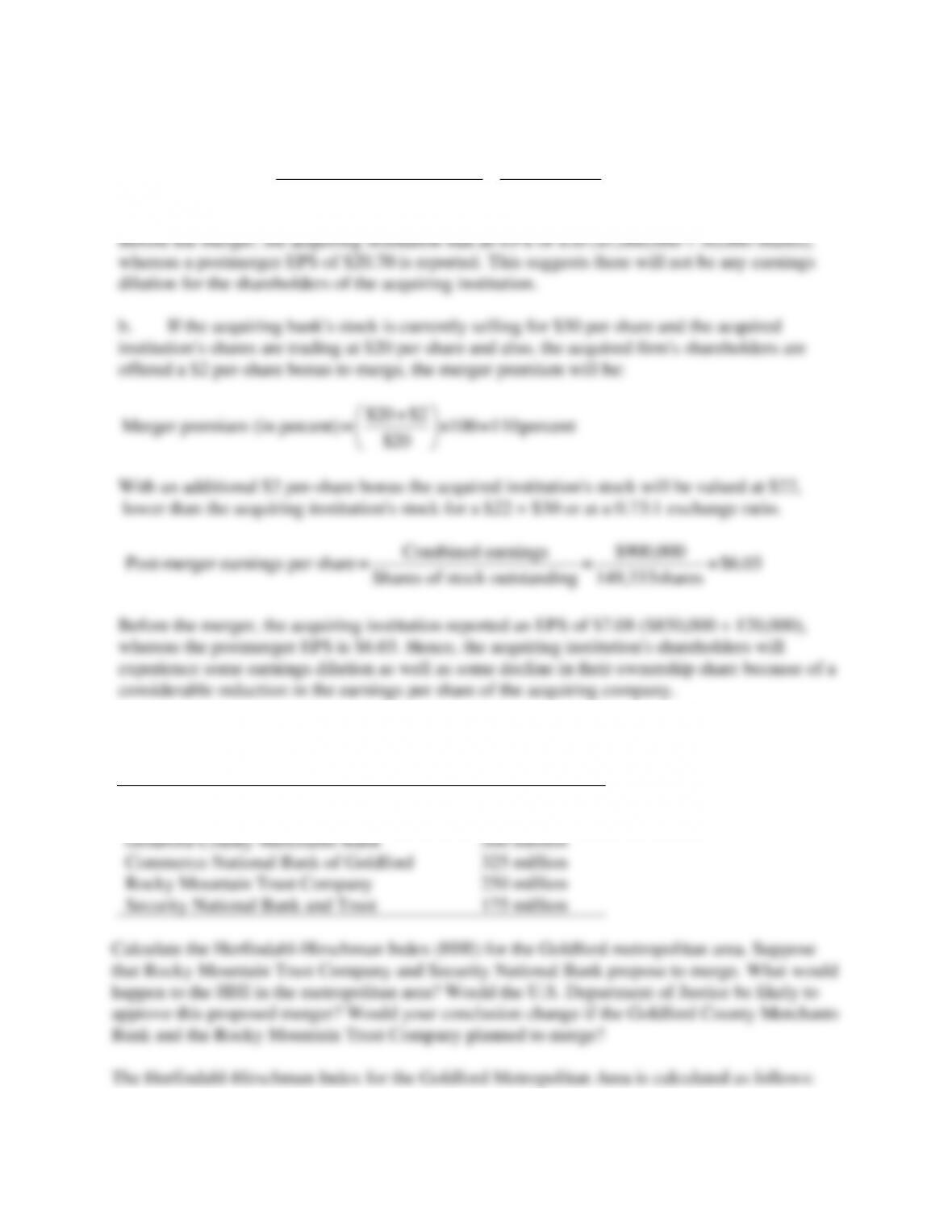
Hence, the earnings per share from the merger will be:
Combined earnings $1,625,000
Earnings per share= = =$20.70
Shares of stock outstanding 78,500shares
19-3. The Goldford metropolitan area is presently served by five depository institutions with
total deposits as follows:
Current Deposits
Goldford National Bank
$750 million
Goldford County Merchants Bank
500 million
Commerce National Bank of Goldford
325 million
Rocky Mountain Trust Company
250 million
Security National Bank and Trust
175 million
Calculate the Herfindahl-Hirschman Index (HHI) for the Goldford metropolitan area. Suppose
that Rocky Mountain Trust Company and Security National Bank propose to merge. What would
happen to the HHI in the metropolitan area? Would the U.S. Department of Justice be likely to
approve this proposed merger? Would your conclusion change if the Goldford County Merchants
Bank and the Rocky Mountain Trust Company planned to merge?
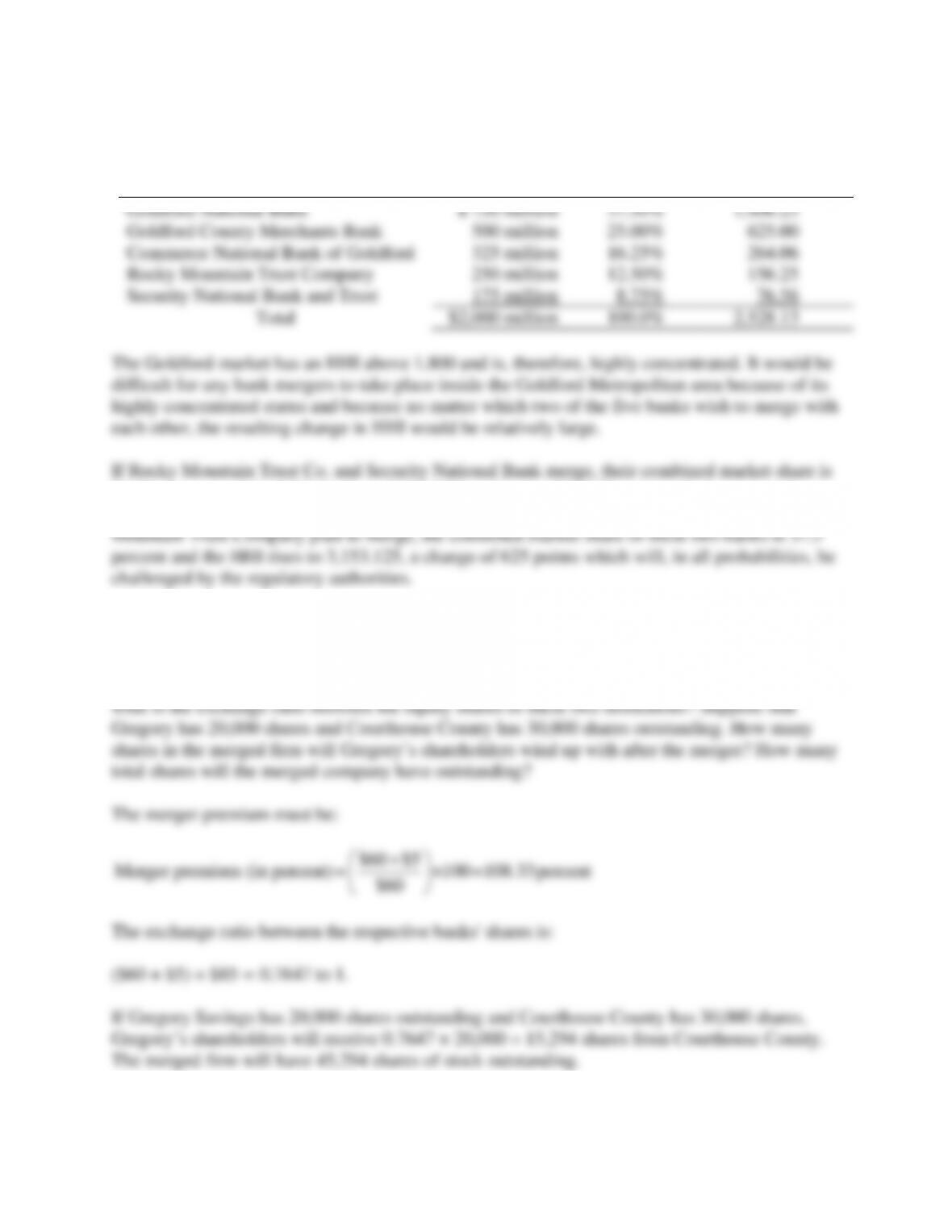
The Herfindahl-Hirschman Index for the Goldford Metropolitan Area is calculated as follows:
Chapter 19 – Acquisitions and Mergers in Financial– Services Management
19-9
Bank
Current
Deposits
Current
Deposit
Market Share
Current Deposit
Market Share
Squared
Goldford National Bank
$ 750 million
37.50%
1,406.25
Goldford County Merchants Bank
500 million
25.00%
625.00
Commerce National Bank of Goldford
325 million
16.25%
264.06
Rocky Mountain Trust Company
250 million
12.50%
156.25
Security National Bank and Trust
175 million
8.75%
76.56
Total
$2,000 million
100.0%
2,528.13
The Goldford market has an HHI above 1,800 and is, therefore, highly concentrated. It would be
difficult for any bank mergers to take place inside the Goldford Metropolitan area because of its
highly concentrated status and because no matter which two of the five banks wish to merge with
each other, the resulting change in HHI would be relatively large.
If Rocky Mountain Trust Co. and Security National Bank merge, their combined market share is
21.25 percent and the HHI climbs to 2,746.875, a change of 218.75 points which may not be
acceptable to the regulatory authorities. Even, if Goldford County Merchants Bank and Rocky
19-4. Gregory Savings Association has just received an offer to merge from Courthouse
County Bank. Gregory’s stock is currently selling for $60 per share. The shareholders of
Courthouse County agree to pay Gregory’s stockholders a bonus of $5 per share. What is the
merger premium in this case? If Courthouse County’s shares are now trading for $85 per share,
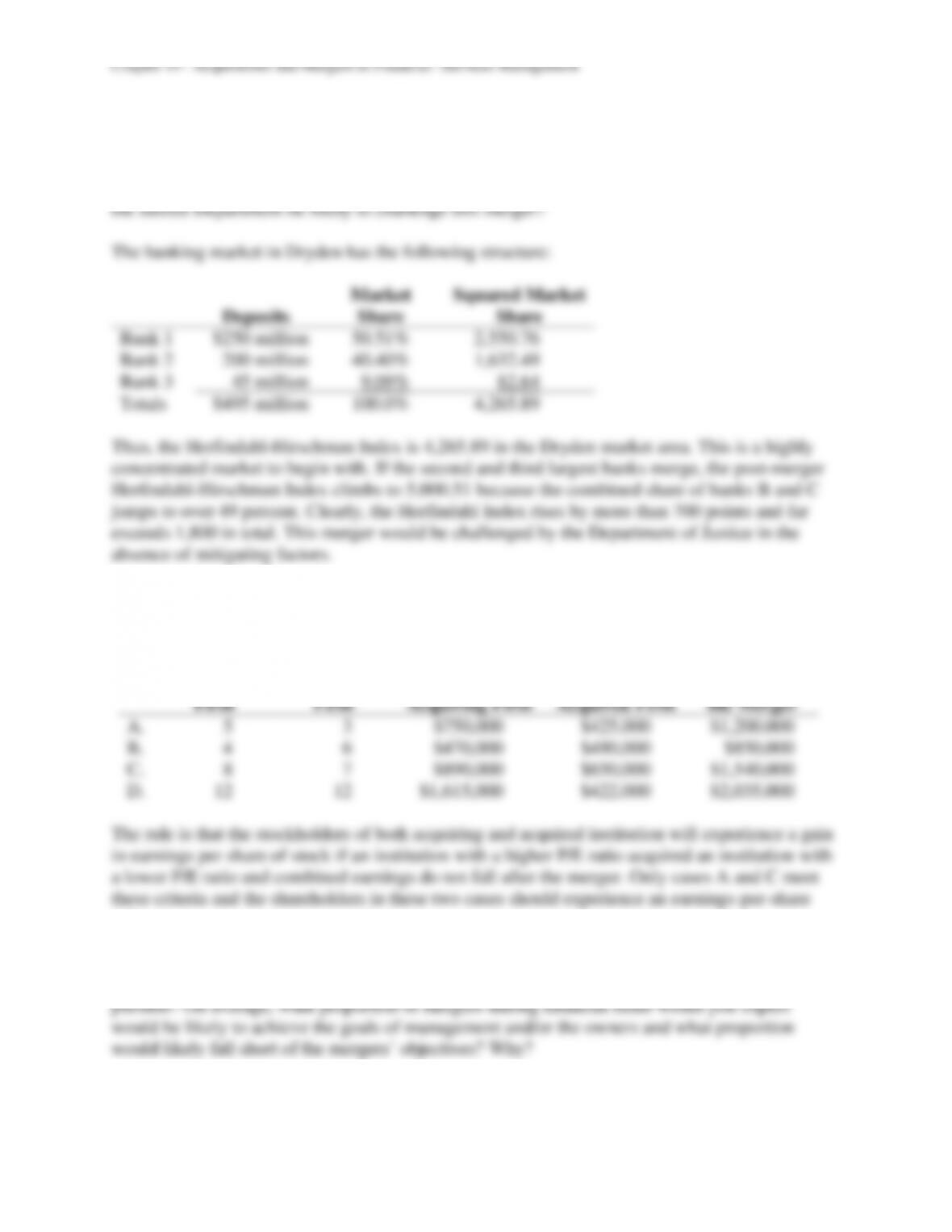
19-5. The city of Dryden is served by three banks, which recently reported deposits of $250
million, $200 million, and $45 million, respectively. Calculate the Herfindahl index for the
Dryden market area. If the second and third largest banks merge, what would the postmerger
Herfindahl index be? Under the Department of Justice guidelines discussed in the chapter, would

Chapter 19 – Acquisitions and Mergers in Financial– Services Management
19–11
The steps an institution can take that will contribute positively to the success in a merger include
the following:
A. The institution must first evaluate its own financial condition, understand its own
strengths and weaknesses and its own goals. Mergers can then magnify strengths and