Chapter 18 – Consumer Loans, Credit Cards, and Real Estate Lending
18-1
CHAPTER 18
CONSUMER LOANS, CREDIT CARDS, AND REAL ESTATE LENDING
Goal of This Chapter: To learn about the different types of loans lenders make to consumers
(individuals and families) and to real estate borrowers, and to understand the factors that
influence the profitability and risk of these loans. Additionally, the chapter also examines how
consumer and real estate loan rates may be determined and the options a loan officer has today in
pricing the loans extended to individuals and families.
Key Topics in This Chapter
• Types of Loans for Individuals and Families
• Unique Characteristics of Consumer Loans
• Dodd-Frank, the Consumer Protection Bureau, and CARD
• Evaluating a Consumer Loan Request
• Credit Cards and Credit Scoring
• Disclosure Rules and Discrimination
• Consumer Loan Pricing and Refinancing
Chapter Outline
I. Introduction
II. Types of Loans Granted to Individuals and Families
A. Residential Mortgage Loans
B. Nonresidential Loans
1. Installment Loans
2. Noninstallment Loans
C. Credit Card Loans and Revolving Credit
D. New Credit Card Regulations
E. New Consumer Regulations: Dodd-Frank, CARD Act, and the New Consumer
Protection Bureau
1. Tricks and Traps—The CARD Act and Revised Regulation Z Appear
2. Dodd-Frank Reforms and Protections Push the Rules Farther Down the Road
F. Debit Cards: A Partial Substitute for Credit Cards?
G. Rapid Consumer Loan Growth: Rising Debt-to-Income Ratios
III. Characteristics of Consumer Loans
IV. Evaluating a Consumer Loan Application
A. Character and Purpose
B. Income Levels
C. Deposit Balances
D. Employment and Residential Stability
E. Pyramiding of Debt
F. How to Qualify for a Consumer Loan
G. The Challenge of Consumer Lending
V. Example of a Consumer Loan Application
Chapter 18 – Consumer Loans, Credit Cards, and Real Estate Lending
18-2
VI. Credit Scoring Consumer Loan Applications
A. The FICO Scoring System
VII. Laws and Regulations Applying to Consumer Loans
A. Customer Disclosure Requirements
B. Outlawing Credit Discrimination
C. Predatory Lending and Subprime Loans
VIII. Real Estate Loans
A. Differences between Real Estate Loans and Other Loans
B. Factors in Evaluating Applications for Real Estate Loans
C. Home Equity Lending
D. The Most Controversial of Home Mortgage Loans: Interest-Only and Adjustable
Mortgages and the Recent Mortgage Crisis
IX. A Revised Federal Bankruptcy Code as Bankruptcy Filings Soar
X. Pricing Consumer and Real Estate Loans: Determining the Rate of Interest and Other Loan
Terms A. The Interest Rate Attached to Nonresidential Consumer Loans
1. The Cost-Plus Model
2. Annual Percentage Rate
3. Simple Interest
4. The Discount Rate Method
5. The Add-On Loan Rate Method
6. Rule of 78s
B. Interest Rates on Home Mortgage Loans
1. Fixed-Rate Mortgages (FRMs)
2. Adjustable-Rate Mortgages (ARMs)
3. Charging the Customer Mortgage Points
XI. Summary of the Chapter
Concept Checks
18-1. What are the principal differences among residential loans, nonresidential installment
loans, noninstallment loans, and credit card or revolving loans?
Residential loans are credit to finance the purchase of a home or fund improvements on a private
residence. Nonresidential loans to individuals and families include installment loans and
Chapter 18 – Consumer Loans, Credit Cards, and Real Estate Lending
18-3
18-2. Why do interest rates on consumer loans typically average higher than on most other
kinds of loans?
18-3. What features of a consumer loan application should a loan officer examine most
carefully?
18-4. How do credit-scoring systems work?
Credit-scoring systems use statistical techniques (usually multiple discriminant analysis) to
evaluate the loan applications they receive from consumers. Credit-scoring systems are usually
18-5. What are the principal advantages to a lending institution of using a credit-scoring
system?
18-6. Are there any significant disadvantages to a credit-scoring system?
A credit-scoring system assumes that the same factors that separated good from bad loans in the
past will, with an acceptable risk of error, separate good from bad loans in the future. Clearly,
18-4
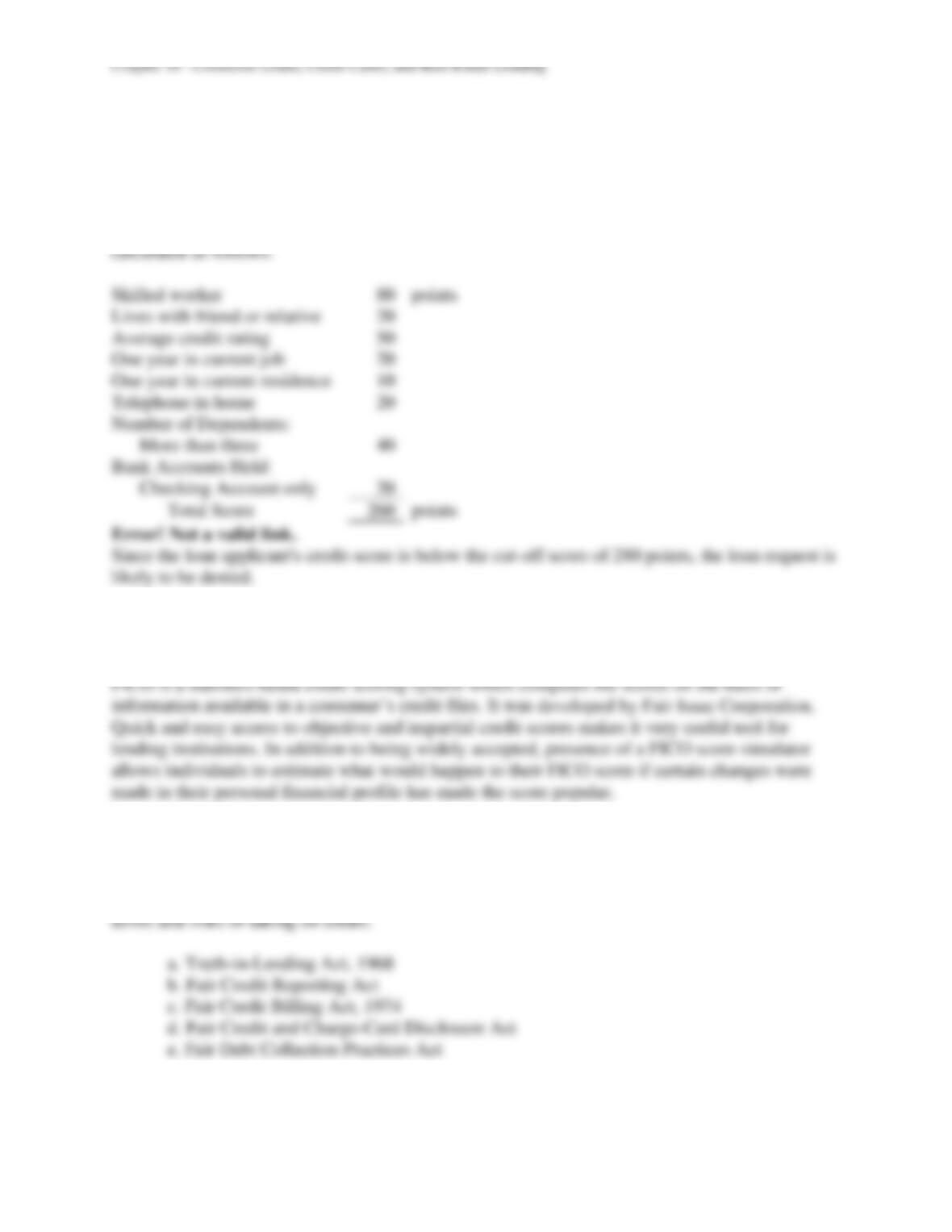
18-7. In the credit-scoring system presented in this chapter, would a loan applicant who is a
skilled worker, lives with a relative, has an average credit rating, has been in his or her present
job and at his or her current address for exactly one year, has four dependents and a telephone,
and holds a checking account be likely to receive a loan? Please explain why.
Given, the credit scoring model in the chapter, the credit-score for the loan applicant can be
18-8. What is FICO and what does it do for lenders? Why is this credit-scoring system so
popular today?
18-9. What laws exist today to give consumers fuller disclosure about the terms and risks of
taking on credit?
The following federal laws give consumers who are borrowing money fuller disclosure about the
Chapter 18 – Consumer Loans, Credit Cards, and Real Estate Lending
18-5
The Truth-in-Lending Act mandates that lenders must provide their customers with information
on all loan charges and associated risks in a disclosure statement. The Fair Credit Reporting Act
18-10. What legal protections are available today to protect borrowers against discrimination?
Against predatory lending?
The Equal Credit Opportunity Act outlaws discrimination in lending based on race, age, sex,
religious preference, receipt of public assistance, or any other irrelevant factors. The Community
18-11. In your opinion, are any additional laws needed in these areas?
Depending on one’s point of view, a case can be made, both for and against the requirement of
18-12. In what ways is a real estate loan unique compared to other kinds of bank loans?
Chapter 18 – Consumer Loans, Credit Cards, and Real Estate Lending
18-6
18-13. What factors should a lender consider in evaluating real estate loan applications?
Some of the important factors to be considered in evaluating a real estate loan application are:
1. The amount of down payment planned by the borrower as a percentage of the purchase
3. Amount and stability of the borrower’s income—a determinant of the borrower’s
capacity to service the debt as and when it becomes due.
5. The outlook for interest rates in the economy
18-14. What is home equity lending, and what are its advantages and disadvantages for banks
and other consumer lending institutions?
Loans involving a borrowing base of the residual market value of a home (value over and above
the amount of any outstanding liens against the home), being drawn upon as collateral is known
18-15. How is the changing age structure of the population likely to affect consumer loan
programs? What other forces are reshaping household lending today?
As people grow older, especially beyond the age of 40 or 45, they tend to make less use of credit
18-7
18-16. What challenges have U.S. bankruptcy laws provided for consumers and those lending
money to them?
Recent changes in U.S. bankruptcy laws present serious challenges to consumer lending
institutions. Congress passed the Bankruptcy Reform Act in 1978, amending a federal
bankruptcy code that had stood since the turn of the century. While amendments in 1984
18-17. What options does a loan officer have in pricing consumer loans?
Most consumer loans, like most business loans, are priced off some base or cost rate, with a
profit margin and compensation for risk added on. This is known as cost plus model. Some of the
other pricing mechanisms followed in pricing a consumer loans are:
18-18. Suppose a customer is offered a loan at a discount rate of 8 percent and pays $75 in
Chapter 18 – Consumer Loans, Credit Cards, and Real Estate Lending
18-8
$75 = $937.5
8%
An effective rate of 12 percent implies an interest cost of 12 percent on the available funds to the
borrower. Since the interest paid is $75, the average funds available will be:
$75 = $625
12%
18-19. See if you can determine what APR you are charging a consumer loan customer if you
Since the loan period is five years, the monthly installment will be:
$142.74 = $2.379
5×12
18-20. If you quote a consumer loan customer an APR of 16 percent on a $10,000 loan with a
term of four years that requires monthly installment payments, what finance charge must this
( )
-48
$10,000 = $283.4028
1- 1.0133
0.0133
Thus, the total amount paid by the borrower will be:
( )
$283.4028 × 12 × 4 $13,606.33=
Therefore, finance charges on the loan equals;
$13,606.33 – $10,000 = $3,606.33
18-21. What differences exist between ARMs and FRMs?
An ARM or adjustable rate mortgage is a mortgage whose interest rate changes over time,
Chapter 18 – Consumer Loans, Credit Cards, and Real Estate Lending
18-9
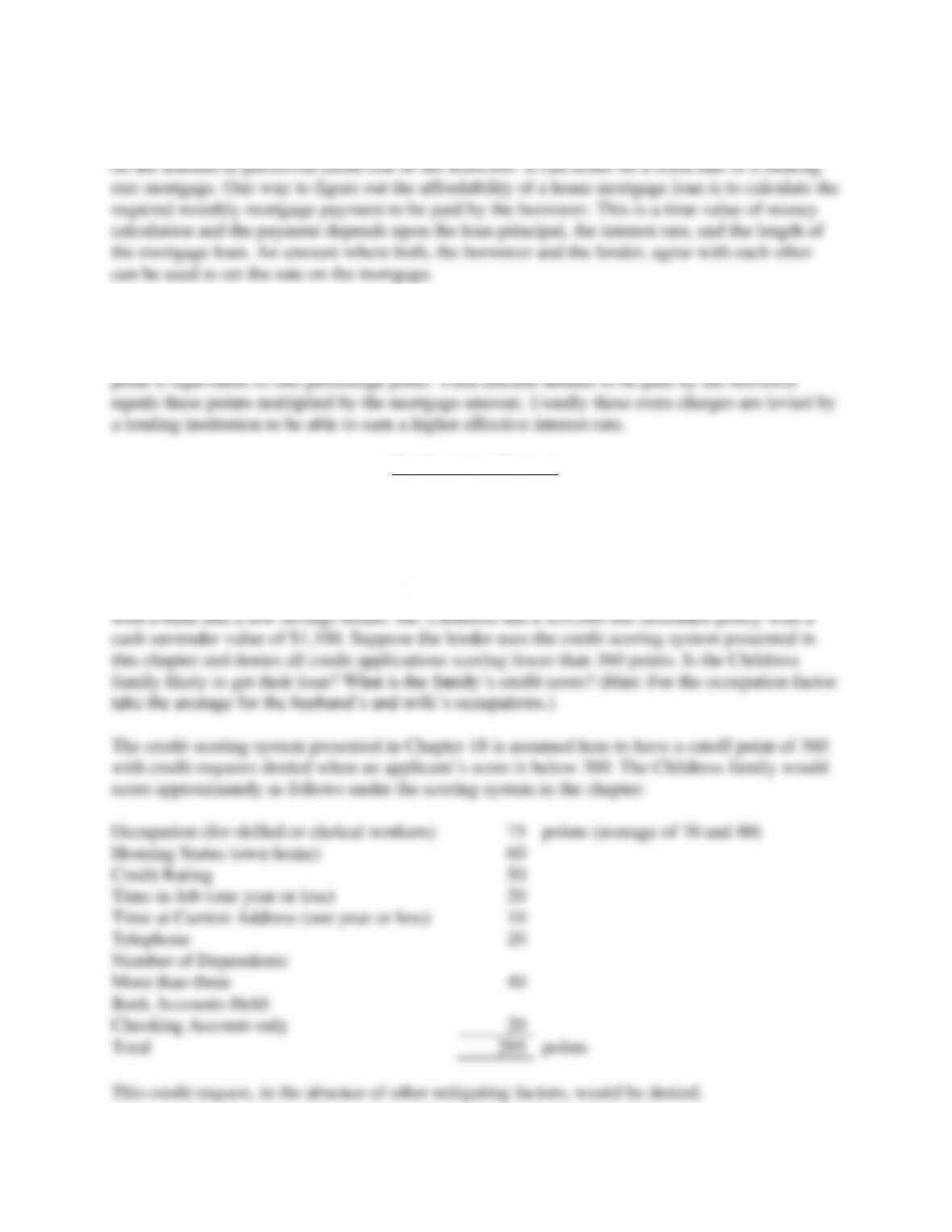
A home mortgage loan rate is usually based on the market rate of interest plus a premium based
18-23. What are points? What is their function?
Often, home loan borrowers are required to pay an additional charge upfront called points. Each
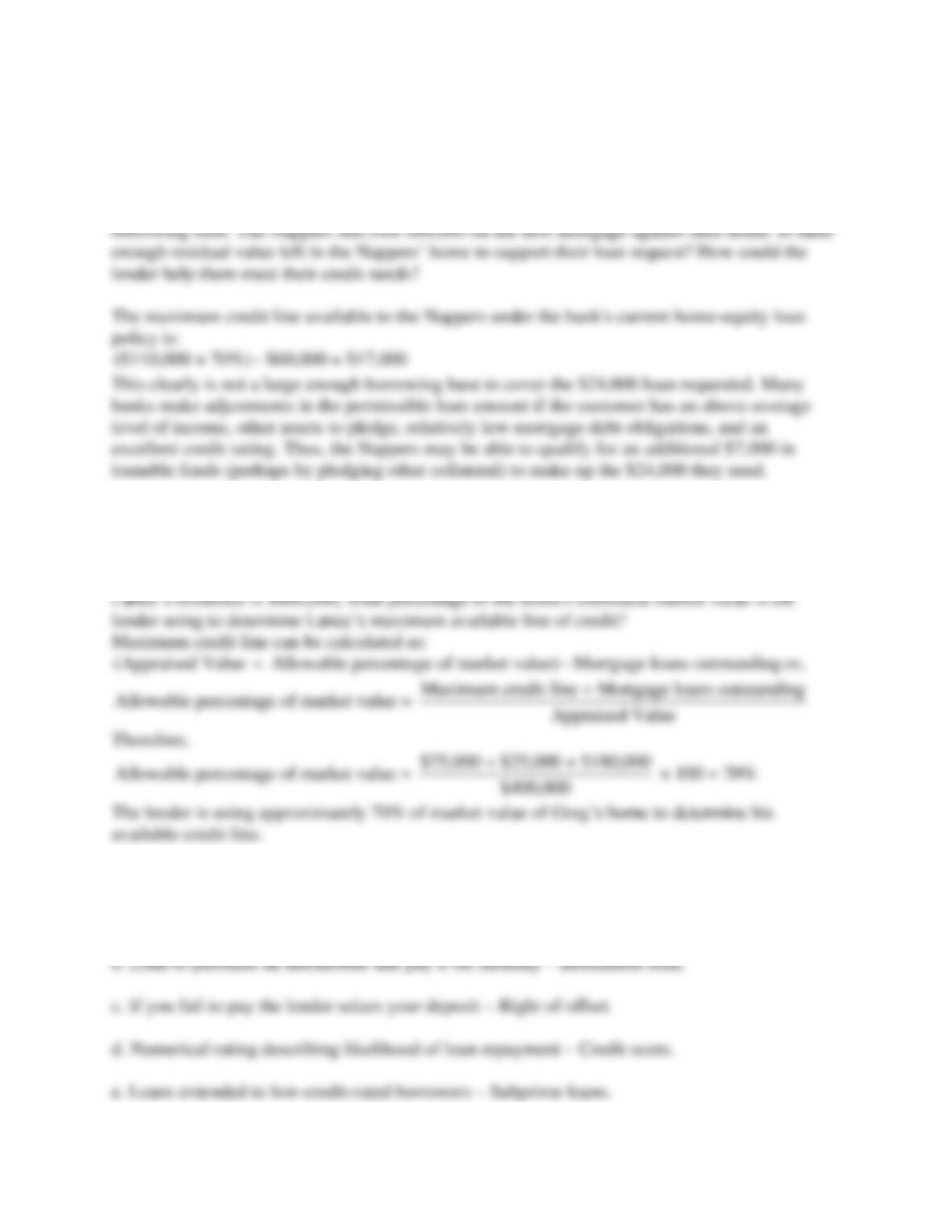
18-1. The Childress family has applied for a $5,000 loan for home improvements, especially to
install a new roof and add new carpeting. Bob Childress is a welder at Ford Motor Co., the first
year he has held that job, and his wife sells clothing at Wal-Mart. They have three children. The
Childresses own their home, which they purchased six months ago, and have an average credit
rating, with some late bill payments. They have a telephone, but hold only a checking account
Chapter 18 – Consumer Loans, Credit Cards, and Real Estate Lending
18–10
18-2. Mr. and Mrs. Napper are interested in funding their children’s college education by taking
out a home equity loan in the amount of $24,000. Eldridge National Bank is willing to extend a
loan, using the Nappers’ home as collateral. Their home has been appraised at $110,000, and
Eldridge permits a customer to use no more than 70 percent of the appraised value of a home as a
18-3. Greg Lance has just been informed by a finance company that he can access a line of
credit of no more than $75,000 based upon the equity value in his home. Lance still owes
$180,000 on a first mortgage against his home and $25,000 on a second mortgage against the
home, which was incurred last year to repair the roof and driveway. If the appraised value of
18-4. What term in the consumer lending field does each of the following statements describe?
a. Plastic card used to pay for goods and services without borrowing money – Debit card.
Chapter 18 – Consumer Loans, Credit Cards, and Real Estate Lending
18–11
f. Loan based on spread between a home’s market value and its mortgage balance – Home equity
loans.
18-5. Which federal law or laws apply to each of the situations described below?
a. A loan officer asks an individual requesting a loan about her race – This is prohibited by the
Equal Credit Opportunity Act.
b. A bill collector called Jim Jones three times yesterday at his work number without first asking
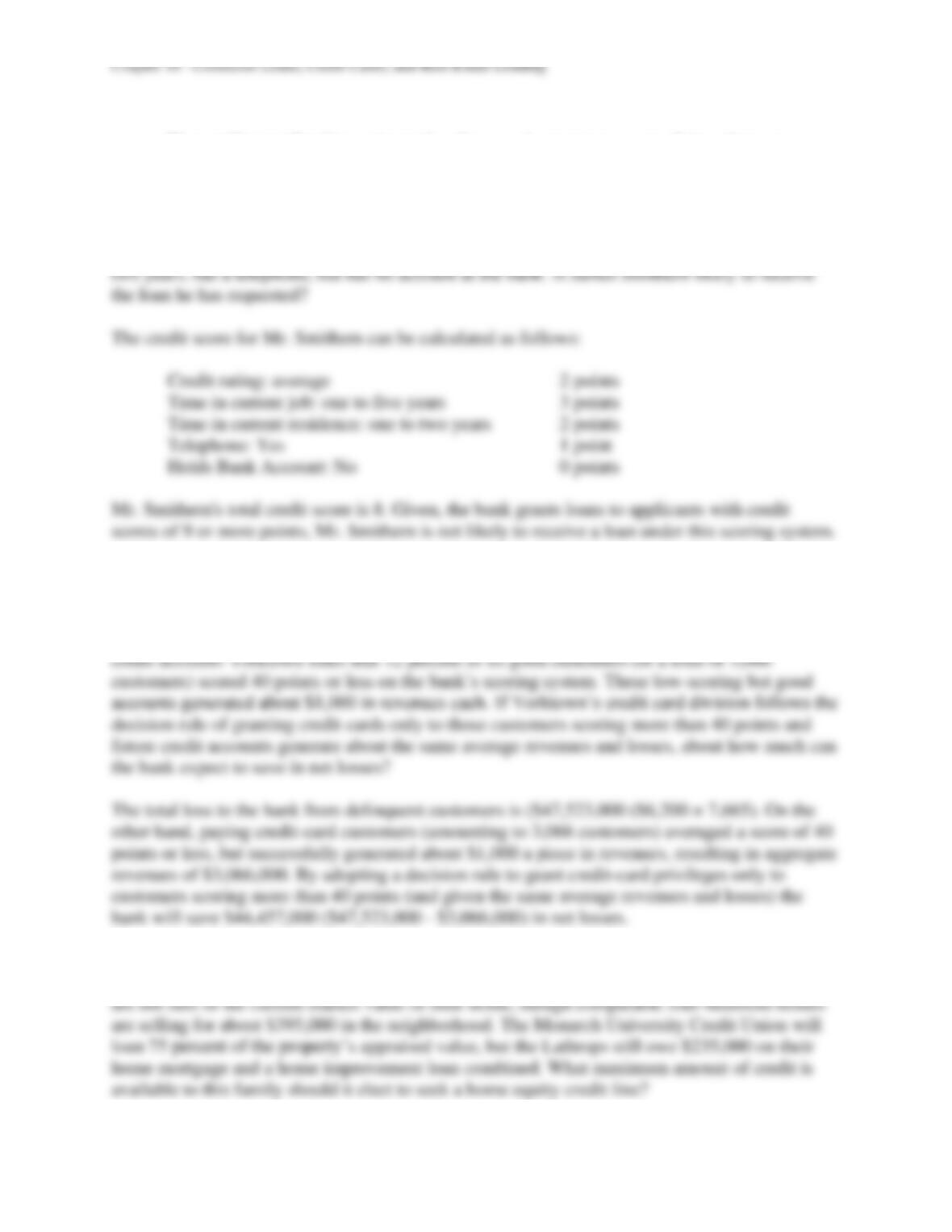
18-6. James Smithern has asked for a $3,500 loan from Beard Center National Bank to repay
some personal expenses. The bank uses a credit-scoring system to evaluate such requests, which
18–12
1)
Telephone in Residence (yes, 1; no, 0)
Holds Account at Bank (yes, 2; no, 0)
The bank generally grants a loan if a customer scores 9 or more points. Mr. Smithern has an
average credit rating, has been in his current job for three years and at his current residence for
18-7. Yorktown Savings Bank, in reviewing its credit card customers, finds that of those
customers who scored 40 points or less on its credit-scoring system, 30 percent (or a total of
7,665 credit customers) turned out to be delinquent credits, resulting in total loss. This group of
bad credit card loans averaged $6,200 in size per customer account. Examining its successful
18-8 The Lathrop family needs some extra funds to put their two children through college
starting this coming fall and to buy a new computer system for a part-time home business. They
Chapter 18 – Consumer Loans, Credit Cards, and Real Estate Lending
Maximum credit line can be calculated as:
(Current market value × Allowable percentage of market value) – Mortgage loans outstanding
or
($395,000 × 75%) – $235,000 = $61,250
Therefore, maximum amount of credit available to Lathrop family will be $61,250.
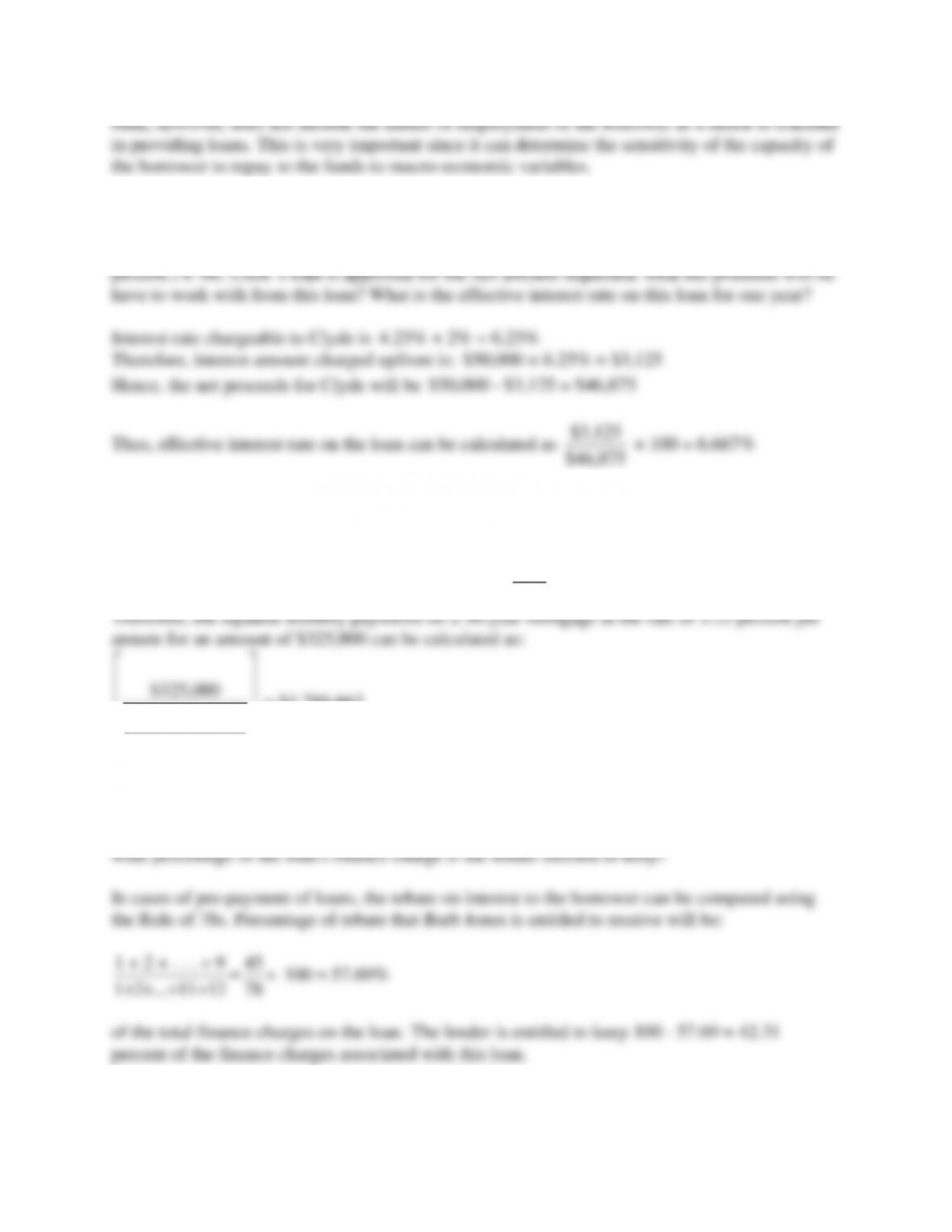
18-9 San Carlos Bank and Trust Company uses a credit-scoring system to evaluate most
consumer loans that amount to more than $2,500. The key factors used in its scoring system are
found at the conclusion of this problem.
The Mulvaney family has two wage earners who have held their present jobs for 18 months.
They have lived at their current street address for one year, where they rent on a six month lease.
Chapter 18 – Consumer Loans, Credit Cards, and Real Estate Lending
18-10. Clyde Cook wants to start his own business. He has asked his bank for a $50,000 new-
venture loan. The bank has a policy of making discount-rate loans in these cases if the venture
looks good, but at an interest rate of prime plus 2. (The prime rate is currently posted at 4.25
$46,875
18-11. The Michael family has asked for a 30-year mortgage in the amount of $325,000 to
purchase a home. At a 5.25 percent loan rate, what is the required monthly payment?
Given an annual rate of 5.25 percent, monthly rate is
5.25 = 0.4375%
12
( )
-360
$325,000 = $1,794.662
1- 1.004375
0.004375
18-12. Barb Jones received a $5,000 loan last month with the intention of repaying the loan in
12 months. However, Jones now discovers she has cash to repay the loan after making just three
payments. What percentage of the total finance charge is Jones entitled to receive as a rebate and
Chapter 18 – Consumer Loans, Credit Cards, and Real Estate Lending
18-13. The Bender family has been planning a vacation to Europe for the past two years. Tabb
Savings agrees to advance a loan of $8,000 to finance the trip provided the Benders pay the loan
back in 12 equal monthly installments. Tabb will charge an add-on loan rate of 5.75 percent.
How much in interest will the Benders pay under the add-on rate method? What is the amount of
Average funds held during the Year $4,000
18-14. Jane Zahrley’s request for a five-year automobile loan for $39,000 has been approved.
Reston Bank will require equal monthly installment payments for 60 months. The bank tells Jane
that she must pay a total of $5,500 in finance charges. What is the loan’s APR?
18-15. Susie Que has asked for a 25-year mortgage to purchase a home at Nag’s Head. The
5.5% = 0.458%
12
The equated monthly installments that Susie will be required to pay can be calculated as:
( )
-300
$395,000 = $2,425.65
1 – 1.0045833
0.0045833
18-16. Mary Contrary is offered a $1,600 loan for a year to be paid back in equal quarterly
Chapter 18 – Consumer Loans, Credit Cards, and Real Estate Lending
18–16
cost) if she were offered the $1,600 at 5 percent simple interest with only one principal payment
when the loan reaches maturity? What advantage would this second set of loan terms have over
the first set of loan terms?
18-17. Buck and Marie Rogers are negotiating with their local bank to secure a mortgage loan in
order to buy their first home. With only a limited down payment available to them, Buck and
0.5
$300,000 × = $1,500
100
Thus, the amount of funds available to the Rogers will be:
$300,000 – $1,500 = $298,500
18-18. Dryden Bank’s personal loan department quotes Lance Greg a finance charge of $3.75
for each $100 in credit the bank is willing to extend to him for a year (assuming the balance of
equated monthly payments required is
$103.75 = $8.645
12
. The monthly rate charged by the bank

( )
-6
$100 = $17.002
1 – 1.00571
0.00571
($103.75 – $102.008).