Chapter 17 – Lending to Business Firms and Pricing Business Loans
17–12
725
Depreciation expenses
12
Liabilities and Equity
Selling, administrative,
and other expenses
28
Short-term debt:
108
Before-tax net income
6
Accounts payable
117*
Taxes owed
1
Notes payable
325*
After-tax net income
5
Long-term debt (bonds)
15
Equity capital
160
725
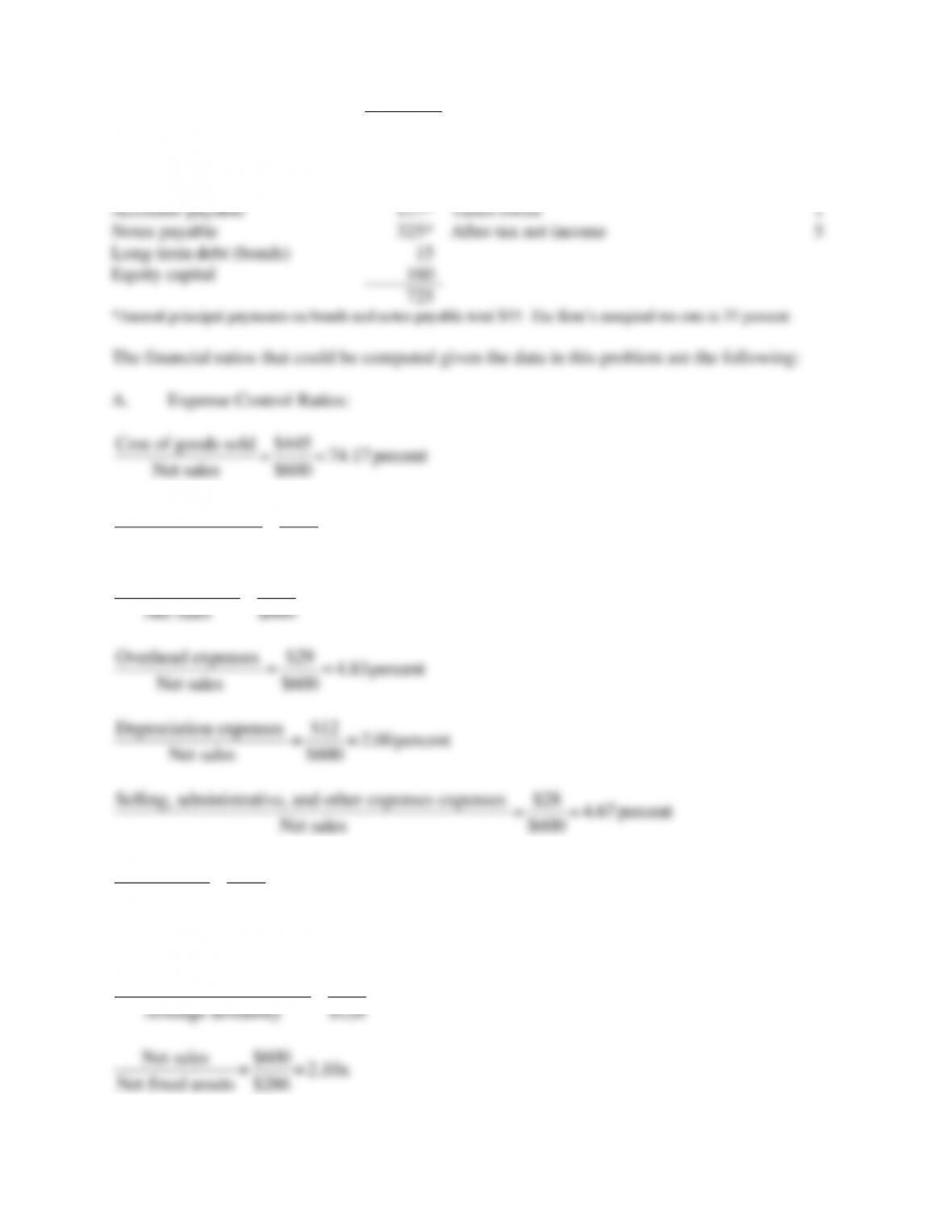
*Annual principal payments on bonds and notes payable total $55. The firm’s marginal tax rate is 35 percent.
The financial ratios that could be computed given the data in this problem are the following:
A. Expense Control Ratios:
Cost of goods sold $445
= = 74.17 percent
Net sales $600
Wages and salaries $52
= =8.67 percent
Net sales $600
Interest expense $28
= = 4.67 percent
Net sales $600
Net sales $600
Taxes owed $1
= = 0.17 percent
Net sales $600
B. Operating Efficiency: Measure of a Business Firm’s Performance Effectiveness
Annual cost of goods sold $445
= =3.48x
Average inventory $128
Net fixed assets $286
Chapter 17 – Lending to Business Firms and Pricing Business Loans
Net sales $600
= = 0.83x
Total assets $725
Net sales $600
= =3.87x
Accounts and notes receivable $155
( )
( )
Accounts receivable $155
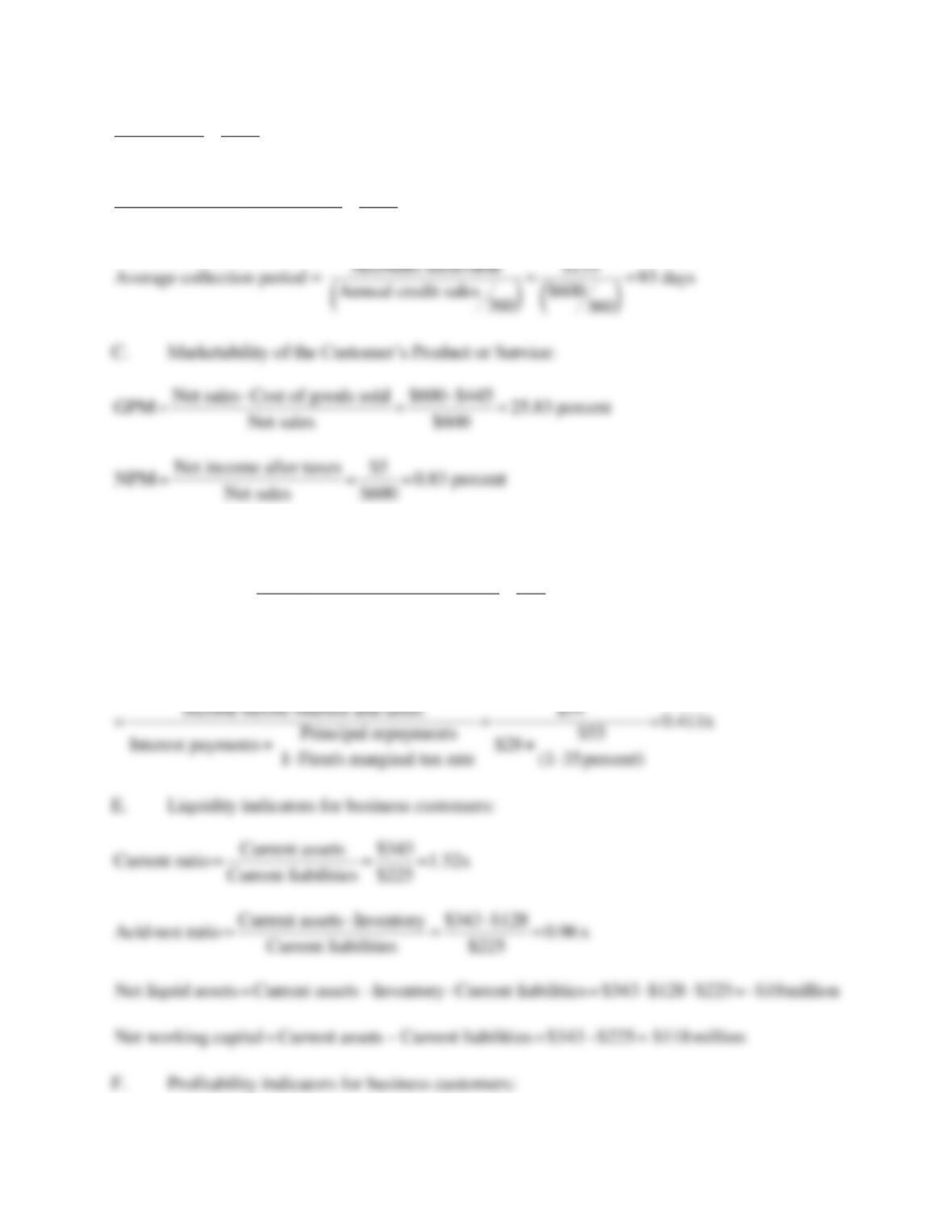
Average collection period = = = 93 days
$600
Annual credit sales 360 360
C. Marketability of the Customer’s Product or Service:
Net sales –Cost of goods sold $600–$445
GPM = = 25.83 percent
Net sales $600
=
Net income after taxes $5
NPM = = = 0.83 percent
Net sales $600
D. Coverage Ratios: Measuring the Adequacy of Earnings
Income before interest and taxes $34
Interest coverage = =1.214x
Interest payments $28
=
Coverage of interest and principal payments =
Income before interest and taxes $34
= = = 0.411x
Principal repayments $55
Interest payments + $28+
1–Firm‘s marginal tax rate (1-35percent)
Chapter 17 – Lending to Business Firms and Pricing Business Loans
Before-tax net income $6
= = 0.83percent
Total assets $725
After-tax net income $5
= = 0.69percent
Total assets $725
Before-tax net income $6
= =3.75percent
Net worth $160
After-tax net income $5
= =3.13percent
Net worth $160
G. The Financial leverage factor:
Total liabilities $565
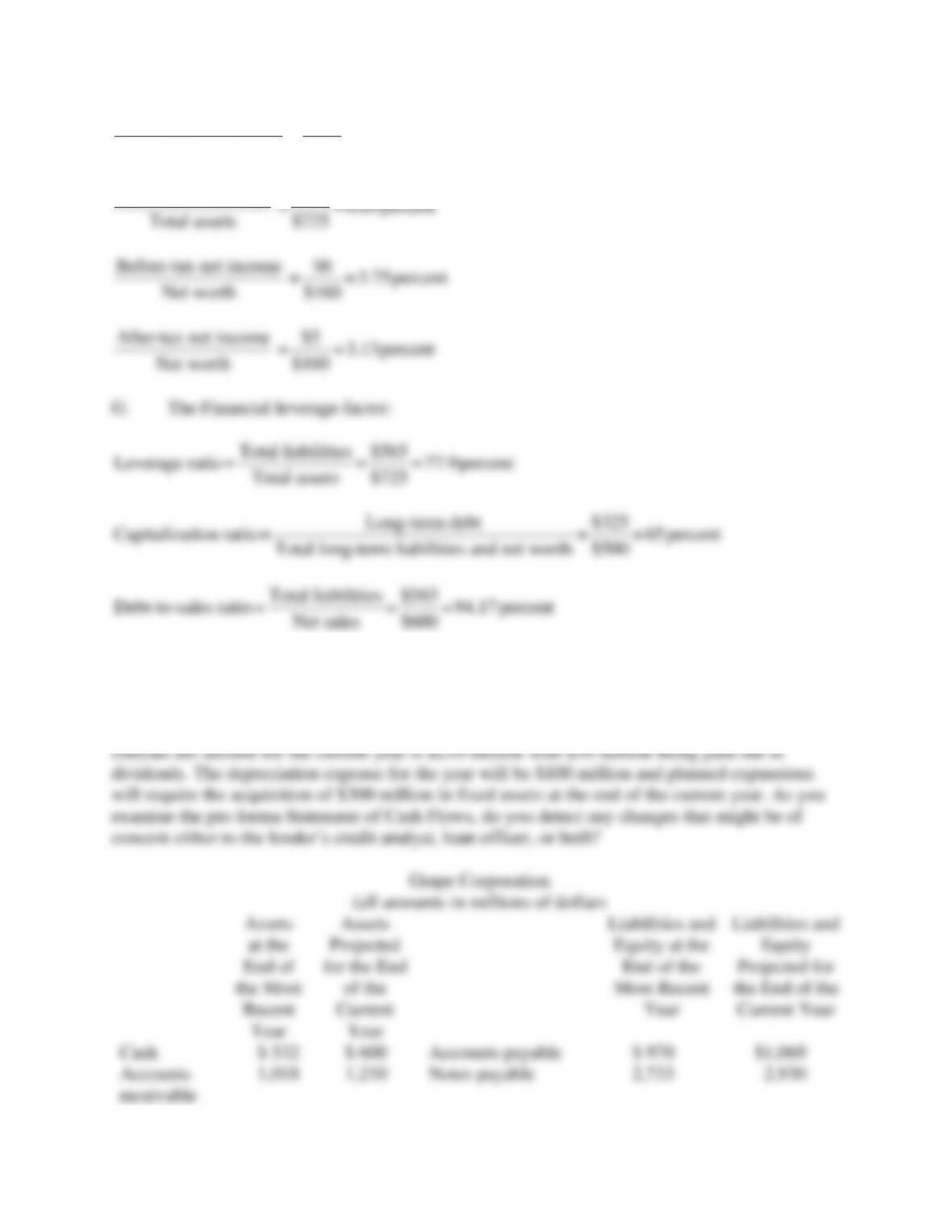
Leverage ratio = = =77.9percent
Total assets $725
Long-term debt $325
Capitalization ratio = = = 65percent
Total long-term liabilities and net worth $500
Total liabilities $565
Debt-to-sales ratio = = =94.17 percent
Net sales $600
17-4. Grape Corporation has placed a term loan request with its lender and submitted the
following balance sheet entries for the year just concluded and the pro forma balance sheet
expected by the end of the current year. Construct a pro forma Statement of Cash Flows for the
current year using the consecutive balance sheets and some additional needed information. The
Chapter 17 – Lending to Business Firms and Pricing Business Loans
17–15
Inventories
894
973
Taxes payable
327
216
Net fixed
assets
2,740
2,940
Long-term debt
obligations
872
1,072
Other assets
66
87
Common stock
85
85
Undivided profits
263
473
Total assets
$5,250
$5,810
Total liabilities and
equity capital
$5,250
$5,810
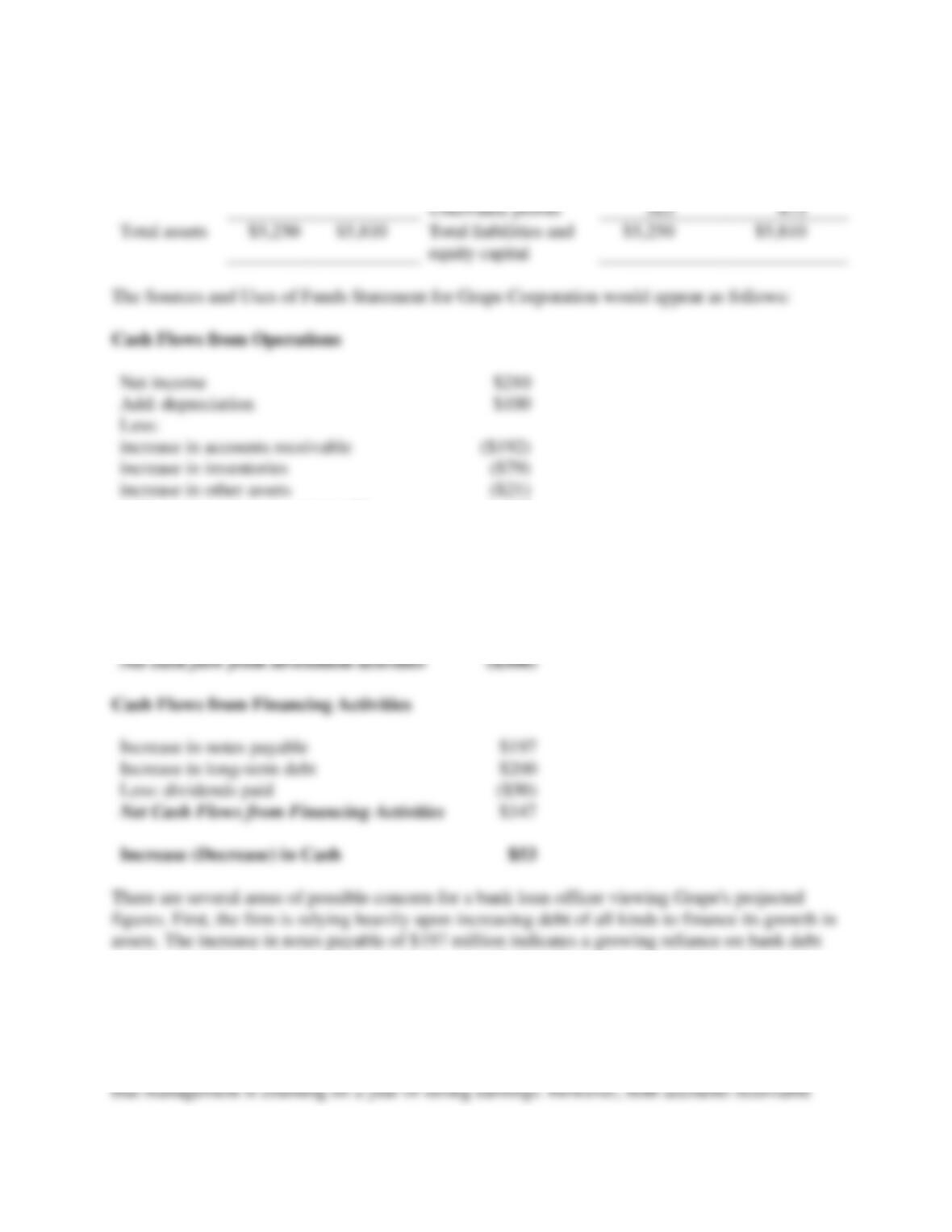
The Sources and Uses of Funds Statement for Grape Corporation would appear as follows:
Cash Flows from Operations
Net income
$210
Add: depreciation
$100
Less:
increase in accounts receivable
($192)
increase in inventories
($79)
increase in other assets
($21)
Add: increase in accounts payable
$99
Less: decrease in tax payable
($111)
Net cash flow from operations
$6
Cash Flows from Investment Activities
Acquisition of fixed assets
($300)
Net cash flow from investment activities
($300)
Cash Flows from Financing Activities
Increase in notes payable
$197
Increase in long-term debt
$200
Less: dividends paid
($50)
Net Cash Flows from Financing Activities
$347
Increase (Decrease) in Cash
$53
There are several areas of possible concern for a bank loan officer viewing Grape’s projected
figures. First, the firm is relying heavily upon increasing debt of all kinds to finance its growth in
assets. The increase in notes payable of $197 million indicates a growing reliance on bank debt
supplemented by sizable increases in supplier-provided credit (accounts payable) and long-term
debt obligations (most likely, bonds) with no change in funds provided by issuing stock. The
bank could experience a serious weakening in the strength of its claim against the firm as other
creditors post a more substantial claim against assets.
Grape is projecting a sizable increase in its retained earnings (undivided profits) which suggests
Chapter 17 – Lending to Business Firms and Pricing Business Loans
and inventories (as well as net fixed assets) are growing rapidly, perhaps reflecting troubles in
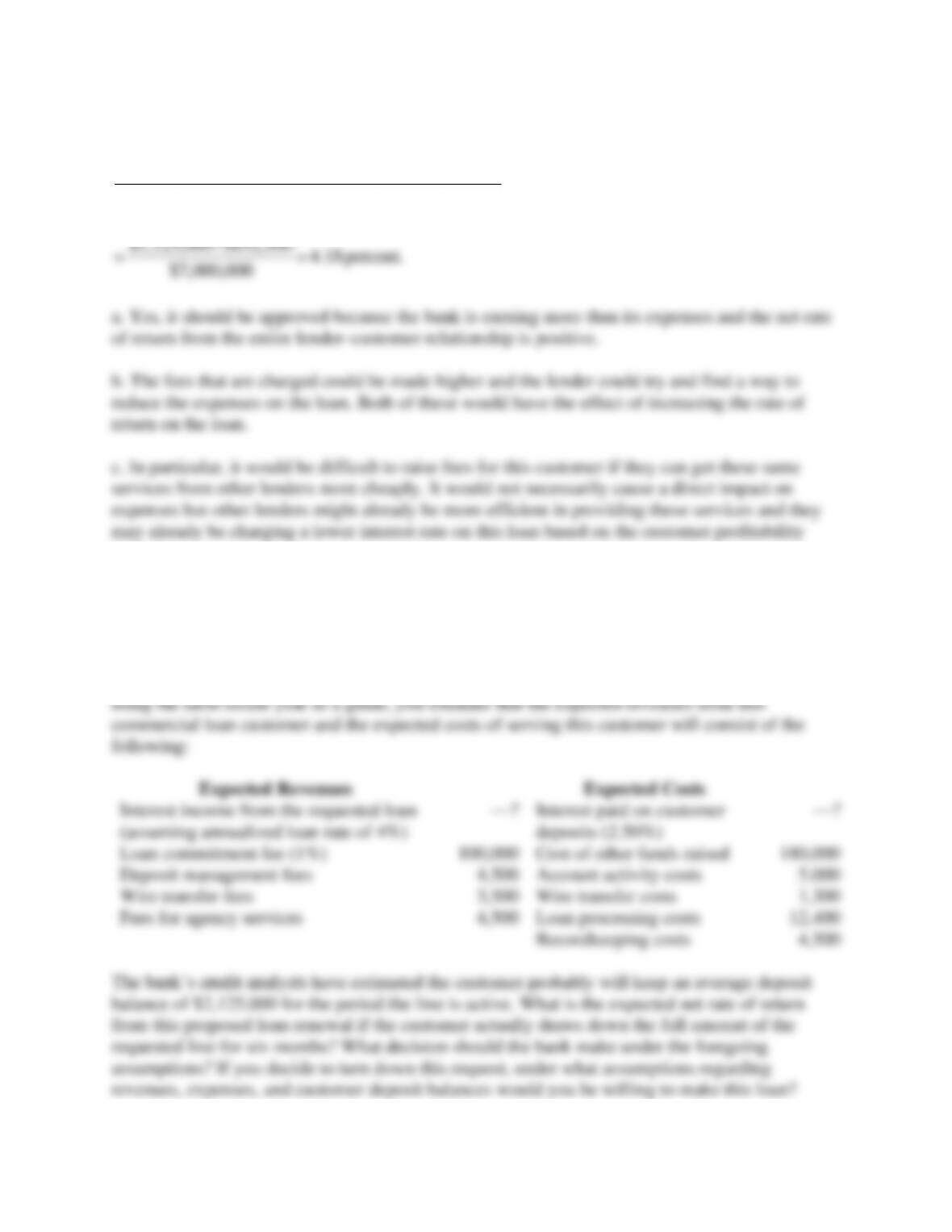
17-5 Blue Jay Corporation is a new business client for First Commerce National Bank and has
asked for a one-year, $10 million loan at an annual interest rate of 6 percent. The company plans
to keep a 2.75 percent, $3 million CD with the bank for the loan’s duration. The loan officer in
charge of the case recommends at least a 4 percent annual before-tax rate of return over all costs.
Using customer profitability analysis (CPA), the loan committee hopes to estimate the following
Chapter 17 – Lending to Business Firms and Pricing Business Loans
17–17
Before-tax rate of return over costs from the entire lender-customer relationship
Revenues expected –Costs expected
Net amount of all loanable funds supplied customer
=
$1,125,000–$832,500
= = 4.18percent.
$7,000,000
a. Yes, it should be approved because the bank is earning more than its expenses and the net rate
of return from the entire lender–customer relationship is positive.
b. The fees that are charged could be made higher and the lender could try and find a way to
reduce the expenses on the loan. Both of these would have the effect of increasing the rate of
return on the loan.
c. In particular, it would be difficult to raise fees for this customer if they can get these same
services from other lenders more cheaply. It would not necessarily cause a direct impact on
expenses but other lenders might already be more efficient in providing these services and they
may already be charging a lower interest rate on this loan based on the customer profitability
analysis.
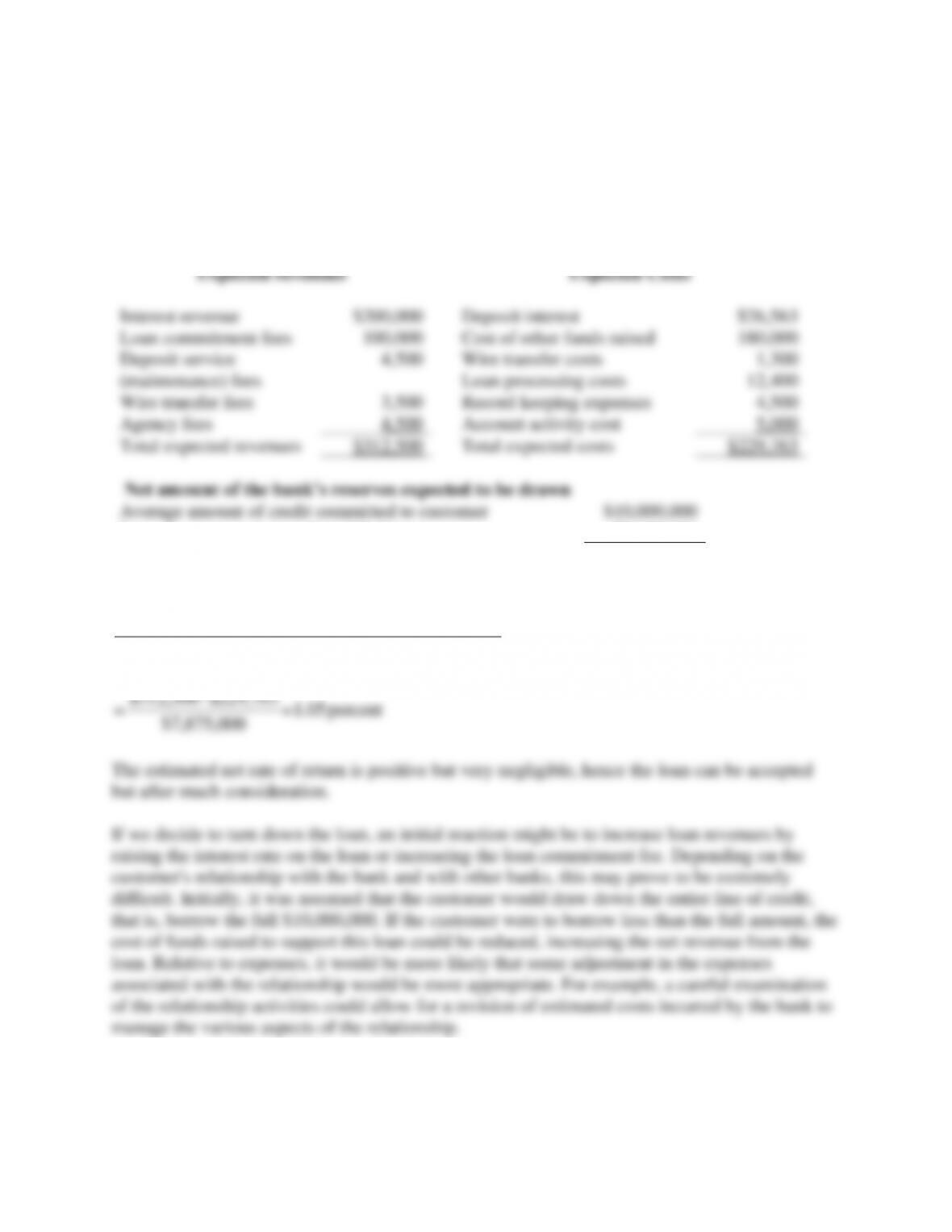
17-6. As a loan officer for Allium National Bank, you have been responsible for the bank’s
relationship with USF Corporation, a major producer of remote-control devices for activating
television sets, DVDs, and other audio-video equipment. USF has just filed a request for renewal
of its $10 million line of credit, which will cover approximately six months. USF also regularly
uses several other services sold by the bank. Applying customer profitability analysis (CPA) and
Chapter 17 – Lending to Business Firms and Pricing Business Loans
17–18
The expected revenues and costs from continuing the present relationship between Allium
National Bank and USF Corporation were given in this problem and the reader is asked to
estimate the expected net rate of return if the bank renews its loan to USF.
The total of expected revenues and expected costs is:
Expected revenues
Expected Costs
Interest revenue
$200,000
Deposit interest
$26,563
Loan commitment fees
100,000
Cost of other funds raised
180,000
Deposit service
4,500
Wire transfer costs
1,300
(maintenance) fees
Loan processing costs
12,400
Wire transfer fees
3,500
Record keeping expenses
4,500
Agency fees
4,500
Account activity cost
5,000
Total expected revenues
$312,500
Total expected costs
$229,763
Net amount of the bank’s reserves expected to be drawn
Average amount of credit committed to customer
$10,000,000
Less: Average customer deposit balances
$2,125,000
Net amount of loanable reserves supplied to customer
$7,875,000
Before-tax rate of return over costs from the entire lender-customer relationship
Revenues expected –Costs expected
Net amount of all loanable funds supplied customer
=
$312,500–$229,763
= =1.05percent
$7,875,000
The estimated net rate of return is positive but very negligible, hence the loan can be accepted
but after much consideration.
If we decide to turn down the loan, an initial reaction might be to increase loan revenues by
raising the interest rate on the loan or increasing the loan commitment fee. Depending on the
customer’s relationship with the bank and with other banks, this may prove to be extremely
difficult. Initially, it was assumed that the customer would draw down the entire line of credit,
that is, borrow the full $10,000,000. If the customer were to borrow less than the full amount, the
cost of funds raised to support this loan could be reduced, increasing the net revenue from the
loan. Relative to expenses, it would be more likely that some adjustment in the expenses
associated with the relationship would be more appropriate. For example, a careful examination
of the relationship activities could allow for a revision of estimated costs incurred by the bank to
manage the various aspects of the relationship.

17–19
17-7. In order to help fund a loan request of $10 million for one year from one of its best
customers, Lone Star Bank sold negotiable CDs to its business customers in the amount of $6
million at a promised annual yield of 2.75 percent and borrowed $4 million in the Federal funds
market from other banks at today’s prevailing interest rate of 2.80 percent.
Credit investigation and recordkeeping costs to process this loan application were an
17-8. Many loans to corporations are quoted today at small risk premiums and profit margins
over the London Interbank Offered rate (LIBOR). Englewood Bank has a $25 million loan
request for working capital to fund accounts receivable and inventory from one of its largest
Chapter 17 – Lending to Business Firms and Pricing Business Loans
17–20
At today’s prevailing LIBOR rate the customer’s requested loan-rate formula would generate a
17-9. Five weeks ago, Robin Corporation borrowed from the commercial finance company that
employs you as a loan officer. At that time, the decision was made (at your personal urging) to
base the loan rate on below-prime market pricing, using the average weekly Federal funds
interest rate as the money market borrowing cost. The loan was quoted to Robin at the Federal
funds rate plus a three-eighths percentage point markup for risk and profit.
Weekly Averages of Money Market Rates over the Most Recent 5 Weeks
Money Market Interest Rates
Week 1
(1 week ago)
Week 2
Week 3
Week 4
Week 5
(5 weeks ago)
Federal funds
1.99%
2.04%
1.98%
2.06%
2.02%
Commercial paper
(one-month maturity)
2.13
2.17
2.17
2.20
2.05
CDs (one-month maturity)
2.47
2.58
2.52
2.53
2.43
Eurodollar deposits (three-month
maturity)
3.00
3.00
3.00
3.10
2.85
U.S. Treasury bills
(three-month, secondary market)
1.84
1.87
1.85
2.04
1.86
0.375 percent charged for risk and profitability, we find the following trend:
Chapter 17 – Lending to Business Firms and Pricing Business Loans
17–21
Week 1
Week 2
Week 3
Week 4
Week 5
Loan granted at Fed rate
2.3650%
2.415%
2.355%
2.435%
2.395%
Commercial paper
2.505%
2.545%
2.545%
2.575%
2.425%
CDs (one-month maturity)
2.845%
2.955%
2.895%
2.905%
2.805%
Eurodollar deposits
3.375%
3.375%
3.375%
3.475%
3.225%
US Treasury
2.215%
2.245%
2.225%
2.415%
2.235%
Week 1
Week 2
Week 3
Week 4
Week 5
Fed Funds
1.99%
2.04%
1.98%
2.06%
2.02%
Margin
0.25%
0.25%
0.25%
0.25%
0.25%
Loan Rate
2.24%
2.29%
2.23%
2.31%
2.27%
17-10. Eagle Corporation has posted an average deposit balance this past month of $325,000.
Float included in this one-month average balance has been estimated at $50,000. Required legal
reserves are 3 percent of net collected funds. What is the amount of net investable (usable) funds
available to the bank holding the deposit?