
Chapter 16 – Lending Policies and Procedures: Managing Credit Risk
16-1
CHAPTER 16
LENDING POLICIES AND PROCEDURES: MANAGING CREDIT RISK
Goal of This Chapter: The purpose of this chapter is to learn the steps in a lending process,
regulations in the industry, and the importance of lending policies for banks and other lending
institutions.
Key Topics in This Chapter
• Types of Loans Banks and Competing Lenders Make
• Factors Affecting the Mix of Loans Made
• Regulation of Lending
• Creating a Written Loan Policy
• Steps in the Lending Process
• Loan Review and Loan Workouts
Chapter Outline
I. Introduction
II. Types of Loans
A. Types of Loans:
1. Real Estate Loans
2. Financial Institution Loans
3. Agricultural Loans
4. Commercial and Industrial Loans
5. Loans to Individuals
6. Miscellaneous Loans
7. Lease Financing Receivables
B. Factors Determining the Growth and Mix of Loans
III. Regulation of Lending
A. Relevant Regulations:
B. Establishing A Good Written Loan Policy
IV. Steps in the Lending Process
1. Finding Prospective Loan Customers
2. Evaluating a Prospective Customer’s Character and Sincerity of Purpose
3. Making Site Visits and Evaluating a Prospective Customer’s Credit Record
4. Evaluating a Prospective Customer’s Financial Condition
5. Assessing Possible Loan Collateral and Signing the Loan Agreement
6. Monitoring Compliance with the Loan Agreement and Other Customer Service
Needs
V. Credit Analysis: What Makes a Good Loan?
A. Is the Borrower Creditworthy? The Cs of Credit
Chapter 16 – Lending Policies and Procedures: Managing Credit Risk
16-2
1. Character
2. Capacity
3. Cash
4. Collateral
5. Conditions
6. Control
B. Can the Loan Agreement Be Properly Structured and Documented?
C. Can the Lender Perfect Its Claim Against the Borrower’s Earnings and Any Assets
That May Be Pledged as Collateral?
1. Reasons for Taking Collateral
2. Common Types of Loan Collateral
a. Accounts Receivable
b. Factoring
c. Inventory
d. Real Property
e. Personal Property
f. Personal Guarantees
3. Other Safety Devices to Protect a Loan
VI. Sources of Information About Loan Customers
VII. Parts of A Typical Loan Agreement
A. The Promissory Note
B. Loan Commitment Agreement
C. Collateral
D. Covenants (Affirmative and Negative)
E. Borrower Guaranties or Warranties
F. Events of Default
VIII. Loan Review
IX. Loan Workouts
X. Summary of the Chapter
Concept Checks
16-1. In what ways does the lending function affect the economy of its community or region?
Bank credit is one of the most important sources of capital that fuels local economic growth and
16-2. What are the principal types of loans made by banks?
Bank loans are usually classified by the purpose of the loans. The most common classifications
16-3. What factors appear to influence the growth and mix of loans held by a lending
institution?
16-4 A lender’s cost accounting system reveals that its losses on real estate loans average 0.45
percent of loan volume and its operating expenses from making these loans average 1.85 percent
Chapter 16 – Lending Policies and Procedures: Managing Credit Risk
16-4
A loan officer usually takes or receives such a request initially and passes it along to the credit
16-9. What three major questions or issues must a lender consider in evaluating nearly all loan
2. Can the loan agreement be properly structured and documented?
16-10. Explain the following terms: character, capacity, cash, collateral, conditions, and control.
a. Character – Character assessment involves finding out the purpose of credit request by a
customer and the intention of the borrower to repay the funds.
b. Capacity – Capacity is a customer’s authority to request a loan and the legal standing to sign a
16-11. Suppose a business borrower projects that it will experience net profits of $2.1 million,
compared to $2.7 million the previous year, and will record depreciation and other noncash
Chapter 16 – Lending Policies and Procedures: Managing Credit Risk
million and noncash expenses decrease by $0.2 million. What happens to the firm’s cash flow?
What would be the lender’s likely reaction to these events?
(Note: Assume the noncash expense is already included in the cost of goods sold.)
Chapter 16 – Lending Policies and Procedures: Managing Credit Risk
16-6
16-14. What is loan review? How should a loan review be conducted?
Loan review is a process of periodic review of outstanding loans on an institution’s books to
make sure each loan is paying out as planned, all necessary documentation is present, and the
2. Structuring the loan review process carefully to make sure the most important features
of each loan are checked
4. Conducting more frequent reviews of troubled loans
16-15. What are some warning signs to management that a problem loan may be developing?
Loans characterized by reduced communication between borrower and lender, delays in
16-16. What steps should a lender go through in trying to resolve a problem loan situation?
1. The goal of all loan workouts should be to maximize the chances of recovery of funds.
3. Loan workout process should be independent of the lending function to avoid any
conflict of interest.
4. Loan workout specialists should conduct a preliminary analysis of the problem and its
6. Loan workout personnel should conduct a tax and litigation search to check for any other
unpaid liabilities of the borrower.
7. For business borrowers, loan personnel must evaluate the quality, competence, and
integrity of current management.
8. Loan workout professionals must consider all reasonable alternatives for cleaning up the
16-1. The lending function of depository institutions is highly regulated and this chapter gives
some examples of the structure of these regulations for national banks. In this problem you are
asked to apply those regulations to Red Rose National Bank (RRNB). Red Rose has the
following sources of funds: $300 million in capital and surplus, $325 million in demand deposits,
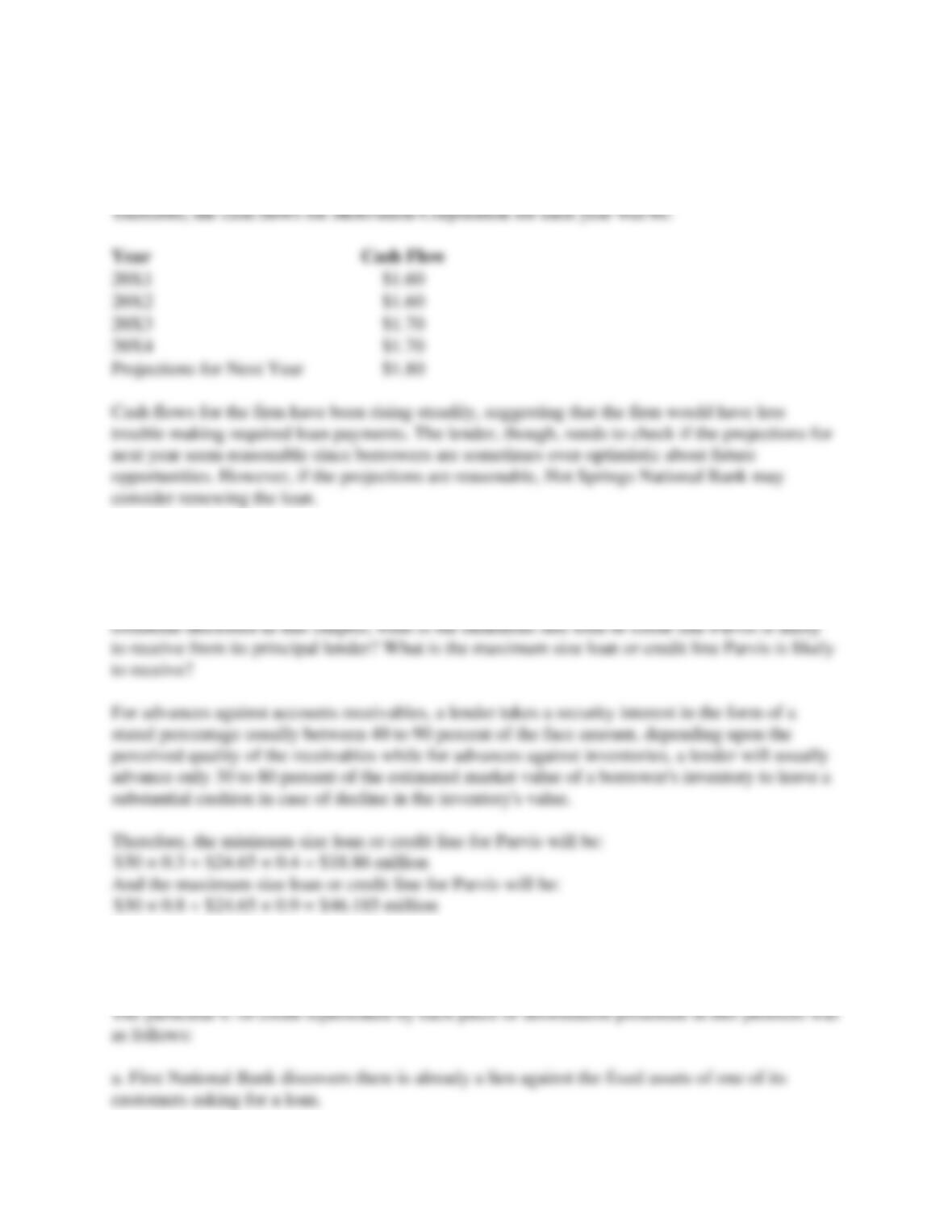
16-2. Motivation Corporation, seeking renewal of its $12 million credit line, reports the data in
the following table (in millions of dollars) to Hot Springs National Bank’s loan department.
Please calculate the firm’s cash flow as defined earlier in this chapter. What trends do you
Chapter 16 – Lending Policies and Procedures: Managing Credit Risk
16-8
(Note: Assume the noncash expense is already included in the cost of goods sold.)
Cash flows for a firm can be calculated as:
Sales Revenues – Cost of Goods Sold – Selling and Admin – Taxes Paid in Cash + Non Cash Expenses
16-3. Parvis Manufacturing and Service Company holds a sizable inventory of dryers and
washing machines, which it hopes to sell to retail dealers over the next six months. These
appliances have a total estimated market value currently of $30 million. The firm also reports
accounts receivable currently amounting to $24,650,000. Under the guidelines for taking
16-4. Under which of the six Cs of credit discussed in this chapter does each of the following
pieces of information belong?
Chapter 16 – Lending Policies and Procedures: Managing Credit Risk
16-9
Collateral
b. Xron Corporation has asked for a type of loan its lender normally refuses to make.
Control
c. John Selman has an excellent credit rating.
Character
d. Smithe Manufacturing Company has achieved higher earnings each year for the past six years.
Cash
Chapter 16 – Lending Policies and Procedures: Managing Credit Risk
16–10
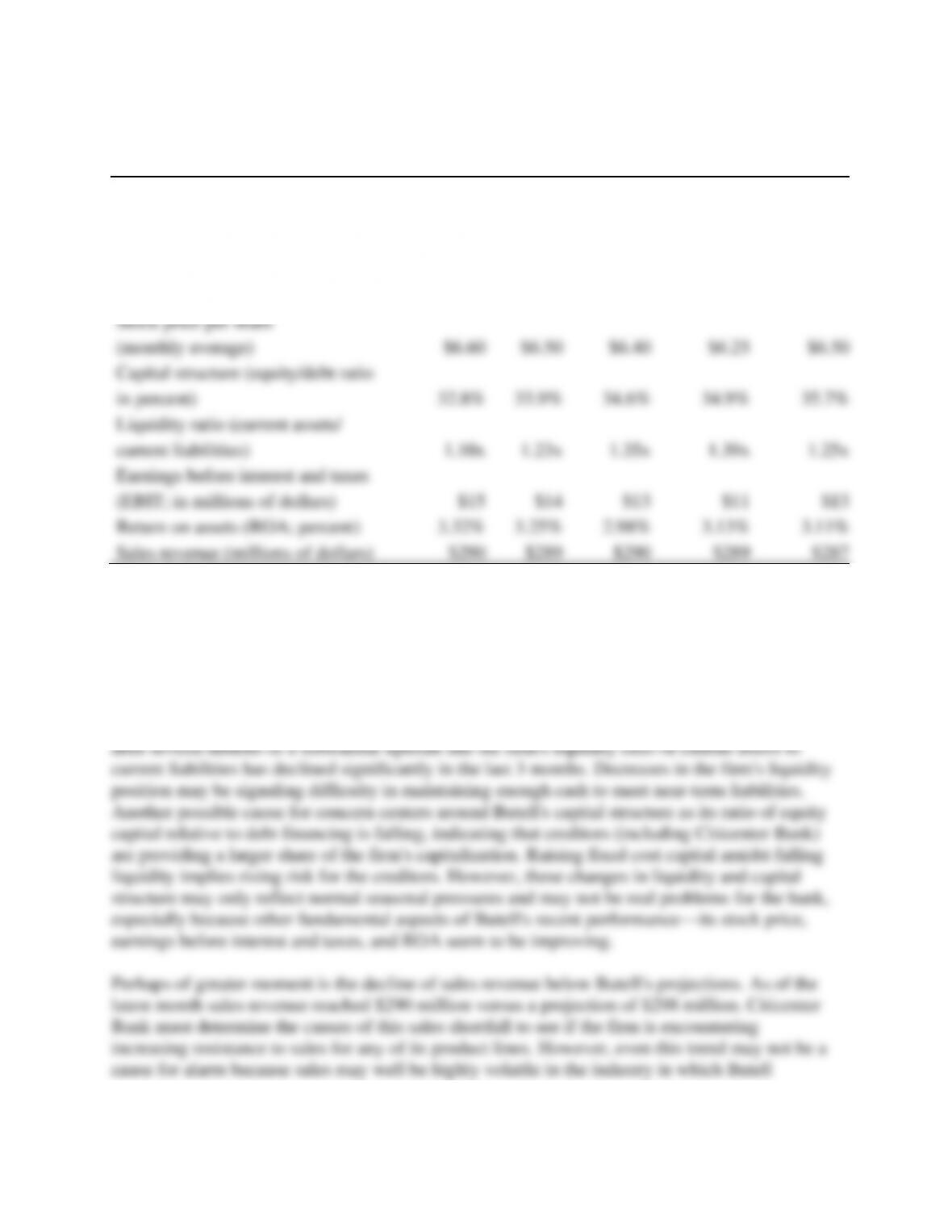
each month. Based on the following information, is there any indication of a developing problem
loan? About what dimensions of the firm’s performance should Citicenter Bank be concerned?
One
Two
Three
Four
Current
Month
Months
Months
Months
Month
Ago
Ago
Ago
Ago
Cash account (millions of dollars)
$33
$57
$51
$44
$43
Projected sales (millions of dollars)
$298
$295
$294
$291
$288
Stock price per share
(monthly average)
$6.60
$6.50
$6.40
$6.25
$6.50
Capital structure (equity/debt ratio
in percent)
32.8%
33.9%
34.6%
34.9%
35.7%
Liquidity ratio (current assets/
current liabilities)
1.10x
1.23x
1.35x
1.39x
1.25x
Earnings before interest and taxes
(EBIT; in millions of dollars)
$15
$14
$13
$11
$13
Return on assets (ROA; percent)
3.32%
3.25%
2.98%
3.13%
3.11%
Sales revenue (millions of dollars)
$290
$289
$290
$289
$287
Butell has announced within the past 30 days that it is switching to new methods for calculating
depreciation of its fixed assets and for valuing inventories. The firm’s board of directors is
planning to discuss at its next meeting a proposal to reduce stock dividends in the coming year.
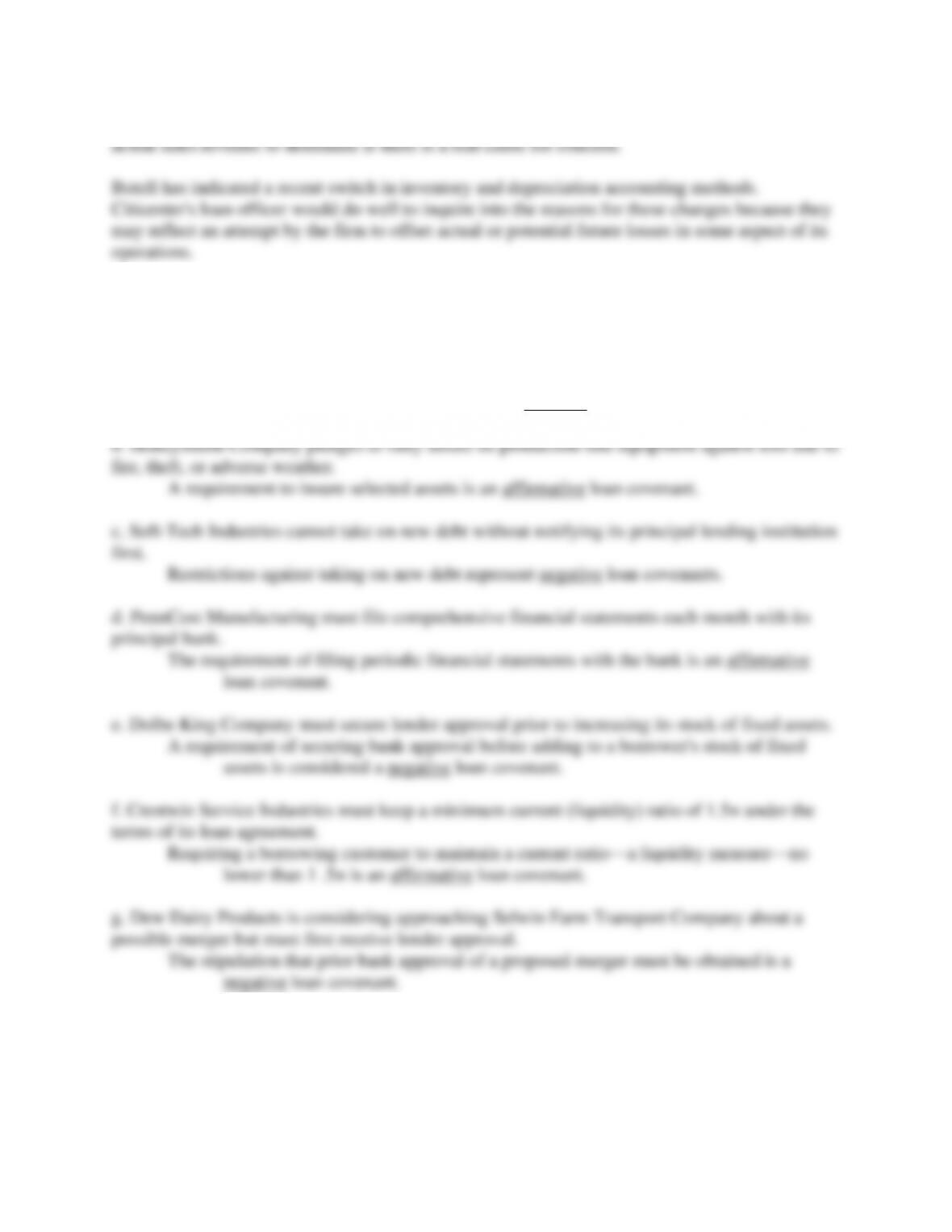
Selected items reported to the bank by the company do indicate the possible development of a
problem loan situation. For one thing, Butell’s cash account has fallen sharply in the latest month
Chapter 16 – Lending Policies and Procedures: Managing Credit Risk
16–11
operates. The bank’s loan officer needs to review the customer’s earlier sales projections and
16-6. Identify which of the following loan covenants are affirmative and which are negative
covenants:
a. Nige Trading Corporation must pay no dividends to its shareholders above $3 per share
without express lender approval.
Restrictions on payment of dividends represent negative loan covenants.
16-7. Please identify which of the basic Cs of lending—character, capacity, cash, collateral,
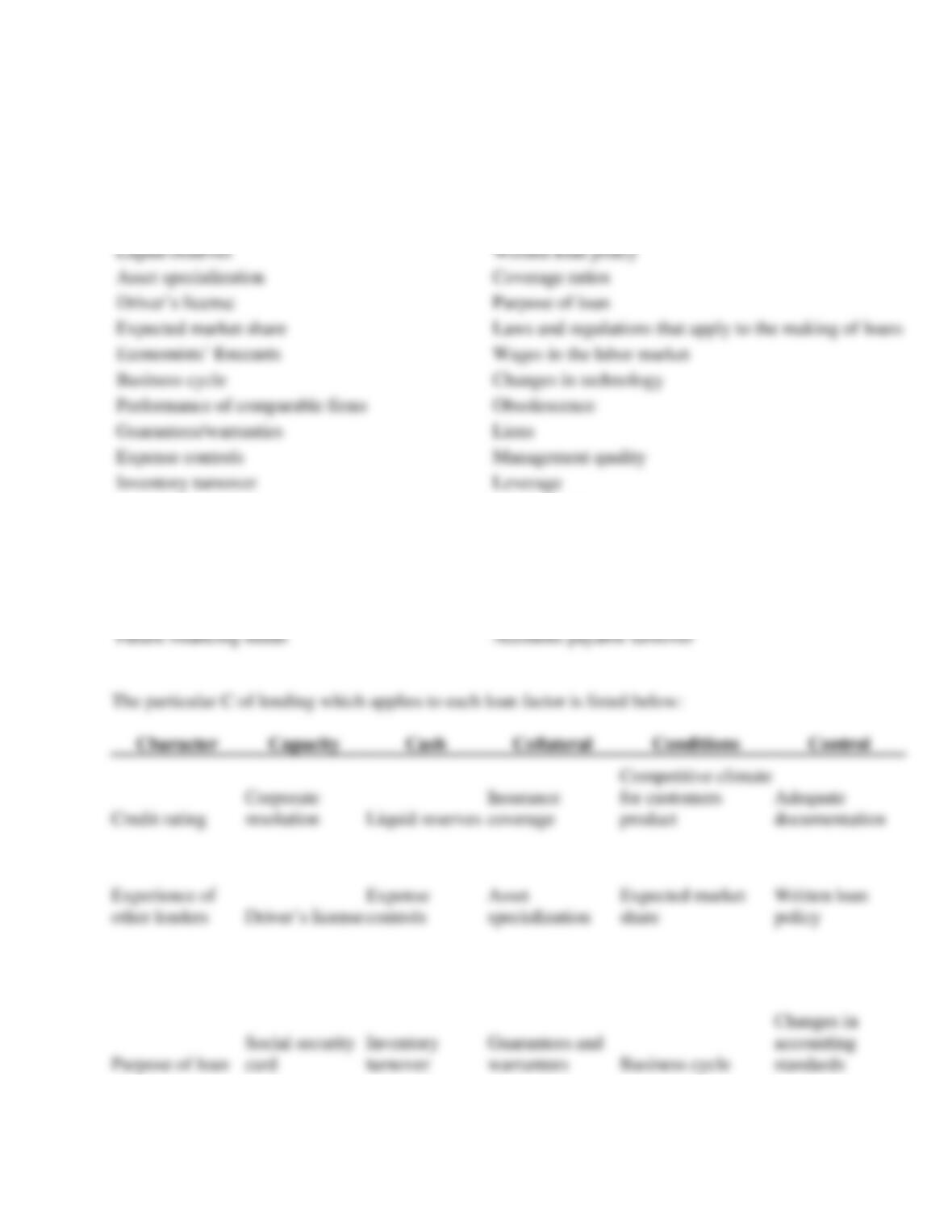
conditions, and control—applies to each of the loan factors listed here:
Chapter 16 – Lending Policies and Procedures: Managing Credit Risk
16–12
Insurance coverage
Asset liquidation
Competitive climate for customer’s product
Inflation outlook
Credit rating
Adequate documentation
Corporate resolution
Changes in accounting standards
Liquid reserves
Written loan policy
Asset specialization
Coverage ratios
Driver’s license
Purpose of loan
Expected market share
Laws and regulations that apply to the making of loans
Economists’ forecasts
Wages in the labor market
Business cycle
Changes in technology
Performance of comparable firms
Obsolescence
Guarantees/warranties
Liens
Expense controls
Management quality
Inventory turnover
Leverage
Projected cash flow
History of firm
Experience of other lenders
Customer identity
Social Security card
Payment record
Price-earnings ratio
Partnership agreement
Industry outlook
Accounts receivable turnover
Future financing needs
Accounts payable turnover
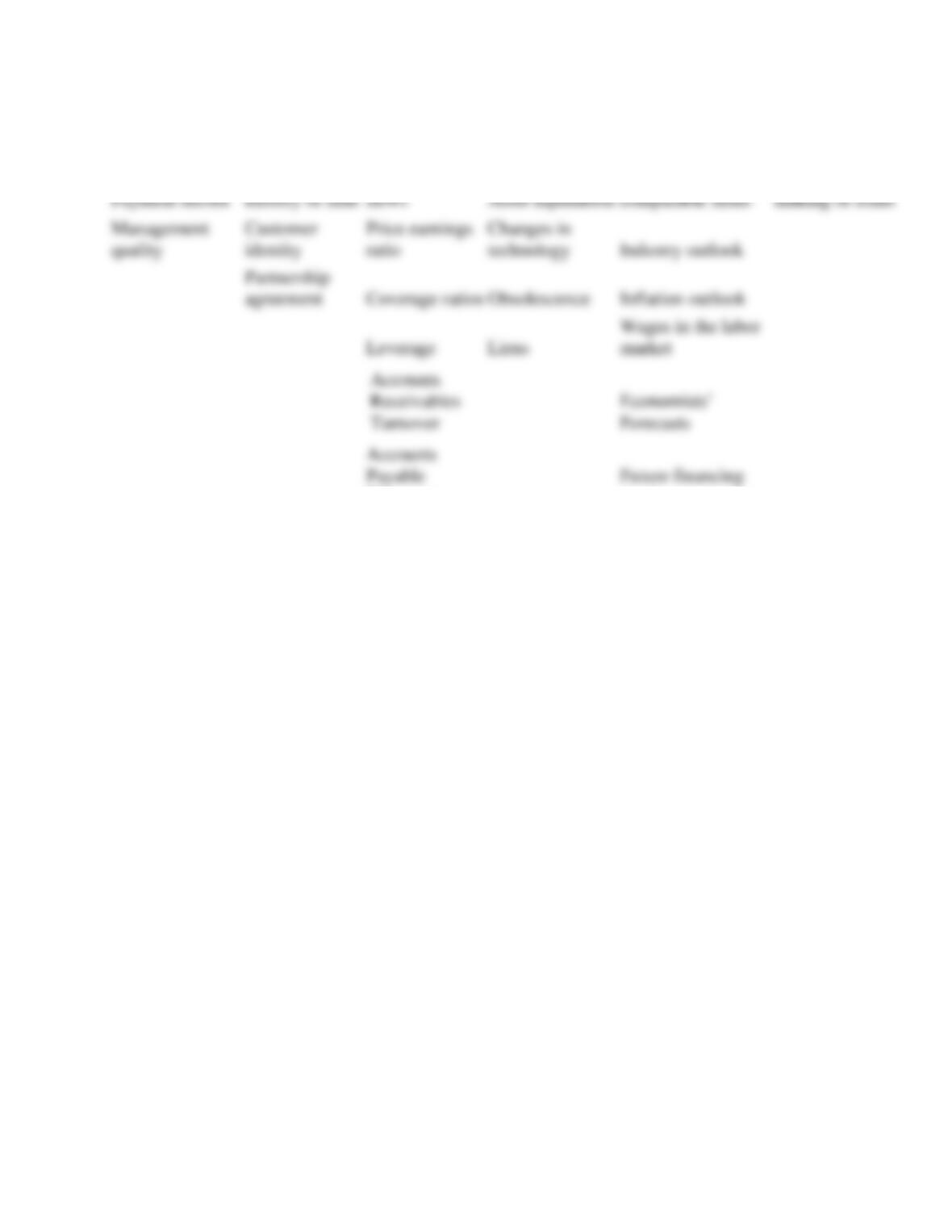
The particular C of lending which applies to each loan factor is listed below:
Character
Capacity
Cash
Collateral
Conditions
Control
Credit rating
Corporate
resolution
Liquid reserves
Insurance
coverage
Competitive climate
for customers
product
Adequate
documentation
Experience of
other lenders
Driver’s license
Expense
controls
Asset
specialization
Expected market
share
Written loan
policy
Purpose of loan
Social security
card
Inventory
turnover
Guarantees and
warrantees
Business cycle
Changes in
accounting
standards
Chapter 16 – Lending Policies and Procedures: Managing Credit Risk
16–13
Payment record
History of firm
Projected cash
flows
Asset liquidation
Performance of
comparable firms
Laws and
regulations that
apply to the
making of loans
Management
quality
Customer
identity
Price earnings
ratio
Changes in
technology
Industry outlook
Partnership
agreement
Coverage ratios
Obsolescence
Inflation outlook
Leverage
Liens
Wages in the labor
market
Accounts
Receivables
Turnover
Economists’
Forecasts
Accounts
Payable
Turnover
Future financing
needs