
Chapter 15 – The Management of Capital
15-1
CHAPTER 15
THE MANAGEMENT OF CAPITAL
Goal of This Chapter: The purpose of this chapter is to discover why capital—particularly equity
capital—is so important for financial institutions, to learn how managers and regulators assess
the adequacy of an institution’s capital position, and to explain the ways that management can
raise new capital.
Key Topics in This Chapter
• The Many Tasks of Capital
• Capital and Risk Exposures
• Types of Capital In Use
• Capital as the Centerpiece of Regulation
• Basel I and Basel II
• Capital Regulation in the Wake of the Great Recession/Basel III
• Planning to Meet Capital Needs
Chapter Outline
I. Introduction
II. The Many Tasks Capital Performs
A. Cushion Against Risk of Failure
B. Provides Funds Needed to Begin Operations
C. Promotes Public Confidence
D. Provides Funds for Future Growth and New Services
E. Regulator of Growth
F. Capital Plays a Role in Mergers
G. Limits How Much Risk Exposure Banks and Competing Firms Can Accept
III. Capital and Risk
A. Key Risks in Banking and Financial Institutions’ Management
1. Credit Risk
2. Liquidity Risk
3. Interest Rate Risk
4. Operational Risk
5. Exchange Risk
6. Crime Risk
B. Defenses against Risk
1. Quality Management
2. Diversification
a. Portfolio Diversification
b. Geographic Diversification
3. Deposit Insurance
4. Owners’ Capital
IV. Types of Capital in Use
Chapter 15 – The Management of Capital
15-2
A. Common Stock
B. Preferred Stock
C. Surplus
D. Undivided Profits
E. Equity Reserves
F. Subordinated Debentures
G. Minority Interest in Consolidated Subsidiaries
H. Equity Commitment Notes
Relative Importance of Different Sources of Capital
V. One of the Great Issues in the History of Banking: How Much Capital Is Really Needed?
A. Regulatory Approach to Evaluating Capital Needs
1. Reasons for Capital Regulation
2. Research Evidence
VI. The Basel Agreement on International Capital Standards: A Continuing Historic Contract
among Leading Nations
A. Basel I
1. Tier 1 (Core) Capital
2. Tier 2 (Supplemental) Capital
3. Calculating Risk-Weighted Assets
4. Calculating the Capital-to-Risk-Weighted Assets Ratio
B. Capital Requirements Attached to Derivatives
1. Bank Capital Standards and Market Risk
2. Value at Risk (VaR) Models Responding to Market Risk
3. Limitations and Challenges of VaR and Internal Modeling
C. Basel II
1 Pillars of Basel II
2. Internal Risk Assessment
3. Operational Risk
4. Basel II and Credit Risk Models
5. A Dual (Large-Bank, Small-Bank) Set of Rules
6. Problems Accompanying the Implementation of Basel II
D. Basel III: Another Major Regulatory Step Underway, Born in Global Crisis
VII. Changing Capital Standards Inside the United States
A. FDIC Improvement Act
B. Prompt Corrective Action
1. Well capitalized
2. Adequately capitalized
3. Undercapitalized
4. Significantly undercapitalized
5. Critically undercapitalized
VIII. Planning to Meet Capital Needs
A. Raising Capital Internally
1. Dividend Policy
2. How Fast Must Internally Generated Funds Grow?
B. Raising Capital Externally
1. Selling Common Stock
Chapter 15 – The Management of Capital
15-3
2. Selling Preferred Stock
3. Issuing Debt Capital
4. Selling Assets and Leasing Facilities
5. Swapping Stock for Debt Securities
Choosing the Best Alternative for Raising Outside Capital
IX. Summary of the Chapter
Concept Checks
15-1. What does the term capital mean as it applies to financial institutions?
15-2. What crucial roles does capital play in the management and viability of a financial firm?
Capital provides the long-term, permanent funding that is needed to construct facilities and
15-3. What are the links between capital and risk exposure among financial-service providers?
Capital functions as a cushion to absorb losses until management can correct the problems
15-4. What forms of capital are in use today? What are the key differences between the
different types of capital?
The principal forms of bank capital include common and preferred stock, surplus, undivided
profits, equity reserves, subordinated debentures, minority interest in consolidated subsidiaries,
Chapter 15 – The Management of Capital
15-4
stock.
15-5. Measured by volume and percentage of total capital, what are the most important and
least important forms of capital held by U.S.-insured banks? Why do you think this is so?
The most important form of capital is surplus, accounting for about two-thirds of all long-term
debt and equity capital. This is followed by retained earnings and capital reserves representing
15-6. How do small banks differ from large banks in the composition of their capital accounts
and in the total volume of capital they hold relative to their assets? Why do you think these
differences exist?
Small banks rely mainly on surplus value of their stock and retained earnings (undivided profits)
15-7 What is the rationale for having the government set capital standards for financial
institutions as opposed to letting the private marketplace set those standards?
The government’s interest in set capital standards stems from its efforts to stabilize the financial
15-8. What evidence does recent research provide on the role of the private marketplace in
determining capital standards?
15-9. According to recent research, does capital prevent a financial institution from failing?
15-10. What are the most popular financial ratios regulators use to assess the adequacy of bank
capital today?
15-11. What is the difference between core (or tier 1) capital and supplemental (or tier 2)
capital?
Core capital is the permanent capital of a bank, consisting mainly of common stock and surplus,
undivided profits (retained earnings), qualifying noncumulative perpetual preferred stock,
15-12. A bank reports the following items on its latest balance sheet: allowance for loan and
lease losses, $42 million; undivided profits, $81 million; subordinated debt capital, $3 million;
common stock and surplus, $27 million; equity notes, $2 million; minority interest in
Chapter 15 – The Management of Capital
15-6
Undivided profits
81 million
Subordinated debt capital
3 million
Noncumulative
perpetual preferred
stock
5 million
Mandatory convertible
debt
5 million
Identifiable
intangible assets
3 million
Equity notes
2 million
Minority interest in
subsidiaries
4 million
Total Tier 1 capital
$120 million
Total Tier 2 capital
$52 million
The bank does not have too much Tier 2 capital. Tier 2 capital can be up to 100 percent of the
amount of Tier 1 capital and hence can still count toward meeting its capital requirements.
15-13. What changes in the regulation of bank capital were brought into being by the Basel
Agreement? What is Basel I? Basel II?
Capital requirements today are set by regulatory agencies and, for banks in leading countries
today, under rules laid out in the Basel Agreement on International Bank Capital Standards.
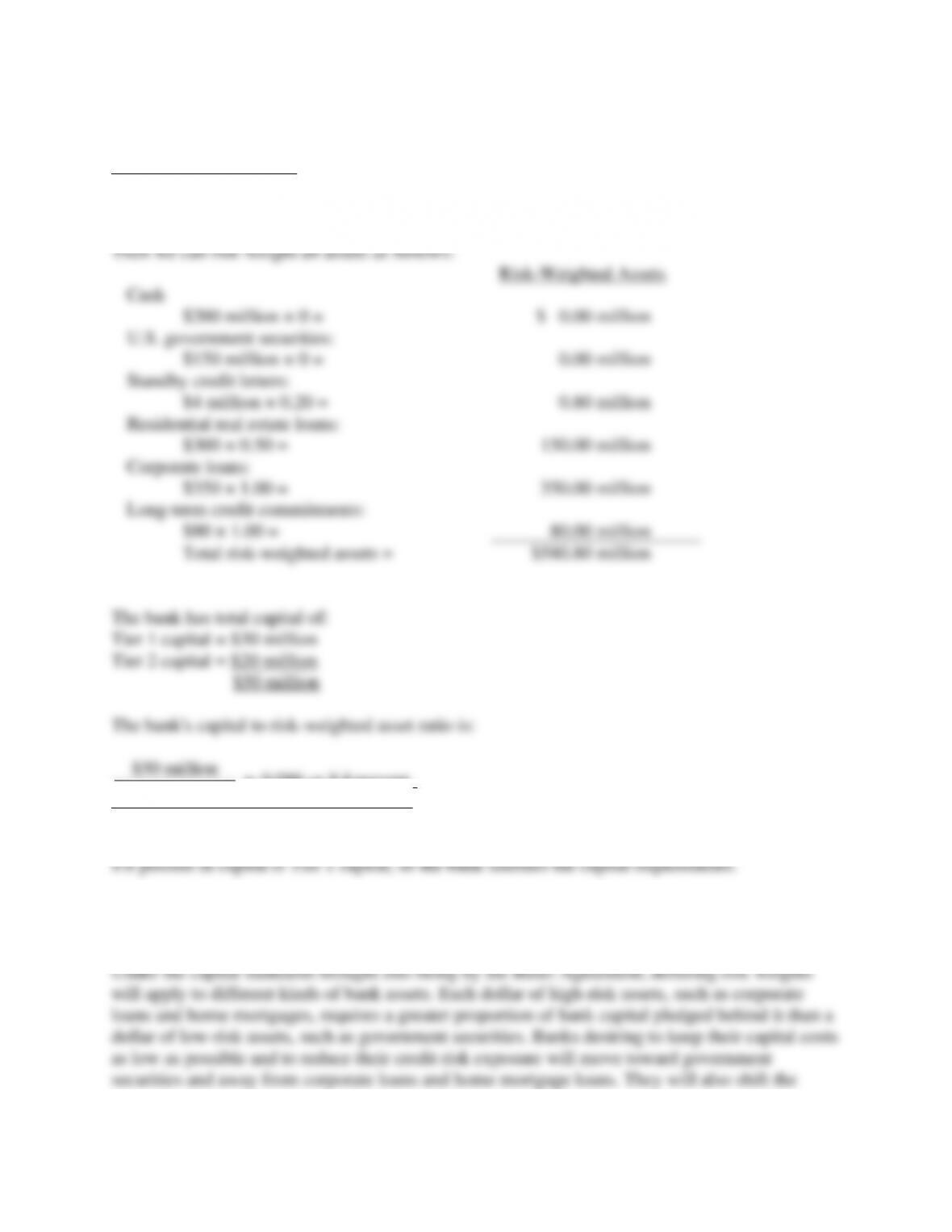
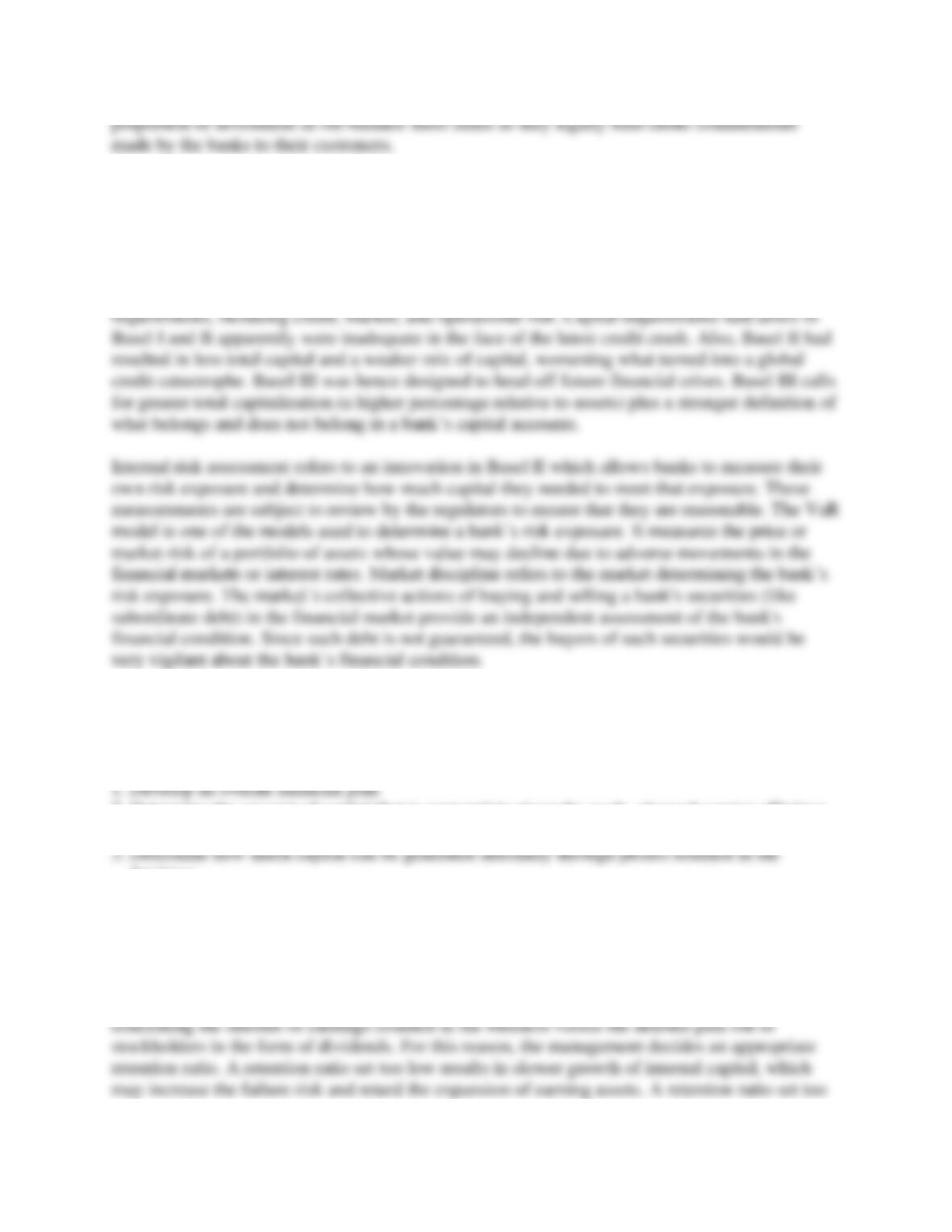
15-14. First National Bank reports the following items on its balance sheet: cash, $200 million;
U.S. government securities, $150 million; residential real estate loans, $300 million; and
corporate loans, $350 million. Its off-balance-sheet items include standby credit letters, $20
bonds.)
Chapter 15 – The Management of Capital
We first convert the off-balance-sheet items to their credit-equivalent amounts:
Off-Balance-Sheet Items:
Standby credit letters: $20 million × 0.20 = $4 million
Long-term commitments to corporations: $160 million × 0.50 = 80 million
Chapter 15 – The Management of Capital
15-8
15-16. What are the most significant differences among Basel I, II, and III? Explain the
importance of the concepts of internal risk assessment, VaR, and market discipline.
Basel I used a “one size fits all” approach to determine a bank’s capital requirements. Basel II
recognizes that different banks have different risk exposures and should be subject to different
capital requirements. It also broadens the types of risk considered for determining capital
15-17. What steps should be part of any plan for meeting a long-range need for capital?
The four key phases of planning to meet a bank’s capital needs are as follows:
2. Determine the amount of capital that is appropriate given the goals, planned service offerings,
acceptable risk exposure, and state and federal regulations
business
4. Evaluate and choose that source of external capital best suited to the institution’s needs and
goals
15-18. How does dividend policy affect the need for capital?
Relying on the growth of earnings to meet capital needs means that a decision must be made
Chapter 15 – The Management of Capital
15-9
15-19. What is the ICGR, and why is it important to the management of a financial firm?
The Internal capital growth rate (ICGR) is ratio of retained earnings to the equity capital of the
firm. It shows that if we want to increase internally generated capital, we must increase earnings
15-20. Suppose that a bank has a return on equity capital of 12 percent and that its retention
ratio is 35 percent. How fast can this bank’s assets grow without reducing its current ratio of
capital to assets? Suppose that the bank’s earnings (measured by ROE) drop unexpectedly to only
15-21. What are the principal sources of external capital for a financial institution?
15-22. What factors should management consider in choosing among the various sources of
Chapter 15 – The Management of Capital
15–10
factors to consider are the institution’s risk exposure, the impact on control by existing
stockholders, the state of the market for the assets or securities being sold, and regulations.
15-1. The management at Sage National Bank located in Key West, Florida, is calculating the
key capital adequacy ratios for its third-quarter reports. At quarter-end, the bank’s total assets are
$95 million and its total risk-weighted assets including off-balance-sheet items are $75 million.
Tier 1 capital items sum to $4 million, while Tier 2 capital items total $2.5 million. Calculate
Sage National’s leverage ratio, total capital–to-total assets, core capital-to-total risk-weighted
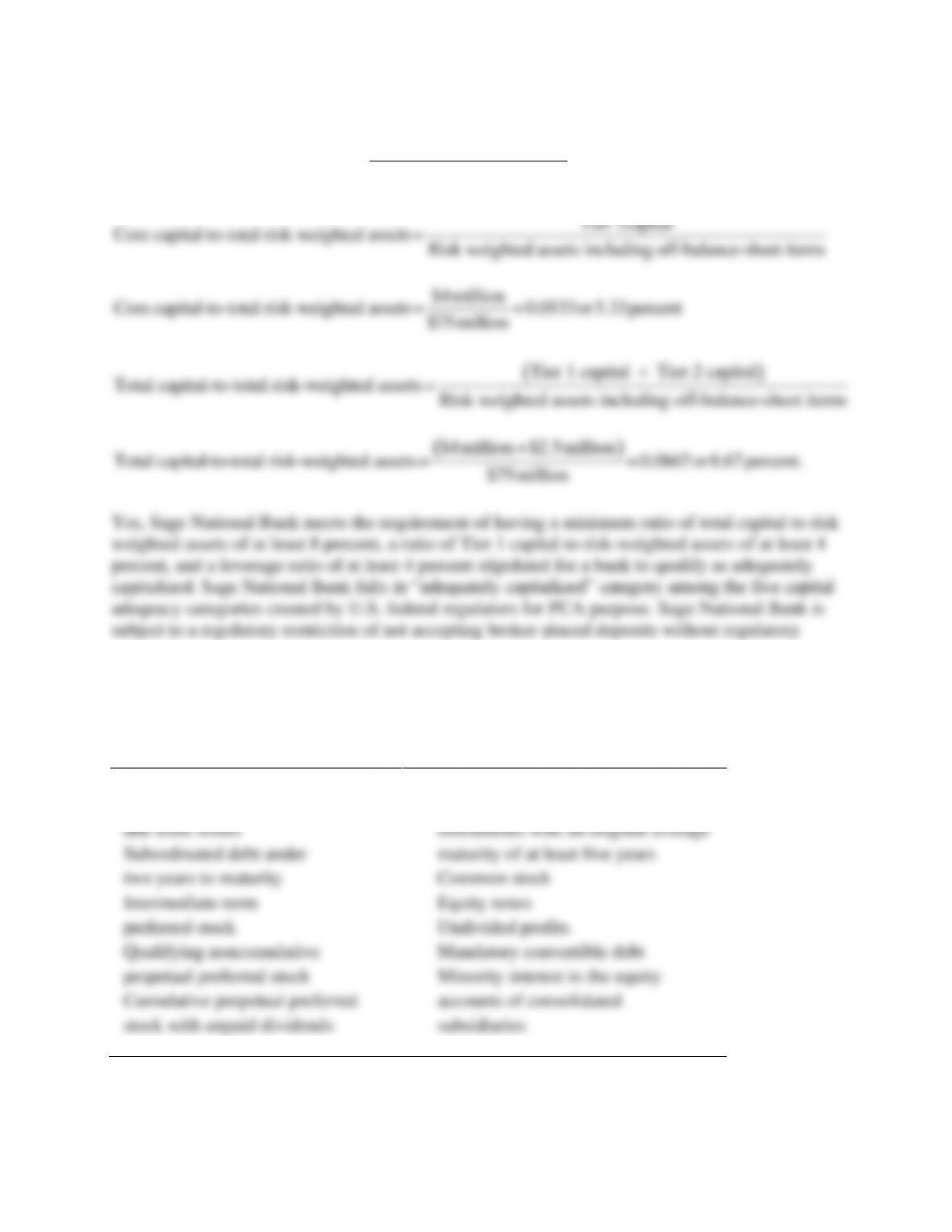
Chapter 15 – The Management of Capital
15–11
( )
$4million +$2.5million
Total capital-to-total assets ratio = = 0.0684or 6.84percent
$95million
Tier 1capital
Core capital–to-total risk-weighted assets= Risk weighted assets including off-balance-sheet items
$4million
Core capital-to-total risk-weighted assets= = 0.0533or5.33percent
$75million
( )
Tier 1 capital Tier 2 capital
Total capital-to-total risk-weighted assets= Risk weighted assets including off-balance-sheet items
+
( )
$4million +$2.5million
Total capital-to-total risk-weighted assets = = 0.0867or8.67 percent.
$75million
Yes, Sage National Bank meets the requirement of having a minimum ratio of total capital to risk
weighted assets of at least 8 percent, a ratio of Tier 1 capital to risk-weighted assets of at least 4
percent, and a leverage ratio of at least 4 percent stipulated for a bank to qualify as adequately
capitalized. Sage National Bank falls in “adequately capitalized” category among the five capital
adequacy categories created by U.S. federal regulators for PCA purpose. Sage National Bank is
subject to a regulatory restriction of not accepting broker-placed deposits without regulatory
approval.
15-2. Please indicate which items appearing on the following financial statements would be
classified under the terms of the regulatory requirement for ( a ) Tier 1 capital or ( b ) Tier 2
capital.
Allowance for loan
Subordinated debt capital
and lease losses
instruments with an original average
Subordinated debt under
maturity of at least five years
two years to maturity
Common stock
Intermediate-term
Equity notes
preferred stock
Undivided profits
Qualifying noncumulative
Mandatory convertible debt
perpetual preferred stock
Minority interest in the equity
Cumulative perpetual preferred
accounts of consolidated
stock with unpaid dividends
subsidiaries