
Chapter 13 – Managing Nondeposit Liabilities
13-1
CHAPTER 13
MANAGING NONDEPOSIT LIABILITIES
Goal of This Chapter: The purpose of this chapter is to learn about the principal nondeposit
sources of funds that financial institutions can borrow from, to help finance their activities and to
see how managers choose among the various nondeposit funds sources currently available to
them.
Key Topics in this Chapter
• Liability Management
• Customer Relationship Doctrine
• Alternative Nondeposit Funds Sources
• Measuring the Funds Gap
• Choosing Among Different Funds Sources
• Determining the Overall Cost of Funds
Chapter Outline
I. Introduction
II. Liability Management and the Customer Relationship Doctrine
A. Customer Relationship Doctrine
B. Liability Management
III. Alternative Nondeposit Sources of Funds
A. Federal Funds Market (“Fed Funds”)
B. Repurchase Agreements as a Source of Funds
C. Borrowing from Federal Reserve Banks
1. Primary Credit
2. Secondary Credit
3. Seasonal Credit
D. Advances from Federal Home Loan Banks
E. Development and Sale of Large Negotiable CDs
F. The Eurocurrency Deposit Market
G. Commercial Paper Market
H. Long-Term Nondeposit Funds Sources
IV. Choosing Among Alternative Nondeposit Sources
A. Measuring a Financial Firm’s Total Need for Nondeposit Funds: The Available Funds
Gap
B. Nondeposit Funding Sources: Factors to Consider
1. Relative Costs
2. The Risk Factor
3. The Length of Time Funds Are Needed
4. The Size of the Borrowing Institution
5. Regulations
V. Summary of the Chapter
Chapter 13 – Managing Nondeposit Liabilities
13-2
Concept Checks
13-1. What is liability management?
13-2. What advantages and risks does the pursuit of liability management bring to a borrowing
institution?
13-3. What is the customer relationship doctrine, and what are its implications for fund-raising
by lending institutions?
13-4. For what kinds of funding situations are Federal funds best suited?
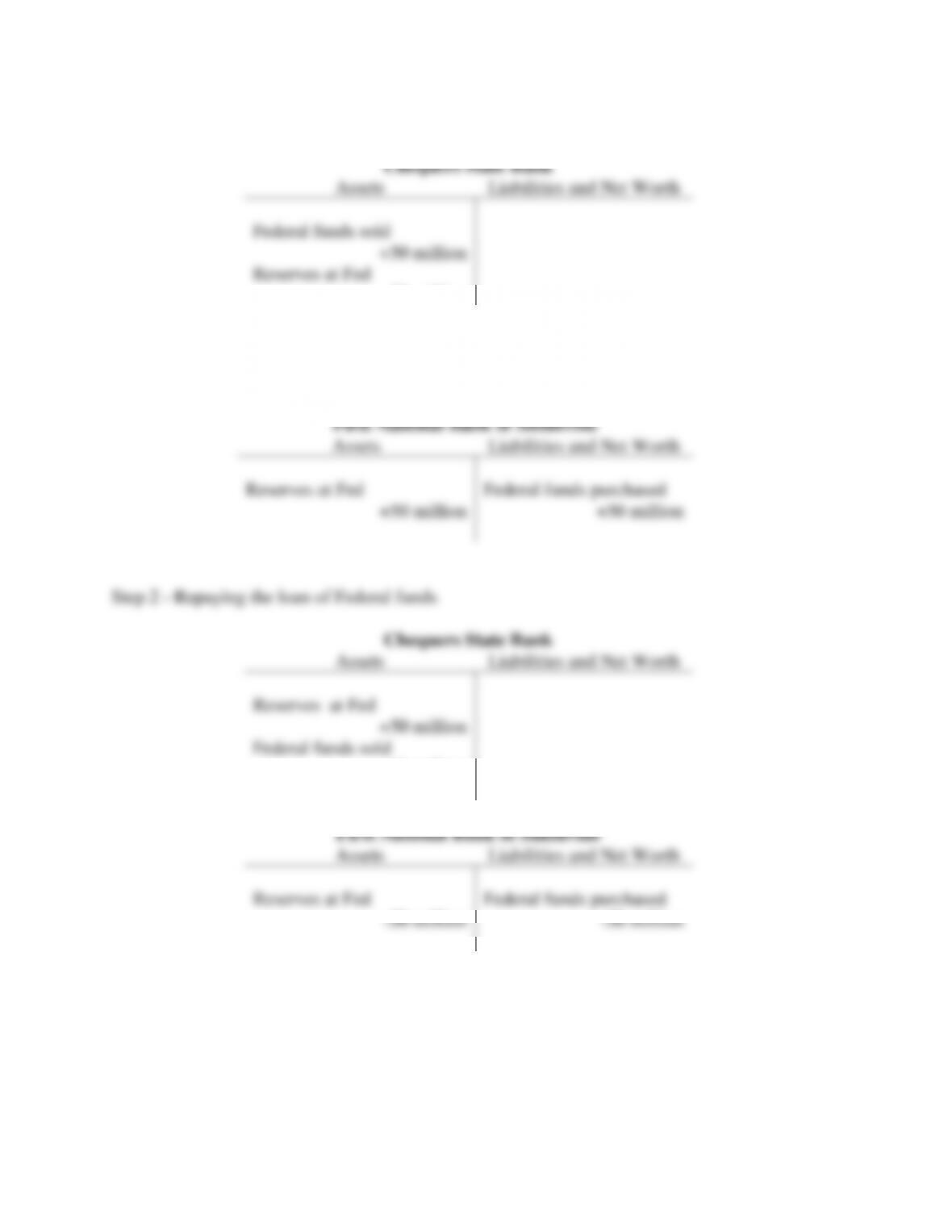
13-5. Chequers State Bank loans $50 million from its reserve account at the Federal Reserve
Chapter 13 – Managing Nondeposit Liabilities
Step 1 – Lending the $50 million
Chequers State Bank
Assets
Liabilities and Net Worth
Federal funds sold
+50 million
Reserves at Fed
-50 million
Using the borrowed funds can also be shown, though it is not mentioned in the problem. You
could show First National Bank of Smithville making a loan for $50 million under Assets, giving
up $50 million from its reserve account.
First National Bank of Smithville
Assets
Liabilities and Net Worth
Reserves at Fed
Federal funds purchased
+50 million
+50 million
Chequers State Bank
Assets
Liabilities and Net Worth
Reserves at Fed
Federal funds sold
-50 million
Assets
Liabilities and Net Worth
Reserves at Fed
-50 million
Federal funds purchased
Chapter 13 – Managing Nondeposit Liabilities
the proper accounting entries for the extension of this loan and for the recovery of the loaned
Chapter 13 – Managing Nondeposit Liabilities
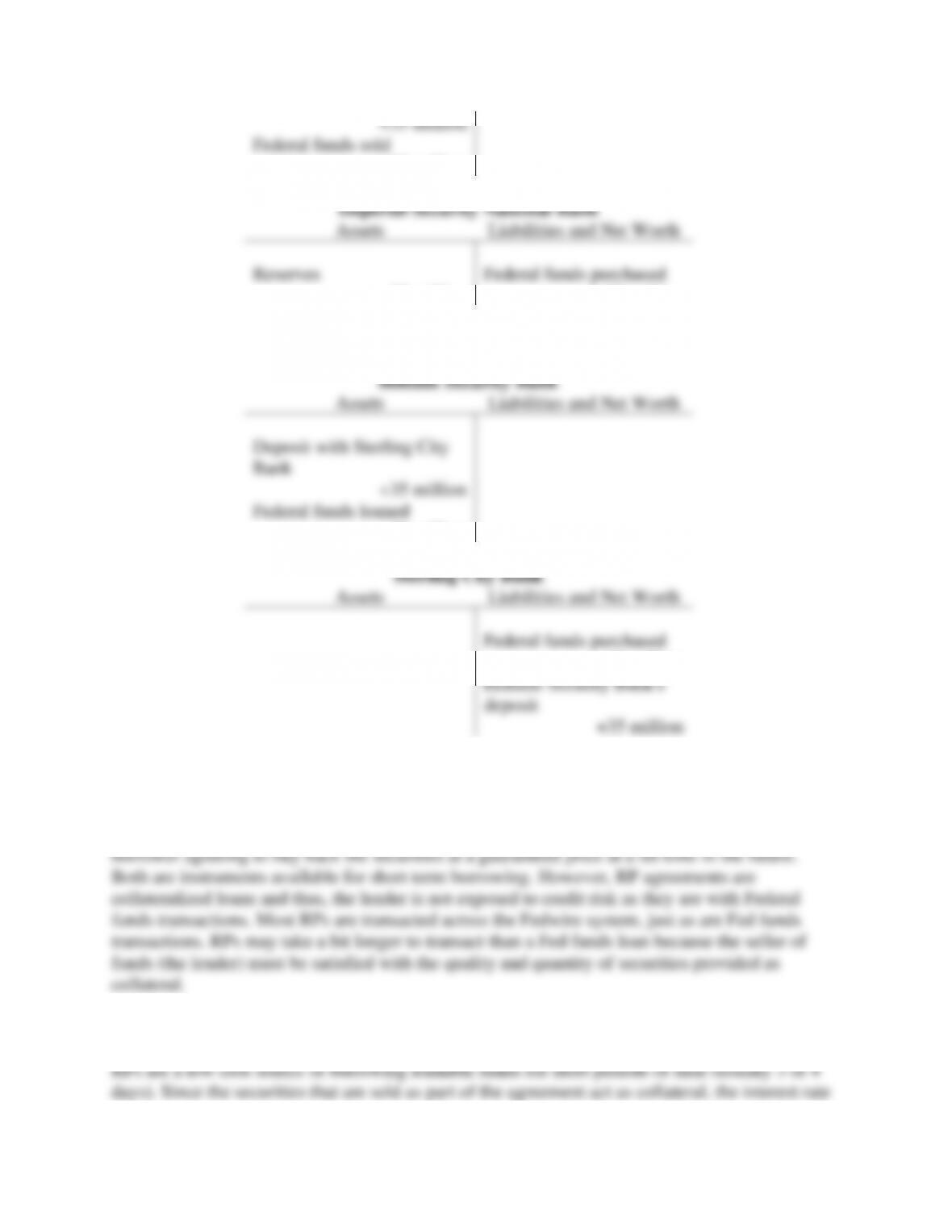
13-5
+35 million
Federal funds sold
-35 million
Imperial Security National Bank
Assets
Liabilities and Net Worth
Reserves
-35 million
Federal funds purchased
-35 million
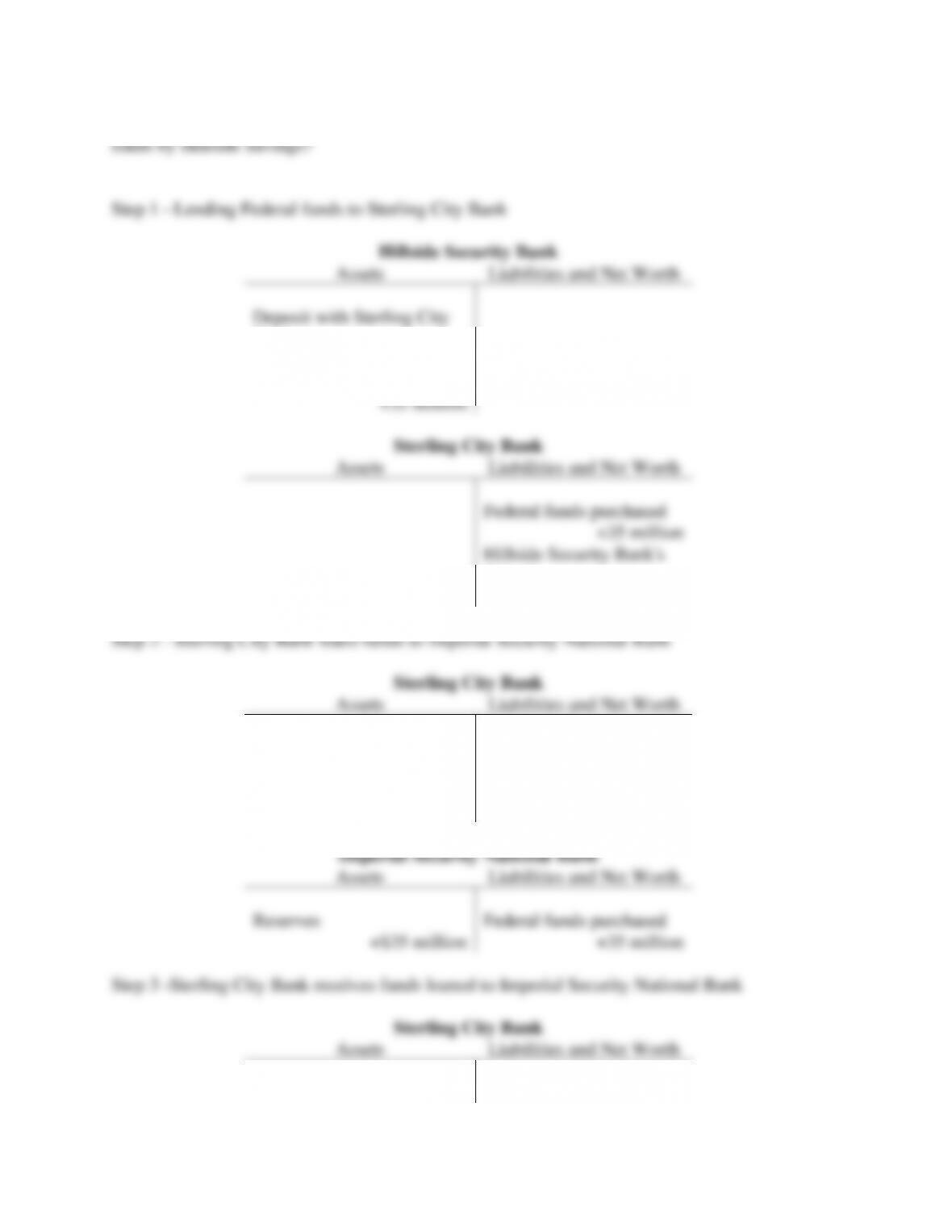
Step 4 – Repaying the loan to Hillside Security Bank
Hillside Security Bank
Assets
Liabilities and Net Worth
Deposit with Sterling City
Bank
+35 million
Federal funds loaned
-35 million
Sterling City Bank
Assets
Liabilities and Net Worth
Federal funds purchased
-35 million
Hillside Security Bank’s
deposit
+35 million
13-7. Compare and contrast Fed funds transactions with RPs.
Less popular than Fed funds and more complex are repurchase agreements (RPs). RPs are
agreements to sell securities temporarily by a borrower of funds to the lender of funds with the
13-8. What are the principal advantages to the borrower of funds under an RP agreement?
Chapter 13 – Managing Nondeposit Liabilities
13-6
13-9. What are the advantages of borrowing from the Federal Reserve banks or other central
banks? Are there any disadvantages? What is the difference between primary, secondary, and
seasonal credit? What is a Lombard rate and why might such a rate be useful in achieving
monetary policy goals?
Borrowing from the Federal Reserve banks is a viable alternative to the Federal funds market.
13-10. How is a discount window loan from the Federal Reserve secured? Is collateral really
necessary for these kinds of loans?
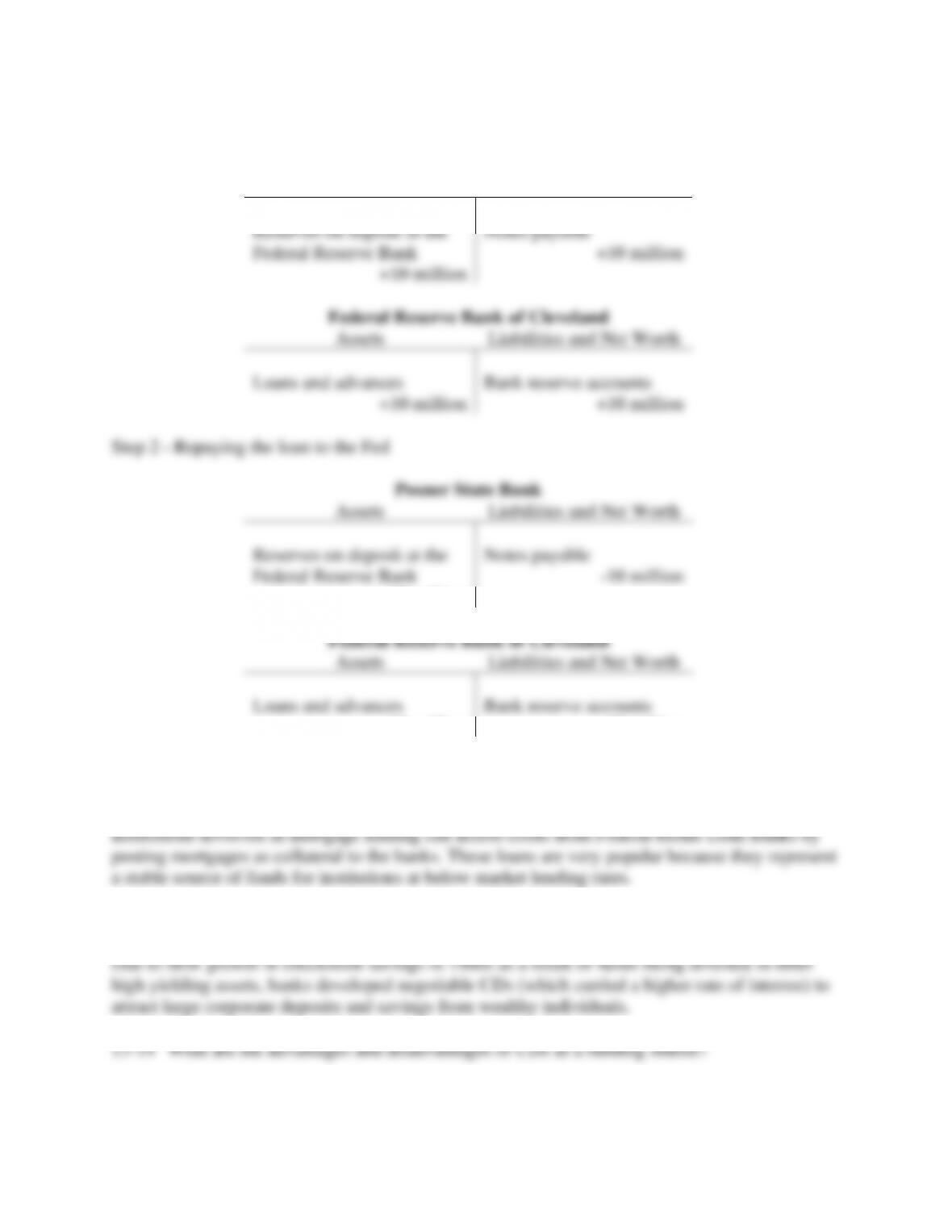
13-11. Posner State Bank borrows $10 million in primary credit from the Federal Reserve Bank
Chapter 13 – Managing Nondeposit Liabilities
13-7
Step 1 – Securing a loan from the Fed.
Posner State Bank
Assets
Liabilities and Net Worth
Reserves on deposit at the
Federal Reserve Bank
+10 million
Notes payable
+10 million
Federal Reserve Bank of Cleveland
Assets
Liabilities and Net Worth
Loans and advances
+10 million
Bank reserve accounts
+10 million
Step 2 – Repaying the loan to the Fed
Posner State Bank
Assets
Liabilities and Net Worth
Reserves on deposit at the
Federal Reserve Bank
-10 million
Notes payable
-10 million
Federal Reserve Bank of Cleveland
Assets
Liabilities and Net Worth
Loans and advances
-10 million
Bank reserve accounts
-10 million
13-12. Which institutions are allowed to borrow from the Federal Home Loan Banks? Why is
this source so popular for many institutions?
13-13. Why were negotiable CDs developed?
Chapter 13 – Managing Nondeposit Liabilities
For borrowers, negotiable CDs offer a way to attract large amounts of funds quickly and for a
13-15. Suppose a customer purchases a $1 million 90-day CD, carrying a promised 6 percent
annualized yield. How much in interest income will the customer earn when this 90-day
13-16. Where do Eurodollars come from?
13-17. How does a bank gain access to funds from the Eurocurrency markets?
A bank can borrow funds in a Eurocurrency market by either from one of its own subsidiaries in
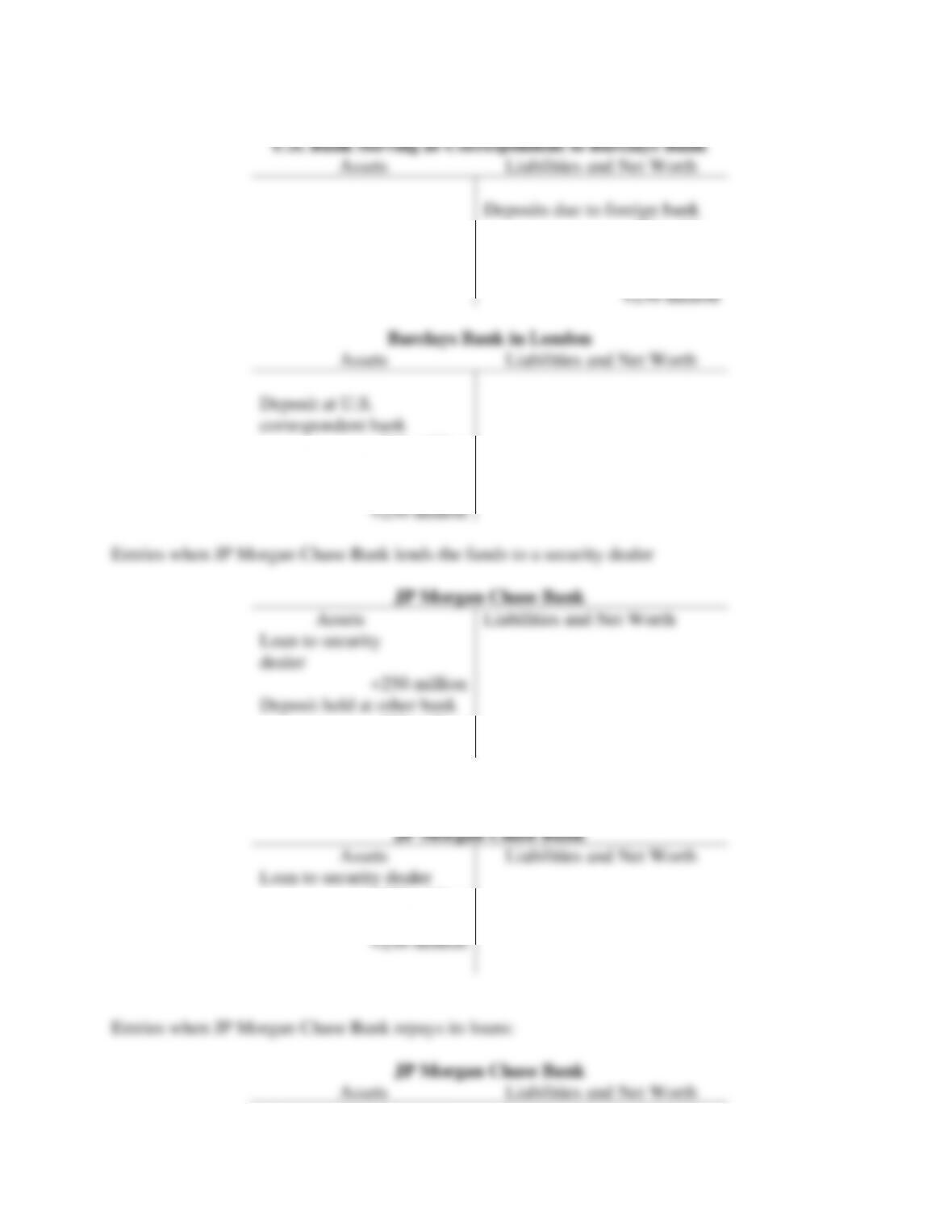
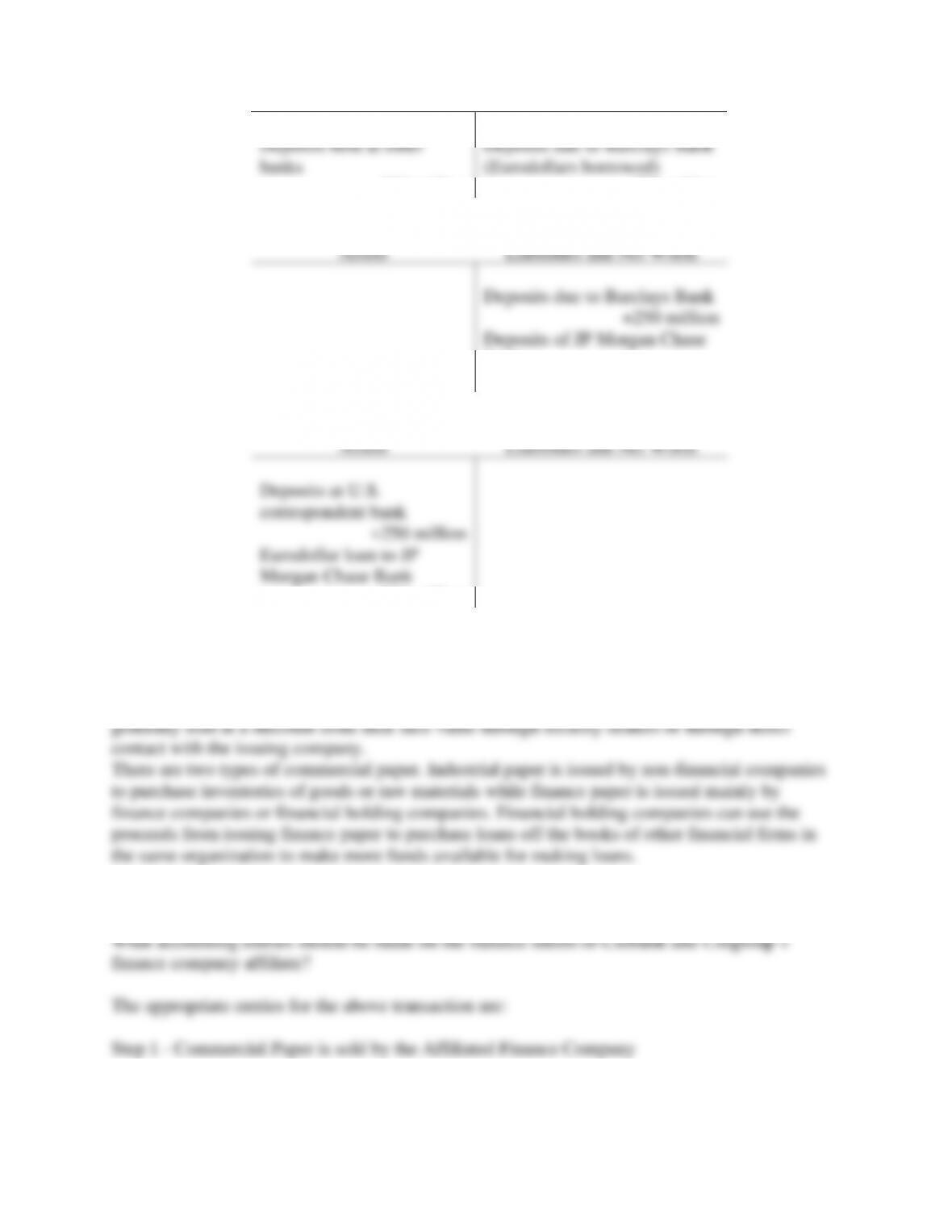
13-18. Suppose that JP Morgan Chase Bank in New York elects to borrow $250 million from
Barclays Bank in London and loans the borrowed funds for a week to a security dealer, and then
returns the borrowed funds. Can you trace through the resulting accounting entries?
Chapter 13 – Managing Nondeposit Liabilities
U.S. Bank Serving as Correspondent to Barclays Bank
Assets
Liabilities and Net Worth
Deposits due to foreign bank
-250 million
Deposits of JP Morgan Chase
Bank
+250 million
Barclays Bank in London
Assets
Liabilities and Net Worth
Deposit at U.S.
correspondent bank
-250 million
Eurodollar loan to JP
Morgan Chase Bank
+250 million
Entries when JP Morgan Chase Bank lends the funds to a security dealer
JP Morgan Chase Bank
Assets
Loan to security
Liabilities and Net Worth
dealer
+250 million
Deposit held at other bank
-250 million
Entries when JP Morgan Chase Bank receives loaned funds from the security dealer
JP Morgan Chase Bank
Assets
Liabilities and Net Worth
Loan to security dealer
-250 million
Deposit held at other bank
+250 million
Chapter 13 – Managing Nondeposit Liabilities
Deposits held at other
banks
-250 million
Deposits due to Barclays Bank
(Eurodollars borrowed)
-250 million
U.S. Bank Serving as Correspondent to Barclays Bank
Assets
Liabilities and Net Worth
Deposits due to Barclays Bank
+250 million
Deposits of JP Morgan Chase
Bank
-250 million
Barclays Bank in London
Assets
Liabilities and Net Worth
Deposits at U.S.
correspondent bank
+250 million
Eurodollar loan to JP
Morgan Chase Bank
-250 million
13-19. What is commercial paper? What types of organizations issue such paper?
Commercial paper consists of short-term notes, with maturities ranging from three or four days
to nine months, issued by well-known companies to raise working capital. The notes are
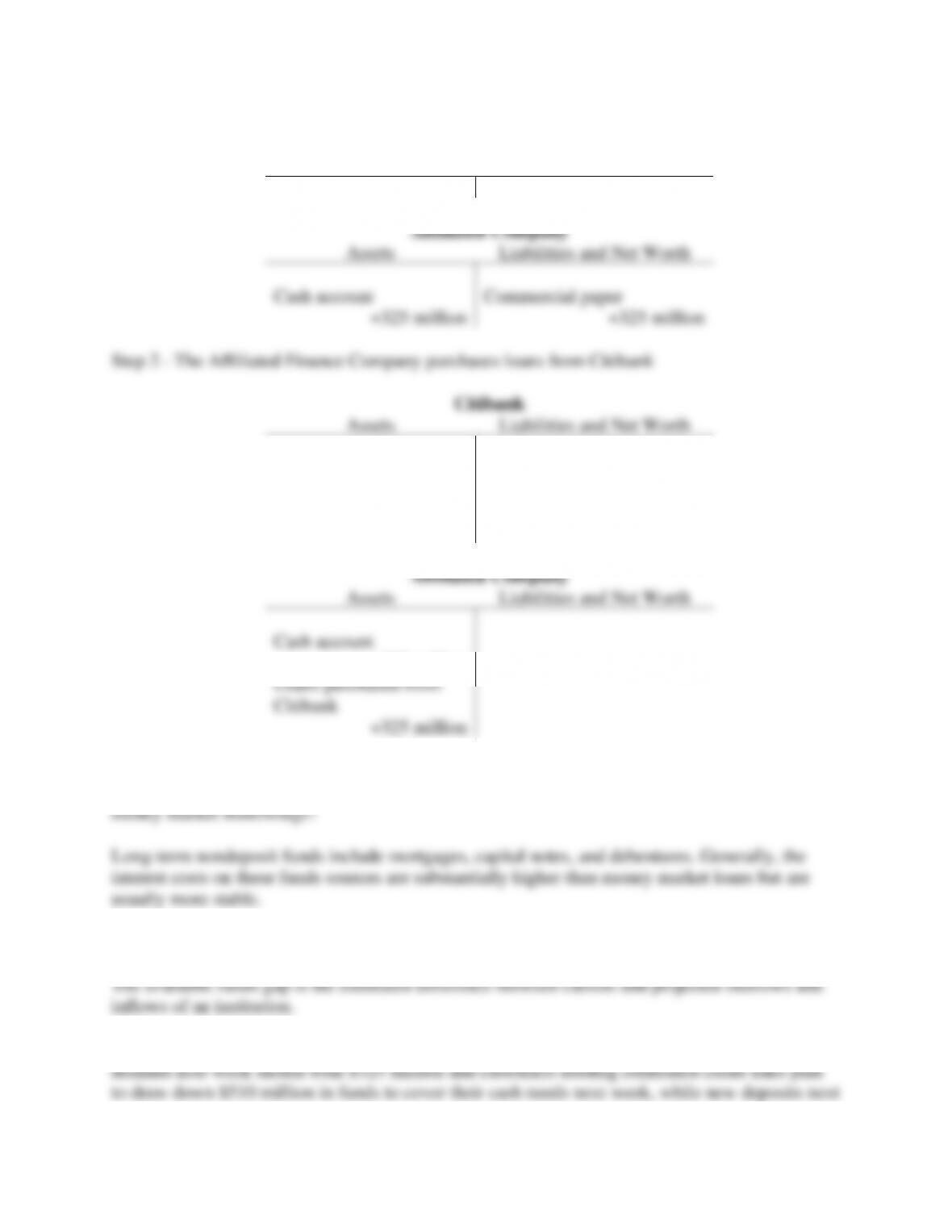
13-20. Suppose that the finance company affiliate of Citigroup issues $325 million in 90 day
commercial paper to interested investors and uses the proceeds to purchase loans from Citibank.
Chapter 13 – Managing Nondeposit Liabilities
13–11
Citibank
Assets
Liabilities and Net Worth
Affiliated Company
Assets
Liabilities and Net Worth
Cash account
+325 million
Commercial paper
+325 million
Step 2 – The Affiliated Finance Company purchases loans from Citibank
Citibank
Assets
Liabilities and Net Worth
Loans
-325 million
Reserves
+325 million
Affiliated Company
Assets
Liabilities and Net Worth
Cash account
-325 million
Loans purchased from
Citibank
+325 million
13-21. What long-term nondeposit funds sources do banks and some of their closest competitors
draw upon today? How do these interest costs differ from those costs associated with most
13-22. What is the available funds gap?
13-23. Suppose J.P. Morgan Chase Bank of New York discovers that projected new loan