
Chapter 12 – Managing and Pricing Deposit Services
12-1
CHAPTER 12
MANAGING AND PRICING DEPOSIT SERVICES
Goal of This Chapter: This chapter has multiple goals. One of the most important is to learn
about the different types of deposits financial institutions offer and, from the perspective of a
manager, to discover which types of deposits are among the most profitable to offer their
customers. We also want to explore how an institution’s cost of funding can be determined and
examine the different methods open to institutions to price the deposits and deposit-related
services they sell to the public.
Key Topics in This Chapter
• Types of Deposit Accounts Offered
• The Changing Mix of Deposits and Deposit Costs
• Pricing Deposit Services
• Conditional Deposit Pricing
• Rules for Deposit Insurance Coverage
• Disclosure of Deposit Terms
• Lifeline Banking
Chapter Outline
I. Introduction
II. Types of Deposits Offered by Depository Institutions
A. Transaction (Payments or Demand) Deposits
1. Noninterest-Bearing Transaction (Demand) Deposits
2. Interest-Bearing Transaction Deposits
a. Negotiable Order Of Withdrawal (NOW) Accounts
b. Money Market Deposit Accounts (MMDAs)
c. Super NOWs (SNOWs)
3. Mobile Apps—Impact on Transaction Deposits and Potential Customers
B. Nontransaction (Savings or Thrift) Deposits
1. Passbook Savings Deposits
2. Time Deposits
C. Retirement Savings Deposits
1. Individual Retirement Accounts (IRAs)
2. Keogh Plans
3. Roth IRAs
III. Interest Rates Offered on Different Types of Deposits
A. The Composition of Deposits
1. Trend toward Interest-Bearing and Nontransaction Deposits
2. The Importance of Core Deposits
3. Changes in the Relative Importance of Mix of Deposits
Chapter 12 – Managing and Pricing Deposit Services
12-2
B. The Ownership of Deposits
C. The Cost of Different Deposit Accounts
IV. Pricing Deposit-Related Services
V. Pricing Deposits at Cost Plus Profit Margin
A. Estimating Deposit Service Costs
VI New Deposit Insurance Rules–Insights and Issues
VII. Using Marginal Cost to Set Interest Rates on Deposits
A. Conditional Pricing
VIII. Pricing Based on the Total Customer Relationship and Choosing a Depository
A. The Role That Pricing and Other Factors Play When Customers Choose a
Depository Institution to Hold Their Accounts
IX. Basic (Lifeline) Banking: Key Services for Low-Income Customers
X. Summary of the Chapter
Concept Checks
12-1. What are the major types of deposit plans that depository institutions offer today?
Deposit plans can be divided broadly into transaction deposits, thrift or nontransaction deposits,
and retirement savings deposits. The primary function of transaction deposits is to make
12-2. What are core deposits, and why are they so important today?
Core deposits are the most stable components of a depositary institution’s funding base and
12-3. How has the composition of deposits changed in recent years?
There has been a shift in the public’s holdings of deposits toward greater relative proportions of
Chapter 12 – Managing and Pricing Deposit Services
12-3
12-4. What are the consequences for the management and performance of depository
institutions resulting from recent changes in deposit composition?
While depository institutions would prefer to sell only the cheapest deposits to the public, it is
12-5. Which deposits are the least costly for depository institutions? The most costly?
12-6. Describe the essential differences between the following deposit pricing methods in use
today: cost-plus pricing, conditional pricing, and relationship pricing.
Cost-plus deposit pricing encourages banks to determine what costs they are incurring in labor
and management time, materials, etc., in offering each deposit service. Cost-plus pricing
12-7. A bank determines from an analysis of its cost-accounting figures that for each $500
minimum-balance checking account it sells, account processing and other operating costs will
Chapter 12 – Managing and Pricing Deposit Services
12-4
The relevant formula is:
Unit price charged the customer for each deposit service =
Operating expense per unit of deposit service +
Estimated overhead expense allocated to the deposit-service function +
Planned profit margin from each service unit sold
In this case, the unit price charged per month should be $6.69 ($4.87 + $1.21 + [0.10 × ($4.87 +
$1.21)]) for each $500 minimum-balance checking account it sells.
12-8. To price deposits successfully, service providers must know their costs. How are these
costs determined using the historical average cost approach? The marginal cost of funds
approach? What are the advantages and disadvantages of each approach?
The historical average cost approach looks at the past. It asks the following question:
12-9. How can the historical average cost and marginal cost of funds approaches be used to
help select assets (such as loans) that a depository institution might wish to acquire?
The historical average cost rate is called break-even because the institution must earn at least this
Chapter 12 – Managing and Pricing Deposit Services
Studies cited in this chapter indicate that households (individuals and families) appear to
consider, in rank order, the following factors in choosing an institution to hold their checking
12-11. What does the 1991 Truth in Savings Act require financial firms selling deposits inside
the United States to tell their customers?
The 1991 Truth in Savings Act requires financial firms to fully inform their deposit customers on
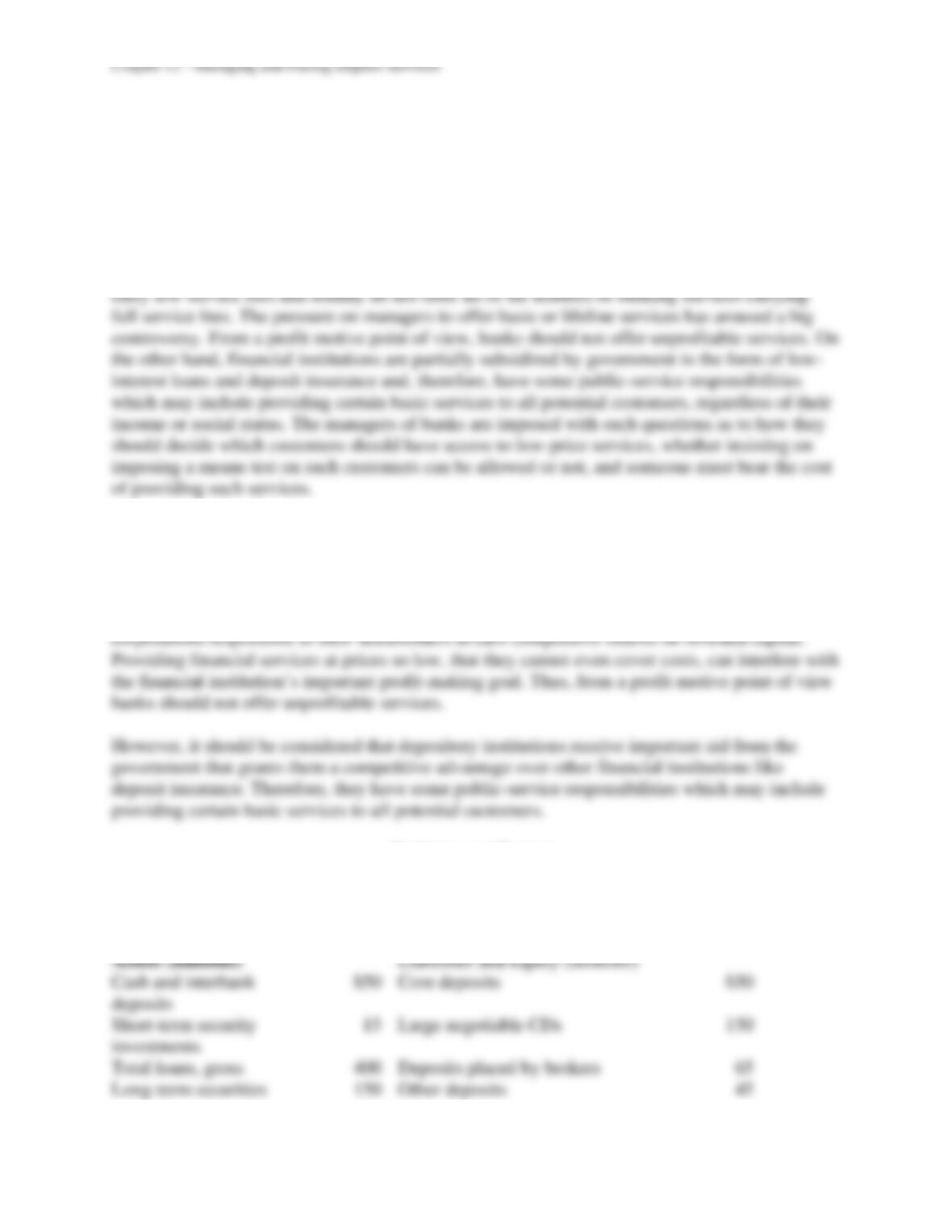
12-12. Use the APY formula required by the Truth in Savings Act for the following
calculation. Suppose that a customer holds a savings deposit in a savings bank for a year. The
balance in the account stood at $2,000 for 180 days and $100 for the remaining days in the year.
If the Savings bank paid this depositor $8.50 in interest earnings for the year, what APY did this
12-6
APY = 0.82 percent.
12-13. What is lifeline banking? What pressures does it impose on the managers of banks and
other financial institutions?
Lifeline banking refers to basic service packages offered by banks to customers not generally
able to afford conventional bank service offerings. The essence of these services is that they
12-14. Should lifeline banking be offered to low-income customers? Why or why not?
This is not an easy question to answer. One of the most serious problems individuals outside the
financial mainstream face is lack of access to a deposit account. Lifeline banking is providing
basic banking services to these individuals. Most financial-service providers are privately owned
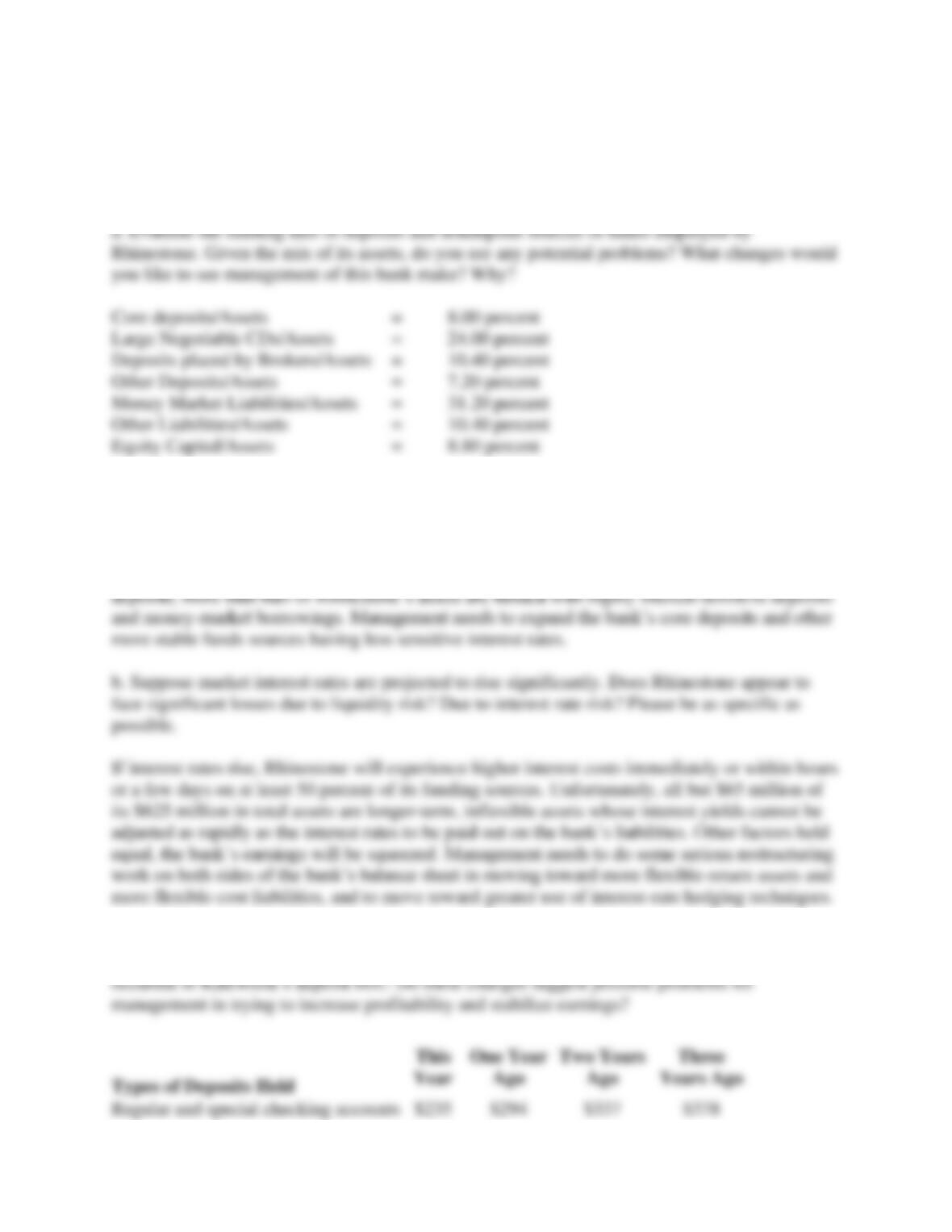
12-1. Rhinestone National Bank reports the following figures in its current Report of
Condition:
Assets (millions)
Liabilities and Equity (millions)
Cash and interbank
deposits
$50
Core deposits
$50
Short-term security
investments
15
Large negotiable CDs
150
Total loans, gross
400
Deposits placed by brokers
65
Long-term securities
150
Other deposits
45
Chapter 12 – Managing and Pricing Deposit Services
Other assets
10
Money market liabilities
195
Other liabilities
65
Equity capital
55
Total assets
$625
Total liabilities and equity capital
$625
The proportion of core deposits at Rhinestone is exceptionally low, while large CDs and other
money-market borrowings make up more than 55 percent of the bank’s total funding sources.
This funding mix tends to subject the bank to excessive vulnerability to quick withdrawal of
funds and high interest-rate risk exposure. Rhinestone also appears to be excessively dependent
on brokered deposits which are highly volatile and interest-sensitive. Adding in these brokered
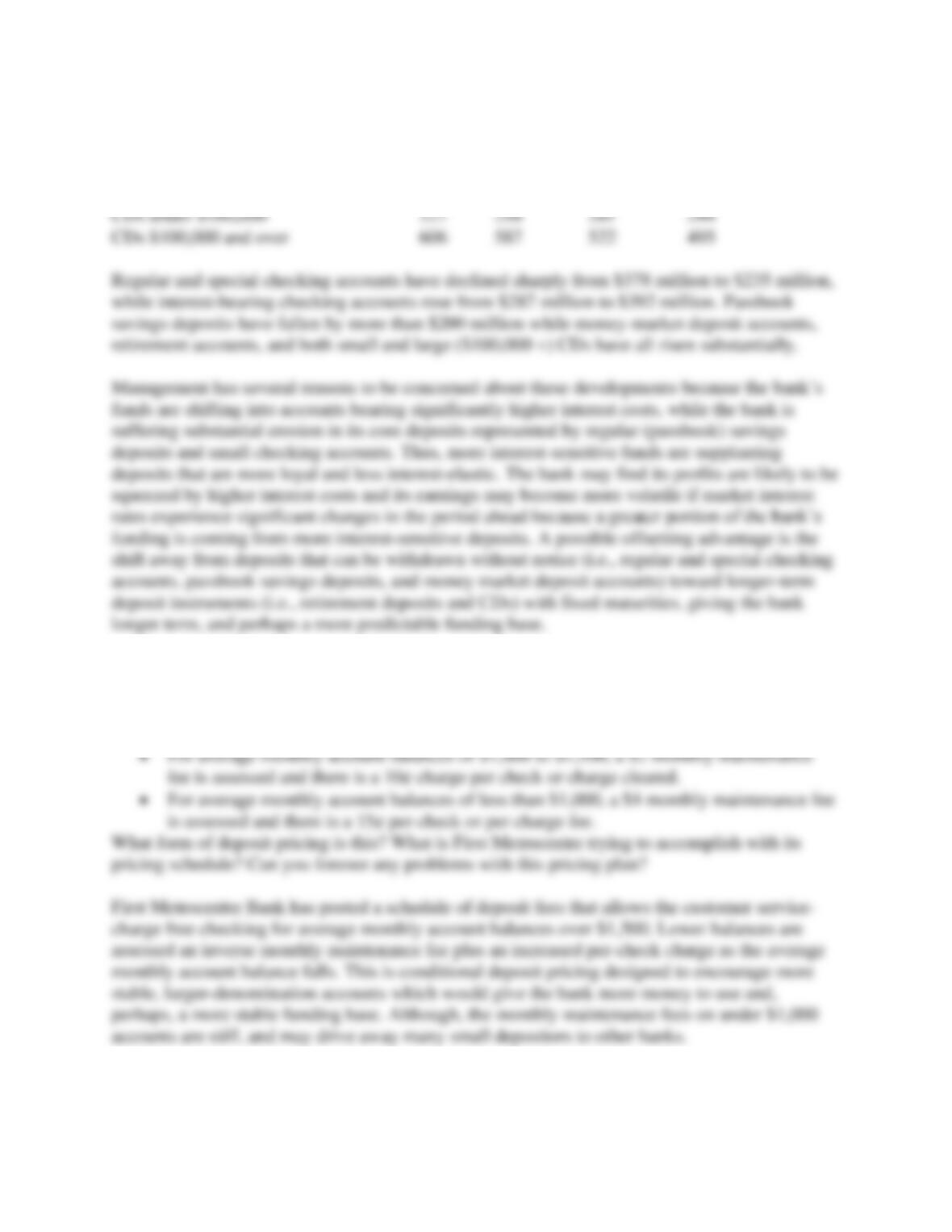
12-2. Kalewood Savings Bank has experienced recent changes in the composition of its
deposits (see the following table; all figures in millions of dollars). What changes have recently
Chapter 12 – Managing and Pricing Deposit Services
12-8
Interest-bearing checking accounts
392
358
329
287
Regular (passbook) savings deposits
501
596
646
709
Money market deposit accounts
863
812
749
725
Retirement deposits
650
603
542
498
CDs under $100,000
327
298
261
244
CDs $100,000 and over
606
587
522
495
12-3. First Metrocentre Bank posts the following schedule of fees for its household and small-
business transaction accounts:
• For average monthly account balances over $1,500, there is no monthly maintenance fee
and no charge per check or other draft.
Inflows
Rate
Offered
on New
Funds
Marginal
Marginal
Marginal
Exp. Diff.
In Marg.
Rev and
Profits
2.25%
2.50%
4.25%
+1.75%
$4.00
12-4 Fine-Tuned Savings Association finds that it can attract the following amounts of
deposits if it offers new depositors and those rolling over their maturing CDs at the interest rates
indicated below:
Expected Volume of New
Deposits
Rate of Interest Offered
Depositors
$10 million
2.00%
15 million
2.25
20 million
2.50
24 million
2.75
26 million
3.00
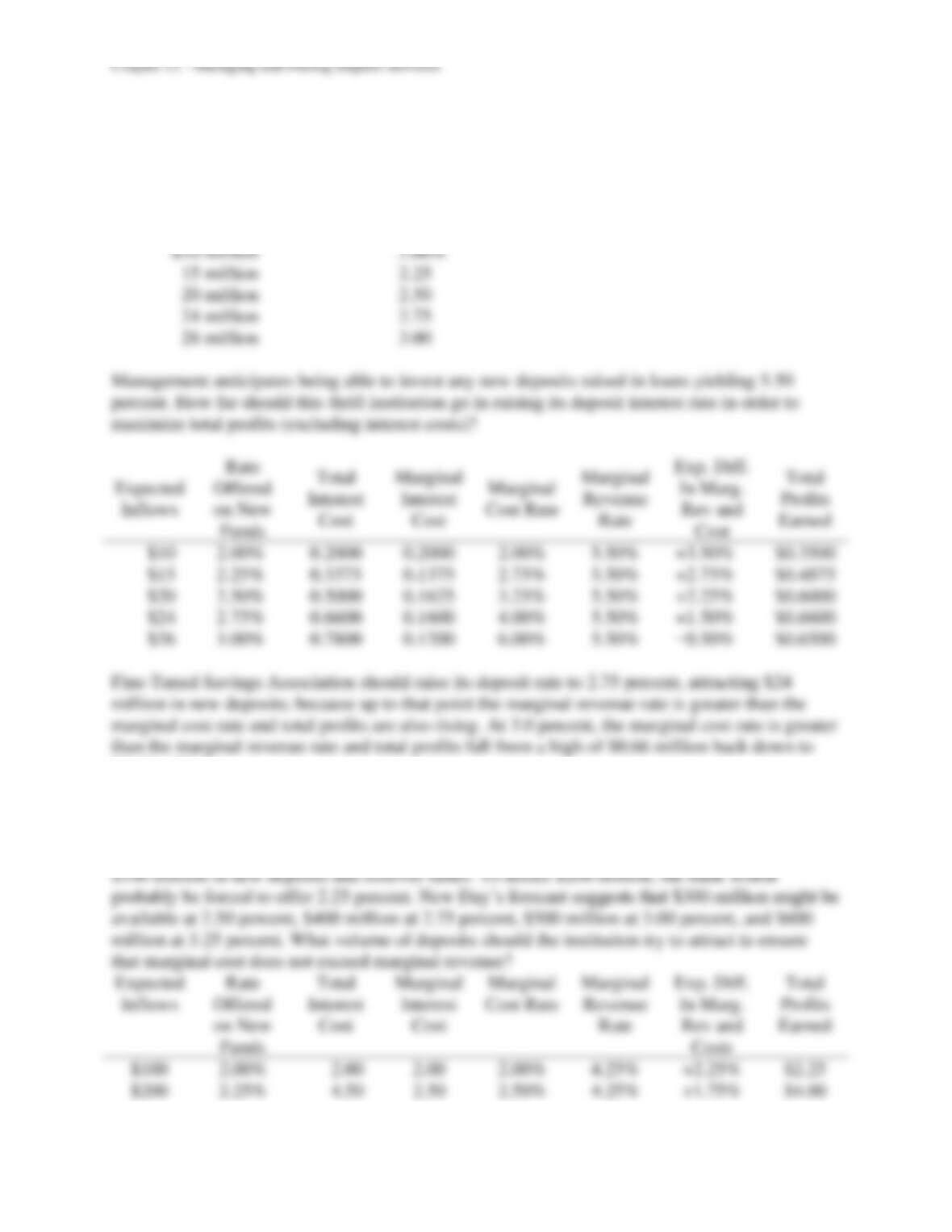
Management anticipates being able to invest any new deposits raised in loans yielding 5.50
percent. How far should this thrift institution go in raising its deposit interest rate in order to
maximize total profits (excluding interest costs)?
Expected
Inflows
Rate
Offered
on New
Funds
Total
Interest
Cost
Marginal
Interest
Cost
Marginal
Cost Rate
Marginal
Revenue
Rate
Exp. Diff.
In Marg.
Rev and
Cost
Total
Profits
Earned
$10
2.00%
0.2000
0.2000
2.00%
5.50%
+3.50%
$0.3500
$15
2.25%
0.3375
0.1375
2.75%
5.50%
+2.75%
$0.4875
$20
2.50%
0.5000
0.1625
3.25%
5.50%
+2.25%
$0.6000
$24
2.75%
0.6600
0.1600
4.00%
5.50%
+1.50%
$0.6600
$26
3.00%
0.7800
0.1200
6.00%
5.50%
−0.50%
$0.6500
Fine-Tuned Savings Association should raise its deposit rate to 2.75 percent, attracting $24
million in new deposits; because up to that point the marginal revenue rate is greater than the
marginal cost rate and total profits are also rising. At 3.0 percent, the marginal cost rate is greater
than the marginal revenue rate and total profits fall from a high of $0.66 million back down to
$0.65 million.
12–5. New Day Bank plans to launch a new deposit campaign next week in hopes of bringing
in from $100 million to $600 million in new deposit money, which it expects to invest at a 4.25
percent yield. Management believes that an offer rate on new deposits of 2 percent would attract
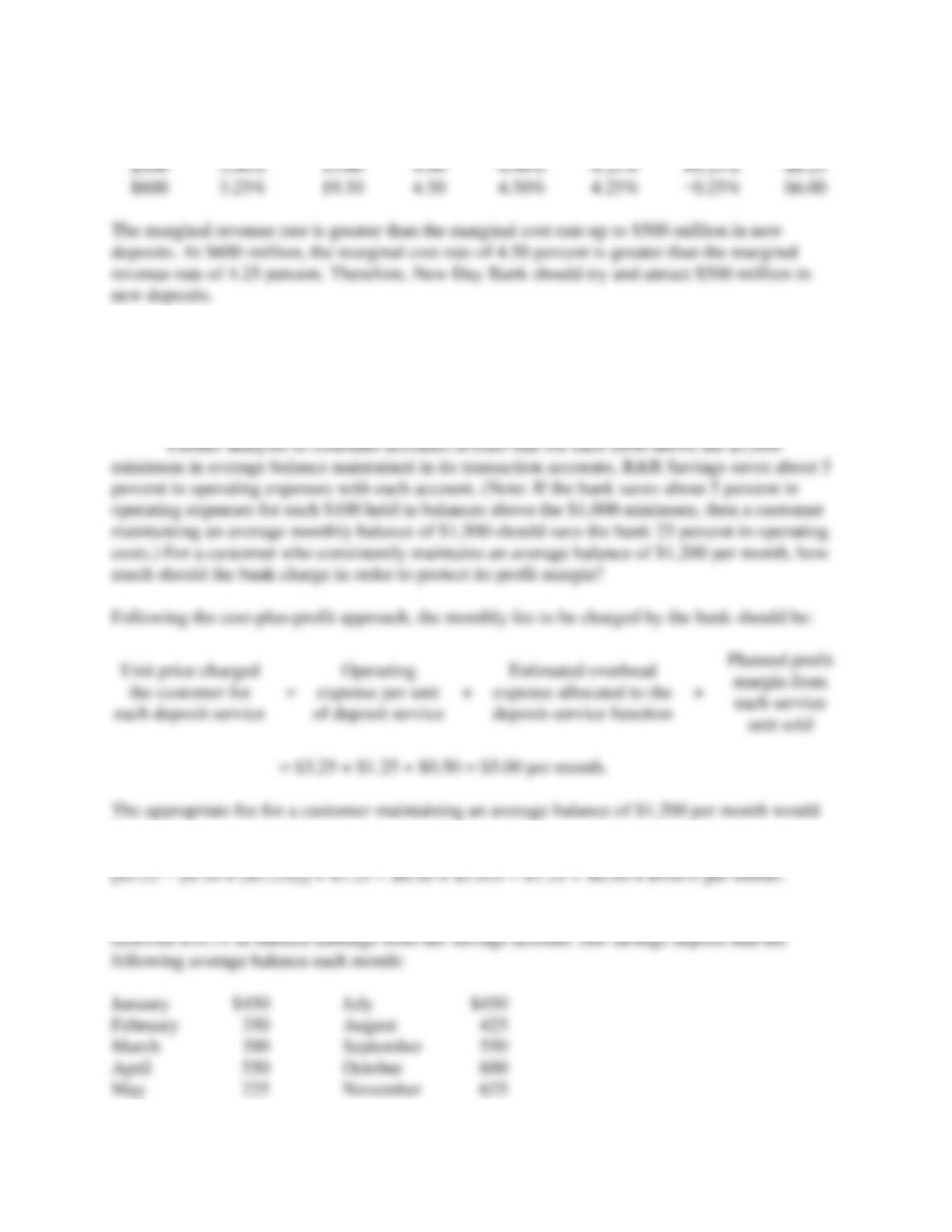
Chapter 12 – Managing and Pricing Deposit Services
$300
2.50%
7.50
3.00
3.00%
4.25%
+1.25%
$5.25
$400
2.75%
11.00
3.50
3.50%
4.25%
+0.75%
$6.00
$500
3.00%
15.00
4.00
4.00%
4.25%
+0.25%
$6.25
$600
3.25%
19.50
4.50
4.50%
4.25%
−0.25%
$6.00
12-6. R&R Savings Bank finds that its basic transaction account, which requires a $1,000
minimum balance, costs this savings bank an average of $3.25 per month in servicing costs
(including labor and computer time) and $1.25 per month in overhead expenses. The savings
bank also tries to build in a $0.50 per month profit margin on these accounts. What monthly fee
should the bank charge each customer?
be:
12-7. Lucy Lane maintains a savings deposit with Monarch Credit Union. This past year Lucy
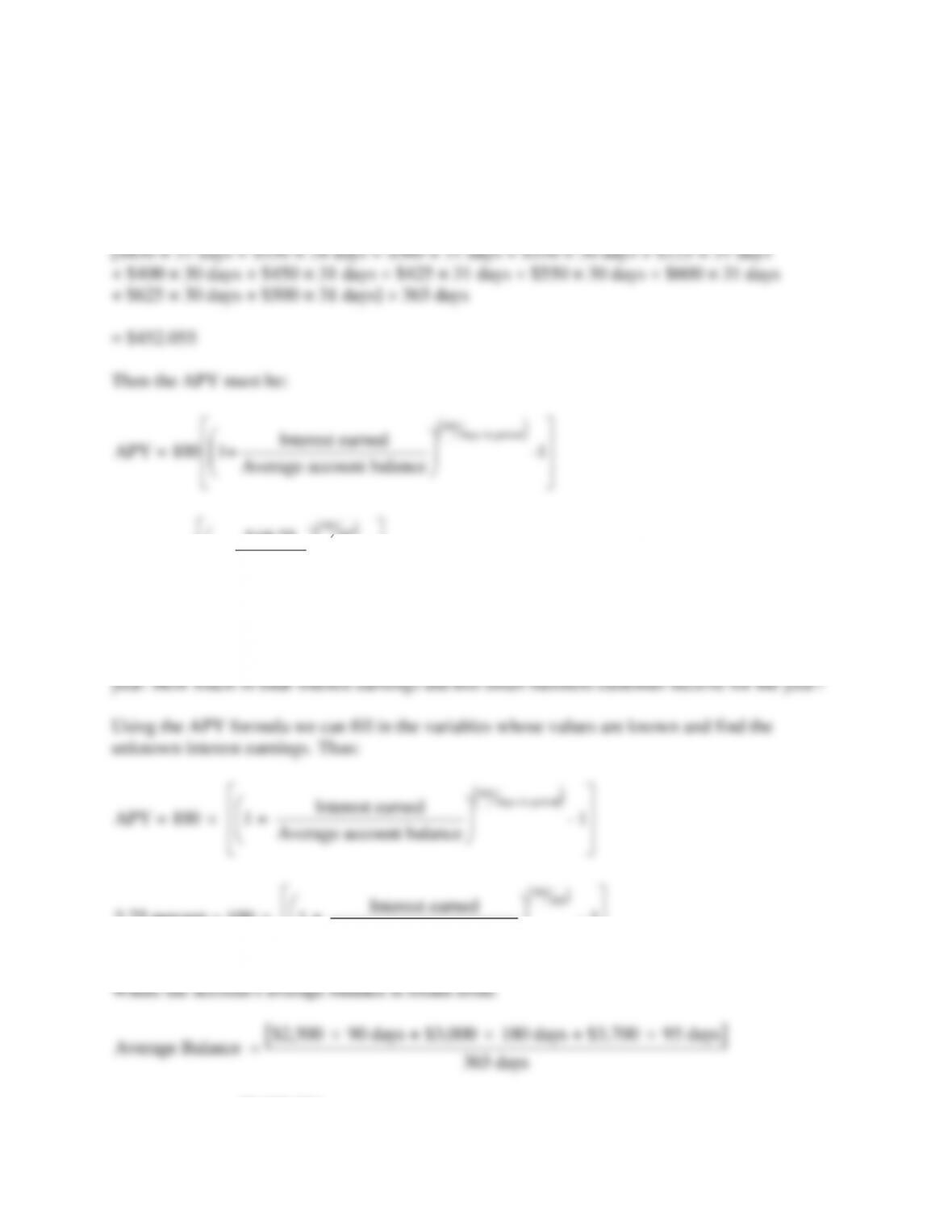
Chapter 12 – Managing and Pricing Deposit Services
June
400
December
500
What was the annual percentage yield (APY) earned on Lucy’s savings account?
Lucy’s account had an average balance this year of:
( )
365365
$10.75
APY =100 1+ –1
$452.055
= 2.38 percent.
12-8. The National Bank of Mayville quotes an APY of 2.75 percent on a one-year money
market CD sold to one of the small businesses in town. The firm posted a balance of $2,500 for
the first 90 days of the year, $3,000 over the next 180 days, and $3,700 for the remainder of the

Chapter 12 – Managing and Pricing Deposit Services
12–12
Then:
( )
365365
Interest earned
2.75 percent = 100 × 1 + – 1
$3,058.904