Chapter 11 – Liquidity and Reserves Management: Strategies and Policies
expected deposit inflows of $26 million, revenues from nondeposit service sales of $18 million,
scheduled repayments of previously made customer loans of $23 million, asset sales of $10
million, other operating expenses of $15 million, and money market borrowings of $15 million.
How much must Mountain Top’s expected deposit withdrawals be for the coming week?
Supply of Liquidity Flowing into the Mountain Top Savings
Expected deposit inflows
$26
Revenues from nondeposit service sales
18
Scheduled repayments of previously made customer loans
23
Asset sales
10
Money market borrowings
15
Total Source of Liquidity
Demands on the Mountain Top Savings for Liquidity
Expected quality loan demand
32
Necessary repayments of previous borrowings
15
Other operating expenses
15
Stockholder dividend payments
10
Total Uses of Liquidity Excluding Deposit Withdrawals
Net liquidity deficit = Liquidity supplies − Liquidity demands − Deposit withdrawals
−$10 million = $92 million − $72 million − Deposit withdrawals
Deposit withdrawals = $30
Therefore, expected deposit withdrawals must equal $30 million for the next week.
11-3. First National Bank of Belle Mead has forecast its checkable deposits, time and savings
deposits, and commercial and household loans over the next eight months. The resulting
estimates (in millions) are shown below. Use the sources and uses of funds approach to indicate
which months are likely to result in liquidity deficits and which in liquidity surpluses if these
February
March
April
May
June
July
August
Chapter 11 – Liquidity and Reserves Management: Strategies and Policies
11–13
Month
Total
Deposits
Change from
Previous
Month
Total Loans
Change from
Previous
Month
Estimated
Liquidity –
Deficit or
Surplus
January
670
—
810
—
February
615
-55
880
70
-125
March
600
-15
910
30
-45
April
575
-25
875
-35
10
May
570
-5
870
-5
0
June
570
0
900
30
-30
July
615
45
875
-25
70
August
615
0
825
-50
50
1. aggressive advertising to attract NOW deposits,
3. if they have a holding company, the holding company could sell commercial paper and pass
the proceeds through to the bank subsidiary,
5. borrowing from the Federal Reserve district bank (although this is not a likely alternative for
most banks),
7. selling some of their loans,
9. a combination of a number of these alternatives.
1. aggressively pursue new loans,
3. a combination of these alternatives.
Since both periods are relatively short lived, the bank should opt for more temporary measures,
Chapter 11 – Liquidity and Reserves Management: Strategies and Policies
11–14
11-4. Queen Savings is attempting to determine its liquidity requirements today (the last day in
August) for the month of September. September is usually a month of heavy loan demand due to
the beginning of the school term and the buildup of business inventories of goods and services
for the fall season and winter. This thrift institution has analyzed its deposit accounts thoroughly
and classified them as explained below.
+ 0.05 [Net “Core” Funds]
a) Net Hot Money Funds = [$10 million − ($10 million × 0.03)] + [$5 million] + [$1,200
$704.450 million
Therefore, deposit liquidity requirement = 0.85 × $1,214.7 + 0.25 × $955.05 + 0.05 × $704.450
Chapter 11 – Liquidity and Reserves Management: Strategies and Policies
11–15
Recent experience: Currently, loans total $2,500 million, but recently have been as high as
$2,550 million, or an additional $50 million.
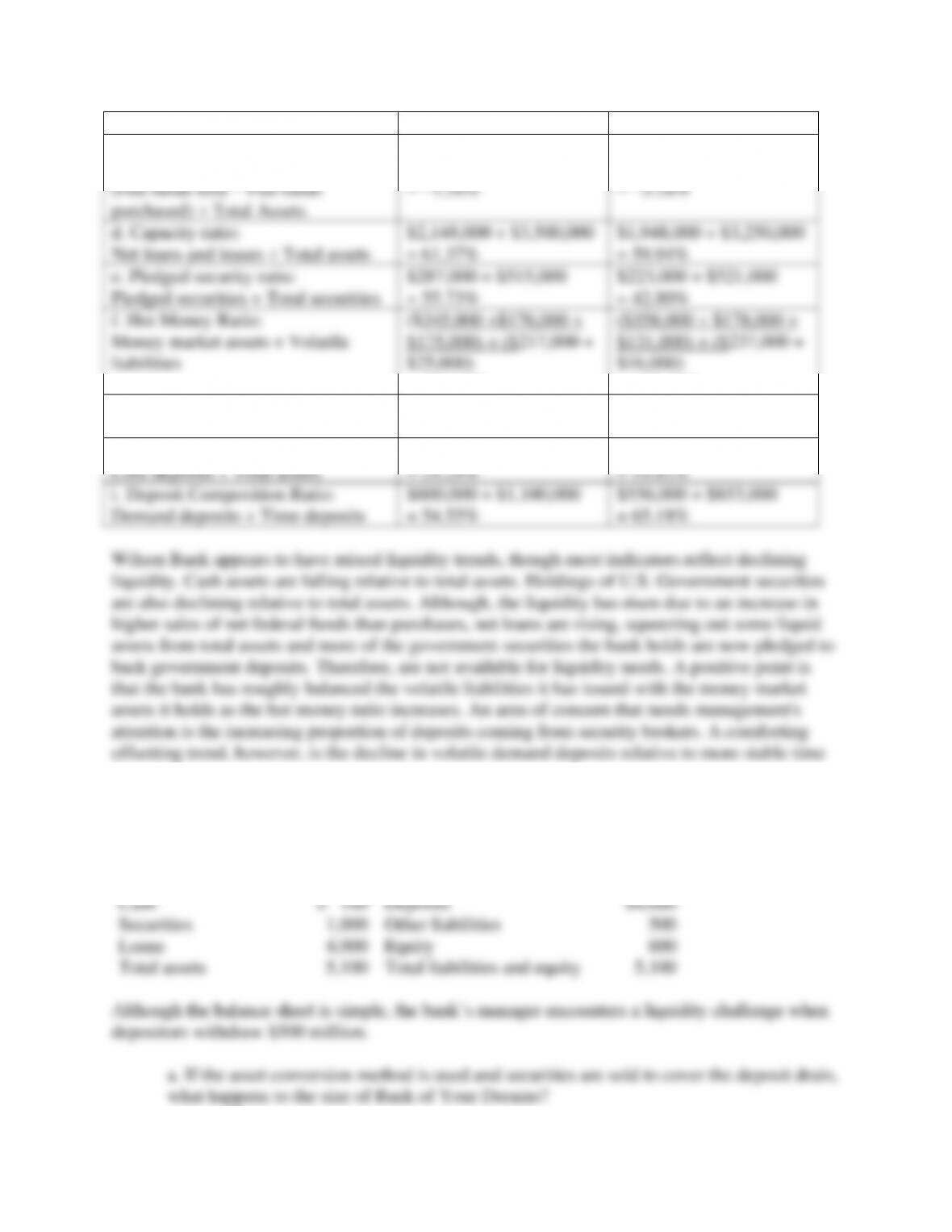
11-5 Using the following financial information for Wilson National Bank, calculate as many
of the liquidity indicators discussed in this chapter for Wilson as you can. Do you detect any
significant liquidity trends? Which trends should management investigate?
Most Recent Year
Previous Year
Assets:
Cash and due from depository
institutions
$ 345,000
$ 358,000
U.S. Treasury securities
176,000
178,000
Other securities
339,000
343,000
Pledged securities
287,000
223,000
Federal funds sold and reverse
repurchase agreements
175,000
131,000
Loans and leases net
2,148,000
1,948,000
Total Assets
3,500,000
3,250,000
Liabilities:
Demand deposits
600,000
556,000
Savings deposits
730,000
721,000
Time deposits
1,100,000
853,000
Total deposits
2,430,000
2,130,000
Core deposits
850,000
644,000
Brokered deposits
58,000
37,000
Federal funds purchased and
repurchase agreements
217,000
237,000
Other money market borrowings
25,000
16,000
Most Recent Year
Previous Year
a. Cash Position Indicator:
Cash and due from banks ÷ Total
assets
$345,000 ÷ $3,500,000
= 9.86%
$358,000 ÷ $3,250,000
= 11.02%
b. Liquid securities indicator:
$176,000 ÷ $3,500,000
$178,000 ÷ $3,250,000
Chapter 11 – Liquidity and Reserves Management: Strategies and Policies
U.S. Govt. sec. ÷ Total assets
= 5.03%
= 5.48%
c. Net federal funds and repurchase
agreement position:
(Fed funds sold − Fed funds
purchased) ÷ Total Assets
($175,000 − $217,000) ÷
$3,500,000
= −1.20%
($131,000 − $237,000) ÷
$3,250,000
= −3.26%
d. Capacity ratio:
Net loans and leases ÷ Total assets
$2,148,000 ÷ $3,500,000
= 61.37%
$1,948,000 ÷ $3,250,000
= 59.94%
e. Pledged security ratio:
Pledged securities ÷ Total securities
$287,000 ÷ $515,000
= 55.73%
$223,000 ÷ $521,000
= 42.80%
f. Hot Money Ratio:
Money market assets ÷ Volatile
liabilities
($345,000 +$176,000 +
$175,000) ÷ ($217,000 +
$25,000)
= 287.60%
($358,000 + $178,000 +
$131,000) ÷ ($237,000 +
$16,000)
= 122.13%
g. Deposit brokerage index:
Brokered deposits ÷ Total deposits
$58,000 ÷ $2,430,000
= 2.39%
$37,000 ÷ $2,130,000
= 1.74%
h. Core deposit ratio:
Core deposits ÷ Total assets
$850,000 ÷ $3,500,000
= 24.29%
$644,000 ÷ $3,250,000
= 19.82%
i. Deposit Composition Ratio:
Demand deposits ÷ Time deposits
$600,000 ÷ $1,100,000
= 54.55%
$556,000 ÷ $853,000
= 65.18%
deposits.
11-6. The Bank of Your Dreams has a simple balance sheet. The figures are in millions of dollars
as follows:
Assets
Liabilities and Equity
Cash
$ 100
Deposits
$4,000
Securities
1,000
Other liabilities
500
Loans
4,000
Equity
600
Total assets
5,100
Total liabilities and equity
5,100
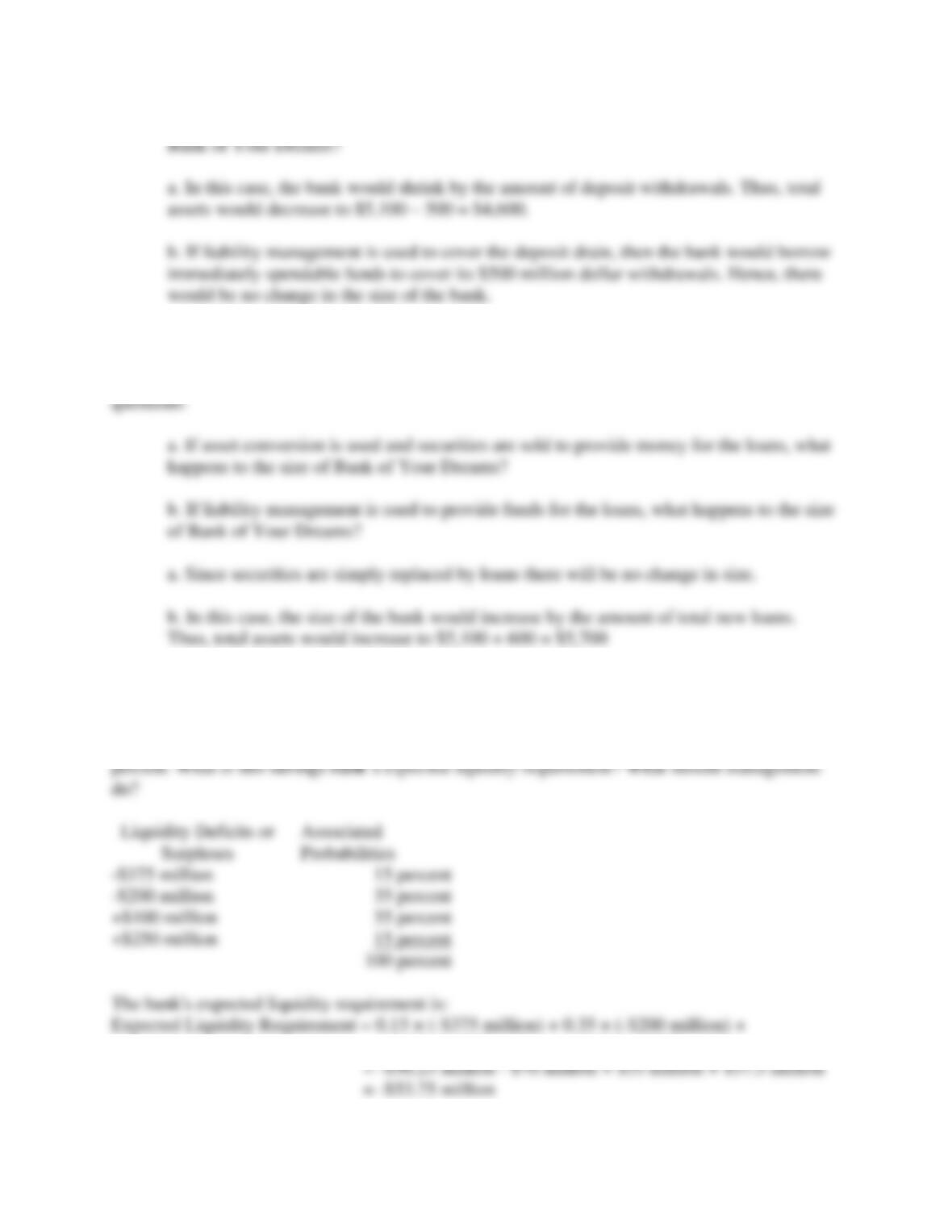
Although the balance sheet is simple, the bank’s manager encounters a liquidity challenge when
depositors withdraw $500 million.
a. If the asset conversion method is used and securities are sold to cover the deposit drain,
what happens to the size of Bank of Your Dreams?
Chapter 11 – Liquidity and Reserves Management: Strategies and Policies
11–17
b. If liability management is used to cover the deposit drain, what happens to the size of
11-7. The liquidity manager for the Bank of Your Dreams needs cash to meet some
unanticipated loan demand. The loan officer has $600 million in loans that he wants to make.
Use the simplified balance sheet provided in the previous problem to answer the following
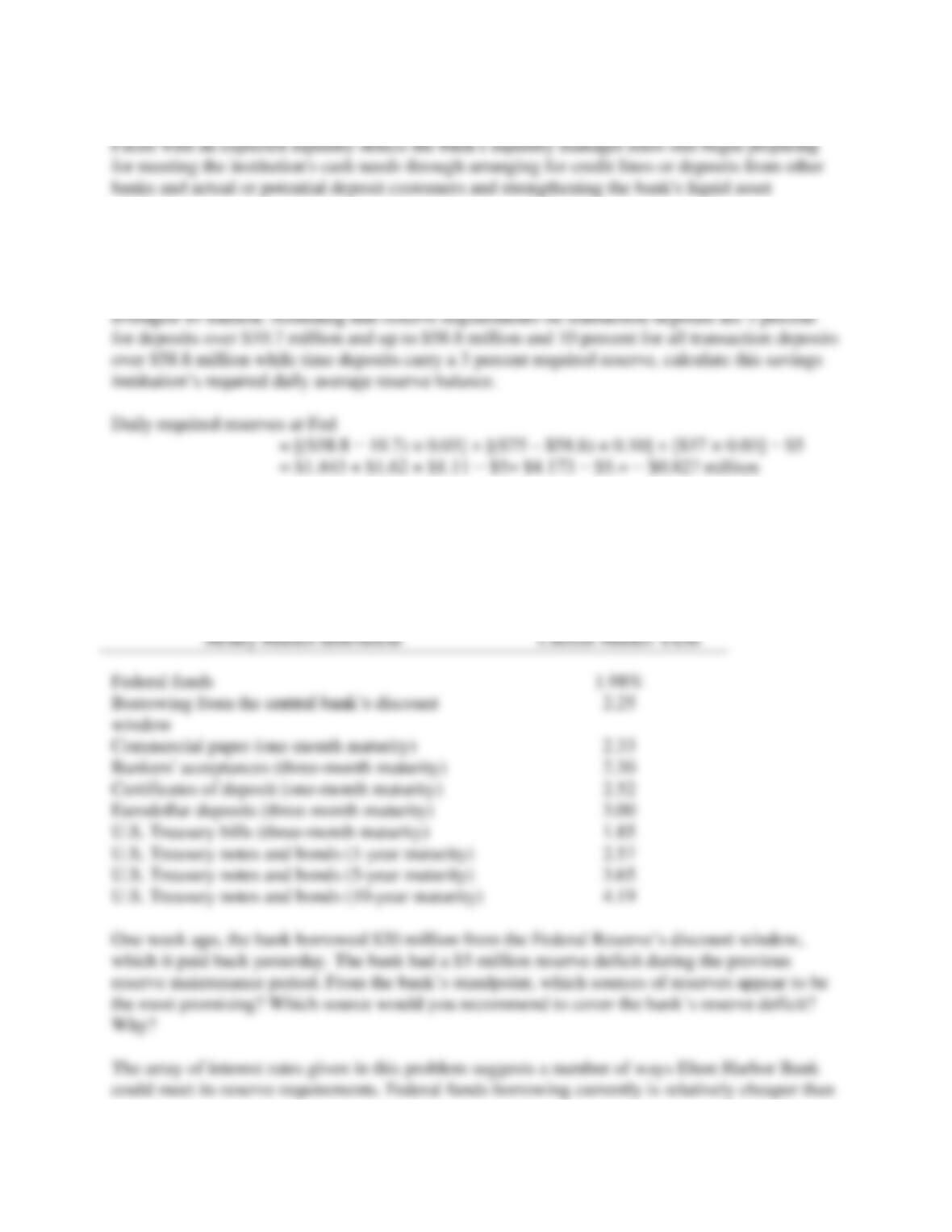
11-8. Suppose Abigail Savings Bank’s liquidity manager estimates that the bank will
experience a $375 million liquidity deficit next month with a probability of 15 percent, a $200
million liquidity deficit with a probability of 35 percent, a $100 million liquidity surplus with a
probability of 35 percent, and a $250 million liquidity surplus bearing a probability of 15
0.35× (+$100 million) + 0.15 × (+$250 million)
Chapter 11 – Liquidity and Reserves Management: Strategies and Policies
11–18
position.
11-9. First Savings of Rainbow, Iowa, reported transaction deposits of $75 million (the daily
average for the latest two–week reserve computation period). Its nonpersonal time deposits over
the most recent reserve computation period averaged $37 million daily, while vault cash
11-10. Elton Harbor Bank has a cumulative legal reserve deficit of $44 million as of the close of
business this Tuesday. The bank must cover this deficit by the close of business tomorrow
(Wednesday).
Charles Tilby, the bank’s money desk supervisor, examines the current distribution of money
market and long–term interest rates and discovers the following:
Money Market Instrument
Current Market Yield
Federal funds
1.98%
Borrowing from the central bank’s discount
window
2.25
Commercial paper (one-month maturity)
2.33
Bankers’ acceptances (three-month maturity)
2.30
Certificates of deposit (one-month maturity)
2.52
Eurodollar deposits (three-month maturity)
3.00
U.S. Treasury bills (three-month maturity)
1.85
U.S. Treasury notes and bonds (1-year maturity)
2.57
U.S. Treasury notes and bonds (5-year maturity)
3.65
U.S. Treasury notes and bonds (10-year maturity)
4.19
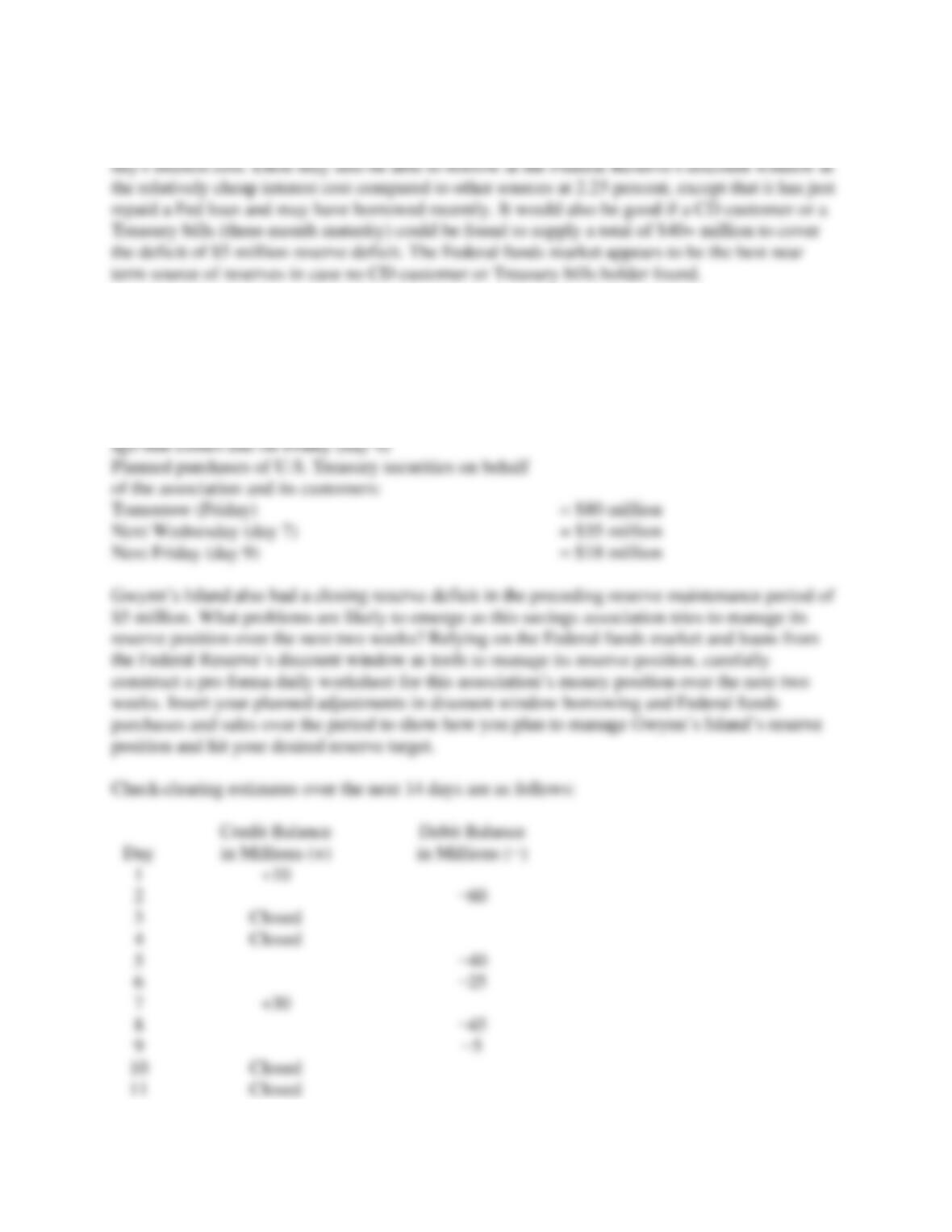
One week ago, the bank borrowed $20 million from the Federal Reserve’s discount window,
which it paid back yesterday. The bank had a $5 million reserve deficit during the previous
reserve maintenance period. From the bank’s standpoint, which sources of reserves appear to be
the most promising? Which source would you recommend to cover the bank’s reserve deficit?
Why?
The array of interest rates given in this problem suggests a number of ways Elton Harbor Bank
could meet its reserve requirements. Federal funds borrowing currently is relatively cheaper than
Chapter 11 – Liquidity and Reserves Management: Strategies and Policies
most other short-term sources of funds at an annual rate of 1.98 percent. The bank only has to
borrow for 24 hours and can return the borrowed funds on Thursday, thus incurring only one
11-11. Gwynn’s Island Building and Loan Association estimates the following information
regarding this institution’s reserve position at the Federal Reserve for the reserve maintenance
period that begins today (Thursday):
Calculated required daily average legal reserve balance
= $760 million
A loan received by the Fed’s discount window a week
ago that comes due on Friday (day 9)
= $70 million
Planned purchases of U.S. Treasury securities on behalf
of the association and its customers:
Tomorrow (Friday)
= $80 million
Next Wednesday (day 7)
= $35 million
Next Friday (day 9)
= $18 million

Chapter 11 – Liquidity and Reserves Management: Strategies and Policies
11–20
12
+20
13
−70
14
+10
Day
Estima
ted
Daily
Avera
ge
Reserv
e
Balanc
e
Requir
ed
Check
−
Cleari
ngs
Federal
Funds
Transactio
ns
Purchases
(+)
Sales (−)
Federal
Discount
Window
Borrow
(+)
Repay(−
)
Treas.
Sec.
Red. (+)
Purch
(−)
Clos-
ing
Daily
Avg.
Bal.
Excess
or
Deficit
in
Legal
Res.
Cum.
Exc.
or
Def.
Cum.
Closing
Res.
Bal.
at Fed.
Deficit from Previous Period – $5 million
1 (Thurs)
$760
+10
$765
+5
+5
765
2 (Fri)
$760
−60
+205
−80
830
+70
+75
1,595
3 (Sat)
$760
830
+70
+145
2,425
4 (Sun)
$760
830
+70
+215
3,255
5 (Mon)
$760
−40
−205
585
−175
+40
3,840
6 (Tues)
$760
−25
560
−200
−160
4,400
7 (Weds)
$760
+30
−35
555
−205
−365
4,955
8 (Thurs)
$760
−45
510
−250
−615
5,465
9 (Fri)
$760
−5
+300
+230
−18
1,017
+257
−358
6,482
10 (Sat)
$760
1,017
+257
−101
7,499
11 (Sun)
$760
1,017
+257
+156
8,516
12 (Mon)
$760
+20
−300
737
−23
+133
9,253
13 (Tues)
$760
−70
667
−93
+40
9,920
14 (Wed)
$760
+10
+43
720
−40
0
10,640
In this case the bank’s money desk manager tried to avoid deepening deficits by periodically –
particularly on Fridays – borrowing heavily in the Federal funds market and at the Federal
Reserve bank. And fortunately, however, by the beginning of the last day (Wednesday) of the
reserve settlement period the bank has a cumulative deficit of $0 million. The planned borrowing
in Federal funds will be enough to prevent any deficit position. It will have a cumulative reserve
balance of $10,640 million as of the final Wednesday in the settlement period and under the law
must have a cumulative reserve balance slightly in excess of $760 million × 14 or $10,640
million. Clearly, this institution has managed its reserve position well.
11-12. Parvis Bank and Trust Co. has calculated its daily average deposits and vault cash
holdings for the most recent two–week computation period as follows:
Net transaction deposits = $ 90,000,000
Nonpersonal time deposits under
Chapter 11 – Liquidity and Reserves Management: Strategies and Policies
11–21
18 months to maturity = $169,000,000
Eurocurrency liabilities = $ 7,000,000
Daily average balance in vault cash = $ 2,000,000.
Suppose the reserve requirements posted by the Board of Governors of the Federal Reserve
System are as follows:
Net transaction accounts:
$10.7 to $58.8 million 3%
More than $58.8 million 10%
Nonpersonal time deposits:
Less than 18 months 3%
18 months or more 0%
Eurocurrency liabilities—all types 3%
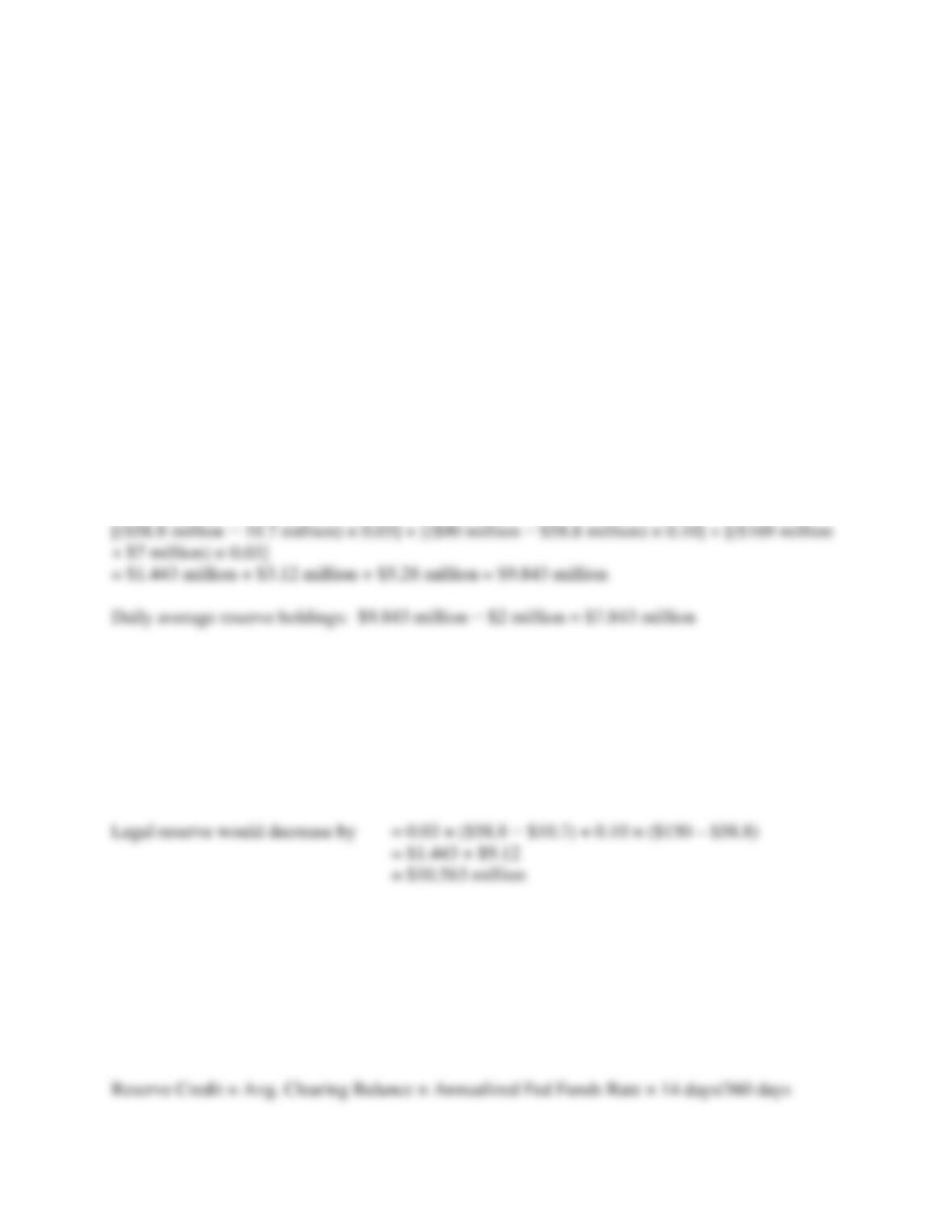
What is this bank’s daily average required level of legal reserves? How much must the bank hold
on a daily average basis with the Federal Reserve bank in its district?
Solution:
11-13. Frost Street National Bank currently holds $750 million in transaction deposits subject to
reserve requirements but has managed to enter into sweep account arrangements with its
transaction deposit customers affecting $150 million of their deposits. Given the current legal
reserve requirements applying to transaction deposits (as mentioned in this chapter), by how
much would Frost Street’s total legal reserves decrease as a result of these new sweep account
arrangements, which stipulate that transaction deposit balances covered by the sweep agreements
will be moved overnight into savings deposits?
11-14 Bridgewater Savings Association maintains a clearing account at the Federal Reserve
Bank and agrees to keep a minimum balance of $30 million in its clearing account. Over the two–
week reserve maintenance period ending today Sweetbriar managed to keep an average clearing
account balance of $33 million. If the Federal funds interest rate has averaged 1.75 percent over
this particular maintenance period, what maximum amount would Bridgewater have available in
the form of Federal Reserve credit to help offset any fees the Federal Reserve bank might charge
this association for using Federal Reserve services?

Chapter 11 – Liquidity and Reserves Management: Strategies and Policies
11–22