
Chapter 11 – Liquidity and Reserves Management: Strategies and Policies
11-1
CHAPTER 11
LIQUIDITY AND RESERVES MANAGEMENT: STRATEGIES AND POLICIES
Goal of This Chapter: The purpose of this chapter is to explore the reasons why financial
institutions often face heavy demands for immediately spendable funds (liquidity) and learn
about the methods they can use to prepare for meeting their cash needs.
Key Topics in This Chapter
• Sources of Demand for and Supply of Liquidity
• Why Financial Firms Have Liquidity Problems
• Liquidity Management Strategies
• Estimating Liquidity Needs
• The Impact of Market Discipline
• Legal Reserves and Money Management
Chapter Outline
I. Introduction: Meaning of Liquidity
II. The Demand for and Supply of Liquidity
A. Sources of Liquidity Demands
B. Sources of Liquidity Supplies
C. Net Liquidity Position
1. Liquidity Surplus
2. Liquidity Deficit
D. Liquidity Time Dimension
1. Immediate Liquidity
2. Longer-term Liquidity
E. Liquidity Management Problems
1. Rarely are Demands for Liquidity Equal to the Supply of Liquidity
2. There is a Trade-off Between Liquidity and Profitability
F. Risks Involved I n Management of Liquidity
1. Interest Rate Risk
2. Availability Risk
III. Why Financial Firms Often Face Significant Liquidity Problems
A. Maturity Mismatches
B. Sensitivity to Changes in Market Interest Rates
C. Meeting Demand for Liquidity and Public Confidence
IV. Strategies for Liquidity Managers
A. Asset Liquidity Management (or Asset Conversion) Strategies
B. Borrowed Liquidity (Liability) Management Strategies
C. Balanced Liquidity Management Strategies
D. Guidelines for Liquidity Managers
V. Estimating Liquidity Needs
Chapter 11 – Liquidity and Reserves Management: Strategies and Policies
11-2
A. The Sources and Uses of Funds Approach
1. Trend Component
2. Seasonal Component
3. Cyclical Component
B. The Structure of Funds Approach
C. Liquidity Indicator Approach (Ratios)
1. Cash Position Indicator
2. Liquid Securities Indicator
3. Net Federal Funds And Repurchase Agreements Position
4. Capacity Ratio
5. Pledged Securities Ratio
6. Hot Money Ratio
7. Deposit Brokerage Index
8. Core Deposit Ratio
9. Deposit Composition Ratio
10. Loan Commitments Ratio
D. The Ultimate Standard for Assessing Liquidity Needs: Signals from the Marketplace
1. Public Confidence
2. Stock Price Behavior
3. Risk Premiums on CDs and Other Borrowings
4. Loss Sales of Assets
5. Meeting Commitments to Credit Customers
6. Borrowings from the Central Bank
VI. Legal Reserves and Money Position Management
A. The Money Position Manager
B. Legal Reserves
C. Regulations on Calculating Legal Reserve Requirements
1. Reserve Computation
2. Reserve Maintenance
3. Reserve Requirements
4. Calculating Required Reserves
5. Clearing Balances
D. Factors Influencing the Money Position
1. Controllable Factors
2. Noncontrollable Factors
3. An Example
4. Use of the Federal Funds Market
5. Other Options besides Fed Funds
6. Bank Size and Borrowing and Lending Reserves for the Money Position
7. Overdraft Penalties
VII. Factors in Choosing among the Different Sources of Reserves
A. Immediacy of need
B. Duration of need
C. Access to the market for liquid funds
D. Relative costs and risks of alternative sources of funds
E. The interest rate outlook
Chapter 11 – Liquidity and Reserves Management: Strategies and Policies
F. Outlook for central bank monetary policy
G. Rules and regulations applicable to a liquidity source
VIII. Central Bank Reserve Requirements around the Globe
IX. Summary of the Chapter
Concept Checks
11-1. What are the principal sources of liquidity demand for a financial firm?
The most pressing demands for liquidity arise principally from customers withdrawing money
11-2. What are the principal sources from which the supply of liquidity comes?
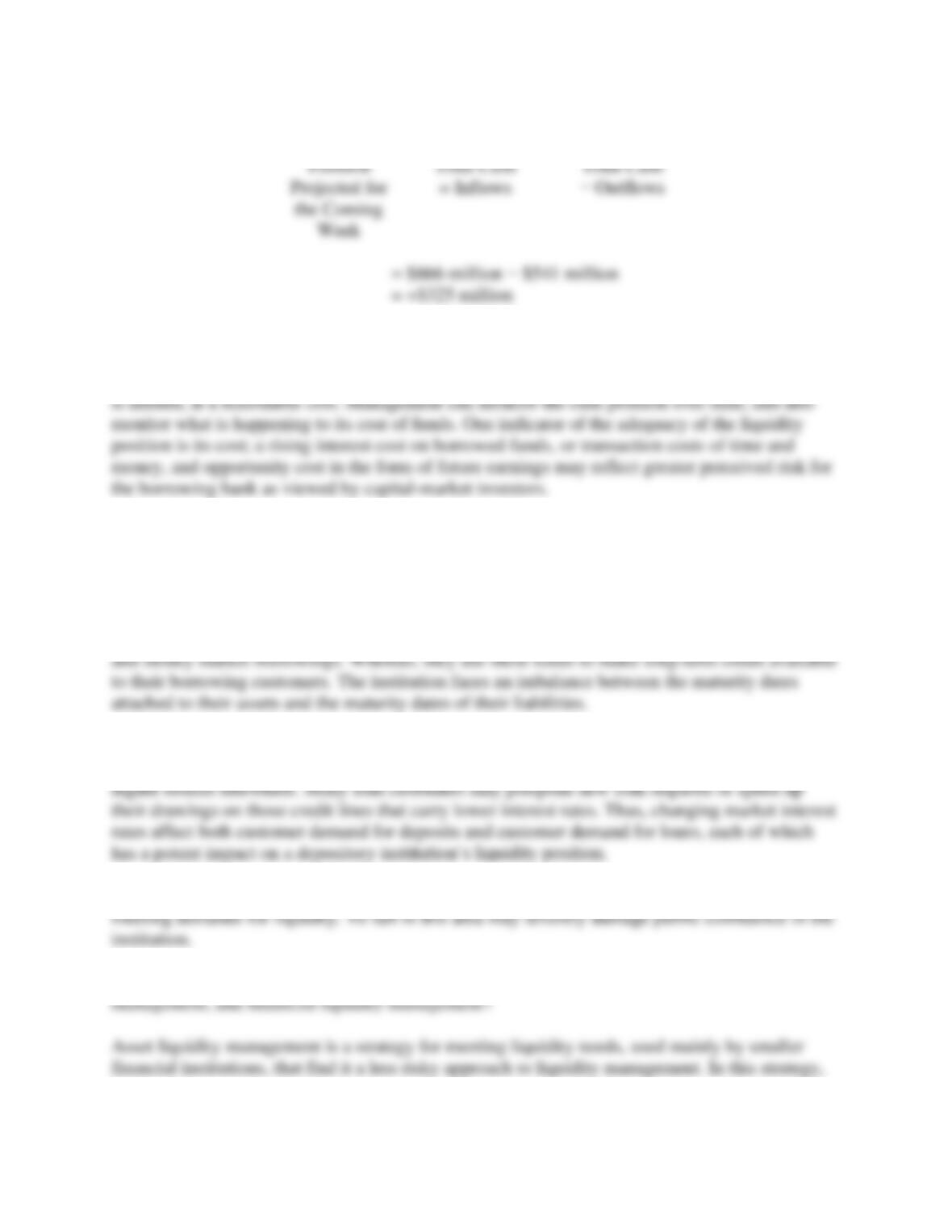
11-3. Suppose that a bank faces the following cash inflows and outflows during the coming
week: (a) deposit withdrawals are expected to total $33 million, (b) customer loan repayments
are expected to amount to $108 million, (c) operating expenses demanding cash payment will
probably approach $51 million, (d) acceptable new loan requests should reach $294 million, (e)
Chapter 11 – Liquidity and Reserves Management: Strategies and Policies
11-4
Net Liquidity
Position
Total Cash
Total Cash
Projected for
= Inflows
− Outflows
the Coming
Week
= $866 million − $541 million
= +$325 million
11-4. When is a financial institution adequately liquid?
A financial institution is adequately liquid if it has adequate cash available precisely when cash
11-5. Why do financial firms face significant liquidity management problems?
Financial institutions are prone to liquidity management problems due to:
(1) A maturity mismatch situation in which most depository institutions hold an unusually high
proportion of liabilities subject to immediate payment, especially demand (checkable) deposits
(2) The sensitivity of changes to their assets and liabilities values towards market interest-rate
movements. When interest rates rise, some customers will withdraw their funds in search of
(3) Their central role in the payments process is that financial firms must give high priority to
11-6. What are the principal differences among asset liquidity management, liability
Chapter 11 – Liquidity and Reserves Management: Strategies and Policies
11-5
liquid funds are stored in readily marketable assets that can be quickly converted into cash as
needed.
Liability management involves borrowing enough immediately spendable funds to cover all
funds.
11-7. What guidelines should management keep in mind when it manages a financial firm’s
liquidity position?
It is important for a liquidity manager to: (a) keep track of the activities of all departments within
the bank which use or supply funds; (b) know in advance the activities and plans of the bank’s
11-8. How does the sources and uses of funds approach help a manager estimate a financial
institution’s need for liquidity?
The sources and uses of funds approach estimates future deposit inflows and estimated outflows
Chapter 11 – Liquidity and Reserves Management: Strategies and Policies
11-6
negative liquidity gap (deficit). It now must raise funds from the cheapest and most timely
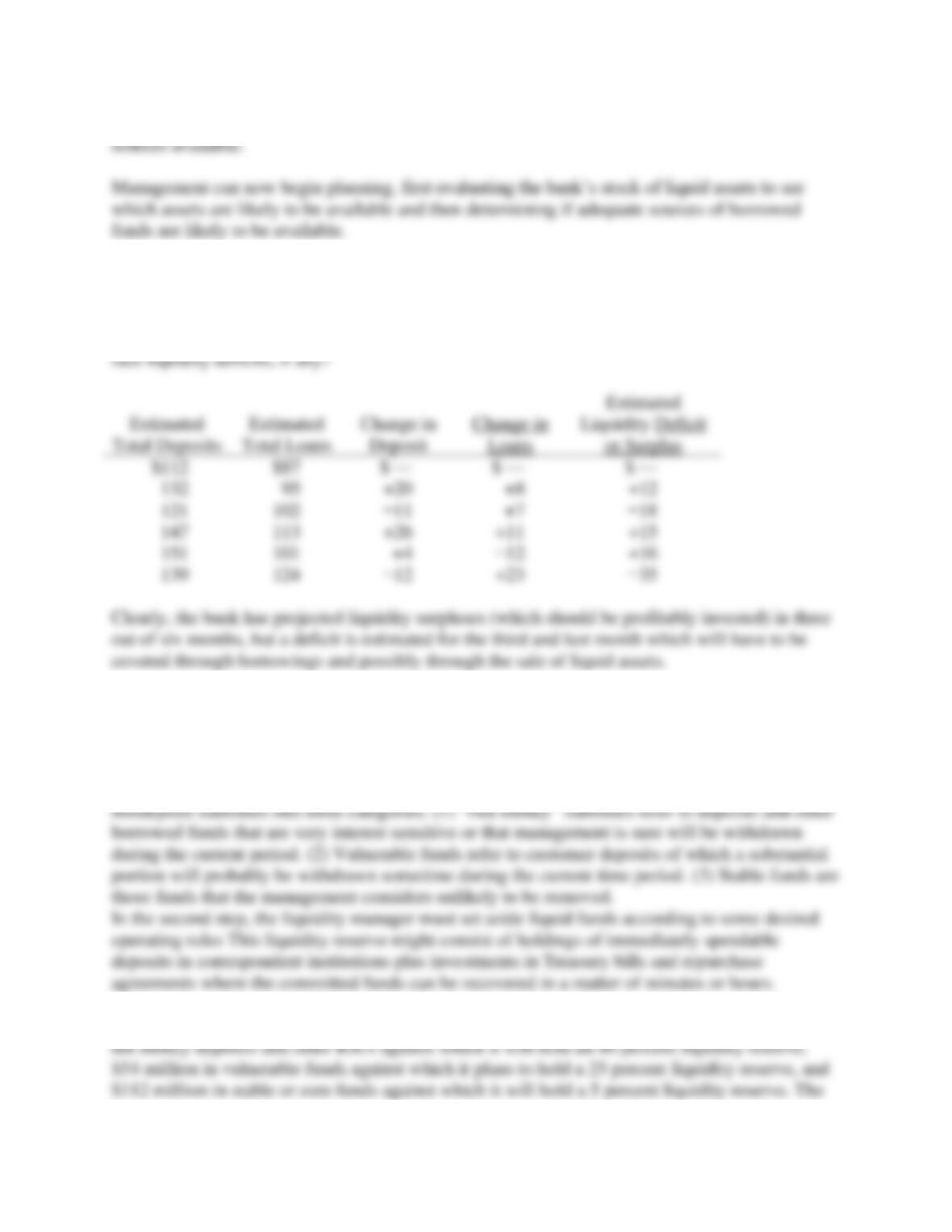
11-9. Suppose that a bank estimates its total deposits for the next six months in millions of
dollars to be, respectively, $112, $132, $121, $147, $151, and $139, while its loans (also in
millions of dollars) will total an estimated $87, $95, $102, $113, $101, and $124, respectively,
over the same six months. Under the sources and uses of funds approach, when does this bank
11-10. What steps are needed to carry out the structure of funds approach to liquidity
management?
In the first step, the institution’s deposits and other funds sources are divided into categories
based upon their estimated probability of being withdrawn. We can divide a bank’s deposit and
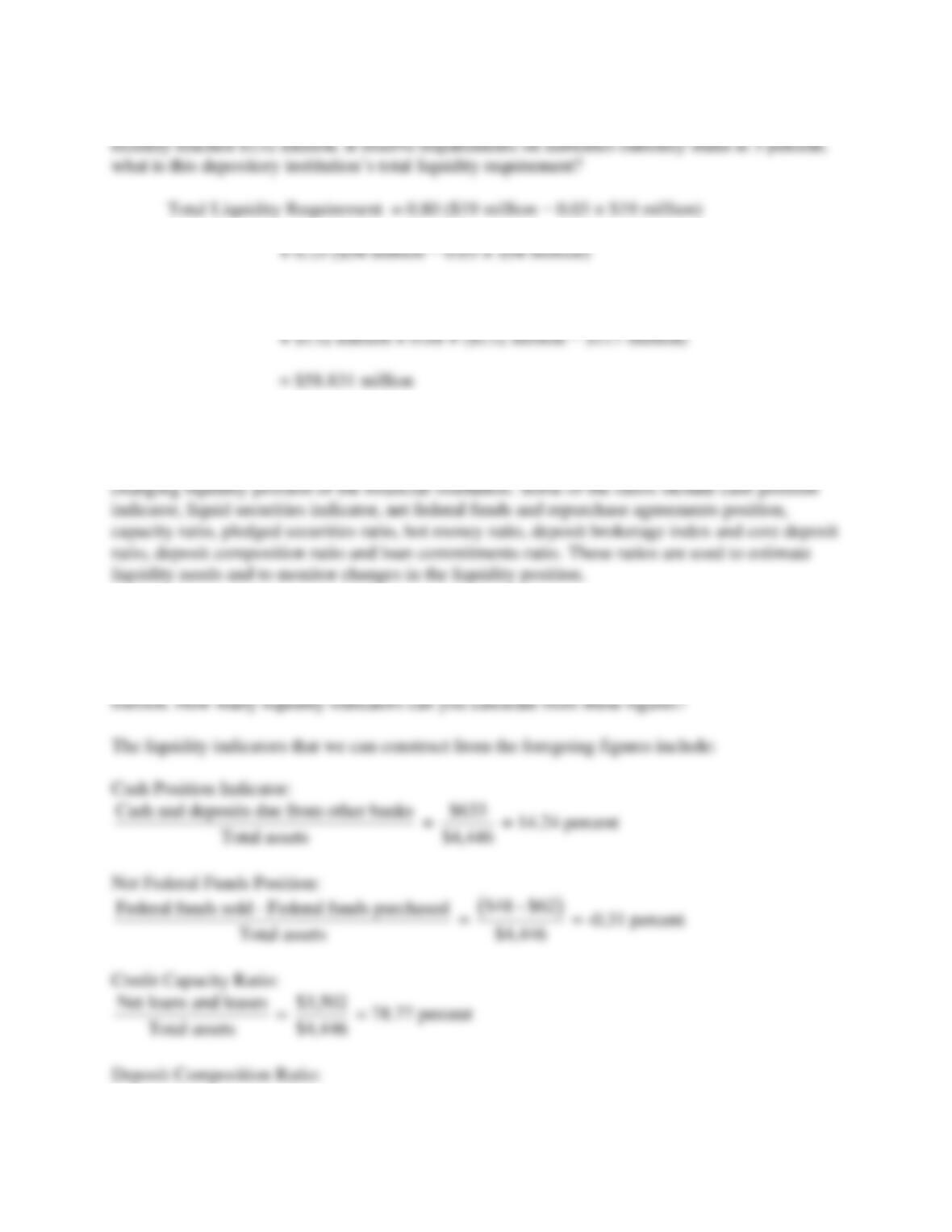
11-11. Suppose that a thrift institution’s liquidity division estimates that it holds $19 million in
Chapter 11 – Liquidity and Reserves Management: Strategies and Policies
11-7
thrift expects its loans to grow 8 percent annually; its loans currently total $117 million but have
+ 0.05 ($112 million − 0.03 × $112 million)
11-12. What is the liquidity indicator approach to liquidity management?
The liquidity indicator approach uses financial ratios whose changes over time may reflect the
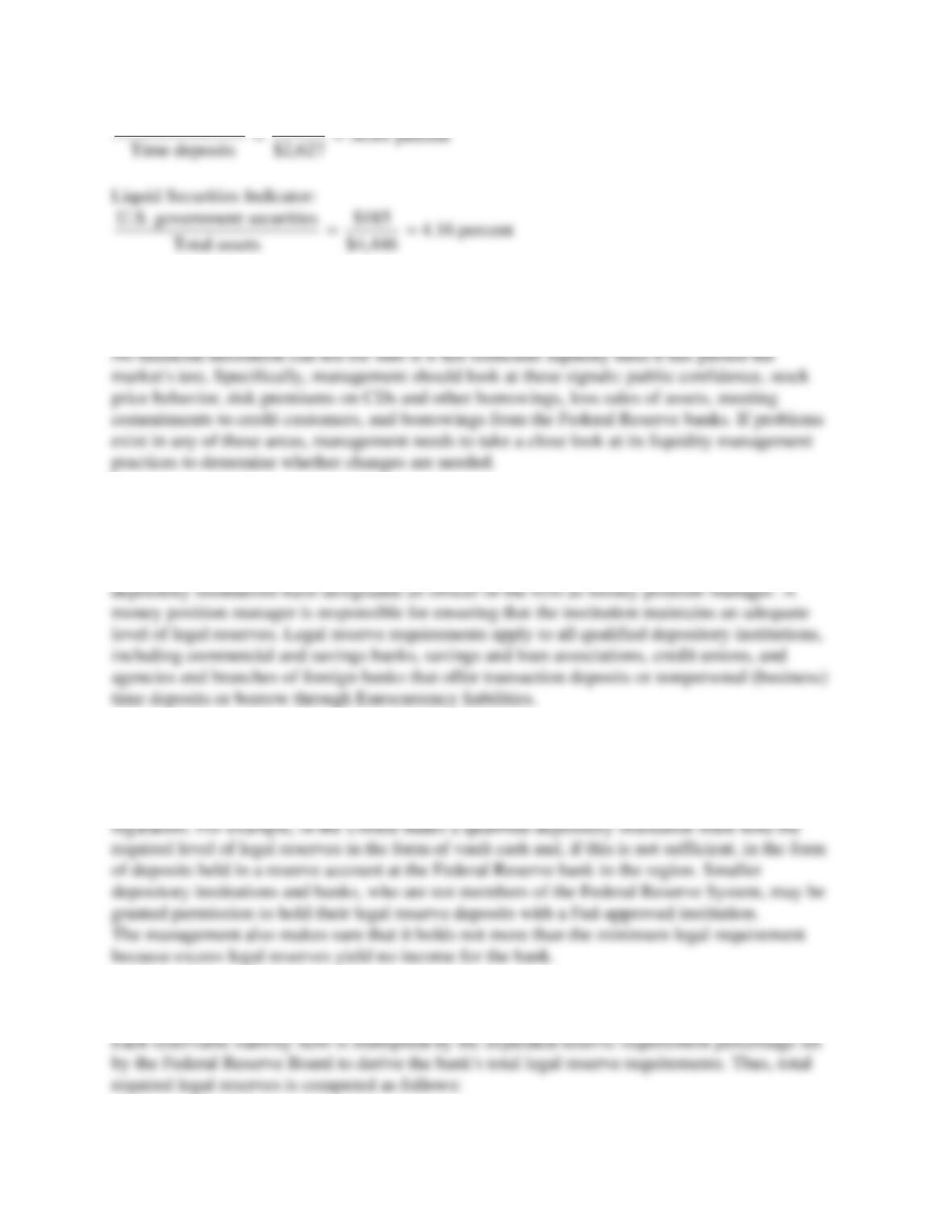
11-13. First National Bank posts the following balance sheet entries on today’s date: Net loans
and leases, $3,502 million; cash and deposits held at other banks, $633 million; Federal funds
sold, $48 million; U.S. government securities, $185 million; Federal funds purchased, $62
million; demand deposits, $988 million; time deposits, $2,627 million; and total assets, $4,446
Chapter 11 – Liquidity and Reserves Management: Strategies and Policies
11-8
Demand deposits $988
= = 36.61 percent
Time deposits $2,627
Liquid Securities Indicator:
U.S. government securities $185
= = 4.16 percent
Total assets $4,446
11-14. How can the discipline of the marketplace be used as a guide for making liquidity
management decisions?
11-15. What is money position management?
Money position management is the management of a financial institution’s liquidity position that
requires quick decisions which may have long-run consequences on profitability. Most large
11-16. What is the principal goal of money position management?
The money position management’s goal is to ensure that the bank has sufficient legal reserves to
meet its reserve requirements at a particular time, as imposed by the law and central bank
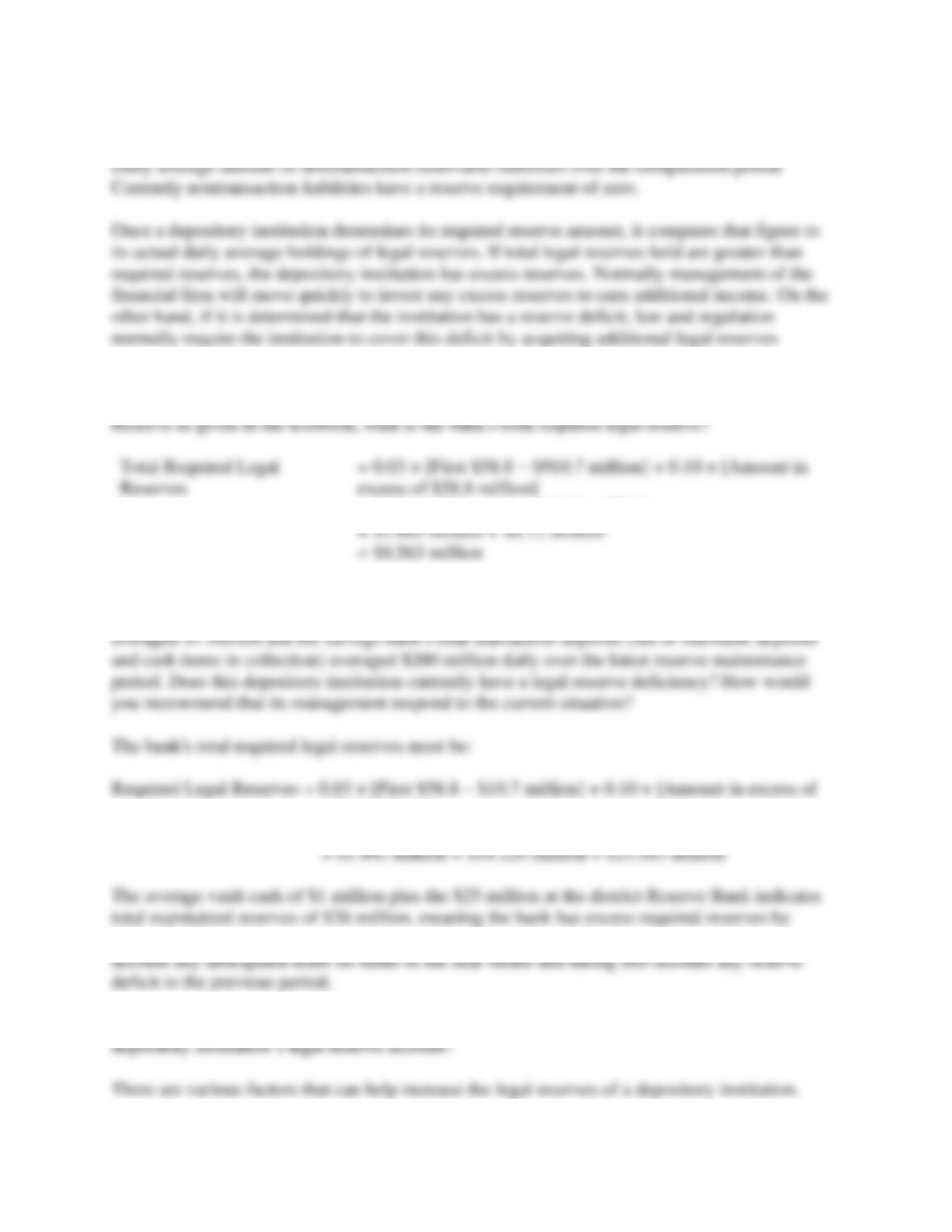
11-17. Exactly how is a depository institution’s legal reserve requirement determined?
Chapter 11 – Liquidity and Reserves Management: Strategies and Policies
Reserve requirement on transaction deposits × Daily average amount of net transaction deposits
over the computation period + Reserve requirement on nontransaction reservable liabilities ×
11-18. First National Bank finds that its net transaction deposits average $140 million over the
latest reserve computation period. Using the reserve requirement ratios imposed by the Federal

Chapter 11 – Liquidity and Reserves Management: Strategies and Policies
11–10
Some such factors are receiving more deposited checks in the institutions favor than checks
drawn against it, receiving deposits made by the U.S. Treasury into a tax and loan account held
11-21. What are clearing balances? Of what benefit can clearing balances be to a depository that
uses the Federal Reserve System’s check-clearing network?
Depository institutions, along with holding a legal reserve account, also hold a clearing balance
11-22. Suppose a bank maintains an average clearing balance of $5 million during a period in
which the Federal funds rate averages 6 percent. How much would this bank have available in
11-23. What are sweep accounts? Why have they led to a significant decline in the total legal
reserves held at the Federal Reserve banks by depository institutions operating in the United
States?
A sweeps account is a service provided by banks where they sweep money out of accounts that
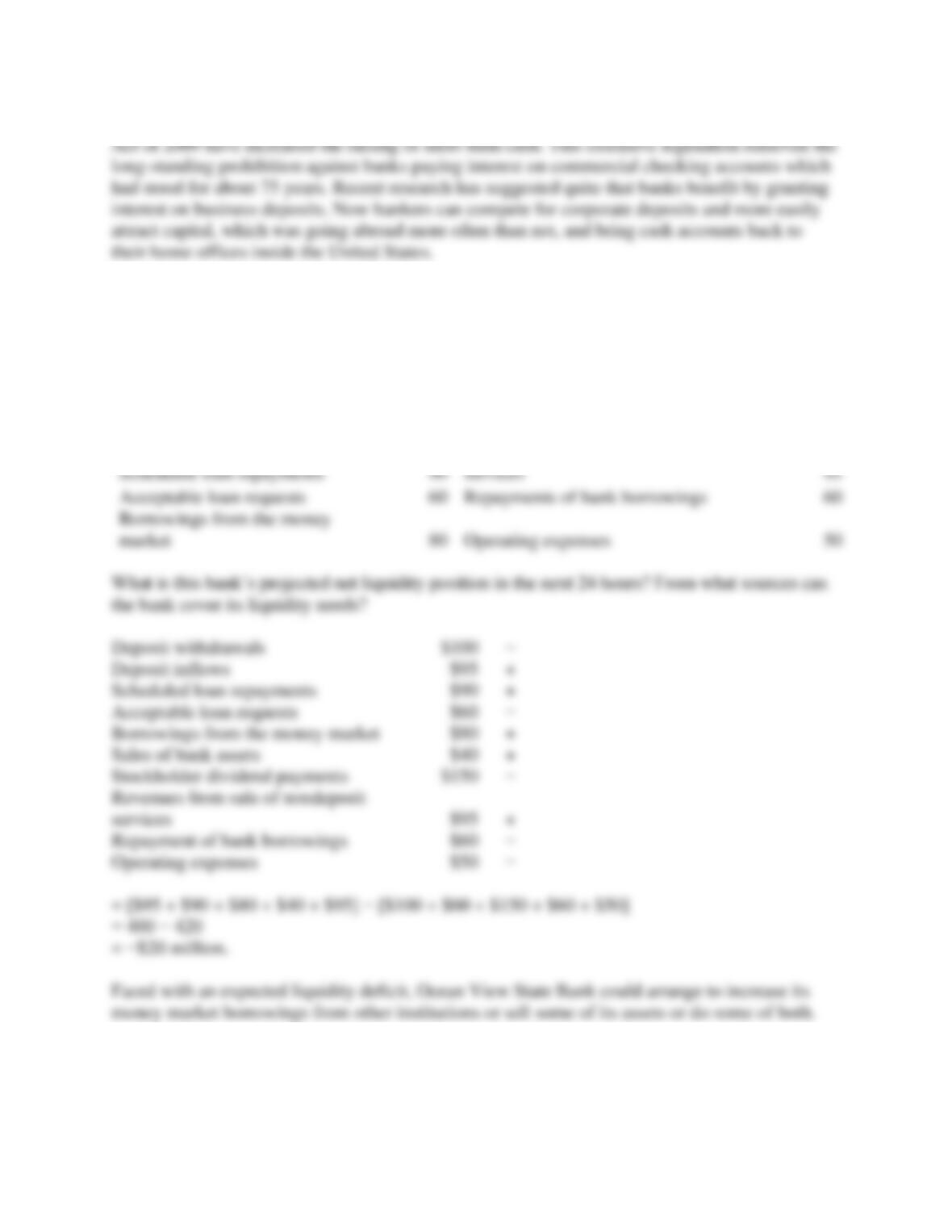
11-24. What impact has recent financial reform legislation had on raising short-term cash?
Chapter 11 – Liquidity and Reserves Management: Strategies and Policies
11–11
The recent passage of FINREG—the Dodd-Frank Wall Street Reform and Consumer Protection
Problems
11-1. Ocean View State Bank estimates that over the next 24 hours the following cash inflows
and outflows will occur (all figures in millions of dollars):
Deposit withdrawals
$100
Sales of bank assets
$ 40
Deposit inflows
95
Stockholder dividend payments
150
Scheduled loan repayments
90
Revenues from sale of nondeposit
services
95
Acceptable loan requests
60
Repayments of bank borrowings
60
Borrowings from the money
market
80
Operating expenses
50
Deposit withdrawals
$100
−
Deposit inflows
$95
+
Scheduled loan repayments
$90
+
Acceptable loan requests
$60
−
Borrowings from the money market
$80
+
Sales of bank assets
$40
+
Stockholder dividend payments
$150
−
Revenues from sale of nondeposit
services
$95
+
Repayment of bank borrowings
$60
−
Operating expenses
$50
−
= [$95 + $90 + $80 + $40 + $95] − [$100 + $60 + $150 + $60 + $50]
= 400 − 420
= −$20 million.
Faced with an expected liquidity deficit, Ocean View State Bank could arrange to increase its
money market borrowings from other institutions or sell some of its assets or do some of both.
11-2. Mountain Top Savings is projecting a net liquidity deficit of $10 million next week
partially as a result of expected quality loan demand of $32 million, necessary repayments of
previous borrowings of $15 million, planned stockholder dividend payments of $10 million,