
Chapter 10 – The Investment Function in Financial-Services Management
10-1
CHAPTER 10
THE INVESTMENT FUNCTION IN FINANCIAL-SERVICES MANAGEMENT
Goal of This Chapter: The purpose of this chapter is to discover the types of securities that
financial institutions acquire for their investment portfolio and to explore the factors that a
manager should consider in determining what securities a financial institution should buy or sell.
Key Topics in This Chapter
• Nature and Functions of Investments
• Investment Securities Available: Advantages and Disadvantages
• Measuring Expected Returns
• Taxes, Credit, and Interest-Rate Risks
• Liquidity, Prepayment, and Other Risks
• Investment Maturity Strategies
• Maturity Management Tools
Chapter Outline
I. Introduction
II. Investment Instruments Available to Financial Firms
III. Popular Money Market Investment Instruments
A. Treasury Bills
B. Short-Term Treasury Notes and Bonds
C. Federal Agency Securities
D. Certificates of Deposit
E. International Eurocurrency Deposits
F. Bankers’ Acceptances
G. Commercial Paper
H. Short-Term Municipal Obligations
IV. Popular Capital Market Investment Instruments
A. Treasury Notes and Bonds
B. Municipal Notes and Bonds
C. Corporate Notes and Bonds
V. Investment Instruments Developed More Recently
A. Structured Notes
B. Securitized Assets
C. Stripped Securities
VI. Investment Securities Held by Banks
VII. Factors Affecting Choice of Investment Securities
A. Expected Rate of Return
B. Tax Exposure
1. The Tax Status of State and Local Government Bonds
2. The Impact of Changes in Tax Laws

Chapter 10 – The Investment Function in Financial-Services Management
10-2
3. Bank Qualified Bonds
4. The Tax Swapping Tool
5. The Portfolio Shifting Tool
C. Interest Rate Risk
D. Credit or Default Risk
E. Business Risk
F. Liquidity Risk
G. Call Risk
H. Prepayment Risk
I. Inflation Risk
J. Pledging Requirements
VIII. Investment Maturity Strategies
A. The Ladder, or Spaced-Maturity, Policy
B. The Front-End Load Maturity Policy
C. The Back-End Load Maturity Policy
D. The Barbell Strategy
E. The Rate Expectations Approach
IX. Maturity Management Tools
A. The Yield Curve
1. Forecasting Interest Rates and the Economy
2. Risk-Return Trade-Offs
3. Pursuing the Carry Trade
4. Riding the Yield Curve
B. Duration
1. Immunization
X. Summary of the Chapter
Concept Checks
10-1. Why do banks and other institutions choose to devote a significant portion of their assets
to investment securities?
The primary function of most banks and other depository institutions is not to buy and sell
bonds, but rather to make loans to businesses and individuals. After all, loans support business

Chapter 10 – The Investment Function in Financial-Services Management
10-3
10-2. What key roles do investments play in the management of a depository institution?
Investment security portfolios perform many different roles that act as a necessary complement
to the advantages loans provide. They help stabilize income when loan revenues fall. Investment
10-3. What are the principal money market and capital market instruments available to
institutions today? What are their most important characteristics?
Banks purchase a wide range of investment securities. The principal money market instruments
10-4. What types of investment securities do banks seem to prefer the most? Can you explain
why?
Commercial banks clearly prefer these major types of investment securities: U. S government
10-5. What are securitized assets? Why have they grown so rapidly in recent years?

Chapter 10 – The Investment Function in Financial-Services Management
10-4
yields. Also, guarantees are received from government agencies (in the case of most home-
10-6. What special risks do securitized assets present to institutions investing in them?
Securitized assets often carry substantial prepayment risk, which arises when certain loans in the
securitized-asset pool are paid off early by the borrowers (usually because interest rates have
10-7. What are structured notes and stripped securities? What unusual features do they contain?
Structured notes usually are packaged investments, such as pools of federal agency securities,
assembled by security dealers that offer customers flexible yields in order to protect their
10-8. How is the expected yield on most bonds determined?
For most bonds, determining the expected yield requires the calculation of the yield to maturity
(YTM), if the bond is to be held to maturity or the planned holding period yield (HPY) between

Chapter 10 – The Investment Function in Financial-Services Management
10-5
10-9. If a government bond is expected to mature in two years and has a current price of $950,
what is the bond’s YTM if it has a par value of $1,000 and a promised coupon rate of 10 percent?
Suppose this bond is sold one year after purchase for a price of $970. What would this investor’s
holding period yield be?
10-10. What forms of risk affect investments?
The following forms of risk affect investments:
a. interest rate risk,
b. credit or default risk,
10-11. How has the tax exposure of various U.S. bank security investments changed in recent
years?
In recent years, the government has treated interest income and capital gains from most bank

10-6
10-12. Suppose a corporate bond an investments officer would like to purchase for her bank
has a before-tax yield of 8.98 percent and the bank is in the 35 percent federal income tax
bracket. What is the bond’s after-tax gross yield? What after-tax rate of return must a prospective
loan generate to be competitive with the corporate bond? Does a loan have some advantages for
10-13. What is the net after-tax return on a qualified municipal security whose nominal gross
return is 6 percent, the cost of borrowed funds is 5 percent, and the financial firm holding the
bond is in the 35 percent tax bracket? What is the tax-equivalent yield (TEY) on this tax-exempt
security?
Netafter-taxreturnon municipals (in percent) =
Nominal return on municipals after taxes (in percent) –
Interest expense incurred in acquiring themunicipals (in percent)
+ Tax advantageof a qualified bo
nd
Taxadvantageof qualifiedbond =
Thebank’smarginalincometax rate (in percent) ×
Percentageof interestexpensethatisstilltaxdeductible ×
Interestexpenseof acquiringthemunicipals (in percent)
Net after-tax return = (0.06 − 0.05) + (0.35 × 0.80 × 0.05) = 0.024 or 2.4 percent
( )
After–tax return on a tax–exempt investment
Tax–equivalent yield = 1 – Investingfirm‘s marginal tax rate
The security’s tax-equivalent yield in gross terms:
( )
6 percent
= = 0.0923 or 9.23 percent.
1 – 0.35
10-14. Spiro Savings Bank currently holds a government bond valued on the day of its
purchase at $5 million, with a promised interest yield of 6 percent, whose current market value is

10-7
$3.9 million. Comparable quality bonds are available today for a promised yield of 8 percent.
What are the advantages to Spiro Savings from selling the government bond bearing a 6 percent
10-15. What is tax swapping? What is portfolio shifting? Give an example of each.
A tax swap involves exchanging one type of investment security for another when it is
advantageous to do so in reducing the bank’s current or future tax exposure. For example, the
10-16. Why do depository institutions face pledging requirements when they accept
government deposits?
10-17. What types of securities are used to meet collateralization requirements?
When a bank borrows from the discount window of its district Federal Reserve Bank, it must
pledge either federal government securities or other collateral acceptable to the Fed. Typically,
10-18. What factors affect a financial-service institution’s decision regarding the different
maturities of securities it should hold?

Chapter 10 – The Investment Function in Financial-Services Management
10-8
In choosing among various maturities of short-term and long-term securities to hold, the
10-19. What maturity strategies do financial firms employ in managing their portfolios?
In choosing the maturity distribution of securities to be held in the financial firm’s investment
portfolio one of the following strategies typically is chosen by most institutions:
a. The Ladder, or Spaced-Maturity, Policy
10-20. Bacone National Bank has structured its investment portfolio, which extends out to
four-year maturities, so that it holds about $11 million each in one-year, two-year, three-year,
and four-year securities. In contrast, Dunham National Bank and Trust holds $36 million in one-
and two-year securities and about $30 million in 8- to 10-year maturities. What maturity strategy

10-9
10-21. How can the yield curve and duration help an investments officer choose which
securities to acquire or sell?
Yield curves possibly provide a forecast of the future course of short-term rates, telling us what
the current average expectation is in the market. The yield curve also provides an indication of
10-22. A bond currently sells for $950 based on a par value of $1,000 and promises $100 in
interest for three years before being retired. Yields to maturity on comparable-quality securities
are currently at 12 percent. What is the bond’s duration? Suppose interest rates in the market fall
to 10 percent. What will be the approximate percent change in the bond’s price?
Period of
Expected
Cash
Flow
Expected
Cash Flow
from loan
Present Value of
Annual Interest (at
12 percent YTM in
this case)
Time Period
Cash Is to
Be
Received (t)
Present Value of
Expected Cash
Flows × t
1
$ 100
$ 89.29
1
$ 89.29
2
100
79.72
2
159.44
3
1,100
782.96
3
2,348.87
PV of Cash Flows × t = $2,597.60
Hence, duration of the bond = $2,597.60 ÷ $950= 2.73 years
If interest in the market fall to 10 percent, the approximate percentage change in the bond‘s price
will be:
Δi
Percentagechangeinprice –D ×
(1 + i)
–0.02
= –2.73 × = –0.0488 or –4.88 percent
(1 + 0.12)
Chapter 10 – The Investment Function in Financial-Services Management
10–10
Problems and Projects
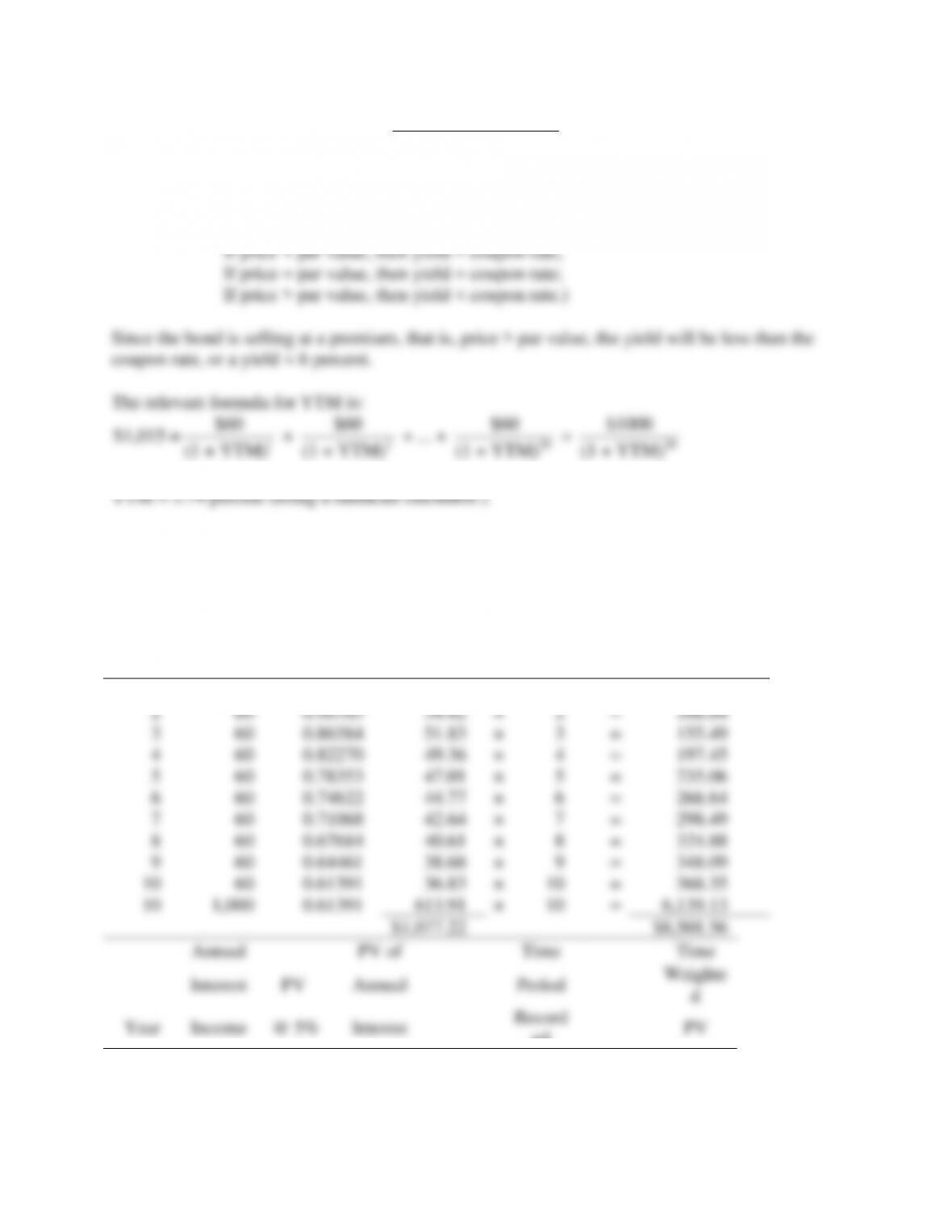
10-1. A 20-year U.S. Treasury bond with a par value of $1,000 is currently selling for $1,025
from various securities dealers. The bond carries a 6 percent coupon rate with payments made
annually. If purchased today and held to maturity, what is its expected yield to maturity?
(Hint – the following relationships can help in solving for the yield:
1 2 20 20
(1 + YTM) (1 + YTM) (1 + YTM) (1 + YTM)
10-2. A municipal bond has a $1,000 face (par) value. Its yield to maturity is 5 percent, and the
bond promises its holders $60 per year in interest (paid annually) for the next 10 years before it
matures. What is the bond’s duration?
Annual
PV of
Time
Time
Interest
PV
Annual
Period
Weighted
Year
Income
At 5%
Interest
Recorded
PV
1
$ 60
0.95238
$ 57.14
×
1
=
$ 57.14
2
60
0.90703
54.42
×
2
=
108.84
3
60
0.86384
51.83
×
3
=
155.49
4
60
0.82270
49.36
×
4
=
197.45
5
60
0.78353
47.01
×
5
=
235.06
6
60
0.74622
44.77
×
6
=
268.64
7
60
0.71068
42.64
×
7
=
298.49
8
60
0.67684
40.61
×
8
=
324.88
9
60
0.64461
38.68
×
9
=
348.09
10
60
0.61391
36.83
×
10
=
368.35
10
1,000
0.61391
613.91
×
10
=
6,139.13
$1,077.22
$8,501.56
Annual
PV of
Time
Time
Interest
PV
Annual
Period
Weighte
d
Year
Income
@ 5%
Interest
Record
ed
PV
1
60
0.9523
8
57.14
x
1
=
57.14
2
60
0.9070
54.42
x
2
=
108.84

3
3
60
0.8638
4
51.83
x
3
=
155.49
4
60
0.8227
49.36
x
4
=
197.45
5
60
0.7835
3
47.01
x
5
=
235.06
6
60
0.7462
2
44.77
x
6
=
268.64
7
60
0.7106
8
42.64
x
7
=
298.49
8
60
0.6768
4
40.61
x
8
=
324.88
9
60
0.6446
1
38.68
x
9
=
348.09
10
60
0.6139
1
36.83
x
10
=
368.35
10
1,000
0.6139
1
613.91
x
10
=
6139.13
1077.22
8501.56
Then, duration of the bond = $ 8,501.56 ÷ $1,077.22 = 7.89 years
10-3. Calculate the yield to maturity of a 20-year U.S. government bond that is selling for $975
in today’s market and carries a 5 percent coupon rate with interest paid semiannually.
10-4. A corporate bond being seriously considered for purchase by Old Dominion Financial
will mature 20 years from today and promises a 7 percent interest payment once a year. Recent
inflation in the economy has driven the yield to maturity on this bond to 10 percent, and it carries

Chapter 10 – The Investment Function in Financial-Services Management
6
70
0.564
39.51
×
6
=
237.08
7
70
0.513
35.92
×
7
=
251.45
8
70
0.467
32.66
×
8
=
261.24
9
70
0.424
29.69
×
9
=
267.18
10
70
0.386
26.99
×
10
=
269.88
11
70
0.350
24.53
×
11
=
269.88
12
70
0.319
22.30
×
12
=
267.65
13
70
0.290
20.28
×
13
=
263.59
14
70
0.263
18.43
×
14
=
258.06
15
70
0.239
16.76
×
15
=
251.36
16
70
0.218
15.23
×
16
=
243.74
17
70
0.198
13.85
×
17
=
235.44
18
70
0.180
12.59
×
18
=
226.62
19
70
0.164
11.45
×
19
=
217.47
20
70
0.149
10.41
×
20
=
208.10
20
1000
0.149
148.64
×
20
=
2972.87
$744.59
$7,447.31
10-5. Forever Savings Bank regularly purchases municipal bonds issued by small rural school
6.75 percent. Forever Savings, which is in the top corporate tax bracket of 35 percent, must pay
an average interest rate of 4.25 percent to borrow the funds needed to purchase the municipals.
Would you recommend purchasing these bonds?
Calculate the net after-tax return on this bank-qualified municipal security. What is the tax

Chapter 10 – The Investment Function in Financial-Services Management
10–13
Net after-tax retrun = (0.0675 – 0.0425 ) + (0.35 × 0.80 × 0.0425)
= 0.025 + 0.0119
10-6. Forever Savings Bank also purchases municipal bonds issued by the city of Richmond.
Currently the bank is considering a nonqualified general obligation municipal issue. The bonds,
which mature in 15 years, provide a nominal annual rate of return of 9.75 percent. Forever
= 3.69 percent – 5.50 percent = 1.81 percent
Therefore, the net after-tax return from the qualified security is 1.81 percent less than the
bond.
10-7. Lakeway Thrift Savings and Trust is interested in doing some investment portfolio
shifting. This institution has had a good year thus far, with strong loan demand; its loan revenue

Chapter 10 – The Investment Function in Financial-Services Management
10–14
of 8 percent and issued at par. The Dallas bonds have a current market value of $3,750,000 but
are listed at par on the institution’s books.
b. Selling $4 million in 12-year U.S. Treasury bonds that carry a coupon rate of 12 percent
and are recorded at par, which was the price when the institution purchased them. The market
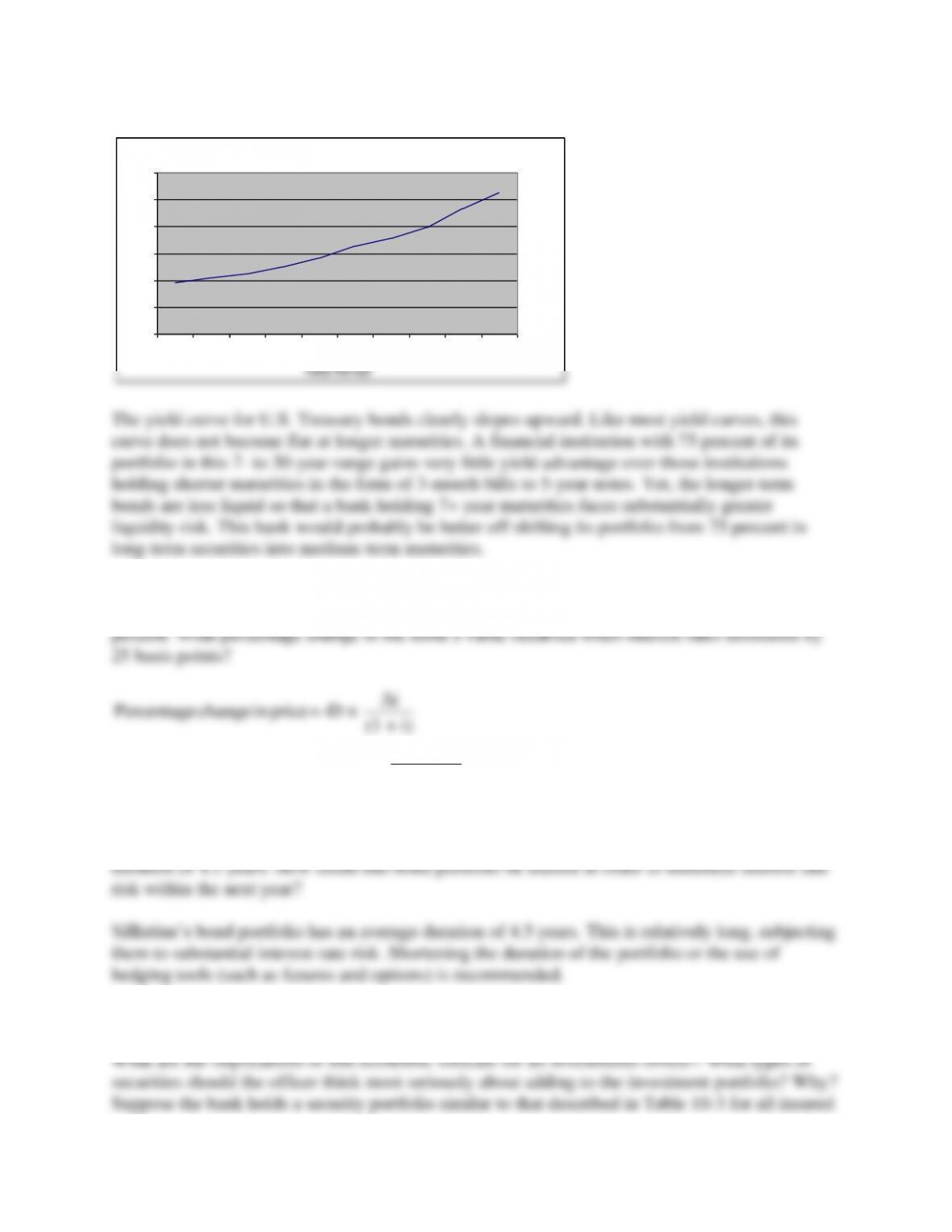
10-8. Current market yields on U.S. government securities are distributed by maturity as
follows:
3-month Treasury bills
=
1.90 percent
6-month Treasury bills
=
2.10 percent
1-year Treasury notes
=
2.25 percent
2-year Treasury notes
=
2.51 percent
3-year Treasury notes
=
2.82 percent
5-year Treasury notes
=
3.28 percent
7-year Treasury notes
=
3.56 percent
10-year Treasury bonds
=
3.98 percent
20-year Treasury bonds
=
4.69 percent
30-year Treasury bonds
=
5.25 percent
Chapter 10 – The Investment Function in Financial-Services Management
10–15
Yield Curve
0
1
2
3
4
5
6
3M 6M 1Y 2Y 3Y 5Y 7Y 10Y 20Y 30Y
Time Period
Percentage
10-9. A bond possesses a duration of 8.89 years. Suppose that market interest rates on
comparable bonds were 7.5 percent this morning, but have now shifted downward to 7.25
(1 + i)
Percent Change in Value =
–0.0025
–8.89 × = 0.02067 or 2.067 percent
1 + 0.075
10-10. The investments officer for Sillistine Savings is concerned about interest rate risk
lowering the value of the institution’s bonds. A check of the bond portfolio reveals an average
10-11. A bank’s economics department has just forecast accelerated growth in the economy,
with GDP expected to grow at a 4.5 percent annual growth rate for at least the next two years.

Chapter 10 – The Investment Function in Financial-Services Management
U.S. banks. Which types of securities might the investments officer want to think seriously about
selling if the projected economic expansion takes place? What losses might occur and how could
these losses be minimized?
10-12. Contrary to the exuberant economic forecast described in problem 11, suppose a bank’s
economics department is forecasting a significant recession in economic activity. Output and
employment are projected to decline significantly over the next 18 months. What are the
implications of this forecast for an investment portfolio manager? What is the outlook for interest
10-13. Arrington Hills Savings Bank, a $3.5 billion asset institution, holds the investment
portfolio outlined in the following table. This savings bank serves a rapidly growing money
center into which substantial numbers of businesses are relocating their corporate headquarters.

Chapter 10 – The Investment Function in Financial-Services Management
10–17
Under one year
State and local
government obligations
15.5
One to five years
37.9
Domestic debt
securities
5.1
Over five years
50.8
Foreign debt securities
4.9
Equities
0.6
This bank is going to experience increasing loan demand in the future. This may mean increased
taxes in the future, increased liquidity risk and increased credit risk from its loan portfolio. To
help with the liquidity risk, the bank may want to consider shifting some of its portfolio from