
Chapter 03 – Needs Assessment
© 2013 by McGraw-Hill Education. This is proprietary material solely for authorized instructor use. Not authorized for sale or distribution in
any manner. This document may not be copied, scanned, duplicated, forwarded, distributed, or posted on a website, in whole or part.
3-1
Discussion Questions
1. Which of the factors that influence performance and learning do you think is most important?
Which is least important?
Answer: Student answers would vary. Person characteristics, input, output, consequences,
and feedback are the factors which influence performance and learning. These factors also
2. If you had to conduct a needs assessment for a new job at a new plant, describe the method
you would use.
Answer: To conduct a needs assessment for a new job at a new plant, the method would be:
Conducting an organization analysis, which would identify whether the new job supports
Conducting a personal analysis, which would help to identify whether an existing
Whether time and money are devoted to the new job opening would be contingent on the
results of organizational, person, and task analyses. Various techniques are available for
3. If you were going to use online technology to identify training needs for customer service
representatives for a web-based clothing company. What steps would you take to ensure that
the technology was not threatening to employees?
Answer: Online technology is available to monitor and track employee performance. This
information is useful for identifying training needs and providing employees with feedback

Chapter 03 – Needs Assessment
© 2013 by McGraw-Hill Education. This is proprietary material solely for authorized instructor use. Not authorized for sale or distribution in
any manner. This document may not be copied, scanned, duplicated, forwarded, distributed, or posted on a website, in whole or part.
3-2
4. Needs assessment involves organization, person, and task analysis. Which one of these
analyses do you believe is most important? Which is least important? Why?
Answer: Student answers would vary. Organizational analysis involves identifying whether
training supports the company’s strategic direction; whether managers, peers, and employees
support training activity; and what training resources are available. Person analysis helps to
identify employees who need training, that is, whether employees’ current performance or
5. Why should upper level managers be included in the needs assessment process?
Answer: Upper level managers are involved in the needs assessment process to identify the
role of training in relation to other human resource practices in the company (e.g. selection,
6. Explain how you would determine if employees had the reading level necessary to succeed in
a training program. How would you determine if employees had the necessary computer
skills needed to use a Web-based training program?
Answer: A literacy audit can be used to determine employees’ basic skill levels. Employees
without the necessary reading level could be identified through reading tests and reassigned
To determine if employees have the necessary computer skills needed to use a Web-based
training program the company can use tests and work samples. Surveys can be conducted,

Chapter 03 – Needs Assessment
© 2013 by McGraw-Hill Education. This is proprietary material solely for authorized instructor use. Not authorized for sale or distribution in
any manner. This document may not be copied, scanned, duplicated, forwarded, distributed, or posted on a website, in whole or part.
3-3
7. What conditions would suggest that a company should buy a training program from an
outside vendor? Which would suggest that the firm should develop the program itself?
Answer: It is necessary to identify whether the company has the budget, time, and expertise
for training. One of the questions that the company must answer is whether it has the
8. Assume you have to prepare older employees with little computer experience to attend a
training course on how to use the World Wide Web. How will you ensure that they have high
levels of readiness for training? How will you determine their readiness for training?
Answer: To ensure that the employees have high levels of readiness for training, their
motivation level and willingness to learn should be increased. Special care should be taken to
9. Review the accompanying sample tasks and task ratings for the electronic technician’s job.
What tasks do you believe should be emphasized in the training program? Why?
Task
Importance
Frequency
Learning Difficulty
1. Replaces
components
1
2
1
2. Repairs equipment
2
5
5
3. Interprets
instrument readings
1
4
5
4. Uses small tools
2
5
1
Answer: Repairs equipment should be emphasized in the training program followed by uses
small tools, as amongst the tasks given these two tasks have greater importance and are
Chapter 03 – Needs Assessment
© 2013 by McGraw-Hill Education. This is proprietary material solely for authorized instructor use. Not authorized for sale or distribution in
any manner. This document may not be copied, scanned, duplicated, forwarded, distributed, or posted on a website, in whole or part.
3-4
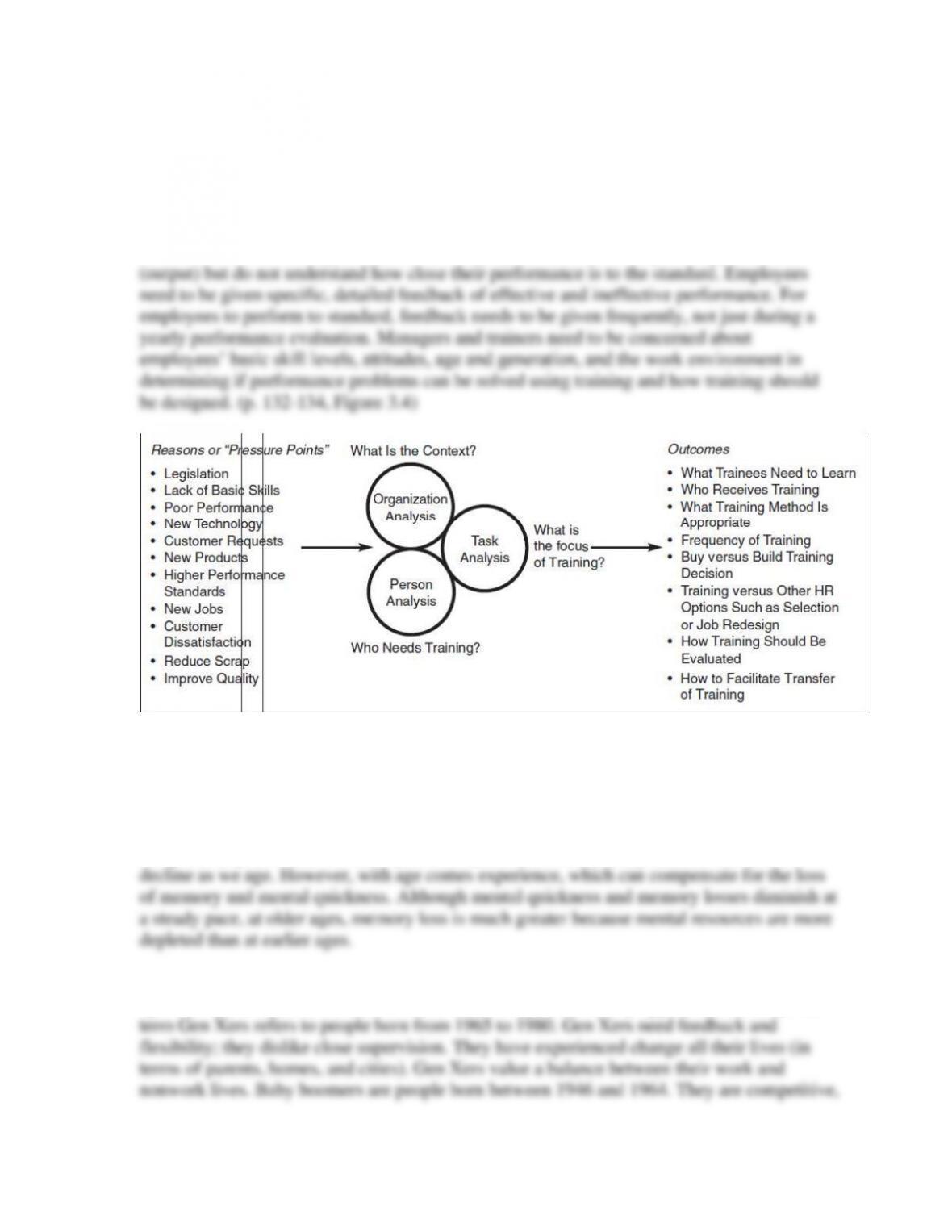
10. Explain the process you would use to determine the cause of a performance problem. Draw a
picture showing the process.
Answer: Performance problems can result when employees do not receive feedback
regarding the extent to which they are meeting performance standards. Training may not be
the best solution to this type of problem if employees know what they are supposed to do
11. Why would we consider age and generational differences as part of needs assessment? Is this
important? Explain. Discuss the types of evidence that you would look for to determine
whether a needs analysis has been conducted improperly.
Answer: There is biological evidence that certain mental capacities decrease from age twenty
to age seventy. Short-term memory and the speed at which people process information
The terms millenniums and Generation Y refer to people born after 1980. They are
optimistic, willing to work and learn, and technology-literate; they appreciate diversity. The
Chapter 03 – Needs Assessment
© 2013 by McGraw-Hill Education. This is proprietary material solely for authorized instructor use. Not authorized for sale or distribution in
any manner. This document may not be copied, scanned, duplicated, forwarded, distributed, or posted on a website, in whole or part.
3-5
If needs assessment is not properly conducted, any one or more of the following situations
could occur:
Training may be incorrectly used as a solution to a performance problem (when the
solution should deal with employee motivation, job design, or a better communication of
performance expectations).
12. How is competency modeling similar to traditional needs assessment? How does it differ?
Answer: Both, competency modeling and traditional needs assessment play a vital role in
training and development. However, in a traditional needs assessment, three different types
of analyses are involved. They are organizational, person and task analysis. A competency
model identifies the competencies necessary for each job as well as the knowledge, skills,
13. What is a rapid needs assessment? How would you conduct a rapid needs assessment so that
it is valuable and accurately identifies training needs?
Answer: A rapid needs assessment refers to a needs assessment that is done quickly and
First, the scope of needs assessment depends on the size of the potential pressure point. If
the pressure point seems to be local and has a potentially small impact on the business,

Chapter 03 – Needs Assessment
© 2013 by McGraw-Hill Education. This is proprietary material solely for authorized instructor use. Not authorized for sale or distribution in
any manner. This document may not be copied, scanned, duplicated, forwarded, distributed, or posted on a website, in whole or part.
3-6
Consider using already available data collected for other purposes. For example, error
If a person is attuned to the business problems, technological developments, and other
issues facing the organization, he or she will be able to anticipate training needs. For