1 Chapter 05
2 Understand Business to Business Markets
1.1 ETHICAL DIMENSION 5
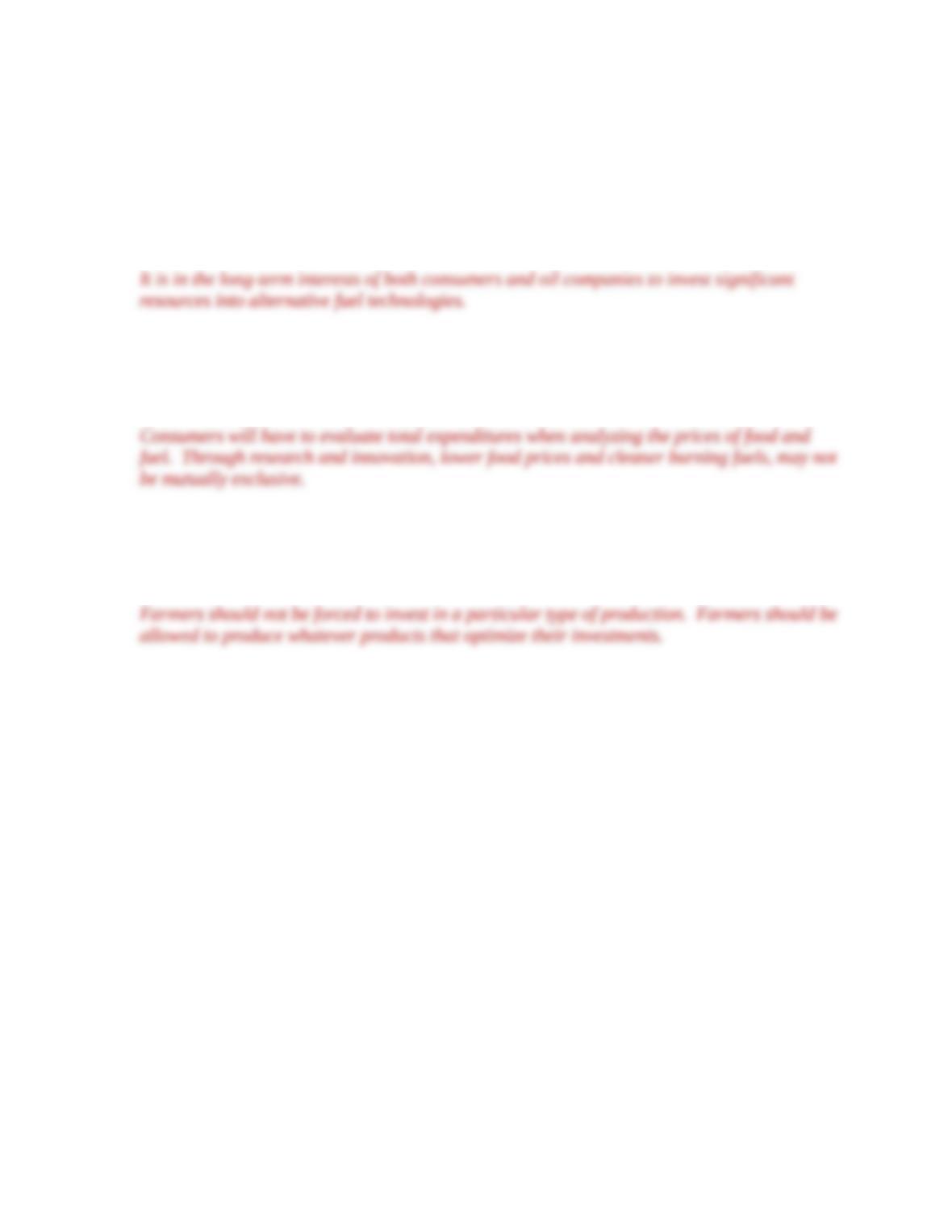
Ethical Perspective
1. Oil companies: Should they invest in alternative fuel technologies such as ethanol to reduce
fossil fuel consumption?
2. Consumers: Should they be willing to pay higher food prices to achieve greater energy
independence and cleaner burning fuel?
3. Farmers: Should they be required to invest in greater production of critical biofuel plants
such as corn?
KEY TERMS
B2B (business-to-business) markets Markets in which a firm’s customers are other firms,
characterized by few but large customers, personal relationships, complex buying processes, less
price sensitive demand.
supply chain A complex logistics network characterized by high levels of coordination and
integration among its members.
product demand Demand within business markets affected by three critical dimensions: derived
demand, fluctuating demand, and inelastic demand
derived demand Demand that originates from the demand for consumer products in business-to-
acceleration effect When small changes in consumer demand lead to considerable shifts in
business product demand.
inelastic demand When changes in demand are not significantly affected by changes in price.
Marketing Management 2nd Edition 5-1
1 Chapter 05
2 Understand Business to Business Markets
buying decision Decisions made throughout the purchase decision process that vary widely and
are based on factors such as: nature of the purchase, number of people involved in the decision,
understanding of the product being purchased, and time frame for the decision.
straight rebuy A buying decision that requires little evaluation because the products are
purchased on a consistent, regular basis.
out supplier A company that is not on a firm’s list of approved suppliers.
modified rebuy A buying decision in which a customer is familiar with the product and supplier
in a purchase decision, but is looking for additional information because of one or more of three
circumstances: the supplier has performed poorly, new products have come into the market, or
new purchase A buying decision in which the purchase of a product or service by a customer is
for the first time.
buying center A number of individuals with a stake in a purchase decision who manage the
purchase decision process and ultimately make the decision.
user Actual customers of a product or service who have a great deal of input at various stages of
the buying decision process, but are typically not decision makers.
initiator The individual who starts the buying decision process.
influencer An individual, either inside or outside the organization, with relevant expertise in a
particular area who provides information used by the buying center in making a final buying
decision.
gatekeeper An individual who controls access to information and relevant individuals in the
buying center.
decider An individual within the buying center who ultimately makes the purchase decision.
North American Industrial Classification System (NAICS) A system developed by the United
States, Canada, and Mexico that classifies companies on the basis of their primary output to
define and segment business markets.
original equipment manufacturer (OEM) Manufacturing firms that sell products that are used
as integral manufacturing components by their customer companies.
end-user purchase A category of products purchased by manufacturers that represents the
equipment, supplies, and services needed to keep their business operational.
capital equipment A firm’s significant, long-term investments in critical equipment or
technology necessary for its manufacturing and production activities.
materials, repairs, operational (MRO) Products used in everyday business operations that are
not typically considered to be a significant expense for the firm.
Marketing Management 2nd Edition 5-2
1 Chapter 05
2 Understand Business to Business Markets
resellers Companies that buy products and then resell them to other businesses or consumers for
a profit.
government Local, state, and federal entities that have unique and frequently challenging
purchasing practices for manufacturing firms.
institutions Nongovernmental organizations driven by the delivery of service to the target
constituency, rather than by profits.
request for proposal (RFP) The document distributed to potential vendors that outlines an
organization’s product or service needs. It serves as a starting point from which vendors put
together their product solution.
product choice The first decision made in the purchase decision process that is usually based on
a single criterion
supplier choice Selecting between multiple suppliers offering similar product configurations by
examining their qualifications.
reliability The percentage of time a product works without failure or stoppage.
personal factors The needs, desires, and objectives of those involved in a purchase decision.
organizational factors Organization-wide beliefs and attitudes that factor into a purchase
decision.
electronic data interchange (EDI) Sophisticated programs that link a customer with its
suppliers to manage inventories and automatically replenish supplies.
e-procurement The process of online business purchasing.
Marketing Management 2nd Edition 5-3
1 Chapter 05
2 Understand Business to Business Markets
1.2 APPLICATION QUESTIONS
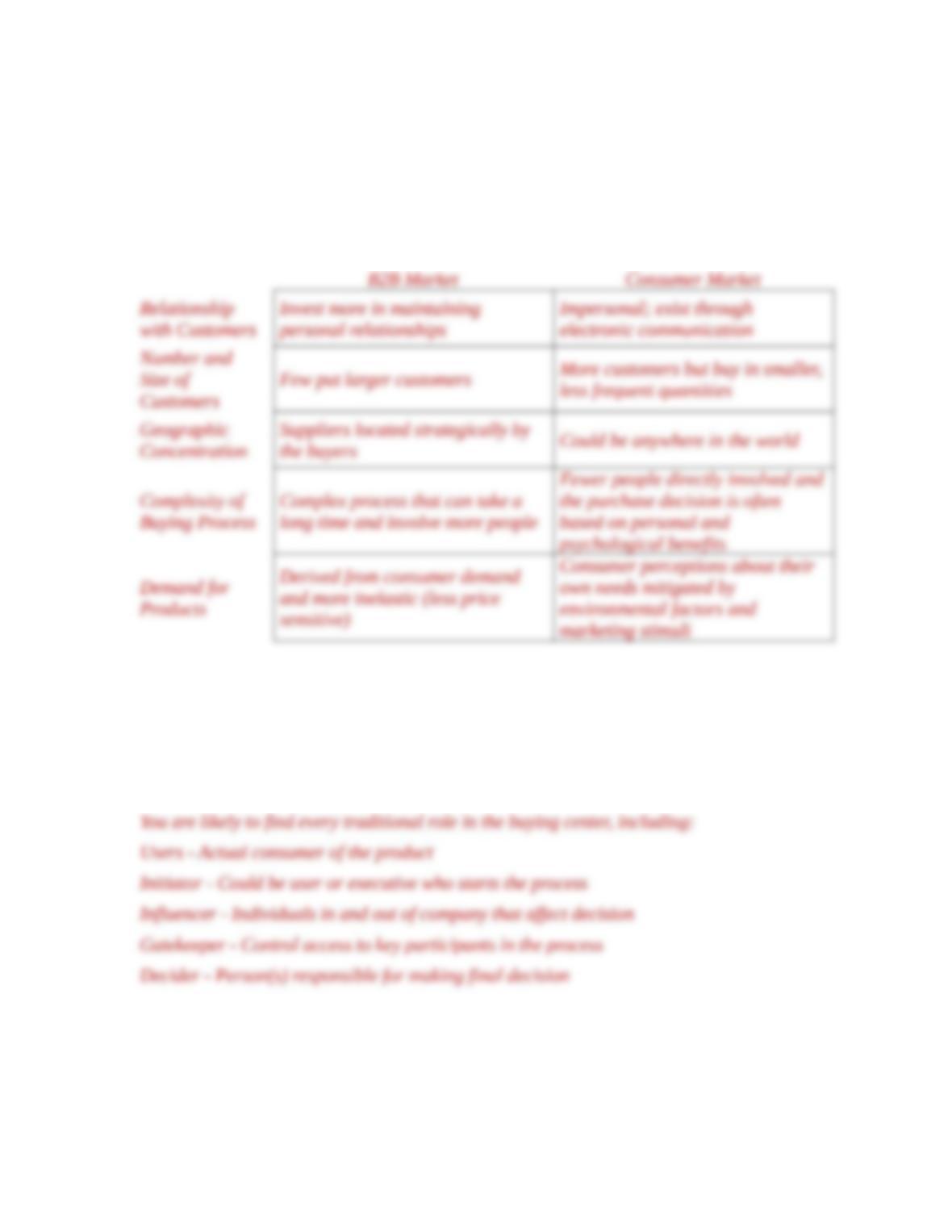
1 You are the marketing manager for HP Laptop computers. Identify and briefly discuss the
differences between the consumer market for laptops and the business market. Then give an
example of each difference using college students as the consumer market and defense
related companies as the business market.
4. You work for Siemens Power Generations systems and are responsible for the sale of large,
expensive ($2-5 million) turbine generators to Power Utility companies. You have been
contacted by the Ever-sure Utility Corporation in Anytown, USA. Identify the buying center
you are likely to find inside the company and how you would market the generators to the
buying center group.
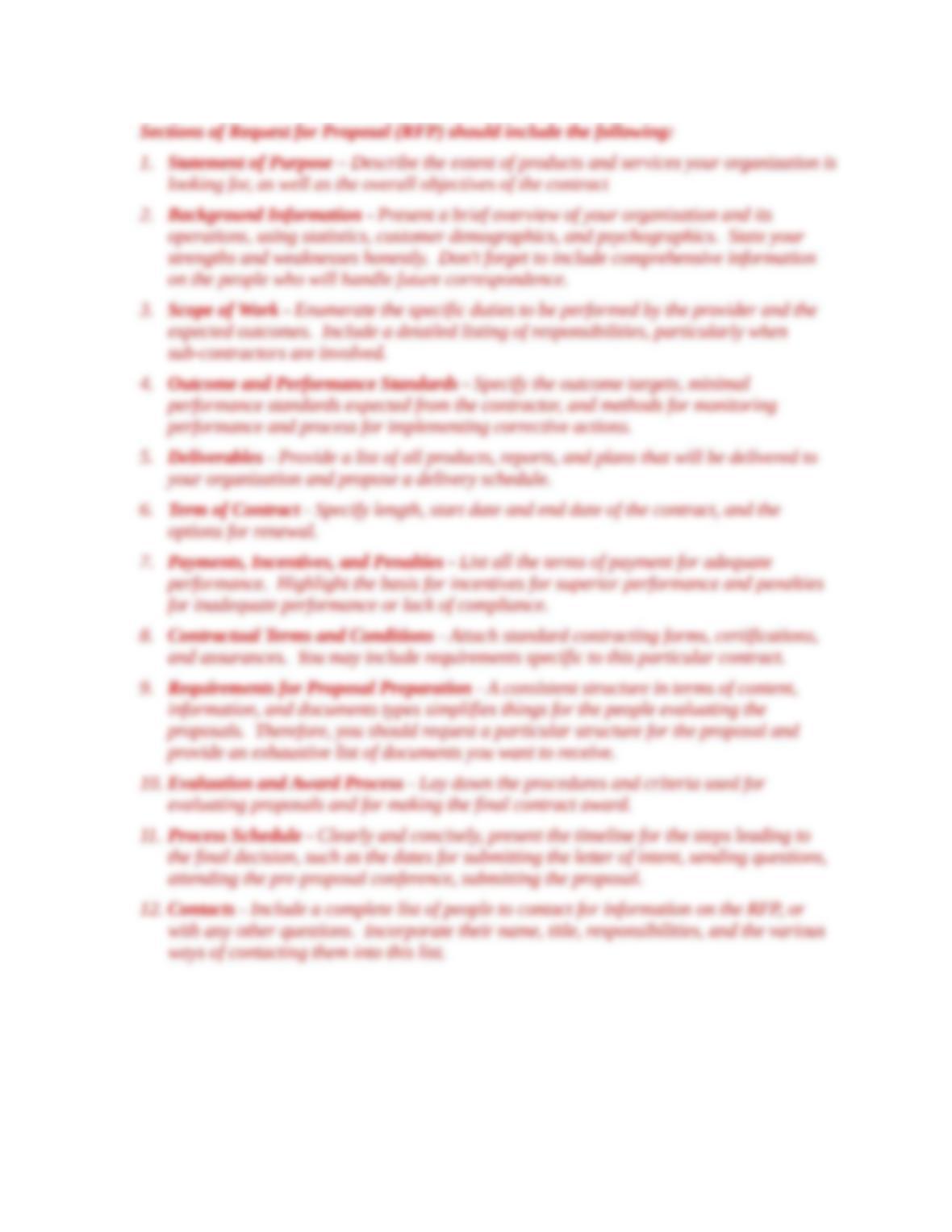
5. You are Vice President for Information Technology at your University. Recently you have
been authorized to upgrade the network servers on campus. Draft an RFP that will be given
to prospective vendors to help guide them in their sales process.
Marketing Management 2nd Edition 5-4
1 Chapter 05
2 Understand Business to Business Markets
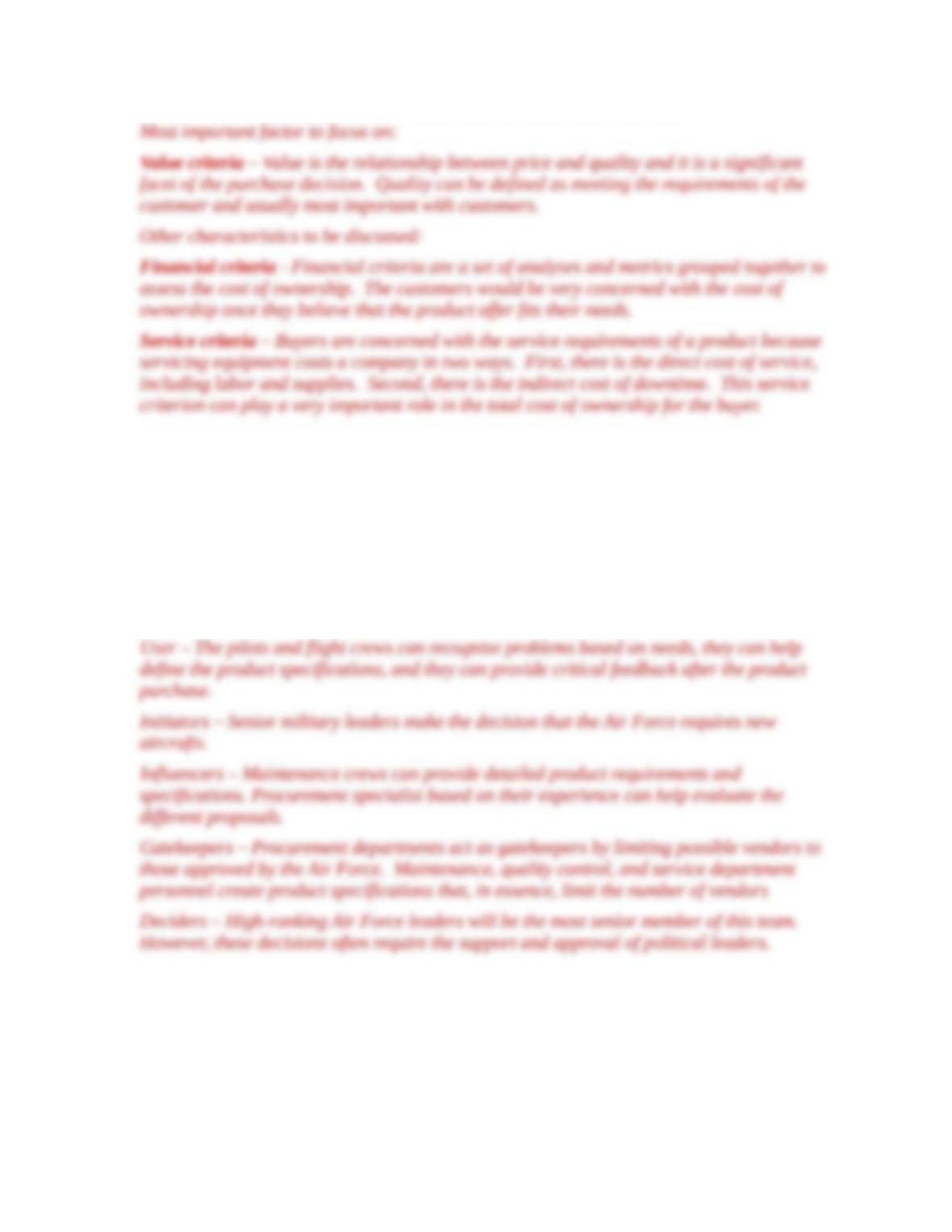
6. You are the primary sales representative for IBM calling on your university and are
responsible for finalizing the sale of 20 new network servers. What is the most important
factor you would focus on in making the sales presentation to the Vice President of
Information Technology and why? What other characteristics would you discuss and why?
Marketing Management 2nd Edition 5-5
1 Chapter 05
2 Understand Business to Business Markets
MANAGEMENT DECISION CASE: Organizational Buying on a Grand Scale
Questions for Consideration
1. Use the chapter discussion of various buying center roles to describe the potential members
of the buying center for the Air Force when purchasing an item like the B-2 Stealth Bomber.
Who should be included and what are their roles?
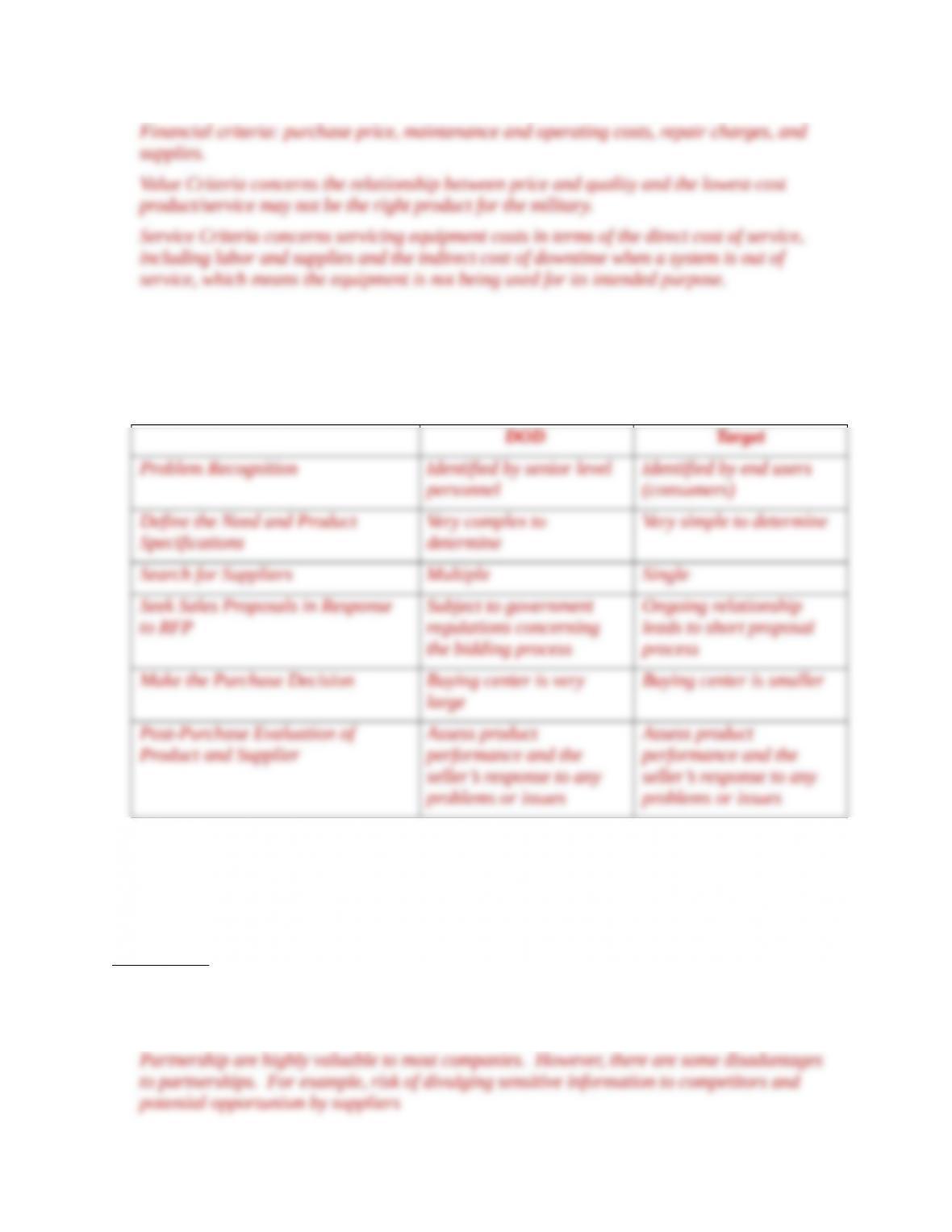
2. Assess the financial, value, and service criteria that a buying center at the U.S. DOD may
consider when making purchases for both equipment (like the B-2 Stealth Bomber) and
services (such as fuel transportation or food service). Also, what personal and organizational
factors may influence a purchase decision at the U.S. DOD?
Marketing Management 2nd Edition 5-6
1 Chapter 05
2 Understand Business to Business Markets
3. Contrast the buying process for the DOD with buying process used by Target Corporation’s
procurement of laundry detergent from P&G for resale in Target Stores. What aspects of
those buying processes are likely different and what aspects are likely similar?
1.3 SUGGESTED VIDEO
Dole: Buying from Vendors around the Globe (7:05 minutes)
Description: Dole manages their large scale operations by contracting vendors from around the
world. Discusses the essential steps of business-to-business.
1. Dole creates partnerships with its vendors, are there any drawbacks with this philosophy?
Marketing Management 2nd Edition 5-7
1 Chapter 05
2 Understand Business to Business Markets
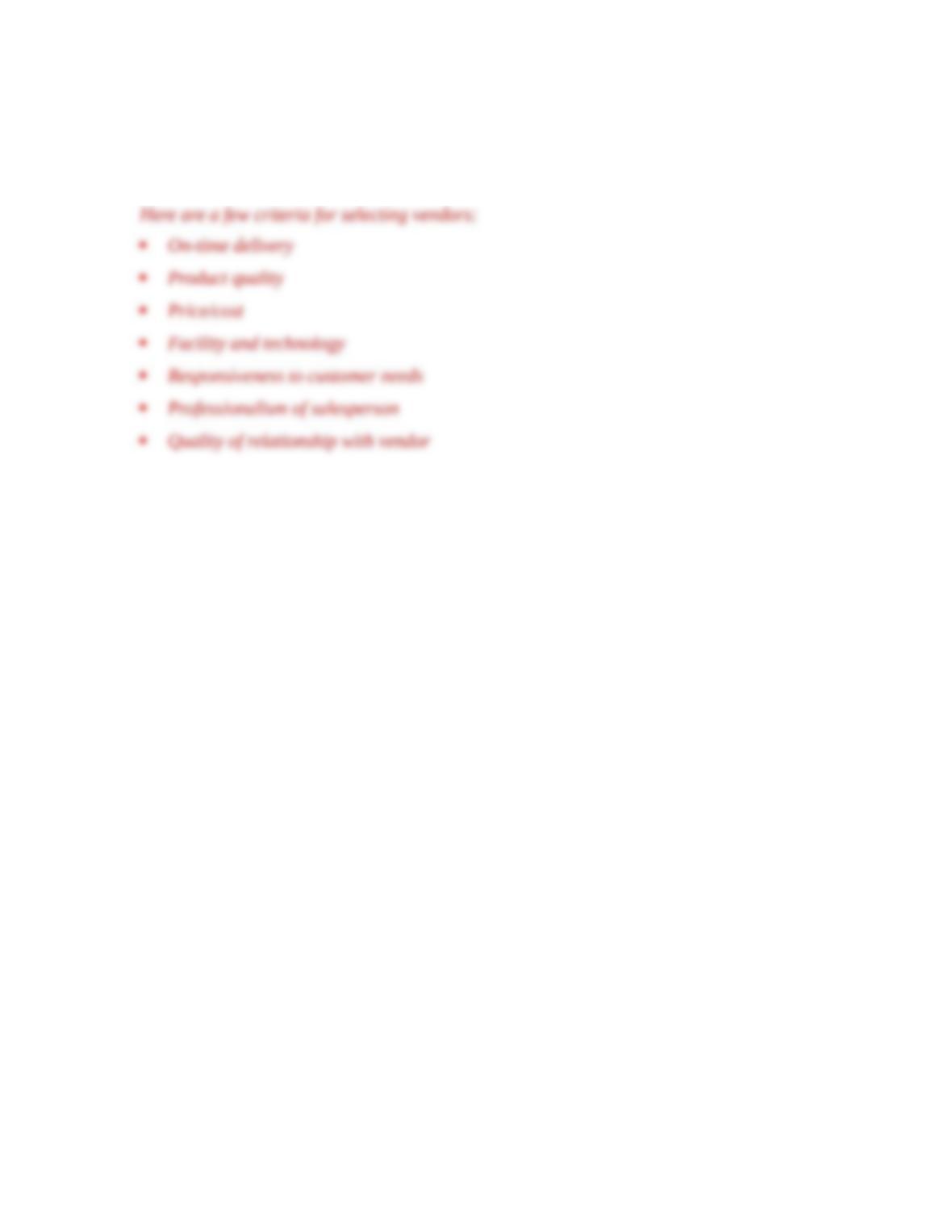
2. What are some of the criteria that Dole should consider when selecting vendors?
Marketing Management 2nd Edition 5-8