20–63
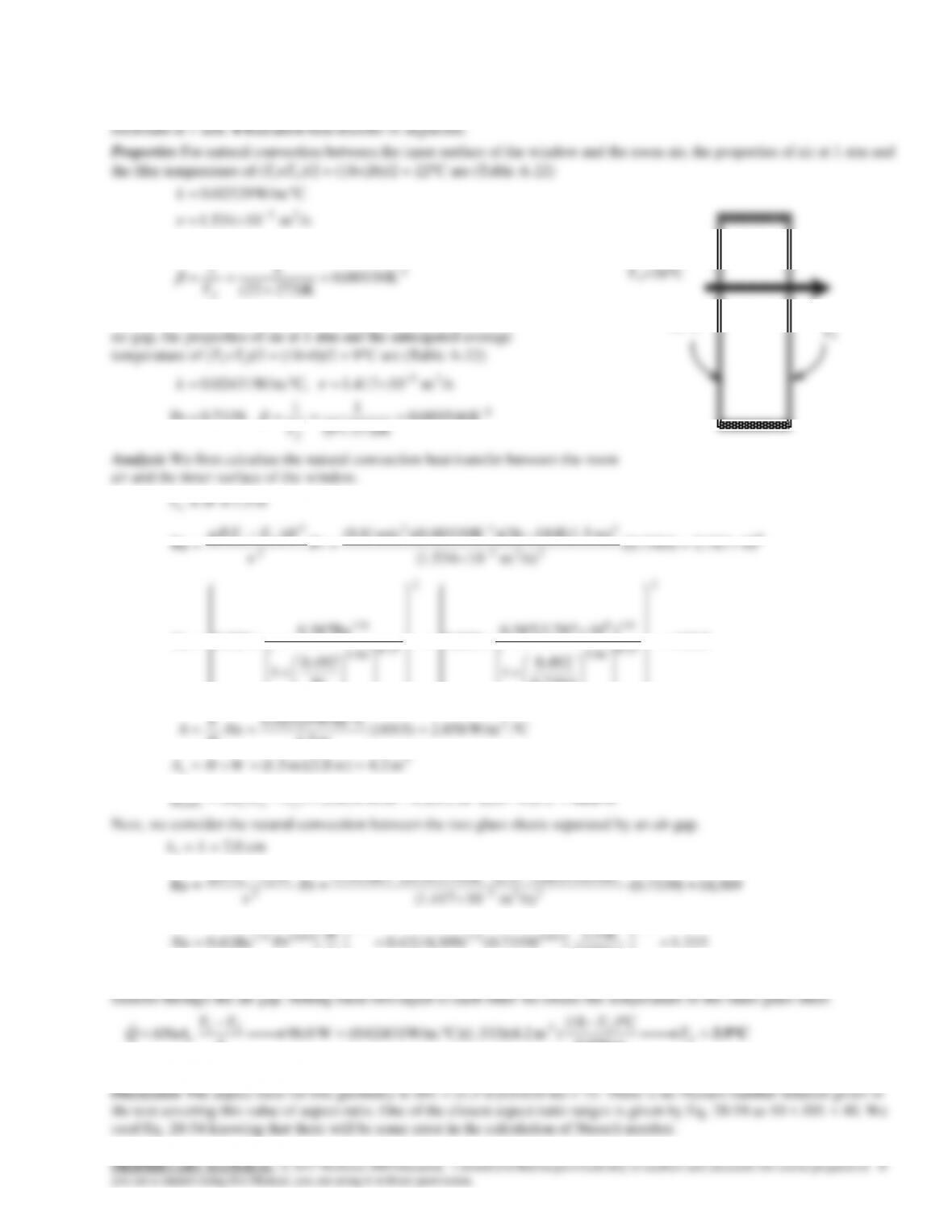
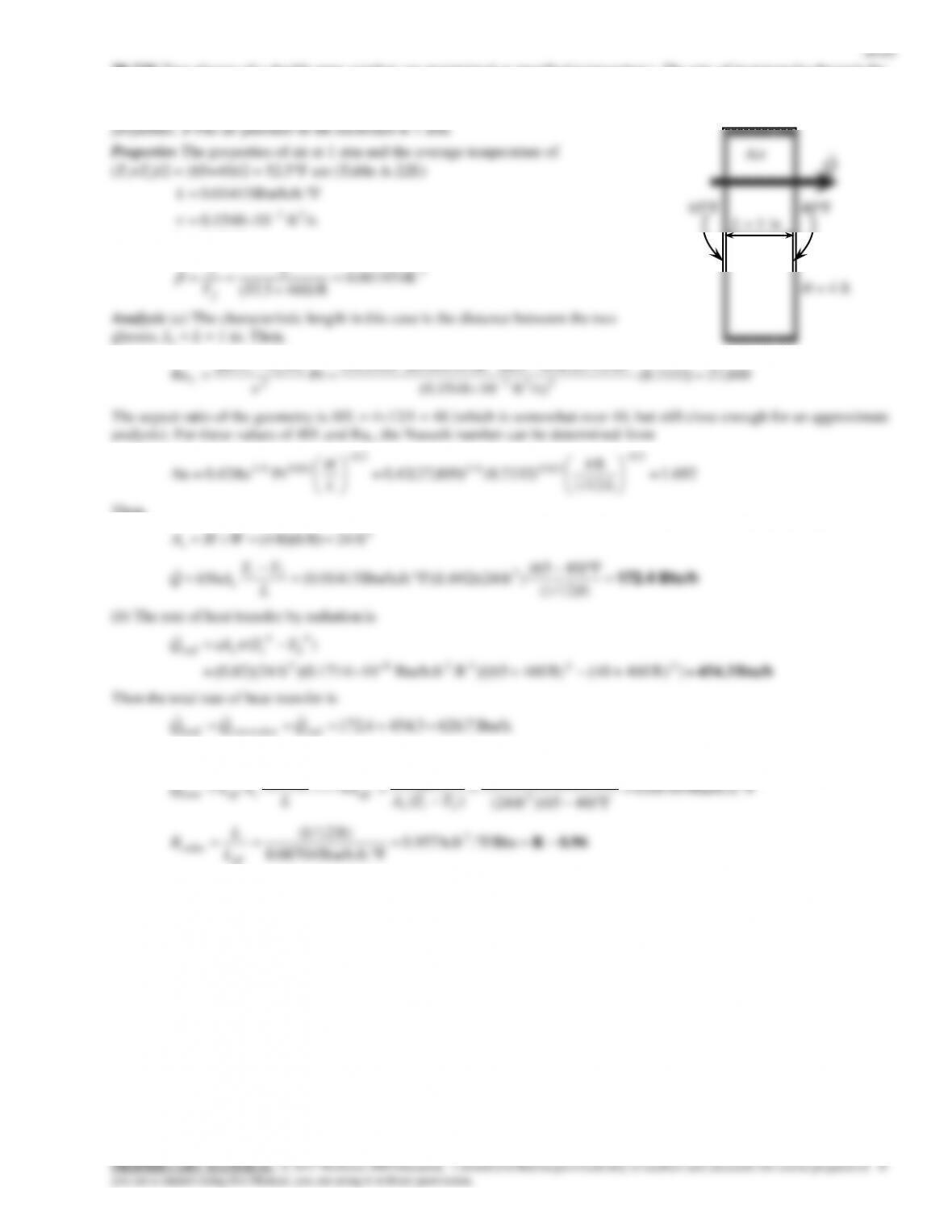
20–72 A double pane window with an air gap is considered. The rate of heat transfer through the window by natural
convection the temperature of the outer glass layer are to be determined.
Assumptions 1 Steady operating conditions exist. 2 Air is an ideal gas with constant properties. 3 The air pressure in the
1–
25
K 00339.0
K)27322(
11
7304.0Pr
/sm 10534.1
C W/m.02529.0
f
T
k
For natural convection between the two glass sheets separated by an
18C
T2
L=2.0 cm
Q
Air
Room air
T=26C

20–65
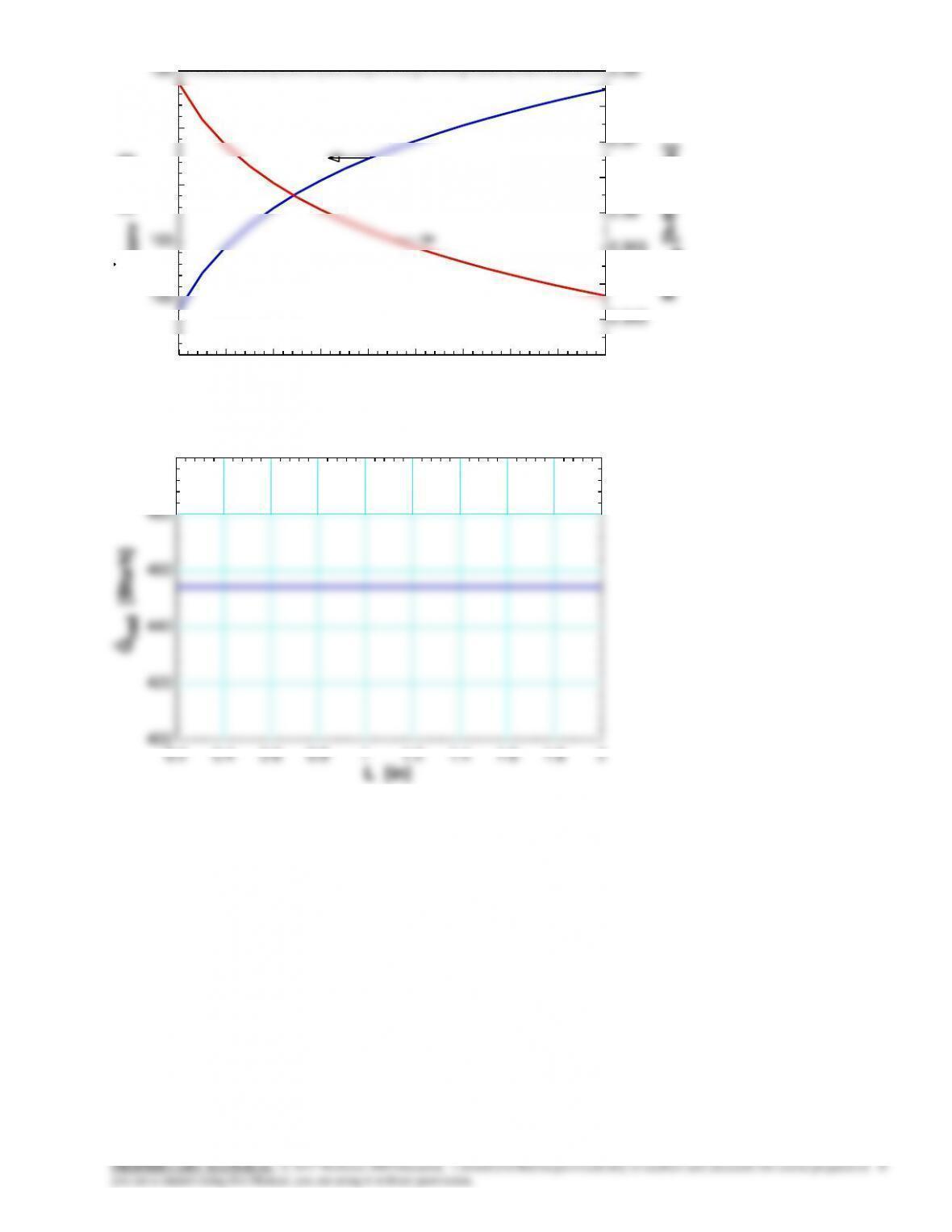
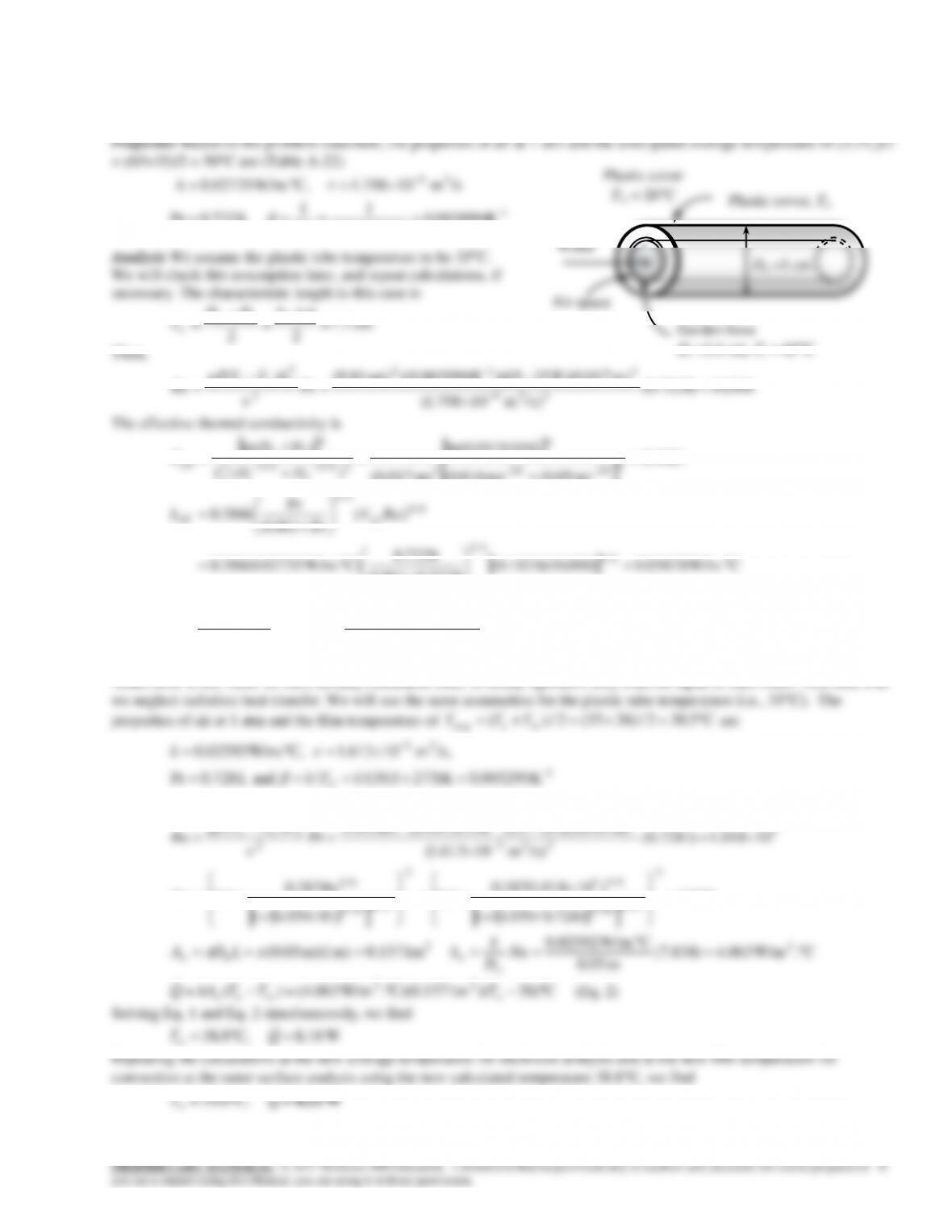
20–74E Prob. 20–73E is reconsidered. The effect of the air gap thickness on the rates of heat transfer by natural
convection and radiation, and the R–value of insulation is to be investigated.
Analysis The problem is solved using EES, and the solution is given below.
“GIVEN”
g=32.2 [ft/s^2]
sigma=0.1714E-8 [Btu/h-ft^2-R^4]
“ANALYSIS”
L_ft=L*Convert(in, ft)
1
1.1
1.2
1.3
1.4
1.5
1.6
1.7
1.8
1.9
2
172.3
173.1
173.9
174.6
175.2
175.8
176.4
176.9
177.4
177.9
178.4
454.3
454.3
454.3
454.3
454.3
454.3
454.3
454.3
454.3
454.3
454.3
0.9575
0.9563
0.9551
0.9541
0.9531
0.9522
0.9513
0.9505
0.9497
0.949
0.9483
20–66
0.2 0.4 0.6 0.8 1 1.2 1.4 1.6 1.8 2
155
160
165
170
175
180
0.94
0.945
0.95
0.955
0.96
0.965
0.97
0.975
0.98
L [in]
Qconv [Btu/h]
Rvalue [h-ft2-F/Btu]
0.2 0.4 0.6 0.8 1 1.2 1.4 1.6 1.8 2
400
420
440
460
480
500
Qrad [Btu/h]
20–67
20–75 A simple solar collector is built by placing a clear plastic tube around a garden hose. The rate of heat loss from the
water in the hose per meter of its length by natural convection is to be determined.
Assumptions 1 Steady operating conditions exist. 2 Air is an ideal gas with constant properties. 3 Heat loss by radiation is
negligible. 3 The air pressure in the enclosure is 1 atm.
20–68
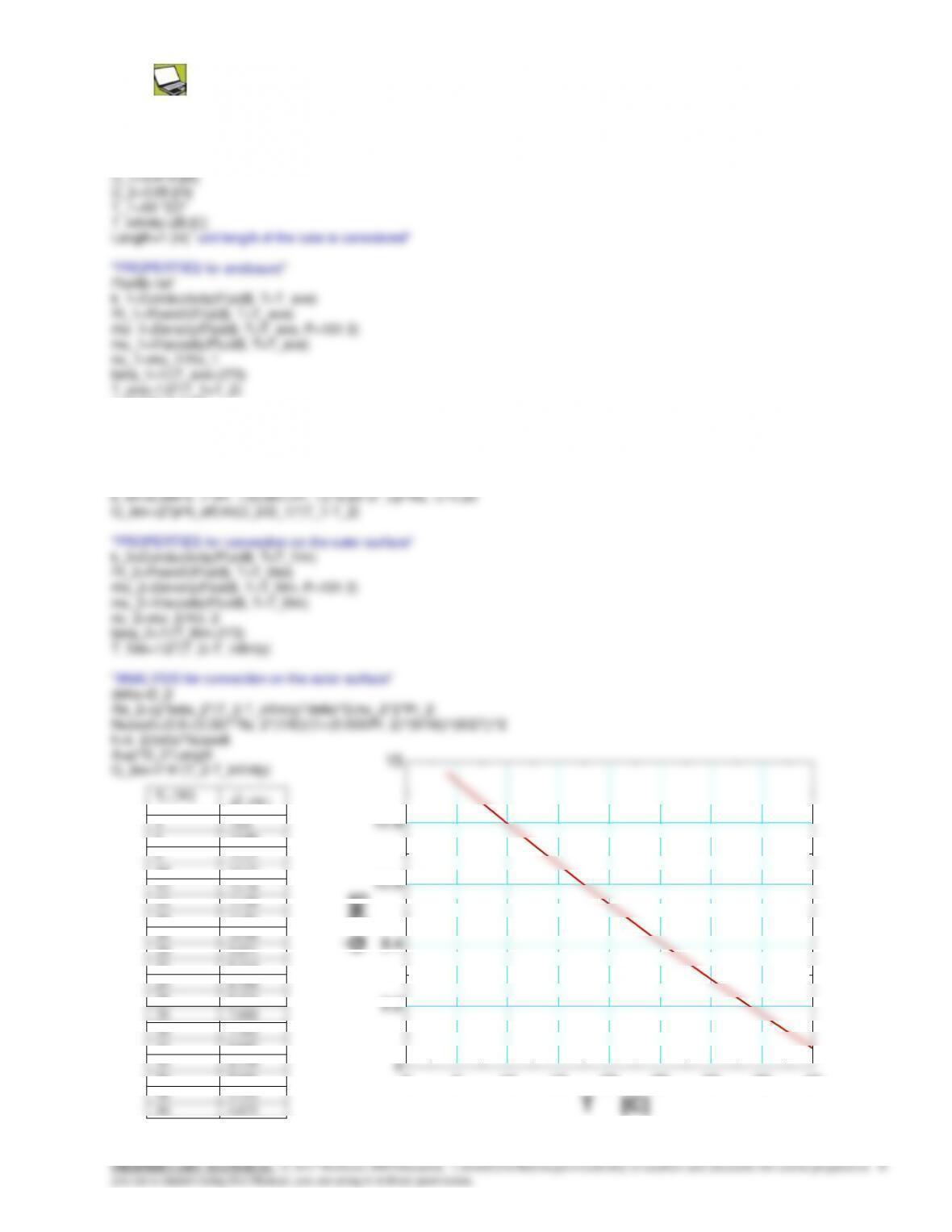
20–76 Prob. 20–75 is reconsidered. The rate of heat loss from the water by natural convection as a function of the
ambient air temperature is to be plotted.
Analysis The problem is solved using EES, and the solution is given below.
“GIVEN”
g=9.807 [m/s^2]
“ANALYSIS for enclosure”
L=(D_2-D_1)/2
Ra_1=(g*beta_1*(T_1-T_2)*L^3)/nu_1^2*Pr_1
F_cyl=(ln(D_2/D_1))^4/(L^3*(D_1^(-3/5)+D_2^(-3/5))^5)

20–70
20–78 Two surfaces of a spherical enclosure are maintained at specified temperatures. The rate of heat transfer through the
enclosure is to be determined.
Assumptions 1 Steady operating conditions exist. 2 Nitrogen is an ideal gas with constant properties. 3 Radiation heat
transfer is negligible
4
225
31–32
2
3
10132.3
)7025.0(
)/sm 10851.2(
)m 025.0(K)100200)(K 10364.2)(m/s 81.9(
Pr
)(
Ra
cio
L
LTTg
006268.0
oioi
K W/m07747.0
)K W/m03416.0()]10132.3)(006268.0[(
7025.0861.0
7025.0
74.0
)Ra(
Pr861.0
Pr
74.0
4/14
4/1
4/1
sp h
4/1
eff
kFk L

20–71
20–79 Two surfaces of a spherical enclosure are maintained at specified temperatures. The rate of heat transfer through the
enclosure is to be determined.
Assumptions 1 Steady operating conditions exist. 2 Air is an ideal gas with constant properties. 3 The air pressure in the
enclusure is 1 atm.
1–
25
K 003200.0
K 5.312
11
7256.0Pr
/sm 10697.1
C W/m.02658.0
f
T
k
Analysis The characteristic length in this case is
determined from
1525
12
5
225
3-12
2
3
21 10415.7)7256.0(
)/sm 10697.1(
)m 05.0)(K 275350)(K 003200.0)(m/s 81.9(
Pr
)(
c
LTTg
Ra
005900.0
m) 25.0(m) 15.0(m) 25.0(m) 15.0(
m 05.0
)()( 5
7/5–7/5–
4
5
5/75/7
4
sph
oioi
c
DDDD
L
F
7256.0
)(
Pr861.0
Pr
74.0
4/1
5
4/1
4/1
4/1
eff
RaFkk sph
D2 = 25 cm
T2 = 275 K
D1 = 15 cm
T1 = 350 K
Lc=5 cm

20–73
20–81 Two surfaces of a spherical enclosure are maintained at specified temperatures. The rate of heat transfer through the
enclosure is to be determined.
Assumptions 1 Steady operating conditions exist. 2 Air is an ideal gas. 3
Analysis We have a spherical enclosure filled with air. The
characteristic length in this case is the distance between the two
spheres,
m 05.02/)2.03.0(2/)( ioc DDL
The Rayleigh number is
225
312
2
3
)729.0(
)m 05.0(K )280320()K 300)(m/s 81.9(
Pr
)(
Ra
coi LTTg
0005229.0
]m) 3.0(m) 2.0[(]m) 3.0(m) 2.0[(
m 05.0
)DD()DD(
L
F55/75/74
5
5/7
o
5/7
i
4
oi
c
sph
K W/m1105.0
)]10775.4)(0005229.0[(
729.0861.0
729.0
K) W/m02566.0(74.0
)Ra(
Pr861.0
Pr
74.0
4/15
4/1
4/1
4/1
eff
sph
Fkk
Then, the rate of heat transfer between spheres becomes
)(
eff oi
c
oi TT
L
DD
kQ
W16.7
K)280320(
m05.0
m3.0m2.0
)1105.0(
Discussion Note that the air in the spherical enclosure acts like a stationary fluid whose thermal conductivity is keff/k =
20–74
Review Problems
20–82 An electric resistance space heater filled with oil is placed against a wall. The power rating of the heater and the time it
will take for the heater to reach steady operation when it is first turned on are to be determined.
Assumptions 1 Steady operating conditions exist. 2 Air is an ideal gas with constant properties. 3 Heat transfer from the
50 cm
1–
K 003096.0
K)27350(
11
f
T
Analysis Heat transfer from the top and bottom surfaces are said to be negligible,
and thus the heat transfer area in this case consists of the three exposed side
surfaces. The characteristic length is the height of the box, Lc = L = 0.5 m. Then,
8
225
3-12
2
3
10244.4)7228.0(
)/sm 10798.1(
)m 5.0)(K 2575)(K 003096.0)(m/s 81.9(
Pr
)(
LTTg
Ra s
68.94
7228.0
492.0
1
)10244.4(387.0
825.0
Pr
492.0
1
Ra387.0
825.0
2
27/8
16/9
6/18
2
27/8
16/9
6/1
Nu
2
2
m 55.0)m 5.0)(m 15.0(2)m 8.0)(m 5.0(
C.W/m179.5)68.94(
m 5.0
C W/m.02735.0
s
A
Nu
L
k
h
and
W311.5 1.1694.142
total
Q
= 0.8
Ts = 75C
15 cm
80 cm
20–75
20–83 A hot part of the vertical front section of a natural gas furnace in a plant is considered. The rate of heat loss from this
section and the annual cost of this heat loss are to be determined.
Assumptions 1 Steady operating conditions exist. 2 Air is an ideal gas with constant properties. 3 The local atmospheric
1–
25
K 002937.0
K)2735.67(
11
7183.0Pr
/sm 1097.1
C W/m.02863.0
f
T
k
225
2
)/sm 1097.1(
1.289
7183.0
492.0
1
)10530.1(387.0
825.0
Pr
492.0
1
Ra387.0
825.0
2
27/8
16/9
6/110
2
27/8
16/9
6/1
Nu
2
2
m 5.1)m 1)(m 5.1(
C.W/m518.5)1.289(
C W/m.02863.0
s
A
Nu
k
h
and
= 0.7
Ts = 110C
Room
25C
furnace
1.5 m 1 m
20–78
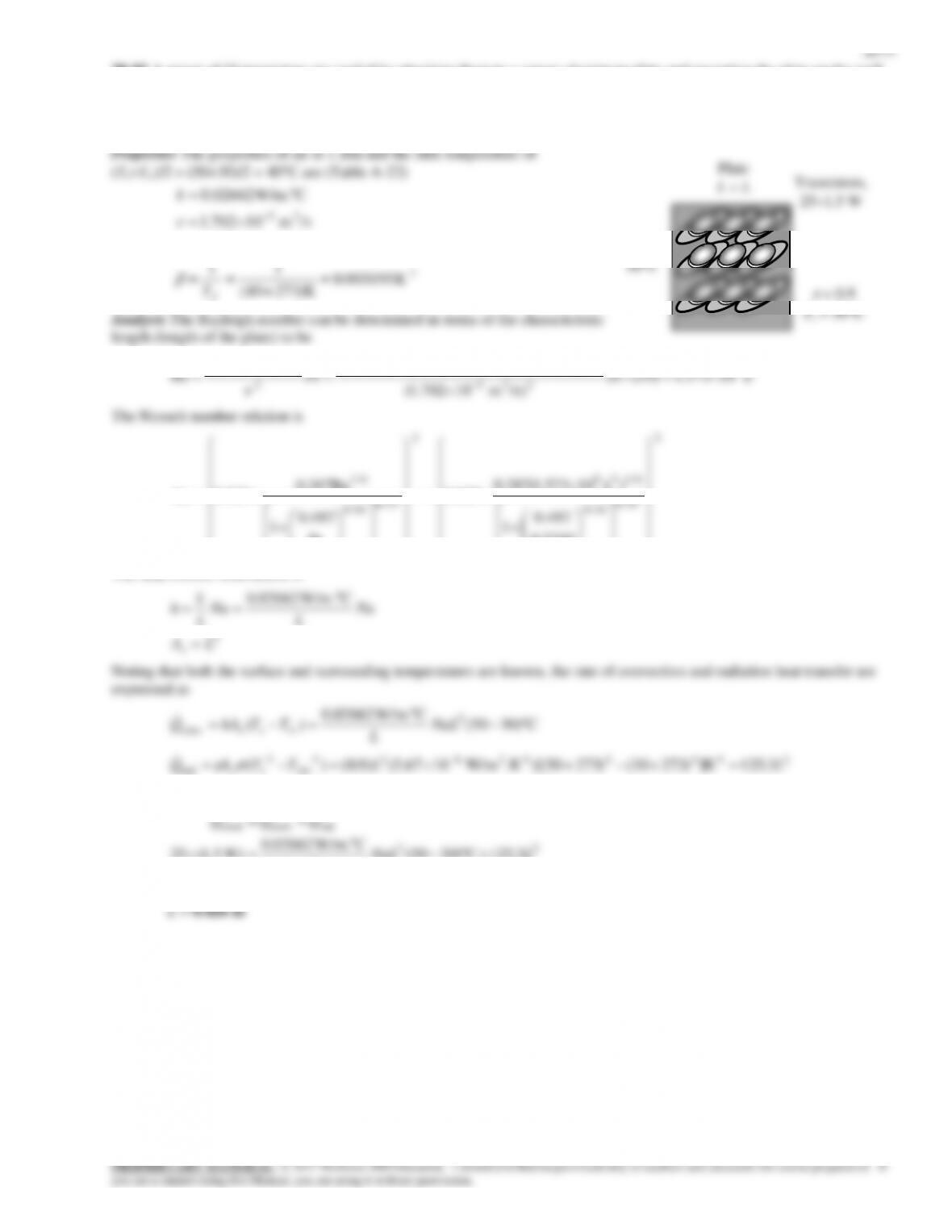
20–86 A group of 25 transistors are cooled by attaching them to a square aluminum plate and positioning the plate
horizontally in a room. The required size of the plate to limit the surface temperature to 50C is to be determined for two
cases.
Assumptions 1 Steady operating conditions exist. 2 Air is an ideal gas with constant properties. 3 The local atmospheric
1–
25
K 003195.0
K)27340(
11
7255.0Pr
/sm 10702.1
C W/m.02662.0
f
T
k
Analysis The characteristic length and the Rayleigh number for
the horizontal case are determined to be
2L
L
A
22. Then the Nusselt number and the convection heat transfer coefficient become
4/34/1374/1 0.38)10454.2(54.054.0 LLRaNu
Then,
24/14/3 C. W/m047.4)0.38(
C W/m.02662.0
LL
Nu
k
h
W94.80)3050()047.4()( 4/724/1
conv LLLTThAQss
W3.12594.80 W)5.1(25 24/7
radconvtotal LLQQQ
L = 0.407 m
Note that L < 0.75 m, and therefore the assumption of Ra < 107 is verified. That is,
Then,
023.2)0.19(
4/
C W/m.02662.0 4/14/3
LL
L
Nu
L
k
h
c
Then,
W3.12547.40 W)5.1(25 24/7
radconvtotal LLQQQ
Transistors,
251.5 W
= 0.9
Ts = 50C
Room
30C
Plate
L L
20–79
20–87 An L × L horizontal plate is placed in a quiescent air with the hot surface facing up, and the expressions, having the
form
n
L
CRaNu
, for the average heat transfer coefficient are to be determined.
Assumptions 1 Steady operating conditions exist. 2 Air is an ideal gas with constant properties.
Properties The properties of air at Tf = 20°C are k = 0.02514 W/m∙K,
= 1.516 × 10⁻⁵ m2/s, Pr = 0.7309 (from Table A-22).