19–63
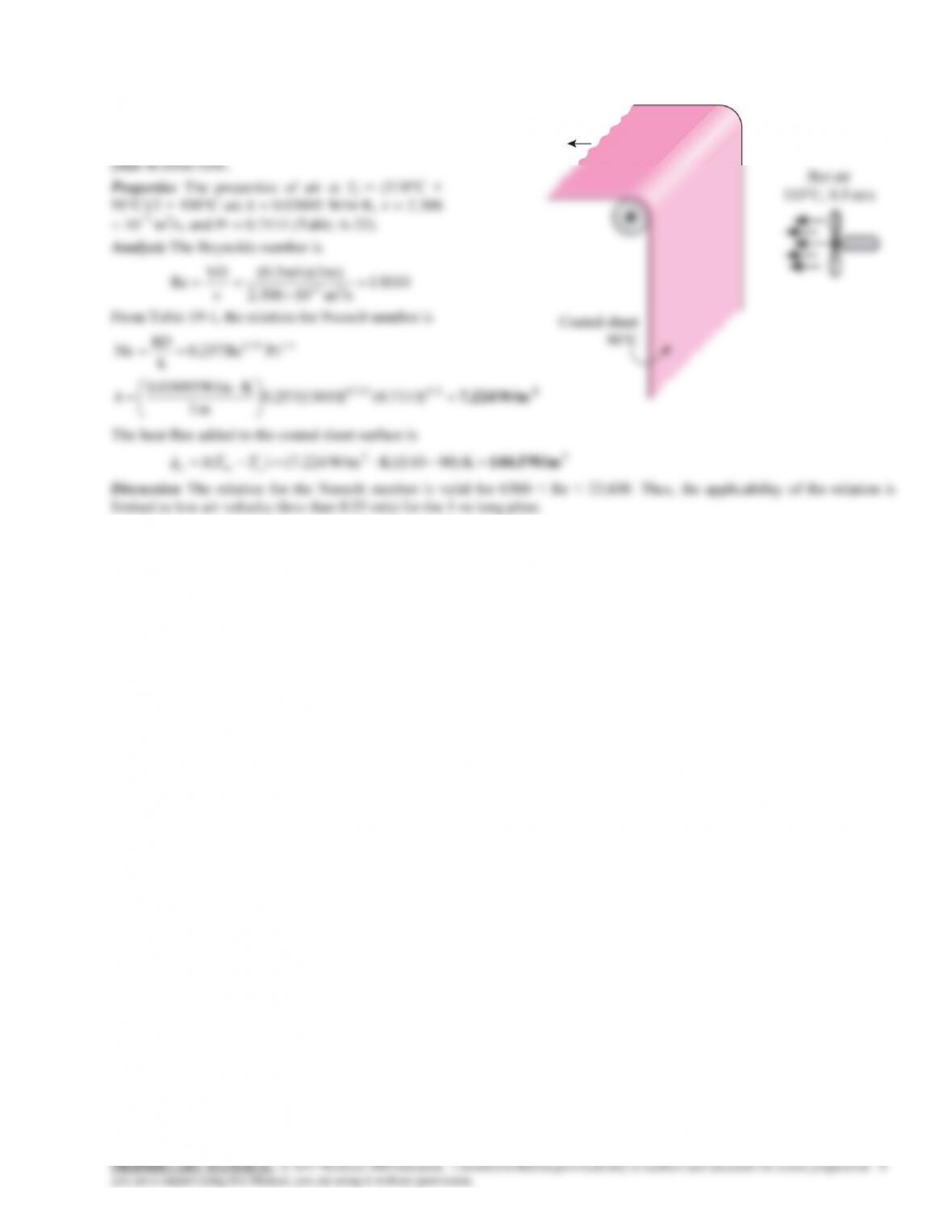
19–63 A coated sheet is being dried with hot air in cross flow. The convection heat transfer coefficient and the heat flux
added to the sheet surface are to be determined.
Assumptions 1 Steady operating conditions exist. 2
Properties are constant. 3 The surface temperature is
constant. 4 The coated sheet is treated as a vertical
19–65
Flow in Tubes
19–65C The region of flow over which the thermal boundary layer develops and reaches the tube center is called the thermal
thickness of thermal boundary layer is zero, and decreases gradually to the fully developed value.
between the fluid and the surface for the entire tube. It truly reflects the exponential decay of the local temperature difference.
The error in using the arithmetic mean temperature increases to undesirable levels when
e
T
differs from
i
T
by great
amounts. Therefore we should always use the logarithmic mean temperature.
)/ln(
ie
TT
19–70C The number of transfer units NTU is a measure of the heat transfer area and effectiveness of a heat transfer system. A
small value of NTU (NTU < 5) indicates more opportunities for heat transfer whereas a large NTU value (NTU >5) indicates
that heat transfer will not increase no matter how much we extend the length of the tube.
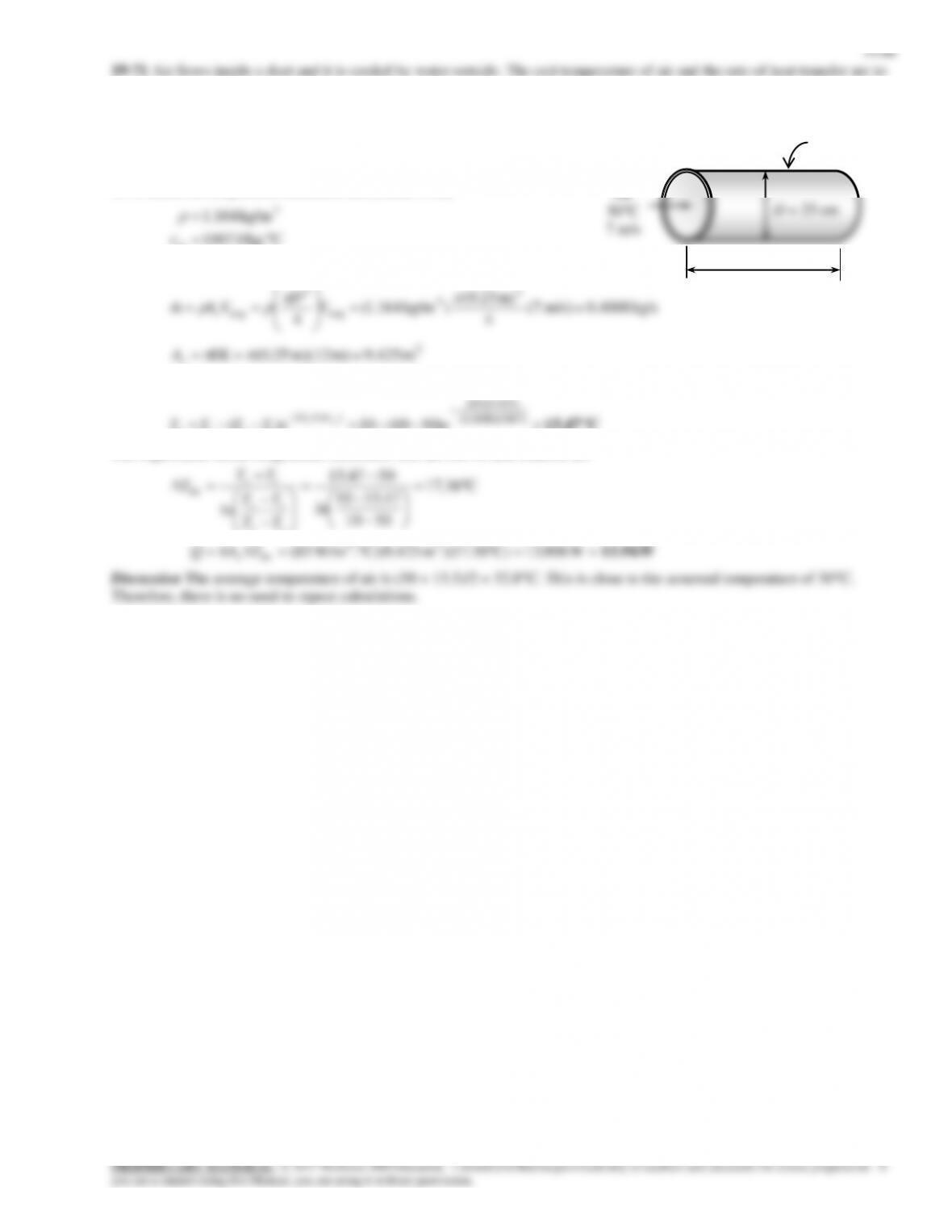
be determined.
Assumptions 1 Steady operating conditions exist. 2 The surface
temperature of the duct is constant. 3 The thermal resistance of the duct
is negligible.
Properties The properties of air at the anticipated average temperature of
30C based on the problem statement are (Table A-22)
kg/m 164.1 3
10C
D = 25 cm
Air
50C
19–68
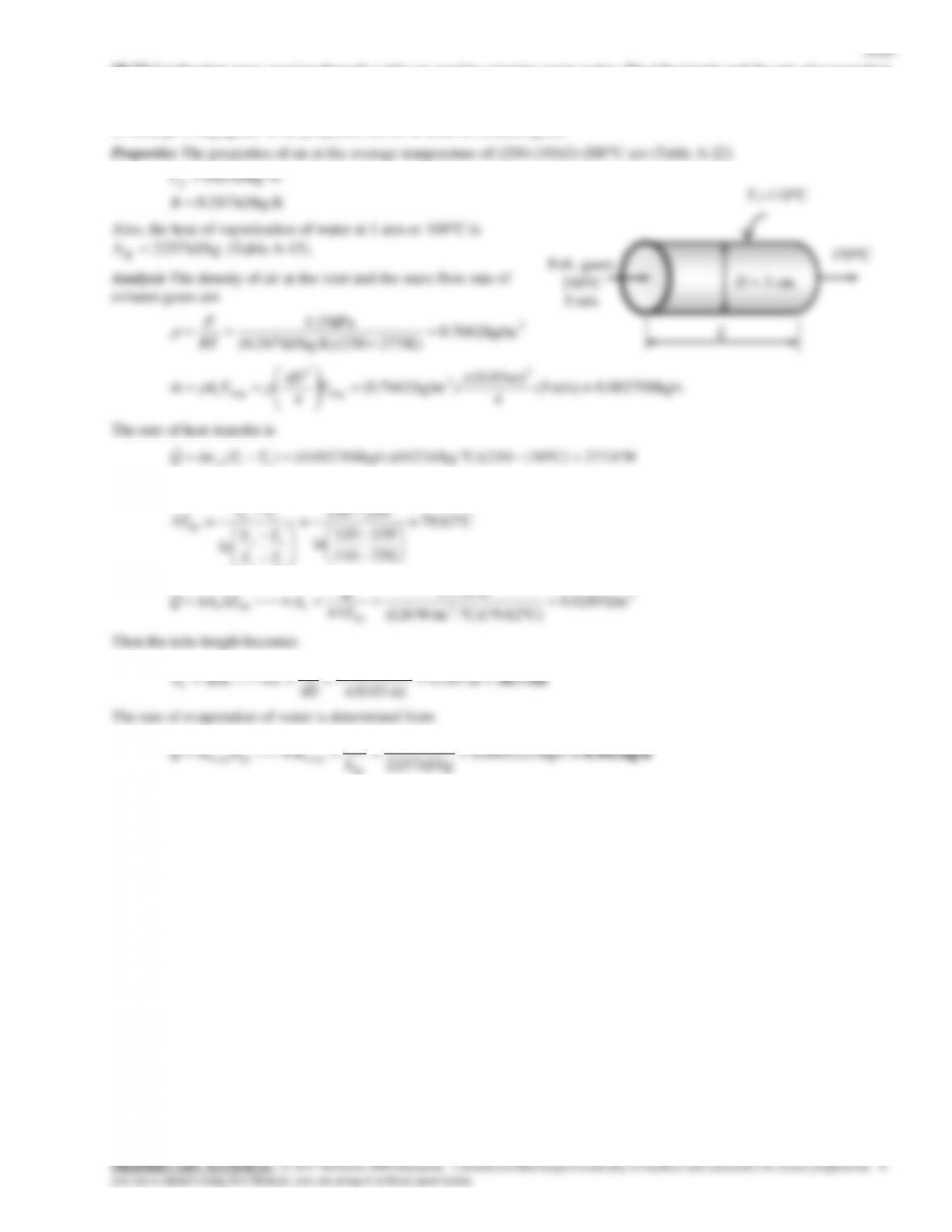
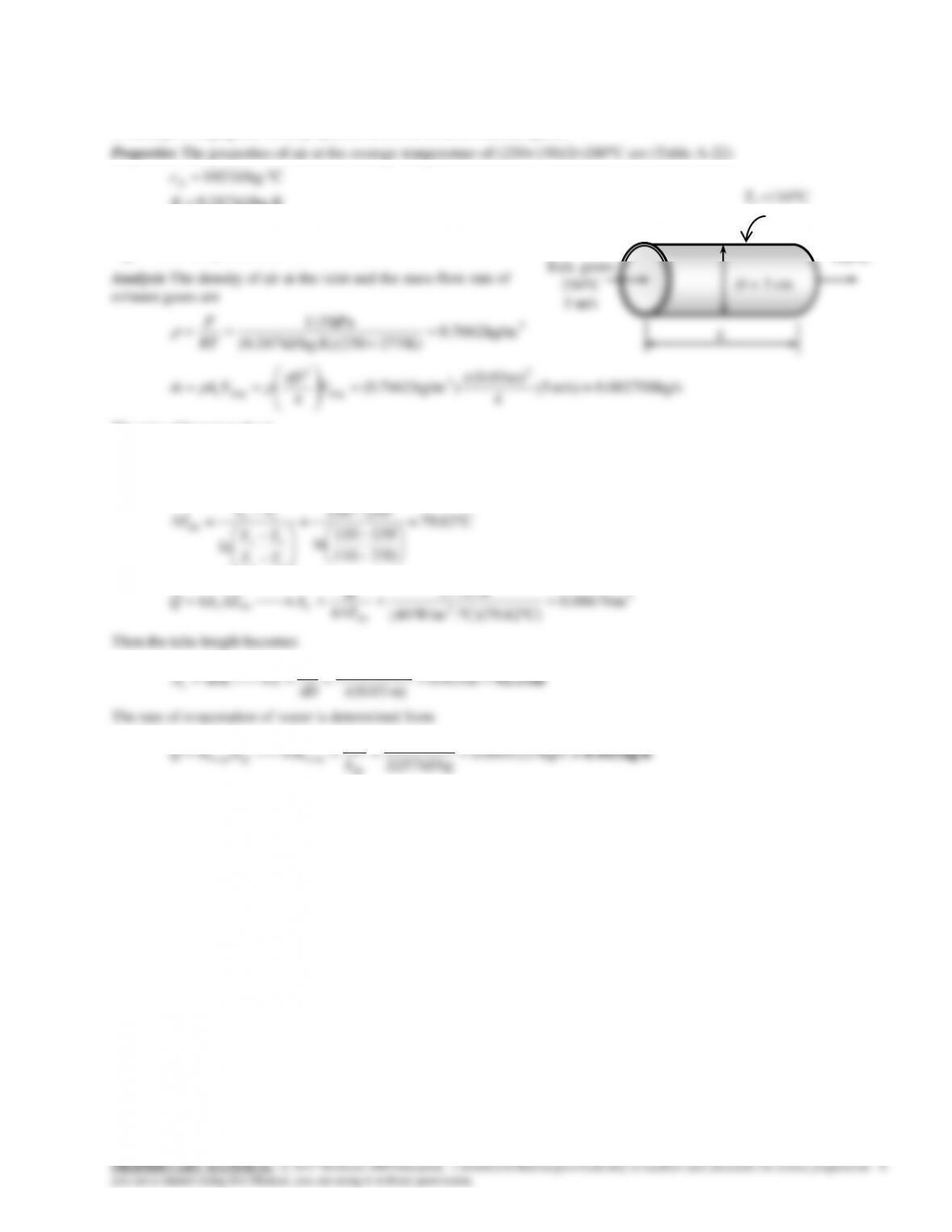
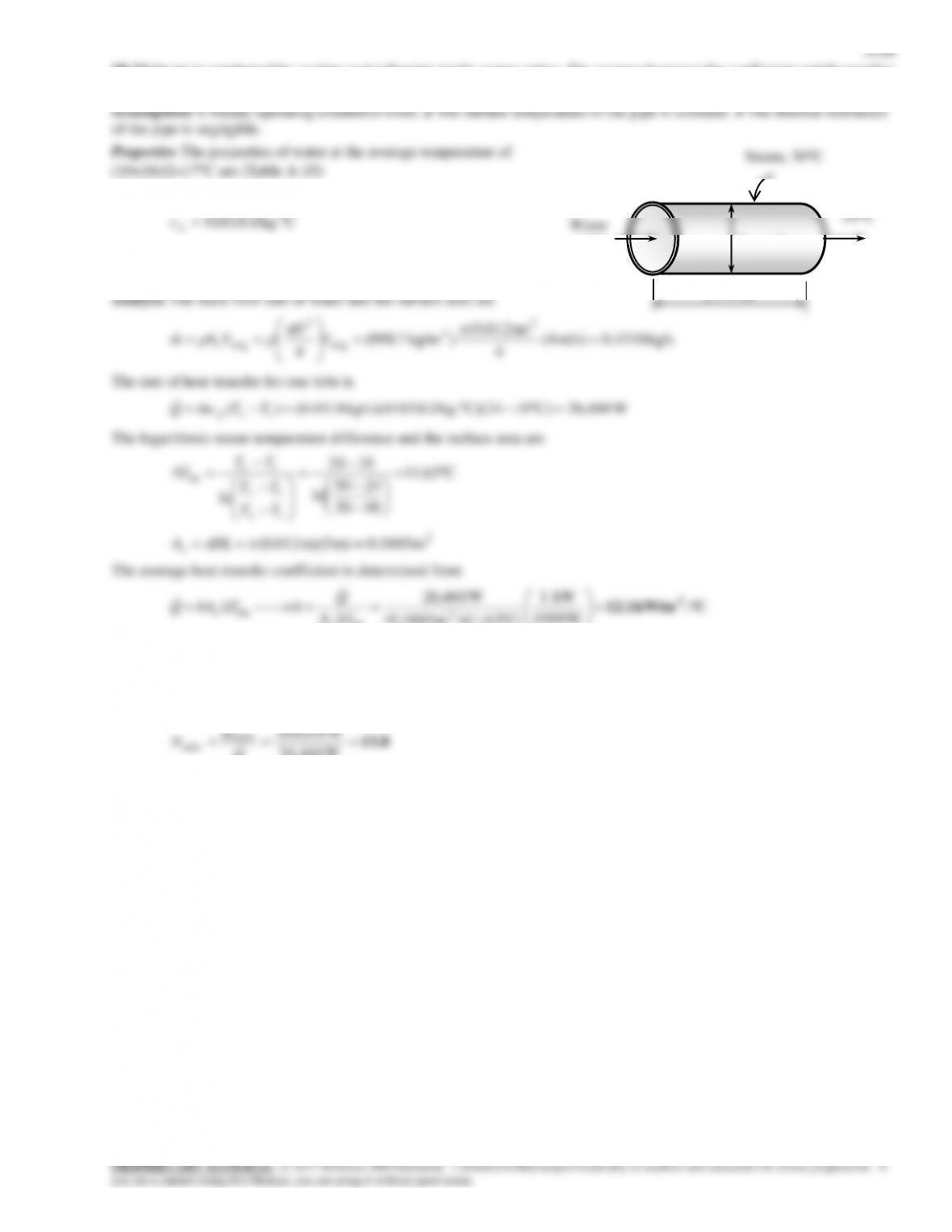
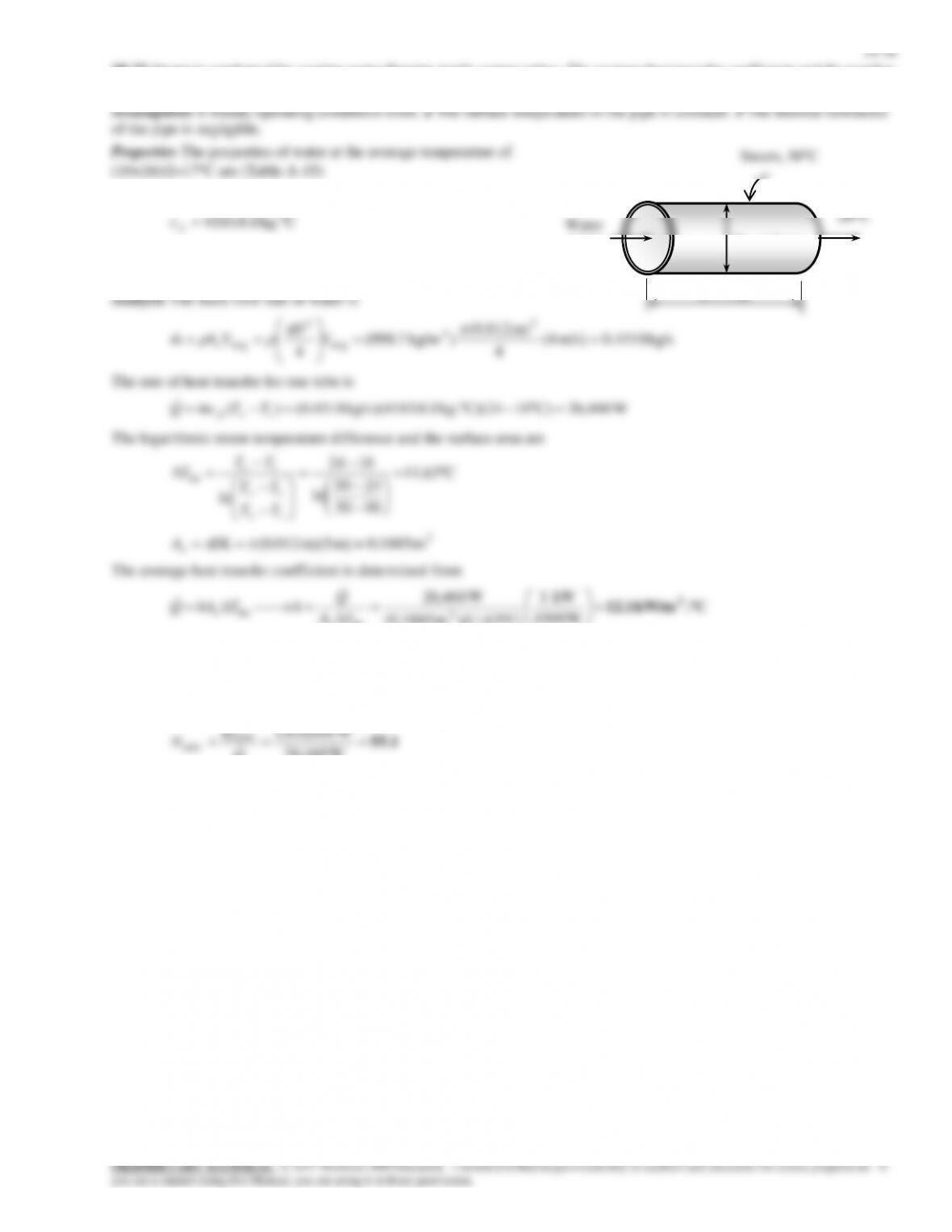
19–73 Combustion gases passing through a tube are used to vaporize waste water. The tube length and the rate of evaporation
of water are to be determined.
Assumptions 1 Steady operating conditions exist. 2 The surface temperature of the pipe is constant. 3 The thermal resistance
of the pipe is negligible. 4 Air properties are to be used for exhaust gases.
kJ/kg.K 287.0
R
Also, the heat of vaporization of water at 1 atm or 100C is
kJ/kg 2257
fg
h
(Table A-15).
4
4
The rate of heat transfer is
W0.277)C150250)(CJ/kg. 1023)(kg/s 002708.0()( eip TTcmQ
The logarithmic mean temperature difference and the surface area are
C82.79
250110
150110
ln
250150
ln
lm
is
es
ie
TT
TT
TT
T
2
2
lm
lm m 0.08676
)C82.79)(C. W/m40(
W0.277
Th
Q
AThAQss
Then the tube length becomes
cm 92.1 m 921.0
m) 03.0(
m 0.08676 2
D
A
LDLAs
s
The rate of evaporation of water is determined from
kW 2770.0
Q
Ts =110C
Exh. gases
150C
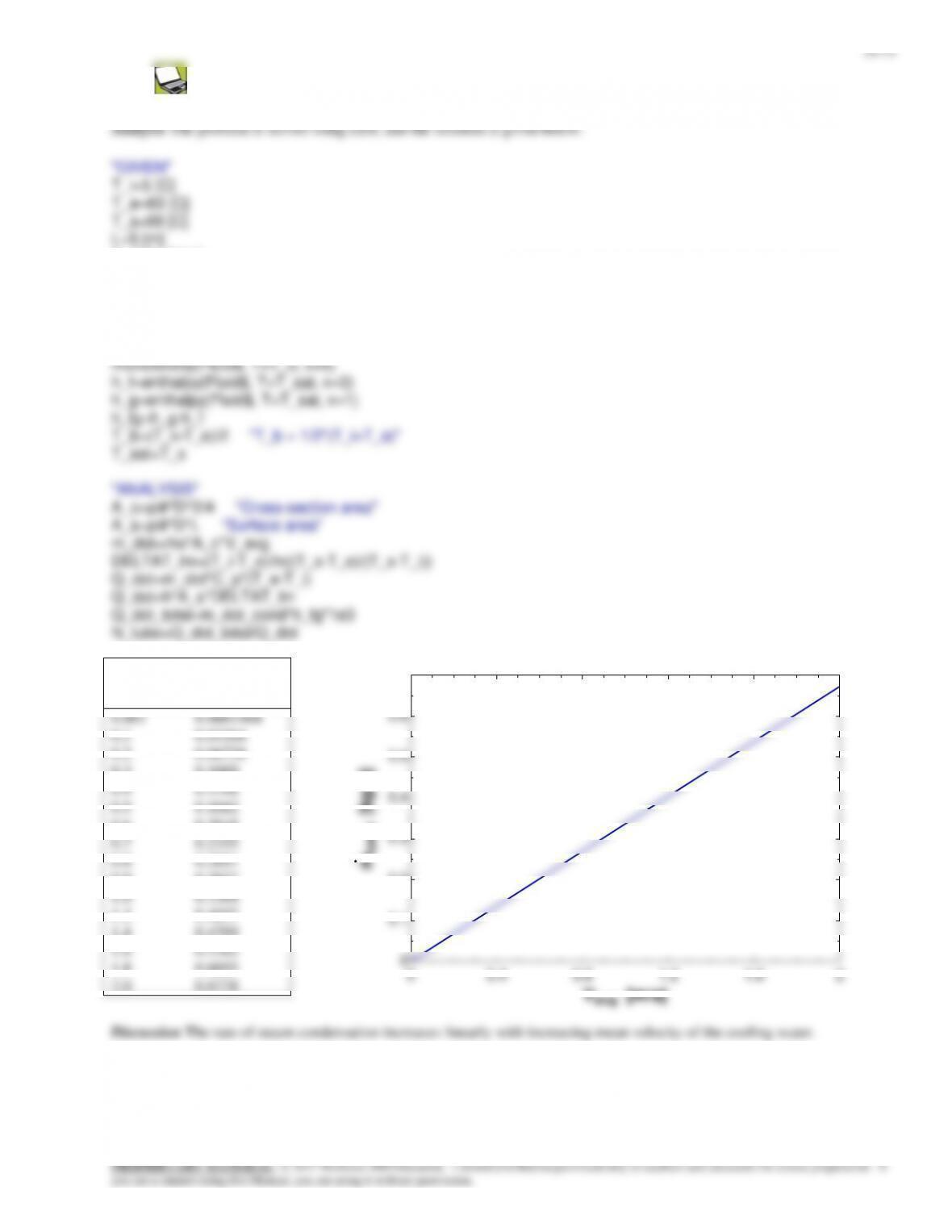
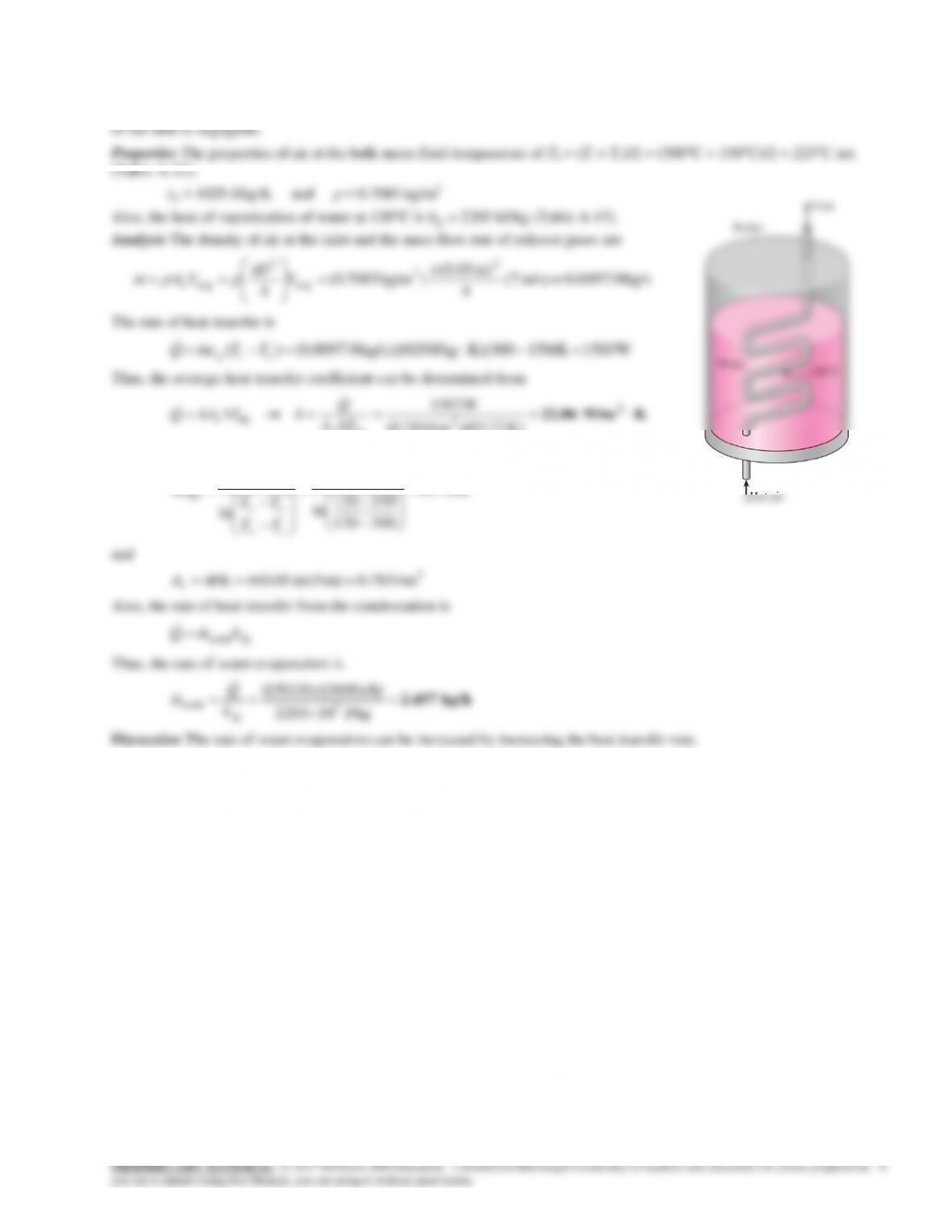
19–74
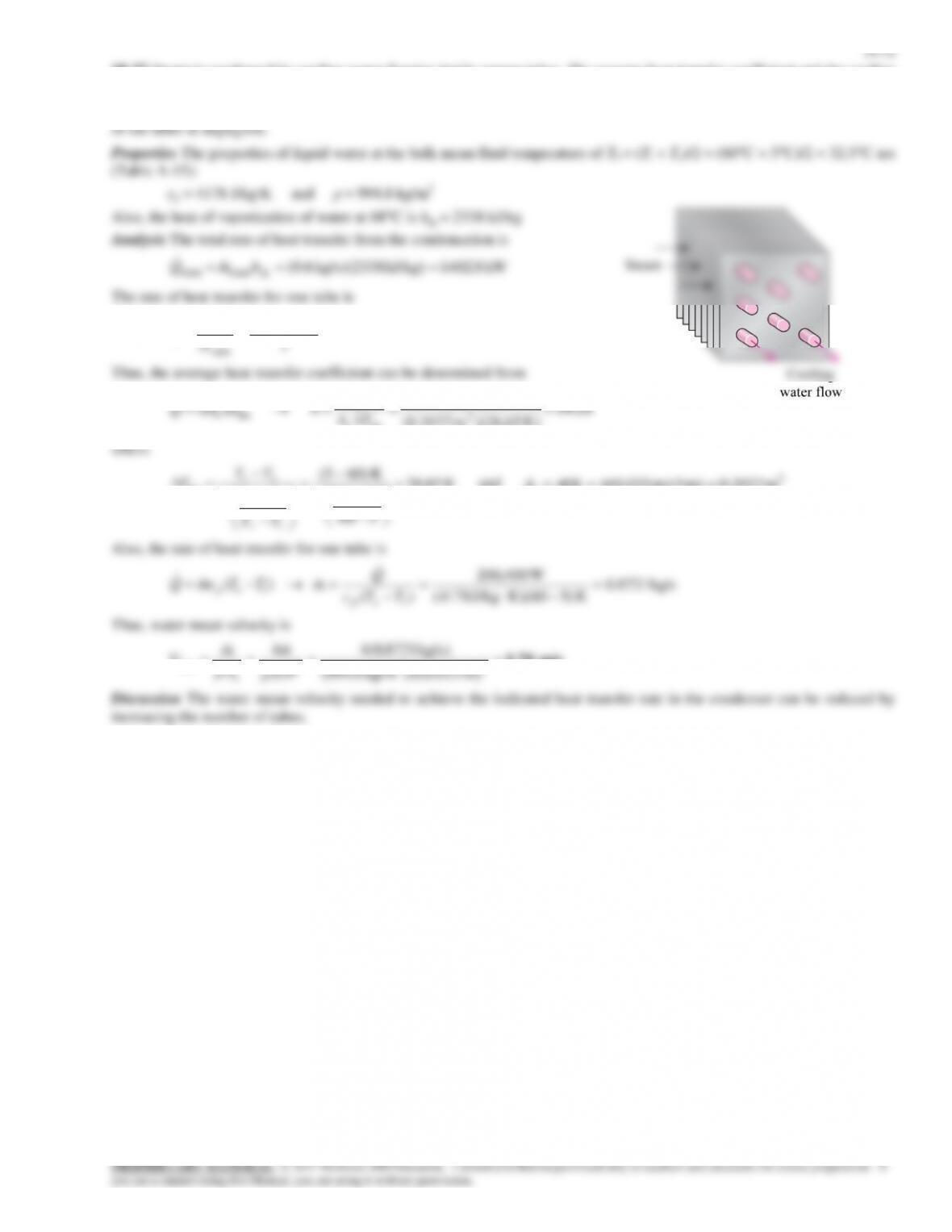
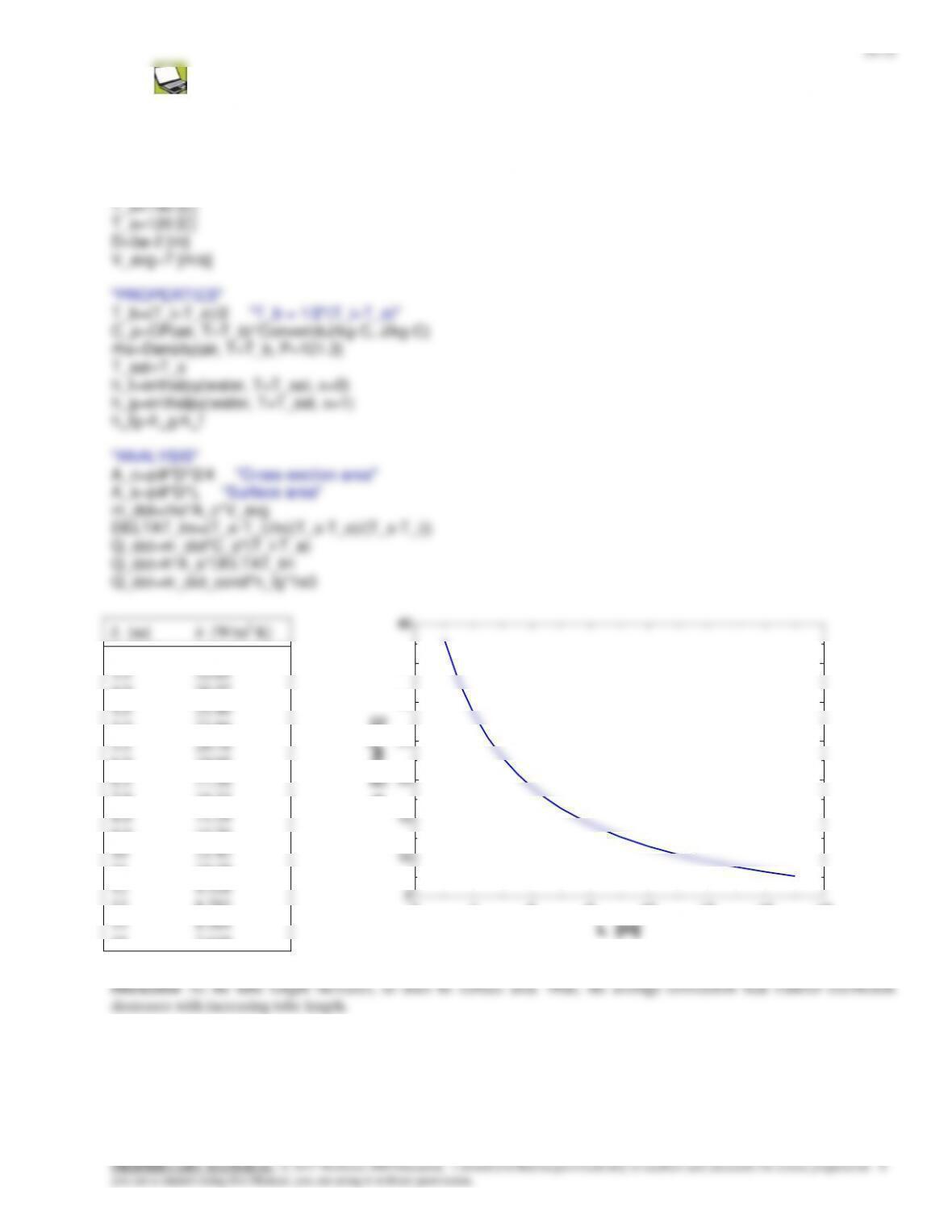
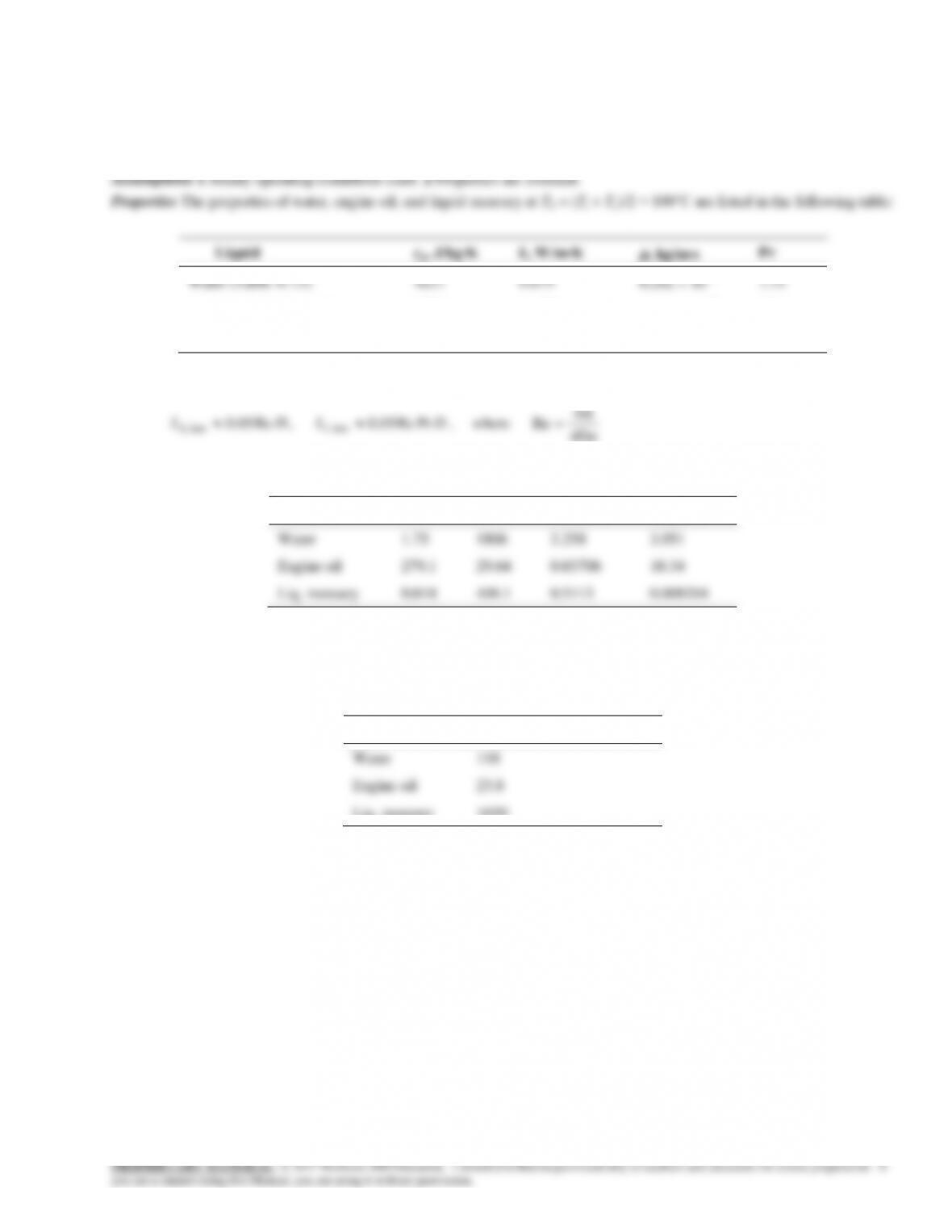
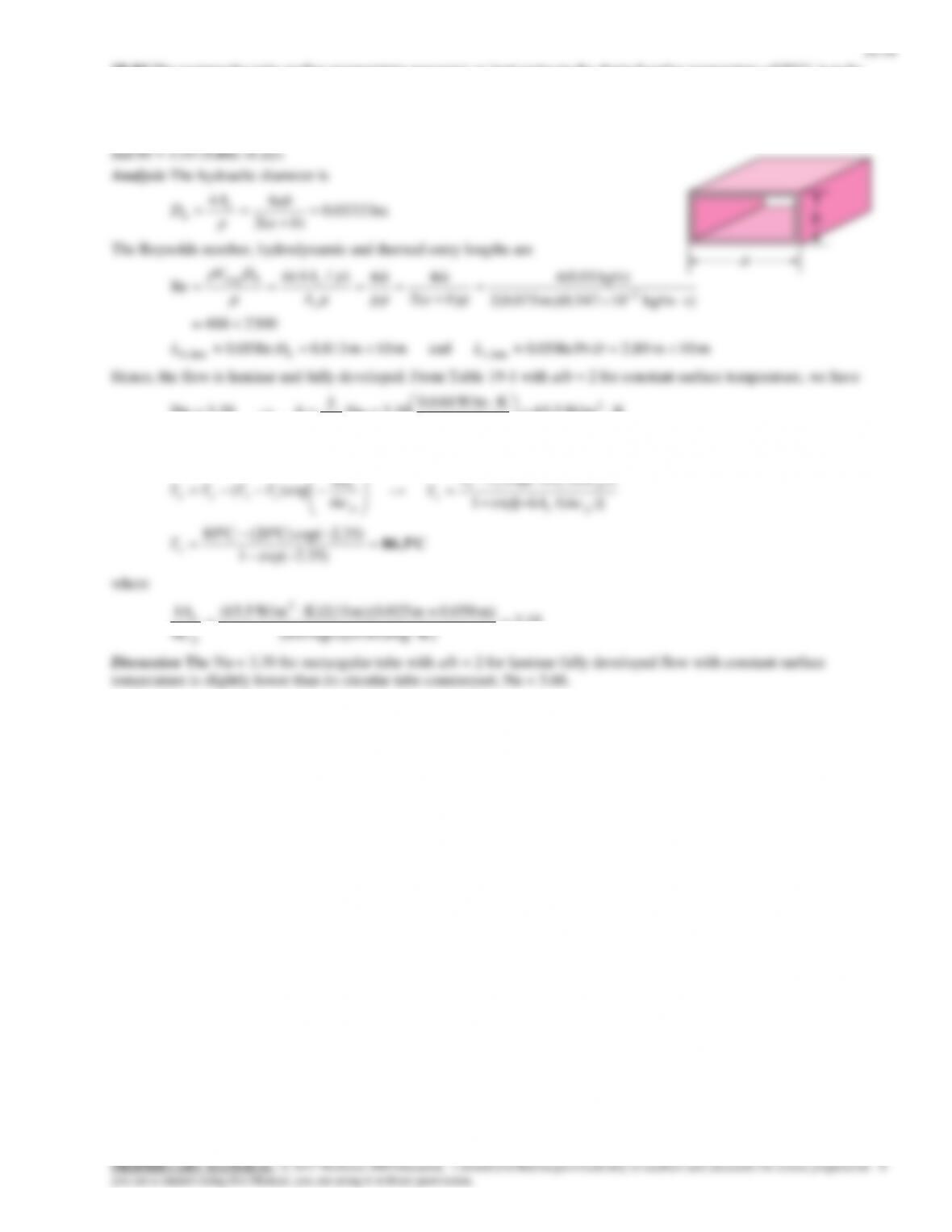
19-79 Hot air at 1 atm passing through a tube is used to boil water. The average heat transfer coefficient and the rate of
evaporation of water are to be determined.
Assumptions 1 Steady operating conditions exist. 2 The surface temperature of the pipe is constant. 3 The thermal resistance
19–76
Laminar and Turbulent Flow
19–81 A tube with constant surface heat flux, the convection heat transfer coefficients at the tube outlet are to be determined
for water, engine oil, and liquid mercury.
PROPRIETARY MATERIAL. © 2017 McGraw-Hill Education. Limited distribution permitted only to teachers and educators for course preparation. If
you are a student using this Manual, you are using it without permission.
Properties The properties of water, engine oil, and liquid mercury at Tb = (Ti + Te)/2 = 100°C are listed in the following table:
Liquid
cp, J/kg∙K
k, W/m∙K
, kg/m∙s
Pr
Water (Table A-15)
4217
0.679
0.282 10−3
1.75
Engine oil (Table A-13)
2220
0.1367
17.18 10−3
279.1
Liq. mercury (Table A-14)
137.1
9.46706
1.245 10−3
0.0180
DLhRe05.0
lam ,
,
DLtPrRe05.0
lam ,
, where
D
m
4
Re
Liquid
Pr
Re
Lh, lam, m
Lt, lam, m
Water
1.75
1806
2.258
3.951
Engine oil
279.1
29.64
0.03706
10.34
Liq. mercury
0.018
409.1
0.5113
0.009204
Since the Reynolds numbers are less than 2300, and the hydrodynamic and thermal entry lengths are less than 15 m, therefore
the flow is laminar and fully developed at the tube outlet. Hence, the Nusselt number for constant surface temperature is Nu =
3.66. The convection heat transfer coefficients and the tube surface temperatures can be determined using
Nu
D
k
h
p
s
hA
)]/(exp[1
)]/(exp[
ps
psie
cmhATT
The calculated convection heat transfer coefficients and tube surface temperatures are
Liquid
h, W/m2∙K
Ts, °C
Water
99.4
157
Engine oil
20.0
203
Liq. mercury
1390
150
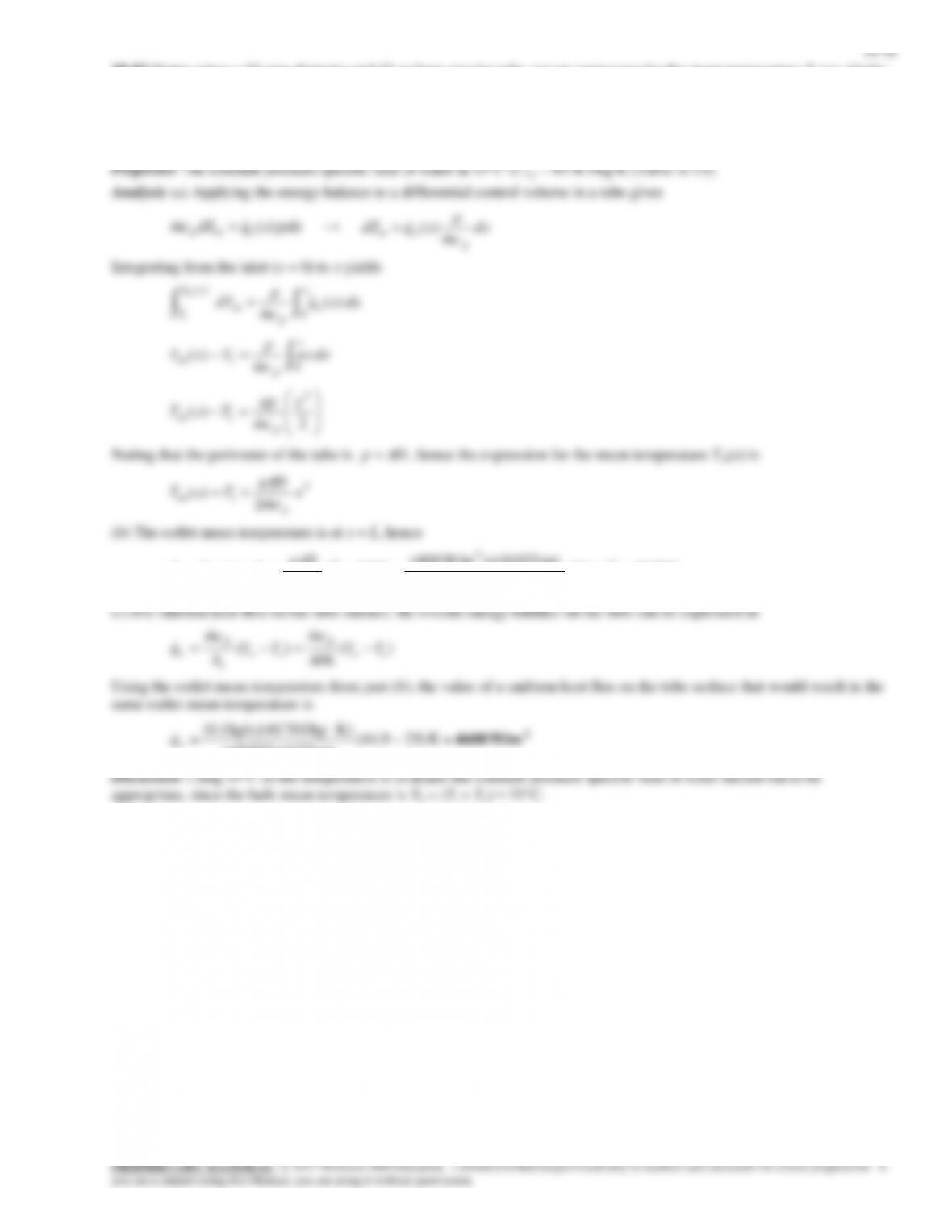
Discussion Liquid metals such as mercury, due to their high thermal conductivities, are particularly applicable to cases where
large amount of energy must be removed from a relatively small space.
19–80
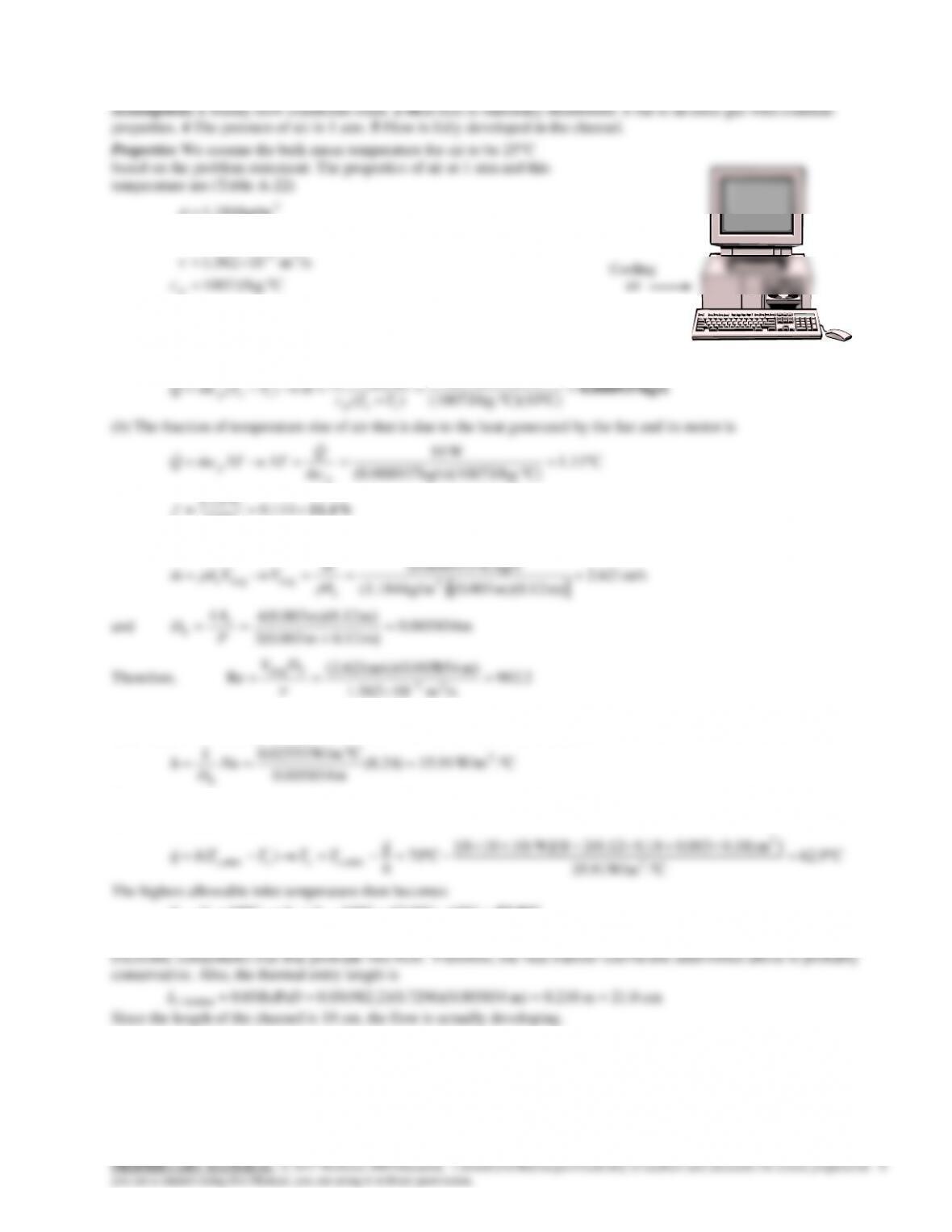
19–85 A computer is cooled by a fan blowing air through its case. The flow rate of the air, the fraction of the temperature rise
of air that is due to heat generated by the fan, and the highest allowable inlet air temperature are to be determined.
0.7296Pr
CJ/kg. 1007
p
c
Analysis (a) Noting that the electric energy consumed by the fan is converted to
thermal energy, the mass flow rate of air is
W)10 10(8
WQ
Cooling
air